REVIEW 4 major objections 4 minor 60 references
The paper establishes that the loop-induced charged-Higgs decay H±→W±γ is gauge-invariant and finite in the THDM, and that a 3 TeV muon collider could observe it.
Reviewed by Pith at T0; open to challenge. T0 means a machine referee read the full paper against a public rubric. the ladder, T0–T4 →
2026-08-04 20:40 UTC pith:24DTWXKC
load-bearing objection Careful Rξ-gauge loop calculation with a missing benchmark and an overstated abstract; worth refereeing but not as is. the 4 major comments →
Probing one-loop--induced decay channel H^pm to W^pmγ in the Two Higgs Doublet Models at muon-TeV colliders
The pith
A machine-rendered reading of the paper's core claim, the machinery that carries it, and where it could break.
Core claim
On the paper's own terms, the central result is that H±→W±γ in a CP-conserving THDM is described by two independent one-loop form factors, F2 and F3, after the photon Ward identity removes F1 through F2 = −2(M_H±² − M_W²)F1. The complete set of triangle, self-energy, and tadpole diagrams evaluated in the general Rξ gauge has explicit ξ-dependence that cancels through coupling sum rules and Goldstone/ghost replacement identities, and the ultraviolet and renormalization-scale parts cancel coefficient by coefficient. The authors therefore claim that the width in Eq. (25), expressed through F2 and F3, is the correct one-loop prediction. They use it to compute branching ratios in the viable Type-
What carries the argument
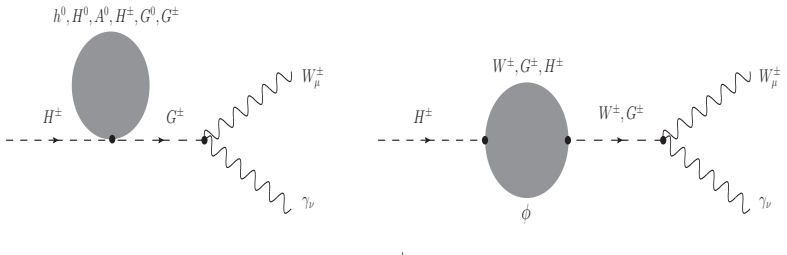
The load-bearing object is the one-loop amplitude decomposition A_{H±→W±γ} = F1 g^{μν} + F2 k2^μ k1^ν + F3 i ε^{μνρσ} k1ρ k2σ, with F1, F2, F3 extracted from the complete set of triangle, self-energy, and tadpole diagrams in the Rξ gauge. The photon Ward identity forces F2 = −2(M_H±² − M_W²)F1, so the decay width depends only on F2 and F3. Gauge-parameter independence follows from the model sum rules Σ_φ g(φWW)g(φH−W+γ) = Σ_φ g(φWW)g(φH−W+) = 0 together with Goldstone and ghost coupling replacements, while ultraviolet and scale cancellation is shown by expanding the scalar one-loop integrals A0 and B0 in their UV-divergent and ln μ² parts. These mechanisms together make the width formula Eq.
Load-bearing premise
The consistency result depends on exact cancellations, via the coupling sum rules and Goldstone/ghost replacement identities, among the complete set of one-loop diagrams; if a diagram is missing, double-counted, or one of those identities holds only approximately, the claimed ξ-independence and Ward identity could fail even if the formulas appear finite.
What would settle it
Vary the gauge parameter numerically, for example compare ξ = 1 with ξ = 0, in the full formulas for F2 and F3 at a fixed benchmark point and compute Γ(H±→W±γ) from Eq. (25); any ξ-dependence in the width would refute the gauge-invariance claim. Also compute the same width using the independent expressions of Ref. [38] for identical masses and couplings; the two results should agree to numerical precision. Finally, change the renormalization scale μ by a factor of a few and check that the width remains unchanged; any residual scale dependence would contradict the stated scale independence.
If this is right
- In the Type-I THDM, BR(H±→Wγ) can be as large as O(10⁻¹) for M_H± ≈ 210–240 GeV and tanβ ≳ 10, and drops below about 10⁻⁶ at high charged-Higgs mass, so the mode is a low-mass charged-Higgs probe.
- At √s = 3 TeV and L = 3000 fb⁻¹, the process μ+μ−→H+H−→W+W−hγ gives more than 2σ significance in that region and reaches 5σ at tanβ = 20 in the first benchmark scenario, after including SM backgrounds.
- The photon-fusion process μ+μ−→γγ→H+H−→W+W−hγ gives a similar but somewhat weaker reach, exceeding 2σ in the same low-mass, large-tanβ region.
- Because the final-state photon amplitude satisfies the Ward identity, the decay rate is controlled by two independent form factors, F2 and F3, so photon angular and energy distributions carry information about the chiral structure of the fermionic loops.
- The same form factors can be used directly in other THDM types; the Type-I enhancement at large tanβ arises from suppression of the fermionic contribution, while the bosonic contribution dominates.
Where Pith is reading between the lines
- The manuscript contains a numerical-significance discrepancy: the abstract states 5σ, while the concluding section says 2σ for 'several benchmark points.' The plotted significances show 5σ only near tanβ = 20 and M_H± ≈ 210–240 GeV, so the strong claim is specific to that corner, and the 2σ phrasing appears to describe a broader part of the scanned region.
- The paper scans only Type-I THDM parameter space, but the analytic form factors apply unchanged to Types II, X, and Y; in those types the Yukawa suppression patterns differ, so the H±→Wγ branching ratio could serve as a discriminator among the four THDM types.
- A direct numerical comparison with the earlier independent calculation of Ref. [38] at identical benchmark points would settle any residual ambiguity in the form factors; the paper verifies internal consistency but does not present that comparison.
- The photon-energy and invariant-mass cuts used in the significance estimate (Eγ ≥ 1 MeV, |M_{W+h} − M_H±| ≤ 10 GeV) are analysis-level choices; whether they survive realistic detector acceptance and photon reconstruction is a collider-detector question the paper does not address.
Editorial analysis
A structured set of objections, weighed in public.
Referee Report
Summary. The paper presents an alternative one-loop calculation of the decay H±→W±γ in the general Rξ gauge within the CP-conserving THDM. The authors claim to verify analytically the ξ-independence, ultraviolet finiteness, renormalization-scale independence, and the Ward identity F2 = -2(M_H±^2 - M_W^2)F1 for the one-loop form factors. They then use the resulting width to study charged-Higgs pair production at a 3 TeV muon collider, focusing on μ+μ−→H+H−→W+W−hγ and μ+μ−→γγ→H+H−→W+W−hγ in the Type-I THDM, with scans constrained by 2HDMC, HiggsBounds, HiggsSignals, and SuperIso. The abstract claims 5σ discovery potential for some benchmarks at L=3000 fb−1, while the conclusion states 2σ.
Significance. If the one-loop calculation is correct, the paper provides a useful independent derivation of H±→W±γ in a general gauge, with explicit analytic checks that go beyond the original literature, and it applies the result to a timely muon-collider phenomenology. The strengths are the detailed analytic expressions for the form factors, the explicit demonstrations of UV/scale cancellation for the fermionic and bosonic parts, and the use of public tools for parameter-space constraints. However, the central result is not numerically validated against the existing published calculation of Ref. [38], the Ward-identity check shown in Appendix C covers only the bosonic W±H± piece and not the fermionic piece that enters the total amplitude, and the abstract/conclusion significance claims are inconsistent. The phenomenological conclusions are therefore conditional on these missing checks.
major comments (4)
- [§3, Eq. (23), Appendix C, Eq. (149)] The Ward identity is verified only for the bosonic contribution F^{W±H±}_i. The total form factor is a sum, F_i = F^f_i + F^{W±H±}_i, and Eq. (25) uses Eq. (22) to eliminate F1 for the total amplitude. The manuscript does not demonstrate that the fermionic triangle diagrams individually satisfy F2^f = -2(M_H±^2-M_W^2)F1^f, nor does it provide a numerical check of k2ν A^{μν} after summing fermionic and bosonic pieces. Without this, the on-shell photon condition is not established for the full amplitude and the width formula is not justified. Please provide either an analytic proof for F^f or an explicit numerical test of the total Ward identity.
- [§3 and §4; Ref. [38]] The paper presents 'alternative analytic results' but never benchmarks the new form factors or the resulting width against the existing published calculation of H±→W±γ, Ref. [38]. A missing overall normalization, a sign error in the fermionic/bosonic interference, or an omitted diagram would pass the internal ξ-independence and UV-finiteness checks, yet would change the width and the branching ratios used in Sec. 4. I request a numerical comparison for a few representative masses and tanβ values, e.g. a table of F2, F3, and Γ(H±→W±γ) from this work versus Ref. [38].
- [Abstract vs. Sec. 5] The abstract states that the signals 'can be detected with a statistical significance of 5σ for several benchmark scenarios', while the Conclusions state that 'the signals can be observed with a 2σ significance for several benchmark points'. The text around Figs. 6 and 7 says the significance exceeds 2σ in a region and surpasses 5σ only for tanβ=20. These statements need to be reconciled; the paper's headline claim is ambiguous.
- [§4.3–§4.4] The significance calculation uses S = N_S/sqrt(N_S+N_B) with only an Eγ≥1 MeV cut and simple invariant-mass cuts, with no detector simulation, no acceptance/efficiency model, and no systematic uncertainties. As presented, the quoted 5σ/2σ values are parton-level statistical estimates. This should be stated explicitly, and the sensitivity of the conclusions to the very low photon-energy threshold should be discussed.
minor comments (4)
- [References] Ref. [58] is cited as 'in preparation'. Since it is used as a supporting reference, please either remove it or replace it with a publicly available source.
- [§4.2 and captions] The description of the benchmark scenarios appears truncated around Fig. 3, and the caption of Fig. 5 repeats 'are shown in Fig. 5'. Please clarify the benchmark definitions and clean up the captions.
- [§4.3–§4.4] The SM background generation with GRACE is mentioned, but no details are given on the final-state object definitions, lepton identification, jet/photon reconstruction, or the precise event selection beyond the two invariant-mass windows. A brief list of cuts would make the analysis reproducible.
- [Eq. (25)] The width formula is written in terms of F2 and F3 after using the Ward identity. It would be helpful to state explicitly that F1 is eliminated via Eq. (22), so that the reader is not puzzled by the absence of F1.
Circularity Check
No significant circularity: the one-loop form factors are independently computed and consistency conditions are checked, not imposed; phenomenological predictions follow from a constrained parameter scan.
full rationale
The derivation chain is self-contained. The form factors F1, F2, F3 are computed by direct extraction of Lorentz coefficients from the one-loop diagrams (Eq. 21 plus Appendices A-D); the Ward identity (Eq. 22) is derived from the on-shell photon condition and then checked in Appendix C, where Eq. (149) shows the bosonic part satisfies F^{W±H±}_2 = -2(M_H±^2 - M_W^2) F^{W±H±}_1. The ξ-independence proof in Appendix B cancels the ξ-dependent A0/B0 coefficients using model sum rules (Eqs. 91-98), not by assuming the result. UV-finiteness and renormalization-scale independence are demonstrated by explicit cancellation of the Δ and ln μ^2 terms (Eqs. 48-58). No parameter is fitted to the H±→W±γ signal: the Type-I scan uses 2HDMC, HiggsBounds, HiggsSignals, and SuperIso constraints and then evaluates branching ratios and collider rates as predictions. The only self-citation, Ref. [58] ("Khiem Hong Phan et al., in preparation"), is not cited in the body and carries no load. Two non-circular caveats are noted: the fermionic analogue of the Ward identity check is not displayed (Appendix C shows only the W±H± part), and no numerical benchmark against Ref. [38] is provided; these concern validation and completeness, not equivalence of inputs and outputs, and therefore do not raise the circularity score.
Axiom & Free-Parameter Ledger
free parameters (6)
- tan beta benchmark values =
2, 8, 14, 20; 5 sigma only claimed at tan beta = 20
- Charged Higgs mass in discovery window =
210 GeV to 240 GeV
- sin(beta-alpha) =
0.98
- m12^2 =
10^4 GeV^2
- M_A and M_H =
500 GeV for the first benchmark
- Photon energy cut =
E_gamma >= 1 MeV
axioms (8)
- domain assumption CP-conserving THDM scalar potential with Z2 symmetry and soft m12^2 breaking (Eq. 1)
- domain assumption Fermion content and gauge sector identical to the SM, quantized in the general Rxi gauge
- ad hoc to paper Completeness of the one-loop diagram set in Appendix D (triangle, self-energy and tadpole diagrams)
- ad hoc to paper Identities (91)-(92) and coupling relations (93)-(98) used for xi cancellation
- standard math Passarino-Veltman reduction and the A0/B0 divergence expansions (Eqs. 48-49)
- domain assumption Ward identity relation Eq. (22) holds for the complete amplitude
- domain assumption Tree-level SM backgrounds generated by GRACE with no systematic uncertainties
- domain assumption Photon structure function f_gamma/mu with xmax = 0.83 from Telnov
read the original abstract
In this work, we study the one-loop--induced decay channel $H^{\pm} \rightarrow W^{\pm}\gamma$ in the general $\mathcal{R}_{\xi}$ gauge within Two Higgs Doublet Models. We analytically verify the gauge invariance ($\xi$-independence), ultraviolet finiteness, and renormalization-scale independence of the one-loop form factors, thereby confirming the consistency of our calculations. On the phenomenological side, we perform a parameter scan of the Type-I THDM and, based on the viable parameter space, evaluate the branching ratios of this decay process. Furthermore, we investigate charged Higgs pair production at muon-TeV colliders through the representative processes $\mu^+\mu^- \rightarrow H^{+}H^{-} \rightarrow W^+W^- h\gamma$ and $\mu^+\mu^- \rightarrow \gamma\gamma \rightarrow H^{+}H^{-} \rightarrow W^+W^- h\gamma$, as typical applications of our results. The events for the processes are computed within the allowed parameter regions of the Type-I THDM. The corresponding signal significances are evaluated, including the relevant Standard Model backgrounds, at a center-of-mass energy of $\sqrt{s} = 3$~TeV. With the high integrated luminosity expected at muon-TeV colliders, reaching up to $\mathcal{L} = 3000~\text{fb}^{-1}$, our analysis indicates that the signals can be detected with a statistical significance of $5\sigma$ for several benchmark scenarios in the viable parameter space of the Type-I THDM.
Figures




Reference graph
Works this paper leans on
-
[1]
Search for a light charged Higgs boson in top quark decays in pp collisions at sqrt(s) = 7 TeV
S. Chatrchyan et al. [CMS], JHEP 07 (2012), 143 doi:10.1007/JHEP07(2012)143 [arXiv:1205.5736 [hep-ex]]
work page internal anchor Pith review Pith/arXiv arXiv 2012
-
[2]
V. Khachatryan et al. [CMS], JHEP 11 (2015), 018 doi:10.1007/JHEP11(2015)018 [arXiv:1508.07774 [hep-ex]]
Pith/arXiv arXiv 2015
-
[3]
G. Aad et al. [ATLAS], JHEP 09 (2023), 004 doi:10.1007/JHEP09(2023)004 [arXiv:2302.11739 [hep-ex]]
Pith/arXiv arXiv 2023
-
[4]
G. Aad et al. [ATLAS], Eur. Phys. J. C 85 (2025) no.2, 153 doi:10.1140/epjc/s10052-024- 13715-4 [arXiv:2407.10096 [hep-ex]]
Pith/arXiv arXiv 2025
-
[5]
G. Aad et al. [ATLAS], JHEP 06 (2012), 039 doi:10.1007/JHEP06(2012)039 [arXiv:1204.2760 [hep-ex]]
work page internal anchor Pith review Pith/arXiv arXiv 2012
-
[6]
G. Aad et al. [ATLAS], Eur. Phys. J. C 73 (2013) no.6, 2465 doi:10.1140/epjc/s10052-013- 2465-z [arXiv:1302.3694 [hep-ex]]. 31
work page internal anchor Pith review Pith/arXiv arXiv 2013
-
[7]
G. Aad et al. [ATLAS], JHEP 03 (2016), 127 doi:10.1007/JHEP03(2016)127 [arXiv:1512.03704 [hep-ex]]
Pith/arXiv arXiv 2016
-
[8]
G. Aad et al. [ATLAS], JHEP 06 (2021), 145 doi:10.1007/JHEP06(2021)145 [arXiv:2102.10076 [hep-ex]]
work page internal anchor Pith review Pith/arXiv arXiv 2021
-
[9]
A. M. Sirunyan et al. [CMS], JHEP 07 (2020), 126 doi:10.1007/JHEP07(2020)126 [arXiv:2001.07763 [hep-ex]]
work page internal anchor Pith review Pith/arXiv arXiv 2020
-
[10]
G. Aad et al. [ATLAS], Phys. Rev. Lett. 114 (2015) no.23, 231801 doi:10.1103/PhysRevLett.114.231801 [arXiv:1503.04233 [hep-ex]]
Pith/arXiv arXiv 2015
-
[11]
M. Aaboud et al. [ATLAS], Phys. Lett. B 787 (2018), 68-88 doi:10.1016/j.physletb.2018.10.021 [arXiv:1806.01532 [hep-ex]]
Pith/arXiv arXiv 2018
-
[12]
A. M. Sirunyan et al. [CMS], Eur. Phys. J. C 81 (2021) no.8, 723 doi:10.1140/epjc/s10052- 021-09472-3 [arXiv:2104.04762 [hep-ex]]
Pith/arXiv arXiv 2021
-
[13]
A. M. Sirunyan et al. [CMS], JHEP 11 (2018), 115 doi:10.1007/JHEP11(2018)115 [arXiv:1808.06575 [hep-ex]]
work page internal anchor Pith review Pith/arXiv arXiv 2018
-
[14]
A. M. Sirunyan et al. [CMS], Phys. Rev. D 102 (2020) no.7, 072001 doi:10.1103/PhysRevD.102.072001 [arXiv:2005.08900 [hep-ex]]
Pith/arXiv arXiv 2020
-
[15]
A. Tumasyan et al. [CMS], JHEP 09 (2023), 032 doi:10.1007/JHEP09(2023)032 [arXiv:2207.01046 [hep-ex]]
Pith/arXiv arXiv 2023
-
[16]
G. Aad et al. [ATLAS], JHEP 02 (2025), 143 doi:10.1007/JHEP02(2025)143 [arXiv:2411.03969 [hep-ex]]
Pith/arXiv arXiv 2025
-
[17]
M. Aaboud et al. [ATLAS], JHEP 09 (2018), 139 doi:10.1007/JHEP09(2018)139 [arXiv:1807.07915 [hep-ex]]
Pith/arXiv arXiv 2018
-
[18]
G. Aad et al. [ATLAS], Phys. Rev. D 111 (2025) no.7, 072006 doi:10.1103/PhysRevD.111.072006 [arXiv:2412.17584 [hep-ex]]
Pith/arXiv arXiv 2025
-
[19]
A. M. Sirunyan et al. [CMS], JHEP 07 (2019), 142 doi:10.1007/JHEP07(2019)142 [arXiv:1903.04560 [hep-ex]]
Pith/arXiv arXiv 2019
-
[20]
Signal to background interference in $pp\to t H^-\to t W^- b\bar b$ at the LHC Run-II
A. Arhrib, R. Benbrik, S. Moretti, R. Santos and P. Sharma, Ph ys. Rev. D 97 (2018) no.7, 075037 doi:10.1103/PhysRevD.97.075037 [arXiv:1712.05018 [hep-ph]]
work page internal anchor Pith review Pith/arXiv arXiv 2018
-
[21]
Top quark polarization as a probe of charged Higgs bosons
A. Arhrib, A. Jueid and S. Moretti, Phys. Rev. D 98 (2018) no.11, 115006 doi:10.1103/PhysRevD.98.115006 [arXiv:1807.11306 [hep-ph]]
work page internal anchor Pith review Pith/arXiv arXiv 2018
-
[22]
Signal versus Background Interference in $H^+\to t\bar b$ Signals for MSSM Benchmark Scenarios
A. Arhrib, D. Azevedo, R. Benbrik, H. Harouiz, S. Moretti, R. P atrick and R. Santos, JHEP 10 (2020), 209 doi:10.1007/JHEP10(2020)209 [arXiv:1905.02635 [hep- ph]]
work page internal anchor Pith review Pith/arXiv arXiv 2020
-
[23]
Same-sign Charged Higgs Pair Production in bosonic decay channels at the HL-LHC and HE-LHC
A. Arhrib, K. Cheung and C. T. Lu, Phys. Rev. D 102 (2020) no.9, 095026 doi:10.1103/PhysRevD.102.095026 [arXiv:1910.02571 [hep-ph]]
work page internal anchor Pith review Pith/arXiv arXiv 2020
-
[24]
A. Arhrib, R. Benbrik, H. Harouiz, S. Moretti, Y. Wang and Q. S. Yan, Phys. Rev. D 102 (2020) no.11, 115040 doi:10.1103/PhysRevD.102.115040 [arXiv:2003 .11108 [hep-ph]]. 32
-
[25]
A. Arhrib, R. Benbrik, M. Krab, B. Manaut, S. Moretti, Y. Wang and Q. S. Yan, JHEP 10 (2021), 073 doi:10.1007/JHEP10(2021)073 [arXiv:2106.13656 [hep- ph]]
Pith/arXiv arXiv 2021
-
[26]
Y. Wang, A. Arhrib, R. Benbrik, M. Krab, B. Manaut, S. Morett i and Q. S. Yan, JHEP 12 (2021), 021 doi:10.1007/JHEP12(2021)021 [arXiv:2107.01451 [hep- ph]]
Pith/arXiv arXiv 2021
- [27]
-
[28]
B. A. Ouazghour, A. Arhrib, K. Cheung, E. s. Ghourmin and L. R ahili, Phys. Rev. D 109 (2024) no.11, 115009 doi:10.1103/PhysRevD.109.115009 [arXiv:2308 .15664 [hep-ph]]
-
[29]
Accommodating the LHC Charged Higgs Boson Excess at 130 GeV in the General Two-Higgs Doublet Model
A. Arhrib, M. Krab and S. Semlali, J. Phys. G 51 (2024) no.11, 115003 doi:10.1088/1361- 6471/ad7d24 [arXiv:2402.03195 [hep-ph]]
work page internal anchor Pith review Pith/arXiv arXiv 2024
-
[30]
A. Arhrib, R. Benbrik, M. Berrouj, M. Boukidi and B. Manaut, P hys. Rev. D 111 (2025) no.9, 095026 doi:10.1103/PhysRevD.111.095026 [arXiv:2407.01348 [he p-ph]]
Pith/arXiv arXiv 2025
-
[31]
B. A. Ouazghour, A. Arhrib, K. Cheung, E. s. Ghourmin and L. R ahili, Phys. Rev. D 110 (2024) no.9, 095026 doi:10.1103/PhysRevD.110.095026 [arXiv:2408.1 3952 [hep-ph]]
-
[32]
B. A. Ouazghour, A. Arhrib, K. Cheung, E. s. Ghourmin, M. Kra b and L. Rahili, [arXiv:2506.01554 [hep-ph]]
work page internal anchor Pith review Pith/arXiv arXiv
-
[34]
Probing Heavy Charged Higgs Boson Using Multivariate Technique at Gamma-Gamma Collider
I. Ahmed, A. Quddus, J. Muhammad, M. Shoaib and S. Shafaq, C hin. Phys. C 49 (2025) no.4, 043101 doi:10.1088/1674-1137/ada0b4 [arXiv:2403.20293 [hep -ph]]
work page internal anchor Pith review Pith/arXiv arXiv 2025
-
[35]
M. Hashemi and L. Roushandel, Eur. Phys. J. C 84 (2024) no.9, 966 doi:10.1140/epjc/s10052-024-13316-1 [arXiv:2310.06519 [hep-ph ]]
Pith/arXiv arXiv 2024
-
[36]
H. E. Logan and Y. Wu, JHEP 11 (2018), 121 doi:10.1007/JHEP11(2018)121 [arXiv:1809.09127 [hep-ph]]
work page internal anchor Pith review Pith/arXiv arXiv 2018
-
[37]
J. Hernandez-Sanchez, M. A. Perez, G. Tavares-Velasco an d J. J. Toscano, Phys. Rev. D 69 (2004), 095008 doi:10.1103/PhysRevD.69.095008 [arXiv:hep-ph/04 02284 [hep-ph]]
-
[38]
Charged Higgs Bosons decays H^\pm \to W^\pm (\gamma, Z) revisited
A. Arhrib, R. Benbrik and M. Chabab, J. Phys. G 34 (2007), 907-928 doi:10.1088/0954- 3899/34/5/011 [arXiv:hep-ph/0607182 [hep-ph]]
work page internal anchor Pith review Pith/arXiv arXiv 2007
-
[39]
Loop induced $H^\pm W^\mp Z$ vertices in the general two Higgs doublet model with CP violation
S. Kanemura and Y. Mura, JHEP 10 (2024), 041 doi:10.1007/JHEP10(2024)041 [arXiv:2408.06863 [hep-ph]]
work page internal anchor Pith review Pith/arXiv arXiv 2024
- [41]
-
[42]
J. E. Barradas Guevara, F. C. Cazarez Bush, A. Cordero Cid, O. Felix Beltran, J. Her- nandez Sanchez and R. Noriega Papaqui, J. Phys. G 37 (2010), 115008 doi:10.1088/0954- 3899/37/11/115008 [arXiv:1002.2626 [hep-ph]]. 33
work page internal anchor Pith review Pith/arXiv arXiv 2010
-
[43]
G. C. Branco, P. M. Ferreira, L. Lavoura, M. N. Rebelo, M. She r and J. P. Silva, Phys. Rept. 516 (2012), 1-102 doi:10.1016/j.physrep.2012.02.002 [arXiv:1106.0034 [h ep-ph]]
Pith/arXiv arXiv 2012
-
[44]
M. Aoki, S. Kanemura, K. Tsumura and K. Yagyu, Phys. Rev. D 80 (2009), 015017 doi:10.1103/PhysRevD.80.015017 [arXiv:0902.4665 [hep-ph]]
Pith/arXiv arXiv 2009
-
[45]
S. Kanemura, T. Kubota and E. Takasugi, Phys. Lett. B 313 (1993), 155-160 doi:10.1016/0370-2693(93)91205-2 [arXiv:hep-ph/9303263 [hep- ph]]
Pith/arXiv arXiv 1993
-
[46]
M. E. Peskin and T. Takeuchi, Phys. Rev. D 46 (1992), 381-409 doi:10.1103/PhysRevD.46.381
-
[47]
S. Navas et al. [Particle Data Group], Phys. Rev. D 110 (2024) no.3, 030001 doi:10.1103/PhysRevD.110.030001
-
[48]
B. Ait-Ouazghour, A. Arhrib, M. Chabab and K. Goure, [arXiv:25 08.04493 [hep-ph]]
-
[49]
D. Eriksson, J. Rathsman and O. Stal, Comput. Phys. Commun. 181 (2010), 189-205 doi:10.1016/j.cpc.2009.09.011 [arXiv:0902.0851 [hep-ph]]
Pith/arXiv arXiv 2010
-
[50]
P. Bechtle, D. Dercks, S. Heinemeyer, T. Klingl, T. Stefaniak, G . Weiglein and J. Wit- tbrodt, Eur. Phys. J. C 80 (2020) no.12, 1211 doi:10.1140/epjc/s10052-020-08557-9 [arXiv:2006.06007 [hep-ph]]
Pith/arXiv arXiv 2020
-
[51]
P. Bechtle, S. Heinemeyer, T. Klingl, T. Stefaniak, G. Weiglein and J. Wittbrodt, Eur. Phys. J. C 81 (2021) no.2, 145 doi:10.1140/epjc/s10052-021-08942-y [arXiv:20 12.09197 [hep-ph]]
-
[52]
F. Mahmoudi, Comput. Phys. Commun. 180 (2009), 1579-1613 doi:10.1016/j.cpc.2009.02.017 [arXiv:0808.3144 [hep-ph]]
Pith/arXiv arXiv 2009
-
[53]
J. Haller, A. Hoecker, R. Kogler, K. M ¨onig, T. Peiffer and J. Stelzer, Eur. Phys. J. C 78 (2018) no.8, 675 doi:10.1140/epjc/s10052-018-6131-3 [arXiv:180 3.01853 [hep-ph]]
-
[54]
Y. Amhis et al. [HFLA V], Eur. Phys. J. C 77 (2017) no.12, 895 doi:10.1140/epjc/s10052- 017-5058-4 [arXiv:1612.07233 [hep-ex]]
Pith/arXiv arXiv 2017
-
[55]
Y. S. Amhis et al. [HFLA V], Phys. Rev. D 107 (2023) no.5, 052008 doi:10.1103/PhysRevD.107.052008 [arXiv:2206.07501 [hep-ex]]
Pith/arXiv arXiv 2023
-
[56]
A. Denner, Fortsch. Phys. 41 (1993), 307-420 doi:10.1002/prop.2190410402 [arXiv:0709.1075 [hep-ph]]
Pith/arXiv arXiv 1993
-
[57]
T. Hahn and M. Perez-Victoria, Comput. Phys. Commun. 118 (1999), 153-165 doi:10.1016/S0010-4655(98)00173-8 [arXiv:hep-ph/9807565 [hep -ph]]
Pith/arXiv arXiv 1999
-
[58]
Khiem Hong Phan et al., in preparation
-
[59]
G. Belanger, F. Boudjema, J. Fujimoto, T. Ishikawa, T. Kanek o, K. Kato and Y. Shimizu, Phys. Rept. 430 (2006), 117-209 doi:10.1016/j.physrep.2006.02.001 [arXiv:hep-ph/ 0308080 [hep-ph]]
-
[60]
A. F. Zarnecki, Acta Phys. Polon. B 34 (2003), 2741-2758 [arXiv:hep-ex/0207021 [hep-ex]]. 34
work page internal anchor Pith review Pith/arXiv arXiv 2003
-
[61]
V. I. Telnov, Nucl. Instrum. Meth. A 294 (1990), 72-92 doi:10.1016/0168-9002(90)91826-W
-
[62]
T. Hahn, Comput. Phys. Commun. 140 (2001), 418-431 doi:10.1016/S0010-4655(01)00290- 9 [arXiv:hep-ph/0012260 [hep-ph]]. 35
Pith/arXiv arXiv 2001
This paper was first reviewed by deepseek-v4-flash on August 4, 2026.
discussion (0)
Sign in with ORCID, Apple, or X to comment. Anyone can read and Pith papers without signing in.