REVIEW 3 major objections 5 minor 43 references
Prompt-Driven Image Analysis with Multimodal Generative AI: Detection, Segmentation, Inpainting, and Interpretation
T0 review · 3 major / 5 minor · reviewed 2026-08-15 · deepseek-v4-flash
Pith's one-line read The paper claims that four off-the-shelf vision models chained behind a single prompt can run detection, segmentation, inpainting, and description end-to-end, with usable masks reported in over 90% of a small single-word-prompt test.
desk verdict Useful integration case study with practical guardrails, but the headline quantitative claim is not backed by released data and should be toned down. read the letter →
The pith
A machine-rendered reading of the paper's core claim, the machinery that carries it, and where it could break.
The reading
What carries the argument
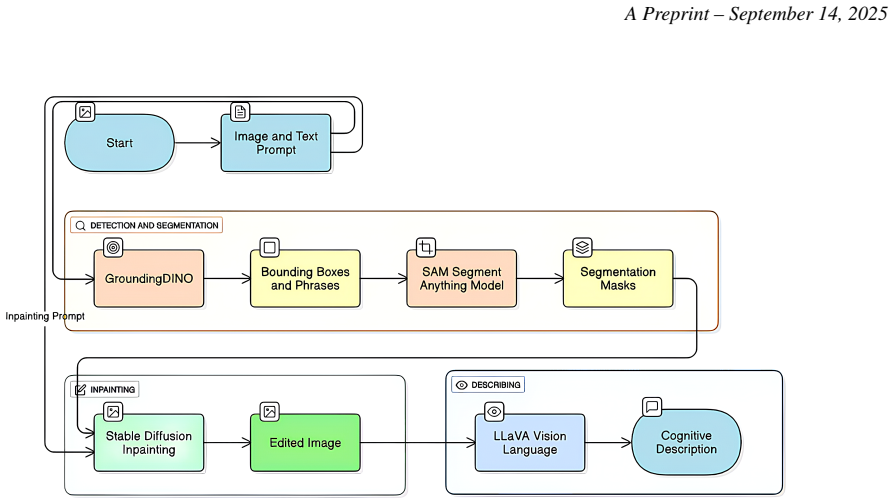
The load-bearing object is the LSID pipeline itself, a four-stage sequential assembly: open-vocabulary detection converts the prompt phrase into candidate boxes, promptable segmentation turns each box into a binary mask, text-conditioned diffusion inpainting regenerates the masked region under the edit prompt, and a vision-language model describes the result as a lightweight semantic check. The mechanism that keeps the assembly reliable is artifact-level transparency combined with tunable guardrails: threshold sweeps on detection and text alignment, overlay inspection with light morphological post-processing for masks, slight mask dilation to control diffusion seams, and guidance/steps settings that trade adherence against latency. Version pinning, seed control, and a shared backend between UI and CLI make runs replayable.
What would settle it
Re-run the $n=40$ single-word-prompt protocol with two or more independent annotators who draw reference masks without seeing the pipeline's masks, and pre-register an $\text{IoU} \geq 0.80$ threshold; if the success rate falls below 90% under the pre-registered protocol, the central quantitative claim is refuted. Alternatively, score the same prompts against masks from a public segmentation dataset and compare the success rate.
Extended reading notes
Core claim
On its own terms, the paper's central claim is that the LSID pattern—Locate with GroundingDINO, Segment with SAM, Inpaint with a latent diffusion model, Describe with a vision-language model—is a transparent and dependable way to compose off-the-shelf vision and multimodal models behind a single prompt. The evidence is a qualitative case study on in-the-wild images covering object replacement, scene augmentation, and removal, supported by an indicative quantitative slice: from $n=40$ single-word prompts, detect-plus-segment trials succeeded in over 90% of cases with accuracy above 85% (95% confidence interval approximately $[0.78, 0.97]$), where success means a covering box plus a visually acceptable mask with $\text{IoU} \geq 0.80$ against a quick manual reference. Latency profiling shows inpainting dominates runtime at 60–75% of the total, which motivates the paper's tuning guidance on diffusion steps and guidance scale. The paper does not introduce new architectures; it claims the value lies in integration choices, guardrails, and reproducible practices.
Load-bearing premise
The reported success figures rest on the assumption that unblinded overlay inspection against a quick manual reference is a valid ground truth for $\text{IoU} \geq 0.80$, since the paper provides no inter-annotator agreement, no released reference masks, and no protocol for drawing them.
Editorial extensions
If this is right
- Object replacement, removal, and scene augmentation can be scripted through a CLI with the same behavior as the interactive UI, enabling repeatable batch edits.
- Persisting artifacts at each stage localizes failures to a specific stage, so users can fix a threshold or a mask instead of re-running the whole pipeline.
- Because inpainting accounts for 60–75% of runtime, lowering diffusion steps or guidance gives the largest latency savings for interactive use.
- Raising the detection threshold reduces false-positive boxes that cascade into spurious masks and unwanted edits, while adding spatial qualifiers to prompts stabilizes grounding.
- Version pinning, seed control, and artifact manifests make qualitative outcomes replayable even as dependencies and remote APIs drift.
Reading between the lines
- Because the paper's argument is about the assembly pattern rather than the specific weights, the LSID guardrails (threshold sweeps, mask inspection, light morphology, seed control) should transfer to other detector–segmenter–inpainter–describer pairings, though the absolute success rates likely shift per component.
- The $n=40$ success figure is probably optimistic under stricter ground truth; an independent study using a public segmentation benchmark as reference would reveal how much of the >90% reflects pipeline skill versus lenient, self-referential criteria.
- The documented mask-leakage case (small 'islands' at the eye boundary) points to a cheap automated quality gate: connected-component analysis or boundary-edge coverage could flag masks needing morphological cleanup before inpainting, turning the paper's manual overlay inspection into a scriptable check.
Signed reviews
Editorial analysis
A structured set of objections, weighed in public.
Referee Report
Summary. The paper presents LSID, a four-stage prompt-driven image analysis pipeline that composes GroundingDINO open-vocabulary detection, SAM promptable segmentation, a Stable Diffusion inpainting model, and a LLaVA-based vision-language description stage behind a single natural-language instruction. The authors describe implementation details: a shared backend for an interactive Gradio UI and a scriptable CLI, threshold defaults (tau_det=0.50, tau_txt=0.35), mask post-processing, guidance scale 7.5, 50 DDIM steps, version pinning, artifact logging, and seed control. The main claims are (i) a qualitative demonstration of object replacement, scene augmentation, and removal with documented failure modes; (ii) a 'mini-quantitative slice' (Section 5.1) in which detection plus segmentation produced usable masks in 'over 90% of cases' with 'accuracy above 85%' on n=40 single-word-prompt trials; and (iii) a latency profile in which inpainting accounts for 60-75% of total runtime on a T4 GPU. The paper is explicitly framed as a practical case study rather than a new architecture or a multi-dataset benchmark, and Section 8 lists internal, external, and construct-validity limitations.
Significance. If the reported reliability numbers are taken at face value, the paper offers a useful integration template for composing off-the-shelf vision-language models into a reproducible editing workflow. Its strengths include concrete version pinning (Table 3), explicit default thresholds, artifact-level transparency, UI/CLI parity, and honest documentation of failure cascades such as mask leakage and diffusion under-coverage. The paper does not propose new architectures, and its main value is engineering guidance rather than algorithmic novelty. The central quantitative claim, however, is currently not independently checkable: it rests on n=40 trials, a single unblinded annotator, an unreleased manual reference, and no trial-level data. The paper's own Section 8 describes the slice as 'indicative rather than a benchmark claim,' which tempers the contribution but also conflicts with the abstract's strong percentage wording. With better data reporting and more cautious framing, the reproducibility-oriented contribution could be solid, but the current evidence base is thinner than the headline claims suggest.
major comments (3)
- [Abstract; Section 5.1] The central quantitative claim that detection and segmentation produced 'usable masks in over 90% of cases with an accuracy above 85%' is not independently checkable as reported. Section 5.1 defines a success as a covering box plus a mask with IoU >= 0.80 against a 'quick manual reference' and 'visually acceptable' overlay inspection, but it does not specify the reference-drawing protocol, report inter-annotator agreement, or provide the 40 input images, predicted masks, and reference masks. Since the abstract presents this metric as a headline result, the authors should either release the trial-level data and a precise evaluation protocol or explicitly demote the claim to an anecdotal observation consistent with Section 8's 'indicative rather than a benchmark claim' disclaimer.
- [Section 5.1] The reported 95% confidence interval [0.78, 0.97] for n=40 is internally inconsistent with the phrase 'over 90% of cases.' For 40 trials, the normal-approximation or Wilson interval with lower bound 0.78 corresponds to about 36 successes (90%), while 37 successes gives a lower bound near 0.80. The paper should report the exact number of successes and the precise definition of 'accuracy exceeded 85%' (e.g., mean IoU, median IoU, or fraction above a threshold); without these, the reader cannot determine whether the claim is 36/40, 37/40, or something else.
- [Section 5, Table 5] The latency claim that inpainting makes up '60 to 75% of total runtime' is derived from a single configuration reported in Table 5 (one GPU, one SAM variant, one set of diffusion settings), yet the abstract and Section 5 generalize across 'typical guidance and sampling settings.' The paper should state the range of configurations that produce the 60-75% span and report the number of runs behind the mean +/- std values, or the claim should be restricted to the exact measured setting.
minor comments (5)
- [Section 4] The paragraph beginning 'The UI shows the four stages as tabs...' is duplicated verbatim a few lines later in the same section; one copy should be removed.
- [Section 5, Table 4] Table 4 lists 'stability (stab) = 0.95' as a mask dimension and describes it as a stability score under prompt perturbations, but the study protocol in Section 5 never explains how this score is computed or why the default is 0.95; a one-sentence definition is needed.
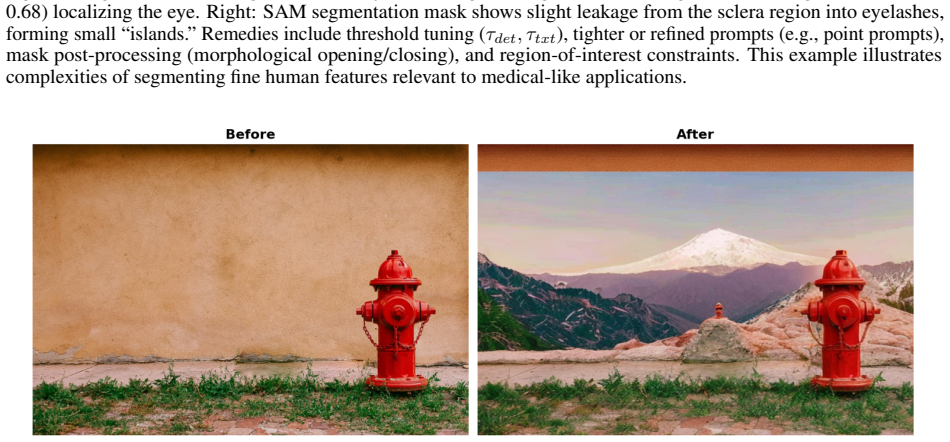
- [Figure 4 caption] The caption 'BEST (10/10) qualitative example' uses an unexplained '10/10' rating; clarify what the score represents or replace it with a neutral description.
- [Table 5] Table 5 reports mean +/- standard deviation over 'multiple runs' without stating the number of runs; specify n for reproducibility.
- [Section 2, Table 2] Table 2 positions Grounded SAM as a 'closely related' assembly without any quantitative or qualitative comparison to LSID; since Grounded SAM is the most relevant baseline, a brief discussion of what LSID adds beyond it would strengthen the positioning.
Circularity Check
The paper is an empirical systems integration case study with no self-referential derivation chain, so no significant circularity is present.
full rationale
This manuscript builds a pipeline from externally published models (GroundingDINO, SAM, Stable Diffusion inpainting, LLaVA) and reports qualitative and small-scale quantitative observations; there is no mathematical derivation whose conclusion is equivalent to its inputs. The main quantitative claim in Section 5.1, that detect-plus-segment succeeded in more than 90% of 40 trials with IoU at least 0.80 against a quick manual reference, is an empirical evaluation rather than a fitted prediction: the thresholds and sampling settings are fixed defaults (tau_det=0.50, tau_txt=0.35, g=7.5, N_steps=50), not parameters tuned to force the reported rate. The paper does not define its success metric in terms of the output it then claims to predict, nor does it invoke any author-derived uniqueness theorem or self-citation as load-bearing evidence. The limitation that the slice is 'indicative rather than a benchmark claim' is explicitly stated in Section 8, and concerns about reproducibility, single-annotator scoring, or statistical interpretation are validity issues rather than circularity. Because the integration pattern is honestly presented as an assembly of existing components and the empirical claims rest on external models with transparent defaults, there is no step where a result is reduced by construction to its own inputs. Score 0 is therefore the appropriate finding.
Assumptions & free parameters
free parameters (5)
- detection threshold tau_det =
0.50
- text threshold tau_txt =
0.35
- guidance scale g =
7.5
- diffusion steps N_steps =
50
- IoU success threshold =
0.80
assumptions (3)
- domain assumption GroundingDINO, SAM, stable-diffusion-2-inpainting, and LLaVA behave as described in their respective papers and give outputs consistent with the qualitative panels.
- domain assumption Manual reference masks for the n=40 IoU evaluation are accurate and consistent enough to define 'usable'.
- domain assumption Selected in-the-wild images are representative of object replacement, scene augmentation, and removal tasks.
Cite this review
Pith. "Pith review of Prompt-Driven Image Analysis with Multimodal Generative AI: Detection, Segmentation, Inpainting, and Interpretation." pith.science (2026). https://pith.science/paper/EFYQUH7D
@misc{pith2026250908489,
  author       = {Pith},
  title        = {Pith review of: Prompt-Driven Image Analysis with Multimodal Generative AI: Detection, Segmentation, Inpainting, and Interpretation},
  year         = {2026},
  howpublished = {\url{https://pith.science/paper/EFYQUH7D}},
  note         = {Machine review of arXiv:2509.08489}
}
read the original abstract
Prompt-driven image analysis converts a single natural-language instruction into multiple steps: locate, segment, edit, and describe. We present a practical case study of a unified pipeline that combines open-vocabulary detection, promptable segmentation, text-conditioned inpainting, and vision-language description into a single workflow. The system works end to end from a single prompt, retains intermediate artifacts for transparent debugging (such as detections, masks, overlays, edited images, and before and after composites), and provides the same functionality through an interactive UI and a scriptable CLI for consistent, repeatable runs. We highlight integration choices that reduce brittleness, including threshold adjustments, mask inspection with light morphology, and resource-aware defaults. In a small, single-word prompt segment, detection and segmentation produced usable masks in over 90% of cases with an accuracy above 85% based on our criteria. On a high-end GPU, inpainting makes up 60 to 75% of total runtime under typical guidance and sampling settings, which highlights the need for careful tuning. The study offers implementation-guided advice on thresholds, mask tightness, and diffusion parameters, and details version pinning, artifact logging, and seed control to support replay. Our contribution is a transparent, reliable pattern for assembling modern vision and multimodal models behind a single prompt, with clear guardrails and operational practices that improve reliability in object replacement, scene augmentation, and removal.
Figures

Figures from the paper (1 more)

Reference graph
Works this paper leans on
-
[1]
Shilong Liu, Zhaoyang Zeng, Tianhe Ren, Feng Li, Hao Zhang, Jie Yang, Chunyuan Li, Hang Su, Jun Zhu, and Lei Zhang. Grounding dino: Marrying dino with grounded pre-training for open-set object detection.arXiv preprint arXiv:2303.05499, 2023
arXiv 2023
-
[2]
Segment anything.arXiv preprint arXiv:2304.02643, 2023
Alexander Kirillov, Eric Mintun, Nikhila Ravi, Hanzi Mao, Chloe Rolland, Laura Gustafson, Tete Xiao, Spencer Whitehead, Alexander C Berg, Wan-Yen Lo, Piotr Dollár, and Ross Girshick. Segment anything.arXiv preprint arXiv:2304.02643, 2023
arXiv 2023
-
[3]
High-resolution image synthesis with latent diffusion models
Robin Rombach, Andreas Blattmann, Dominik Lorenz, Patrick Esser, and Björn Ommer. High-resolution image synthesis with latent diffusion models. InProceedings of the IEEE/CVF Conference on Computer Vision and Pattern Recognition, pages 10684–10695, 2022
2022
-
[4]
Visual instruction tuning.arXiv preprint arXiv:2304.08485, 2023
Haotian Liu, Chunyuan Li, Qingyang Wu, and Yong Jae Lee. Visual instruction tuning.arXiv preprint arXiv:2304.08485, 2023
arXiv 2023
-
[5]
Hidden technical debt in machine learning systems
D Sculley, Gary Holt, Daniel Golovin, Eugene Davydov, Todd Phillips, Dietmar Ebner, Vinay Chaudhary, Michael Young, Jean-François Crespo, and Dan Dennison. Hidden technical debt in machine learning systems. InAdvances in Neural Information Processing Systems, 2015
work page 2015
-
[6]
Tianhe Ren, Jianwei Zhang, Haoyu Yang, Shixuan Li, Fei Deng, et al. Grounded sam: Assembling open-world models for diverse visual tasks.arXiv preprint arXiv:2401.14159, 2024
arXiv 2024
-
[7]
Learning transferable visual models from natural language supervision
Alec Radford, Jong Wook Kim, Chris Hallacy, Aditya Ramesh, Gabriel Goh, Sandhini Agarwal, Girish Sastry, Amanda Askell, Pamela Mishkin, Jack Clark, Gretchen Krueger, and Ilya Sutskever. Learning transferable visual models from natural language supervision. InProceedings of the International Conference on Machine Learning, 2021
work page 2021
-
[8]
Junnan Li, Dongxu Li, Caiming Xiong, and Steven C. H. Hoi. Blip: Bootstrapping language-image pre-training for unified vision-language understanding and generation. InProceedings of the International Conference on Machine Learning, 2022
work page 2022
Show all 43 references
-
[9]
Junnan Li, Dongxu Li, Haoxuan Hu, Caiming Xiong, and Steven C. H. Hoi. Blip-2: Bootstrapping language-image pre-training with frozen image encoders and large language models.arXiv preprint arXiv:2301.12597, 2023
2023 arXiv
-
[10]
Masked-attention mask transformer for universal image segmentation
Bowen Cheng, Alexander Schwing, and Alexander Kirillov. Masked-attention mask transformer for universal image segmentation. InProceedings of the IEEE/CVF Conference on Computer Vision and Pattern Recognition, 2022
2022
-
[11]
X-decoder: Generalized decoding for pixel, image, and language
Xiaodi Zou, Baoxiong Yu, Zhaowei Zhang, et al. X-decoder: Generalized decoding for pixel, image, and language. InProceedings of the IEEE/CVF Conference on Computer Vision and Pattern Recognition, 2023
2023
-
[12]
Cris: Clip-driven referring image segmentation
Tianhe Wang, Jiajun Zhu, Ning Wang, Shiliang Yang, Xian-Sheng Hu, and Kun Fu. Cris: Clip-driven referring image segmentation. InProceedings of the IEEE/CVF Conference on Computer Vision and Pattern Recognition, 2022
2022
-
[13]
Language-aware vision transformer for referring image segmentation
Fan Yang, Zhen Yang, Huan Fu, et al. Language-aware vision transformer for referring image segmentation. In Proceedings of the IEEE/CVF Conference on Computer Vision and Pattern Recognition, 2022
2022
-
[14]
Restr: Convolution-free referring image segmentation with transformers
Junyeong Kim, Minsu Jeong, Seoung Wug Cho, and Seong Joon Woo. Restr: Convolution-free referring image segmentation with transformers. InProceedings of the IEEE/CVF Conference on Computer Vision and Pattern Recognition, 2022. 12 A Preprint – September 14, 2025
2022
-
[15]
Clip-adapter: Better vision-language models with feature adapters.arXiv preprint arXiv:2110.04544, 2021
Hang Gao, Renrui Yang, Peng Wang, Song Han, Xiaojie Wang, Yifan Wang, Xiangming Zeng, Yuntao Chen, Ulas Dogan, and Humphrey Shi. Clip-adapter: Better vision-language models with feature adapters.arXiv preprint arXiv:2110.04544, 2021
-
[16]
Tip-adapter: Training- free clip-adapter for better vision-language modeling
Songyang Zhang, Kaiyang Zhou, Zekun Lin, Chen Change Liu, Meng Hu, and Ziwei Li. Tip-adapter: Training- free clip-adapter for better vision-language modeling. InProceedings of the European Conference on Computer Vision, 2022
2022
-
[17]
Repaint: Inpainting using denoising diffusion probabilistic models
Andreas Lugmayr, Martin Danelljan, Andres Romero, Radu Timofte, and Luc Van Gool. Repaint: Inpainting using denoising diffusion probabilistic models. InProceedings of the IEEE/CVF Conference on Computer Vision and Pattern Recognition, 2022
2022
-
[18]
Sdedit: Image synthesis and editing with stochastic differential equations.arXiv preprint arXiv:2108.01073, 2021
Chenlin Meng, Yang Song, Jiaming Song, and Stefano Ermon. Sdedit: Image synthesis and editing with stochastic differential equations.arXiv preprint arXiv:2108.01073, 2021
2021 arXiv
-
[19]
Prompt-to-prompt image editing with cross attention control.arXiv preprint arXiv:2208.01626, 2022
Amir Hertz, Kfir Aberman, Yael Pritch, and Daniel Cohen-Or. Prompt-to-prompt image editing with cross attention control.arXiv preprint arXiv:2208.01626, 2022
2022 arXiv
-
[20]
Tim Brooks, Aleksander Holynski, and Alexei A. Efros. Instructpix2pix: Learning to follow image editing instructions. InProceedings of the IEEE/CVF Conference on Computer Vision and Pattern Recognition, 2023
2023
-
[21]
Adding conditional control to text-to-image diffusion models.arXiv preprint arXiv:2302.05543, 2023
Lvmin Zhang and Maneesh Agrawala. Adding conditional control to text-to-image diffusion models.arXiv preprint arXiv:2302.05543, 2023
2023 arXiv
-
[22]
Paint by example: Exemplar-based image editing with diffusion models.arXiv preprint arXiv:2211.13227, 2022
Shuai Yang, Zongxin Xu, Jianming Zhang, et al. Paint by example: Exemplar-based image editing with diffusion models.arXiv preprint arXiv:2211.13227, 2022
2022 arXiv
-
[23]
Blended diffusion for text-driven editing of natural images
Omri Avrahami, Dani Lischinski, and Daniel Fried. Blended diffusion for text-driven editing of natural images. arXiv preprint arXiv:2206.02779, 2022
2022 arXiv
-
[24]
Palette: Image-to-image diffusion models.ACM Transactions on Graphics, 2022
Chitwan Saharia, William Chan, Saurabh Saxena, et al. Palette: Image-to-image diffusion models.ACM Transactions on Graphics, 2022
2022
-
[25]
Dreambooth: Fine tuning text-to-image diffusion models for subject-driven generation
Nataniel Ruiz, Yuanzhen Li, Varun Jampani, Yael Pritch, Michael Rubinstein, and Kfir Aberman. Dreambooth: Fine tuning text-to-image diffusion models for subject-driven generation. InProceedings of the IEEE/CVF Conference on Computer Vision and Pattern Recognition, 2023
2023
-
[26]
Bermano, Gal Chechik, and Daniel Cohen-Or
Rinon Gal, Yuval Alaluf, Yuval Atzmon, Or Patashnik, Amit H. Bermano, Gal Chechik, and Daniel Cohen-Or. An image is worth one word: Personalizing text-to-image generation using textual inversion.arXiv preprint arXiv:2208.01618, 2022
2022 arXiv
-
[27]
Null-text inversion for editing real images using guided diffusion models
Ron Mokady, Amir Hertz, and Kfir Aberman. Null-text inversion for editing real images using guided diffusion models. InProceedings of the IEEE/CVF Conference on Computer Vision and Pattern Recognition, 2023
2023
-
[28]
Attend-and-excite: Attention-based guidance for text-to-image diffusion models.arXiv preprint arXiv:2301.13826, 2023
Hila Chefer, Yuval Alaluf, Lior Reich, and Daniel Cohen-Or. Attend-and-excite: Attention-based guidance for text-to-image diffusion models.arXiv preprint arXiv:2301.13826, 2023
2023 arXiv
-
[29]
Classifier-free diffusion guidance.arXiv preprint arXiv:2207.12598, 2022
Jonathan Ho and Tim Salimans. Classifier-free diffusion guidance.arXiv preprint arXiv:2207.12598, 2022
2022 arXiv
-
[30]
Flamingo: a visual language model for few-shot learning
Jean-Baptiste Alayrac, Jeff Donahue, Pauline Luc, et al. Flamingo: a visual language model for few-shot learning. arXiv preprint arXiv:2204.14156, 2022
2022 arXiv
-
[31]
Clipscore: A reference-free evaluation metric for image captioning
Jack Hessel, Ari Holtzman, Maxwell Forbes, and Yejin Choi. Clipscore: A reference-free evaluation metric for image captioning. InProceedings of the 2021 Conference on Empirical Methods in Natural Language Processing, 2021
2021
-
[32]
The unreasonable effectiveness of deep features as a perceptual metric
Richard Zhang, Phillip Isola, Alexei A Efros, Eli Shechtman, and Oliver Wang. The unreasonable effectiveness of deep features as a perceptual metric. InProceedings of the IEEE/CVF Conference on Computer Vision and Pattern Recognition, 2018
2018
-
[33]
Image quality assessment: From error visibility to structural similarity.IEEE Transactions on Image Processing, 13(4):600–612, 2004
Zhou Wang, Alan C Bovik, Hamid R Sheikh, and Eero P Simoncelli. Image quality assessment: From error visibility to structural similarity.IEEE Transactions on Image Processing, 13(4):600–612, 2004
2004
-
[34]
Gans trained by a two time-scale update rule converge to a local nash equilibrium
Martin Heusel, Hubert Ramsauer, Thomas Unterthiner, Bernhard Nessler, and Sepp Hochreiter. Gans trained by a two time-scale update rule converge to a local nash equilibrium. InAdvances in Neural Information Processing Systems, pages 6626–6637, 2017
2017
-
[35]
Sutherland, Michael Arbel, and Arthur Gretton
Mikołaj Bi´nkowski, Dougal J. Sutherland, Michael Arbel, and Arthur Gretton. Demystifying mmd gans. In International Conference on Learning Representations, 2018
2018
-
[36]
Improving reproducibility in ma- chine learning research: A report from the neurips 2019 reproducibility program.arXiv preprint arXiv:2003.12206, 2020
Joelle Pineau, Philippe Vincent-Lamarre, Koustuv Sinha, Vincent Larivière, et al. Improving reproducibility in ma- chine learning research: A report from the neurips 2019 reproducibility program.arXiv preprint arXiv:2003.12206, 2020. 13 A Preprint – September 14, 2025
2019 arXiv
-
[37]
Model cards for model reporting
Margaret Mitchell, Simone Wu, Andrew Zaldivar, Parker Barnes, Lucy Vasserman, Ben Hutchinson, Elena Spitzer, Inioluwa Deborah Raji, and Timnit Gebru. Model cards for model reporting. InProceedings of the Conference on Fairness, Accountability, and Transparency, 2019
2019
-
[38]
Datasheets for datasets.arXiv preprint arXiv:1803.09010, 2018
Timnit Gebru, Jamie Morgenstern, Briana Vecchione, Jennifer Wortman Vaughan, Hanna Wallach, Hal Daumé III, and Kate Crawford. Datasheets for datasets.arXiv preprint arXiv:1803.09010, 2018
2018 arXiv
-
[39]
The ml test score: A rubric for ml production readiness and technical debt reduction
Eric Breck, Shanqing Cai, Eric Nielsen, Michael Salib, and D Sculley. The ml test score: A rubric for ml production readiness and technical debt reduction. InIEEE International Conference on Big Data, 2017
2017
-
[40]
Everyone wants to do the model work, not the data work: Data cascades in high-stakes ai
Nithya Sambasivan, Shravya Kapania, et al. Everyone wants to do the model work, not the data work: Data cascades in high-stakes ai. InProceedings of the 2021 CHI Conference on Human Factors in Computing Systems, 2021
2021
-
[41]
Denoising diffusion implicit models
Jiaming Song, Chenlin Meng, and Stefano Ermon. Denoising diffusion implicit models. InProceedings of the International Conference on Learning Representations, 2021
2021
-
[42]
Mehdi S. M. Sajjadi, Olivier Bachem, Mario Lucic, Olivier Bousquet, and Sylvain Gelly. Assessing generative models via precision and recall. InAdvances in Neural Information Processing Systems, 2018
2018
-
[43]
Improved precision and recall metric for assessing generative models
Tuomas Kynkäanniemi, Tero Karras, Samuli Laine, Jaakko Lehtinen, and Timo Aila. Improved precision and recall metric for assessing generative models. InAdvances in Neural Information Processing Systems, 2019. 14
2019
Reviewed August 15, 2026 · model on record in the stance chip above.
Discussion (0). Continue with ORCID to comment.