REVIEW 3 major objections 4 minor 28 references
In multi-view plant phenotyping, a small subset of views picked by a random binary mask evaluated on validation data beats using all 24 views, and this ViewSparsifier approach won both GroMo 2025 challenge tasks – plant age prediction and l
Reviewed by Pith at T0; open to challenge. T0 means a machine referee read the full paper against a public rubric. the ladder, T0–T4 →
2026-08-04 20:25 UTC pith:D22T47M2
load-bearing objection A credible challenge-winning recipe whose central sparsity claim overreaches its validation-selected mask search. the 3 major comments →
ViewSparsifier: Killing Redundancy in Multi-View Plant Phenotyping
The pith
A machine-rendered reading of the paper's core claim, the machinery that carries it, and where it could break.
Core claim
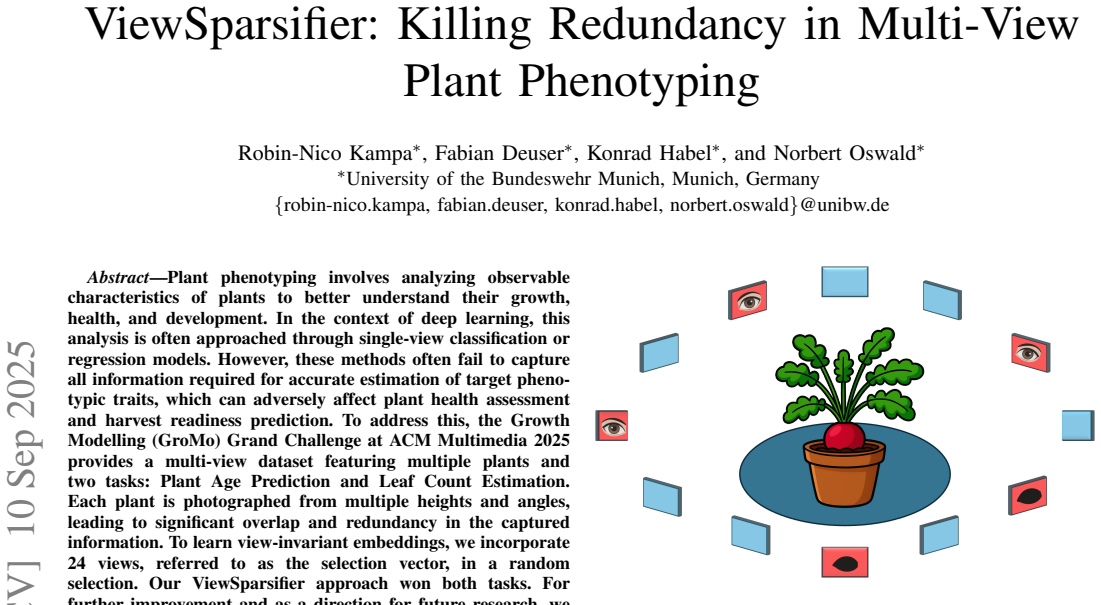
ViewSparsifier claims that view redundancy — not view scarcity — is the main obstacle in multi-view plant phenotyping. On the GroMo 2025 dataset of 24 near-duplicate views per height level, the authors search random binary selection masks over the camera ring, score each on the validation split, and keep the best mask per crop and task. The sparse subset then outperforms all 24 views: validation MAE for radish age drops from 0.818 with all views to 0.671 with only 6 selected views, and from 1.140 to 1.104 for wheat leaf count with 11 views; the approach went on to win both official challenge tasks. The pipeline extracts features with a frozen pre-trained vision transformer (DINOv2; a trainab
What carries the argument
The load-bearing mechanism is the random binary selection mask: a length-24 vector (or a 5×24 matrix) marking which views the model sees. Because a good mask is unknown in advance, the paper searches masks on the validation set and couples the choice with permutation-based averaging — each selected mask is evaluated under all 24 circular rotations during inference and the predictions are averaged. This rotation averaging is what de-risks the arbitrary mask found by search, and it doubles as data augmentation during training (a random shift per sample). The view features come from a frozen pre-trained vision transformer (DINOv2), fused by a transformer encoder armed with positional encodings
Load-bearing premise
The mask that scores best on the validation split is assumed to also be best on the unseen test plants — a bet the authors make on a single split without repeating the mask search to show the choice is stable; the paper itself notes validation fluctuations in its discussion.
What would settle it
Retrain the pipeline repeatedly, each time with an independent random mask search (fresh seeds or train/validation splits), and compare the chosen mask's test MAE against the all-views baseline and against a randomly fixed mask of the same size. If the validation-best mask does not beat both across repeats — or loses to a fixed random mask — the sparsification benefit is a selection artifact. A cheaper check: run the radish-age-best 6-view mask on wheat leaf count and vice versa; if the best masks transfer across crops, the redundancy story holds, and if not, they are task-specific lucky picks
If this is right
- If sparse view selection beats all-view fusion, multi-view phenotyping pipelines should treat view redundancy as a first-class design variable rather than an afterthought.
- The best configurations used only 6 to 11 of 24 views, so comparable accuracy is achievable at a fraction of the compute and memory (the paper reports GPU memory dropping from about 296 MB to about 246 MB).
- Rotation-averaged inference turns any fixed azimuthal camera ring into a self-averaging ensemble, a trick that should transfer to other ring-camera or turntable setups.
- The matrix variant shows that once the single-height constraint is relaxed, cross-height selection is even more valuable, pointing toward joint camera-placement-and-selection as the next step.
- Because the same approach won both official leaderboards, it resets the reference point for the GroMo challenge baseline.
Where Pith is reading between the lines
- The random-search protocol is effectively performing viewpoint feature selection: some azimuths and heights carry more signal for a given trait, and the validation search is exploiting that non-uniformity — an interpretation the paper does not directly test.
- The reported gains rest on a single validation split without repeated-seed error bars; repeating the mask search across several splits, or comparing the chosen mask against a randomly fixed mask of the same size, would separate 'sparsification helps' from 'this particular mask is lucky'.
- The recipe of binary selection masks plus rotation averaging is directly testable in other dense multi-view domains — drone image rings, medical volume cross-sections, 360° product scans — where near-duplicate views are common; the paper's claim implies that redundancy removal, not just architecture, is the transferable lesson.
- A learned, differentiable view-gating module trained end-to-end would amortize the brute-force validation search and generalize to unseen crops or novel viewpoints — an upgrade the authors leave implicit.
Editorial analysis
A structured set of objections, weighed in public.
Referee Report
Summary. The paper presents ViewSparsifier, a multi-view plant phenotyping method that uses random binary view-selection vectors (and, in an extension, selection matrices) to choose a subset of camera views, fuses per-view DINOv2 features with a Transformer encoder, and averages predictions over all rotational permutations of the selected views. The authors report that the method won both tasks of the GroMo 2025 Grand Challenge, and their validation ablations on Radish Age and Wheat Leaf Count suggest that a small random subset of views outperforms using all available views. The central claim is that random sparse view selection reduces redundancy and improves generalization compared to using all views, and that the matrix extension over five height levels further improves performance.
Significance. If the central claim is correct, the paper offers a simple and practical recipe for multi-view phenotyping: randomly selecting a small subset of views, combined with permutation-averaged inference, can improve accuracy while reducing memory footprint. The competition results are concrete external evidence that the overall pipeline is competitive, and the memory benchmarks in Table III quantify a real efficiency benefit. The paper also makes a useful conceptual contribution by drawing attention to inter-view redundancy and by showing that a randomized selection strategy can work in a challenging benchmark. However, the load-bearing comparison between sparse selection and all-view baselines currently rests on validation metrics that are confounded by the inference-time permutation ensemble and by validation-based mask selection, so the significance of the redundancy-removal claim is not yet established.
major comments (3)
- [Section III (inference protocol) and Table II] The sparse-selection gain is confounded with the permutation-averaging ensemble. The method averages predictions over all 24 rotational permutations of the selected mask. For an all-views selection, every rotation is identical, so the all-views baseline receives no ensemble benefit. Thus 'random 6' vs 'all views' compares a 24-member ensemble of 6-view subsets against a single forward pass over 24 views. The reported gains (e.g., 0.671 vs 0.818 for Radish Age; 0.660 vs 1.050 for the matrix variant) may stem from ensembling rather than from sparsity per se. To support the central claim, the authors should compare under a matched inference protocol, e.g., evaluate a fixed rotation of the sparse selection without averaging, or provide an all-views baseline with an equivalent form of ensembling if one exists.
- [Section III-B and Table II] The 'random' selections are chosen as the best-performing masks on the validation split from an unspecified number of random binary masks. No repeated-seed experiments, standard deviations, or multiple-comparison corrections are reported. Selecting the best of many random masks by validation MAE produces an optimistic bias that need not transfer to test. This is especially concerning for Wheat Leaf Count, where the best vector result (0.970) is only marginally better than all views (0.994), and for Radish Age where the paper itself notes validation fluctuations. The authors should report the number of masks tried, the seed/randomization procedure, and either error bars across seeds or an evaluation on a held-out selection split.
- [Section VI and Table I] The challenge test-set results demonstrate that the full ViewSparsifier pipeline is competitive, but they do not isolate the sparsity effect: no same-method all-views test baseline is reported for the challenge tasks. The conclusion that 'a smaller subset ... outperforms all views' is therefore supported only by validation-set comparisons from Table II, which have the issues described above. A test-set or properly held-out comparison of the selected sparse mask against the all-views model under matched training and inference conditions is needed before the central claim can be accepted.
minor comments (4)
- [Abstract] The sentence 'To learn view-invariant embeddings, we incorporate 24 views, referred to as the selection vector, in a random selection' is unclear. It should state that a random subset of the 24 views is selected and then rotated.
- [Table II] The matrix entries labeled 'random 5' and 'random 17' do not specify the structure of the random matrix (e.g., how many views per height level) or the number of random matrices evaluated. Please clarify in the caption or text.
- [Table I caption] The notation 'Ourst, 15e' and 'Ourst+v, 15e, es' is dense; a brief explanation of the abbreviations in the caption would improve readability.
- [Section V] The discussion states that random selection 'encourages the model to extract additional information' and 'improves its generalization capability.' These are causal interpretations that go beyond the reported validation numbers; they should be framed as hypotheses or supported by additional experiments.
Circularity Check
No circularity: validation-based view selection is an empirical optimization, and the challenge test results provide independent support.
full rationale
The paper does not contain a first-principles derivation whose output is equivalent to its input. The view-selection vectors/matrices are generated randomly and chosen by validation MAE (Section III-B: "we generate random binary selection vectors ... and evaluate their performance on the validation set. The best-performing selection is then determined per crop and task"), and Table II is explicitly labeled as validation-split performance. Thus the reported ablation numbers are transparently the selection criterion, not a disguised test prediction. The central competitive claim (winning both GroMo 2025 tasks, Table I) rests on an external test-set evaluation, not on the fitted selection masks. No load-bearing self-citation, uniqueness theorem, or ansatz-smuggling chain appears in the paper; citations are to external prior work. The validation-selection procedure raises a legitimate statistical concern about multiple comparisons and lack of repeated-seed error bars, but that is a correctness/overfitting issue, not circularity by construction. Under the stated rules, no circular step can be exhibited, so the appropriate finding is no significant circularity.
Axiom & Free-Parameter Ledger
free parameters (4)
- Per-crop-task view selection mask =
e.g., radish age vector uses 6 views; wheat leaf matrix uses 17 views; not all masks disclosed
- Task-specific dropout rate =
0.0 or 0.1125
- Training schedule length =
15 epochs for most tasks; 4 epochs for Wheat Age and Mustard Leaf Count
- Backbone and fine-tuning policy =
DINOv2-Giant frozen except DINOv2-Base trainable for Wheat Age and Mustard Leaf Count
axioms (3)
- domain assumption The 24 views within a height level are rotationally ordered with known 15 degree spacing.
- domain assumption Validation MAE is a reliable selector for view masks.
- domain assumption Small rotations are redundant but sparse subsets preserve task-relevant signal.
read the original abstract
Plant phenotyping involves analyzing observable characteristics of plants to better understand their growth, health, and development. In the context of deep learning, this analysis is often approached through single-view classification or regression models. However, these methods often fail to capture all information required for accurate estimation of target phenotypic traits, which can adversely affect plant health assessment and harvest readiness prediction. To address this, the Growth Modelling (GroMo) Grand Challenge at ACM Multimedia 2025 provides a multi-view dataset featuring multiple plants and two tasks: Plant Age Prediction and Leaf Count Estimation. Each plant is photographed from multiple heights and angles, leading to significant overlap and redundancy in the captured information. To learn view-invariant embeddings, we incorporate 24 views, referred to as the selection vector, in a random selection. Our ViewSparsifier approach won both tasks. For further improvement and as a direction for future research, we also experimented with randomized view selection across all five height levels (120 views total), referred to as selection matrices.
Figures


Reference graph
Works this paper leans on
-
[1]
Deep learning for plant stress detection: A comprehensive review of technologies, challenges, and future directions,
N. Paul, G. Sunil, D. Horvath, and X. Sun, “Deep learning for plant stress detection: A comprehensive review of technologies, challenges, and future directions,”Computers and Electronics in Agriculture, vol. 229, p. 109734, 2025. [Online]. Available: https://www.sciencedirect.com/science/article/pii/S0168169924011256
2025
-
[2]
Deep learning and computer vision in plant disease detection: a comprehensive review of techniques, models, and trends in precision agriculture,
A. Upadhyay, N. S. Chandel, K. P. Singh, S. K. Chakraborty, B. M. Nandede, M. Kumar, A. Subeesh, K. Upendar, A. Salem, and A. El- beltagi, “Deep learning and computer vision in plant disease detection: a comprehensive review of techniques, models, and trends in precision agriculture,”Artificial Intelligence Review, vol. 58, no. 3, p. 92, 2025
2025
-
[3]
Deep learning in image-based plant phenotyping,
K. M. Murphy, E. Ludwig, J. Gutierrez, and M. A. Gehan, “Deep learning in image-based plant phenotyping,”Annual Review of Plant Biology, vol. 75, no. 1, pp. 771–795, 2024
2024
-
[4]
Computer vision with deep learning for plant phenotyping in agriculture: A survey,
V . Balasubramanian, W. Guo, A. Chandra, and S. V . Desai, “Computer vision with deep learning for plant phenotyping in agriculture: A survey,” Advanced Computing and Communications, 03 2020
2020
-
[5]
Deep learning in agriculture: A survey,
A. Kamilaris and F. X. Prenafeta-Bold ´u, “Deep learning in agriculture: A survey,”Computers and Electronics in Agriculture, vol. 147, pp. 70–90, 2018. [Online]. Available: https://www.sciencedirect.com/science/article/pii/S0168169917308803
2018
-
[6]
Finely- grained annotated datasets for image-based plant phenotyping,
M. Minervini, A. Fischbach, H. Scharr, and S. A. Tsaftaris, “Finely- grained annotated datasets for image-based plant phenotyping,”Pattern recognition letters, vol. 81, pp. 80–89, 2016
2016
-
[7]
Annotated image datasets of rosette plants,
H. Scharr, M. Minervini, A. Fischbach, and S. A. Tsaftaris, “Annotated image datasets of rosette plants,” inEuropean conference on computer vision. Suisse Z ¨urich, 2014, pp. 6–12
2014
-
[8]
Gromo: Plant growth modeling with multiview images,
R. Bhatt, S. Bansal, A. Chander, R. Kaur, M. Singh, M. Kankanhalli, A. E. Saddik, and M. K. Saini, “Gromo: Plant growth modeling with multiview images,”arXiv preprint arXiv:2503.06608, 2025
Pith/arXiv arXiv 2025
-
[9]
Using deep learning for image-based plant disease detection,
S. P. Mohanty, D. P. Hughes, and M. Salath ´e, “Using deep learning for image-based plant disease detection,” Frontiers in Plant Science, vol. V olume 7 - 2016,
2016
-
[10]
Deep machine learning provides state-of-the-art performance in image-based plant phenotyping,
M. P. Pound, J. A. Atkinson, A. J. Townsend, M. H. Wilson, M. Griffiths, A. S. Jackson, A. Bulat, G. Tzimiropoulos, D. M. Wells, E. H. Murchie et al., “Deep machine learning provides state-of-the-art performance in image-based plant phenotyping,”Gigascience, vol. 6, no. 10, p. gix083, 2017
2017
-
[11]
Ensemble of pre-trained vision transformer models in plant disease classification, an efficient approach,
E. B. Hamdiet al., “Ensemble of pre-trained vision transformer models in plant disease classification, an efficient approach,”Procedia Computer Science, vol. 245, pp. 565–573, 2024
2024
-
[12]
Adapting vision foun- dation models for plant phenotyping,
F. Chen, M. V . Giuffrida, and S. A. Tsaftaris, “Adapting vision foun- dation models for plant phenotyping,” inProceedings of the IEEE/CVF International Conference on Computer Vision, 2023, pp. 604–613
2023
-
[13]
A comparative study of plant phenotyping workflows based on three-dimensional reconstruction from multi-view images,
S. Daiki and K. Noshita, “A comparative study of plant phenotyping workflows based on three-dimensional reconstruction from multi-view images,”BioRxiv, pp. 2024–03, 2024
2024
-
[14]
A miniaturized phenotyping platform for individual plants using multi-view stereo 3d reconstruction,
S. Wu, W. Wen, W. Gou, X. Lu, W. Zhang, C. Zheng, Z. Xiang, L. Chen, and X. Guo, “A miniaturized phenotyping platform for individual plants using multi-view stereo 3d reconstruction,”Frontiers in plant science, vol. 13, p. 897746, 2022
2022
-
[15]
Wheat3dgs: In-field 3d reconstruction, instance segmentation and phenotyping of wheat heads with gaussian splatting,
D. Zhang, J. Gajardo, T. Medic, I. Katircioglu, M. Boss, N. Kirchgessner, A. Walter, and L. Roth, “Wheat3dgs: In-field 3d reconstruction, instance segmentation and phenotyping of wheat heads with gaussian splatting,” inProceedings of the Computer Vision and Pattern Recognition Confer- ence, 2025, pp. 5360–5370
2025
-
[16]
Deep multiview image fusion for soybean yield estimation in breeding applications,
L. G. Riera, M. E. Carroll, Z. Zhang, J. M. Shook, S. Ghosal, T. Gao, A. Singh, S. Bhattacharya, B. Ganapathysubramanian, A. K. Singhet al., “Deep multiview image fusion for soybean yield estimation in breeding applications,”Plant Phenomics, 2021
2021
-
[17]
Incomplete multi-view multi-label classification via diffusion-guided redundancy removal,
S. Ou, Z. Xue, L. Qin, Y . Li, M. Liang, J. Wu, X. Zhang, A. Be- heshti, and Y . Qi, “Incomplete multi-view multi-label classification via diffusion-guided redundancy removal,” inProceedings of the AAAI Conference on Artificial Intelligence, vol. 39, no. 18, 2025, pp. 19 758– 19 766
2025
-
[18]
Countering modal redundancy and heterogeneity: A self-correcting multimodal fu- sion,
P. Wang, X. Wang, B. Wang, Y . Zhang, L. Bai, and Y . Wang, “Countering modal redundancy and heterogeneity: A self-correcting multimodal fu- sion,” in2022 IEEE International Conference on Data Mining (ICDM). IEEE, 2022, pp. 518–527
2022
-
[19]
Investigating redundancy in multimodal large language models with multiple vision encoders,
S. Mao, Y . Chen, P. Cai, D. Wang, G. Yan, Z. Yu, and B. Shi, “Investigating redundancy in multimodal large language models with multiple vision encoders,”arXiv preprint arXiv:2507.03262, 2025
arXiv 2025
-
[20]
Delving deep into rectifiers: Surpassing human-level performance on imagenet classification,
K. He, X. Zhang, S. Ren, and J. Sun, “Delving deep into rectifiers: Surpassing human-level performance on imagenet classification,” in Proceedings of the IEEE international conference on computer vision, 2015, pp. 1026–1034
2015
-
[21]
Cautious optimizers: Improving training with one line of code,
K. Liang, L. Chen, B. Liu, and Q. Liu, “Cautious optimizers: Improving training with one line of code,”arXiv preprint arXiv:2411.16085, 2024
arXiv 2024
-
[22]
Vision transformers need registers,
T. Darcet, M. Oquab, J. Mairal, and P. Bojanowski, “Vision transformers need registers,”arXiv preprint arXiv:2309.16588, 2023
Pith/arXiv arXiv 2023
-
[23]
Eva-02: A visual representation for neon genesis,
Y . Fang, Q. Sun, X. Wang, T. Huang, X. Wang, and Y . Cao, “Eva-02: A visual representation for neon genesis,”Image and Vision Computing, vol. 149, p. 105171, 2024
2024
-
[24]
M. Tschannen, A. Gritsenko, X. Wang, M. F. Naeem, I. Alabdul- mohsin, N. Parthasarathy, T. Evans, L. Beyer, Y . Xia, B. Mustafa et al., “Siglip 2: Multilingual vision-language encoders with improved semantic understanding, localization, and dense features,”arXiv preprint arXiv:2502.14786, 2025
Pith/arXiv arXiv 2025
-
[25]
Paligemma: A versatile 3b vlm for transfer,
L. Beyer, A. Steiner, A. S. Pinto, A. Kolesnikov, X. Wang, D. Salz, M. Neumann, I. Alabdulmohsin, M. Tschannen, E. Bugliarello et al., “Paligemma: A versatile 3b vlm for transfer,”arXiv preprint arXiv:2407.07726, 2024
Pith/arXiv arXiv 2024
-
[26]
Dinov2: Learning robust visual features without supervision,
M. Oquab, T. Darcet, T. Moutakanni, H. V o, M. Szafraniec, V . Khalidov, P. Fernandez, D. Haziza, F. Massa, A. El-Noubyet al., “Dinov2: Learning robust visual features without supervision,”arXiv preprint arXiv:2304.07193, 2023
Pith/arXiv arXiv 2023
-
[27]
Hierarchical text-conditional image generation with clip latents,
A. Ramesh, P. Dhariwal, A. Nichol, C. Chu, and M. Chen, “Hierarchical text-conditional image generation with clip latents,”arXiv preprint arXiv:2204.06125, vol. 1, no. 2, p. 3, 2022. APPENDIX Figure 1 includes AI-generated images created on July 15, 2025, using DALL·E 3 [27] through the ChatGPT-4o interface solely for illustrative purposes. Specifically, ...
Pith/arXiv arXiv 2022
-
[2016]
Available: https://www.frontiersin.org/journals/plant- science/articles/10.3389/fpls.2016.01419
[Online]. Available: https://www.frontiersin.org/journals/plant- science/articles/10.3389/fpls.2016.01419
arXiv 2016
This paper was first reviewed by deepseek-v4-flash on August 4, 2026.
discussion (0)
Sign in with ORCID, Apple, or X to comment. Anyone can read and Pith papers without signing in.