REVIEW 3 major objections 3 minor 6 cited by
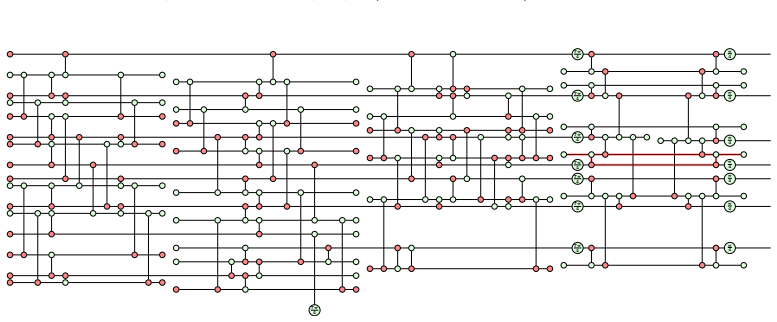
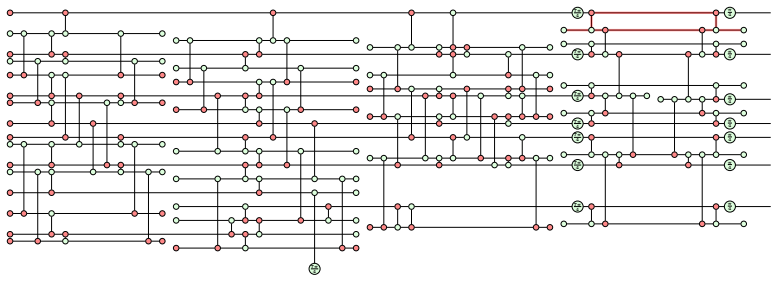
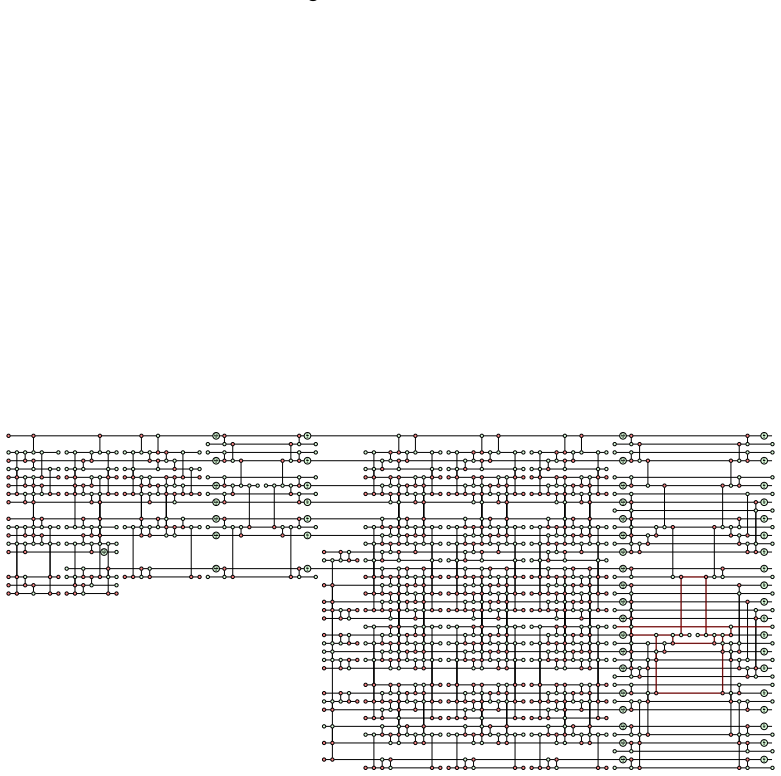
This paper tries to establish that the d=5 magic state cultivation circuit, whose 53 non-Clifford gates naively require a 6,377,292-term magic cat stabiliser decomposition, can be simulated as a weighted sum of about 8 pure Clifford ZX-diag
Reviewed by Pith at T0; open to challenge. T0 means a machine referee read the full paper against a public rubric. the ladder, T0–T4 →
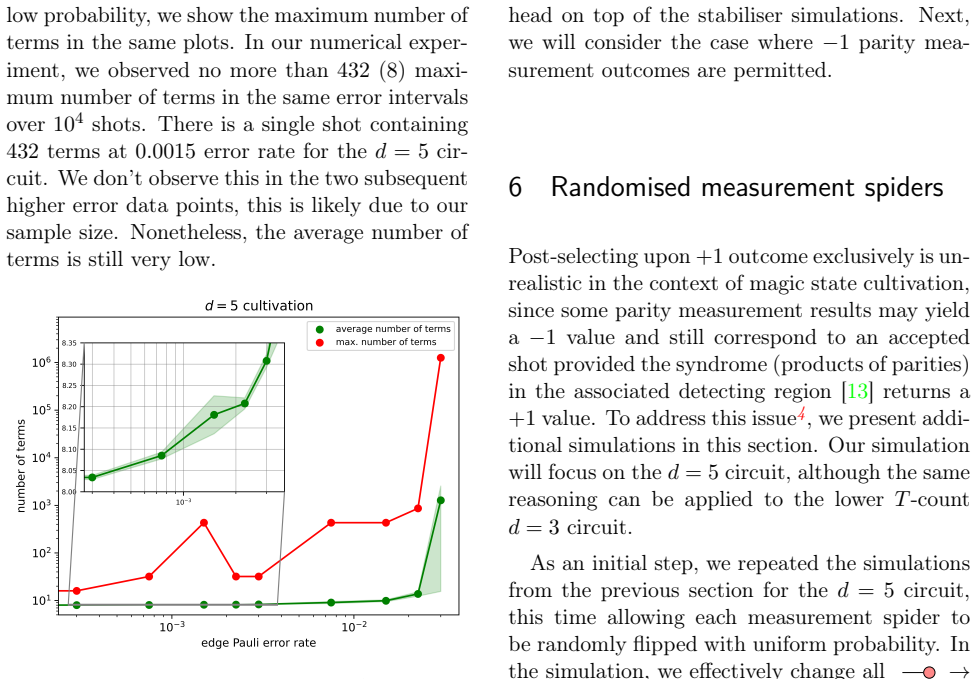
A d=5 magic state cultivation circuit with 53 non-Clifford gates can be represented, with 0.1% edge noise, as about 8 Clifford diagrams on average instead of 6,377,292.
T0 review reviewed 2026-08-04 challenge →
load-bearing objection The ~8-term noise-robustness result is real and worth knowing; the end-to-end sampling method ignores interference and overstates the simulation cost claim. the 3 major comments →
Simulating magic state cultivation with few Clifford terms
The pith
A machine-rendered reading of the paper's core claim, the machinery that carries it, and where it could break.
The reading
Core claim
The central discovery is empirical: applying the cutting decomposition from the authors' companion work to Pauli-errored ZX-diagrams of the d=3 and d=5 cultivation circuits keeps the average number of pure Clifford terms near 4 and 8, respectively, for edge error rates 10^-4 to 10^-3, against a baseline of 6,377,292 pure Clifford terms from the magic cat state stabiliser decomposition of all 53 non-Clifford spiders. The reduction is not automatic: if measurement spiders are randomly flipped and the secondary decomposition is the magic cat expansion, the average jumps to 10^2 to 10^3 terms; the low average is restored by using the BSS stabiliser decomposition or by post-selecting on closed Pa
What carries the argument
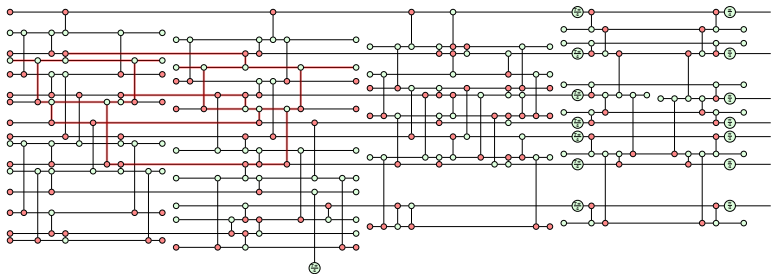
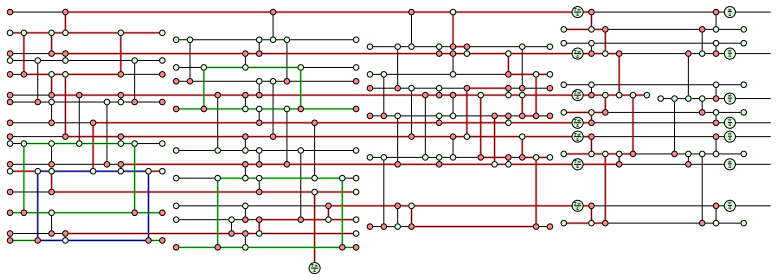
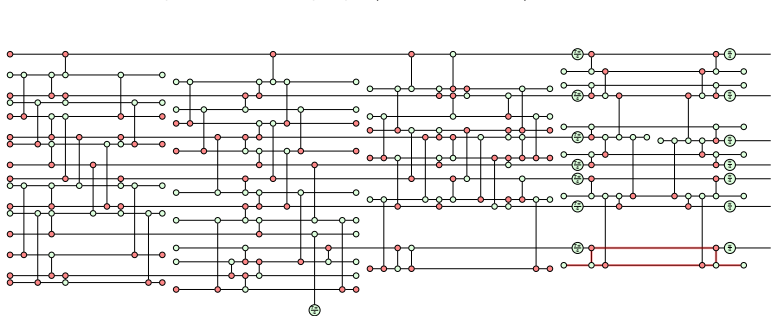
The cutting stabiliser decomposition is the central mechanism: a ZX-calculus rewriting that turns selected non-Clifford phase spiders into small combinations of Clifford diagrams, applied to diagrams where every edge carries an independent Pauli X/Y/Z error. When the cutting step leaves behind spiders that are still non-Clifford, a secondary decomposition (magic cat, BSS, or additional cuts) finishes the job; closed Pauli webs and detecting regions serve as a post-selection filter that decides which error realisations even need to be decomposed. The work these pieces do is to keep the pure-Clifford term count near 4 or 8 across the operationally relevant noise range, while still preserving t
Load-bearing premise
The claim stands on the empirical observation—not a proof—that the chosen cutting recipe keeps about 8 terms on average when every wire is independently depolarised at rates near 10^-3; if a realistic circuit-level noise model or a different decomposition choice inflates that average, the near-Clifford simulation story collapses.
What would settle it
Run the same decomposition on the d=5 cultivation circuit with circuit-level SD6 noise (the noise model used in the original cultivation paper) instead of per-edge depolarising noise; if the average number of terms in a sufficiently large sample exceeds a few tens at p=10^-3, the claim does not transfer. Independently, contract the eight Clifford terms of the noiseless companion-paper decomposition and compare against direct state-vector simulation; any discrepancy beyond numerical precision would invalidate the base decomposition.
If this is right
- For d=3 and d=5 cultivation circuits, per-shot sampling can run nearly as fast as a stabiliser simulation: about 4×10^6 shots per second on a laptop at SD6-level noise, within about 1.1 times the speed of a fully Clifford proxy.
- End-to-end logical error rate simulation of cultivation becomes feasible without the T-to-S approximation that caused an about 2× logical error rate discrepancy in the d=3 benchmark.
- The final cultivated state is delivered as a sum of about 8 Clifford tableaus, so the escape stage—tomography or injection into a much larger near-Clifford circuit—can be handled with overhead proportional to the mean term count.
- Low average term counts survive even when -1 measurement outcomes are allowed, provided the decomposition is supplemented with BSS cuts or the simulation post-selects on un-violated closed Pauli webs.
- The magic-cat-only secondary route without post-selection is not practical at 10^-3 noise (100–1000 terms), so the choice of secondary decomposition and post-selection is load-bearing for the claim.
Where Pith is reading between the lines
- A likely broader lesson, not proven here: for structured non-Clifford circuits, simulability under realistic noise is governed less by raw T-count than by how the T gates are wired and by which measurement outcomes are accepted; circuits with a low post-selection discard ratio may inherit a low decomposition cost.
- The rare 432-term tail implies that worst-case shots dominate runtime variance; a robust simulator should either count over-threshold shots as logical failures, as the paper suggests, or terminate and retry, so the average term count alone understates the cost of a long run.
- The closed-Pauli-web approach could be tested directly as a noise filter: because it discards most rejected shots before decomposition, the cost per accepted shot may be even lower than the about-8 average, and the discard-ratio curves already show the expected trade-off.
- A natural next experiment is to apply the same cutting-plus-post-selection recipe to other magic state cultivation variants; if the about-8-term average persists, near-Clifford simulation of 50-T-class circuits may be a general phenomenon rather than a feature of this one protocol.
Editorial analysis
A structured set of objections, weighed in public.
Referee Report
Summary. The paper proposes that the d=5 magic state cultivation circuit can be simulated classically by representing its ZX-diagram, under per-edge depolarising noise, as a sum of on average about 8 Clifford ZX-diagrams, compared with 6,377,292 terms for a magic-cat-state stabiliser decomposition. It reports numerical experiments on the average and maximum number of terms for d=3 and d=5 circuits, with different secondary decompositions (magic cat, BSS) and with post-selection on closed Pauli webs, and sketches an end-to-end simulation procedure. The abstract additionally claims a tsim-based throughput of nearly 4e6 shots/s for d=3 at SD6 noise. The paper is an empirical sketch; no code or data are shipped.
Significance. If the ~8-term average were robust and if a valid sampling procedure existed, the result would be significant: it would bring a 53-T-gate cultivation circuit into a regime where near-Clifford simulation is feasible, and the explicit closed Pauli webs in Appendices D/E and the Appendix A observation that the flag-free double-checking circuit equals I^⊗n+(XS†)^⊗n are concrete, reusable contributions. However, the central end-to-end simulation claim is not justified by the current manuscript: the proposed sampling step ignores quantum interference, and the headline benchmark appears only in the abstract. The paper is currently a preliminary research sketch whose main quantitative evidence is not independently verifiable without code/data.
major comments (3)
- [§8.1, Algorithm 1; §8.3] The proposed sampling procedure is not a valid estimator for measurement probabilities. A decomposition of the form |ψ⟩ = Σ_j c_j |C_j⟩ (Eqs. (11)-(12)) gives p(m) = |Σ_j c_j ⟨m|C_j⟩|^2, which contains cross terms 2 Re Σ_{j<k} c_j^* c_k ⟨m|C_j⟩^*⟨m|C_k⟩ unless the Clifford terms are orthogonal on the measured algebra. Algorithm 1 samples one term and reads its measurement outcomes; §8.3 instructs to 'simulate χ different numerical experiments' per shot. Both estimate only the diagonal terms. The paper does not state or prove that the Clifford terms are orthogonal, and the phases in Eqs. (6)-(7) and (11)-(12) make orthogonality non-obvious. Consequently, the claim 'only track ≈8 Clifford terms per shot' does not imply a valid Monte Carlo estimate of logical error rates; at least the estimator's bias must be analysed or the procedure replaced by an exact amplitude-summing method.
- [Abstract vs §6 and §8-§9] The abstract promises 'numerical results for full non-Clifford stabiliser rank simulation based on tsim' and a throughput of 'nearly 4×10^6 shots per second', 'only ~1.1 times slower' than a stim proxy, at SD6 noise p=0.0005. The body does not contain this benchmark. Section 6 instead says a 'definitive test would be to develop and integrate quizx with the code from [18] and carry out the end-to-end simulations', and §8 is explicitly a sketch. Either the benchmark must be reported with methodology and data, or the abstract must be corrected. This is not a presentation issue: the practical payoff of the paper depends on this claim.
- [§5 and §7; Figures 1-6] The numerical evidence for the central '~8 terms' claim is not reproducible from the manuscript. Sample sizes differ (10^4 shots in §5, 10^5 in §7), no confidence intervals are reported, and the maximum term count at p=0.0015 (432 terms) is a single event that the authors attribute to sample size. The decomposition pipeline is underspecified: the trigger for secondary decompositions, the number/placement of extra cuts, and the exact BSS routine are described only qualitatively (§5-§6). Figure 3 shows that with random measurement flips and magic-cat secondary decomposition the average is 10^2-10^3, so the low average is not a property of the circuit alone but of a particular heuristic pipeline. Code/data or a precise algorithm description is needed to verify the main quantitative claim.
minor comments (3)
- [Section 5, Eqs. (11)-(12)] The 4- and 8-term base decompositions are taken from the authors' companion paper [2] and are not proved in this manuscript. If Eqs. (11)-(12) are incorrect, the noise-averaged results inherit the error. I am not claiming circularity, but since the current paper's central claim rests on these external decompositions, a concise proof or a machine-checkable certificate for Eqs. (11)-(12) should be included or explicitly cited with the relevant theorem.
- [Figure 6] The comparison of discard ratios mixes different error models (per-edge depolarising vs SD6 circuit-level noise). The text acknowledges this, but the figure could mislead; please label the models clearly and state that the comparison is qualitative.
- [Throughout] There are several informal remarks and unpolished sentences ('are need', 'Probably not useful', 'we wonder if'). These are presentation issues but should be cleaned for a journal submission.
Circularity Check
No circularity: term-count results are outputs of the decomposition algorithm, and the companion-paper decompositions are restated and checkable.
full rationale
The claimed quantities (average ~8 terms for d=5 and ~4 for d=3 under per-edge depolarising noise) are empirical outputs of the cutting decomposition applied to Pauli-errored ZX-diagrams under Eq. (13). They are not fit parameters reused as predictions, and no equation defines the result in terms of itself. The error-free 4/8-term decompositions are attributed to the authors' companion paper [2], but Eqs. (11)-(12) restate them as explicit ZX-diagram equalities, so the central identity is not accepted solely on the authority of a self-citation. The choice of secondary decomposition (magic cat vs BSS) and the post-selection on closed Pauli webs are disclosed algorithmic conditioning choices that affect the averages, and the paper reports the adverse regime (random measurement flips, Section 6/Fig. 3) rather than hiding it. The paper's own qualifications ('preliminary simulations', 'definitive test would be...') corroborate that the term-counts are exploratory outputs rather than definitional predictions. The potential neglect of interference cross-terms in Algorithm 1/Section 8.3 is a correctness question about whether term-sampling reproduces Born-rule probabilities; even if valid, it is not an input-output identity and, under the given instructions, is not scored as circularity. No circular step can be exhibited.
Axiom & Free-Parameter Ledger
free parameters (2)
- cutting decomposition heuristic settings (number/placement of cuts, choice of secondary decomposition: magic cat states,
- secondary decomposition trigger threshold
axioms (4)
- domain assumption ZX-calculus diagrammatic rules used for spider fusion, unfusion, and cuts are sound and complete
- domain assumption The per-edge depolarising channel Eq. (13) with rate p is an adequate error model for simulating cultivation logical error rates
- ad hoc to paper The error-free d=3 and d=5 circuits admit cutting decompositions into exactly 4 and 8 Clifford terms as stated in [2] (Eqs. 11-12)
- domain assumption Detectors/closed Pauli webs from [18] are correctly translated into ZX-diagram subgraphs (appendices D/E)
Cite this review
Pith. "Pith review of Simulating magic state cultivation with few Clifford terms." pith.science (2026). https://pith.science/paper/IPSORCG6
@misc{pith2026250908658,
  author       = {Pith},
  title        = {Pith review of: Simulating magic state cultivation with few Clifford terms},
  year         = {2026},
  howpublished = {\url{https://pith.science/paper/IPSORCG6}},
  note         = {Machine review of arXiv:2509.08658}
}
abstract
Building upon [arXiv:2509.01224], we present a few methods on how to simulate the non-Clifford $d=5$ magic state cultivation circuits [arXiv:2409.17595] with a sum of $\approx 8$ Clifford ZX-diagrams on average, at $0.1\%$ noise. Compared to a magic cat state stabiliser decomposition of all $53$ non-Clifford spiders ($6{,}377{,}292$ terms required), this is more than $7 \times 10^{5}$ times reduction in the number of terms. Our stabiliser decomposition has the advantage of representing the final non-Clifford state (in light of circuit errors) as a sum of Clifford ZX-diagrams. This will be useful in simulating the escape stage of magic state cultivation, where one needs to port the resultant state of cultivation into a larger Clifford circuit with many more qubits. Still, it's necessary to only track $\approx 8$ Clifford terms. Our result sheds light on the simulability of operationally relevant, high $T$-count quantum circuits with some internal structure. Finally, we provide numerical results for full non-Clifford stabiliser rank simulation based on $\mathtt{tsim}$ along with optimisations using our cutting decompositions. Nearly $4\times 10^{6}$ shots per second can be obtained on a laptop for the smaller $d = 3$ circuits at SD6 circuit level noise $p=0.0005$, making it only $\sim$$1.1$ times slower than its (circuit-unspecific and un-optimised) fully Clifford proxy simulation via $\mathtt{stim}$ using $S$ gates.
Figures








Forward citations
Cited by 6 Pith papers
-
Clifft: Fast Exact Simulation of Near-Clifford Quantum Circuits
Clifft introduces a factored-state simulator that shifts exponential cost to a dynamic active subspace, generalizing Stim's compile-once model to near-Clifford circuits and enabling the first exact end-to-end simulati...
-
Computing logical error thresholds with the Pauli Frame Sparse Representation
A new sparse Pauli-frame method shows coherent noise thresholds are overestimated by a factor of ~4 under Pauli-twirling and revises the T-to-S gate error rate factor to as high as 7 at distance d=5.
-
Reducing Postselection Overhead in Magic-State Cultivation by In-Patch Multiplexing
In-patch multiplexing reduces expected attempts for early-stage magic-state cultivation by 45.46% (d1=3) to 72.91% (d1=5) and full-cycle attempts by 49-79% at p=2e-3, while final logical error rates stay governed by t...
-
Reducing Postselection Overhead in Magic-State Cultivation by In-Patch Multiplexing
In-patch multiplexing reduces expected attempts per accepted logical magic state by 45-79% at physical error rate 2e-3 for distances 3 and 5 while leaving the escape stage unchanged.
-
Clifft: Fast Exact Simulation of Near-Clifford Quantum Circuits
Clifft achieves fast exact simulation of near-Clifford quantum circuits via dynamic active subspaces, delivering orders-of-magnitude speedups and the first full end-to-end simulations of magic state cultivation over h...
-
Efficient simulation of logical magic state preparation protocols
A classical simulation method that propagates circuit-level Pauli noise to a Clifford error makes logical magic-state preparation protocols simulable in time polynomial in qubits and the target state's stabilizer rank.
Reference graph
Works this paper leans on
-
[1]
Magic state cultivation: growing T states as cheap as CNOT gates, 2024
CraigGidney, NoahShutty, andCodyJones. Magic state cultivation: growing T states as cheap as CNOT gates, 2024. URLhttps: //arxiv.org/abs/2409.17595
Pith/arXiv arXiv 2024
-
[2]
Cut- ting stabiliser decompositions of magic state cultivation with ZX-calculus, 2025
Kwok Ho Wan and Zhenghao Zhong. Cut- ting stabiliser decompositions of magic state cultivation with ZX-calculus, 2025. URL https://arxiv.org/abs/2509.01224
arXiv 2025
-
[3]
Stim: a fast stabilizer cir- cuit simulator
Craig Gidney. Stim: a fast stabilizer cir- cuit simulator. Quantum, 5:497, July 2021. ISSN 2521-327X. DOI: 10.22331/q-2021- 07-06-497. URLhttp://dx.doi.org/10. 22331/q-2021-07-06-497
doi:10.22331/q-2021- 2021
-
[4]
Improved upper bounds on the stabilizer rank of magic states
Hammam Qassim, Hakop Pashayan, and David Gosset. Improved upper bounds on the stabilizer rank of magic states. Quantum, 5:606, December 2021. ISSN 2521-327X. DOI: 10.22331/q-2021-12-20-
-
[5]
Cutting-Edge Graphical Sta- biliser Decompositions for Classical Simula- tion of Quantum Circuits
Julien Codsi. Cutting-Edge Graphical Sta- biliser Decompositions for Classical Simula- tion of Quantum Circuits. Master’s thesis, University of Oxford, 2022
2022
-
[6]
Classical simulation of quantum circuits with partial and graphical stabiliser decompositions
Aleks Kissinger, John van de Wetering, and Renaud Vilmart. Classical simulation of quantum circuits with partial and graphical stabiliser decompositions. Schloss Dagstuhl – Leibniz-Zentrum für Informatik, 2022. DOI: 10.4230/LIPICS.TQC.2022.5. URL https://drops.dagstuhl.de/entities/ document/10.4230/LIPIcs.TQC.2022.5
-
[7]
Universal quantum computation with ideal Clifford gates and noisy ancillas
Sergey Bravyi and Alexei Kitaev. Universal quantum computation with ideal Clifford gates and noisy ancillas. Physical Review A, 71(2), February 2005. ISSN 1094-1622. DOI: 10.1103/physreva.71.022316. URL http://dx.doi.org/10.1103/PhysRevA. 71.022316
-
[8]
Magic State Distilla- tion: Not as Costly as You Think
Daniel Litinski. Magic State Distilla- tion: Not as Costly as You Think. Quantum, 3:205, December 2019. ISSN 2521-327X. DOI: 10.22331/q-2019-12-02-
-
[9]
Pro- cedurally Optimised ZX-Diagram Cutting for Efficient T-Decomposition in Classi- cal Simulation
Matthew Sutcliffe and Aleks Kissinger. Pro- cedurally Optimised ZX-Diagram Cutting for Efficient T-Decomposition in Classi- cal Simulation. Electronic Proceedings in Theoretical Computer Science, 406:63–78, August 2024. ISSN 2075-2180. DOI: 10.4204/eptcs.406.3. URLhttp://dx.doi. org/10.4204/EPTCS.406.3
-
[10]
Novel Methods for Classical Simulation of Quantum Circuits via ZX-Calculus
Matthew Sutcliffe. Novel Methods for Classical Simulation of Quantum Circuits via ZX-Calculus. PhD thesis, University of Oxford, 2025
2025
-
[11]
Unifying flavors of fault tolerance with the ZX calculus
Hector Bombin, Daniel Litinski, Naomi Nickerson, Fernando Pastawski, and Sam Roberts. Unifying flavors of fault tolerance with the ZX calculus. Quantum, 8:1379, June 2024. ISSN 2521- 327X. DOI: 10.22331/q-2024-06-18-1379. URLhttp://dx.doi.org/10.22331/ q-2024-06-18-1379
-
[12]
PyZX: Large Scale Automated Di- agrammatic Reasoning
Aleks Kissinger and John van de Weter- ing. PyZX: Large Scale Automated Di- agrammatic Reasoning. In Bob Coecke and Matthew Leifer, editors, Proceedings 16th International Conference on Quantum Physics and Logic, Chapman University, Orange, CA, USA., 10-14 June 2019, volume 318 of Electronic Proceedings in Theoretical Computer Science, pages 229–
2019
-
[13]
Fault Tolerance by Construction,
BenjaminRodatz, BoldizsárPoór, andAleks Kissinger. Fault Tolerance by Construction,
-
[14]
Pedro Sales Rodriguez, John M. Robin- son, Paul Niklas Jepsen, Zhiyang He, Casey Duckering, Chen Zhao, Kai-Hsin Wu, Joseph Campo, Kevin Bagnall, Minho Kwon, Thomas Karolyshyn, Phillip Wein- berg, Madelyn Cain, Simon J. Evered, Alexandra A. Geim, Marcin Kalinowski, So- phie H. Li, Tom Manovitz, Jesse Amato- Grill, James I. Basham, Liane Bernstein, Boris Br...
arXiv 2024
-
[15]
Sergey Bravyi, Graeme Smith, and John A. Smolin. Trading Classical and Quantum Computational Resources. Phys. Rev. X, 6:021043, Jun 2016. DOI: 10.1103/Phys- RevX.6.021043. URLhttps://link.aps. org/doi/10.1103/PhysRevX.6.021043
doi:10.1103/phys- 2016
-
[16]
Speedy Contraction of ZX Dia- grams with Triangles via Stabiliser Decom- 10 positions, 2023
Mark Koch, Richie Yeung, and Quanlong Wang. Speedy Contraction of ZX Dia- grams with Triangles via Stabiliser Decom- 10 positions, 2023. URLhttps://arxiv.org/ abs/2307.01803
arXiv 2023
-
[17]
Graphical Stabilizer De- compositions for Multi-Control Toffoli Gate DenseQuantumCircuits, 2025
Yves Vollmeier. Graphical Stabilizer De- compositions for Multi-Control Toffoli Gate DenseQuantumCircuits, 2025. URLhttps: //arxiv.org/abs/2503.03798
Pith/arXiv arXiv 2025
-
[18]
Magic state culti- vation: growing T states as cheap as CNOT gates
Craig Gidney. Data for "Magic state culti- vation: growing T states as cheap as CNOT gates". Zenodo, September 2024. DOI: 10.5281/zenodo.13777072
-
[19]
Smith, Shrad- dha Singh, and Shruti Puri
Kaavya Sahay, Pei-Kai Tsai, Kathleen Chang, Qile Su, Thomas B. Smith, Shrad- dha Singh, and Shruti Puri. Fold-transversal surface code cultivation, 2025. URLhttps: //arxiv.org/abs/2509.05212
arXiv 2025
-
[20]
Cultivating T states on the surface code with only two-qubit gates,
Jahan Claes. Cultivating T states on the surface code with only two-qubit gates,
-
[21]
Efficient Magic State Cultivation on the Surface Code,
Yotam Vaknin, Shoham Jacoby, Arne Grimsmo, and Alex Retzker. Efficient Magic State Cultivation on the Surface Code,
-
[22]
Efficient Magic StateCultivationonRP 2, 2025
Zi-Han Chen, Ming-Cheng Chen, Chao- Yang Lu, and Jian-Wei Pan. Efficient Magic StateCultivationonRP 2, 2025. URLhttps: //arxiv.org/abs/2503.18657
Pith/arXiv arXiv 2025
-
[23]
Pauli Webs (YITP Quantum Error Correction Workshop),
Alex Townsend-Teague. Pauli Webs (YITP Quantum Error Correction Workshop),
-
[24]
Picturing Quantum Software: An Introduction to the ZX-Calculus and Quantum Compilation
Aleks Kissinger and John van de We- tering. Picturing Quantum Software: An Introduction to the ZX-Calculus and Quantum Compilation. A Cutting the basic flag-free double checking circuit The double checking sub-circuit dominates theT-count in cultivation circuits. Essentially, they are a series ofncontrolled-(H XY )gates applied to qubits on an-GHZ state a...
-
[25]
URLhttps://arxiv.org/abs/2509. 05232
-
[27]
URLhttps://arxiv.org/abs/2502. 01743
-
[30]
Accessed: 2025-09- 20
URLhttps://www.youtube.com/ watch?v=-mpc-70zUfU. Accessed: 2025-09- 20
2025
-
[32]
We wonder if(I+XS †)⊗n =I ⊗n + (XS†)⊗n−∑ j(cross terms)j admits a nice interpretation in ZH-calculus
from ZH-calculus via I+XS † = −i π . We wonder if(I+XS †)⊗n =I ⊗n + (XS†)⊗n−∑ j(cross terms)j admits a nice interpretation in ZH-calculus. Probably not useful. B An observation We noticed that the orange dotted (star) edge [16] defined as: = √ 2 7π4π4 π 7π4π4 ,(21) has resemblance to the double checking circuits. This ZX-diagram has some very nice stabili...
-
[205]
URLhttp://dx.doi.org/10.22331/ q-2019-12-02-205
2019
-
[241]
Open Publishing Association, 2020. DOI: 10.4204/EPTCS.318.14
-
[606]
URLhttp://dx.doi.org/10.22331/ q-2021-12-20-606. 9
2021
-
[2025]
URLhttps://arxiv.org/abs/2506. 17181
This paper was first reviewed by deepseek-v4-flash on August 4, 2026.
discussion (0)
Sign in with ORCID, Apple, or X to comment. Anyone can read and Pith papers without signing in.