REVIEW 4 major objections 6 minor 42 references
ArgoTweak: Towards Self-Updating HD Maps through Structured Priors
T0 review · 4 major / 6 minor · reviewed 2026-08-15 · deepseek-v4-flash
Pith's one-line read A new dataset makes HD-map updating trainable on realistic priors, cutting the simulation-to-reality gap tenfold.
desk verdict ArgoTweak is a genuinely useful dataset and benchmark, but its headline sim2real claim is measured against self-annotated labels built with the same change vocabulary as the training priors, so the transfer result is provisional. read the letter →
The pith
A machine-rendered reading of the paper's core claim, the machinery that carries it, and where it could break.
The reading
What carries the argument
The load-bearing mechanism is the bijective change mapping: a design principle that makes every structural map update decomposable into a unique, traceable set of atomic element-level edits, enforced by a mapping matrix C and a road-graph disambiguation rule (insertions/deletions only when topology changes; otherwise in-place edits). This turns map updating into a supervised, explainable task, supports the dataset's annotations, and feeds two-stage change-assessment heads in the baseline model (primary classification into No Change/Insertion/Deletion/Other, secondary heads for geometry and marking edits). The companion evaluation machinery is the dual metric: coarse mACC for frame-level change detection and fine-grained mAPC for element accuracy conditioned on correct change status.
What would settle it
Take a set of genuinely outdated HD maps (or record map changes over a construction cycle) and check what fraction of observed changes can be expressed as the paper's atomic-change vocabulary; if a substantial share fall outside it, the framework's coverage claim fails. Alternatively, have a second independent team re-annotate the ArgoTweak test changes and rerun the baseline; if the mACC gap reduction does not reproduce, the result may reflect annotation bias rather than transferable realism.
Extended reading notes
Core claim
ArgoTweak is the first hand-curated dataset that completes the triplet of an up-to-date map, current sensor data, and a realistic map prior, with element-level change annotations. Its bijective change mapping framework defines a closed vocabulary of five macro-modifications (shape, appearance, function, lane graph, lane number) and six atomic changes (geometry, markings, type, connectivity, insertion, deletion), with a disambiguation rule that maps each structural update to a unique set of elemental edits. Using this framework, the authors generate realistic priors from ground-truth maps for training and re-annotate real-world changes from the Argoverse 2 Map Change Dataset for testing. Models trained on ArgoTweak detect and integrate changes with a much smaller sim2real gap than models trained on synthetic rule-based or noise-based priors, and the fine-grained metrics mAPC and mACC expose that mAP alone hides the difference between preserving unchanged regions and correctly updating changed ones.
Load-bearing premise
The training priors in ArgoTweak are not actual historical stale maps; they are generated by applying the paper's atomic-change framework to ground-truth maps, so the claimed realism rests on the assumption that the five macro-modifications and six atomic changes capture the full range of real-world map aging.
Editorial extensions
If this is right
- Training on ArgoTweak-style realistic priors cuts the simulation-to-reality gap in change detection accuracy by more than a factor of ten (mACC gap from -36.0 to -3.5).
- The standard mAP metric is blind to whether a model updates changed regions or merely preserves unchanged ones; change-aware metrics mAPC and mACC are needed to judge update efficacy.
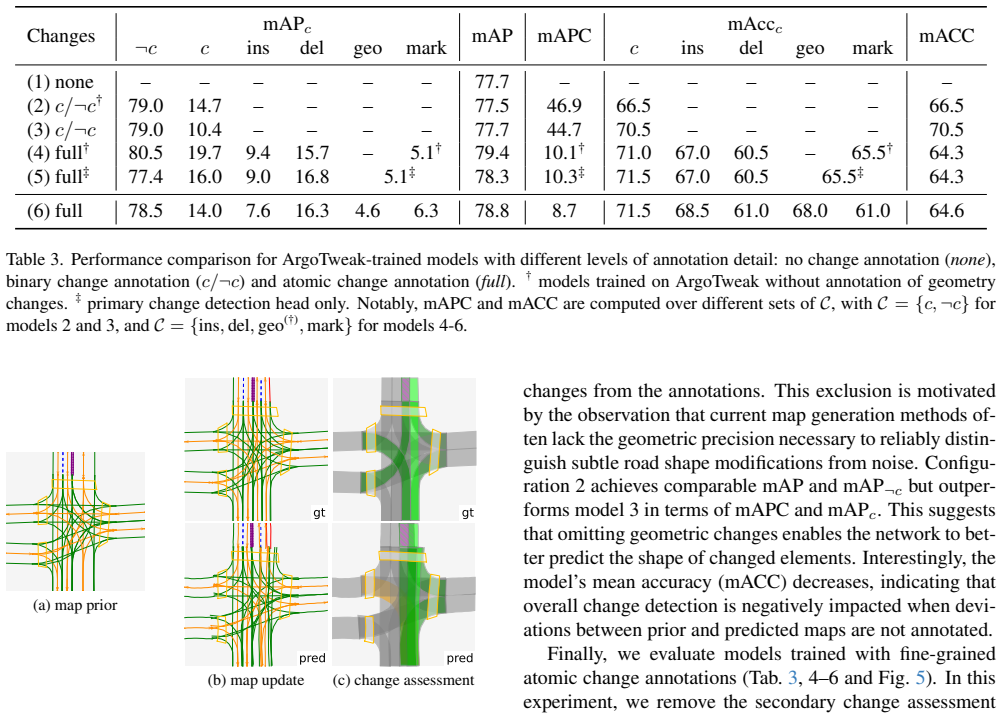
- The bijective change mapping enables explainable supervision that also improves performance: models trained with full change annotations outperform those trained without them.
- ArgoTweak establishes a benchmark and baseline for prior-aided HD mapping, making results across methods comparable for the first time.
- Excluding geometric changes from annotation changes the stability/adaptability tradeoff, indicating that annotation granularity is a substantive design choice for self-updating maps.
Reading between the lines
- The closed vocabulary of five macro-modifications and six atomic changes may not cover all real-world road aging (e.g., traffic signal additions, temporary construction layouts, or changes in road class semantics); a test of vocabulary coverage on independently collected stale maps would tell whether the claimed realism is complete.
- The 'realistic' priors are still generated by applying the framework to ground-truth maps; true end-to-end self-updating would ultimately need to ingest actual historical prior maps at scale, which the framework does not yet demonstrate.
- The two-stage change-assessment design suggests a natural extension to detecting entirely new change categories (e.g., speed-limit or traffic-sign changes) by adding secondary heads without retraining the primary classifier.
- Because the model runs at about 4 FPS, a practical fleet deployment would need to decide whether to update maps online or post-process batches, a tradeoff the paper does not address.
Signed reviews
Editorial analysis
A structured set of objections, weighed in public.
Referee Report
Summary. The paper introduces ArgoTweak, a dataset for prior-aided HD map updating built on Argoverse 2. It contributes (i) a hand-curated set of realistic map priors paired with sensor data and updated ground-truth maps, (ii) a ``bijective change mapping'' framework that decomposes structural road modifications into atomic changes (geometry, markings, type, connectivity, insertion/deletion), (iii) a LaneSegNet-based baseline with explainable change-assessment heads, and (iv) a dual metric mAPC/mACC that evaluates changed and unchanged regions separately. Experiments compare training on ArgoTweak against training on synthetic priors and report that ArgoTweak reduces the sim2real gap in mACC from ΔmACC=-36.0 to -3.5 (Sec. 7.2). Ablations study binary vs. atomic change annotations (Sec. 7.3). The paper claims to be the first dataset completing the triplet of prior map, current sensor data, and updated map, and to provide a benchmark for explainable prior-aided mapping.
Significance. If the central claims hold, ArgoTweak fills a real and widely felt gap: no public dataset currently provides stale priors, current sensor data, and updated ground truth together, and existing work relies on scripted perturbations. The structured annotation vocabulary and the separate treatment of stability vs. responsiveness are useful methodological contributions, and the authors commit to releasing the dataset, baselines, and modification toolbox, which is commendable. The paper also takes data-leakage concerns seriously by geographically separating validation and test splits. The key weakness is that the headline sim2real result is evaluated on labels generated by the authors with the same closed vocabulary used to synthesize the training priors, so the test cannot independently validate coverage of real-world map aging. The dataset's value is real, but the empirical claim of a tenfold gap reduction is not yet established by the present evaluation.
major comments (4)
- [Sec. 4.2 and Sec. 7.2] The headline sim2real result is not independently grounded. Training priors in ArgoTweak are produced by applying the paper's own atomic-change framework to ground-truth maps (Sec. 4.2), and the real-world test labels are also authored by the authors for the [12] validation split (Sec. 4.2), using the same five macro-modifications and the soft bijection matrix C (Sec. 4.1). The reported reduction from ΔmACC=-36.0 to -3.5 therefore measures how well a model trained on author-generated priors predicts author-generated labels. Real-world aging processes that fall outside the closed vocabulary--for example, a partial lane shift, a re-routing that is not a clean insertion/deletion, or a lane-type change (which Appendix B explicitly excludes from the experiments)--are either forced into the vocabulary or omitted. The use of [12]'s validation split as the test split, rather than its test split, compounds the lack of independence. To support the general claim, the paper should evaluate against independently available labels (e.g., [12]'s own change annotations) or, at minimum, provide an audit of what fraction of real-world priors cannot be represented by the vocabulary and report inter-annotator agreement on the test annotations.
- [Sec. 7.2 and Fig. 4] The central comparison rests on single-run point estimates. The paper reports ΔmACC=-36.0 for the rule-based prior and ΔmACC=-3.5 for ArgoTweak, with no standard deviations, seed variation, or repeated runs anywhere in the experiments. Since mACC is an average over several change classes and a small set of scenes, the difference could be affected by initialization and training noise. The paper should report multiple seeds (at least for the two compared training regimes) and indicate whether the gap reduction is statistically stable; otherwise the ``more than a factor of 10'' claim is only a point-estimate observation.
- [Appendix C and Sec. 7.2] The rule-based baseline is an author-modified reimplementation of the prior-generation method of [12], and Appendix C lists several substantive deviations: a maximum of 20 sampling iterations, an additional height condition h>2m, replacement of the original image-edge constraint by a 15 m ego-trajectory buffer, a maximum of two bike lanes per global map, and a fixed number of marking-change attempts. If these deviations make the baseline weaker or less realistic than the original [12] procedure, the comparison may overstate the advantage of ArgoTweak. The paper should either use the original [12] pipeline, if available, or provide a sensitivity analysis showing that the sim2real gap is robust to these implementation choices.
- [Sec. 4.1, Eqs. (1)-(2)] The formal bijectivity conditions are stated as if they hold over the full space Y of structural updates, but the construction immediately restricts to five macro-modifications and a ``soft bijection.'' The paper gives no empirical evidence of consistency: there is no inter-annotator agreement study, no measure of how often a structural update admits multiple atomic decompositions, and no statistics on how the disambiguation rules (e.g., the Right-Handside-Rule of Appendix A.5) resolve ambiguity in practice. Since the explainability claim, the dataset annotations, and the mAPC metric all depend on this mapping being consistent, the paper should either provide a consistency study or explicitly downgrade the ``bijective'' terminology to a design heuristic.
minor comments (6)
- [Throughout] The term ``bijective'' is used in the title and framework name even though Sec. 4.1 states it is not a strict mathematical bijection; a consistent qualifier such as ``soft bijection'' would be clearer.
- [Fig. 4] The third row is labeled Δ(mAccc), while the text reports ΔmACC; clarify whether the figure shows per-class deltas or the macro-averaged metric.
- [Table 3] The note that mAPC and mACC are computed over different sets of C is important but easy to miss; consider stating the category set C explicitly in each row of the table.
- [Table 1] The entry ``Argoverse 2 TbV'' should be expanded as ``Trust but Verify'' at first use in the table or text.
- [Sec. 5.1] The prior encoding description says lane marking color is not used and then ``the same holds for lane type,'' but the preceding sentence only mentions color; clarify whether lane type is intentionally omitted from the encoded features and how this interacts with the type-change annotations in the dataset.
- [Appendix C] ``Attempt to change four three-segment sequences'' is imprecise; specify whether these attempts are guaranteed to produce a change or may be dropped if a validity check fails.
Circularity Check
No circularity: the headline sim2real comparison is evaluated on real-world priors from Argoverse 2 [12], and no metric or training objective reduces to the dataset's own labels by construction.
full rationale
The central claim is that training on ArgoTweak reduces the sim2real gap compared to training on rule-based synthetic priors. The evidence for this is a transfer experiment: both models are evaluated on the real-world validation split of [12], whose priors and sensor data come from an external dataset, while the ground-truth maps are annotated by the authors. This is a legitimate held-out evaluation rather than a fitted prediction. The authors' own framework is used to generate the ArgoTweak training priors (Sec. 4.2), and it is also used to annotate the test ground truth, which creates a coverage limitation: real-world changes outside the closed atomic vocabulary, such as the lane-type changes explicitly not used in the experiments (App. B), cannot be independently validated. However, that is a scope limitation and a correctness risk, not a circular derivation. The mACC and mAPC metrics are new, but they are computed on held-out predictions against independently sourced real priors; they are not algebraic rearrangements of the training loss. Self-citations to ExelMap [27] appear for prior encoding and metric inspiration, but they are not load-bearing: the architecture is built on LaneSegNet [15] and the empirical comparison does not depend on the cited prior work. No equation in the paper equates a fitted parameter with a reported prediction, and no uniqueness theorem is imported from the authors' own prior work. The closed-vocabulary concern is best framed as an external-validity caveat, not as evidence that the derivation is circular.
Assumptions & free parameters
free parameters (3)
- Loss weights in Eq. (4) =
λ_vec=0.025, λ_seg=3.0, λ_ce=1.0, λ_dice=1.0, λ_cls=1.5, λ_type=0.01, λ_cd_primary=λ_cd_secondary=0.5
- Synthetic baseline perturbation parameters =
σ=0.5 Gaussian noise; p_del=p_shift=0.2
- mAPC distance thresholds =
1.0/2.0/3.0 m (lane segments), 0.5/1.0/1.5 m (crossings)
assumptions (5)
- domain assumption Closed vocabulary of 5 macro-modifications and 6 atomic changes covers all relevant real-world map changes.
- domain assumption Lane segments and pedestrian crossings, in Argoverse 2 format, are the right element granularity, and pedestrian crossings can be treated as lane segments.
- domain assumption The re-annotated ground-truth maps for the test split are correct.
- domain assumption The prior encoding (10 points per boundary, 7 one-hot marking types, no color or lane-type information) retains the information needed for map updating.
- standard math Standard deep-learning components (ResNet-50, DETR-style decoder, LaneSegNet) work as intended.
Cite this review
Pith. "Pith review of ArgoTweak: Towards Self-Updating HD Maps through Structured Priors." pith.science (2026). https://pith.science/paper/LJWNSSFL
@misc{pith2026250908764,
  author       = {Pith},
  title        = {Pith review of: ArgoTweak: Towards Self-Updating HD Maps through Structured Priors},
  year         = {2026},
  howpublished = {\url{https://pith.science/paper/LJWNSSFL}},
  note         = {Machine review of arXiv:2509.08764}
}
read the original abstract
Reliable integration of prior information is crucial for self-verifying and self-updating HD maps. However, no public dataset includes the required triplet of prior maps, current maps, and sensor data. As a result, existing methods must rely on synthetic priors, which create inconsistencies and lead to a significant sim2real gap. To address this, we introduce ArgoTweak, the first dataset to complete the triplet with realistic map priors. At its core, ArgoTweak employs a bijective mapping framework, breaking down large-scale modifications into fine-grained atomic changes at the map element level, thus ensuring interpretability. This paradigm shift enables accurate change detection and integration while preserving unchanged elements with high fidelity. Experiments show that training models on ArgoTweak significantly reduces the sim2real gap compared to synthetic priors. Extensive ablations further highlight the impact of structured priors and detailed change annotations. By establishing a benchmark for explainable, prior-aided HD mapping, ArgoTweak advances scalable, self-improving mapping solutions. The dataset, baselines, map modification toolbox, and further resources are available at https://kth-rpl.github.io/ArgoTweak/.
Figures


Figures from the paper (7 more)


Reference graph
Works this paper leans on
-
[12]
John W. Lambert and James Hays. Trust, but Verify: Cross- modality fusion for hd map change detection. InNeurIPS Datasets and Benchmarks, 2021. 2, 3, 4, 5, 6, 7, 15
work page 2021
-
[1]
Samuel M. Bateman, Ning Xu, H. Charles Zhao, Yael Ben Shalom, Vince Gong, Greg Long, and Will Maddern. Exploring Real World Map Change Generalization of Prior- Informed HD Map Prediction Models. InCVPR Workshops,
-
[2]
Holger Caesar, Varun Bankiti, Alex H. Lang, Sourabh V ora, Venice Erin Liong, Qiang Xu, Anush Krishnan, Yu Pan, Gi- ancarlo Baldan, and Oscar Beijbom. NuScenes: A multi- modal dataset for autonomous driving. InCVPR, 2020. 2, 4
work page 2020
-
[3]
End-to- End Object Detection with Transformers
Nicolas Carion, Francisco Massa, Gabriel Synnaeve, Nicolas Usunier, Alexander Kirillov, and Sergey Zagoruyko. End-to- End Object Detection with Transformers. InECCV, 2020. 2
work page 2020
-
[4]
MapTracker: Tracking with Strided Memory Fusion for Consistent Vector HD Mapping
Jiacheng Chen, Yuefan Wu, Jiaqi Tan, Hang Ma, and Yasu- taka Furukawa. MapTracker: Tracking with Strided Memory Fusion for Consistent Vector HD Mapping. InECCV, 2024. 2
work page 2024
-
[5]
Mask2Map: Vectorized HD Map Construction Using Bird’s Eye View Segmentation Masks
Sehwan Choi, Jungho Kim, Hongjae Shin, and Jungwook Choi. Mask2Map: Vectorized HD Map Construction Using Bird’s Eye View Segmentation Masks. InECCV, 2024. 2
work page 2024
-
[6]
Gamal Elghazaly, Rapha ¨el Frank, Scott Harvey, and Stefan Safko. High-Definition Maps: Comprehensive Survey, Chal- lenges, and Future Perspectives.ITS, 4:527–550, 2023. 1
work page 2023
-
[7]
Deep Residual Learning for Image Recognition
Kaiming He, Xiangyu Zhang, Shaoqing Ren, and Jian Sun. Deep Residual Learning for Image Recognition. InCVPR,
Show all 42 references
-
[8]
ADMap: Anti-disturbance framework for reconstructing online vectorized HD map
Haotian Hu, Fanyi Wang, Yaonong Wang, Laifeng Hu, Jing- wei Xu, and Zhiwang Zhang. ADMap: Anti-disturbance framework for reconstructing online vectorized HD map. In ECCV, 2024. 2
2024
-
[9]
M3TR: Generalist HD Map Construction with Variable Map Priors.arXiv preprint 2411.10316, 2024
Fabian Immel, Richard Fehler, Frank Bieder, Jan-Hendrik Pauls, and Christoph Stiller. M3TR: Generalist HD Map Construction with Variable Map Priors.arXiv preprint 2411.10316, 2024. 1, 2, 3, 5, 6
2024 arXiv
-
[10]
P-MapNet: Far-seeing Map Generator Enhanced by both SDMap and HDMap Priors.arXiv preprint 2403.10521,
Zhou Jiang, Zhenxin Zhu, Pengfei Li, Huan ang Gao, Tianyuan Yuan, Yongliang Shi, Hang Zhao, and Hao Zhao. P-MapNet: Far-seeing Map Generator Enhanced by both SDMap and HDMap Priors.arXiv preprint 2403.10521,
-
[11]
Unveiling the Hidden: Online Vectorized HD Map Construc- tion with Clip-Level Token Interaction and Propagation
Nayeon Kim, Hongje Seong, Daehyun Ji, and Sujin Jang. Unveiling the Hidden: Online Vectorized HD Map Construc- tion with Clip-Level Token Interaction and Propagation. In NeurIPS, 2024. 2
2024
-
[13]
HDMapNet: An Online HD Map Construction and Evaluation Frame- work
Qi Li, Yue Wang, Yilun Wang, and Hang Zhao. HDMapNet: An Online HD Map Construction and Evaluation Frame- work. InICRA, 2022. 1, 2
2022
-
[14]
Graph-based Topology Reasoning for Driving Scenes.arXiv preprint 2304.05277, 2023
Tianyu Li, Li Chen, Huijie Wang, Yang Li, Jiazhi Yang, Xiangwei Geng, Shengyin Jiang, Yuting Wang, Hang Xu, Chunjing Xu, Junchi Yan, Ping Luo, and Hongyang Li. Graph-based Topology Reasoning for Driving Scenes.arXiv preprint 2304.05277, 2023. 2
2023 arXiv
-
[15]
LaneSegNet: Map Learning with Lane Segment Perception for Autonomous Driving
Tianyu Li, Peijin Jia, Bangjun Wang, Li Chen, Kun Jiang, Junchi Yan, and Hongyang Li. LaneSegNet: Map Learning with Lane Segment Perception for Autonomous Driving. In ICLR, 2024. 2, 5, 6, 11
2024
-
[16]
MapTR: Structured Modeling and Learning for Online Vectorized HD Map Construction
Bencheng Liao, Shaoyu Chen, Xinggang Wang, Tianheng Cheng, Qian Zhang, Wenyu Liu, and Chang Huang. MapTR: Structured Modeling and Learning for Online Vectorized HD Map Construction. InICRL, 2023. 1, 2
2023
-
[17]
MapTRv2: An End-to-End Framework for Online Vector- ized HD Map Construction.IJCV, 133, 2025
Bencheng Liao, Shaoyu Chen, Yunchi Zhang, Bo Jiang, Qian Zhang, Wenyu Liu, Chang Huang, and Xinggang Wang. MapTRv2: An End-to-End Framework for Online Vector- ized HD Map Construction.IJCV, 133, 2025. 2
2025
-
[18]
Localization Is All You Evaluate: Data Leakage in Online Mapping Datasets and How to Fix It
Adam Lilja, Junsheng Fu, Erik Stenborg, and Lars Ham- marstrand. Localization Is All You Evaluate: Data Leakage in Online Mapping Datasets and How to Fix It. InCVPR,
-
[19]
Focal Loss for Dense Object Detection.PAMI, 42(2):318–327, 2020
Tsung-Yi Lin, Priya Goyal, Ross Girshick, Kaiming He, and Piotr Doll´ar. Focal Loss for Dense Object Detection.PAMI, 42(2):318–327, 2020. 6
2020
-
[20]
MGMap: Mask-Guided Learning for Online Vectorized HD Map Construction
Xiaolu Liu, Song Wang, Wentong Li, Ruizi Yang, Junbo Chen, and Jianke Zhu. MGMap: Mask-Guided Learning for Online Vectorized HD Map Construction. InCVPR, 2024. 2
2024
-
[21]
VectorMapNet: End-to-end Vectorized HD Map Learning
Yicheng Liu, Yuan Yuantian, Yue Wang, Yilun Wang, and Hang Zhao. VectorMapNet: End-to-end Vectorized HD Map Learning. InICML, 2023. 1, 2
2023
-
[22]
Leveraging Enhanced Queries of Point Sets for Vectorized Map Construction
Zihao Liu, Xiaoyu Zhang, Guangwei Liu, Ji Zhao, and Ningyi Xu. Leveraging Enhanced Queries of Point Sets for Vectorized Map Construction. InECCV, 2024. 2
2024
-
[23]
Aug- menting Lane Perception and Topology Understanding with Standard Definition Navigation Maps
Katie Z Luo, Xinshuo Weng, Yan Wang, Shuang Wu, Jie Li, Kilian Q Weinberger, Yue Wang, and Marco Pavone. Aug- menting Lane Perception and Topology Understanding with Standard Definition Navigation Maps. InICRA, 2024. 1, 2, 5
2024
-
[24]
Mind the map! Accounting for existing map infor- mation when estimating online HDMaps from sensor data
R ´emy Sun, Li Yang, Diane Lingrand, and Fr ´ed´eric Pre- cioso. Mind the map! Accounting for existing map infor- mation when estimating online HDMaps from sensor data. InWACV, 2025. 1, 2, 5, 6
2025
-
[25]
Openlane-v2: A topology rea- soning benchmark for unified 3d hd mapping
Huijie Wang, Tianyu Li, Yang Li, Li Chen, Chonghao Sima, Zhenbo Liu, Bangjun Wang, Peijin Jia, Yuting Wang, Shengyin Jiang, Feng Wen, Hang Xu, Ping Luo, Junchi Yan, Wei Zhang, and Hongyang Li. Openlane-v2: A topology rea- soning benchmark for unified 3d hd mapping. InNeurIPS,
-
[26]
Stream Query Denoising for Vec- torized HD-Map Construction
Shuo Wang, Fan Jia, Weixin Mao, Yingfei Liu, Yucheng Zhao, Zehui Chen, Tiancai Wang, Chi Zhang, Xiangyu Zhang, and Feng Zhao. Stream Query Denoising for Vec- torized HD-Map Construction. InECCV, 2024. 2
2024
-
[27]
ExelMap: Explainable Element-based HD-Map Change Detection and Update, 2024
Lena Wild, Ludvig Ericson, Rafael Valencia, and Patric Jens- felt. ExelMap: Explainable Element-based HD-Map Change Detection and Update, 2024. 1, 2, 3, 5, 6
2024
-
[28]
Argoverse 2: Next Generation Datasets for Self-Driving Perception and Forecasting
Benjamin Wilson, William Qi, Tanmay Agarwal, John Lam- bert, Jagjeet Singh, Siddhesh Khandelwal, Bowen Pan, Rat- nesh Kumar, Andrew Hartnett, Jhony Kaesemodel Pontes, Deva Ramanan, Peter Carr, and James Hays. Argoverse 2: Next Generation Datasets for Self-Driving Perception an...
2021
-
[29]
TopoMLP: An Simple yet Strong Pipeline for Driving Topology Reasoning.ICLR, 2024
Dongming Wu, Jiahao Chang, Fan Jia, Yingfei Liu, Tiancai Wang, and Jianbing Shen. TopoMLP: An Simple yet Strong Pipeline for Driving Topology Reasoning.ICLR, 2024. 2
2024
-
[30]
Neural Map Prior for Autonomous Driving
Xuan Xiong, Yicheng Liu, Tianyuan Yuan, Yue Wang, Yilun Wang, and Hang Zhao. Neural Map Prior for Autonomous Driving. InCVPR, 2023. 2
2023
-
[31]
Zhenhua Xu, Kwan-Yee. K. Wong, and Hengshuang Zhao. InsMapper: Exploring Inner-instance Information for Vec- torized HD Mapping. InECCV, 2024. 2
2024
-
[32]
MGMapNet: Multi-Granularity Representation Learning for End-to-End Vectorized HD Map Construction
Jing Yang, Minyue Jiang, Sen Yang, Xiao Tan, Yingying Li, Errui Ding, Jingdong Wang, and Hanli Wang. MGMapNet: Multi-Granularity Representation Learning for End-to-End Vectorized HD Map Construction. InICLR, 2025. 2
2025
-
[33]
StreamMapNet: Streaming Mapping Network for Vectorized Online HD Map Construction
Tianyuan Yuan, Yicheng Liu, Yue Wang, Yilun Wang, and Hang Zhao. StreamMapNet: Streaming Mapping Network for Vectorized Online HD Map Construction. InWACV,
-
[34]
Driving with Prior Maps: Unified Vector Prior Encoding for Autonomous Vehicle Mapping.arXiv preprint arXiv:2409.05352, 2024
Shuang Zeng, Xinyuan Chang, Xinran Liu, Zheng Pan, and Xing Wei. Driving with Prior Maps: Unified Vector Prior Encoding for Autonomous Vehicle Mapping.arXiv preprint arXiv:2409.05352, 2024. 1, 2, 6
2024
-
[35]
Enhancing Vectorized Map Perception with Historical Rasterized Maps
Xiaoyu Zhang, Guangwei Liu, Zihao Liu, Ningyi Xu, Yun- hui Liu, and Ji Zhao. Enhancing Vectorized Map Perception with Historical Rasterized Maps. InECCV, 2024. 2
2024
-
[36]
Online Vectorized HD Map Construction using Geometry
Zhixin Zhang, Yiyuan Zhang, Xiaohan Ding, Fusheng Jin, and Xiangyu Yue. Online Vectorized HD Map Construction using Geometry. InECCV, 2024. 2
2024
-
[37]
Cross-view Trans- formers for real-time Map-view Semantic Segmentation
Brady Zhou and Philipp Kr ¨ahenb¨uhl. Cross-view Trans- formers for real-time Map-view Semantic Segmentation. In CVPR, 2022. 2
2022
-
[38]
structural change
Yi Zhou, Hui Zhang, Jiaqian Yu, Yifan Yang, Sangil Jung, Seung-In Park, and ByungIn Yoo. HIMap: HybrId Repre- sentation Learning for End-to-end Vectorized HD Map Con- struction. InCVPR, 2024. 2 ArgoTweak: Towards Self-Updating HD Maps through Structured Priors Supplementary Ma...
2024
-
[39]
lane marking change color change left right mark change left right
-
[40]
geometry change width change left right border shape left right
-
[41]
opening ...→vehicle
lane type change restriction vehicle→... opening ...→vehicle
-
[42]
deletion Figure 9
insertion 5. deletion Figure 9. Hierarchical annotation granularity within atomic changes. Notably, insertions and deletions cannot be categorized further, as they do not have any correspondences between prior and ground-truth map. Category train val test global frame element ...
Reviewed August 15, 2026 · model on record in the stance chip above.
Discussion (0). Continue with ORCID to comment.