REVIEW 4 major objections 4 minor 1 cited by
Calibrating MLLM-as-a-judge via Multimodal Bayesian Prompt Ensembles
T0 review · 4 major / 4 minor · reviewed 2026-08-15 · deepseek-v4-flash
Pith's one-line read This paper shows that a Bayesian prompt ensemble whose prompt weights are conditioned on image clusters improves both accuracy and calibration of MLLM judges on text-to-image preference tasks.
desk verdict A solid, carefully tested extension of BPE to multimodal judging, but the cluster mechanism is never isolated—a random-cluster ablation is needed to know if the visual grouping is actually doing the work. read the letter →
The pith
A machine-rendered reading of the paper's core claim, the machinery that carries it, and where it could break.
The reading
What carries the argument
The load-bearing object is the soft image-conditional mixture: a set of prompts treated as latent variables, a variational distribution $q(a|z)$ with learnable weights $w_{za}$ per visual cluster $z$, and a soft assignment $p(z|x)$ derived from cosine similarities between the image embedding and cluster centroids. Spherical k-means on a pretrained image encoder partitions an unlabeled support set into $K$ groups; temperature $\tau$ in the soft assignment interpolates between independent per-cluster BPE as $\tau\to0$ and a single global BPE as $\tau\to\infty$. The training objective balances, over validation data, the sum of soft-assignment-weighted per-cluster log-likelihoods minus per-cluster entropy, which is an evidence lower bound under the conditional-independence assumptions $a\perp x\mid z$ and $y\perp z\mid a$. Inference mixes the MLLM's per-prompt probabilities according to the learned weights and the test image's soft group membership.
What would settle it
Run MMB on a preference benchmark whose images all come from one narrow visual style, so every image lands in essentially one cluster, and compare it with BPE on the same data; if MMB's calibration improvement persists, the advantage is not caused by visual conditioning, undercutting the paper's explanation.
Extended reading notes
Core claim
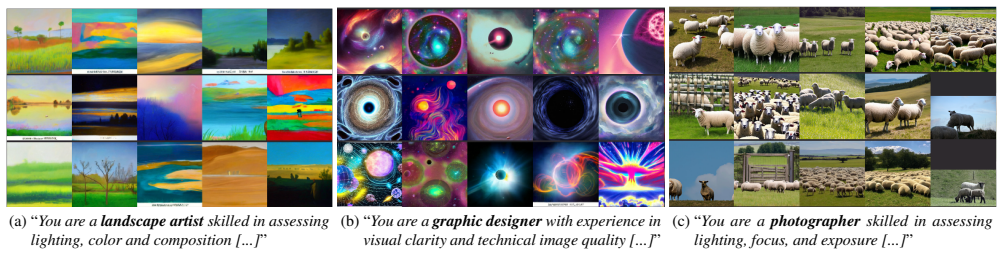
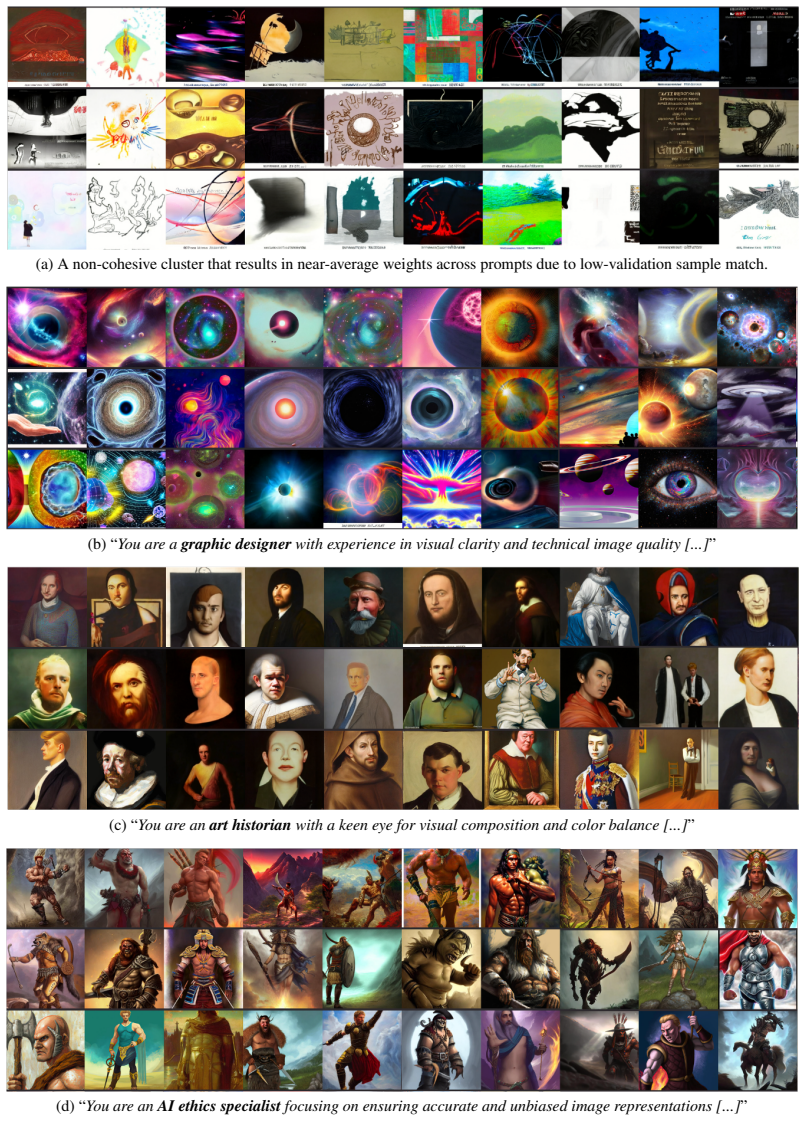
The central claim is that an MLLM judge's reliability on a text-to-image preference question is not a global property of the prompt alone, but depends on the visual content being judged, and that this dependence can be captured with a mixture-of-experts-style ensemble. MMB forms $K$ groups by spherical k-means on image embeddings from a pretrained encoder, assigns each image a soft membership $p(z|x)$ based on cosine similarity to cluster centroids, and learns cluster-specific prompt weights $w^*_{za}$ by maximizing an evidence lower bound on validation pairs that balances per-group log-likelihood against an entropy regularizer. At test time the final preference probability is a soft mixture, $p(y|x)\approx\sum_z p(z|x)\sum_a w^*_{za}\,p(y|x,a)$, so images in different visual styles effectively use different prompt experts. At 10 prompts and 20 validation samples on HPSv2, the paper reports expected calibration error of 0.091 for MMB versus 0.114 for BPE and 0.142 for a simple average.
Load-bearing premise
The method's gains rest on the assumption that images which are close in the embedding space used for clustering also tend to agree on which evaluation prompt is most reliable; if prompt reliability does not vary coherently across these visual clusters, the cluster-specific weights add no useful signal.
Editorial extensions
If this is right
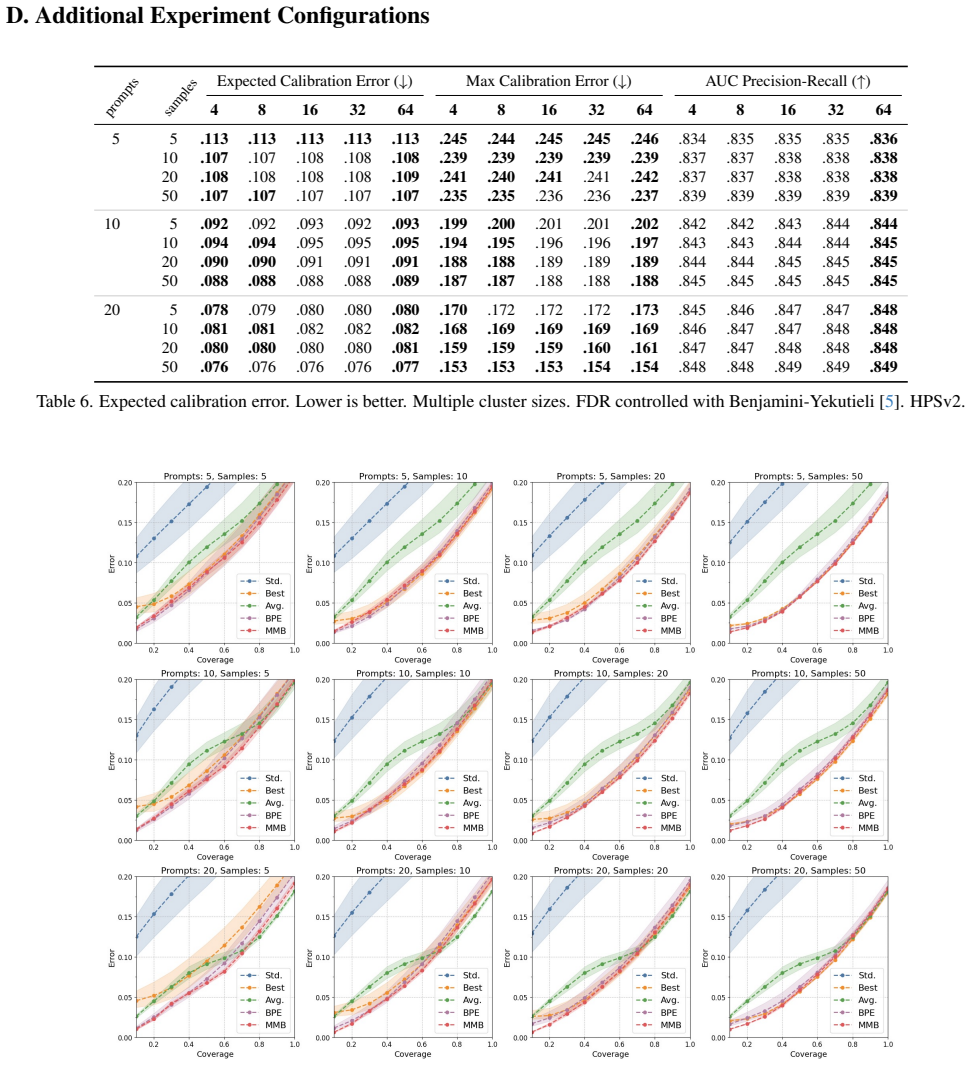
- Selective evaluation becomes practical: a developer can set a confidence threshold and defer low-confidence judgments to human reviewers, and the reported coverage-error curves show MMB keeps error low even as coverage rises.
- The method works on closed-source judges because it only queries the model and never needs weight access or fine-tuning.
- MMB is data-efficient: calibration and accuracy gains hold with as few as five validation samples and five prompts, and performance saturates at moderate cluster counts, so the added machinery is cheap to tune.
- The cluster-level weights are interpretable, revealing which prompt personas are most reliable for which visual styles, a diagnostic that single-prompt selection hides.
- The same scaffold transfers to other multimodal judgment tasks, including VQA, content moderation, and ordinal Likert-style ratings, without modifying the base model.
Reading between the lines
- Beyond the paper: if prompt reliability really does vary coherently along embedding clusters, the learned cluster-to-prompt mapping could be reused as a cheap prompt-selection rule, letting a human read the highest-weighted prompt per cluster and build a specialized rubric without running the ensemble at test time.
- Beyond the paper: the temperature $\tau$ and cluster count $K$ could themselves be learned from validation data; the paper grids over $K$ and treats $\tau$ as a fixed hyperparameter, so an adaptive version would remove the main tuning burden and sharpen comparisons with BPE.
- Beyond the paper: on bias-focused benchmarks like MJBench, visual clustering may not align with the demographic axes along which judge bias varies, so the equal-preference confidence improvement may not transfer to other bias dimensions; a direct test would compare MMB's confidence on images that are visually similar but differ demographically.
Signed reviews
Editorial analysis
A structured set of objections, weighed in public.
Referee Report
Summary. The paper proposes Multimodal Mixture-of-Bayesian Prompt Ensembles (MMB), an extension of Bayesian Prompt Ensembles (BPE) for calibrating multimodal LLM judges on text-to-image preference tasks. MMB clusters CLIP image embeddings with spherical k-means, learns prompt weights per cluster by maximizing an ELBO on a validation set, and at inference time mixes prompt predictions using soft cluster assignments p(z|x). The authors evaluate MMB against single-prompt and ensemble baselines on HPSv2 pairwise human preferences and on a synthetically constructed MJBench no-preference task, reporting consistent improvements in ECE, MCE, F1, and related metrics on HPSv2, with extensive factorial experiments (multiple prompt counts, validation sizes, cluster counts, and random seeds) and permutation tests with FDR control.
Significance. If the reported results hold, MMB is a practically useful, black-box-compatible method for improving calibration and accuracy of closed-source MLLM judges, with a lightweight inference procedure. The HPSv2 experiments are unusually thorough (52.2k configurations, permutation tests with Benjamini-Yekutieli correction, multiple seeds), and the gains over BPE are consistent across prompt and validation-size settings. The ELBO derivation is self-contained and the method does not appear circular: weights are fit on a held-out split and evaluated on test splits. However, the central novelty, namely that image-cluster structure is what drives the improvement, is not directly tested; the paper lacks a random-cluster ablation, and the group-assignment procedure for pairwise inputs is underspecified. The MJBench evidence is synthetic and does not by itself demonstrate calibration to human preferences.
major comments (4)
- [Sec. 4, Eq. (7)] Eq. (7) states that the factorization applies conditional independencies a⊥x|z and y⊥z|a. The second independence is not the one actually used: the derivation retains p(y|x,a), so the required condition is y⊥z|x,a (along with a⊥x|z). As printed, y⊥z|a would not justify the factor p(y|x,a) with x conditioning retained, and it is not implied by the model described in the text. Please correct the stated independence and align the derivation in Sec. C with the correct condition.
- [Sec. 4.2, Eq. (10); Sec. 5] The end-to-end task is pairwise preference judgment with input x=(I1,I2), and Eq. (10) requires p(z|x), but the soft group assignment in Sec. 4 is defined only for a single image embedding ϕ_I(x). The paper never specifies how pairwise inputs are assigned to clusters: whether p(z|x) is an average of the two per-image soft assignments, a product, an assignment based on one image, or something else. This is a reproducibility gap in the central inference formula and must be stated explicitly.
- [Sec. 6, Table 3] The claim that visual clustering is the source of MMB's gains is not isolated. Table 3 varies K while keeping true k-means clusters, and the comparisons in Table 1 are against a global BPE that has N prompt weights rather than K×N. Because MMB has K times as many weights, the improvement could in principle come from the higher-capacity parameterization regularized by the entropy term rather than from meaningful image groups. Please add a random-cluster ablation (e.g., permuted cluster assignments with the same K and the same number of parameters) and, ideally, a test with cluster assignments based on non-visual nuisance features, to show that the visual structure of the clusters is load-bearing.
- [Sec. 5, MJBench; Table 4] The MJBench calibration evidence is synthetic: lower-preference variants are produced by deterministic aesthetic degradations, and the test pairs are constructed so that the unbiased prediction is 50% confidence. Reporting lower average confidence on this artificial no-preference task shows only that MMB is less overconfident on these synthetic pairs; it does not demonstrate calibration to human preferences, since no human labels are involved. Please either evaluate on real human preference data for MJBench or explicitly reframe Table 4 as an overconfidence/ambiguity analysis rather than as calibration evidence.
minor comments (4)
- [Sec. 4.2, Eq. (10)] In Eq. (10), the index i in p(y|x,a_i) is undefined; the sum is over a, so the term should be p(y|x,a).
- [Sec. 3.1, Eq. (5)] The relationship w_a = q(a)/N with the uniform prior p(a)≈C is not fully specified; please clarify the normalization and the role of N in the discrete reparameterization.
- [Sec. 5, experimental setup] The stated total of 52.2k unique experimental configurations does not match the factorial product of the listed factors (3 prompt levels × 4 sample levels × 5 cluster counts × 3 train seeds × 50 data seeds × 5 clustering seeds = 45,000, before accounting for baselines without clusters). Please clarify how the 52.2k figure is obtained.
- [Sec. 5, Table 4] Table 4 marks best and second-best methods but does not report significance tests for the MJBench confidence values; please state whether the differences are statistically significant, or mark the table accordingly.
Circularity Check
No significant circularity: MMB's weights are fit on a held-out validation split and evaluated on held-out test splits; the ELBO derivation is self-contained.
full rationale
MMB's central mechanism is an empirical extension of external BPE: cluster-specific prompt weights w_za are optimized on D_val via the ELBO in Eq. (9) and then applied to test inputs through Eq. (10). The target quantities (test accuracy, ECE, MCE, AUC-PR, NLL, Brier) are measured on held-out test splits (HPSv2 14.4k pairwise comparisons; MJBench held-out folds) that were not used to select w_za. The variational derivation in Sec. C is standard and does not define p(y|x) in terms of fitted weights; p(z|x) uses only unlabeled support-set embeddings and CLIP similarities. The paper's limiting cases (K=1 collapses to BPE; |D_val|=0 reduces to AVG) are explicit boundaries, not hidden reuse of the target result. The absence of a random-cluster ablation is an experimental-control question, not circularity, because the reported gains are not forced by construction or by a self-citation chain. No load-bearing self-citations are present; reference [59] is external prior work.
Assumptions & free parameters
free parameters (2)
- K (number of image clusters) =
4 to 64 swept; around 16 recommended
- tau (temperature in soft group assignment) =
not reported
assumptions (5)
- domain assumption Conditional independence a⊥x|z and y⊥z|a used to factor p(y,a,z|x) in Eq 7.
- domain assumption Prompt reliability varies by image cluster.
- domain assumption CLIP-ViT-B16 cosine similarity to k-means centroids is a valid relevance function for prompt weighting.
- standard math Uniform prior p(a|z) over prompts within each group.
- domain assumption Validation annotations D_val are representative ground truth for prompt weighting.
Cite this review
Pith. "Pith review of Calibrating MLLM-as-a-judge via Multimodal Bayesian Prompt Ensembles." pith.science (2026). https://pith.science/paper/BYMASWWZ
@misc{pith2026250908777,
  author       = {Pith},
  title        = {Pith review of: Calibrating MLLM-as-a-judge via Multimodal Bayesian Prompt Ensembles},
  year         = {2026},
  howpublished = {\url{https://pith.science/paper/BYMASWWZ}},
  note         = {Machine review of arXiv:2509.08777}
}
read the original abstract
Multimodal large language models (MLLMs) are increasingly used to evaluate text-to-image (TTI) generation systems, providing automated judgments based on visual and textual context. However, these "judge" models often suffer from biases, overconfidence, and inconsistent performance across diverse image domains. While prompt ensembling has shown promise for mitigating these issues in unimodal, text-only settings, our experiments reveal that standard ensembling methods fail to generalize effectively for TTI tasks. To address these limitations, we propose a new multimodal-aware method called Multimodal Mixture-of-Bayesian Prompt Ensembles (MMB). Our method uses a Bayesian prompt ensemble approach augmented by image clustering, allowing the judge to dynamically assign prompt weights based on the visual characteristics of each sample. We show that MMB improves accuracy in pairwise preference judgments and greatly enhances calibration, making it easier to gauge the judge's true uncertainty. In evaluations on two TTI benchmarks, HPSv2 and MJBench, MMB outperforms existing baselines in alignment with human annotations and calibration across varied image content. Our findings highlight the importance of multimodal-specific strategies for judge calibration and suggest a promising path forward for reliable large-scale TTI evaluation.
Figures


Figures from the paper (5 more)


Forward citations
Cited by 1 Pith paper
-
Prototypicality Bias Reveals Blindspots in Multimodal Evaluation Metrics
Prototypicality bias: common text-to-image metrics systematically prefer plausible-but-wrong images over correct non-prototypical ones; PROTOSCORE mitigates but does not eliminate the failure.
Reference graph
Works this paper leans on
-
[1]
Spice: Semantic propositional image cap- tion evaluation
Peter Anderson, Basura Fernando, Mark Johnson, and Stephen Gould. Spice: Semantic propositional image cap- tion evaluation. InComputer Vision–ECCV 2016: 14th European Conference, Amsterdam, The Netherlands, Octo- ber 11-14, 2016, Proceedings, Part V 14, pages 382–398. Springer, 2016. 1
work page 2016
-
[2]
Lawrence Zitnick, and Devi Parikh
Stanislaw Antol, Aishwarya Agrawal, Jiasen Lu, Margaret Mitchell, Dhruv Batra, C. Lawrence Zitnick, and Devi Parikh. VQA: Visual Question Answering.ICCV, 2015. 1
work page 2015
-
[3]
Anas Awadalla, Irena Gao, Josh Gardner, Jack Hessel, Yusuf Hanafy, Wanrong Zhu, Kalyani Marathe, Yonatan Bitton, Samir Gadre, Shiori Sagawa, Jenia Jitsev, Simon Kornblith, Pang Wei Koh, Gabriel Ilharco, Mitchell Wortsman, and Ludwig Schmidt. Openflamingo: An open-source frame- work for training large autoregressive vision-language mod- els.arXiv, 2023. 1
work page 2023
-
[4]
Jinze Bai, Shuai Bai, Shusheng Yang, Shijie Wang, Sinan Tan, Peng Wang, Junyang Lin, Chang Zhou, and Jingren Zhou. Qwen-vl: A versatile vision-language model for un- derstanding, localization, text reading, and beyond.arXiv,
-
[5]
The control of the false discovery rate in multiple testing under dependency
Yoav Benjamini and Daniel Yekutieli. The control of the false discovery rate in multiple testing under dependency. Annals of statistics, pages 1165–1188, 2001. 6, 7, 3
work page 2001
-
[6]
Improving image genera- tion with better captions.arXiv, 2023
James Betker, Gabriel Goh, Li Jing, Tim Brooks, Jianfeng Wang, Linjie Li, Long Ouyang, Juntang Zhuang, Joyce Lee, Yufei Guo, Wesam Manassra, Prafulla Dhariwal, Casey Chu, Yunxin Jiao, and Aditya Ramesh. Improving image genera- tion with better captions.arXiv, 2023. 1
work page 2023
-
[7]
Visit-bench: A benchmark for vision- language instruction following inspired by real-world use
Yonatan Bitton, Hritik Bansal, Jack Hessel, Rulin Shao, Wanrong Zhu, Anas Awadalla, Josh Gardner, Rohan Taori, and Ludwig Schmidt. Visit-bench: A benchmark for vision- language instruction following inspired by real-world use. NeurIPS, Datasets and Benchmarks, 2024. 2
work page 2024
-
[8]
Andrew P. Bradley. The use of the area under the ROC curve in the evaluation of machine learning algorithms.Pattern Recognition, 30(7):1145–1159, 1997. 6
work page 1997
Show all 75 references
-
[9]
Glenn W. Brier. Verification of forecasts expressed in terms of probability.Monthly Weather Review, 78(1):1–3, 1950. 6
1950
-
[10]
X-iqe: explainable image quality evaluation for text-to-image generation with visual large language models.arXiv, 2023
Yixiong Chen, Li Liu, and Chris Ding. X-iqe: explainable image quality evaluation for text-to-image generation with visual large language models.arXiv, 2023. 2
2023
-
[11]
Mj-bench: Is your multimodal reward model really a good judge for text-to- image generation?arXiv preprint arXiv:2407.04842, 2024
Zhaorun Chen, Yichao Du, Zichen Wen, Yiyang Zhou, Chenhang Cui, Zhenzhen Weng, Haoqin Tu, Chaoqi Wang, Zhengwei Tong, Qinglan Huang, et al. Mj-bench: Is your multimodal reward model really a good judge for text-to- image generation?arXiv preprint arXiv:2407.04842, 2024. 5
2024 arXiv
-
[12]
Dall-eval: Probing the reasoning skills and social biases of text-to- image generation models.ICCV, 2023
Jaemin Cho, Abhay Zala, and Mohit Bansal. Dall-eval: Probing the reasoning skills and social biases of text-to- image generation models.ICCV, 2023. 1
2023
-
[13]
A coefficient of agreement for nominal scales
Jacob Cohen. A coefficient of agreement for nominal scales. Educational and Psychological Measurement, 20(1):37–46,
-
[14]
Ex- ploring GPT-4 vision for text-to-image synthesis evaluation
Xiao Cui, Qi Sun, Wengang Zhou, and Houqiang Li. Ex- ploring GPT-4 vision for text-to-image synthesis evaluation. ICLR, Tiny Papers, 2024. 2
2024
-
[15]
Instructblip: Towards general- purpose vision-language models with instruction tuning
Wenliang Dai, Junnan Li, Dongxu Li, Anthony Meng Huat Tiong, Junqi Zhao, Weisheng Wang, Boyang Li, Pascale N Fung, and Steven Hoi. Instructblip: Towards general- purpose vision-language models with instruction tuning. NeurIPS, 2024. 1
2024
-
[16]
Improving selective visual question answering by learning from your peers
Corentin Dancette, Spencer Whitehead, Rishabh Mahesh- wary, Ramakrishna Vedantam, Stefan Scherer, Xinlei Chen, Matthieu Cord, and Marcus Rohrbach. Improving selective visual question answering by learning from your peers. In Proceedings of the IEEE/CVF Conference on Computer V...
2023
-
[17]
Moura, Devi Parikh, and Dhruv Batra
Abhishek Das, Satwik Kottur, Khushi Gupta, Avi Singh, Deshraj Yadav, Jos ´e M.F. Moura, Devi Parikh, and Dhruv Batra. Visual Dialog.CVPR, 2017. 1
2017
-
[18]
The relationship be- tween precision-recall and ROC curves
Jesse Davis and Mark Goadrich. The relationship be- tween precision-recall and ROC curves. InProceedings of the 23rd International Conference on Machine Learning (ICML), pages 233–240, 2006. 6
2006
-
[19]
Mllm-bench, evaluating multi- modal llms using gpt-4v.arXiv, 2023
Wentao Ge, Shunian Chen, Guiming Chen, Junying Chen, Zhihong Chen, Shuo Yan, Chenghao Zhu, Ziyue Lin, Wenya Xie, Xidong Wang, et al. Mllm-bench, evaluating multi- modal llms using gpt-4v.arXiv, 2023. 2
2023
-
[20]
Selective classification for deep neural networks.NeurIPS, 30, 2017
Yonatan Geifman and Ran El-Yaniv. Selective classification for deep neural networks.NeurIPS, 30, 2017. 2
2017
-
[21]
Practical variational inference for neural net- works.Advances in neural information processing systems, 24, 2011
Alex Graves. Practical variational inference for neural net- works.Advances in neural information processing systems, 24, 2011. 3
2011
-
[22]
A survey on llm-as-a-judge.arXiv preprint arXiv:2411.15594, 2024
Jiawei Gu, Xuhui Jiang, Zhichao Shi, Hexiang Tan, Xue- hao Zhai, Chengjin Xu, Wei Li, Yinghan Shen, Shengjie Ma, Honghao Liu, et al. A survey on llm-as-a-judge.arXiv preprint arXiv:2411.15594, 2024. 2
2024 arXiv
-
[23]
Weinberger
Chuan Guo, Geoff Pleiss, Yu Sun, and Kilian Q. Weinberger. On calibration of modern neural networks. InProceedings of the 34th International Conference on Machine Learning (ICML), pages 1321–1330, 2017. 2, 6
2017
-
[24]
Springer, New York, NY , USA, 2001
Trevor Hastie, Robert Tibshirani, and Jerome Friedman.The Elements of Statistical Learning. Springer, New York, NY , USA, 2001. 6
2001
-
[25]
Glass, and Yulia Tsvetkov
Tianxing He, Jingyu Zhang, Tianle Wang, Sachin Kumar, Kyunghyun Cho, James R. Glass, and Yulia Tsvetkov. On the blind spots of model-based evaluation metrics for text generation.ACL, 2023. 2
2023
-
[26]
Machine learning with a re- ject option: A survey.Machine Learning, pages 1–38, 2024
Kilian Hendrickx, Lorenzo Perini, Dries Van der Plas, Wannes Meert, and Jesse Davis. Machine learning with a re- ject option: A survey.Machine Learning, pages 1–38, 2024. 2
2024
-
[27]
Gans trained by a two time-scale update rule converge to a local nash equilib- rium.Advances in neural information processing systems, 30, 2017
Martin Heusel, Hubert Ramsauer, Thomas Unterthiner, Bernhard Nessler, and Sepp Hochreiter. Gans trained by a two time-scale update rule converge to a local nash equilib- rium.Advances in neural information processing systems, 30, 2017. 1
2017
-
[28]
Promptboosting: Black-box text classification with ten forward passes
Bairu Hou, Joe O’connor, Jacob Andreas, Shiyu Chang, and Yang Zhang. Promptboosting: Black-box text classification with ten forward passes. InInternational Conference on Ma- chine Learning, pages 13309–13324. PMLR, 2023. 2, 3 9
2023
-
[29]
Are llm-based evaluators con- fusing nlg quality criteria?arXiv, 2024
Xinyu Hu, Mingqi Gao, Sen Hu, Yang Zhang, Yicheng Chen, Teng Xu, and Xiaojun Wan. Are llm-based evaluators con- fusing nlg quality criteria?arXiv, 2024. 2
2024
-
[30]
Gpt-4o system card
Aaron Hurst, Adam Lerer, Adam P Goucher, Adam Perel- man, Aditya Ramesh, Aidan Clark, AJ Ostrow, Akila Weli- hinda, Alan Hayes, Alec Radford, et al. Gpt-4o system card. arXiv preprint arXiv:2410.21276, 2024. 5
2024 arXiv
-
[31]
Calibrating language models via augmented prompt ensembles.ICML Workshop on Deployable Generative AI, 2023
Mingjian Jiang, Yangjun Ruan, Sicong Huang, Saifei Liao, Silviu Pitis, Roger Baker Grosse, and Jimmy Ba. Calibrating language models via augmented prompt ensembles.ICML Workshop on Deployable Generative AI, 2023. 2, 3
2023
-
[32]
How can we know what language models know?Trans- actions of the Association for Computational Linguistics, 8: 423–438, 2020
Zhengbao Jiang, Frank F Xu, Jun Araki, and Graham Neu- big. How can we know what language models know?Trans- actions of the Association for Computational Linguistics, 8: 423–438, 2020. 3
2020
-
[33]
Billion- scale similarity search with GPUs.IEEE Transactions on Big Data, 2019
Jeff Johnson, Matthijs Douze, and Herv ´e J ´egou. Billion- scale similarity search with GPUs.IEEE Transactions on Big Data, 2019. 5
2019
-
[34]
Pick-a-pic: An open dataset of user preferences for text-to-image generation
Yuval Kirstain, Adam Polyak, Uriel Singer, Shahbuland Ma- tiana, Joe Penna, and Omer Levy. Pick-a-pic: An open dataset of user preferences for text-to-image generation. arXiv preprint arXiv:2305.01569, 2023. 1
2023 arXiv
-
[35]
Benchmarking cog- nitive biases in large language models as evaluators.arXiv,
Ryan Koo, Minhwa Lee, Vipul Raheja, Jong Inn Park, Zae Myung Kim, and Dongyeop Kang. Benchmarking cog- nitive biases in large language models as evaluators.arXiv,
-
[36]
Improved precision and recall met- ric for assessing generative models.Advances in neural in- formation processing systems, 32, 2019
Tuomas Kynk ¨a¨anniemi, Tero Karras, Samuli Laine, Jaakko Lehtinen, and Timo Aila. Improved precision and recall met- ric for assessing generative models.Advances in neural in- formation processing systems, 32, 2019. 1
2019
-
[37]
Seed-bench: Bench- marking multimodal large language models.CVPR, 2024
Bohao Li, Yuying Ge, Yixiao Ge, Guangzhi Wang, Rui Wang, Ruimao Zhang, and Ying Shan. Seed-bench: Bench- marking multimodal large language models.CVPR, 2024. 1
2024
-
[38]
From generation to judgment: Op- portunities and challenges of llm-as-a-judge.arXiv preprint arXiv: 2411.16594, 2024
Dawei Li, Bohan Jiang, Liangjie Huang, Alimohammad Beigi, Chengshuai Zhao, Zhen Tan, Amrita Bhattacharjee, Yuxuan Jiang, Canyu Chen, Tianhao Wu, Kai Shu, Lu Cheng, and Huan Liu. From generation to judgment: Op- portunities and challenges of llm-as-a-judge.arXiv preprint arXiv:...
2024
-
[39]
Llms-as-judges: a com- prehensive survey on llm-based evaluation methods.arXiv preprint arXiv:2412.05579, 2024
Haitao Li, Qian Dong, Junjie Chen, Huixue Su, Yujia Zhou, Qingyao Ai, Ziyi Ye, and Yiqun Liu. Llms-as-judges: a com- prehensive survey on llm-based evaluation methods.arXiv preprint arXiv:2412.05579, 2024. 2
2024 arXiv
-
[40]
ROUGE: A package for automatic evaluation of summaries.Text Summarization Branches Out, 2004
Chin-Yew Lin. ROUGE: A package for automatic evaluation of summaries.Text Summarization Branches Out, 2004. 1
2004
-
[41]
Microsoft coco: Common objects in context.ECCV,
Tsung-Yi Lin, Michael Maire, Serge Belongie, James Hays, Pietro Perona, Deva Ramanan, Piotr Doll´ar, and C Lawrence Zitnick. Microsoft coco: Common objects in context.ECCV,
-
[42]
Mitigating hallucination in large multi-modal models via robust instruction tuning.ICLR,
Fuxiao Liu, Kevin Lin, Linjie Li, Jianfeng Wang, Yaser Ya- coob, and Lijuan Wang. Mitigating hallucination in large multi-modal models via robust instruction tuning.ICLR,
-
[43]
Visual instruction tuning.NeurIPS, 2023
Haotian Liu, Chunyuan Li, Qingyang Wu, and Yong Jae Lee. Visual instruction tuning.NeurIPS, 2023. 1, 2
2023
-
[44]
Llms as narcissistic evaluators: When ego inflates evaluation scores
Yiqi Liu, Nafise Sadat Moosavi, and Chenghua Lin. Llms as narcissistic evaluators: When ego inflates evaluation scores. arXiv, 2023. 2
2023
-
[45]
Predict re- sponsibly: improving fairness and accuracy by learning to defer.NeurIPS, 31, 2018
David Madras, Toni Pitassi, and Richard Zemel. Predict re- sponsibly: improving fairness and accuracy by learning to defer.NeurIPS, 31, 2018. 2
2018
-
[46]
Gpt-4v(ision) technical work and authors.https: //openai.com/contributions/gpt-4v/, 2023
OpenAI. Gpt-4v(ision) technical work and authors.https: //openai.com/contributions/gpt-4v/, 2023. 1
2023
-
[47]
Openai o1 system card.https://openai
OpenAI. Openai o1 system card.https://openai. com/index/openai-o1-system-card/, 2024. 1
2024
-
[48]
Bowman, and Shi Feng
Arjun Panickssery, Samuel R. Bowman, and Shi Feng. Llm evaluators recognize and favor their own generations.arXiv,
-
[49]
Bleu: a method for automatic evaluation of machine translation.ACL, 2002
Kishore Papineni, Salim Roukos, Todd Ward, and Wei-Jing Zhu. Bleu: a method for automatic evaluation of machine translation.ACL, 2002. 1
2002
-
[50]
Kosmos-2: Grounding multimodal large language models to the world.arXiv, 2023
Zhiliang Peng, Wenhui Wang, Li Dong, Yaru Hao, Shaohan Huang, Shuming Ma, and Furu Wei. Kosmos-2: Grounding multimodal large language models to the world.arXiv, 2023. 1
2023
-
[51]
Sdxl: improving latent diffusion models for high-resolution image synthesis
Dustin Podell, Zion English, Kyle Lacey, Andreas Blattmann, Tim Dockhorn, Jonas M ¨uller, Joe Penna, and Robin Rombach. Sdxl: improving latent diffusion models for high-resolution image synthesis. InInternational Con- ference on Learning Representations, pages 1–13, 2024. 1
2024
-
[52]
Ramesh, Gabriel Goh, Sandhini Agarwal, Girish Sastry, Amanda Askell, Pamela Mishkin, Jack Clark, Gretchen Krueger, and Ilya Sutskever
Alec Radford, Jong Wook Kim, Chris Hallacy, A. Ramesh, Gabriel Goh, Sandhini Agarwal, Girish Sastry, Amanda Askell, Pamela Mishkin, Jack Clark, Gretchen Krueger, and Ilya Sutskever. Learning transferable visual models from nat- ural language supervision.ICML, 2021. 5, 1
2021
-
[53]
Learning transferable visual models from natural language supervi- sion
Alec Radford, Jong Wook Kim, Chris Hallacy, Aditya Ramesh, Gabriel Goh, Sandhini Agarwal, Girish Sastry, Amanda Askell, Pamela Mishkin, Jack Clark, et al. Learning transferable visual models from natural language supervi- sion. InInternational conference on machine learning, p...
2021
-
[54]
High-resolution image synthesis with latent diffusion models
Robin Rombach, Andreas Blattmann, Dominik Lorenz, Patrick Esser, and Bj ¨orn Ommer. High-resolution image synthesis with latent diffusion models. InProceedings of the IEEE/CVF conference on computer vision and pattern recognition, pages 10684–10695, 2022. 1
2022
-
[55]
Photorealistic text-to-image diffusion models with deep language understanding.Advances in neural information processing systems, 35:36479–36494, 2022
Chitwan Saharia, William Chan, Saurabh Saxena, Lala Li, Jay Whang, Emily L Denton, Kamyar Ghasemipour, Raphael Gontijo Lopes, Burcu Karagol Ayan, Tim Salimans, et al. Photorealistic text-to-image diffusion models with deep language understanding.Advances in neural information ...
2022
-
[56]
Verbosity bias in preference labeling by large language models.arXiv preprint arXiv:2310.10076, 2023
Keita Saito, Akifumi Wachi, Koki Wataoka, and Youhei Aki- moto. Verbosity bias in preference labeling by large language models.arXiv preprint arXiv:2310.10076, 2023. 2
2023 arXiv
-
[57]
Improved techniques for training gans.Advances in neural information processing systems, 29, 2016
Tim Salimans, Ian Goodfellow, Wojciech Zaremba, Vicki Cheung, Alec Radford, and Xi Chen. Improved techniques for training gans.Advances in neural information processing systems, 29, 2016. 1
2016
-
[58]
Gemini: a 10 family of highly capable multimodal models.arXiv preprint arXiv:2312.11805, 2023
Gemini Team, Rohan Anil, Sebastian Borgeaud, Jean- Baptiste Alayrac, Jiahui Yu, Radu Soricut, Johan Schalkwyk, Andrew M Dai, Anja Hauth, Katie Millican, et al. Gemini: a 10 family of highly capable multimodal models.arXiv preprint arXiv:2312.11805, 2023. 1
2023 arXiv
-
[59]
Bayesian prompt ensembles: Model uncer- tainty estimation for black-box large language models
Francesco Tonolini, Nikolaos Aletras, Jordan Massiah, and Gabriella Kazai. Bayesian prompt ensembles: Model uncer- tainty estimation for black-box large language models. In Findings of the Association for Computational Linguistics ACL 2024, pages 12229–12272, 2024. 1, 2, 3, 6
2024
-
[60]
Large language models are not fair evaluators.arXiv, 2023
Peiyi Wang, Lei Li, Liang Chen, Dawei Zhu, Binghuai Lin, Yunbo Cao, Qi Liu, Tianyu Liu, and Zhifang Sui. Large language models are not fair evaluators.arXiv, 2023. 2
2023
-
[61]
A prompt pattern catalog to enhance prompt engineering with chatgpt.arXiv preprint arXiv:2302.11382, 2023
Jules White, Quchen Fu, Sam Hays, Michael Sandborn, Car- los Olea, Henry Gilbert, Ashraf Elnashar, Jesse Spencer- Smith, and Douglas C Schmidt. A prompt pattern catalog to enhance prompt engineering with chatgpt.arXiv preprint arXiv:2302.11382, 2023. 3
2023 arXiv
-
[62]
Reliable visual question answering: Abstain rather than answer incorrectly
Spencer Whitehead, Suzanne Petryk, Vedaad Shakib, Joseph Gonzalez, Trevor Darrell, Anna Rohrbach, and Marcus Rohrbach. Reliable visual question answering: Abstain rather than answer incorrectly. InEuropean Conference on Computer Vision, pages 148–166. Springer, 2022. 2
2022
-
[63]
Strength in numbers: Estimating confidence of large language models by prompt agreement
Gwenyth Portillo Wightman, Alexandra Delucia, and Mark Dredze. Strength in numbers: Estimating confidence of large language models by prompt agreement. InProceedings of the 3rd Workshop on Trustworthy Natural Language Pro- cessing (TrustNLP 2023), pages 326–362, 2023. 2, 3
2023
-
[64]
Gpt- 4v(ision) is a human-aligned evaluator for text-to-3d genera- tion.CVPR, 2024
Tong Wu, Guandao Yang, Zhibing Li, Kai Zhang, Ziwei Liu, Leonidas Guibas, Dahua Lin, and Gordon Wetzstein. Gpt- 4v(ision) is a human-aligned evaluator for text-to-3d genera- tion.CVPR, 2024. 2
2024
-
[65]
Human preference score v2: A solid benchmark for evaluating human preferences of text-to-image synthesis.arXiv preprint arXiv:2306.09341,
Xiaoshi Wu, Yiming Hao, Keqiang Sun, Yixiong Chen, Feng Zhu, Rui Zhao, and Hongsheng Li. Human preference score v2: A solid benchmark for evaluating human preferences of text-to-image synthesis.arXiv preprint arXiv:2306.09341,
-
[66]
Llava- critic: Learning to evaluate multimodal models.arXiv preprint arXiv:2410.02712, 2024
Tianyi Xiong, Xiyao Wang, Dong Guo, Qinghao Ye, Haoqi Fan, Quanquan Gu, Heng Huang, and Chunyuan Li. Llava- critic: Learning to evaluate multimodal models.arXiv preprint arXiv:2410.02712, 2024. 2
2024 arXiv
-
[67]
Vigor: Improving visual ground- ing of large vision language models with fine-grained reward modeling.arXiv, 2024
Siming Yan, Min Bai, Weifeng Chen, Xiong Zhou, Qixing Huang, and Li Erran Li. Vigor: Improving visual ground- ing of large vision language models with fine-grained reward modeling.arXiv, 2024. 2
2024
-
[68]
Jus- tice or prejudice? quantifying biases in llm-as-a-judge.arXiv preprint arXiv:2410.02736, 2024
Jiayi Ye, Yanbo Wang, Yue Huang, Dongping Chen, Qihui Zhang, Nuno Moniz, Tian Gao, Werner Geyer, Chao Huang, Pin-Yu Chen, Nitesh V Chawla, and Xiangliang Zhang. Jus- tice or prejudice? quantifying biases in llm-as-a-judge.arXiv preprint arXiv:2410.02736, 2024. 2
-
[69]
Lamm: Language-assisted multi- modal instruction-tuning dataset, framework, and bench- mark.NeurIPS, Datasets and Benchmarks, 2023
Zhenfei Yin, Jiong Wang, Jianjian Cao, Zhelun Shi, Dingn- ing Liu, Mukai Li, Lu Sheng, Lei Bai, Xiaoshui Huang, Zhiyong Wang, et al. Lamm: Language-assisted multi- modal instruction-tuning dataset, framework, and bench- mark.NeurIPS, Datasets and Benchmarks, 2023. 2
2023
-
[70]
From image descriptions to visual denotations: New similarity metrics for semantic inference over event descrip- tions.TACL, 2014
Peter Young, Alice Lai, Micah Hodosh, and Julia Hocken- maier. From image descriptions to visual denotations: New similarity metrics for semantic inference over event descrip- tions.TACL, 2014. 1
2014
-
[71]
Llama-adapter: Efficient fine-tuning of language models with zero-init attention.ICLR, 2024
Renrui Zhang, Jiaming Han, Chris Liu, Peng Gao, Aojun Zhou, Xiangfei Hu, Shilin Yan, Pan Lu, Hongsheng Li, and Yu Qiao. Llama-adapter: Efficient fine-tuning of language models with zero-init attention.ICLR, 2024. 1
2024
-
[72]
Gpt-4v (ision) as a generalist eval- uator for vision-language tasks.arXiv, 2023
Xinlu Zhang, Yujie Lu, Weizhi Wang, An Yan, Jun Yan, Lianke Qin, Heng Wang, Xifeng Yan, William Yang Wang, and Linda Ruth Petzold. Gpt-4v (ision) as a generalist eval- uator for vision-language tasks.arXiv, 2023. 2
2023
-
[73]
Xing, Haotong Zhang, Joseph Gon- zalez, and Ion Stoica
Lianmin Zheng, Wei-Lin Chiang, Ying Sheng, Siyuan Zhuang, Zhanghao Wu, Yonghao Zhuang, Zi Lin, Zhuohan Li, Dacheng Li, Eric P. Xing, Haotong Zhang, Joseph Gon- zalez, and Ion Stoica. Judging llm-as-a-judge with mt-bench and chatbot arena.NeurIPS, 2023. 1
2023
-
[74]
Minigpt-4: Enhancing vision-language understanding with advanced large language models.ICLR,
Deyao Zhu, Jun Chen, Xiaoqian Shen, Xiang Li, and Mo- hamed Elhoseiny. Minigpt-4: Enhancing vision-language understanding with advanced large language models.ICLR,
-
[2024]
aug- mented
1 11 Calibrating MLLM-as-a-judge via Multimodal Bayesian Prompt Ensembles Supplementary Material A. Additional Experimental Details Factor Levels/Value Notes Exps. prompts 5, 10, 20 Num. prompts ina samples 5, 10, 20, 50 Num. samples inD val clusters 4, 8, 16, 32, 64 Num. clus...
Reviewed August 15, 2026 · model on record in the stance chip above.
Discussion (0). Continue with ORCID to comment.