REVIEW 4 major objections 7 minor 1 cited by
Calib3R claims the first joint patternless camera-to-robot calibration and metric-scaled 3D reconstruction in a single optimization, using only RGB images and robot poses.
Reviewed by Pith at T0; open to challenge. T0 means a machine referee read the full paper against a public rubric. the ladder, T0–T4 →
2026-08-04 20:05 UTC pith:3YTI4BKF
load-bearing objection A genuine joint calibration-and-reconstruction method with a coherent loss, but the abstract oversells it and the single-scale assumption needs testing. the 4 major comments →
Calib3R: A 3D Foundation Model for Multi-Camera to Robot Calibration and 3D Metric-Scaled Scene Reconstruction
The pith
A machine-rendered reading of the paper's core claim, the machinery that carries it, and where it could break.
Core claim
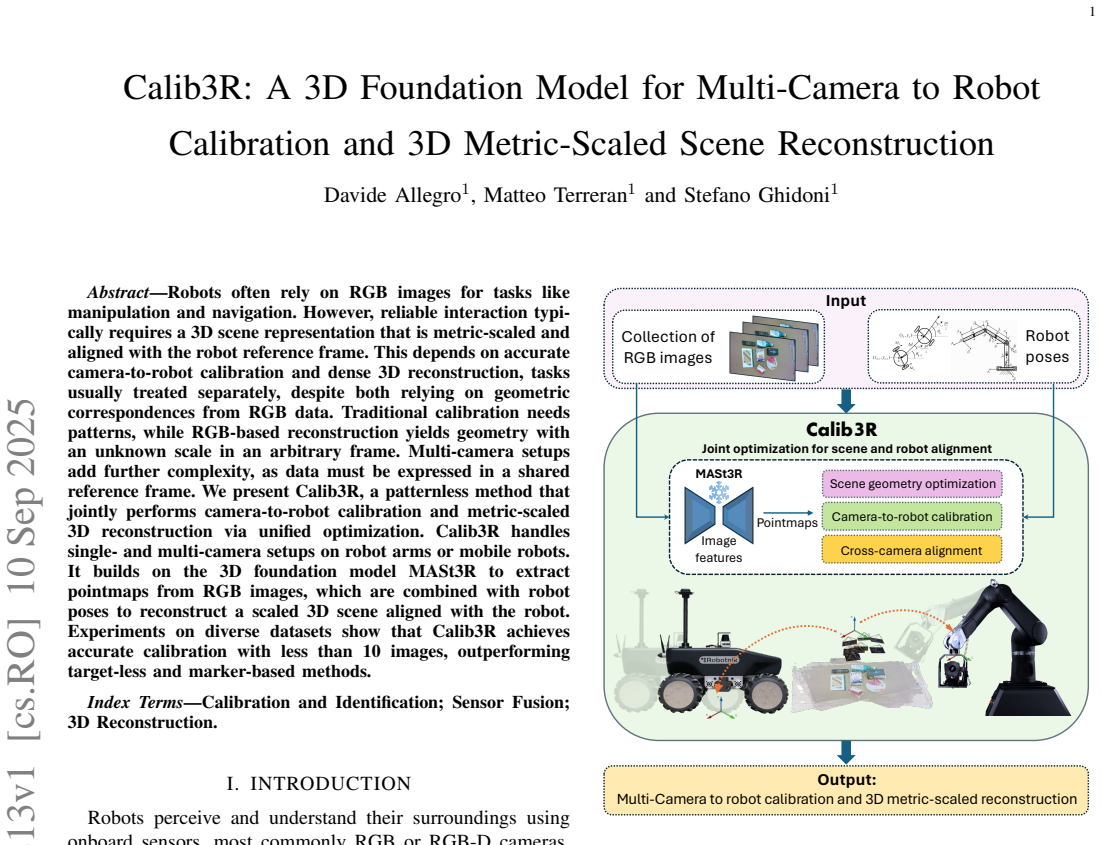
Calib3R jointly solves camera-to-robot calibration and metric-scaled dense 3D reconstruction in a single optimization, using only RGB images and the corresponding robot poses. It replaces calibration patterns with dense pointmaps produced by the 3D foundation model MASt3R, adds an unknown per-camera scale factor to bridge reconstruction scale ambiguity, and ties camera motion to robot motion via the hand-eye constraint AX = XB. The output is a 3D scene expressed in the robot's initial frame with metric units, plus the camera-to-robot transform. Experiments report translation errors below 0.5 cm on manipulator scenes and relative scale errors near 3.7 percent.
What carries the argument
The central mechanism is the unified loss L_Calib3R = sum_j (L3D,j + L2D,j + Lcal,j) + sum Lcross, combining MASt3R pointmap alignment losses (3D matching and 2D reprojection), a hand-eye calibration loss with a per-camera scale factor lambda_j, and a cross-camera rigidity loss. The lambda_j factor in the camera motion B_{j,i}(lambda_j) converts scale-ambiguous pointmap motion into metric-scaled motion, and the cross-camera loss enforces fixed inter-camera geometry across the trajectory.
Load-bearing premise
The single per-camera scale factor lambda_j assumes each MASt3R pointmap is metrically consistent up to one global scale; if the reconstruction has non-uniform scale errors or drift along the trajectory, no single lambda can absorb them.
What would settle it
Take a long, texture-rich trajectory and split it into segments of equal length. Run Calib3R on each prefix and check whether the recovered checkerboard corner spacing stays within the reported 3.7 percent relative scale error. If scale error grows with trajectory length or varies when the same scene is reconstructed from different subsets, the single-per-camera-scale assumption is violated.
If this is right
- Calibration no longer requires checkerboards or dedicated infrastructure; generic scenes and fewer than 10 RGB images per camera suffice.
- Multi-camera rigs can be calibrated to the robot frame even when cameras share no visual overlap, using per-camera scale factors and a cross-camera rigidity loss.
- The metric-scaled reconstruction aligned with the robot frame can be used directly for manipulation planning or navigation, without a separate depth sensor.
- Joint optimization is more accurate than decoupled reconstruction-then-calibrate pipelines because scene geometry and calibration refine each other.
- The approach generalizes across single/multi cameras and manipulator/mobile setups within one formulation.
Where Pith is reading between the lines
- A natural stress test is longer trajectories: if MASt3R pointmaps accumulate non-uniform scale drift, a single global scale per camera may not suffice; detecting per-segment scale changes could extend Calib3R to large environments.
- The same unified loss could be adapted to other 3D foundation models, suggesting a general recipe for patternless calibration.
- The VLM-based ground-plane estimation for the z-component on mobile robots could be replaced by geometric plane fitting where the scene is known, trading robustness against prompt dependence.
- If calibration can be solved online on a stream of images, continuous recalibration during operation becomes possible, addressing drift in long-running robots.
Editorial analysis
A structured set of objections, weighed in public.
Referee Report
Summary. The paper proposes Calib3R, a patternless joint camera-to-robot calibration and metric-scaled dense reconstruction method. It uses MASt3R to produce pairwise pointmaps from RGB images, then optimizes a unified loss (Eq. 11) that combines scene-geometry terms (L3D, L2D), hand-eye calibration terms with per-camera scale factors λ_j (Eqs. 7-8), and optional cross-camera rigidity constraints (Eq. 10). The method is evaluated on manipulator and mobile platforms using Franka Pattern, Franka Object, GraspNet-1Billion, MEMROC, OpenLORIS, and CSE benchmark datasets. The paper claims calibration accuracy with fewer than 10 images, superiority over targetless and marker-based baselines, and metric-scaled reconstructions aligned with the robot frame.
Significance. If the claims hold, Calib3R would be a practically useful step toward fast, patternless multi-camera calibration and metric reconstruction. The formulation is coherent, uses an open foundation model, and the experimental suite spans arms and mobile robots, including real and synthetic data. However, the evidence currently does not fully support the strongest claims: the marker-based comparison is contradicted by the authors' own tables, and the metric-scale claim rests on an unvalidated assumption that each camera's MASt3R pointmaps are metrically consistent up to a single global scale. The mobile-robot variant also relies on an external VLM-based ground-plane stage for the z component, outside the unified optimization.
major comments (4)
- [Eq. (8) and Sec. IV] The per-camera scale model B_{j,i}(λ_j)=[R, λ_j t] can absorb exactly one global scale per camera. This is sufficient only if each camera's MASt3R-SfM reconstruction is metrically consistent up to a single similarity. However, MASt3R-SfM optimizes a per-pointmap scale σ_n (Eq. 2), and L3D/L2D do not force those scales to be equal along a trajectory. Pose-dependent scale drift (changing baselines, mixed close/distant content, or repeated non-overlapping motions) would make the hand-eye residuals in Eq. (7) biased and the metric scale wrong. The paper provides no diagnostic: Table II covers one checkerboard scene, and there is no analysis of residual structure in Eq. (7) or comparison with per-pose scale factors. Please add such an analysis or restrict the metric-scale claim.
- [Sec. VII, Eq. (14)] For mobile robots, the z component is estimated after the main optimization by a Grounding DINO + SAM 2 floor segmentation pipeline, and averaged via Eq. (14). This is not part of L_Calib3R (Eq. (11)), so the statement that Calib3R performs calibration within a single comprehensive optimization process does not hold for the mobile-robot case. Either integrate the z estimation into the optimization or present the method as a hybrid pipeline and temper the 6DoF claim.
- [Abstract; Tables I and III] The abstract's claim that Calib3R outperforms marker-based methods is contradicted by the reported numbers. In Table I, Evangelista [31] achieves 0.781 cm translation on Franka Pattern vs. 1.127 cm for Calib3R. In Table III, Joint-MEMROC achieves 3.325 cm on real MEMROC vs. 3.725 cm for Calib3R. The text in Secs. VI and VII acknowledges these cases, but the abstract and contributions should be reworded to 'comparable to or better than' or should specify the actual subsets.
- [Sec. VI, Fig. 7; Sec. VII, Fig. 13] The data-efficiency experiments remove two random images at each step and report a single trajectory. With only one random draw, the 'less than 10 images' claim has no error bars or multiple-seed statistics. Please report means and variances over several random subsets, and state whether the reported curves are typical.
minor comments (7)
- [Eqs. (5), (7)] The sums run from i=0 to N-1, but A_i and B_i are defined using poses i and i+1, so the last term requires a pose N that does not exist. The sums should run to N-2.
- [Table I] The Calib3R row contains duplicated digits (e.g., '0.0140.0140.014'), likely a typesetting/OCR artifact. Please correct the formatting.
- [Table III] The SensorX2Car row shows negative values and no translation entries. Please clarify the sign convention and identify which columns are actually filled.
- [Table III caption] Typo: 'CSE benchamrk' should be 'CSE benchmark'.
- [Sec. V.C] The MEMROC checkerboard is described as 7×6; please verify this against the dataset description and figures, since initial text refers to different checkerboard sizes for the other datasets.
- [Sec. V.A and Table II] The metric-scale evaluation reprojects checkerboard corners into 'the reconstructed pointcloud.' Please specify whether this is the raw pointmap or the constrained pointmap χ_n, since this choice can affect the reported scale error.
- [General] No code release or reproducibility statement is mentioned. Adding one would strengthen the paper.
Circularity Check
No significant circularity: the metric scale is grounded in external robot poses, and the joint optimization is a fitting procedure rather than a self-referential prediction.
full rationale
The paper's derivation chain is self-contained in the relevant sense. Calib3R takes as input RGB images plus robot poses (kinematics/odometry). MASt3R provides dense local pointmaps; the scene-geometry losses L3D and L2D align them; the calibration loss in Eq. (7), with per-camera scale λ_j in Eq. (8), fits the camera-to-robot transform X and the scale λ_j against the externally supplied robot motions A_i. Thus the metric scale of the reconstruction is not derived from the reconstruction itself: it is constrained by robot poses that are independent of the RGB-based pointmap prediction. The checkerboard-based scale evaluation (Table II) is an external check on that fitted scale, not a restatement of the fitting target. The z-unobservability limitation for mobile robots is explicitly acknowledged in Sec. VII ('we estimate this z-translation component post-calibration using the camera's height from the ground'), and the VLM ground-plane pipeline uses external models (Grounding DINO, SAM 2) plus back-projection; this is a supplemental measurement and a robustness limitation, not a circular step. The authors do cite their own prior work (MEMROC, multi-camera hand-eye papers), but those citations are used as baselines/datasets and related work, not as load-bearing justification for the core derivation. The central risk identified by the skeptic—that a single per-camera scale λ_j may not absorb per-view scale drift in MASt3R pointmaps—is an assumption about the error model and a correctness/robustness concern, not a circularity: the method could fail without being self-referential. No prediction or claimed result reduces by construction to its own inputs.
Axiom & Free-Parameter Ledger
free parameters (2)
- λ_j (per-camera scale factor) =
not reported, estimated in optimization
- camera height z (mobile robots) =
estimated from VLM ground plane, Eq. (14)
axioms (5)
- domain assumption MASt3R provides accurate, dense 3D pointmaps and pixel correspondences for input image pairs.
- domain assumption Robot poses from kinematics or odometry are metrically accurate and free of drift.
- domain assumption The 3D scene is static during image collection.
- domain assumption A single scalar λ_j per camera suffices to make the MASt3R reconstruction metrically consistent.
- domain assumption For planar mobile robots, the z-component is unobservable from motion and can be recovered from a detected ground plane.
Cite this review
Pith. "Pith review of Calib3R: A 3D Foundation Model for Multi-Camera to Robot Calibration and 3D Metric-Scaled Scene Reconstruction." pith.science (2026). https://pith.science/paper/3YTI4BKF
@misc{pith2026250908813,
  author       = {Pith},
  title        = {Pith review of: Calib3R: A 3D Foundation Model for Multi-Camera to Robot Calibration and 3D Metric-Scaled Scene Reconstruction},
  year         = {2026},
  howpublished = {\url{https://pith.science/paper/3YTI4BKF}},
  note         = {Machine review of arXiv:2509.08813}
}
read the original abstract
Robots often rely on RGB images for tasks like manipulation and navigation. However, reliable interaction typically requires a 3D scene representation that is metric-scaled and aligned with the robot reference frame. This depends on accurate camera-to-robot calibration and dense 3D reconstruction, tasks usually treated separately, despite both relying on geometric correspondences from RGB data. Traditional calibration needs patterns, while RGB-based reconstruction yields geometry with an unknown scale in an arbitrary frame. Multi-camera setups add further complexity, as data must be expressed in a shared reference frame. We present Calib3R, a patternless method that jointly performs camera-to-robot calibration and metric-scaled 3D reconstruction via unified optimization. Calib3R handles single- and multi-camera setups on robot arms or mobile robots. It builds on the 3D foundation model MASt3R to extract pointmaps from RGB images, which are combined with robot poses to reconstruct a scaled 3D scene aligned with the robot. Experiments on diverse datasets show that Calib3R achieves accurate calibration with less than 10 images, outperforming target-less and marker-based methods.
Figures


Forward citations
Cited by 1 Pith paper
-
Multi-Camera Self-Calibration in Sports Motion Capture: Leveraging Human and Stick Poses
A three-stage optimization pipeline for multi-camera extrinsic self-calibration that refines camera poses, reconstructs human and stick trajectories, and resolves global scale using the known stick length constraint.
Reference graph
Works this paper leans on
-
[1]
Fusion-perception- to-action transformer: Enhancing robotic manipulation with 3-d visual fusion attention and proprioception,
Y . Liu, S. Liu, B. Chen, Z.-X. Yang, and S. Xu, “Fusion-perception- to-action transformer: Enhancing robotic manipulation with 3-d visual fusion attention and proprioception,”IEEE Transactions on Robotics, vol. 41, pp. 1553–1567, 2025
2025
-
[2]
Latent space planning for multiobject manipulation with environment-aware relational classifiers,
Y . Huang, N. C. Taylor, A. Conkey, W. Liu, and T. Hermans, “Latent space planning for multiobject manipulation with environment-aware relational classifiers,”IEEE Transactions on Robotics, vol. 40, pp. 1724– 1739, 2024
2024
-
[3]
L. Barcellona, A. Zadaianchuk, D. Allegro, S. Papa, S. Ghidoni, and E. Gavves, “Dream to manipulate: Compositional world models empowering robot imitation learning with imagination,”arXiv preprint arXiv:2412.14957, 2024
Pith/arXiv arXiv 2024
-
[4]
Dynamic slam: The need for speed,
M. Henein, J. Zhang, R. Mahony, and V . Ila, “Dynamic slam: The need for speed,” in2020 IEEE International Conference on Robotics and Automation (ICRA). IEEE, 2020, pp. 2123–2129
2020
-
[5]
Multisensor-based navigation and control of a mobile service robot,
W. Yuan, Z. Li, and C.-Y . Su, “Multisensor-based navigation and control of a mobile service robot,”IEEE Transactions on Systems, Man, and Cybernetics: Systems, vol. 51, no. 4, pp. 2624–2634, 2019
2019
-
[6]
Deep depth completion of a single rgb-d image,
Y . Zhang and T. Funkhouser, “Deep depth completion of a single rgb-d image,” inProceedings of the IEEE conference on computer vision and pattern recognition, 2018, pp. 175–185
2018
-
[7]
An overview of depth cameras and range scanners based on time-of-flight technologies,
R. Horaud, M. Hansard, G. Evangelidis, and C. M ´enier, “An overview of depth cameras and range scanners based on time-of-flight technologies,” Machine vision and applications, vol. 27, no. 7, pp. 1005–1020, 2016
2016
-
[8]
3d depth cameras in vision: Benefits and limitations of the hardware: With an emphasis on the first- and second-generation kinect models,
A. Kadambi, A. Bhandari, and R. Raskar, “3d depth cameras in vision: Benefits and limitations of the hardware: With an emphasis on the first- and second-generation kinect models,” inComputer vision and machine learning with RGB-D sensors. Springer, 2014, pp. 3–26
2014
-
[9]
Challenges for monocular 6d object pose estimation in robotics,
D. Bauer, P. H ¨onig, J.-B. Weibel, J. Garc´ıa-Rodr´ıguez, M. Vinczeet al., “Challenges for monocular 6d object pose estimation in robotics,”IEEE Transactions on Robotics, 2024
2024
-
[10]
Rgbmanip: Monocular image-based robotic manipulation through active object pose estimation,
B. An, Y . Geng, K. Chen, X. Li, Q. Dou, and H. Dong, “Rgbmanip: Monocular image-based robotic manipulation through active object pose estimation,” in2024 IEEE International Conference on Robotics and Automation (ICRA). IEEE, 2024, pp. 7748–7755
2024
-
[11]
H. Chen, B. Sun, A. Zhang, M. Pollefeys, and S. Leutenegger, “Vidbot: Learning generalizable 3d actions from in-the-wild 2d human videos for zero-shot robotic manipulation,”arXiv preprint arXiv:2503.07135, 2025
Pith/arXiv arXiv 2025
-
[12]
Sugar: Pre-training 3d visual representations for robotics,
S. Chen, R. Garcia, I. Laptev, and C. Schmid, “Sugar: Pre-training 3d visual representations for robotics,” inProceedings of the IEEE/CVF Conference on Computer Vision and Pattern Recognition, 2024, pp. 18 049–18 060
2024
-
[13]
Autonomous robot navigation based on multi-camera perception,
K. Zhu, W. Chen, W. Zhang, R. Song, and Y . Li, “Autonomous robot navigation based on multi-camera perception,” in2020 IEEE/RSJ International Conference on Intelligent Robots and Systems (IROS). IEEE, 2020, pp. 5879–5885
2020
-
[14]
Multi-camera unified pre-training via 3d scene reconstruction,
C. Min, L. Xiao, D. Zhao, Y . Nie, and B. Dai, “Multi-camera unified pre-training via 3d scene reconstruction,”IEEE Robotics and Automation Letters, vol. 9, no. 4, pp. 3243–3250, 2024
2024
-
[15]
Uncertainty-aware hand–eye calibration,
M. Ulrich and M. Hillemann, “Uncertainty-aware hand–eye calibration,” IEEE Transactions on Robotics, vol. 40, pp. 573–591, 2024. 12
2024
-
[16]
Motion-based calibration of multimodal sensor extrinsics and timing offset estimation,
Z. Taylor and J. Nieto, “Motion-based calibration of multimodal sensor extrinsics and timing offset estimation,”IEEE Transactions on Robotics, vol. 32, no. 5, pp. 1215–1229, 2016
2016
-
[17]
Robust odometry and mapping for multi-lidar systems with online extrinsic calibration,
J. Jiao, H. Ye, Y . Zhu, and M. Liu, “Robust odometry and mapping for multi-lidar systems with online extrinsic calibration,”IEEE Transactions on Robotics, vol. 38, no. 1, pp. 351–371, 2021
2021
-
[18]
Simultaneous calibration of odometry and camera for a differential drive mobile robot,
G. Antonelli, F. Caccavale, F. Grossi, and A. Marino, “Simultaneous calibration of odometry and camera for a differential drive mobile robot,” in2010 IEEE International Conference on Robotics and Automation, 2010, pp. 5417–5422
2010
-
[19]
A general approach to hand–eye calibration through the optimization of atomic transforma- tions,
E. Pedrosa, M. Oliveira, N. Lau, and V . Santos, “A general approach to hand–eye calibration through the optimization of atomic transforma- tions,”IEEE Transactions on Robotics, vol. 37, no. 5, pp. 1619–1633, 2021
2021
-
[20]
Memroc: Multi-eye to mobile robot calibration,
D. Allegro, M. Terreran, and S. Ghidoni, “Memroc: Multi-eye to mobile robot calibration,” in2024 IEEE/RSJ International Conference on Intelligent Robots and Systems (IROS). IEEE, 2024, pp. 884–891
2024
-
[21]
Extrinsic infrastructure calibration using the hand-eye robot-world formulation,
M. Horn, T. Wodtko, M. Buchholz, and K. Dietmayer, “Extrinsic infrastructure calibration using the hand-eye robot-world formulation,” in2023 IEEE Intelligent V ehicles Symposium (IV), 2023, pp. 1–8
2023
-
[22]
A graph-based optimization framework for hand-eye calibration for multi- camera setups,
D. Evangelista, E. Olivastri, D. Allegro, E. Menegatti, and A. Pretto, “A graph-based optimization framework for hand-eye calibration for multi- camera setups,” in2023 IEEE International Conference on Robotics and Automation (ICRA). IEEE, 2023, pp. 11 474–11 480
2023
-
[23]
Accurate calibration of multi-perspective cameras from a generalization of the hand-eye constraint,
Y . Wang, W. Jiang, K. Huang, S. Schwertfeger, and L. Kneip, “Accurate calibration of multi-perspective cameras from a generalization of the hand-eye constraint,” in2022 International Conference on Robotics and Automation (ICRA). IEEE, 2022, pp. 1244–1250
2022
-
[24]
On-line calibration of multiple lidars on a mobile vehicle platform,
C. Gao and J. R. Spletzer, “On-line calibration of multiple lidars on a mobile vehicle platform,” in2010 IEEE International Conference on Robotics and Automation, 2010, pp. 279–284
2010
-
[25]
Automatic robot hand-eye calibration enabled by learning-based 3d vision,
L. Li, X. Yang, R. Wang, and X. Zhang, “Automatic robot hand-eye calibration enabled by learning-based 3d vision,”Journal of Intelligent & Robotic Systems, vol. 110, no. 3, p. 130, 2024
2024
-
[26]
Accurate calibration of multi-perspective cameras from a generalization of the hand-eye constraint,
Y . Wang, W. Jiang, K. Huang, S. Schwertfeger, and L. Kneip, “Accurate calibration of multi-perspective cameras from a generalization of the hand-eye constraint,” in2022 International Conference on Robotics and Automation (ICRA), 2022, pp. 1244–1250
2022
-
[27]
Opencalib: A multi-sensor calibration toolbox for autonomous driving,
G. Yan, Z. Liu, C. Wang, C. Shi, P. Wei, X. Cai, T. Ma, Z. Liu, Z. Zhong, Y . Liuet al., “Opencalib: A multi-sensor calibration toolbox for autonomous driving,”Software Impacts, vol. 14, p. 100393, 2022
2022
-
[28]
Unified temporal and spatial calibration for multi-sensor systems,
P. Furgale, J. Rehder, and R. Siegwart, “Unified temporal and spatial calibration for multi-sensor systems,” in2013 IEEE/RSJ International Conference on Intelligent Robots and Systems. IEEE, 2013, pp. 1280– 1286
2013
-
[29]
Automatic calibration of multiple 3d lidars in urban environments,
J. Jiao, Y . Yu, Q. Liao, H. Ye, R. Fan, and M. Liu, “Automatic calibration of multiple 3d lidars in urban environments,” in2019 IEEE/RSJ Inter- national Conference on Intelligent Robots and Systems (IROS). IEEE, 2019, pp. 15–20
2019
-
[30]
Mc-calib: A generic and robust calibration toolbox for multi-camera systems,
F. Rameau, J. Park, O. Bailo, and I. S. Kweon, “Mc-calib: A generic and robust calibration toolbox for multi-camera systems,”Computer Vision and Image Understanding, vol. 217, p. 103353, 2022
2022
-
[31]
An unified iterative hand-eye calibration method for eye-on-base and eye-in- hand setups,
D. Evangelista, D. Allegro, M. Terreran, A. Pretto, and S. Ghidoni, “An unified iterative hand-eye calibration method for eye-on-base and eye-in- hand setups,” in2022 IEEE 27th International Conference on Emerging Technologies and Factory Automation (ETF A). IEEE, 2022, pp. 1–7
2022
-
[32]
Unified motion-based calibration of mobile multi-sensor platforms with time delay estimation,
B. Della Corte, H. Andreasson, T. Stoyanov, and G. Grisetti, “Unified motion-based calibration of mobile multi-sensor platforms with time delay estimation,”IEEE Robotics and Automation Letters, vol. 4, no. 2, pp. 902–909, 2019
2019
-
[33]
Dust3r: Geometric 3d vision made easy,
S. Wang, V . Leroy, Y . Cabon, B. Chidlovskii, and J. Revaud, “Dust3r: Geometric 3d vision made easy,” inProceedings of the IEEE/CVF Conference on Computer Vision and Pattern Recognition, 2024, pp. 20 697–20 709
2024
-
[34]
Grounding image matching in 3d with mast3r,
V . Leroy, Y . Cabon, and J. Revaud, “Grounding image matching in 3d with mast3r,” inEuropean Conference on Computer Vision. Springer, 2024, pp. 71–91
2024
-
[35]
Mast3r-sfm: a fully-integrated solution for unconstrained structure-from-motion,
B. Duisterhof, L. Zust, P. Weinzaepfel, V . Leroy, Y . Cabon, and J. Revaud, “Mast3r-sfm: a fully-integrated solution for unconstrained structure-from-motion,”arXiv preprint arXiv:2409.19152, 2024
Pith/arXiv arXiv 2024
-
[36]
A new technique for fully autonomous and efficient 3 d robotics hand/eye calibration,
R. Y . Tsai, R. K. Lenzet al., “A new technique for fully autonomous and efficient 3 d robotics hand/eye calibration,”IEEE Transactions on robotics and automation, vol. 5, no. 3, pp. 345–358, 1989
1989
-
[37]
Robot sensor calibration: solving ax= xb on the euclidean group,
F. C. Park and B. J. Martin, “Robot sensor calibration: solving ax= xb on the euclidean group,”IEEE Transactions on Robotics and Automation, vol. 10, no. 5, pp. 717–721, 1994
1994
-
[38]
Multi-camera hand-eye cal- ibration for human-robot collaboration in industrial robotic workcells,
D. Allegro, M. Terreran, and S. Ghidoni, “Multi-camera hand-eye cal- ibration for human-robot collaboration in industrial robotic workcells,” IEEE Robotics and Automation Letters, 2024
2024
-
[39]
Solving the robot-world/hand-eye calibration problem using the kronecker product,
M. Shah, “Solving the robot-world/hand-eye calibration problem using the kronecker product,”Journal of Mechanisms and Robotics, vol. 5, no. 3, p. 031007, 2013
2013
-
[40]
Simultaneous robot-world and hand-eye calibration using dual-quaternions and kronecker product,
A. Li, L. Wang, and D. Wu, “Simultaneous robot-world and hand-eye calibration using dual-quaternions and kronecker product,”Int. J. Phys. Sci, vol. 5, no. 10, pp. 1530–1536, 2010
2010
-
[41]
Robot hand-eye calibration using structure-from-motion,
N. Andreff, R. Horaud, and B. Espiau, “Robot hand-eye calibration using structure-from-motion,”The International Journal of Robotics Research, vol. 20, no. 3, pp. 228–248, 2001
2001
-
[42]
Structure-from- motion based hand-eye calibration usingL ∞ minimization,
J. Heller, M. Havlena, A. Sugimoto, and T. Pajdla, “Structure-from- motion based hand-eye calibration usingL ∞ minimization,” inCVPR
-
[43]
Distinctive image features from scale-invariant keypoints,
D. G. Lowe, “Distinctive image features from scale-invariant keypoints,” International journal of computer vision, vol. 60, pp. 91–110, 2004
2004
-
[44]
Learning eye-in-hand camera calibration from a single image,
E. Valassakis, K. Dreczkowski, and E. Johns, “Learning eye-in-hand camera calibration from a single image,” inConference on Robot Learning. PMLR, 2022, pp. 1336–1346
2022
-
[45]
Unifying scene representation and hand-eye calibration with 3d foundation models,
W. Zhi, H. Tang, T. Zhang, and M. Johnson-Roberson, “Unifying scene representation and hand-eye calibration with 3d foundation models,” arXiv preprint arXiv:2404.11683, 2024
Pith/arXiv arXiv 2024
-
[46]
Hand-eye calibration,
R. Horaud and F. Dornaika, “Hand-eye calibration,”The international journal of robotics research, vol. 14, no. 3, pp. 195–210, 1995
1995
-
[47]
Simultaneous calibration of odometry and sensor parameters for mobile robots,
A. Censi, A. Franchi, L. Marchionni, and G. Oriolo, “Simultaneous calibration of odometry and sensor parameters for mobile robots,”IEEE Transactions on Robotics, vol. 29, no. 2, pp. 475–492, 2013
2013
-
[48]
Simultaneous calibration, localization, and mapping,
R. K ¨ummerle, G. Grisetti, and W. Burgard, “Simultaneous calibration, localization, and mapping,” in2011 IEEE/RSJ International Conference on Intelligent Robots and Systems. IEEE, 2011, pp. 3716–3721
2011
-
[49]
Camodocal: Automatic intrinsic and extrinsic calibration of a rig with multiple generic cameras and odometry,
L. Heng, B. Li, and M. Pollefeys, “Camodocal: Automatic intrinsic and extrinsic calibration of a rig with multiple generic cameras and odometry,” in2013 IEEE/RSJ International Conference on Intelligent Robots and Systems. IEEE, 2013, pp. 1793–1800
2013
-
[50]
An analytical least- squares solution to the odometer-camera extrinsic calibration problem,
C. X. Guo, F. M. Mirzaei, and S. I. Roumeliotis, “An analytical least- squares solution to the odometer-camera extrinsic calibration problem,” in2012 IEEE International Conference on Robotics and Automation. IEEE, 2012, pp. 3962–3968
2012
-
[51]
Automatic multi-sensor extrinsic calibration for mobile robots,
D. Zu ˜niga-No¨el, J.-R. Ruiz-Sarmiento, R. Gomez-Ojeda, and J. Gonzalez-Jimenez, “Automatic multi-sensor extrinsic calibration for mobile robots,”IEEE Robotics and Automation Letters, vol. 4, no. 3, pp. 2862–2869, 2019
2019
-
[52]
Automatic extrinsic rotational calibration of lidar sensors and vehicle orientation estimation,
S. W. Meyer, H. Chen, and D. M. Bevly, “Automatic extrinsic rotational calibration of lidar sensors and vehicle orientation estimation,”IF AC- PapersOnLine, vol. 54, no. 20, pp. 424–429, 2021
2021
-
[53]
Sensorx2car: Sensors-to-car calibration for autonomous driving in road scenarios,
G. Yan, Z. Luo, Z. Liu, and Y . Li, “Sensorx2car: Sensors-to-car calibration for autonomous driving in road scenarios,”arXiv preprint arXiv:2301.07279, 2023
Pith/arXiv arXiv 2023
-
[54]
Structure-from-motion revisited,
J. L. Schonberger and J.-M. Frahm, “Structure-from-motion revisited,” inProceedings of the IEEE conference on computer vision and pattern recognition, 2016, pp. 4104–4113
2016
-
[55]
Multi-view stereo: A tutorial,
Y . Furukawa, C. Hern ´andezet al., “Multi-view stereo: A tutorial,” F oundations and trends® in Computer Graphics and Vision, vol. 9, no. 1-2, pp. 1–148, 2015
2015
-
[56]
Vggsfm: Visual geometry grounded deep structure from motion,
J. Wang, N. Karaev, C. Rupprecht, and D. Novotny, “Vggsfm: Visual geometry grounded deep structure from motion,” inProceedings of the IEEE/CVF conference on computer vision and pattern recognition, 2024, pp. 21 686–21 697
2024
-
[57]
Detector-free structure from motion,
X. He, J. Sun, Y . Wang, S. Peng, Q. Huang, H. Bao, and X. Zhou, “Detector-free structure from motion,” inProceedings of the IEEE/CVF Conference on Computer Vision and Pattern Recognition, 2024, pp. 21 594–21 603
2024
-
[58]
On the opportunities and risks of foundation models,
R. Bommasani, D. A. Hudson, E. Adeli, R. Altman, S. Arora, S. von Arx, M. S. Bernstein, J. Bohg, A. Bosselut, E. Brunskillet al., “On the opportunities and risks of foundation models,”arXiv preprint arXiv:2108.07258, 2021
Pith/arXiv arXiv 2021
-
[59]
Foundation models in robotics: Applications, challenges, and the future,
R. Firoozi, J. Tucker, S. Tian, A. Majumdar, J. Sun, W. Liu, Y . Zhu, S. Song, A. Kapoor, K. Hausmanet al., “Foundation models in robotics: Applications, challenges, and the future,”The International Journal of Robotics Research, p. 02783649241281508, 2023
2023
-
[60]
Vggt: Visual geometry grounded transformer,
J. Wang, M. Chen, N. Karaev, A. Vedaldi, C. Rupprecht, and D. Novotny, “Vggt: Visual geometry grounded transformer,” inProceedings of the Computer Vision and Pattern Recognition Conference, 2025, pp. 5294– 5306. 13
2025
-
[61]
To aggregate or not to aggregate: Selective match kernels for image search,
G. Tolias, Y . Avrithis, and H. J ´egou, “To aggregate or not to aggregate: Selective match kernels for image search,” inProceedings of the IEEE international conference on computer vision, 2013, pp. 1401–1408
2013
-
[62]
Graspnet-1billion: A large- scale benchmark for general object grasping,
H.-S. Fang, C. Wang, M. Gou, and C. Lu, “Graspnet-1billion: A large- scale benchmark for general object grasping,” inProceedings of the IEEE/CVF Conference on Computer Vision and Pattern Recognition, 2020, pp. 11 444–11 453
2020
-
[63]
Are we ready for service robots? the openloris- scene datasets for lifelong slam,
X. Shi, D. Li, P. Zhao, Q. Tian, Y . Tian, Q. Long, C. Zhu, J. Song, F. Qiao, L. Songet al., “Are we ready for service robots? the openloris- scene datasets for lifelong slam,” in2020 IEEE international conference on robotics and automation (ICRA). IEEE, 2020, pp. 3139–3145
2020
-
[64]
A benchmark dataset for collaborative slam in service environments,
H. Park, I. Lee, M. Kim, H. Park, and K. Joo, “A benchmark dataset for collaborative slam in service environments,”IEEE Robotics and Automation Letters, 2024
2024
-
[65]
On-line hand-eye calibration,
N. Andreff, R. Horaud, and B. Espiau, “On-line hand-eye calibration,” in Second International Conference on 3-D Digital Imaging and Modeling (Cat. No. PR00062). IEEE, 1999, pp. 430–436
1999
-
[66]
The dual quaternion approach to hand-eye calibration,
K. Daniilidis and E. Bayro-Corrochano, “The dual quaternion approach to hand-eye calibration,” inProceedings of 13th International Confer- ence on Pattern Recognition, vol. 1. IEEE, 1996, pp. 318–322
1996
-
[67]
Grounding dino: Marrying dino with grounded pre-training for open-set object detection,
S. Liu, Z. Zeng, T. Ren, F. Li, H. Zhang, J. Yang, Q. Jiang, C. Li, J. Yang, H. Suet al., “Grounding dino: Marrying dino with grounded pre-training for open-set object detection,” inEuropean Conference on Computer Vision. Springer, 2024, pp. 38–55
2024
-
[68]
Sam 2: Segment anything in images and videos,
N. Ravi, V . Gabeur, Y .-T. Hu, R. Hu, C. Ryali, T. Ma, H. Khedr, R. R¨adle, C. Rolland, L. Gustafsonet al., “Sam 2: Segment anything in images and videos,”arXiv preprint arXiv:2408.00714, 2024
Pith/arXiv arXiv 2024
-
[69]
An improved ransac for 3d point cloud plane segmentation based on normal distribution transformation cells,
L. Li, F. Yang, H. Zhu, D. Li, Y . Li, and L. Tang, “An improved ransac for 3d point cloud plane segmentation based on normal distribution transformation cells,”Remote Sensing, vol. 9, no. 5, p. 433, 2017
2017
-
[2011]
3497–3503
IEEE, 2011, pp. 3497–3503
2011
This paper was first reviewed by deepseek-v4-flash on August 4, 2026.
discussion (0)
Sign in with ORCID, Apple, or X to comment. Anyone can read and Pith papers without signing in.