REVIEW 4 major objections 5 minor 16 references
A multilingual RAG pipeline can extract and score corporate climate-policy evidence from PDFs, reaching stance-classification hit rates close to those of human-selected snippets—and sometimes beating them.
Reviewed by Pith at T0; open to challenge. T0 means a machine referee read the full paper against a public rubric. the ladder, T0–T4 →
T0 review · deepseek-v4-flash
2026-08-04 19:59 UTC pith:Y7MORJYT
load-bearing objection Useful applied RAG paper for climate-lobbying monitoring, but the component rankings are in-sample selections and the 'best performance' claim needs a held-out evaluation before it generalizes. the 4 major comments →
Automated Evidence Extraction and Scoring for Corporate Climate Policy Engagement: A Multilingual RAG Approach
The pith
A machine-rendered reading of the paper's core claim, the machinery that carries it, and where it could break.
Core claim
On its own terms, the paper's discovery is that a fully automated evidence-extraction pipeline—Docling parsing, semantic chunking, Nomic embeddings, BGE reranking, and a Qwen3-4B model prompted with 'Few Query Few Stance' few-shot examples—extracts and classifies evidence from multilingual corporate documents at near-human accuracy. Against a gold standard of 2,018 human-annotated evidence snippets from ten companies, the pipeline's stance-classification hit rate is 0.655 when all retrieved chunks are considered and 0.636 for the first retrieved chunk, compared with 0.673 when the language model is given the human-selected snippet. The paper interprets the small gap as evidence that the RAG
What carries the argument
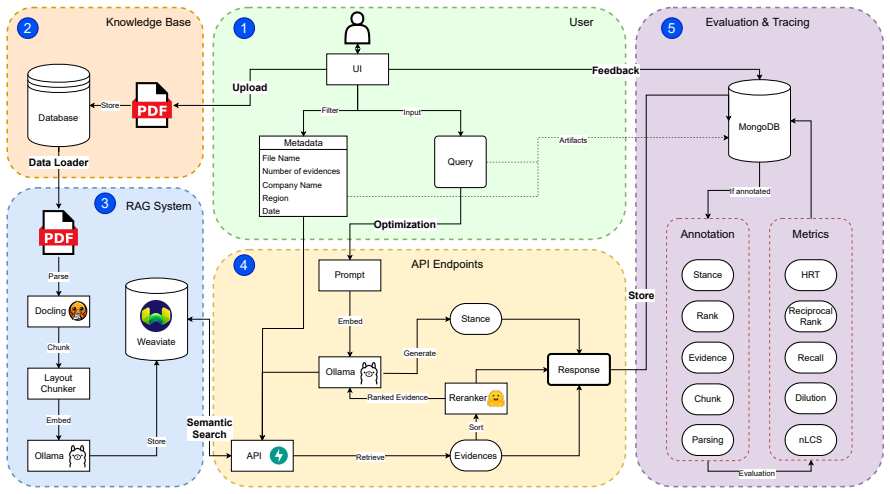
The central object is a five-stage RAG pipeline: (1) layout-aware parsing with Docling to turn PDFs into structured Markdown, (2) semantic or layout chunking to segment text, (3) dense retrieval with the Nomic embedding model over a vector store, (4) optional reranking with bge-reranker-v2-m3, and (5) stance generation with a Qwen3 model that outputs a score from -2 (opposes the policy) to +2 (strongly supports it) for one of 13 fixed climate-policy queries. The 'FS Few Query Few Stance' prompting strategy is the paper's named configuration: few-shot examples that include only a handful of queries and stances. The argument runs on the comparison of four evidence-selection strategies—First Re
Load-bearing premise
The evaluation treats the 2,018 human-annotated evidence snippets and their stance labels from ten companies as correct ground truth; if those annotations are biased, internally inconsistent, or too few, every reported ranking of parsers, embeddings, and prompts—and the pipeline's final hit rate—shifts.
What would settle it
Have a second, independent team of climate-policy analysts re-annotate a random subset of the 2,018 evidences and measure inter-annotator agreement on both span selection and stance score; if agreement falls below the pipeline's 0.636–0.655 hit-rate range, the gold standard is too noisy to support the accuracy claim. Alternatively, run the pipeline with randomly selected chunks instead of retrieved chunks; if random-chunk accuracy approaches the reported hit rates, retrieval is contributing little.
If this is right
- If the reported hit rates hold, an analyst-assisted system can cut the time spent reading long reports: the system returns the relevant passage and a first-pass stance score for human verification.
- Monitoring organisations could scale coverage beyond the roughly 500 companies and 250 industry associations currently tracked, because parsing, retrieval, and classification run automatically across languages and PDF layouts.
- Because retrieved evidence can outperform gold snippets, future systems may optimise for 'helpfulness' to the reasoning model rather than textual overlap with human annotations.
- The evaluation framework—nLCS, Hit Rate with Tolerance, and oracle diagnostics—gives other developers a way to compare parsers, chunkers, embedders, rerankers, and prompts on evidence-extraction tasks.
Where Pith is reading between the lines
- The paper's observation that non-English retrieval is 'easier' because documents have fewer chunks suggests that chunk granularity, not embedding quality, may be the real driver of apparent multilingual gains; a direct test would hold chunk counts constant across languages.
- A natural extension is to run the same pipeline on public corporate sustainability reports and release an open benchmark, since the current evaluation rests on a proprietary 10-company sample and cannot be independently reproduced.
- The oracle diagnostics point to helpfulness as more decisive than faithfulness for final stance accuracy, so training the reranker to maximise helpfulness—using the stance model's confidence as feedback—might close the remaining gap with ground truth.
- The finding that first-retrieved evidence often beats best-match evidence suggests that document order and surrounding context affect LLM reasoning; a testable extension is to feed the model the paragraphs around the retrieved chunk and measure whether accuracy rises further.
Editorial analysis
A structured set of objections, weighed in public.
Referee Report
Summary. The paper presents LobbyMap Search, a multilingual retrieval-augmented generation (RAG) system for extracting and scoring evidence of corporate climate policy engagement, following the InfluenceMap LobbyMap schema. The pipeline compares two PDF parsers (Docling, PyMuPDF), two chunking strategies (layout, semantic), three embedding models (bge-m3, Nomic, Qwen3-Embedding), three reranking options (BGE, MXBAI, none), and several Qwen3 prompting strategies for stance classification on a proprietary dataset of 2,018 gold evidence snippets from 10 companies. The authors report component-level nLCS, Recall, and MRR results, and a final pipeline evaluation (Table 4) with Hit Rates of 0.673 (Ground Truth), 0.655 (All Retrieved), 0.636 (First Retrieved), and 0.600 (Best Match), concluding that Docling parsing, semantic chunking, Nomic embeddings, BGE reranking, and the 'FS Few Query Few Stance' prompt yield the best performance. The paper also applies oracle-based diagnostics to compare retrieval strategies.
Significance. If the central empirical claim were supported, the system would be a practically valuable tool for scaling LobbyMap-style monitoring, reducing manual evidence extraction while keeping stance accuracy close to human-selected snippets. The paper is useful in documenting a concrete multilingual RAG configuration for a real regulatory-monitoring task, and the component-wise comparisons plus oracle diagnostics are a reasonable evaluation framework. The authors are also transparent in listing limitations. However, the headline 'best performance' claim is currently an in-sample selection result: the configuration was chosen by ranking component and pipeline outcomes on the same 2,018-evidence dataset used for the final evaluation, with no held-out validation, cross-validation, or significance testing. This limits the generalizability of every comparative claim, although the comparisons between First Retrieved, All Retrieved, and Ground Truth are not circular in themselves.
major comments (4)
- [§5, Tables 2–5, Appendix G] The central claim that the selected configuration 'yields the best performance' is an in-sample ranking. All component evaluations and the final pipeline are computed on the same 2,018-evidence sample, and the winning parser, chunker, embedding, reranker, and prompt are chosen by ranking those same results. Reported margins are small (e.g., Table 2: Nomic vs Qwen nLCS 0.724 vs 0.719; Table 3: BGE vs no-reranker MRR 0.531 vs 0.490). Without a held-out split, cross-validation, or at least error bars and significance tests, the reported top scores can arise from selection over many configurations. Please either provide a proper validation protocol or reframe the claim as best-of-sample on this dataset.
- [§4.4, Table 4, Best Match (BM)] The Best Match strategy selects the chunk with the highest nLCS overlap with the gold snippet G. This makes BM an oracle-based selector, not a retrieval strategy; its ranking position is provided by the annotation rather than by the system. Using BM in Table 4 to draw conclusions about 'retrieval rank' and 'chunk quality' is therefore circular for retrieval quality. The FR vs AR vs GT comparisons remain non-circular, but BM should be relabeled as a diagnostic oracle or removed from the headline retrieval-strategy comparison.
- [§4.1/Appendix E, Limitations] The evaluation relies on 2,018 gold evidence snippets from only 10 companies, and the paper explicitly states there is no mechanism to detect annotation errors. The gold labels are the reference for every component ranking, the relevance judgments, and the final pipeline accuracy; any systematic bias or noise in these annotations propagates through all tables. Please report inter-annotator agreement, error statistics, per-company/per-query breakdowns, and confidence intervals, or temper the generalizability claims accordingly.
- [§4.2–4.3, Eqs. (1)–(3), thresholds σ=0.5, τ=1] Two thresholds are load-bearing and appear arbitrary. Files are filtered by PnLCS > σ = 0.5, and retrieved chunks are considered relevant when nLCS with G exceeds this same threshold; Hit Rate with Tolerance uses τ = 1 with a polarity condition. No sensitivity analysis is provided for either threshold, and the relevance definition partly depends on the same nLCS metric used for evaluation. Please justify these thresholds or show that the conclusions are robust across a range of values.
minor comments (5)
- [Abstract and §5.5] The abstract and conclusion state that the configuration 'yields the best performance' without the caveat that this is on the current dataset and in-sample. Qualify these claims to avoid overgeneralization.
- [§4.4, All Retrieved] The number of chunks k used in 'All Retrieved' is never specified. Please state the value of k and the maximum context length used for concatenation.
- [§4.2, nLCS notation] The notation PnLCS and CnLCS is used before it is formally defined. Please define the normalization denominators explicitly for both parsing and chunking cases.
- [Figure 2] Figure 2 shows 'Model Alignment and Hit Rates' but the axes and the exact metric definitions are not described in the caption. Clarify what 'alignment' means, which hit-rate definition is used, and how the balanced subset in Appendix G relates to the main unbalanced set.
- [Tables 2–3, markers] The superscript markers (*, +) in Tables 2 and 3 are not defined in the captions. Define them explicitly, as they appear to denote English-only and Non-English subsets.
Circularity Check
BM oracle and same-set component selection make the 'best performance' headline partly in-sample, but the GT-anchored hit rates are not circular.
specific steps
-
fitted input called prediction
[Abstract; Section 5.5; Appendix G]
"Our evaluation shows that a combination of layout-aware parsing, the Nomic embedding model, and few-shot prompting strategies yields the best performance... We evaluate the full pipeline using the best-performing configuration: Docling parsing, semantic chunking, Nomic embeddings, BGE reranking, and Qwen3:4B "FS Few Query Few Stance" prompting... The reported evaluations were performed on a sample of 2018 evidences extracted from 10 companies."
The 'best-performing configuration' is selected by ranking results on the very same 2018-evidence evaluation set (Tables 1–3, Figure 2; Appendix G) and then re-evaluated on that same set in Table 4 to justify the abstract's best-performance claim. There is no held-out split, cross-validation, or significance testing, so the final hit rates are in-sample. The claim that this combination 'yields the best performance' is a restatement of the selection criterion, not an independent out-of-sample prediction. Small margins (e.g., Nomic vs Qwen nLCS 0.724 vs 0.719 in Table 2; BGE vs no-reranker MRR 0.531 vs 0.490 in Table 3) make it plausible that selection noise alone produced the reported ranking.
-
self definitional
[Section 4.4, Table 4]
"Best Match (BM): Using the chunk with highest nLCS overlap with G. Useful to showcase the impact of rank."
BM's evidence selection is defined as the chunk with maximum nLCS to the gold snippet G, so the 'retrieval' it performs is an oracle by construction. Reporting its stance-generation hit rate (0.600 in Table 4) alongside First Retrieved and All Retrieved presents an oracle selection as one of four retrieval strategies. The BM result cannot validate the pipeline's retrieval ability; it only shows what happens if a system were given access to G before retrieval. The paper is transparent about BM's oracle role, so the circularity is contained, but the comparison table still treats BM as a retrieval strategy, making its evidence selection circular with respect to the gold labels.
full rationale
The paper's core measurement—hit rates against human-annotated gold snippets—is anchored in external labels and is not itself circular. The AR (0.655) vs GT (0.673) comparison in Table 4 is an independent evaluation of a defined pipeline, and the Helpfulness/Faithfulness diagnostics use the model's own probabilities rather than definitions that contain the conclusion. The main circularity is limited to two places. First, the headline 'best performance' is an in-sample selection result: the same 2018-evidence sample (Appendix G) is used both to rank parsers, chunkers, embeddings, rerankers, and prompts (Tables 1–3, Figure 2) and to report the final pipeline numbers (Tables 4–5). With no train/dev/test separation or significance testing, the reported margins are within selection noise, so the abstract's claim that this combination 'yields the best performance' is a restatement of the selection criterion rather than an out-of-sample prediction. The Limitations section's admission that the 'stance prediction model is sensitive to prompting and may overfit to the specific formulation used in few-shot examples' further supports this concern. Second, BM is defined as the chunk with highest nLCS to G and then scored as a 'retrieval strategy'; that particular evidence selection is true by construction. The paper is transparent about BM being an oracle, so this is a contained circular baseline rather than a hidden derivation. No load-bearing self-citation or imported uniqueness theorem appears: the few self-references (e.g., Leippold et al. 2024) are contextual, and the oracle metrics and dataset structure are cited to external work. Overall, the central retrieval-vs-ground-truth comparison retains independent content, so a moderate score of 4 is appropriate.
Axiom & Free-Parameter Ledger
free parameters (4)
- nLCS relevance threshold sigma =
0.5
- HRT tolerance tau =
1
- Semantic chunk size =
1536 tokens
- Layout chunk minimum length =
30 words
axioms (4)
- domain assumption Human gold annotations (evidence spans and stance labels) are correct and representative.
- domain assumption The 13 fixed climate policy queries cover the relevant dimensions of corporate climate lobbying.
- domain assumption nLCS overlap is a valid proxy for semantic evidence relevance.
- domain assumption The InfluenceMap scoring rubric (-2..+2) is the correct target for stance classification.
Cite this review
Pith. "Pith review of Automated Evidence Extraction and Scoring for Corporate Climate Policy Engagement: A Multilingual RAG Approach." pith.science (2026). https://pith.science/paper/Y7MORJYT
@misc{pith2026250908907,
  author       = {Pith},
  title        = {Pith review of: Automated Evidence Extraction and Scoring for Corporate Climate Policy Engagement: A Multilingual RAG Approach},
  year         = {2026},
  howpublished = {\url{https://pith.science/paper/Y7MORJYT}},
  note         = {Machine review of arXiv:2509.08907}
}
read the original abstract
InfluenceMap's LobbyMap Platform monitors the climate policy engagement of over 500 companies and 250 industry associations, assessing each entity's support or opposition to science-based policy pathways for achieving the Paris Agreement's goal of limiting global warming to 1.5{\deg}C. Although InfluenceMap has made progress with automating key elements of the analytical workflow, a significant portion of the assessment remains manual, making it time- and labor-intensive and susceptible to human error. We propose an AI-assisted framework to accelerate the monitoring of corporate climate policy engagement by leveraging Retrieval-Augmented Generation to automate the most time-intensive extraction of relevant evidence from large-scale textual data. Our evaluation shows that a combination of layout-aware parsing, the Nomic embedding model, and few-shot prompting strategies yields the best performance in extracting and classifying evidence from multilingual corporate documents. We conclude that while the automated RAG system effectively accelerates evidence extraction, the nuanced nature of the analysis necessitates a human-in-the-loop approach where the technology augments, rather than replaces, expert judgment to ensure accuracy.
Figures


Reference graph
Works this paper leans on
-
[1]
URL: " 'urlintro :=
ENTRY address author booktitle chapter edition editor howpublished institution journal key month note number organization pages publisher school series title type volume year eprint doi pubmed url lastchecked label extra.label sort.label short.list INTEGERS output.state before.all mid.sentence after.sentence after.block STRINGS urlintro eprinturl eprintpr...
-
[2]
write newline
" write newline "" before.all 'output.state := FUNCTION n.dashify 't := "" t empty not t #1 #1 substring "-" = t #1 #2 substring "--" = not "--" * t #2 global.max substring 't := t #1 #1 substring "-" = "-" * t #2 global.max substring 't := while if t #1 #1 substring * t #2 global.max substring 't := if while FUNCTION word.in bbl.in capitalize " " * FUNCT...
-
[3]
Jianlv Chen, Shitao Xiao, Peitian Zhang, Kun Luo, Defu Lian, and Zheng Liu. 2024. http://arxiv.org/abs/2402.03216 Bge m3-embedding: Multi-lingual, multi-functionality, multi-granularity text embeddings through self-knowledge distillation
Pith/arXiv arXiv 2024
-
[4]
Markus Leippold, Zacharias Sautner, and Tingyu Yu. 2024. https://doi.org/10.2139/ssrn.4711812 Corporate climate lobbying . European Corporate Governance Institute – Finance Working Paper No. 960/2024
-
[5]
Nikolaos Livathinos, Christoph Auera, Maksym Lysak, Ahmed Nassar, Michele Dolfi, Panos Vagenas, Cesar Berrospi Ramis, Matteo Omenetti, Kasper Dinkla, Yusik Kim, Shubham Gupta, Rafael Teixeira de Lima, Valery Weber, Lucas Morin, Ingmar Meijer, Viktor Kuropiatnyk, and Peter W. J. Staar. 2025. http://arxiv.org/abs/2501.17887 Docling: An efficient open-source...
Pith/arXiv arXiv 2025
-
[6]
Bhavnick Minhas and Shreyash Nigam. 2025. Chonkie: A no-nonsense fast, lightweight, and efficient text chunking library. https://github.com/chonkie-inc/chonkie
2025
-
[7]
Gaku Morio and Christopher D Manning. 2023. https://proceedings.neurips.cc/paper_files/paper/2023/file/7ccaa4f9a89cce6619093226f26b84e6-Paper-Datasets_and_Benchmarks.pdf An nlp benchmark dataset for assessing corporate climate policy engagement . In Advances in Neural Information Processing Systems, volume 36, pages 39678--39702. Curran Associates, Inc
2023
-
[8]
Morris, Brandon Duderstadt, and Andriy Mulyar
Zach Nussbaum, John X. Morris, Brandon Duderstadt, and Andriy Mulyar. 2024. http://arxiv.org/abs/2402.01613 Nomic embed: Training a reproducible long context text embedder
Pith/arXiv arXiv 2024
-
[9]
PyMuPDF Developers . 2024. Pymupdf documentation. https://pymupdf.readthedocs.io/en/latest/. Accessed: 2025-06-24
2024
-
[10]
Renyi Qu, Ruixuan Tu, and Forrest Bao. 2024. http://arxiv.org/abs/2410.13070 Is semantic chunking worth the computational cost?
Pith/arXiv arXiv 2024
-
[11]
Aamir Shakir, Darius Koenig, Julius Lipp, and Sean Lee. 2024. https://www.mixedbread.ai/blog/mxbai-rerank-v1 Boost your search with the crispy mixedbread rerank models
2024
-
[12]
Weaviate. 2023. Retrieval evaluation metrics: Precision, recall, mrr, and nDCG . https://weaviate.io/blog/retrieval-evaluation-metrics. Accessed: 2025-06-24
2023
-
[13]
An Yang, Anfeng Li, Baosong Yang, Beichen Zhang, Binyuan Hui, Bo Zheng, Bowen Yu, Chang Gao, Chengen Huang, Chenxu Lv, Chujie Zheng, Dayiheng Liu, Fan Zhou, Fei Huang, Feng Hu, Hao Ge, Haoran Wei, Huan Lin, Jialong Tang, Jian Yang, Jianhong Tu, Jianwei Zhang, Jianxin Yang, Jiaxi Yang, Jing Zhou, Jingren Zhou, Junyang Lin, Kai Dang, Keqin Bao, Kexin Yang, ...
Pith/arXiv arXiv 2025
-
[14]
Yuheng Zha, Yichi Yang, Ruichen Li, and Zhiting Hu. 2023. https://doi.org/10.18653/v1/2023.acl-long.634 A lign S core: Evaluating factual consistency with a unified alignment function . In Proceedings of the 61st Annual Meeting of the Association for Computational Linguistics (Volume 1: Long Papers), pages 11328--11348, Toronto, Canada. Association for Co...
-
[15]
Yanzhao Zhang, Mingxin Li, Dingkun Long, Xin Zhang, Huan Lin, Baosong Yang, Pengjun Xie, An Yang, Dayiheng Liu, Junyang Lin, Fei Huang, and Jingren Zhou. 2025. http://arxiv.org/abs/2506.05176 Qwen3 embedding: Advancing text embedding and reranking through foundation models
Pith/arXiv arXiv 2025
-
[16]
Xinping Zhao, Dongfang Li, Yan Zhong, Boren Hu, Yibin Chen, Baotian Hu, and Min Zhang. 2024. http://arxiv.org/abs/2410.11315 Seer: Self-aligned evidence extraction for retrieval-augmented generation
Pith/arXiv arXiv 2024
discussion (0)
Sign in with ORCID, Apple, or X to comment. Anyone can read and Pith papers without signing in.