Retrocausal capacity of a quantum channel
Pith reviewed 2026-05-18 17:14 UTC · model grok-4.3
The pith
A quantum channel's retrocausal classical capacity equals the sum of its max-information and regularized Doeblin information, with the quantum capacity as their average.
A machine-rendered reading of the paper's core claim, the machinery that carries it, and where it could break.
Core claim
We completely characterize the one-shot retrocausal quantum and classical capacities of a quantum channel. The corresponding asymptotic capacities equal the average and the sum, respectively, of the channel's max-information and its regularized Doeblin information. The same characterization holds for every completely positive map and therefore limits information transfer through any postselected-teleportation mechanism, including those appearing in black-hole final-state proposals.
What carries the argument
The noisy postselected closed timelike curve represented mathematically by the quantum channel (or general completely positive map) together with chosen postselection boundary conditions.
If this is right
- The max-information and regularized Doeblin information acquire operational interpretations as the building blocks of retrocausal capacities.
- Any postselected teleportation protocol with fixed initial and final states is subject to the same capacity bounds.
- Black-hole final-state models that employ postselection inherit these information-theoretic limits on message recovery.
- The results apply verbatim to all completely positive maps, not only to quantum channels.
Where Pith is reading between the lines
- The sum-and-average structure may link retrocausal resources to ordinary forward capacities in a way that could be tested with existing channel simulation techniques.
- The bounds constrain the amount of information that could be extracted from a black-hole interior under final-state projection models.
Load-bearing premise
The assumption that the physical noisy postselected closed timelike curve is accurately modeled by the given quantum channel under the chosen postselection boundary conditions.
What would settle it
Direct computation of the one-shot or asymptotic retrocausal capacity for a concrete channel such as the depolarizing channel that yields a value different from the sum or average of its max-information and regularized Doeblin information.
Figures


read the original abstract
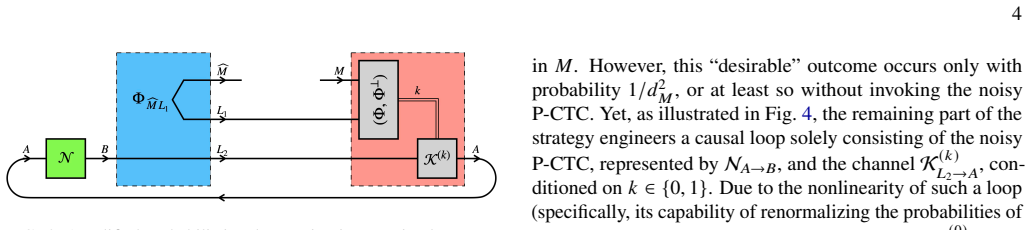
We study the capacity of a quantum channel for retrocausal communication, where messages are transmitted backward in time, from a sender in the future to a receiver in the past, through a noisy postselected closed timelike curve (P-CTC) mathematically represented by the channel. We completely characterize the one-shot retrocausal quantum and classical capacities, and we show that the corresponding asymptotic capacities are equal to the average and sum, respectively, of the channel's max-information and its regularized Doeblin information. This endows these information measures with a novel operational interpretation. Furthermore, our characterization can be generalized beyond quantum channels to all completely positive maps. This imposes information-theoretic limits on transmitting messages via postselected-teleportation-like mechanisms with arbitrary initial- and final-state boundary conditions, including those considered in various black-hole final-state models.
Editorial analysis
A structured set of objections, weighed in public.
Referee Report
Summary. The manuscript studies retrocausal communication through a noisy postselected closed timelike curve (P-CTC) modeled by a quantum channel N equipped with chosen initial- and final-state boundary conditions. It claims a complete characterization of the one-shot retrocausal classical capacity as the sum of the channel's max-information and Doeblin information, and of the one-shot retrocausal quantum capacity as their average; the corresponding asymptotic capacities are obtained by regularization. The results are extended to arbitrary completely positive maps and are presented as imposing information-theoretic limits on postselected-teleportation mechanisms, including certain black-hole final-state models.
Significance. If the central identifications hold, the work supplies operational meanings to the max-information and regularized Doeblin information in a retrocausal setting and derives concrete bounds on the amount of information that can be sent via postselection-based mechanisms. The generalization to all CP maps broadens the scope beyond standard quantum channels.
major comments (2)
- [Model definition and capacity theorems (likely §3–4)] The central equalities rest on the claim that every admissible P-CTC interaction is faithfully captured by an arbitrary CP map together with the chosen boundary conditions that implement postselection. The manuscript must explicitly verify that the resulting effective map remains completely positive and trace-preserving after the postselection projector and normalization step; otherwise the operational capacity definitions no longer apply directly. This verification is load-bearing for both the one-shot and asymptotic claims.
- [One-shot capacity theorems] The one-shot characterizations are stated as complete, yet the provided abstract and surrounding discussion do not exhibit the explicit derivations that map the postselected channel to the sum (classical) or average (quantum) of max-information and Doeblin information. Without these steps, it is impossible to confirm that no additional consistency conditions from the CTC literature have been omitted.
minor comments (2)
- [Preliminaries] Notation for the postselection boundary conditions should be introduced with a clear diagram or explicit Kraus representation to aid readability.
- [Generalization paragraph] The statement that the results apply to 'all completely positive maps' would benefit from a short remark on whether the maps are required to be trace-non-increasing or to satisfy any other technical condition after postselection.
Simulated Author's Rebuttal
We thank the referee for their careful reading of the manuscript and for identifying points that require additional clarification. We address each major comment below and have revised the manuscript to strengthen the presentation of the model and derivations.
read point-by-point responses
-
Referee: [Model definition and capacity theorems (likely §3–4)] The central equalities rest on the claim that every admissible P-CTC interaction is faithfully captured by an arbitrary CP map together with the chosen boundary conditions that implement postselection. The manuscript must explicitly verify that the resulting effective map remains completely positive and trace-preserving after the postselection projector and normalization step; otherwise the operational capacity definitions no longer apply directly. This verification is load-bearing for both the one-shot and asymptotic claims.
Authors: We agree that an explicit verification of complete positivity and trace preservation for the effective postselected map is necessary to ensure the operational capacity definitions apply. In the revised manuscript we have inserted a new Lemma 1 in Section 3 that proves the following: given any CP map N and any pair of valid boundary states, the composition with the postselection projectors followed by normalization yields a CPTP map. The proof proceeds by noting that the unnormalized output operator is positive semidefinite (by complete positivity of N and positivity of the projectors) and that the normalization factor equals the trace of this operator, thereby restoring trace preservation. This lemma directly supports both the one-shot and regularized capacity statements. revision: yes
-
Referee: [One-shot capacity theorems] The one-shot characterizations are stated as complete, yet the provided abstract and surrounding discussion do not exhibit the explicit derivations that map the postselected channel to the sum (classical) or average (quantum) of max-information and Doeblin information. Without these steps, it is impossible to confirm that no additional consistency conditions from the CTC literature have been omitted.
Authors: The explicit derivations appear in Theorems 1 and 2 (Sections 3 and 4). Theorem 1 reduces the one-shot classical retrocausal capacity to the optimization of the max-information plus Doeblin information over inputs compatible with the chosen boundary conditions; the proof proceeds by expressing the postselected output probability distribution and invoking the variational characterizations of both quantities. Theorem 2 performs the analogous reduction for the quantum case using the average of the two quantities. To address the referee’s concern, we have expanded the main-text proof sketches and added a self-contained Appendix B containing the full algebraic steps. In these derivations we explicitly note that the only consistency requirement imposed is the postselection normalization inherent to the P-CTC model; no further self-consistency conditions from other closed-timelike-curve proposals are required or omitted. revision: partial
Circularity Check
Derivation self-contained; capacities derived from explicit P-CTC model without reduction to inputs
full rationale
The paper explicitly constructs the retrocausal setup by representing the noisy postselected CTC as a quantum channel N equipped with chosen initial- and final-state boundary conditions that implement postselection. It then applies standard one-shot and asymptotic capacity formulas from quantum information theory to this effective map, obtaining the stated equalities to max-information and regularized Doeblin information. These information measures receive an operational interpretation precisely because they emerge as the capacities of the constructed model; the derivation does not presuppose the target equalities, nor does it rely on self-citations for load-bearing uniqueness theorems or ansatzes. The modeling step (P-CTC to CPTP map plus boundary conditions) is an assumption stated up front rather than a hidden tautology, and the subsequent characterizations follow from direct calculation. No step reduces by construction to a fitted parameter or renamed input.
Axiom & Free-Parameter Ledger
axioms (2)
- standard math Quantum channels are completely positive trace-preserving maps
- domain assumption Postselection on closed timelike curves can be modeled by a quantum channel with fixed boundary conditions
Lean theorems connected to this paper
-
IndisputableMonolith/Cost/FunctionalEquation.leanwashburn_uniqueness_aczel unclear?
unclearRelation between the paper passage and the cited Recognition theorem.
the asymptotic retrocausal classical capacity ... equal to the sum of its max-information and its regularized Doeblin information, while the quantum capacity is their average
-
IndisputableMonolith/Foundation/RealityFromDistinction.leanreality_from_one_distinction unclear?
unclearRelation between the paper passage and the cited Recognition theorem.
nonlinear map ... renormalization ... postselected teleportation-like mechanisms
What do these tags mean?
- matches
- The paper's claim is directly supported by a theorem in the formal canon.
- supports
- The theorem supports part of the paper's argument, but the paper may add assumptions or extra steps.
- extends
- The paper goes beyond the formal theorem; the theorem is a base layer rather than the whole result.
- uses
- The paper appears to rely on the theorem as machinery.
- contradicts
- The paper's claim conflicts with a theorem or certificate in the canon.
- unclear
- Pith found a possible connection, but the passage is too broad, indirect, or ambiguous to say the theorem truly supports the claim.
Reference graph
Works this paper leans on
-
[1]
G. T. Horowitz and J. Maldacena,The black hole final state, Journal of High Energy Physics2004, 008 (2004)
work page 2004
-
[2]
D. Gottesman and J. Preskill,Comment on “The black hole final state”,Journal of High Energy Physics2004, 026 (2004)
work page 2004
-
[3]
S. Lloyd,Almost certain escape from black holes in final state projection models,Physical Review Letters,96(2006)
work page 2006
-
[4]
S. Lloyd and J. Preskill,Unitarity of black hole evaporation in final-state projection models,Journal of High Energy Physics 2014, 126 (2014)
work page 2014
-
[5]
Deutsch,Quantum mechanics near closed timelike lines, Physical Review D44, 3197 (1991)
D. Deutsch,Quantum mechanics near closed timelike lines, Physical Review D44, 3197 (1991)
work page 1991
- [6]
-
[7]
S. Lloyd, L. Maccone, R. Garcia-Patron, V . Giovannetti, Y . Shikano, S. Pirandola, L. A. Rozema, A. Darabi, Y . Souda- gar, L. K. Shalm, and A. M. Steinberg,Closed timelike curves via postselection: Theory and experimental test of consistency, Physical Review Letters106, 040403 (2011)
work page 2011
- [8]
-
[9]
G. Svetlichny,Effective quantum time travel,(2009), arXiv:0902.4898 [quant-ph]
work page internal anchor Pith review Pith/arXiv arXiv 2009
-
[10]
C. H. Bennett, G. Brassard, C. Crépeau, R. Jozsa, A. Peres, and W. K. Wootters,Teleporting an unknown quantum state via dual classical and Einstein-Podolsky-Rosen channels,Physical Review Letters70, 1895 (1993)
work page 1993
-
[11]
T. A. Brun, J. Harrington, and M. M. Wilde,Localized closed timelike curves can perfectly distinguish quantum states,Physi- cal Review Letters102, 210402 (2009)
work page 2009
-
[12]
T. A. Brun and M. M. Wilde,Perfect state distinguishability and computational speedups with postselected closed timelike curves,Foundations of Physics42, 341 (2012)
work page 2012
-
[13]
T. A. Brun, M. M. Wilde, and A. Winter,Quantum state cloning using Deutschian closed timelike curves,Physical Review Let- ters111, 190401 (2013)
work page 2013
-
[14]
S. Aaronson,Quantum computing, postselection, and proba- bilistic polynomial-time,Proceedings of the Royal Society A: Mathematical, Physical and Engineering Sciences461, 3473 (2005)
work page 2005
-
[15]
S. Aaronson and J. Watrous,Closed timelike curves make quan- tum and classical computing equivalent,Proceedings of the Royal Society A: Mathematical, Physical and Engineering Sci- ences465, 631 (2009)
work page 2009
-
[16]
C. H. Bennett, D. Leung, G. Smith, and J. A. Smolin,Can closed timelike curves or nonlinear quantum mechanics improve quan- tum state discrimination or help solve hard problems?Physical Review Letters103, 170502 (2009)
work page 2009
-
[17]
E. G. Cavalcanti, N. C. Menicucci, and J. L. Pienaar,The preparation problem in nonlinear extensions of quantum theory, (2012), arXiv:1206.2725 [quant-ph]
work page internal anchor Pith review Pith/arXiv arXiv 2012
-
[18]
D. R. M. Arvidsson-Shukur, N. Yunger Halpern, H. V . Lepage, A. A. Lasek, C. H. W. Barnes, and S. Lloyd,Quantum advantage in postselected metrology,Nature Communications11, 3775 (2020)
work page 2020
-
[19]
Regula,Probabilistic transformations of quantum resources, Physical Review Letters128, 110505 (2022)
B. Regula,Probabilistic transformations of quantum resources, Physical Review Letters128, 110505 (2022)
work page 2022
- [20]
- [21]
-
[22]
G. Chiribella, M. Banik, S. S. Bhattacharya, T. Guha, M. Al- imuddin, A. Roy, S. Saha, S. Agrawal, and G. Kar,Indefinite causal order enables perfect quantum communication with zero capacity channels,New Journal of Physics23, 033039 (2021)
work page 2021
-
[23]
K. Ji, B. Regula, and M. M. Wilde,Postselected communica- tion over quantum channels,International Journal of Quantum Information22, 2440012 (2024)
work page 2024
-
[24]
C. E. Shannon,A mathematical theory of communication,Bell System Technical Journal27, 379 (1948)
work page 1948
-
[25]
A. S. Holevo,The capacity of the quantum channel with general signal states,IEEE Transactions on Information Theory44, 269 (1998)
work page 1998
-
[26]
B. Schumacher and M. D. Westmoreland,Sending classical information via noisy quantum channels,Physical Review A56, 131 (1997)
work page 1997
-
[27]
Schumacher,Sending entanglement through noisy quantum channels,Physical Review A54, 2614 (1996)
B. Schumacher,Sending entanglement through noisy quantum channels,Physical Review A54, 2614 (1996)
work page 1996
-
[28]
Lloyd,Capacity of the noisy quantum channel,Physical Re- view A55, 1613 (1997)
S. Lloyd,Capacity of the noisy quantum channel,Physical Re- view A55, 1613 (1997)
work page 1997
-
[29]
P. Shor,The quantum channel capacity and coherent informa- tion,Lecture Notes, MSRI Workshop on Quantum Computation (2002)
work page 2002
-
[30]
I. Devetak,The private classical capacity and quantum capacity of a quantum channel,IEEE Transactions on Information Theory 51, 44 (2005)
work page 2005
-
[31]
C. H. Bennett, P. W. Shor, J. A. Smolin, and A. V . Thapliyal, Entanglement-assisted classical capacity of noisy quantum chan- 6 nels,Physical Review Letters83, 3081 (1999)
work page 1999
-
[32]
T. S. Cubitt, D. Leung, W. Matthews, and A. Winter,Zero- error channel capacity and simulation assisted by non-local correlations,IEEE Transactions on Information Theory57, 5509 (2011)
work page 2011
-
[33]
R. Duan and A. Winter,No-signalling-assisted zero-error capac- ity of quantum channels and an information theoretic interpre- tation of the Lovász number,IEEE Transactions on Information Theory62, 891 (2016)
work page 2016
-
[34]
S. Khatri and M. M. Wilde,Principles of Quantum Com- munication Theory: A Modern Approach(arXiv, 2024) arXiv:2011.04672v2 [cond-mat, physics:hep-th, physics:math- ph, physics:quant-ph]
-
[35]
M. S. Morris, K. S. Thorne, and U. Yurtsever,Wormholes, time machines, and the weak energy condition,Physical Review Letters61, 1446 (1988)
work page 1988
- [36]
-
[37]
D. G. Boulware,Quantum field theory in spaces with closed timelike curves,Physical Review D46, 4421 (1992)
work page 1992
-
[38]
H. D. Politzer,Simple quantum systems in spacetimes with closed timelike curves,Physical Review D46, 4470 (1992)
work page 1992
-
[39]
H. D. Politzer,Path integrals, density matrices, and information flow with closed timelike curves,Physical Review D49, 3981 (1994)
work page 1994
-
[40]
J. B. Hartle,Unitarity and causality in generalized quantum mechanics for nonchronal spacetimes,Physical Review D49, 6543 (1994)
work page 1994
-
[41]
M. M. Wilde,Quantum Information Theory, 2nd ed. (Cambridge University Press, 2017)
work page 2017
-
[42]
M. Hayashi,Quantum Information Theory: Mathematical Foun- dation, Graduate Texts in Physics (Springer Berlin Heidelberg, Berlin, Heidelberg, 2017)
work page 2017
-
[43]
Watrous,The Theory of Quantum Information, 1st ed
J. Watrous,The Theory of Quantum Information, 1st ed. (Cam- bridge University Press, 2018)
work page 2018
-
[44]
S. W. Hawking,Breakdown of predictability in gravitational collapse,Physical Review D14, 2460 (1976)
work page 1976
-
[45]
Y . Aharonov, P. G. Bergmann, and J. L. Lebowitz,Time sym- metry in the quantum process of measurement,Physical Review 134, B1410 (1964)
work page 1964
-
[46]
R. B. Griffiths,Consistent histories and the interpretation of quantum mechanics,Journal of Statistical Physics36, 219 (1984)
work page 1984
-
[47]
M. Gell-Mann and J. B. Hartle,Time symmetry and asymme- try in quantum mechanics and quantum cosmology,inPhysical Origins of Time Asymmetry, edited by J. J. Halliwell, J. Pérez- Mercader, and W. H. Zurek (Cambridge University Press, Cam- bridge, 1994) pp. 311–345
work page 1994
-
[48]
D. Genkina, G. Chiribella, and L. Hardy,Optimal probabilistic simulation of quantum channels from the future to the past, Physical Review A85, 022330 (2012)
work page 2012
-
[49]
K. S. Thorne,The Science of Interstellar, 1st ed. (W.W. Norton & Company, New York, 2014)
work page 2014
-
[50]
The retrocausal capacity of a channel is also referred to as its flux capacity
-
[51]
Nefed,Bookshelf Scene,(2018), Dribbble, https://dribbble.com/shots/5696261-Bookshelf-Scene
A. Nefed,Bookshelf Scene,(2018), Dribbble, https://dribbble.com/shots/5696261-Bookshelf-Scene
- [52]
-
[53]
I. George, C. Hirche, T. Nuradha, and M. M. Wilde,Quantum Doeblin coefficients: Interpretations and applications,(2025), arXiv:2503.22823 [quant-ph]
work page internal anchor Pith review arXiv 2025
-
[54]
See Supplemental Material for technical proofs and discussions
-
[55]
I. Devetak, A. W. Harrow, and A. J. Winter,A resource frame- work for quantum Shannon theory,IEEE Transactions on Infor- mation Theory54, 4587 (2008)
work page 2008
-
[56]
K. Ji, E. L. Brown, S. Lloyd, M. McFly, and M. M. Wilde, October 26, 1985
work page 1985
-
[57]
N. Datta,Min- and max-relative entropies and a new entangle- ment monotone,IEEE Transactions on Information Theory55, 2816 (2009)
work page 2009
-
[58]
M. K. Gupta and M. M. Wilde,Multiplicativity of completely bounded 𝑝-norms implies a strong converse for entanglement- assisted capacity,Communications in Mathematical Physics 334, 867 (2015)
work page 2015
-
[59]
M. G. Díaz, K. Fang, X. Wang, M. Rosati, M. Skotiniotis, J. Cal- samiglia, and A. Winter,Using and reusing coherence to realize quantum processes,Quantum2, 100 (2018). arXiv:1805.04045 [quant-ph]
work page internal anchor Pith review Pith/arXiv arXiv 2018
-
[60]
T. Nuradha, H. K. Mishra, F. Leditzky, and M. M. Wilde,Multi- variate fidelities,Journal of Physics A: Mathematical and Theo- retical58, 165304 (2025)
work page 2025
- [61]
-
[62]
F. Girardi, A. Oufkir, B. Regula, M. Tomamichel, M. Berta, and L. Lami,Quantum umlaut information,(2025), arXiv:2503.21479 [quant-ph]
-
[63]
K. Fang, X. Wang, M. Tomamichel, and M. Berta,Quantum channel simulation and the channel’s smooth max-information, IEEE Transactions on Information Theory66, 2129 (2020)
work page 2020
-
[64]
M. M. Wilde, M. Berta, C. Hirche, and E. Kaur,Amortized chan- nel divergence for asymptotic quantum channel discrimination, Letters in Mathematical Physics110, 2277 (2020)
work page 2020
-
[65]
E. Chitambar, I. George, B. Doolittle, and M. Junge,The com- munication value of a quantum channel,IEEE Transactions on Information Theory69, 1660 (2023)
work page 2023
-
[66]
E. Chitambar and G. Gour,Quantum resource theories,Reviews of Modern Physics91, 025001 (2019)
work page 2019
-
[67]
Gour,Quantum Resource Theories, 1st ed
G. Gour,Quantum Resource Theories, 1st ed. (Cambridge Uni- versity Press, 2025)
work page 2025
-
[68]
G. Vidal and R. Tarrach,Robustness of entanglement,Physical Review A59, 141 (1999)
work page 1999
-
[69]
A. W. Harrow and M. A. Nielsen,Robustness of quantum gates in the presence of noise,Physical Review A,68(2003)
work page 2003
-
[70]
A. C. Elitzur, S. Popescu, and D. Rohrlich,Quantum nonlocality for each pair in an ensemble,Physics Letters A162, 25 (1992)
work page 1992
-
[71]
M. Lewenstein and A. Sanpera,Separability and entanglement of composite quantum systems,Physical Review Letters80, 2261 (1998)
work page 1998
-
[72]
N. Datta,Max-relative entropy of entanglement, alias log ro- bustness,International Journal of Quantum Information07, 475 (2009)
work page 2009
-
[73]
M. Fekete,Über die Verteilung der Wurzeln bei gewissen alge- braischen Gleichungen mit ganzzahligen Koeffizienten,Mathe- matische Zeitschrift17, 228 (1923)
work page 1923
-
[74]
G. Chiribella, G. M. D’Ariano, and P. Perinotti,Transforming quantum operations: Quantum supermaps,EPL (Europhysics Letters)83, 30004 (2008)
work page 2008
-
[75]
J. Burniston, M. Grabowecky, C. M. Scandolo, G. Chiribella, and G. Gour,Necessary and sufficient conditions on measure- ments of quantum channels,Proceedings of the Royal Soci- ety A: Mathematical, Physical and Engineering Sciences476, 20190832 (2020)
work page 2020
-
[76]
A. S. Holevo,Bounds for the quantity of information transmitted by a quantum communication channel,Probl. Peredachi Inf.9, 7 3 (1973)
work page 1973
-
[77]
P. W. Shor,Scheme for reducing decoherence in quantum com- puter memory,Physical Review A52, R2493 (1995)
work page 1995
-
[78]
B. Schumacher and M. A. Nielsen,Quantum data processing and error correction,Physical Review A54, 2629 (1996)
work page 1996
- [79]
- [80]
discussion (0)
Sign in with ORCID, Apple, or X to comment. Anyone can read and Pith papers without signing in.