REVIEW 4 major objections 3 minor 1 cited by
Carbon-aware scheduling in federated learning can cut emissions substantially without sacrificing accuracy, provided the planner's selection probabilities match reality.
Reviewed by Pith at T0; open to challenge. T0 means a machine referee read the full paper against a public rubric. the ladder, T0–T4 →
A carbon-aware federated learning scheduler that adds slack time, fair client selection, and fine-tuning beats a full-participation baseline on MNIST under tight carbon budgets.
T0 review reviewed 2026-08-04 challenge →
load-bearing objection Solid green-FL scheduling formulation with a real evaluation-protocol flaw: the headline accuracy gains come from test-set-chosen fine-tuning placement, not the scheduler as specified. the 4 major comments →
Green Federated Learning via Carbon-Aware Client and Time Slot Scheduling
The pith
A machine-rendered reading of the paper's core claim, the machinery that carries it, and where it could break.
The reading
Core claim
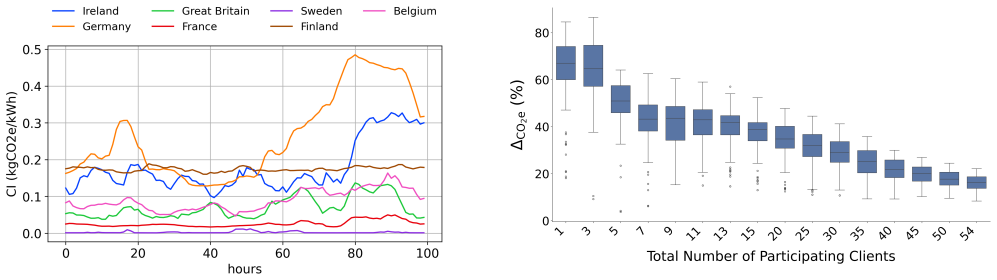
The paper's central claim is that federated learning's carbon footprint can be cut by jointly choosing which clients train and when, rather than treating all rounds and regions as interchangeable. It shows that simply allowing training to extend past its minimum duration (slack time) lets clients pick their lowest-carbon hours, yielding 20–60% CO2e savings per client on variable grids and aggregate savings that stay above 20% even when all clients participate. It then identifies three learning biases that a carbon-greedy schedule introduces — statistical heterogeneity from excluding high-emission clients, selection bias from unequal sampling frequencies, and last-iterate bias from temporally
What carries the argument
The load-bearing object is the scheduling optimization problem (Eq. 8): a carbon-budgeted integer program that maximizes an alpha-fair utility over client-time-slot assignments, with a movable fine-tuning window and a slack window. The alpha-fair utility interpolates between carbon-greedy (alpha=1) and equal-carbon allocation (alpha→0), maintaining fair representation. Around it, two corrections do the work: U-FedAvg, which replaces simple averaging with inverse-frequency weighting so the global update is unbiased under unequal selection, and the fine-tuning window, in which all clients are selected to counteract correlated participation and last-iterate bias. The problem is NP-hard but solv
Load-bearing premise
The load-bearing premise is that the planner's selection probabilities match reality: the unbiased aggregation (U-FedAvg) is only unbiased if each client actually participates at each scheduled slot with the planned probability π_c, and if real devices are unavailable or the schedule is not followed exactly, the accuracy gains claimed here do not follow.
What would settle it
Run the scheduler's exact schedule in an environment where each scheduled client participates with probability 0.9 instead of 1, and compare final accuracy to the slack-agnostic baseline under the same carbon budget; if the accuracy advantage disappears or reverses, the unbiasedness assumption is the fragile link. More directly, compute realized participation frequencies and compare them with the planned π_c — any divergence larger than the scale of 1/T breaks the unbiasedness of the aggregation rule.
If this is right
- With slack time alone, federated training can cut emissions by 20–60% per client on grids with variable carbon intensity, before any aggregation changes.
- A carbon-greedy scheduler that ignores fairness excludes high-emission clients and hurts accuracy; using an alpha-fair allocation improves accuracy by up to 8 percentage points at medium/large budgets.
- Unbiased FedAvg removes the non-vanishing selection-bias error, at the cost of slower convergence when selection is highly heterogeneous.
- A short all-client fine-tuning phase at the end recovers up to 3.8 percentage points of accuracy under temporally and spatially correlated carbon intensity.
- The advantage over a slack-agnostic baseline is highest under tight carbon budgets (up to +4.36 pp) and shrinks to about +0.2 pp when budgets are large.
Where Pith is reading between the lines
- Editorial extension: the same scheduling formulation applies to any per-client, time-varying cost, not just carbon intensity; replacing CI with electricity price or device energy would turn the method into a general cost-aware scheduler.
- Editorial extension: the scheduler is computed offline from carbon-intensity forecasts; a live version that re-solves the problem as forecasts update could capture additional savings when forecasts are wrong, because slack time gives room to shift.
- Editorial extension: the planned-vs-realized assignment assumption in U-FedAvg suggests a practical deployment should track realized participation frequencies and either reweight online or fall back to standard FedAvg when schedules are disrupted.
- Editorial extension: the reported gains use a 7-client MNIST experiment; transferring to large-scale cross-device FL would require accounting for communication energy and client dropout, but the scheduling math is independent of these.
Editorial analysis
A structured set of objections, weighed in public.
Referee Report
Summary. The paper addresses carbon-efficient federated learning by scheduling client participation and training time slots according to regional and temporal carbon intensity (CI). It first quantifies potential CO2e savings from slack time, then studies statistical and temporal biases induced by carbon-aware client selection, and proposes a scheduler that combines slack time, α-fair carbon allocation, unbiased aggregation (U-FedAvg), and a fine-tuning phase. The method is formulated as a non-convex integer program (Problem (8)) and evaluated with real-world Electricity Maps CI traces on federated MNIST. The main claimed result is that the proposed scheduler outperforms a slack-agnostic all-clients baseline in model accuracy across carbon budgets, with especially strong gains at tight budgets.
Significance. If the accuracy gains were obtained by the algorithm as specified, the paper would make a useful contribution to green FL: it integrates carbon awareness with statistical fairness and temporal bias correction, and the carbon-savings analysis in Figures 2 and 3 is a straightforward, reproducible computation on public CI traces. The paper also ships code, which strengthens reproducibility. However, the central accuracy claim is currently supported by an evaluation protocol that selects fine-tuning placement and hyperparameters after observing test accuracy, so the reported gains are likely an oracle upper bound rather than a property of the proposed scheduler. The underlying carbon-savings derivations and the unbiasedness mechanism are plausible, but the empirical comparison needs to be rerun under a non-oracle protocol before the main claim can be accepted.
major comments (4)
- [Section VII, Fig. 7/Table II] The headline accuracy gains (+4.36 pp at 5.73% budget, +3.24 pp at 7.65%) are obtained by choosing, after seeing test accuracy, the best fine-tuning end time s and duration t_ft for each budget (Table II), while α=0.1 is fixed from Figure 5 and learning rates are grid-searched per experiment. Algorithm 1 / Problem (8) chooses s from the carbon utility objective, not from test accuracy. The reported numbers are therefore an oracle upper bound over test-set-selected hyperparameters, not a property of the proposed scheduler. Please evaluate the algorithm as specified (solve (8) for s, or define an a priori selection rule) and report accuracy without test-set peeking.
- [Section VI, Problem (8)] The objective (8a) depends on A only through the carbon-utility sum; s enters only via constraints (8c)-(8f). Hence any feasible s is equally optimal for (8), and the statement that the scheduler 'optimizes' fine-tuning placement is not supported by the optimization problem. Consequently Algorithm 1's line 2 is under-specified: CarbonScheduler must return an s, but no criterion selects it. A secondary objective or an accuracy-aware tie-breaking rule is needed before the simulation can be claimed to evaluate the proposed method.
- [Section V-B, Eq. (7)] Unbiasedness of U-FedAvg requires that the realized participation probabilities equal the planned π_c. In Section V-B the argument is explicitly conditional on independent selection with probability π_c. The experiments execute the planned schedule deterministically, so Eq. (7) is internally consistent in simulation, but the real cross-device claim depends on availability being orthogonal to the schedule. No experiment or bound addresses deviation from planned π_c. Either add a robustness experiment with stochastic availability and resampling, or clearly scope the unbiasedness claim to exact schedule execution.
- [Section V/Experimental Setup and Section VII] The hyperparameter protocol is not valid for comparing algorithms: learning rates are 'tuned for each experiment via grid search' (Section V), α=0.1 is selected from Figure 5 on test accuracy, and baselines are not given the same degree of fine-tuning/slack optimization. This biases comparisons in favor of the proposed method. Please separate model selection (on validation data) from evaluation (on test data), and use the same selection protocol for all baselines.
minor comments (3)
- [Section II] The sentence 'To our knowledge, we are the first to address temporal bias in carbon-aware scheduling...' appears twice, once at the end of the related-work section and once earlier in the same paragraph. Please remove the duplicate.
- [Section V-B, Eq. (7)] The reweighting in Eq. (7) divides by π_c. If a client is never selected (π_c=0), the update is undefined. The paper should state how zero selection frequencies are handled, especially under very tight carbon budgets where the feasible set may exclude some clients despite the α-fair objective.
- [Table II] Table II is dense and the reader cannot easily see which (s, t_ft) configuration is selected for each budget. Consider marking the chosen configuration in each row, or moving the full sweep to an appendix and reporting only the selected configuration in the main text.
Circularity Check
Reported accuracy gains are oracle best-of-grid selections over test-tuned fine-tuning placement, not the output of the proposed scheduler.
specific steps
-
fitted input called prediction
[Section VII, Figure 7 caption / Table II; Section VI, Algorithm 1 line 2 and Problem (8)]
"Each point corresponds to the best end time for fine-tuning configuration (from Table II) for a given budget level and is annotated with its associated budget. We fix the fairness parameter to α=0.1, identified in Figure 5 as providing an effective trade-off between test accuracy and carbon efficiency."
Algorithm 1 line 2 delegates the choice of s to CarbonScheduler solving Problem (8), whose objective (8a) is the α-fair carbon utility and contains no model-accuracy term. The reported benchmark points are not the output of that optimization: each point is the maximum test accuracy over the grid s∈{1,3,...,150}, t_ft∈{1,3} in Table II, and α is selected from the test-accuracy curve in Figure 5. Hence the +4.36 pp and +3.24 pp gains are best-of-grid values chosen after observing the test set, not predictions generated by the proposed scheduler. The performance claim is therefore forced by construction: it compares the baseline to an oracle-tuned version of the method rather than to Algorithm 1 as specified.
full rationale
The carbon-savings quantification in Section IV is self-contained and not circular: Eqs. (4)-(5) compare the T lowest-CI slots to the first T slots using Electricity Maps data. Problem (6)/(8) defines the scheduler independently of test accuracy, and Eq. (7) is a standard importance-weighting correction; the unbiasedness and convergence bounds are imported from [31], a co-author's published theorem, but as external mathematical support rather than a result fitted to the present data, so I do not count that as circularity under the hard rules. The central empirical claim, however, is not evaluated under Algorithm 1 as specified: Figure 7 uses the best s per budget chosen from Table II after observing test accuracy, and α is fixed from Figure 5's test-accuracy curves. Since the scheduler's objective (8a) contains no accuracy term, the reported +4.36 and +3.24 pp gains are maxima over a test-set-tuned grid, i.e. an oracle upper bound. This is a fitted input (s, t_ft, α) presented as the method's predicted performance, reducing the headline comparison to construction. Score 6 reflects this partial circularity; the underlying scheduling derivation itself is not definitionally circular.
Axiom & Free-Parameter Ledger
free parameters (4)
- alpha (fairness exponent) =
0.1
- learning rate eta =
not reported (grid 0.1, 0.0316, 0.01)
- fine-tuning end time s =
varies 1..150, best per budget
- fine-tuning duration t_ft =
1 or 3, best per budget
axioms (5)
- domain assumption Each client consumes fixed energy E_c per one-hour round, so carbon cost g_c^t = E_c * CI_c^t.
- domain assumption Selection frequencies pi_c are known and equal to realized participation probabilities for U-FedAvg unbiasedness.
- standard math Global objective is the unweighted average of client losses F(theta) = (1/K) sum_c F_c(theta).
- domain assumption Smooth strongly convex objectives and diminishing learning rates for the cited U-FedAvg convergence bound O(rho_H/T).
- standard math Objective (8) is monotone submodular under a single-knapsack constraint, enabling the greedy (1-1/e) approximation.
Cite this review
Pith. "Pith review of Green Federated Learning via Carbon-Aware Client and Time Slot Scheduling." pith.science (2026). https://pith.science/paper/NJNHAD5Q
@misc{pith2026250908980,
  author       = {Pith},
  title        = {Pith review of: Green Federated Learning via Carbon-Aware Client and Time Slot Scheduling},
  year         = {2026},
  howpublished = {\url{https://pith.science/paper/NJNHAD5Q}},
  note         = {Machine review of arXiv:2509.08980}
}
abstract
Training large-scale machine learning models incurs substantial carbon emissions. Federated Learning (FL), by distributing computation across geographically dispersed clients, offers a natural framework to leverage regional and temporal variations in Carbon Intensity (CI). This paper investigates how to reduce emissions in FL through carbon-aware client selection and training scheduling. We first quantify the emission savings of a carbon-aware scheduling policy that leverages slack time -- permitting a modest extension of the training duration so that clients can defer local training rounds to lower-carbon periods. We then examine the performance trade-offs of such scheduling which stem from statistical heterogeneity among clients, selection bias in participation, and temporal correlation in model updates. To leverage these trade-offs, we construct a carbon-aware scheduler that integrates slack time, $\alpha$-fair carbon allocation, and a global fine-tuning phase. Experiments on real-world CI data show that our scheduler outperforms slack-agnostic baselines, achieving higher model accuracy across a wide range of carbon budgets, with especially strong gains under tight carbon constraints.
Figures


Forward citations
Cited by 1 Pith paper
-
Standardized Methods and Recommendations for Green Federated Learning
A phase-aware carbon-accounting method for federated learning shows that client efficiency tiers and coordination idle time can inflate total CO2e by 8-22x, while GPU choice changes runtime more than energy.
Reference graph
Works this paper leans on
-
[1]
Energy and Policy Consid- erations for Modern Deep Learning Research,
E. Strubell, A. Ganesh, and A. McCallum, “Energy and Policy Consid- erations for Modern Deep Learning Research,”Proceedings of the AAAI Conference on Artificial Intelligence, 2020
2020
-
[2]
Estimating Power Consumption and Carbon Impact of Deep- Learning on Nef,
M. Vesin, “Estimating Power Consumption and Carbon Impact of Deep- Learning on Nef,” Inria SED SAM Blog, 2020
2020
-
[3]
eco2AI: Carbon Emissions Tracking of Machine Learning Models as the First Step Towards Sustainable AI,
S. A. Budennyy, V . D. Lazarevet al., “eco2AI: Carbon Emissions Tracking of Machine Learning Models as the First Step Towards Sustainable AI,”Doklady Mathematics, 2022
2022
-
[4]
Understanding Higher Order Impacts of Green ICT,
A. Hankel, “Understanding Higher Order Impacts of Green ICT,” inICT for Sustainability 2014. Atlantis Press, 2014
2014
-
[5]
Green AI,
R. Schwartz, J. Dodgeet al., “Green AI,”Communications of the ACM, 2020
2020
-
[6]
Federated Learning: Strategies for Improving Communication Efficiency,
J. Kone ˇcn´y, H. B. McMahanet al., “Federated Learning: Strategies for Improving Communication Efficiency,” inNIPS Workshop on Private Multi-Party Machine Learning, 2016
2016
-
[7]
Communication-Efficient Learning of Deep Networks from Decentralized Data,
B. McMahan, E. Mooreet al., “Communication-Efficient Learning of Deep Networks from Decentralized Data,” inProceedings of the 20th International Conference on Artificial Intelligence and Statistics. PMLR, 2017
2017
-
[8]
Advances and Open Problems in Federated Learning,
P. Kairouz, H. B. McMahanet al., “Advances and Open Problems in Federated Learning,”Foundations and Trends® in Machine Learning, 2021
2021
-
[9]
Electricity Maps Datasets,
“Electricity Maps Datasets,” https://portal.electricitymaps.com/datasets
-
[10]
Multiply-and-Fire: An Event-Driven Sparse Neural Network Accelerator,
M. Yu, T. Xianget al., “Multiply-and-Fire: An Event-Driven Sparse Neural Network Accelerator,”ACM Transactions on Architecture and Code Optimization, 2023
2023
-
[11]
StarSPA: Stride-Aware Sparsity Compres- sion for Efficient CNN Acceleration,
N.-S. Pham, S. Shinet al., “StarSPA: Stride-Aware Sparsity Compres- sion for Efficient CNN Acceleration,”IEEE Access, 2024
2024
-
[12]
Carbon Explorer: A Holistic Framework for Designing Carbon Aware Datacenters,
B. Acun, B. Leeet al., “Carbon Explorer: A Holistic Framework for Designing Carbon Aware Datacenters,” inProceedings of the 28th ACM International Conference on Architectural Support for Programming Languages and Operating Systems, 2023
2023
-
[13]
Enabling Sustainable Clouds: The Case for Virtualizing the Energy System,
N. Bashir, T. Guoet al., “Enabling Sustainable Clouds: The Case for Virtualizing the Energy System,” inProceedings of the ACM Symposium on Cloud Computing, 2021
2021
-
[14]
SqueezeNext: Hardware-Aware Neural Network Design,
A. Gholami, K. Kwonet al., “SqueezeNext: Hardware-Aware Neural Network Design,” inProceedings of the IEEE Conference on Computer Vision and Pattern Recognition Workshops, 2018
2018
-
[15]
DistilBERT, a distilled version of BERT: smaller, faster, cheaper and lighter,
V . Sanh, L. Debutet al., “DistilBERT, a distilled version of BERT: smaller, faster, cheaper and lighter,” in5th Workshop on Energy Efficient Machine Learning and Cognitive Computing, 2019
2019
-
[16]
A Simple and Effective Pruning Approach for Large Language Models,
M. Sun, Z. Liuet al., “A Simple and Effective Pruning Approach for Large Language Models,” inThe Twelfth International Conference on Learning Representations, 2024
2024
-
[17]
Client Selection for Federated Learning with Heterogeneous Resources in Mobile Edge,
T. Nishio and R. Yonetani, “Client Selection for Federated Learning with Heterogeneous Resources in Mobile Edge,” in2019 IEEE International Conference on Communications, 2019
2019
-
[18]
REFL: Resource-Efficient Fed- erated Learning,
A. M. Abdelmoniem, A. N. Sahuet al., “REFL: Resource-Efficient Fed- erated Learning,” inProceedings of the 18th ACM European Conference on Computer Systems, 2023
2023
-
[19]
TiFL: A Tier-based Federated Learning System,
Z. Chai, A. Aliet al., “TiFL: A Tier-based Federated Learning System,” inProceedings of the 29th ACM International Symposium on High- Performance Parallel and Distributed Computing, 2020
2020
-
[20]
Optimal Client Sampling for Federated Learning,
W. Chen, S. Horv ´ath, and P. Richt ´arik, “Optimal Client Sampling for Federated Learning,”Transactions on Machine Learning Research, 2022
2022
-
[21]
Y . J. Cho, J. Wang, and G. Joshi, “Client Selection in Federated Learn- ing: Convergence Analysis and Power-of-Choice Selection Strategies,” no. arXiv:2010.01243, 2020
Pith/arXiv arXiv 2010
-
[22]
Fair Resource Allocation in Federated Learn- ing,
T. Li, M. Sanjabiet al., “Fair Resource Allocation in Federated Learn- ing,” inInternational Conference on Learning Representations, 2019
2019
-
[23]
Oort: Efficient Federated Learning via Guided Par- ticipant Selection,
F. Lai, X. Zhuet al., “Oort: Efficient Federated Learning via Guided Par- ticipant Selection,” in15th USENIX Symposium on Operating Systems Design and Implementation, 2021
2021
-
[24]
A First Look into the Carbon Footprint of Federated Learning,
X. Qiu, T. Parcolletet al., “A First Look into the Carbon Footprint of Federated Learning,”Journal of Machine Learning Research, 2023
2023
-
[25]
Measuring the Carbon Intensity of AI in Cloud Instances,
J. Dodge, T. Prewittet al., “Measuring the Carbon Intensity of AI in Cloud Instances,” inProceedings of the 2022 ACM Conference on Fairness, Accountability, and Transparency, 2022
2022
-
[26]
FedZero: Leveraging Renewable Excess Energy in Federated Learning,
P. Wiesner, R. Khaliliet al., “FedZero: Leveraging Renewable Excess Energy in Federated Learning,” inProceedings of the 15th ACM Inter- national Conference on Future and Sustainable Energy Systems, 2024
2024
-
[27]
FedCarbon: Carbon-Efficient Federated Learn- ing with Double Flexible Controls for Green Edge AI,
Y . Li, T. Ouyanget al., “FedCarbon: Carbon-Efficient Federated Learn- ing with Double Flexible Controls for Green Edge AI,” in2024 IEEE/ACM 32nd International Symposium on Quality of Service, 2024
2024
-
[28]
CAFE: Carbon-Aware Federated Learning in Geographically Distributed Data Centers,
J. Bian, L. Wanget al., “CAFE: Carbon-Aware Federated Learning in Geographically Distributed Data Centers,” inProceedings of the 15th ACM International Conference on Future and Sustainable Energy Systems, 2024
2024
-
[29]
Green Federated Learning via Energy-Aware Client Selection,
R. Albelaihi, L. Yuet al., “Green Federated Learning via Energy-Aware Client Selection,” inIEEE Global Communications Conference, 2022
2022
-
[30]
A Quantitative Measure of Fairness and Discrimination for Resource Allocation in Shared Computer Systems,
R. Jain, D. Chiu, and W. Hawe, “A Quantitative Measure of Fairness and Discrimination for Resource Allocation in Shared Computer Systems,” Digital Equipment Corporation, Tech. Rep. TR-301, 1984
1984
-
[31]
Federated Learning Under Heterogeneous and Correlated Client Availability,
A. Rodio, F. Faticantiet al., “Federated Learning Under Heterogeneous and Correlated Client Availability,”IEEE/ACM Transactions on Net- working, 2023
2023
-
[32]
Overcoming catastrophic forgetting in neural networks,
J. Kirkpatrick, R. Pascanuet al., “Overcoming catastrophic forgetting in neural networks,”Proceedings of the National Academy of Sciences, 2017
2017
-
[33]
Last iterate convergence of SGD for Least-Squares in the Interpolation regime
A. V . Varre, L. Pillaud-Vivien, and N. Flammarion, “Last iterate convergence of SGD for Least-Squares in the Interpolation regime.” inAdvances in Neural Information Processing Systems. Curran Associates, Inc., 2021
2021
-
[34]
Krause and D
A. Krause and D. Golovin,Submodular Function Maximization. Cam- bridge University Press, 2014. 9
2014
This paper was first reviewed by deepseek-v4-flash on August 4, 2026.
discussion (0)
Sign in with ORCID, Apple, or X to comment. Anyone can read and Pith papers without signing in.