REVIEW 2 major objections 6 minor 122 references
This review argues that a soft momentum-dependent equation of state, not a purely soft or uniquely hard one, is what fits the directed and elliptic flow of protons and light clusters in few-GeV heavy-ion collisions.
Reviewed by Pith at T0; open to challenge. T0 means a machine referee read the full paper against a public rubric. the ladder, T0–T4 →
T0 review · deepseek-v4-flash
2026-08-04 19:44 UTC pith:JEHGQRKW
load-bearing objection An openly labeled review by PHQMD insiders; useful as a synthesis and caveat catalog, but its few-GeV conclusion leans on an unconstrained U_opt extrapolation and on self-cited preprints. the 2 major comments →
Study on the equation-of-state with light clusters and hypernuclei
The pith
A machine-rendered reading of the paper's core claim, the machinery that carries it, and where it could break.
Core claim
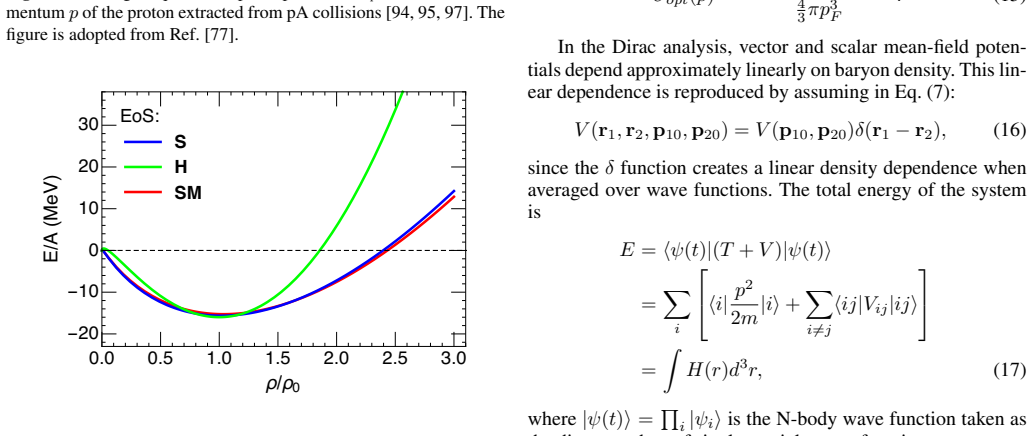
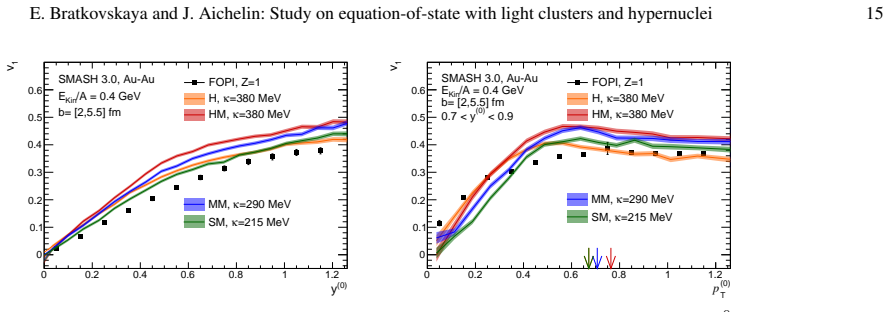
The central claim is that the momentum dependence of the nuclear mean-field potential is not a correction but a necessary part of any successful description of collective flow at SIS to 3 GeV beam energies. Within the PHQMD transport model, a soft momentum-dependent (SM) equation of state reproduces the HADES and FOPI v1 and v2 data for protons, deuterons, and tritons, whereas the same soft static potential systematically underestimates them. A hard static potential also gives acceptable flow, particularly for clusters, which is why the compressibility modulus K is not uniquely determined by flow alone. The reconciliation mechanism is that in a collision, a soft potential plus momentum depen
What carries the argument
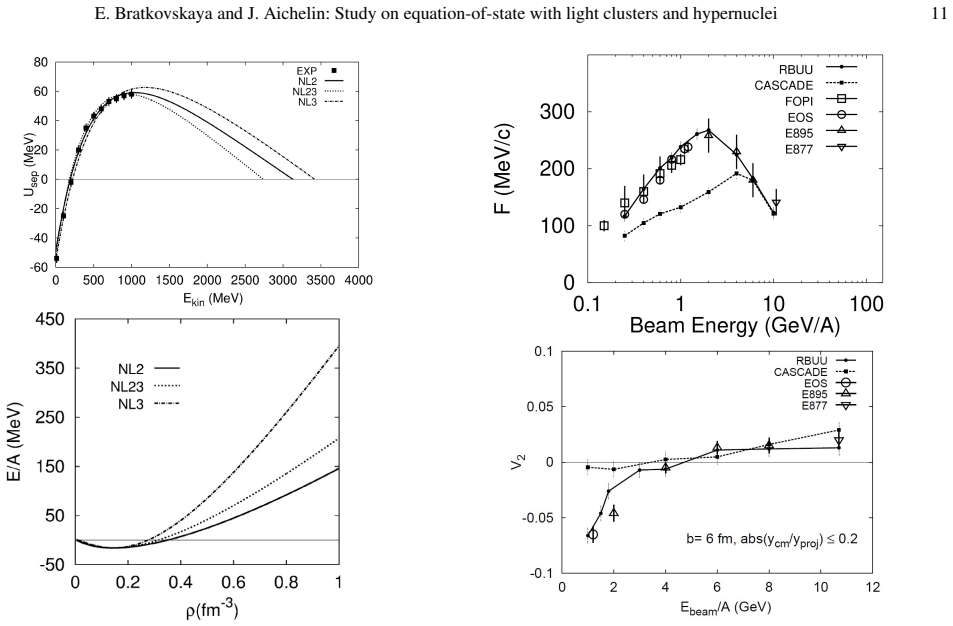
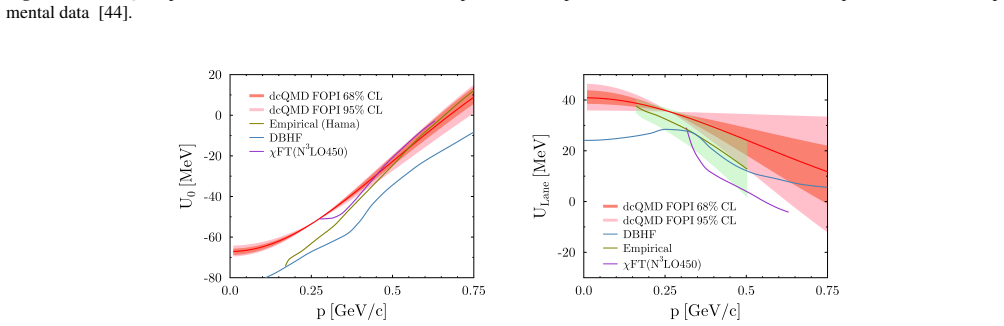
The load-bearing element is the Schrödinger-equivalent optical potential U_opt(p), reconstructed from elastic proton-nucleus scattering up to 1.04 GeV and extrapolated to higher momenta. In PHQMD this is converted into a two-body momentum-dependent potential V(p,p1) whose parameters are fixed so the zero-temperature EoS gives E/A(rho0) = -16 MeV with a chosen compressibility K. Because a soft static and a soft momentum-dependent parametrization share the same energy per nucleon E/A(rho), the extra momentum-dependent pressure generated during a collision is what brings the soft equation of state into agreement with data and mimics a hard static EoS. Cluster flow is extracted by identifying de
Load-bearing premise
The load-bearing assumption is that the momentum-dependent potential, which is measured only up to a proton kinetic energy of about 1 GeV, can be safely extrapolated to the higher momenta probed at sqrt(s_NN)=3 and 5.4 GeV; the paper's own Fig. 8 shows that this extrapolation changes cluster flow at the higher energy.
What would settle it
Measure the optical potential in elastic pA scattering for proton kinetic energies above 1 GeV up to a few GeV. If the measured U_opt(p) disagrees with parametrization I, the PHQMD flow predictions at sqrt(s_NN)=3 and especially 5.4 GeV shift; a high-precision measurement of deuteron v1(pT) or v2(pT) at high pT at sqrt(s_NN)=5.4 GeV would also settle which extrapolation is correct.
If this is right
- A purely soft static EoS is incompatible with SIS and sqrt(s_NN)=3 GeV flow data for protons and light clusters, so any future EoS extraction that ignores momentum dependence will be biased.
- A soft momentum-dependent EoS describes v1 and v2 of protons, deuterons, and tritons to within about 10% at SIS energies, establishing momentum dependence as a required ingredient.
- A hard static EoS produces nearly the same flow, particularly for clusters, so flow observables alone do not fix the compressibility modulus K.
- Including momentum dependence reconciles the K about 380 MeV inferred from Plastic Ball flow with the K about 200 MeV from giant monopole vibrations, suggesting the two measurements constrain the same underlying EoS.
- At sqrt(s_NN)=5.4 GeV, high-pT deuteron flow becomes sensitive to how U_opt(p) is extrapolated, making precision flow data and new elastic pA measurements a discriminating test.
Where Pith is reading between the lines
- A testable extension: if the optical potential is measured above 1 GeV and deviates from the parametrizations used here, the soft-momentum-dependent agreement may degrade, shifting the implied K back toward the hard side.
- The static-hard/soft-momentum-dependent degeneracy suggests that discriminating observables should target early-time pressure gradients—for example, subthreshold kaon yields, baryon stopping, or pT-differential ratios of cluster-to-proton flow—rather than v1/v2 alone.
- Hypernucleus flow carries a separate probe: because the Lambda hyperon feels a different potential than protons, flow of hypertritons and Lambda could test whether the momentum-dependence mechanism extends to the strangeness sector.
- A multi-model Bayesian comparison of the same data sets, as sketched at the end of the review, could quantify how much of the spread in extracted K comes from different implementations of momentum dependence rather than from the EoS itself.
Editorial analysis
A structured set of objections, weighed in public.
Referee Report
Summary. This manuscript is a review of transport-model constraints on the nuclear equation of state (EoS) extracted from collective flow of nucleons, light clusters, and hypernuclei in the few-GeV energy range. The authors present PHQMD results for Au+Au collisions at SIS energies (Ekin = 1.23 A GeV) and at sqrt(s_NN) = 3 and 5.4 GeV, compare them with HADES, FOPI, and STAR data, and contrast these results with pBUU, RBUU, IQMD, dcQMD, UrQMD, and SMASH. The central thesis is that a purely soft static EoS is disfavored, while a soft momentum-dependent (SM) EoS reproduces v1 and v2; a hard static EoS is often degenerate with SM, particularly for light clusters. The authors argue that momentum dependence reconciles the K about 380 MeV (Plastic Ball) and K about 200 MeV (giant monopole vibrations) compressibility values. The limitations are explicitly acknowledged: the optical potential U_opt is constrained only up to 1.04 GeV, model implementations of momentum dependence differ, and the EoS is defined for infinite cold matter while heavy-ion collisions probe hot, off-equilibrium systems.
Significance. If the conclusions hold, the review provides a useful consolidated statement: momentum dependence is indispensable, and few-GeV flow data are compatible with a soft EoS plus momentum dependence, with K not uniquely fixed. The paper's strengths are its explicit comparison across many transport codes, transparent reporting of model disagreements (e.g., SMASH hardening versus IQMD/PHQMD soft MD, Section 3.7), internally consistent parameter tables (Table 1), and a clear statement of limitations in Section 4. It is a synthetic review rather than a new measurement, and it is one of the few works placing PHQMD results in the broader transport-model context. The authors deserve credit for explicitly flagging the U_opt extrapolation problem and the model-dependent treatment of momentum dependence.
major comments (2)
- [Sec. 3.1.2, Figs. 8–10] The STAR comparison in Figs. 9 and 10 is performed only with Parametrization I of U_opt, as noted in Sec. 3.1.1 and 3.1.2. However, Fig. 8 demonstrates that v1(pT) and v2(pT) of deuterons at sqrt(s_NN) = 3 GeV already show visible splitting among Parametrizations I, II, and III at high pT, and the splitting grows at 5.4 GeV. Since the STAR data in Figs. 9–10 extend to several GeV/c, the conclusion that a soft momentum-dependent EoS provides a consistent description of STAR data is not yet shown to be robust against the documented lack of empirical constraints above 1.04 GeV (Sec. 2.2). The manuscript is transparent about this limitation, but the limitation is load-bearing because it sits exactly on the energy range used to extend the EoS constraint beyond SIS. Please either include the II/III variants in the STAR comparison, or explicitly restrict the STAR claim to the pT range where I/I
- [Sec. 4, Summary] The statement that 'the introduction of the momentum dependent potential reconciles the compressibility of both data sets' (K≈380 from Plastic Ball, K≈200 from GMR) is stronger than what the review demonstrates. The models are constructed with K=200 (S, SM) and K=380 (H) as inputs (Table 1), and the flow comparisons in Sec. 3 are qualitative; no single parametrization is shown to simultaneously reproduce both the Plastic Ball-era and GMR constraints in a quantitative fit. Given the paper's own caveats about model dependence and the extrapolated U_opt, the sentence should be softened to state that a soft MD EoS is compatible with both constraints within current uncertainties, unless a closure test is added. This is central to the summary and should be made precise.
minor comments (6)
- [Sec. 3.1.2] Typo: 'high precession data' should be 'high-precision data'.
- [Sec. 3.1.1, Fig. 5] The text refers to 'bottom right panel' of Fig. 5, but the figure appears to have only three panels (p, d, t). Update the reference or add the fourth panel.
- [Sec. 3.3] Typo: 'PHQMD framefork' should be 'PHQMD framework'.
- [Sec. 3.5] The sentence 'For cluster production a MST coalescence algorithm applied at the local freeze-out time (rather than during the entire simulation, as in PHQMD); and threshold effects for elastic scattering' is grammatically incomplete and should be revised.
- [References] References [54] and [56] are the same STAR paper and should be merged. References [76] and [77] are arXiv preprints; in a review they should be clearly labeled as such, and claims based on them should be distinguished from peer-reviewed literature.
- [Sec. 2.2, Fig. 1] The normalization U_opt(p=0)=0 and the relation between the proton kinetic energy epsilon in Eq. (12) and the total momentum p used in Fig. 1 should be stated explicitly.
Circularity Check
No significant circularity: PHQMD flow results are model predictions compared against external data, with EoS and optical-potential inputs fixed independently of the flow observables.
full rationale
The paper's derivation chain is: (i) the momentum-dependent optical potential U_opt is fitted to elastic pA scattering data (Section 2.2, Eq. 12 and Fig. 1); (ii) the static EoS parameters are fixed by nuclear matter saturation properties with K as a free parameter (Section 2.3, Eqs. 18-21 and Table 1); (iii) PHQMD transport then generates v1 and v2 for protons and clusters; (iv) these are compared to HADES, FOPI, and STAR data. No flow observable is used to fit the PHQMD parameters shown in the review, and the paper explicitly stresses that the soft and soft momentum-dependent EoS have identical E/A(ρ) by construction, so the flow differences between S and SM are genuine dynamical predictions rather than definitions. The two anchor studies [76,77] are self-citations from the same collaboration, but they are confronted with external experimental data and are complemented by independent models (IQMD, dcQMD, UrQMD, pBUU, RBUU, SMASH), so the central claim does not reduce to a self-citation chain. The limitation noted in Section 4 that high-momentum U_opt extrapolations 'rely on extrapolations constrained by comparisons with heavy-ion observables' is a stated uncertainty, and the paper actually shows sensitivity among three parametrizations (Fig. 8) and restricts its SIS conclusions to p<1 GeV/c where U_opt is data-constrained. This is a robustness caveat, not evidence that the flow predictions were fitted to the same data they are claimed to describe. Overall, the review is a self-contained model-data comparison with explicit and load-bearing caveats, but no circular step is exhibited.
Axiom & Free-Parameter Ledger
free parameters (7)
- Skyrme parameters alpha, beta, gamma for S/H/SM EoS =
S: -0.3835, 0.3295, 1.15; H: -0.1253, 0.071, 2.0; SM: -0.478, 0.4137, 1.1
- Momentum-dependent potential parameters a, b, c =
a=236.326 GeV^-1, b=-20.730 GeV^-3, c=0.901 GeV^-1
- High-momentum extrapolation parameters d, e, f (parametrization III) =
d=72.237 GeV, e=27.085, f=-1.722 GeV^-1
- Gaussian width L =
4.33 fm^2
- Density correction factor C =
adjusted numerically
- Cluster recognition and coalescence thresholds =
r_clus = 4 fm; 3.575 fm, 285 MeV/c
- SMASH momentum-dependent potential parameters C, Lambda (Eq. 27) =
see Table 1 of Ref. [35]
axioms (4)
- domain assumption N-body wave function factorizes as a direct product of single-particle Gaussian wave functions without antisymmetrization (Eq. 2, Section 2.1)
- domain assumption The Schrodinger-equivalent optical potential U_opt (Eq. 12) extracted from elastic pA scattering below 1.04 GeV describes the in-medium two-body NN potential at the densities and momenta of heavy-ion collisions, also in the extrapolated region.
- domain assumption Transport-model flow observables at few-GeV energies are governed by the mean-field potential (EoS input) to a degree that permits EoS discrimination despite other ingredients (collision parametrization, initial state).
- domain assumption Cluster flow reflects the flow of the constituent nucleons, so clusters can be used as EoS probes (mass-number scaling of v1).
read the original abstract
Heavy-ion collision experiments offer a unique opportunity to explore the early stages of the Universe by creating matter under extreme conditions of high temperature and baryon density. The properties of such matter are governed by the equation-of-state (EoS), which remains a central focus of investigation from both experimental and theoretical perspectives. Flow harmonics are among the most sensitive observables for probing the EoS, as they strongly reflect the underlying interactions and degrees of freedom of the system. In this article, we review the current status of our understanding of the EoS based on microscopic transport models, emphasizing comparisons with experimental data in the few GeV energy range.
Figures








Reference graph
Works this paper leans on
-
[1]
Gustafsson et al., Phys
H.A. Gustafsson et al., Phys. Rev. Lett.52, 1590 (1984)
1984
- [2]
-
[3]
F. Ozel, D. Psaltis, S. Ransom, P. Demorest, M. Alford, Astrophys. J. Lett.724, L199 (2010),1010.5790
Pith/arXiv arXiv 2010
-
[4]
R. Lastowiecki, D. Blaschke, H. Grigorian, S. Typel, Acta Phys. Polon. Supp.5, 535 (2012),1112.6430
Pith/arXiv arXiv 2012
-
[5]
S. Bogdanov et al., Astrophys. J. Lett.914, L15 (2021), 2104.06928
Pith/arXiv arXiv 2021
-
[6]
S. Bogdanov et al., Astrophys. J. Lett.887, L25 (2019), 1912.05706
Pith/arXiv arXiv 2019
-
[7]
S. Bogdanov et al., Astrophys. J. Lett.887, L26 (2019), 1912.05707
Pith/arXiv arXiv 2019
-
[8]
G. Raaijmakers et al., Astrophys. J. Lett.887, L22 (2019), 1912.05703
Pith/arXiv arXiv 2019
-
[9]
A. Bauswein, H.T. Janka, K. Hebeler, A. Schwenk, Phys. Rev. D86, 063001 (2012),1204.1888
Pith/arXiv arXiv 2012
-
[10]
E.R. Most, A. Motornenko, J. Steinheimer, V . Dexheimer, M. Hanauske, L. Rezzolla, H. Stoecker, Phys. Rev. D107, 043034 (2023),2201.13150
Pith/arXiv arXiv 2023
-
[11]
B.P. Abbott et al. (LIGO Scientific, Virgo), Phys. Rev. Lett.121, 161101 (2018),1805.11581
Pith/arXiv arXiv 2018
-
[12]
B.P. Abbott et al. (LIGO Scientific, Virgo), Astrophys. J. Lett.892, L3 (2020),2001.01761
Pith/arXiv arXiv 2020
-
[13]
Botermans, R
W. Botermans, R. Malfliet, Phys. Rept.198, 115 (1990)
1990
-
[14]
Fuchs, T
C. Fuchs, T. Waindzoch, A. Faessler, D.S. Kosov, Phys. Rev. C58, 2022 (1998)
2022
-
[15]
J.W. Holt, N. Kaiser, Phys. Rev. C95, 034326 (2017), 1612.04309
Pith/arXiv arXiv 2017
-
[16]
C. Gale, G. Bertsch, S. Das Gupta, Phys. Rev. C35, 1666 (1987)
1987
-
[17]
Aichelin, A
J. Aichelin, A. Rosenhauer, G. Peilert, H. Stoecker, W. Greiner, Phys. Rev. Lett.58, 1926 (1987)
1926
-
[18]
C.M. Ko, Q. Li, R.C. Wang, Phys. Rev. Lett.59, 1084 (1987)
1987
-
[19]
Aichelin, Phys
J. Aichelin, Phys. Rept.202, 233 (1991)
1991
-
[20]
Weber, B
K. Weber, B. Blaettel, W. Cassing, H.C. Doenges, A. Lang, T. Maruyama, U. Mosel, Nucl. Phys. A552, 571 (1993)
1993
-
[21]
P.K. Sahu, A. Hombach, W. Cassing, U. Mosel, Nucl. Phys. A640, 493 (1998),nucl-th/9801043
Pith/arXiv arXiv 1998
-
[22]
P. Danielewicz, R.A. Lacey, P.B. Gossiaux, C. Pinken- burg, P. Chung, J.M. Alexander, R.L. McGrath, Phys. Rev. Lett.81, 2438 (1998),nucl-th/9803047
Pith/arXiv arXiv 1998
-
[23]
C. Kuhrts, M. Beyer, P. Danielewicz, G. Ropke, Phys. Rev. C63, 034605 (2001),nucl-th/0009037
Pith/arXiv arXiv 2001
-
[24]
P.K. Sahu, W. Cassing, U. Mosel, A. Ohnishi, Nucl. Phys. A672, 376 (2000),nucl-th/9907002
Pith/arXiv arXiv 2000
-
[25]
W. Cassing, E.L. Bratkovskaya, S. Juchem, Nucl. Phys. A674, 249 (2000),nucl-th/0001024
Pith/arXiv arXiv 2000
-
[26]
P.K. Sahu, W. Cassing, Nucl. Phys. A712, 357 (2002), nucl-th/0208002
Pith/arXiv arXiv 2002
-
[27]
Y . Nara, T. Maruyama, H. Stoecker, Phys. Rev. C102, 024913 (2020),2004.05550
Pith/arXiv arXiv 2020
-
[28]
Molitoris, D
J.J. Molitoris, D. Hahn, H. Stoecker, Nucl. Phys. A447, 13C (1986)
1986
-
[29]
Cooper, S
E.D. Cooper, S. Hama, B.C. Clark, Phys. Rev. C80, 034605 (2009)
2009
-
[30]
A. Le F `evre, Y . Leifels, W. Reisdorf, J. Aichelin, C. Hart- nack, Nucl. Phys. A945, 112 (2016),1501.05246
Pith/arXiv arXiv 2016
-
[31]
P. Hillmann, J. Steinheimer, T. Reichert, V . Gaebel, M. Bleicher, S. Sombun, C. Herold, A. Limphirat, J. Phys. G47, 055101 (2020),1907.04571
Pith/arXiv arXiv 2020
-
[32]
Welke, M
G.M. Welke, M. Prakash, T.T.S. Kuo, S. Das Gupta, C. Gale, Phys. Rev. C38, 2101 (1988)
1988
-
[33]
Gale, G.M
C. Gale, G.M. Welke, M. Prakash, S.J. Lee, S. Das Gupta, Phys. Rev. C41, 1545 (1990)
1990
-
[34]
J.m. Zhang, S. Das Gupta, C. Gale, Phys. Rev. C50, 1617 (1994),nucl-th/9405006
Pith/arXiv arXiv 1994
-
[35]
L.A. Tarasovi ˇcov´a, J. Mohs, A. Andronic, H. Elfner, K.H. Kampert (2024),2405.09889
Pith/arXiv arXiv 2024
-
[36]
J. Mohs, S. Spies, H. Elfner (2024),2409.16927
Pith/arXiv arXiv 2024
-
[37]
Cassing, A
W. Cassing, A. Lang, S. Teis, K. Weber, Nucl. Phys. A 545, 123C (1992)
1992
-
[38]
Bleicher, E
M. Bleicher, E. Bratkovskaya, Prog. Part. Nucl. Phys. 122, 103920 (2022)
2022
-
[39]
H. Wolter et al. (TMEP), Prog. Part. Nucl. Phys.125, 103962 (2022),2202.06672
arXiv 2022
-
[40]
A. Sorensen et al., Prog. Part. Nucl. Phys.134, 104080 (2024),2301.13253
Pith/arXiv arXiv 2024
- [41]
-
[42]
J. Adamczewski-Musch et al. (HADES), Phys. Rev. Lett. 125, 262301 (2020),2005.12217
Pith/arXiv arXiv 2020
-
[43]
J. Adamczewski-Musch et al. (HADES), Eur. Phys. J. A 59, 80 (2023),2208.02740
Pith/arXiv arXiv 2023
-
[44]
W. Reisdorf et al. (FOPI), Nucl. Phys. A876, 1 (2012), 1112.3180
Pith/arXiv arXiv 2012
- [45]
- [46]
-
[47]
M.I. Abdulhamid et al. (STAR), JHEP10, 139 (2024), 2407.10110
Pith/arXiv arXiv 2024
- [48]
- [49]
- [50]
-
[51]
W. Reisdorf et al. (FOPI), Nucl. Phys. A848, 366 (2010), 1005.3418
Pith/arXiv arXiv 2010
-
[52]
Anticic et al
T. Anticic et al. (NA49), Phys. Rev. C69, 024902 (2004)
2004
-
[53]
T. Anticic et al. (NA49), Phys. Rev. C94, 044906 (2016), 1606.04234 18 E. Bratkovskaya and J. Aichelin: Study on equation-of-state with light clusters and hypernuclei
Pith/arXiv arXiv 2016
- [55]
- [56]
-
[57]
J. Adamczewski-Musch et al. (HADES), Eur. Phys. J. A 56, 259 (2020),2005.08774
Pith/arXiv arXiv 2020
-
[58]
M. Abdulhamid et al. (STAR), Phys. Rev. Lett.130, 202301 (2023),2209.08058
arXiv 2023
-
[59]
A. Andronic, P. Braun-Munzinger, J. Stachel, H. Stocker, Phys. Lett. B697, 203 (2011),1010.2995
Pith/arXiv arXiv 2011
-
[60]
Butler, C.A
S.T. Butler, C.A. Pearson, Phys. Rev.129, 836 (1963)
1963
- [61]
-
[62]
W. Zhao, C. Shen, C.M. Ko, Q. Liu, H. Song, Phys. Rev. C102, 044912 (2020),2009.06959
Pith/arXiv arXiv 2020
-
[63]
K.J. Sun, R. Wang, C.M. Ko, Y .G. Ma, C. Shen (2021), 2106.12742
Pith/arXiv arXiv 2021
-
[64]
S. Sombun, K. Tomuang, A. Limphirat, P. Hillmann, C. Herold, J. Steinheimer, Y . Yan, M. Bleicher, Phys. Rev. C99, 014901 (2019),1805.11509
Pith/arXiv arXiv 2019
-
[65]
V . Kireyeu, J. Steinheimer, J. Aichelin, M. Bleicher, E. Bratkovskaya, Phys. Rev. C105, 044909 (2022), 2201.13374
Pith/arXiv arXiv 2022
-
[66]
J. Aichelin, E. Bratkovskaya, A. Le F `evre, V . Kireyeu, V . Kolesnikov, Y . Leifels, V . V oronyuk, G. Coci, Phys. Rev. C101, 044905 (2020),1907.03860
Pith/arXiv arXiv 2020
-
[67]
S. Gl ¨aßel, V . Kireyeu, V . V oronyuk, J. Aichelin, C. Blume, E. Bratkovskaya, G. Coci, V . Kolesnikov, M. Winn, Phys. Rev. C105, 014908 (2022), 2106.14839
Pith/arXiv arXiv 2022
-
[68]
G. Coci, S. Gl ¨aßel, V . Kireyeu, J. Aichelin, C. Blume, E. Bratkovskaya, V . Kolesnikov, V . V oronyuk, Phys. Rev. C108, 014902 (2023),2303.02279
Pith/arXiv arXiv 2023
-
[69]
Danielewicz, G.F
P. Danielewicz, G.F. Bertsch, Nucl. Phys. A533, 712 (1991)
1991
-
[70]
Danielewicz, Q.b
P. Danielewicz, Q.b. Pan, Phys. Rev. C46, 2002 (1992)
2002
-
[71]
D. Oliinychenko, C. Shen, V . Koch, Phys. Rev. C103, 034913 (2021),2009.01915
Pith/arXiv arXiv 2021
-
[72]
J. Staudenmaier, D. Oliinychenko, J.M. Torres- Rincon, H. Elfner, Phys. Rev. C104, 034908 (2021), 2106.14287
Pith/arXiv arXiv 2021
-
[73]
R. Wang, Y .G. Ma, L.W. Chen, C.M. Ko, K.J. Sun, Z. Zhang, Phys. Rev. C108, L031601 (2023), 2305.02988
Pith/arXiv arXiv 2023
-
[74]
M. Ege, J. Mohs, J. Staudenmaier, H. Elfner (2024), 2409.04209
Pith/arXiv arXiv 2024
-
[75]
Kireyeu, G
V . Kireyeu, G. Coci, S. Gl ¨aßel, J. Aichelin, C. Blume, E. Bratkovskaya, Phys. Rev. C109, 044906 (2024)
2024
-
[76]
V . Kireyeu, V . V oronyuk, M. Winn, S. Gl¨aßel, J. Aiche- lin, C. Blume, E. Bratkovskaya, G. Coci, J. Zhao (2024), 2411.04969
Pith/arXiv arXiv 2024
- [77]
-
[78]
J. Steinheimer, T. Reichert, Y . Nara, M. Bleicher (2024), 2410.01742
Pith/arXiv arXiv 2024
-
[79]
P. Danielewicz, Nucl. Phys. A673, 375 (2000), nucl-th/9912027
Pith/arXiv arXiv 2000
-
[80]
P. Danielewicz, R. Lacey, W.G. Lynch, Science298, 1592 (2002),nucl-th/0208016
Pith/arXiv arXiv 2002
-
[81]
C. Hartnack, R.K. Puri, J. Aichelin, J. Konopka, S.A. Bass, H. Stoecker, W. Greiner, Eur. Phys. J. A1, 151 (1998),nucl-th/9811015
Pith/arXiv arXiv 1998
discussion (0)
Sign in with ORCID, Apple, or X to comment. Anyone can read and Pith papers without signing in.