REVIEW 4 major objections 5 minor 31 references
S-BEVLoc: BEV-based Self-supervised Framework for Large-scale LiDAR Global Localization
T0 review · 4 major / 5 minor · reviewed 2026-08-04 · deepseek-v4-flash
Pith's one-line read S-BEVLoc claims a self-supervised LiDAR global localization pipeline that needs no ground-truth poses can match or beat supervised approaches on KITTI and NCLT.
desk verdict Genuinely novel self-supervised training signal for LiDAR place recognition, with strong cross-dataset results; the main weak point is the unvalidated proxy that single-scan patch shifts stand in for inter-scan views, plus test-set hyperparameter tuning. read the letter →
The pith
A machine-rendered reading of the paper's core claim, the machinery that carries it, and where it could break.
The reading
What carries the argument
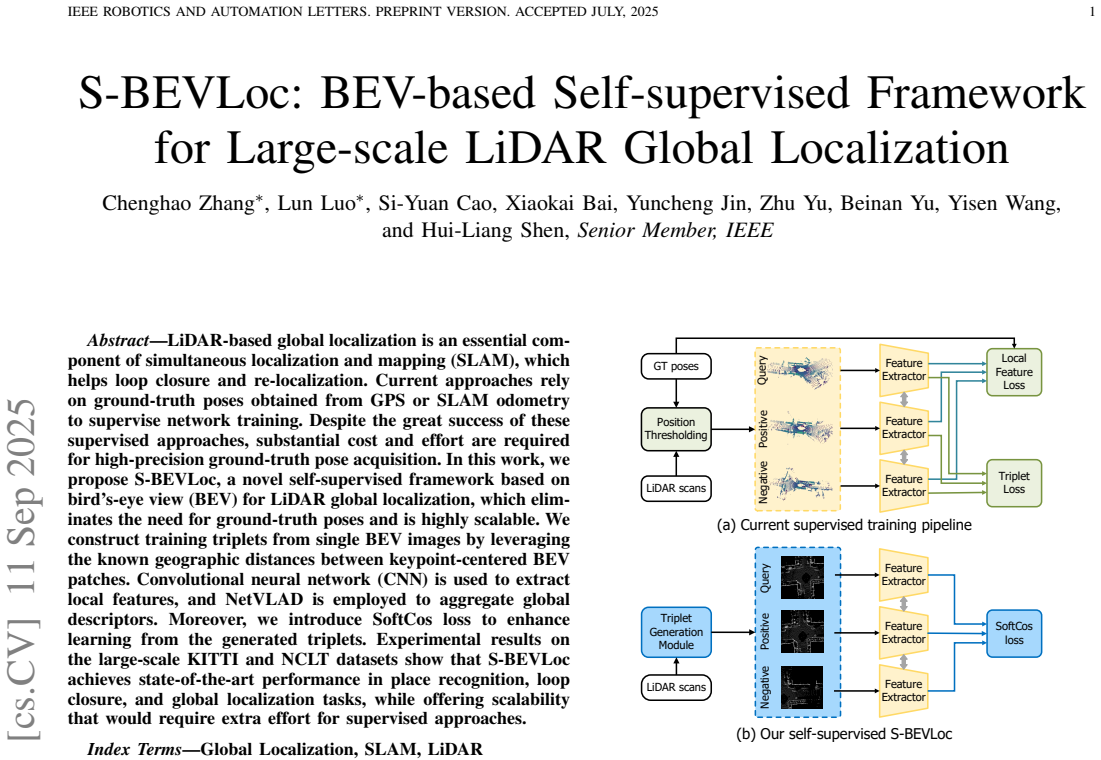
The central mechanism is the triplet generation module: FAST keypoints are detected on a single BEV image, a query point is paired with a positive patch within 5 m and negative patches farther away, all cropped from the same image. This converts known pixel distances into pseudo-geographic labels without any pose. The resulting triplets are fed through a CNN with a rotation-equivariant module and NetVLAD aggregation, trained with SoftCos loss—a softplus-margin, cosine-similarity loss that keeps learning signals from noisy hard negatives.
What would settle it
Take a single KITTI scan, crop a patch 5 m from the keypoint, and compare the network's descriptor distance between that intra-scan pair against an actual LiDAR scan taken 5 m away at the same place: if the intra-scan distance is systematically far smaller than the real inter-scan distance, the training signal has learned an easier shortcut rather than true place invariance.
Extended reading notes
Core claim
The paper claims that the supervision signal for LiDAR global localization can be generated entirely inside one bird's-eye-view image. It constructs hard triplets from patches centered on FAST keypoints, using the known BEV resolution as a distance ruler: any patch within 5 m is a positive and any patch farther away is a negative. Trained with a new SoftCos loss, the resulting descriptors perform place retrieval, loop closure, and pose estimation at levels comparable to or better than supervised counterparts on KITTI and NCLT, and the model can be trained on additional sequences that have no ground-truth poses to improve generalization further.
Load-bearing premise
The load-bearing assumption is that a patch cropped from the same BEV image just a few meters away behaves like a different scan of the same place; if that proxy diverges under occlusion, slopes, or height changes, the self-supervision no longer teaches the network what it needs for cross-scan recognition.
Editorial extensions
If this is right
- Training on unlabeled KITTI sequences 11-21, which lack ground-truth poses, improves cross-dataset recall, indicating that scalability enhances generalization.
- On the long-term NCLT benchmark, the self-supervised model reports higher Top-1 recall than the supervised baselines tested.
- The method runs above 20 Hz on a single GPU, making it suitable for real-time deployment with 10 Hz LiDAR sensors.
- Ablations show that FAST-keypoint selection and SoftCos loss each contribute, outperforming random patch selection and the lazy triplet loss.
- Rotation robustness is preserved: on randomly rotated KITTI scans recall remains around 99 percent.
Reading between the lines
- Editorial: Since training uses only single scans, any unlabeled robot log becomes usable data, so accuracy could keep improving with data volume—a property supervised pipelines lack.
- Editorial: The intra-scan proxy suggests a direct stress test: introduce synthetic occlusions or dynamic objects into BEV patches during training to see if the proxy remains a faithful substitute for true inter-scan positives.
- Editorial: SoftCos's softplus adaptive margin could transfer to other self-supervised metric-learning problems with noisy triplets, not only LiDAR place recognition.
- Editorial: The paper leaves slope variation as future work; on hilly terrain the BEV projection distorts distances, so the 5 m threshold may no longer correspond to geographic distance, a limitation worth testing.
Editorial analysis
A structured set of objections, weighed in public.
Referee Report
Summary. The paper proposes S-BEVLoc, a self-supervised framework for LiDAR global localization that operates on bird's-eye-view (BEV) images and requires no ground-truth poses for training. Training triplets are constructed by selecting FAST keypoints in a single BEV image, using known geographic distances within that image to define positives (within D_TH) and negatives (beyond D_TH), and cropping r x r patches around those keypoints. The feature extractor combines a CNN with a rotation-equivariant module and NetVLAD, trained with a proposed SoftCos loss. At inference, place recognition is performed by global descriptor nearest-neighbor search, followed by RANSAC-based pose estimation using local features. Experiments on KITTI and NCLT report place recognition, loop closure, and global localization results comparable to or better than supervised baselines, with a variant S-BEVLoc* trained on additional sequences without ground-truth poses. The central claim is that fully self-supervised LiDAR global localization is feasible and scalable.
Significance. If the central claim holds, the paper makes a nontrivial contribution: it removes the need for expensive ground-truth pose acquisition in learning-based LiDAR global localization, which would substantially improve scalability. The idea of deriving supervision from known geographic distances within a single BEV image is original, and the experimental coverage is broad, including KITTI, NCLT, rotation robustness, loop closure, and runtime. The authors also introduce a plausible loss modification (SoftCos) and provide ablations. However, the validity of the load-bearing assumption—that intra-scan translated patches are faithful proxies for independent scans of the same place—is not convincingly established, and the experimental evaluation has protocol weaknesses that affect the strength of the claims. The paper is therefore potentially significant, but the current evidence does not fully support the conclusions.
major comments (4)
- [§III-B, Step 4; §IV-B] The training proxy is the load-bearing element of the self-supervision claim, yet it is only weakly validated. With patch size r=200 equal to the full 200x200 BEV image, every training 'patch' is the same full BEV image shifted so that a keypoint lies at the center, with zero-padding outside the image. A positive differs from the query by a shift under D_TH=5 m; negatives differ by larger shifts. The SoftCos objective can therefore be minimized by encoding the zero-padding/shift pattern alone, without learning that two independent scans of the same place have similar descriptors. The only direct evidence for the proxy, Fig. 4, is a single trajectory and does not exercise occlusions, dynamic objects, different sensor heights, or slopes—the last of which the conclusion lists as a limitation. If the training signal is dominated by this padding artifact, the reported cross-dataset generaliza
- [§IV-G, Tables VI-X] Hyperparameters are selected using the evaluation test sequences themselves. Tables VI, VII, VIII, IX, and X report recall on KITTI 08 and NCLT 2012-06-15/2012-09-28/2012-11-16/2013-02-23, and the text states that the best configuration is chosen (e.g., 'S-BEVLoc performs the best when D_TH = 5 m, which aligns with the defined positive threshold'). Because these same sequences are used to report the main results in Tables I-V, the model selection leaks test information and inflates the generalization claims, particularly the cross-dataset results in Table III. The evaluation protocol should be corrected by tuning on a separate validation split (e.g., KITTI sequences not used in the main test set, or an NCLT sequence excluded from the reported tables) and reporting results on the test sequences only once. This is a load-bearing issue for the claimed superiority over supervised baselines.
- [§III-B, 'Effect Illustration'; Contributions] The paper claims to 'statistically validate' that the constructed triplets are hard triplets, but the only evidence is Fig. 4, which shows a single local trajectory from KITTI sequence 00. This is an anecdotal illustration, not a statistical validation. The authors should provide quantitative evidence over many queries and sequences—for example, the fraction of negatives whose descriptor distance is smaller than the positive distance before and after training, or a histogram of relative distances. Without such evidence, the claim that the triplet generation strategy reliably produces hard triplets is not supported. This also weakens the motivation for the SoftCos loss, which is designed specifically for the properties of these triplets.
- [§IV, Comparisons] The fairness of the comparison with supervised baselines is not fully documented. The paper does not state which sequences or data were used to train the supervised baselines (BEVPlace, BEVPlace++, LCDNet, LoGG3D-Net, CVTNet) or whether they were retrained under the same conditions. Since the contribution is about self-supervision, it is important to know whether the baselines were trained on the same KITTI data, on more data, or on their original training splits. If, for example, BEVPlace++ was trained with ground-truth poses on many sequences while S-BEVLoc is trained on sequence 00 alone, the comparison is still informative but should be stated explicitly. The authors should report the training data and protocol for each baseline or cite the exact numbers from the original papers, and discuss any differences in data scale.
minor comments (5)
- [Eq. (3) and §III-C] The softplus formula uses tau both as a temperature and inside the log; consider writing it as Softplus(x) = tau * log(1 + exp(x/tau)) to avoid ambiguity. Also, the claim that cosine similarity 'mitigates the curse of dimensionality' is not substantiated by a citation or analysis; it should be either removed or supported.
- [Fig. 4] The sign of the geographic distance is described as indicating chronological order, but the figure does not label which side is forward/backward. Adding axis labels and a legend would improve interpretability.
- [§IV-A] The evaluation threshold for a 'true positive' is 5 m, which is the same as the training D_TH. This alignment is not circular, but it should be explicitly discussed, especially since D_TH is tuned on test sequences (see major comment 2).
- [§IV-E] The loop closure evaluation says 'excluding the 100 most recent frames,' but it is not clear whether this exclusion is applied to the database construction, the query set, or both. The exact protocol should be stated.
- [Throughout] Several tables (e.g., Table IV) have very dense formatting with many columns. Splitting the table or adding row/column separators would improve readability. Also, the caption of Fig. 1 mentions 'Local Feature Loss' but the final method does not use a local feature loss; this should be corrected.
Circularity Check
No significant circularity: the self-supervised training signal is derived from intra-scan geographic distances and is validated by external benchmarks; the BEVPlace++ citation is not load-bearing.
full rationale
The paper's training triplets are constructed from keypoint-centered patches in a single BEV image using the known pixel-to-metric resolution (Sec. III-B, Steps 1-4), which does not require ground-truth poses. The SoftCos loss (Eq. 3) is a loss on descriptor similarities, not an evaluation metric. The claim of state-of-the-art performance is supported by experiments on KITTI and NCLT against external supervised baselines (Tables I-V). The only overlapping-citation component is the REM feature extractor taken from BEVPlace++ [5]; however, the paper evaluates the resulting localization performance (Tables IV-V) and compares it with supervised methods, so the citation is not the sole evidence. The use of D_TH = 5 m in both triplet generation and evaluation is a shared distance convention/standard positive threshold, not a fitted parameter renamed as a prediction: training positives are same-scan patches within 5 m, while evaluation positives are independent scans within 5 m, and the model's cross-dataset generalization to NCLT supports that the objective is not equivalent to the test metric. Thus no circular step can be exhibited. The r = 200 patch-size concern is a potential shortcut/robustness issue, not a circularity per the specified patterns.
Assumptions & free parameters
free parameters (8)
- D_TH (positive distance threshold) =
5 m
- tau (softplus temperature) =
0.1
- m (number of negatives) =
10
- r (patch size) =
200
- voxel size in BEV projection =
0.4 m
- number of rotations in REM =
8
- NetVLAD clusters =
64
- learning rate / epochs =
1e-4, 50
assumptions (5)
- domain assumption BEV image is an orthographic top-down projection with a known uniform scale (0.4 m per pixel)
- domain assumption A translated patch from the same BEV scan is an adequate proxy for a different scan of the same place within D_TH meters
- domain assumption FAST keypoints on BEV images are repeatable and correspond to texture-rich locations that benefit place recognition
- domain assumption The REM module provides rotation-equivariant features useful without direct local feature supervision
- ad hoc to paper Training and evaluation positive thresholds should coincide (D_TH = 5 m)
Cite this review
Pith. "Pith review of S-BEVLoc: BEV-based Self-supervised Framework for Large-scale LiDAR Global Localization." pith.science (2026). https://pith.science/paper/X3WMHHW7
@misc{pith2026250909110,
  author       = {Pith},
  title        = {Pith review of: S-BEVLoc: BEV-based Self-supervised Framework for Large-scale LiDAR Global Localization},
  year         = {2026},
  howpublished = {\url{https://pith.science/paper/X3WMHHW7}},
  note         = {Machine review of arXiv:2509.09110}
}
read the original abstract
LiDAR-based global localization is an essential component of simultaneous localization and mapping (SLAM), which helps loop closure and re-localization. Current approaches rely on ground-truth poses obtained from GPS or SLAM odometry to supervise network training. Despite the great success of these supervised approaches, substantial cost and effort are required for high-precision ground-truth pose acquisition. In this work, we propose S-BEVLoc, a novel self-supervised framework based on bird's-eye view (BEV) for LiDAR global localization, which eliminates the need for ground-truth poses and is highly scalable. We construct training triplets from single BEV images by leveraging the known geographic distances between keypoint-centered BEV patches. Convolutional neural network (CNN) is used to extract local features, and NetVLAD is employed to aggregate global descriptors. Moreover, we introduce SoftCos loss to enhance learning from the generated triplets. Experimental results on the large-scale KITTI and NCLT datasets show that S-BEVLoc achieves state-of-the-art performance in place recognition, loop closure, and global localization tasks, while offering scalability that would require extra effort for supervised approaches.
Figures


Figures from the paper (2 more)


Reference graph
Works this paper leans on
-
[1]
A Survey on Global LiDAR Localization: Challenges, Advances and Open Problems,
H. Yin, X. Xu, S. Lu, X. Chen, R. Xiong, S. Shen, C. Stachniss, and Y . Wang, “A Survey on Global LiDAR Localization: Challenges, Advances and Open Problems,”International Journal of Computer Vision, pp. 1–33, 2024
2024
-
[2]
EgoNN: Egocentric Neural Network for Point Cloud Based 6DoF Relocalization at the City Scale,
J. Komorowski, M. Wysoczanska, and T. Trzcinski, “EgoNN: Egocentric Neural Network for Point Cloud Based 6DoF Relocalization at the City Scale,”IEEE Robotics and Automation Letters, vol. 7, no. 2, pp. 722– 729, 2021
2021
-
[3]
LCDNet: Deep Loop Closure Detection and Point Cloud Registration for LiDAR SLAM,
D. Cattaneo, M. Vaghi, and A. Valada, “LCDNet: Deep Loop Closure Detection and Point Cloud Registration for LiDAR SLAM,”IEEE Transactions on Robotics, vol. 38, no. 4, pp. 2074–2093, 2022
-
[4]
Fast and Accurate Deep Loop Closing and Relocalization for Reliable LiDAR SLAM,
C. Shi, X. Chen, J. Xiao, B. Dai, and H. Lu, “Fast and Accurate Deep Loop Closing and Relocalization for Reliable LiDAR SLAM,”IEEE Transactions on Robotics, 2024
2024
-
[5]
BEV- Place++: Fast, Robust, and Lightweight LiDAR Global Localization for Unmanned Ground Vehicles,
L. Luo, S. Cao, X. Li, J. Xu, R. Ai, Z. Yu, and X. Chen, “BEV- Place++: Fast, Robust, and Lightweight LiDAR Global Localization for Unmanned Ground Vehicles,”arXiv preprint arXiv:2408.01841, 2024
arXiv 2024
-
[6]
LoGG3D-Net: Locally Guided Global Descriptor Learning for 3D Place Recognition,
K. Vidanapathirana, M. Ramezani, P. Moghadam, S. Sridharan, and C. Fookes, “LoGG3D-Net: Locally Guided Global Descriptor Learning for 3D Place Recognition,” inProceedings of the IEEE International Conference on Robotics and Automation. IEEE, 2022, pp. 2215–2221
2022
-
[7]
Are we ready for autonomous driving? The KITTI vision benchmark suite,
A. Geiger, P. Lenz, and R. Urtasun, “Are we ready for autonomous driving? The KITTI vision benchmark suite,” inProceedings of the IEEE/CVF Conference on Computer Vision and Pattern Recognition. IEEE, 2012, pp. 3354–3361
2012
-
[8]
University of Michigan North Campus Long-Term Vision and Lidar Dataset,
N. Carlevaris-Bianco, A. K. Ushani, and R. M. Eustice, “University of Michigan North Campus Long-Term Vision and Lidar Dataset,”The International Journal of Robotics Research, vol. 35, no. 9, pp. 1023– 1035, 2016
2016
Show all 31 references
-
[9]
LiDAR-Based Place Recognition For Autonomous Driving: A Survey,
Y . Zhang, P. Shi, and J. Li, “LiDAR-Based Place Recognition For Autonomous Driving: A Survey,”ACM Computing Surveys, 2023
2023
-
[10]
3D Point Cloud-based Place Recognition: A Survey,
K. Luo, H. Yu, X. Chen, Z. Yang, J. Wang, P. Cheng, and A. Mian, “3D Point Cloud-based Place Recognition: A Survey,”Artificial Intelligence Review, vol. 57, no. 4, p. 83, 2024
2024
-
[11]
M2DP: A novel 3D point cloud descriptor and its application in loop closure detection,
L. He, X. Wang, and H. Zhang, “M2DP: A novel 3D point cloud descriptor and its application in loop closure detection,” inProceedings of the IEEE/RSJ International Conference on Intelligent Robots and Systems. IEEE, 2016, pp. 231–237
2016
-
[12]
BVMatch: Lidar-Based Place Recognition Using Bird’s-Eye View Images,
L. Luo, S.-Y . Cao, B. Han, H.-L. Shen, and J. Li, “BVMatch: Lidar-Based Place Recognition Using Bird’s-Eye View Images,”IEEE Robotics and Automation Letters, vol. 6, no. 3, pp. 6076–6083, 2021
2021
-
[13]
Bags of Binary Words for Fast Place Recognition in Image Sequences,
D. G ´alvez-L´opez and J. D. Tardos, “Bags of Binary Words for Fast Place Recognition in Image Sequences,”IEEE Transactions on Robotics, vol. 28, no. 5, pp. 1188–1197, 2012
2012
-
[14]
BoW3D: Bag of Words for Real-Time Loop Closing in 3D LiDAR SLAM,
Y . Cui, X. Chen, Y . Zhang, J. Dong, Q. Wu, and F. Zhu, “BoW3D: Bag of Words for Real-Time Loop Closing in 3D LiDAR SLAM,”IEEE Robotics and Automation Letters, vol. 8, no. 5, pp. 2828–2835, 2022
2022
-
[15]
LinK3D: Linear Keypoints Representation for 3D LiDAR Point Cloud,
Y . Cui, Y . Zhang, J. Dong, H. Sun, X. Chen, and F. Zhu, “LinK3D: Linear Keypoints Representation for 3D LiDAR Point Cloud,”IEEE Robotics and Automation Letters, 2024
2024
-
[16]
3D-BBS: Global Localization for 3D Point Cloud Scan Matching Using Branch-and-Bound Algorithm,
K. Aoki, K. Koide, S. Oishi, M. Yokozuka, A. Banno, and J. Meguro, “3D-BBS: Global Localization for 3D Point Cloud Scan Matching Using Branch-and-Bound Algorithm,” inProceedings of the IEEE Interna- tional Conference on Robotics and Automation. IEEE, 2024, pp. 1796– 1802
2024
-
[17]
Narrowing Your FOV With SOLiD: Spatially Organized and Lightweight Global Descriptor for FOV Constrained LiDAR Place Recognition,
H. Kim, J. Choi, T. Sim, G. Kim, and Y . Cho, “Narrowing Your FOV With SOLiD: Spatially Organized and Lightweight Global Descriptor for FOV Constrained LiDAR Place Recognition,”IEEE Robotics and Automation Letters, 2024
2024
-
[18]
OverlapNet: a siamese network for computing LiDAR scan similarity with applications to loop closing and localization,
X. Chen, T. L ¨abe, A. Milioto, T. R ¨ohling, J. Behley, and C. Stachniss, “OverlapNet: a siamese network for computing LiDAR scan similarity with applications to loop closing and localization,”Autonomous Robots, pp. 1–21, 2022
2022
-
[19]
OverlapTransformer: An Efficient and Yaw-Angle-Invariant Transformer Network for LiDAR- Based Place Recognition,
J. Ma, J. Zhang, J. Xu, R. Ai, W. Gu, and X. Chen, “OverlapTransformer: An Efficient and Yaw-Angle-Invariant Transformer Network for LiDAR- Based Place Recognition,”IEEE Robotics and Automation Letters, vol. 7, no. 3, pp. 6958–6965, 2022
2022
-
[20]
Detailed Analysis on Generating the Range Image for LiDAR Point Cloud Processing,
T. Wu, H. Fu, B. Liu, H. Xue, R. Ren, and Z. Tu, “Detailed Analysis on Generating the Range Image for LiDAR Point Cloud Processing,” Electronics, vol. 10, no. 11, p. 1224, 2021
2021
-
[21]
BEVPlace: Learning LiDAR-based Place Recognition using Bird’s Eye View Images,
L. Luo, S. Zheng, Y . Li, Y . Fan, B. Yu, S.-Y . Cao, J. Li, and H.- L. Shen, “BEVPlace: Learning LiDAR-based Place Recognition using Bird’s Eye View Images,” inProceedings of the IEEE/CVF International Conference on Computer Vision, 2023, pp. 8700–8709
2023
-
[22]
SG- LPR: Semantic-Guided LiDAR-Based Place Recognition,
W. Jiang, H. Xue, S. Si, C. Min, L. Xiao, Y . Nie, and B. Dai, “SG- LPR: Semantic-Guided LiDAR-Based Place Recognition,”Electronics, vol. 13, no. 22, 2024
2024
-
[23]
NetVLAD: CNN architecture for weakly supervised place recognition,
R. Arandjelovic, P. Gronat, A. Torii, T. Pajdla, and J. Sivic, “NetVLAD: CNN architecture for weakly supervised place recognition,” inPro- ceedings of the IEEE Conference on Computer Vision and Pattern Recognition, 2016, pp. 5297–5307
2016
-
[24]
CVTNet: A Cross-View Trans- former Network for LiDAR-Based Place Recognition in Autonomous Driving Environments,
J. Ma, G. Xiong, J. Xu, and X. Chen, “CVTNet: A Cross-View Trans- former Network for LiDAR-Based Place Recognition in Autonomous Driving Environments,”IEEE Transactions on Industrial Informatics, 2023
2023
-
[25]
ALSO: Automotive Lidar Self-supervision by Occupancy estimation,
A. Boulch, C. Sautier, B. Michele, G. Puy, and R. Marlet, “ALSO: Automotive Lidar Self-supervision by Occupancy estimation,” inPro- ceedings of the IEEE/CVF Conference on Computer Vision and Pattern Recognition, 2023, pp. 13 455–13 465
2023
-
[26]
SGDet3D: Semantics and Geometry Fusion for 3D Object Detection Using 4D Radar and Camera,
X. Bai, Z. Yu, L. Zheng, X. Zhang, Z. Zhou, X. Zhang, F. Wang, J. Bai, and H.-L. Shen, “SGDet3D: Semantics and Geometry Fusion for 3D Object Detection Using 4D Radar and Camera,”IEEE Robotics and Automation Letters, 2024
2024
-
[27]
BEVContrast: Self-Supervision in BEV Space for Automotive Lidar Point Clouds,
C. Sautier, G. Puy, A. Boulch, R. Marlet, and V . Lepetit, “BEVContrast: Self-Supervision in BEV Space for Automotive Lidar Point Clouds,” in International Conference on 3D Vision. IEEE, 2024, pp. 559–568
2024
-
[28]
Training Region-based Object Detectors with Online Hard Example Mining,
A. Shrivastava, A. Gupta, and R. Girshick, “Training Region-based Object Detectors with Online Hard Example Mining,” inProceedings of the IEEE/CVF Conference on Computer Vision and Pattern Recognition, 2016, pp. 761–769
2016
-
[29]
Machine learning for high-speed corner detection,
E. Rosten and T. Drummond, “Machine learning for high-speed corner detection,” inProceedings of the European Conference on Computer Vision. Springer, 2006, pp. 430–443
2006
-
[30]
PointNetVLAD: Deep Point Cloud Based Retrieval for Large-Scale Place Recognition,
M. A. Uy and G. H. Lee, “PointNetVLAD: Deep Point Cloud Based Retrieval for Large-Scale Place Recognition,” inProceedings of the IEEE/CVF Conference on Computer Vision and Pattern Recognition, 2018, pp. 4470–4479
2018
-
[31]
Directional Statistics-based Deep Metric Learning for Image Classification and Retrieval,
X. Zhe, S. Chen, and H. Yan, “Directional Statistics-based Deep Metric Learning for Image Classification and Retrieval,”Pattern Recognition, vol. 93, pp. 113–123, 2019
2019
Reviewed August 4, 2026 · model on record in the stance chip above.
Discussion (0). Sign in to comment.