REVIEW 4 major objections 6 minor 44 references
CoAtNeXt:An Attention-Enhanced ConvNeXtV2-Transformer Hybrid Model for Gastric Tissue Classification
T0 review · 4 major / 6 minor · reviewed 2026-08-04 · deepseek-v4-flash
Pith's one-line read A hybrid model called CoAtNeXt, built by combining improved ConvNeXtV2 blocks with CoAtNet's transformer stages, reports state-of-the-art classification accuracy on two public gastric histopathology datasets.
desk verdict A sensible hybrid CNN-transformer for gastric histopathology with a clean ablation, but the missing slide-aware cross-validation details and no error bars leave the superiority claim unverified. read the letter →
The pith
A machine-rendered reading of the paper's core claim, the machinery that carries it, and where it could break.
The reading
What carries the argument
The load-bearing component is the Improved ConvNeXtV2 block: a ConvNeXtV2 convolution block (depthwise large-kernel convolution, layer normalization, GELU, Global Response Normalization) with CBAM inserted after normalization to recalibrate channel and spatial features. It replaces MBConv in the early stages of CoAtNet, while the later stages keep relative-position transformer blocks, forming a hybrid local-global feature extractor.
What would settle it
Re-run the same experiments on both datasets with the fold split performed per source slide (so no slide contributes patches to both training and validation), and check whether the accuracy and AUC drop materially from the reported values.
Extended reading notes
Core claim
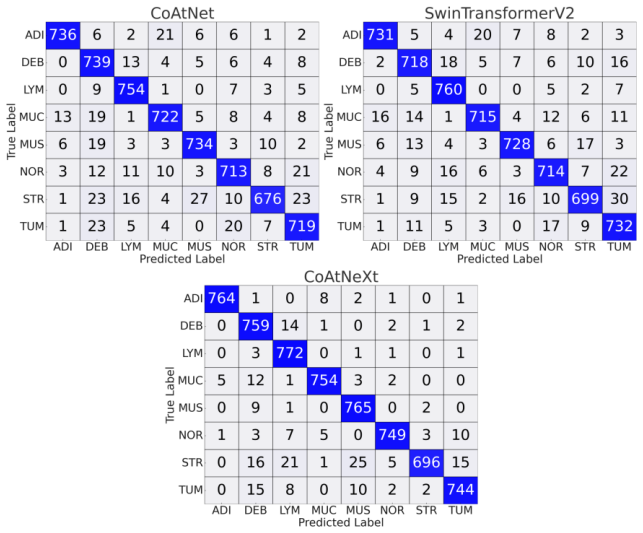
CoAtNeXt is derived from CoAtNet by replacing the MBConv layers in stages S1 and S2 with 'Improved ConvNeXtV2' blocks, which insert the Convolutional Block Attention Module after feature normalization to recalibrate channel and spatial features. The later transformer stages retain relative-position attention for global context. Ablation experiments show accuracy climbing stepwise on HMU-GC-HE-30K: CoAtNet at 93.12%, with plain ConvNeXtV2 at 94.50%, with SE at 94.75%, with ECA at 95.64%, and with CBAM at 96.47%; a similar progression appears on GasHisSDB, reaching 98.29% with CBAM. The paper argues each architectural component contributes measurably, and the final model remains lightweight at
Load-bearing premise
The evaluation's trustworthiness rests on the untreated 5-fold cross-validation split, whose unit (patches vs. whole slides) is not specified; if patches from one slide end up in both training and validation folds, the reported accuracies could be optimistic.
Editorial extensions
If this is right
- On both benchmark datasets, CoAtNeXt reports higher accuracy, F1, and AUC than any of the 10 CNN or 10 ViT baselines evaluated.
- The ablation study attributes the gains to the specific combination: plain ConvNeXtV2 helps, and CBAM provides a larger improvement than SE or ECA.
- CoAtNeXt achieves these results with 18.8 million parameters and a 110 MB model size, smaller than several baselines it outperforms.
- The reported performance on the eight-class HMU-GC-HE-30K dataset exceeds the only prior published AUC for that dataset.
Reading between the lines
- If the cross-validation split is performed at the patch level rather than the slide level, correlated patches from the same whole slide could inflate all reported numbers; a slide-aware split would test generalization more honestly.
- The design principle — upgrading a hybrid backbone's convolutional stages with modern conv blocks plus spatial attention — could transfer to other histopathology tasks or other domains where local texture and global layout both matter.
- The authors implicitly assume that placing CBAM in the early convolutional stages is more effective than adding it to transformer stages; a follow-up varying CBAM placement could test that assumption.
- The model's small size and high accuracy suggest it could be a candidate for embedded or real-time digital pathology deployment, but this would require evaluation on whole-slide images and other staining protocols.
Editorial analysis
A structured set of objections, weighed in public.
Referee Report
Summary. The paper proposes CoAtNeXt, a hybrid CNN-transformer architecture for gastric tissue histopathology classification. CoAtNeXt is built on CoAtNet-0 by replacing the MBConv blocks in stages S1–S2 with ConvNeXtV2 blocks augmented by the Convolutional Block Attention Module (CBAM). The model is evaluated on two public datasets: HMU-GC-HE-30K (eight-class) and GasHisSDB (binary), using 5-fold cross-validation, and compared against 10 CNN and 10 ViT baselines. The authors report state-of-the-art results (96.47% accuracy / 99.89% AUC on HMU-GC-HE-30K; 98.29% accuracy / 99.90% AUC on GasHisSDB) and claim superiority over all baselines and prior literature, with an ablation study showing that CBAM outperforms SE and ECA attention.
Significance. If the reported results are robust, the architectural contribution is modest but useful: replacing MBConv with ConvNeXtV2+CBAM within CoAtNet-0 is a simple, parameter-efficient modification (18.8M parameters) that improves performance on both multiclass and binary gastric histopathology classification. The paper includes a broad empirical comparison (20 baselines), an ablation study, and comparisons to prior work on two public datasets, which are valuable for the community. However, the central empirical claim — that CoAtNeXt outperforms all baselines and all prior studies — rests on a cross-validation protocol whose details are not disclosed and on model selection performed on the same folds used for evaluation. These issues currently prevent the reader from assessing whether the reported gains are genuine or an artifact of evaluation setup.
major comments (4)
- [Section 3, Tables 2–7] The 5-fold cross-validation split unit is never specified. Both datasets are constructed by tiling larger clinical images: HMU-GC-HE-30K comes from 300 slides (Section 2.1.1) and GasHisSDB from 600 original 2048×2048 images (Section 2.1.2). Patches from the same slide share stain, illumination, and tissue microstructure; a random patch-level split leaks slide-level information into the validation folds, inflating all metrics and making the comparisons against baselines and prior work unfair. The paper must state whether folds are split by whole slide/image or by patch, and preferably use a slide-aware grouping (e.g., GroupKFold). Per-fold results and standard deviations should also be reported.
- [Section 3, Sections 4.1–4.2] The baseline comparisons lack essential training details. Section 3 states only batch size 32, 50 epochs, SGD, and that 'all hyperparameters were selected with the grid search method,' but does not specify learning rates, weight decay, data augmentation, pretraining, input resolution, or whether the same protocol was applied to all 20 baselines. Without this information, the reported superiority of CoAtNeXt could simply reflect suboptimal hyperparameters for the baselines. The paper should provide a unified training protocol for all models and report per-model hyperparameters or a reference to the code.
- [Section 4.3, Tables 6–7] The ablation study selects the attention module (SE, ECA, CBAM) using the same 5-fold cross-validation that is subsequently used to report the final performance. This constitutes model selection on the evaluation folds and biases the reported numbers upward. To support the claim that CBAM is the best choice, the authors should use a nested cross-validation or a separate validation split for selecting among attention modules, and then evaluate the chosen model on a truly held-out test set. Otherwise, the reported accuracy and AUC are optimistic.
- [Section 4.4, Tables 8–9] The literature comparisons are not apples-to-apples. For HMU-GC-HE-30K, Lou et al. reported only AUC (96%), likely using a different split; the statement that the proposed model 'surpassed' prior work is based on a single metric comparison. For GasHisSDB, Table 9 mixes results from different sub-datasets (80×80, 120×120, 160×160) and different evaluation protocols; for instance, Hu et al.'s 96.12% is for the 80×80 subset, but the table also reports class-specific metrics from another variant. Without matching the exact data subset, class balance, and split used in each cited work, the superiority claim is not established. The authors should clarify these settings and, if possible, re-evaluate prior published models under the same protocol.
minor comments (6)
- [Section 4.2, Table 5 heading] Table 5 is headed 'Performance metrics of ViT architectures evaluated on the GasHisSDB', but the preceding sentence in Section 4.2 says 'The performance of CNN models on the GasHisSDB dataset is presented in Table 5.' This should be corrected to 'ViT models'.
- [Section 4.2, PVTv2 description] In the text describing PVTv2, the phrase '96.67% sensitivity, 97.35% sensitivity' appears; one of these should be 'precision' and the other 'recall' (the table lists precision 96.67 and recall 97.35).
- [Section 5, first paragraph] The Discussion states CoAtNet achieved '92.13% accuracy' on HMU-GC-HE-30K, but Table 2 reports 93.12%. This inconsistency should be resolved.
- [Abstract] The abstract contains grammatical errors: 'providing performance on binary and multiclass. Its highlights its potential...' should be rephrased for clarity.
- [Section 2.3, Eq. 2] Eq. 2 writes 'MLP(AvgPool)' and 'MLP(MaxPool)' without arguments; the standard CBAM formulation uses the pooled feature descriptors. This is a notational shortcut that could confuse readers.
- [Section 2.4, Eq. 5] In Eq. 5, the denominator is written as ∑ G(X_j), but the normalization factor should be the sum over all channels of G(X_i). The notation is ambiguous and should be clarified.
Circularity Check
No circularity: the paper is an empirical architecture study with external benchmarks and no self-citation chain; reported results are measured, not derived from the architecture definition.
full rationale
The paper contains no mathematical derivation chain that reduces to its inputs. The proposed CoAtNeXt model is defined compositionally from existing published components (CoAtNet, ConvNeXtV2, CBAM) with all components sourced from external prior work (references 23, 24, 26); the authors cite no self-authored prior results, so no self-citation is load-bearing. The performance claims are empirical outputs of 5-fold cross-validation on two public datasets, not predictions derived from fitted parameters or from the architecture equations. The architectural equations (Eqs. 1-6) are cited standard definitions of CoAtNet's relative attention, CBAM, and ConvNeXtV2's GRN; they are not used to derive accuracy or AUC. The ablation study compares variants, which is model selection, not circular reasoning. The only substantive methodological concern is the unspecified split unit in cross-validation (patch vs. slide), which could affect generalization estimates, but this is a correctness/risk issue, not circularity. No equation in the paper is equivalent by construction to another claimed result, and no fitted input is relabeled as a prediction. Therefore the score is 0.
Assumptions & free parameters
free parameters (4)
- Batch size =
32
- Number of training epochs =
50
- Stage-wise layer counts and channel widths =
S0: L2, D32; S1: L2, D64; S2: L3, D128; S3: L4, D256; S4: L2, D512
- Attention module =
CBAM
assumptions (3)
- domain assumption Patches in the evaluation datasets are independent samples
- domain assumption The ground-truth labels of both public datasets are accurate
- domain assumption The TensorFlow/Keras implementation faithfully reflects the described architecture
Cite this review
Pith. "Pith review of CoAtNeXt:An Attention-Enhanced ConvNeXtV2-Transformer Hybrid Model for Gastric Tissue Classification." pith.science (2026). https://pith.science/paper/U2EYTJYW
@misc{pith2026250909242,
  author       = {Pith},
  title        = {Pith review of: CoAtNeXt:An Attention-Enhanced ConvNeXtV2-Transformer Hybrid Model for Gastric Tissue Classification},
  year         = {2026},
  howpublished = {\url{https://pith.science/paper/U2EYTJYW}},
  note         = {Machine review of arXiv:2509.09242}
}
read the original abstract
Background and objective Early diagnosis of gastric diseases is crucial to prevent fatal outcomes. Although histopathologic examination remains the diagnostic gold standard, it is performed entirely manually, making evaluations labor-intensive and prone to variability among pathologists. Critical findings may be missed, and lack of standard procedures reduces consistency. These limitations highlight the need for automated, reliable, and efficient methods for gastric tissue analysis. Methods In this study, a novel hybrid model named CoAtNeXt was proposed for the classification of gastric tissue images. The model is built upon the CoAtNet architecture by replacing its MBConv layers with enhanced ConvNeXtV2 blocks. Additionally, the Convolutional Block Attention Module (CBAM) is integrated to improve local feature extraction through channel and spatial attention mechanisms. The architecture was scaled to achieve a balance between computational efficiency and classification performance. CoAtNeXt was evaluated on two publicly available datasets, HMU-GC-HE-30K for eight-class classification and GasHisSDB for binary classification, and was compared against 10 Convolutional Neural Networks (CNNs) and ten Vision Transformer (ViT) models. Results CoAtNeXt achieved 96.47% accuracy, 96.60% precision, 96.47% recall, 96.45% F1 score, and 99.89% AUC on HMU-GC-HE-30K. On GasHisSDB, it reached 98.29% accuracy, 98.07% precision, 98.41% recall, 98.23% F1 score, and 99.90% AUC. It outperformed all CNN and ViT models tested and surpassed previous studies in the literature. Conclusion Experimental results show that CoAtNeXt is a robust architecture for histopathological classification of gastric tissue images, providing performance on binary and multiclass. Its highlights its potential to assist pathologists by enhancing diagnostic accuracy and reducing workload.
Figures


Figures from the paper (3 more)


Reference graph
Works this paper leans on
-
[1]
Sjövall, and G.C
Johansson, M.E., H. Sjövall, and G.C. Hansson, The gastrointestinal mucus system in health and disease. Nature reviews Gastroenterology & hepatology, 2013. 10(6): p. 352-361
2013
-
[2]
The Intelligent Intestine,
Bourlioux, P., et al., The intestine and its microflora are partners for the protection of the host: report on the Danone Symposium “The Intelligent Intestine,” held in Paris, June 14, 2002. The American journal of clinical nutrition, 2003. 78(4): p. 675-683
2002
-
[3]
Rawla, P. and A. Barsouk, Epidemiology of gastric cancer: global trends, risk factors and prevention. Gastroenterology Review/Przegląd Gastroenterologiczny, 2019. 14(1): p. 26-38
2019
-
[4]
Critical reviews in oncology/hematology, 2023
Lopez, M.J., et al., Characteristics of gastric cancer around the world. Critical reviews in oncology/hematology, 2023. 181: p. 103841
2023
-
[5]
Expert review of gastroenterology & hepatology, 2017
Nie, Y., et al., A global burden of gastric cancer: the major impact of China. Expert review of gastroenterology & hepatology, 2017. 11(7): p. 651-661
2017
-
[6]
Diagnostics, 2023
Orășeanu, A., et al., Landscape of innovative methods for early diagnosis of gastric cancer: a systematic review. Diagnostics, 2023. 13(24): p. 3608
2023
-
[7]
World journal of gastroenterology: WJG, 2014
Pasechnikov, V., et al., Gastric cancer: prevention, screening and early diagnosis. World journal of gastroenterology: WJG, 2014. 20(38): p. 13842
2014
-
[8]
Biomedical Signal Processing and Control, 2025
Zhu, H., et al., A 3D end -to-end multi-task learning network for predicting lymph node metastasis at multiple nodal stations in gastric cancer. Biomedical Signal Processing and Control, 2025. 108: p. 107802
2025
Show all 44 references
-
[9]
Biomedical Signal Processing and Control, 2025
Zhang, X., et al., An endoscopic images and diagnostic records based multimodal method for severity grading of gastric cancer. Biomedical Signal Processing and Control, 2025. 109: p. 107891
2025
-
[10]
Expert Systems with Applications, 2024
Li, Q., et al., APDF: An active preference -based deep forest expert system for overall survival prediction in gastric cancer. Expert Systems with Applications, 2024. 245: p. 123131
2024
-
[11]
Knowledge-Based Systems,
Pornvoraphat, P., et al., Real-time gastric intestinal metaplasia segmentation using a deep neural network designed for multiple imaging modes on high -resolution images. Knowledge-Based Systems,
-
[12]
Engineering Applications of Artificial Intelligence, 2025
Abian, A.I., et al., Atrous spatial pyramid pooling with swin transformer model for classification of gastrointestinal tract diseases from videos with enhanced explainability. Engineering Applications of Artificial Intelligence, 2025. 150: p. 110656
2025
-
[13]
Computer Methods and Programs in Biomedicine, 2025: p
Liu, L., et al., Predicting clinical prognosis in gastric cancer using deep learning -based analysis of tissue pathomics images. Computer Methods and Programs in Biomedicine, 2025: p. 108895
2025
-
[14]
Computerized Medical Imaging and Graphics, 2017
Sharma, H., et al., Deep convolutional neural networks for automatic classification of gastric carcinoma using whole slide images in digital histopathology. Computerized Medical Imaging and Graphics, 2017. 61: p. 2-13
2017
-
[15]
Applied Intelligence, 2022
Li, Y., et al., A hierarchical conditional random field-based attention mechanism approach for gastric histopathology image classification. Applied Intelligence, 2022. 52(9): p. 9717-9738
2022
-
[16]
Computerized Medical Imaging and Graphics, 2024
Wang, J., et al., CrossU-Net: Dual-modality cross-attention U-Net for segmentation of precancerous lesions in gastric cancer. Computerized Medical Imaging and Graphics, 2024. 112: p. 102339
2024
-
[17]
Modern Pathology, 2022
Ba, W., et al., Assessment of deep learning assistance for the pathological diagnosis of gastric cancer. Modern Pathology, 2022. 35(9): p. 1262-1268
2022
-
[18]
Scientific Data, 2025
Lou, S., et al., A large histological images dataset of gastric cancer with tumour microenvironment annotation for AI. Scientific Data, 2025. 12(1): p. 138
2025
-
[19]
Computers in biology and medicine, 2022
Hu, W., et al., GasHisSDB: A new gastric histopathology image dataset for computer aided diagnosis of gastric cancer. Computers in biology and medicine, 2022. 142: p. 105207
2022
-
[20]
Histopathological gastric cancer detection using transfer learning
Yong, M.P., et al. Histopathological gastric cancer detection using transfer learning . in 2023 11th International Conference on Bioinformatics and Computational Biology (ICBCB) . 2023. IEEE
2023
-
[21]
Diagnostics, 2023
Yong, M.P., et al., Histopathological gastric cancer detection on GasHisSDB dataset using deep ensemble learning. Diagnostics, 2023. 13(10): p. 1793
2023
-
[22]
Multimedia Tools and Applications, 2024: p
Khayatian, D., et al., Histopathology image analysis for gastric cancer detection: a hybrid deep learning and catboost approach. Multimedia Tools and Applications, 2024: p. 1-27
2024
-
[23]
Advances in neural information processing systems, 2021
Dai, Z., et al., Coatnet: Marrying convolution and attention for all data sizes. Advances in neural information processing systems, 2021. 34: p. 3965-3977
2021
-
[24]
Cbam: Convolutional block attention module
Woo, S., et al. Cbam: Convolutional block attention module . in Proceedings of the European conference on computer vision (ECCV). 2018
2018
-
[25]
A convnet for the 2020s
Liu, Z., et al. A convnet for the 2020s. in Proceedings of the IEEE/CVF conference on computer vision and pattern recognition. 2022
2022
-
[26]
Convnext v2: Co -designing and scaling convnets with masked autoencoders
Woo, S., et al. Convnext v2: Co -designing and scaling convnets with masked autoencoders . in Proceedings of the IEEE/CVF conference on computer vision and pattern recognition . 2023
2023
-
[27]
Densely connected convolutional networks
Huang, G., et al. Densely connected convolutional networks. in Proceedings of the IEEE conference on computer vision and pattern recognition. 2017
2017
-
[28]
Rethinking the inception architecture for computer vision
Szegedy, C., et al. Rethinking the inception architecture for computer vision . in Proceedings of the IEEE conference on computer vision and pattern recognition. 2016
2016
-
[29]
arXiv preprint arXiv:1704.04861, 2017
Howard, A.G., et al., Mobilenets: Efficient convolutional neural networks for mobile vision applications. arXiv preprint arXiv:1704.04861, 2017
2017 arXiv
-
[30]
Deep residual learning for image recognition
He, K., et al. Deep residual learning for image recognition. in Proceedings of the IEEE conference on computer vision and pattern recognition. 2016
2016
-
[31]
Advances in Neural Information Processing Systems, 2022
Tang, Y., et al., GhostNetv2: Enhance cheap operation with long-range attention. Advances in Neural Information Processing Systems, 2022. 35: p. 9969-9982
2022
-
[32]
Xception: Deep learning with depthwise separable convolutions
Chollet, F. Xception: Deep learning with depthwise separable convolutions. in Proceedings of the IEEE conference on computer vision and pattern recognition. 2017
2017
-
[33]
Edgenext: efficiently amalgamated cnn -transformer architecture for mobile vision applications
Maaz, M., et al. Edgenext: efficiently amalgamated cnn -transformer architecture for mobile vision applications. in European conference on computer vision. 2022. Springer
2022
-
[34]
Inceptionnext: When inception meets convnext
Yu, W., et al. Inceptionnext: When inception meets convnext. in Proceedings of the IEEE/cvf conference on computer vision and pattern recognition. 2024
2024
-
[35]
arXiv preprint arXiv:2212.06795, 2022
Yang, C., et al., GPViT: A high resolution non-hierarchical vision transformer with group propagation. arXiv preprint arXiv:2212.06795, 2022
2022 arXiv
-
[36]
Davit: Dual attention vision transformers
Ding, M., et al. Davit: Dual attention vision transformers. in European conference on computer vision
-
[37]
Efficientvit: Memory efficient vision transformer with cascaded group attention
Liu, X., et al. Efficientvit: Memory efficient vision transformer with cascaded group attention . in Proceedings of the IEEE/CVF conference on computer vision and pattern recognition . 2023
2023
-
[38]
Global context vision transformers
Hatamizadeh, A., et al. Global context vision transformers . in International Conference on Machine Learning. 2023. PMLR
2023
-
[39]
Mehta, S. and M. Rastegari, Separable self -attention for mobile vision transformers. arXiv preprint arXiv:2206.02680, 2022
2022 arXiv
-
[40]
Swin transformer v2: Scaling up capacity and resolution
Liu, Z., et al. Swin transformer v2: Scaling up capacity and resolution. in Proceedings of the IEEE/CVF conference on computer vision and pattern recognition. 2022
2022
-
[41]
Tinyvit: Fast pretraining distillation for small vision transformers
Wu, K., et al. Tinyvit: Fast pretraining distillation for small vision transformers . in European conference on computer vision. 2022. Springer
2022
-
[42]
Maxvit: Multi-axis vision transformer
Tu, Z., et al. Maxvit: Multi-axis vision transformer. in European conference on computer vision. 2022. Springer
2022
-
[43]
Computational visual media, 2022
Wang, W., et al., Pvt v2: Improved baselines with pyramid vision transformer. Computational visual media, 2022. 8(3): p. 415-424
2022
-
[44]
Flexivit: One model for all patch sizes
Beyer, L., et al. Flexivit: One model for all patch sizes . in Proceedings of the IEEE/CVF Conference on Computer Vision and Pattern Recognition. 2023
2023
Reviewed August 4, 2026 · model on record in the stance chip above.
Discussion (0). Sign in to comment.