REVIEW 4 major objections 6 minor 1 cited by
Injecting textual timestamps between frames and selecting frames with a caption-guided, temporally regularized sampler gives pretrained video LLMs state-of-the-art absolute-time localization without retraining.
Reviewed by Pith at T0; open to challenge. T0 means a machine referee read the full paper against a public rubric. the ladder, T0–T4 →
DATE combines inference-time timestamp token injection with a caption-rewritten, temporally regularized CLIP sampling strategy to improve absolute time reasoning and event localization in long videos.
T0 review reviewed 2026-08-04 challenge →
load-bearing objection A plausible training-free recipe for long-video temporal reasoning with consistent gains, but the central timestamp-injection mechanism is confounded in the ablation: the TIM row changes both the positional encoding and the added tokens, so the paper's headline mechanism is not actually isolated. the 4 major comments →
DATE: Dynamic Absolute Time Enhancement for Long Video Understanding
The pith
A machine-rendered reading of the paper's core claim, the machinery that carries it, and where it could break.
The reading
Core claim
The central discovery is that absolute-time reasoning in a pretrained video multimodal LLM can be decoupled from positional geometry. The paper shows that the baseline model's multimodal rotary position encoding, which embeds real seconds into position indices, degrades on long videos; when those indices are replaced with sequential indices and explicit textual timestamps are interleaved with frame embeddings, the model answers "at what time did X happen" questions more accurately. The authors further show that the frames fed to the model matter as much as the time signaling: by rewriting questions as short declarative captions and using CLIP similarity with a temporally regularized greedy s
What carries the argument
Two mechanisms carry the argument. Timestamp Injection Mechanism (TIM): after each frame's visual tokens, the input inserts a textual time token (e.g., "at 45s"), and the temporal branch of the multimodal rotary position encoding is switched from absolute-time-scaled indices to simple sequential indices; this creates a continuous temporal reference system while preventing position-index drift. Temporal-Aware Similarity Sampling (TASS): a language model rewrites the user question into a concise declarative caption, CLIP scores every frame against that caption, below-mean frames are discarded, and a greedy algorithm picks the highest-scoring remaining frames subject to a minimum interval that
Load-bearing premise
The load-bearing premise is that a pretrained video-language model can genuinely read absolute time from plain-text timestamp tokens interleaved between frames once its time-scaled position indices are replaced with sequential ones; the paper's own ablation changes both parts at once, so this premise is not yet isolated.
What would settle it
Run a three-way comparison on identical frames: (a) original model with absolute-time position indices, (b) original model plus timestamp tokens but keeping those indices, and (c) DATE's sequential indices plus timestamps. If (b) is as good as (c), the sequential-index claim is unnecessary; if (c) is not better than (a), timestamp injection per se is not the source of the gain.
If this is right
- Absolute-time localization can be improved at inference time, with no weight updates and no new training data.
- A 7B model using DATE can outperform several 72B baselines on hour-long benchmarks, indicating that sampling and temporal-reference design can matter as much as model scale.
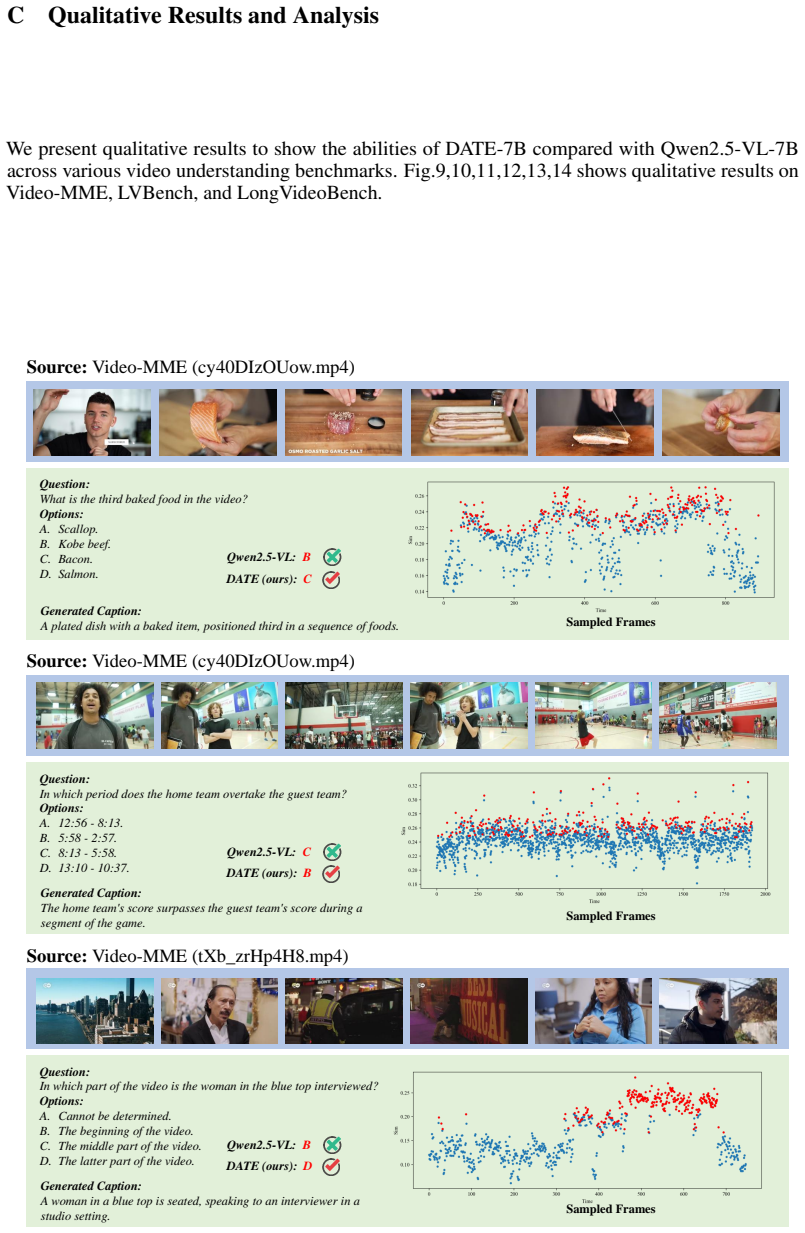
- Framing frame selection as image-caption retrieval, with a rewritten declarative query, yields higher recall of key events than uniform sampling or question-based similarity.
- Explicit timestamp tokens act as attention anchors, concentrating the model's attention on the visual content of the corresponding frame.
- Temporally regularized greedy sampling provides better accuracy than variance-based keyframe selection, especially at very low frame budgets.
Where Pith is reading between the lines
- Inference: If the mechanism holds, "reading the clock" can be moved out of position geometry entirely, which suggests a transferable design for any long-sequence model: attach explicit coordinate tokens and use plain ordinal positions to avoid drift.
- Inference: The caption-rewriting trick is generalizable: any embedding trained on declarative captions will prefer declarative queries; a natural test is to apply it to other retrieval-based video or audio pipelines.
- Inference: A clean experiment the paper does not run is to rescale the timestamp units (seconds vs. HH:MM:SS) and check whether answers track the new clock; that would directly test whether the model grounds language-time rather than exploiting token order.
- Inference: The paper's reported bad cases suggest the added tokens consume context budget and push the model toward its capacity limit; a possible extension is to compress timestamps or make injection conditional on query difficulty.
Editorial analysis
A structured set of objections, weighed in public.
Referee Report
Summary. The paper proposes DATE, a training-free inference-time enhancement for long-video multimodal LLMs. It consists of two components: TIM, which interleaves textual timestamp tokens between visual frame embeddings and replaces Qwen2.5-VL's absolute-time MRoPE temporal indices with sequential indexing; and TASS, which converts user questions into descriptive captions via DeepSeek-V3, scores 1-FPS frames with CLIP, filters negative frames, and greedily selects temporally spaced top candidates. Experiments on Video-MME, LongVideoBench, and LVBench report consistent gains over a re-tested Qwen2.5-VL-7B baseline, with the 7B model approaching or surpassing some larger models on certain benchmarks.
Significance. If the results hold, DATE is a practically attractive recipe: it improves temporal grounding and event localization in existing MLLMs without weight updates, and TASS's query-to-caption reformulation plus temporal regularization appears to be a genuine improvement over uniform sampling and over the recent AKS baseline. The authors provide public code, re-test all baselines under a common protocol, and include extensive qualitative examples. The main weakness is that the paper's central mechanistic claim about TIM is not supported by the current ablations, because the TIM-only condition changes two variables simultaneously. The TASS contribution is better supported and accounts for the larger share of the reported gains.
major comments (4)
- [§3.1, Table 2, Table 3] The TIM ablation is confounded. The 'TIM only' row changes two things relative to the Qwen2.5-VL baseline: (i) it replaces MRoPE's absolute-time temporal position IDs with sequential indices, and (ii) it injects textual timestamp tokens. The 'Prompt' condition in Table 3 adds timestamps to the prompt while keeping MRoPE, and it degrades performance (LVBench 42.5 vs 43.7). No condition tests timestamp tokens while leaving MRoPE unchanged, nor sequential indices without timestamp tokens. Therefore the observed TIM-only gain (e.g., LVBench 43.7→44.9) could be caused by removing the absolute-time MRoPE component rather than by the model grounding absolute time through textual tokens. The assertion in §3.1 that 'absolute time perception is handled independently via the explicit <time_token>s' needs a control experiment that isolates the token injection from the positional-encoding change.
- [§4.1, §4.6, Fig. 7, Table 2] Hyperparameters α=4 and δ0=20 are selected using the same LVBench benchmark that produces the headline numbers, and no held-out split is used. The reported differences are often very small (e.g., LongVideoBench 61.8→61.9 for TIM-only), and no error bars or multiple trials are reported. It is therefore unclear whether the TIM-only gains are statistically meaningful. Please report means and variances over multiple runs, or fix hyperparameters on a separate validation split and then evaluate once on the test benchmarks.
- [Table 1 and footnotes] The state-of-the-art comparison mixes official reported numbers (♠) with re-tested numbers (♣) under different preprocessing protocols. The table footnote states that Qwen2.5-VL's official LongVideoBench result was obtained at 224 resolution, while the re-tested baseline is at 448. Claims such as 'surpassing many 72B models' and 'outperforming the prior best model' are therefore protocol-dependent. To support the SOTA claim, report all baselines and the proposed method under exactly the same resolution, FPS, frame count, and benchmark version, and clearly separate re-tested from official numbers.
- [Table 3, §4.1] The reported sampling times for TASS appear to omit the two most expensive stages: DeepSeek-V3 caption generation and CLIP similarity scoring over all 1-FPS frames. If these stages are excluded, the comparison with AKS under 'the same CPU' is not an end-to-end latency comparison, and the efficiency claim is misleading. If they are included, the wall-clock time would be much larger than the reported 1.2–21.2 s. Please either report end-to-end latency including caption generation and feature extraction, or explicitly state that only the greedy selection step is timed.
minor comments (6)
- [§1, contribution (3)] Typo: 'achieves superior spatial perception' should be 'achieves superior spatial perception' (and probably 'temporal perception' is intended).
- [§1 and §4.1] The paper says 'Our diagnostic experiments further confirm that such models do not solve problems related to absolute time reliably,' but no diagnostic experiment is presented. Either add this evidence or soften the claim.
- [§4.5, Fig. 6] The attention-map analysis is based on a single question and a single video. This is anecdotal; quantify with several examples or aggregate statistics before claiming timestamp tokens act as temporal anchors.
- [Fig. 3] Typo in caption: 'betweet' should be 'between'.
- [Appendix F] The asset list duplicates 'LongVideoBench (CC-BY-NC-SA 4.0 license)' twice.
- [Appendix A] The limitation about linear inference growth is appreciated. It would be useful to also mention the dependence on an external caption-generation LLM (DeepSeek-V3) in the limitations discussion.
Circularity Check
No significant circularity: benchmark gains are external and the method is an inference-time input modification; minor tuning on LVBench and a two-variable TIM ablation are experimental concerns, not by-construction circularity.
full rationale
DATE's central claims are empirical and are evaluated on external benchmarks (Video-MME, LongVideoBench, LVBench), so the headline numbers are not derived from the method's own definitions. TIM injects literal ground-truth timestamps as text tokens and removes the absolute-time component of MRoPE; this is an input transformation, not a fitted parameter renamed as a prediction. TASS uses CLIP similarity with a greedy temporal constraint; its only tuned hyperparameters (alpha=4, delta_0=20) are reported in Sec. 4.1 and analyzed in Fig. 7. If those were selected on LVBench, the LVBench headline is mildly in-sample, but the same settings transfer to Video-MME and LongVideoBench, so the SOTA claim retains independent content. The Table 2 TIM-only ablation changes two variables at once (MRoPE absolute-time removal plus timestamp-token insertion), so the attribution of the gain to timestamp tokens is not cleanly identified; this is an experimental identifiability issue, not a circular derivation. Self-citations to VideoLLaMA 2/3 are background and not load-bearing. Overall, no step reduces by construction to its own inputs.
Axiom & Free-Parameter Ledger
free parameters (4)
- alpha (candidate frame coefficient) =
4
- delta_0 (initial minimum time interval) =
20 s
- lambda (interval decay ratio) =
0.5
- frame extraction FPS =
1 FPS
axioms (4)
- domain assumption Qwen2.5-VL can interpret explicit textual timestamps as temporal anchors for video frames without any training on such inputs.
- domain assumption CLIP ViT-B/32 similarity between a generated caption and video frames is a reliable proxy for the relevance of frames to the user's question.
- domain assumption Removing the absolute-time component from Qwen2.5-VL's MRoPE and replacing it with sequential indices does not destroy the model's spatial or relative temporal understanding.
- domain assumption Benchmark multiple-choice scores are stable indicators of temporal understanding for single-run evaluations.
Cite this review
Pith. "Pith review of DATE: Dynamic Absolute Time Enhancement for Long Video Understanding." pith.science (2026). https://pith.science/paper/MH5PJY45
@misc{pith2026250909263,
  author       = {Pith},
  title        = {Pith review of: DATE: Dynamic Absolute Time Enhancement for Long Video Understanding},
  year         = {2026},
  howpublished = {\url{https://pith.science/paper/MH5PJY45}},
  note         = {Machine review of arXiv:2509.09263}
}
read the original abstract
Long video understanding remains a fundamental challenge for multimodal large language models (MLLMs), particularly in tasks requiring precise temporal reasoning and event localization. Existing approaches typically adopt uniform frame sampling and rely on implicit position encodings to model temporal order. However, these methods struggle with long-range dependencies, leading to critical information loss and degraded temporal comprehension. In this paper, we propose Dynamic Absolute Time Enhancement (DATE) that enhances temporal awareness in MLLMs through the Timestamp Injection Mechanism (TIM) and a semantically guided Temporal-Aware Similarity Sampling (TASS) strategy. Specifically, we interleave video frame embeddings with textual timestamp tokens to construct a continuous temporal reference system. We further reformulate the video sampling problem as a vision-language retrieval task and introduce a two-stage algorithm to ensure both semantic relevance and temporal coverage: enriching each query into a descriptive caption to better align with the vision feature, and sampling key event with a similarity-driven temporally regularized greedy strategy. Our method achieves remarkable improvements w.r.t. absolute time understanding and key event localization, resulting in state-of-the-art performance among 7B and 72B models on hour-long video benchmarks. Particularly, our 7B model even exceeds many 72B models on some benchmarks.
Figures




Forward citations
Cited by 1 Pith paper
-
CoVR-R:Reason-Aware Composed Video Retrieval
Zero-shot LMM reasoning over edit after-effects (states, phases, camera, tempo) plus a new CoVR-R benchmark yields large recall gains on implicit-effect composed video retrieval without task-specific training.
Reference graph
Works this paper leans on
-
[1]
Flamingo: a visual language model for few-shot learning,
J.-B. Alayrac, J. Donahue, P. Luc, A. Miech, I. Barr, Y . Hasson, K. Lenc, A. Mensch, K. Millican, M. Reynoldset al., “Flamingo: a visual language model for few-shot learning,”Advances in neural information processing systems, vol. 35, pp. 23 716–23 736, 2022
2022
-
[2]
Videollama 2: Advancing spatial-temporal modeling and audio understanding in video-llms,
Z. Cheng, S. Leng, H. Zhang, Y . Xin, X. Li, G. Chen, Y . Zhu, W. Zhang, Z. Luo, D. Zhaoet al., “Videollama 2: Advancing spatial-temporal modeling and audio understanding in video-llms,”arXiv preprint arXiv:2406.07476, 2024
Pith/arXiv arXiv 2024
-
[3]
Qwen2-vl: Enhancing vision-language model’s perception of the world at any resolution,
P. Wang, S. Bai, S. Tan, S. Wang, Z. Fan, J. Bai, K. Chen, X. Liu, J. Wang, W. Geet al., “Qwen2-vl: Enhancing vision-language model’s perception of the world at any resolution,”arXiv preprint arXiv:2409.12191, 2024
Pith/arXiv arXiv 2024
-
[4]
S. Bai, K. Chen, X. Liu, J. Wang, W. Ge, S. Song, K. Dang, P. Wang, S. Wang, J. Tanget al., “Qwen2. 5-vl technical report,”arXiv preprint arXiv:2502.13923, 2025
Pith/arXiv arXiv 2025
-
[5]
Roformer: Enhanced transformer with rotary position embedding,
J. Su, M. Ahmed, Y . Lu, S. Pan, W. Bo, and Y . Liu, “Roformer: Enhanced transformer with rotary position embedding,”Neurocomputing, vol. 568, p. 127063, 2024
2024
-
[6]
Adaptive keyframe sampling for long video understanding,
X. Tang, J. Qiu, L. Xie, Y . Tian, J. Jiao, and Q. Ye, “Adaptive keyframe sampling for long video understanding,”arXiv preprint arXiv:2502.21271, 2025
Pith/arXiv arXiv 2025
-
[7]
Learning transferable visual models from natural language supervision,
A. Radford, J. W. Kim, C. Hallacy, A. Ramesh, G. Goh, S. Agarwal, G. Sastry, A. Askell, P. Mishkin, J. Clarket al., “Learning transferable visual models from natural language supervision,” inInternational conference on machine learning. PmLR, 2021, pp. 8748–8763. 18
2021
-
[8]
J. Achiam, S. Adler, S. Agarwal, L. Ahmad, I. Akkaya, F. L. Aleman, D. Almeida, J. Altenschmidt, S. Altman, S. Anadkatet al., “Gpt-4 technical report,”arXiv preprint arXiv:2303.08774, 2023
Pith/arXiv arXiv 2023
-
[9]
Language models are few-shot learners,
T. Brown, B. Mann, N. Ryder, M. Subbiah, J. D. Kaplan, P. Dhariwal, A. Neelakantan, P. Shyam, G. Sastry, A. Askellet al., “Language models are few-shot learners,”Advances in neural information processing systems, vol. 33, pp. 1877–1901, 2020
1901
-
[10]
Vicuna: An open-source chatbot impressing gpt-4 with 90%* chatgpt quality,
W.-L. Chiang, Z. Li, Z. Lin, Y . Sheng, Z. Wu, H. Zhang, L. Zheng, S. Zhuang, Y . Zhuang, J. E. Gonzalez et al., “Vicuna: An open-source chatbot impressing gpt-4 with 90%* chatgpt quality,”See https://vicuna. lmsys. org (accessed 14 April 2023), vol. 2, no. 3, p. 6, 2023
2023
-
[11]
Palm: Scaling language modeling with pathways,
A. Chowdhery, S. Narang, J. Devlin, M. Bosma, G. Mishra, A. Roberts, P. Barham, H. W. Chung, C. Sutton, S. Gehrmannet al., “Palm: Scaling language modeling with pathways,”Journal of Machine Learning Research, vol. 24, no. 240, pp. 1–113, 2023
2023
-
[12]
Scaling instruction-finetuned language models,
H. W. Chung, L. Hou, S. Longpre, B. Zoph, Y . Tay, W. Fedus, Y . Li, X. Wang, M. Dehghani, S. Brahma et al., “Scaling instruction-finetuned language models,”Journal of Machine Learning Research, vol. 25, no. 70, pp. 1–53, 2024
2024
-
[13]
A. Grattafiori, A. Dubey, A. Jauhri, A. Pandey, A. Kadian, A. Al-Dahle, A. Letman, A. Mathur, A. Schelten, A. Vaughanet al., “The llama 3 herd of models,”arXiv preprint arXiv:2407.21783, 2024
Pith/arXiv arXiv 2024
-
[14]
Llama: Open and efficient foundation language models,
H. Touvron, T. Lavril, G. Izacard, X. Martinet, M.-A. Lachaux, T. Lacroix, B. Rozière, N. Goyal, E. Hambro, F. Azharet al., “Llama: Open and efficient foundation language models,”arXiv preprint arXiv:2302.13971, 2023
Pith/arXiv arXiv 2023
-
[15]
Llama 2: Open foundation and fine-tuned chat models,
H. Touvron, L. Martin, K. Stone, P. Albert, A. Almahairi, Y . Babaei, N. Bashlykov, S. Batra, P. Bhargava, S. Bhosaleet al., “Llama 2: Open foundation and fine-tuned chat models,”arXiv preprint arXiv:2307.09288, 2023
Pith/arXiv arXiv 2023
-
[16]
Chatgpt: A comprehensive review on background, applications, key challenges, bias, ethics, limitations and future scope,
P. P. Ray, “Chatgpt: A comprehensive review on background, applications, key challenges, bias, ethics, limitations and future scope,”Internet of Things and Cyber-Physical Systems, vol. 3, pp. 121–154, 2023
2023
-
[17]
S. Chen, Y . Yuan, S. Chen, Z. Jie, and L. Ma, “Fewer tokens and fewer videos: Extending video under- standing abilities in large vision-language models,”arXiv preprint arXiv:2406.08024, 2024
Pith/arXiv arXiv 2024
-
[18]
Lisa: Reasoning segmentation via large language model,
X. Lai, Z. Tian, Y . Chen, Y . Li, Y . Yuan, S. Liu, and J. Jia, “Lisa: Reasoning segmentation via large language model,” inProceedings of the IEEE/CVF Conference on Computer Vision and Pattern Recognition, 2024, pp. 9579–9589
2024
-
[19]
Visual instruction tuning,
H. Liu, C. Li, Q. Wu, and Y . J. Lee, “Visual instruction tuning,”Advances in neural information processing systems, vol. 36, pp. 34 892–34 916, 2023
2023
-
[20]
Video-chatgpt: Towards detailed video understanding via large vision and language models,
M. Maaz, H. Rasheed, S. Khan, and F. S. Khan, “Video-chatgpt: Towards detailed video understanding via large vision and language models,”arXiv preprint arXiv:2306.05424, 2023
Pith/arXiv arXiv 2023
-
[21]
Sharegpt4video: Improving video understanding and generation with better captions,
L. Chen, X. Wei, J. Li, X. Dong, P. Zhang, Y . Zang, Z. Chen, H. Duan, Z. Tang, L. Yuanet al., “Sharegpt4video: Improving video understanding and generation with better captions,”Advances in Neural Information Processing Systems, vol. 37, pp. 19 472–19 495, 2024
2024
-
[22]
Dibs: Enhancing dense video captioning with unlabeled videos via pseudo boundary enrichment and online refinement,
H. Wu, H. Liu, Y . Qiao, and X. Sun, “Dibs: Enhancing dense video captioning with unlabeled videos via pseudo boundary enrichment and online refinement,” inProceedings of the IEEE/CVF conference on computer vision and pattern recognition, 2024, pp. 18 699–18 708
2024
-
[23]
Morevqa: Exploring modular reasoning models for video question answering,
J. Min, S. Buch, A. Nagrani, M. Cho, and C. Schmid, “Morevqa: Exploring modular reasoning models for video question answering,” inProceedings of the IEEE/CVF Conference on Computer Vision and Pattern Recognition, 2024, pp. 13 235–13 245
2024
-
[24]
Momentor: Advancing video large language model with fine-grained temporal reasoning,
L. Qian, J. Li, Y . Wu, Y . Ye, H. Fei, T.-S. Chua, Y . Zhuang, and S. Tang, “Momentor: Advancing video large language model with fine-grained temporal reasoning,”arXiv preprint arXiv:2402.11435, 2024
Pith/arXiv arXiv 2024
-
[25]
Negative sample matters: A renaissance of metric learning for temporal grounding,
Z. Wang, L. Wang, T. Wu, T. Li, and G. Wu, “Negative sample matters: A renaissance of metric learning for temporal grounding,” inProceedings of the AAAI Conference on Artificial Intelligence, vol. 36, no. 3, 2022, pp. 2613–2623
2022
-
[26]
Video-llava: Learning united visual representation by alignment before projection,
B. Lin, Y . Ye, B. Zhu, J. Cui, M. Ning, P. Jin, and L. Yuan, “Video-llava: Learning united visual representation by alignment before projection,”arXiv preprint arXiv:2311.10122, 2023. 19
Pith/arXiv arXiv 2023
-
[27]
Video instruction tuning with synthetic data,
Y . Zhang, J. Wu, W. Li, B. Li, Z. Ma, Z. Liu, and C. Li, “Video instruction tuning with synthetic data,” arXiv preprint arXiv:2410.02713, 2024
Pith/arXiv arXiv 2024
-
[28]
Video-llama: An instruction-tuned audio-visual language model for video understanding,
H. Zhang, X. Li, and L. Bing, “Video-llama: An instruction-tuned audio-visual language model for video understanding,”arXiv preprint arXiv:2306.02858, 2023
Pith/arXiv arXiv 2023
-
[29]
Videollama 3: Frontier multimodal foundation models for image and video understanding,
B. Zhang, K. Li, Z. Cheng, Z. Hu, Y . Yuan, G. Chen, S. Leng, Y . Jiang, H. Zhang, X. Liet al., “Videollama 3: Frontier multimodal foundation models for image and video understanding,”arXiv preprint arXiv:2501.13106, 2025
Pith/arXiv arXiv 2025
-
[30]
Video-mme: The first-ever comprehensive evaluation benchmark of multi-modal llms in video analysis,
C. Fu, Y . Dai, Y . Luo, L. Li, S. Ren, R. Zhang, Z. Wang, C. Zhou, Y . Shen, M. Zhanget al., “Video-mme: The first-ever comprehensive evaluation benchmark of multi-modal llms in video analysis,”arXiv preprint arXiv:2405.21075, 2024
Pith/arXiv arXiv 2024
-
[31]
Longvideobench: A benchmark for long-context interleaved video- language understanding,
H. Wu, D. Li, B. Chen, and J. Li, “Longvideobench: A benchmark for long-context interleaved video- language understanding,”Advances in Neural Information Processing Systems, vol. 37, pp. 28 828–28 857, 2024
2024
-
[32]
Lvbench: An extreme long video understanding benchmark,
W. Wang, Z. He, W. Hong, Y . Cheng, X. Zhang, J. Qi, X. Gu, S. Huang, B. Xu, Y . Donget al., “Lvbench: An extreme long video understanding benchmark,”arXiv preprint arXiv:2406.08035, 2024
Pith/arXiv arXiv 2024
-
[33]
Interpolating video-llms: Toward longer-sequence lmms in a training-free manner,
Y . Shang, B. Xu, W. Kang, M. Cai, Y . Li, Z. Wen, Z. Dong, K. Keutzer, Y . J. Lee, and Y . Yan, “Interpolating video-llms: Toward longer-sequence lmms in a training-free manner,”arXiv preprint arXiv:2409.12963, 2024
Pith/arXiv arXiv 2024
-
[34]
Long context transfer from language to vision,
P. Zhang, K. Zhang, B. Li, G. Zeng, J. Yang, Y . Zhang, Z. Wang, H. Tan, C. Li, and Z. Liu, “Long context transfer from language to vision,”arXiv preprint arXiv:2406.16852, 2024
Pith/arXiv arXiv 2024
-
[35]
Visual context window extension: A new perspective for long video understanding,
H. Wei and Z. Chen, “Visual context window extension: A new perspective for long video understanding,” arXiv preprint arXiv:2409.20018, 2024
Pith/arXiv arXiv 2024
-
[36]
Longvila: Scaling long-context visual language models for long videos,
Y . Chen, F. Xue, D. Li, Q. Hu, L. Zhu, X. Li, Y . Fang, H. Tang, S. Yang, Z. Liuet al., “Longvila: Scaling long-context visual language models for long videos,”arXiv preprint arXiv:2408.10188, 2024
Pith/arXiv arXiv 2024
-
[37]
Adaretake: Adaptive redundancy reduction to perceive longer for video-language understanding,
X. Wang, Q. Si, J. Wu, S. Zhu, L. Cao, and L. Nie, “Adaretake: Adaptive redundancy reduction to perceive longer for video-language understanding,”arXiv preprint arXiv:2503.12559, 2025
Pith/arXiv arXiv 2025
-
[38]
Enhancing long video understanding via hierarchical event-based memory,
D. Cheng, M. Li, J. Liu, Y . Guo, B. Jiang, Q. Liu, X. Chen, and B. Zhao, “Enhancing long video understanding via hierarchical event-based memory,”arXiv preprint arXiv:2409.06299, 2024
Pith/arXiv arXiv 2024
-
[39]
Y . He, F. Chen, J. Liu, W. Shao, H. Zhou, K. Zhang, and B. Zhuang, “Zipvl: Efficient large vision-language models with dynamic token sparsification and kv cache compression,”arXiv preprint arXiv:2410.08584, 2024
Pith/arXiv arXiv 2024
-
[40]
Ma-lmm: Memory- augmented large multimodal model for long-term video understanding,
B. He, H. Li, Y . K. Jang, M. Jia, X. Cao, A. Shah, A. Shrivastava, and S.-N. Lim, “Ma-lmm: Memory- augmented large multimodal model for long-term video understanding,” inProceedings of the IEEE/CVF Conference on Computer Vision and Pattern Recognition, 2024, pp. 13 504–13 514
2024
-
[41]
S. Chen, X. Lan, Y . Yuan, Z. Jie, and L. Ma, “Timemarker: A versatile video-llm for long and short video understanding with superior temporal localization ability,”arXiv preprint arXiv:2411.18211, 2024
Pith/arXiv arXiv 2024
-
[42]
Timechat: A time-sensitive multimodal large language model for long video understanding,
S. Ren, L. Yao, S. Li, X. Sun, and L. Hou, “Timechat: A time-sensitive multimodal large language model for long video understanding,” inProceedings of the IEEE/CVF Conference on Computer Vision and Pattern Recognition, 2024, pp. 14 313–14 323
2024
-
[43]
Qwen2. 5-omni technical report,
J. Xu, Z. Guo, J. He, H. Hu, T. He, S. Bai, K. Chen, J. Wang, Y . Fan, K. Danget al., “Qwen2. 5-omni technical report,”arXiv preprint arXiv:2503.20215, 2025
Pith/arXiv arXiv 2025
-
[44]
Llava- onevision: Easy visual task transfer,
B. Li, Y . Zhang, D. Guo, R. Zhang, F. Li, H. Zhang, K. Zhang, P. Zhang, Y . Li, Z. Liuet al., “Llava- onevision: Easy visual task transfer,”arXiv preprint arXiv:2408.03326, 2024
Pith/arXiv arXiv 2024
-
[45]
Bolt: Boost large vision-language model without training for long-form video understanding,
S. Liu, C. Zhao, T. Xu, and B. Ghanem, “Bolt: Boost large vision-language model without training for long-form video understanding,”arXiv preprint arXiv:2503.21483, 2025
Pith/arXiv arXiv 2025
-
[46]
A. Liu, B. Feng, B. Xue, B. Wang, B. Wu, C. Lu, C. Zhao, C. Deng, C. Zhang, C. Ruanet al., “Deepseek-v3 technical report,”arXiv preprint arXiv:2412.19437, 2024. 20
Pith/arXiv arXiv 2024
This paper was first reviewed by deepseek-v4-flash on August 4, 2026.
discussion (0)
Sign in with ORCID, Apple, or X to comment. Anyone can read and Pith papers without signing in.