REVIEW 4 major objections 5 minor 49 references
SlotSAR disentangles SAR targets from background clutter without mask annotations by fusing semantic and scattering features in a two-slot attention module.
Reviewed by Pith at T0; open to challenge. T0 means a machine referee read the full paper against a public rubric. the ladder, T0–T4 →
T0 review · deepseek-v4-flash
2026-08-04 19:19 UTC pith:VBVAAKUF
load-bearing objection SlotSAR is a plausible SAR object-centric learning method whose central fusion equations as written are dimensionally inconsistent; the empirical results are interesting but currently unverifiable. the 4 major comments →
Learning Object-Centric Representations in SAR Images with Multi-Level Feature Fusion
The pith
A machine-rendered reading of the paper's core claim, the machinery that carries it, and where it could break.
Core claim
SlotSAR's central discovery is that semantic and scattering features play complementary roles in slot attention: the semantic features supply approximate location cues, while the scattering features carry fine-grained structural information that responds differently to targets and clutter. By forming a fusion map—the outer product of a shifted attention map and the scattering features—and using it to gate the values in slot updates, the model lets the target slot refine its structure over iterations while the background slot absorbs clutter. Trained with only a feature-reconstruction loss, the refined slots yield masks that align well with ground-truth target regions across standard and exte
What carries the argument
The multi-level slot attention (MLSA) module. It works in two stages: first it computes a coarse slot attention map from dot-product queries and keys over the semantic features, shifts that map so its mean is one to get a spatial prior Ms; then it builds a fusion map Mf = Fs ⊗ Ms by elementwise (outer-product) combination with the low-level scattering features Fs. This fusion map is multiplied into the value features before the slot update via a gated recurrent unit, so each refinement step injects both 'where the object roughly is' and 'what its structure looks like'. Exactly two slots are used, with one designated target and one background.
Load-bearing premise
The model assumes every SAR image contains exactly one target and nothing but background elsewhere, because it hard-codes two slots with those roles; if a scene has multiple targets, or none, the decomposition cannot represent it and the reported ARI and mBO would degrade.
What would settle it
Evaluate SlotSAR on SAR images with two or more targets in a single chip (or with no target) and measure slot-mask quality against per-target ground truth; if the two slots cannot separate multiple targets or both collapse to background, the fixed-slot prior is falsified. A second check: remove the scattering branch entirely and retrain; if ARI/mBO on high-clutter EOC-scene benchmarks drop only slightly, then the claimed mechanism is not the active ingredient.
If this is right
- On the ATRNet-STAR benchmark, SlotSAR outperforms all compared slot-attention baselines in average ARI, mBO, and mIoU across 21 settings, including extended operating conditions with unseen scenes and sensor parameters.
- Ablations show that adding the scattering features alone raises ARI from 16.20% to 31.16%, and combining them with the spatial map yields 33.36%, indicating the structural guidance is the main driver of the gain.
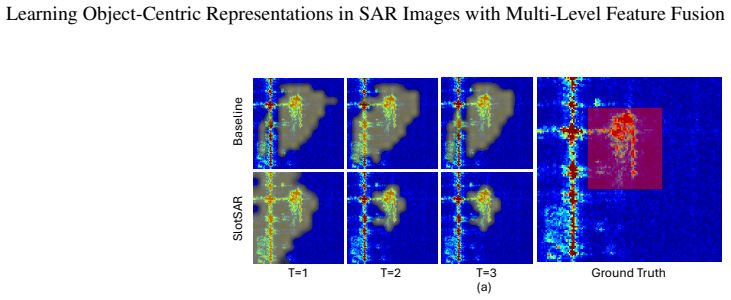
- The iterative refinement analysis shows SlotSAR continues to improve from iteration T=1 to T=3, whereas the baseline stagnates, implying the fusion signal is genuinely steering slot refinement rather than being a static feature.
- Because training uses only a reconstruction loss on visual features and no masks, the method can be pretrained on unlabeled SAR imagery and then fine-tuned, which the paper does by pretraining on a simpler scene set before scenario-specific fine-tuning.
Where Pith is reading between the lines
- Inference: The fixed two-slot prior (one target, one background) means SlotSAR can only represent scenes containing exactly one target. A natural stress test is to apply it to SAR chips with multiple vehicles or no vehicle; the method would likely need a variable slot count or an explicit 'empty' slot to generalize to such scenes.
- Inference: Although training is unsupervised, the quantitative evaluation relies on binary masks derived from bounding-box annotations to compute ARI/mBO. Readers should keep separate the label-free training paradigm from the annotated evaluation pipeline.
- Inference: The parameterized Morlet wavelets are learned jointly with the rest of the model, so the scattering branch may automatically adapt to different frequency bands and polarizations. A testable extension is to fine-tune only the wavelet parameters when transferring to a new sensor and check whether the disentanglement quality is retained.
- Inference: The fusion map is a form of gating; a cheaper alternative that concatenates scattering features into the attention keys rather than gating the values might yield similar gains. This is directly testable with an ablation.
Editorial analysis
A structured set of objections, weighed in public.
Referee Report
Summary. The paper proposes SlotSAR, an object-centric learning (OCL) framework for SAR imagery that disentangles a single target from background clutter without mask annotations. It combines high-level visual features from the SARATR-X foundation model with low-level scattering features from a learnable wavelet scattering network, and introduces a multi-level slot attention (MLSA) module that fuses these features through spatial and structural guidance. The model uses two slots (target and background) and is trained with a reconstruction loss on visual features. Experiments on the ATRNet-STAR dataset report state-of-the-art ARI and mBO results compared to Slot Attention, DINOSAUR, ISA, and SMSA baselines, with average gains of +6.57% ARI and +5.83% mBO.
Significance. If the proposed method is sound, it would be a meaningful step toward unsupervised target/clutter disentanglement in SAR imagery, addressing a real problem of clutter resembling targets. The use of wavelet scattering features to inject structural detail into slot attention is a sensible idea, and the reported gains on a large SAR benchmark, if reproducible, would be noteworthy. However, the manuscript currently does not provide a fully specified, implementable description of the central MLSA module due to several tensor shape inconsistencies, and it lacks code and error bars. The claimed dual-benchmark evaluation is also not reflected in the experimental section. These issues must be resolved before the contributions can be reliably assessed.
major comments (4)
- [Sec. 3.2.3, Eqs. (10)-(11)] The central fusion equations are dimensionally inconsistent. The paper sets D_s=64 (Sec. 3.1.1 and Implementation Details) and D_slot=256. Eq. (10) defines M_f = F''_s ⊗ M_s ∈ R^{2×N×D_s}, so M_f has last dimension 64. Eq. (11) then computes the GRU input as \hat{A}^T · (M_f ⊙ V), where V ∈ R^{N×D_slot} = R^{N×256} (from Eq. 6). Element-wise multiplication M_f ⊙ V requires identical shapes; (2,N,64) and (N,256) cannot be broadcast. Moreover, even if a projection to D_slot were intended, the product \hat{A}^T · (M_f⊙V) does not produce a (2,D_slot) GRU input without further specification. As written, the MLSA module is not implementable.
- [Sec. 3.2.2, Eq. (8)] The attention map definition is internally inconsistent. P = K Q^T / √d_h is a (N,2) matrix because K ∈ R^{N×D_slot} and Q ∈ R^{2×D_slot}, yet A is declared to be in R^{2×N}. Eq. (8) normalizes over the slot index (l=1..2), whereas the later normalization \hat{A}_{i,j}=A_{i,j}/Σ_{l=1}^N A_{i,l} normalizes over the key index. These two normalizations cannot both hold for the same A. If A is actually (N,2), then M_s in Eq. (9) is (N,2), not (2,N), which changes Eq. (10) as well. The index and normalization conventions need to be corrected.
- [Abstract / Conclusion / Sec. 4] The abstract and conclusion claim that SlotSAR achieves state-of-the-art results on both the MSTAR and ATRNet-STAR benchmarks. However, Section 4 reports experiments only on ATRNet-STAR. No MSTAR results, setup, or tables are provided. This is a factual inconsistency between the stated contributions and the presented evidence. Either add the MSTAR experiments or remove the claim.
- [Sec. 3.2.1] The model fixes exactly two slots, S=[S_T,S_B], which implicitly assumes every input image contains exactly one target and everything else is background. The paper does not discuss or test scenarios with multiple targets, no targets, or partially occluded targets. While this may be reasonable for single-target SAR chips, the manuscript should state this assumption explicitly and should evaluate or at least discuss its effect on real-world ATR settings where the assumption may fail.
minor comments (5)
- [Sec. 3.2.3, Eq. (12)] The output shape of the slot update is written as R^{2×N}, but it should be R^{2×D_slot} to be consistent with the slot dimension defined in Sec. 3.2.1.
- [Sec. 1, first paragraph] The text says 'FCLR aims to reduce...' but the acronym introduced is FLCR (feature-level clutter reduction). Please correct the typo.
- [Sec. 4.1, Implementation Details] The paper would benefit from reporting standard deviations or error bars for the reported metrics. With a batch size of 64 and 200 epochs, multiple runs are feasible and would strengthen the quantitative claims.
- [General] The paper does not provide code, training/validation splits, or hyperparameter details for the wavelet scattering network (e.g., number of scales, orientations, initialization). Such details are necessary for reproducibility, especially given the inconsistencies in the main equations.
- [Table 1] The table header format is confusing: the column groups are not clearly labeled regarding which encoder (DINOv2 vs SARATR-X) is used for each baseline. Please make the grouping explicit.
Circularity Check
No significant circularity: training loss is feature reconstruction, not mask fitting; reported ARI/mBO are external benchmark evaluations.
full rationale
SlotSAR is trained with L_Recon = |f_v - g_d(S'_T;S'_B)|^2 (Eq. 13), a reconstruction loss on visual features, not on the ARI/mBO evaluation masks. The quantitative metrics are computed post hoc by Hungarian matching of decoder alpha masks to binary segmentation maps generated from bounding-box annotations using [27]; these masks never enter the training objective. Thus the headline gains (+6.57% ARI, +5.83% mBO) are not forced by construction, and no parameter is fitted to the evaluation target. The only overlap with the authors' prior work is [27], used to build evaluation masks, and [8] for problem motivation; both are peripheral to the derivation and do not supply the central result. The MLSA equations (Eqs. 10-11) appear dimensionally inconsistent as written, but that is an implementability/correctness issue, not circularity. The paper is self-contained against external benchmarks and compares to standard baselines, so the derivation chain does not reduce to its own inputs.
Axiom & Free-Parameter Ledger
free parameters (5)
- Morlet wavelet parameters (scale σ, orientation θ, frequency ξ, aspect ratio γ) =
learned during training on ATRNet-STAR
- Slot initialization parameters μ and diag(σ) =
learned
- All other trainable weights (projections W_k, W_v, W_q, MLPs, GRU, decoder) =
learned
- Number of slot iterations T =
3
- Slot dimension D_slot and scattering feature dimension D_s =
256 and 64
axioms (4)
- domain assumption Each SAR image contains exactly one target and the rest is background, so two slots are sufficient.
- domain assumption Wavelet scattering features provide distinguishable responses to targets vs clutter in SAR.
- domain assumption SARATR-X's pretrained features provide reliable coarse spatial/semantic cues for targets.
- domain assumption Feature-space reconstruction loss is a sufficient training signal for object-centric disentanglement.
read the original abstract
Synthetic aperture radar (SAR) images contain not only targets of interest but also complex background clutter, including terrain reflections and speckle noise. In many cases, such clutter exhibits intensity and patterns that resemble targets, leading models to extract entangled or spurious features. Such behavior undermines the ability to form clear target representations, regardless of the classifier. To address this challenge, we propose a novel object-centric learning (OCL) framework, named SlotSAR, that disentangles target representations from background clutter in SAR images without mask annotations. SlotSAR first extracts high-level semantic features from SARATR-X and low-level scattering features from the wavelet scattering network in order to obtain complementary multi-level representations for robust target characterization. We further present a multi-level slot attention module that integrates these low- and high-level features to enhance slot-wise representation distinctiveness, enabling effective OCL. Experimental results demonstrate that SlotSAR achieves state-of-the-art performance in SAR imagery by preserving structural details compared to existing OCL methods.
Figures



Reference graph
Works this paper leans on
-
[1]
Digital processing of synthetic aperture radar data.Artech house, 1(3):108– 110, 2005
Ian G Cumming and Frank H Wong. Digital processing of synthetic aperture radar data.Artech house, 1(3):108– 110, 2005
2005
-
[2]
Atrnet-star: A large dataset and benchmark towards remote sensing object recognition in the wild
Yongxiang Liu, Weijie Li, Li Liu, Jie Zhou, Bowen Peng, Yafei Song, Xuying Xiong, Wei Yang, Tianpeng Liu, Zhen Liu, et al. Atrnet-star: A large dataset and benchmark towards remote sensing object recognition in the wild. arXiv preprint arXiv:2501.13354, 2025
arXiv 2025
-
[3]
Automatic target recognition on synthetic aperture radar imagery: A survey.IEEE Aerospace and Electronic Systems Magazine, 36(3):56–81, 2021
Odysseas Kechagias-Stamatis and Nabil Aouf. Automatic target recognition on synthetic aperture radar imagery: A survey.IEEE Aerospace and Electronic Systems Magazine, 36(3):56–81, 2021
2021
-
[4]
Diffdet4sar: Diffusion-based aircraft target detection network for sar images.IEEE Geoscience and Remote Sensing Letters, 21:1–5, 2024
Jie Zhou, Chao Xiao, Bo Peng, Zhen Liu, Li Liu, Yongxiang Liu, and Xiang Li. Diffdet4sar: Diffusion-based aircraft target detection network for sar images.IEEE Geoscience and Remote Sensing Letters, 21:1–5, 2024. 9 Learning Object-Centric Representations in SAR Images with Multi-Level Feature Fusion
2024
-
[5]
Sardet-100k: Towards open-source benchmark and toolkit for large-scale sar object detection.Advances in Neural Information Processing Systems, 37:128430–128461, 2024
Yuxuan Li, Xiang Li, Weijie Li, Qibin Hou, Li Liu, Ming-Ming Cheng, and Jian Yang. Sardet-100k: Towards open-source benchmark and toolkit for large-scale sar object detection.Advances in Neural Information Processing Systems, 37:128430–128461, 2024
2024
-
[6]
Saratr-x: Towards building a foundation model for sar target recognition.IEEE Transactions on Image Processing, 2025
Weijie Li, Wei Yang, Yuenan Hou, Li Liu, Yongxiang Liu, and Xiang Li. Saratr-x: Towards building a foundation model for sar target recognition.IEEE Transactions on Image Processing, 2025
2025
-
[7]
Statistical analysis of high-resolution sar ground clutter data.IEEE Transactions on Geoscience and Remote sensing, 45(3):566–575, 2007
Maria S Greco and Fulvio Gini. Statistical analysis of high-resolution sar ground clutter data.IEEE Transactions on Geoscience and Remote sensing, 45(3):566–575, 2007
2007
-
[8]
Irasnet: Improved feature-level clutter reduction for domain generalized sar-atr.IEEE Transactions on Aerospace and Electronic Systems, pages 1–18, 2025
Oh-Tae Jang, Min-Jun Kim, Sung-Ho Kim, Hee-Sub Shin, and Kyung-Tae Kim. Irasnet: Improved feature-level clutter reduction for domain generalized sar-atr.IEEE Transactions on Aerospace and Electronic Systems, pages 1–18, 2025
2025
-
[9]
Weijie Li, Wei Yang, Wenpeng Zhang, Tianpeng Liu, Yongxiang Liu, and Li Liu. Hierarchical disentanglement- alignment network for robust sar vehicle recognition.IEEE Journal of Selected Topics in Applied Earth Observa- tions and Remote Sensing, 16:9661–9679, 2023
2023
-
[10]
Learning invariant representation via contrastive feature alignment for clutter robust sar atr.IEEE Geoscience and Remote Sensing Letters, 20:1–5, 2023
Bowen Peng, Jianyue Xie, Bo Peng, and Li Liu. Learning invariant representation via contrastive feature alignment for clutter robust sar atr.IEEE Geoscience and Remote Sensing Letters, 20:1–5, 2023
2023
-
[11]
Shuai Guo, Ting Chen, Penghui Wang, Junkun Yan, and Hongwei Liu. Tsmal: Target-shadow mask assistance learning network for sar target recognition.IEEE Journal of Selected Topics in Applied Earth Observations and Remote Sensing, 17:18247–18263, 2024
2024
-
[12]
Neural expectation maximization.Advances in neural information processing systems, 30, 2017
Klaus Greff, Sjoerd Van Steenkiste, and Jürgen Schmidhuber. Neural expectation maximization.Advances in neural information processing systems, 30, 2017
2017
-
[13]
Object-centric learning with slot attention.Advances in neural information processing systems, 33:11525–11538, 2020
Francesco Locatello, Dirk Weissenborn, Thomas Unterthiner, Aravindh Mahendran, Georg Heigold, Jakob Uszkoreit, Alexey Dosovitskiy, and Thomas Kipf. Object-centric learning with slot attention.Advances in neural information processing systems, 33:11525–11538, 2020
2020
-
[14]
Bridging the gap to real-world object-centric learning.arXiv preprint arXiv:2209.14860, 2022
Maximilian Seitzer, Max Horn, Andrii Zadaianchuk, Dominik Zietlow, Tianjun Xiao, Carl-Johann Simon-Gabriel, Tong He, Zheng Zhang, Bernhard Schölkopf, Thomas Brox, et al. Bridging the gap to real-world object-centric learning.arXiv preprint arXiv:2209.14860, 2022
Pith/arXiv arXiv 2022
-
[15]
Ondrej Biza, Sjoerd Van Steenkiste, Mehdi SM Sajjadi, Gamaleldin F Elsayed, Aravindh Mahendran, and Thomas Kipf. Invariant slot attention: Object discovery with slot-centric reference frames.arXiv preprint arXiv:2302.04973, 2023
Pith/arXiv arXiv 2023
-
[16]
Grandmother cells, symmetry, and invariance: how the term arose and what the facts suggest
Horace Barlow. Grandmother cells, symmetry, and invariance: how the term arose and what the facts suggest. 2009
2009
-
[17]
Dual information purification for lightweight sar object detection
Xi Yang, Jiachen Sun, Songsong Duan, and De Cheng. Dual information purification for lightweight sar object detection. InProceedings of the AAAI Conference on Artificial Intelligence, volume 39, pages 9274–9282, 2025
2025
-
[18]
Cross-rejective open-set sar image registration
Shasha Mao, Shiming Lu, Zhaolong Du, Licheng Jiao, Shuiping Gou, Luntian Mou, Xuequan Lu, Lin Xiong, and Yimeng Zhang. Cross-rejective open-set sar image registration. InProceedings of the Computer Vision and Pattern Recognition Conference, pages 23027–23036, 2025
2025
-
[19]
Guided slot attention for unsupervised video object segmentation
Minhyeok Lee, Suhwan Cho, Dogyoon Lee, Chaewon Park, Jungho Lee, and Sangyoun Lee. Guided slot attention for unsupervised video object segmentation. InProceedings of the IEEE/CVF conference on computer vision and pattern recognition, pages 3807–3816, 2024
2024
-
[20]
Parametric scattering networks
Shanel Gauthier, Benjamin Thérien, Laurent Alsene-Racicot, Muawiz Chaudhary, Irina Rish, Eugene Belilovsky, Michael Eickenberg, and Guy Wolf. Parametric scattering networks. InProceedings of the IEEE/CVF Conference on Computer Vision and Pattern Recognition, pages 5749–5758, 2022
2022
-
[21]
Speckle Suppression and Analysis for Synthetic Aperture Radar Images
Jong-Sen Lee. Speckle Suppression and Analysis for Synthetic Aperture Radar Images. In Henri H. Arsenault, editor,Intl Conf on Speckle, volume 0556, pages 170 – 179. International Society for Optics and Photonics, SPIE, 1985
1985
-
[22]
Frost, Josephine Abbott Stiles, K
Victor S. Frost, Josephine Abbott Stiles, K. S. Shanmugan, and Julian C. Holtzman. A model for radar images and its application to adaptive digital filtering of multiplicative noise.IEEE Transactions on Pattern Analysis and Machine Intelligence, PAMI-4(2):157–166, 1982
1982
-
[23]
Attributed scattering centers for sar atr.IEEE Transactions on image processing, 6(1):79–91, 1997
Lee C Potter and Randolph L Moses. Attributed scattering centers for sar atr.IEEE Transactions on image processing, 6(1):79–91, 1997
1997
-
[24]
Vsfa: Visual and scattering topological feature fusion and alignment network for unsupervised domain adaptation in sar target recognition
Chen Zhang, Yinghua Wang, Hongwei Liu, Yuanshuang Sun, and Siyuan Wang. Vsfa: Visual and scattering topological feature fusion and alignment network for unsupervised domain adaptation in sar target recognition. IEEE Transactions on Geoscience and Remote Sensing, 61:1–20, 2023. 10 Learning Object-Centric Representations in SAR Images with Multi-Level Featu...
2023
-
[25]
Chenxi Zhao, Daochang Wang, Xianghui Zhang, Yuli Sun, Siqian Zhang, and Gangyao Kuang. Adaptive scattering feature awareness and fusion for limited training data sar target recognition.IEEE Journal of Selected Topics in Applied Earth Observations and Remote Sensing, 2024
2024
-
[26]
Chenxi Zhao, Daochang Wang, Siqian Zhang, and Gangyao Kuang. Bottom-up scattering information perception network for sar target recognition.arXiv preprint arXiv:2504.04780, 2025
Pith/arXiv arXiv 2025
-
[27]
Fusion of target and shadow regions for improved sar atr.IEEE Transactions on Geoscience and Remote Sensing, 60:1–17, 2022
Jae-Ho Choi, Myung-Jun Lee, Nam-Hoon Jeong, Geon Lee, and Kyung-Tae Kim. Fusion of target and shadow regions for improved sar atr.IEEE Transactions on Geoscience and Remote Sensing, 60:1–17, 2022
2022
-
[28]
Sar atr of ground vehicles based on lm-bn-cnn.IEEE Transactions on Geoscience and Remote Sensing, 56(12):7282–7293, 2018
Feng Zhou, Li Wang, Xueru Bai, and Ye Hui. Sar atr of ground vehicles based on lm-bn-cnn.IEEE Transactions on Geoscience and Remote Sensing, 56(12):7282–7293, 2018
2018
-
[29]
Bootstrapping top-down information for self-modulating slot attention.Advances in Neural Information Processing Systems, 37:103751–103773, 2024
Dongwon Kim, Seoyeon Kim, and Suha Kwak. Bootstrapping top-down information for self-modulating slot attention.Advances in Neural Information Processing Systems, 37:103751–103773, 2024
2024
-
[30]
Toward causal representation learning.Proceedings of the IEEE, 109(5):612–634, 2021
Bernhard Schölkopf, Francesco Locatello, Stefan Bauer, Nan Rosemary Ke, Nal Kalchbrenner, Anirudh Goyal, and Yoshua Bengio. Toward causal representation learning.Proceedings of the IEEE, 109(5):612–634, 2021
2021
-
[31]
Andrea Dittadi, Samuele Papa, Michele De Vita, Bernhard Schölkopf, Ole Winther, and Francesco Locatello. Generalization and robustness implications in object-centric learning.arXiv preprint arXiv:2107.00637, 2021
Pith/arXiv arXiv 2021
-
[32]
Object-centric slot diffusion.arXiv preprint arXiv:2303.10834, 2023
Jindong Jiang, Fei Deng, Gautam Singh, and Sungjin Ahn. Object-centric slot diffusion.arXiv preprint arXiv:2303.10834, 2023
Pith/arXiv arXiv 2023
-
[33]
Slotdiffusion: Object-centric generative modeling with diffusion models.Advances in Neural Information Processing Systems, 36:50932–50958, 2023
Ziyi Wu, Jingyu Hu, Wuyue Lu, Igor Gilitschenski, and Animesh Garg. Slotdiffusion: Object-centric generative modeling with diffusion models.Advances in Neural Information Processing Systems, 36:50932–50958, 2023
2023
-
[34]
Improving cross-modal retrieval with set of diverse embeddings
Dongwon Kim, Namyup Kim, and Suha Kwak. Improving cross-modal retrieval with set of diverse embeddings. InProceedings of the IEEE/CVF conference on computer vision and pattern recognition, pages 23422–23431, 2023
2023
-
[35]
Improving sound source localization with joint slot attention on image and audio
Inho Kim, Youngkil Song, Jicheol Park, Won Hwa Kim, and Suha Kwak. Improving sound source localization with joint slot attention on image and audio. InProceedings of the Computer Vision and Pattern Recognition Conference, pages 3121–3130, 2025
2025
-
[36]
Guiqiu Liao, Matjaz Jogan, Marcel Hussing, Edward Zhang, Eric Eaton, and Daniel A Hashimoto. Future slot prediction for unsupervised object discovery in surgical video.arXiv preprint arXiv:2507.01882, 2025
Pith/arXiv arXiv 2025
-
[37]
Conditional object-centric learning from video.arXiv preprint arXiv:2111.12594, 2021
Thomas Kipf, Gamaleldin F Elsayed, Aravindh Mahendran, Austin Stone, Sara Sabour, Georg Heigold, Rico Jonschkowski, Alexey Dosovitskiy, and Klaus Greff. Conditional object-centric learning from video.arXiv preprint arXiv:2111.12594, 2021
Pith/arXiv arXiv 2021
-
[38]
Multimodal slot vision transformer for sar image classification
Tianyi Yu, Fangzhou Han, Lamei Zhang, and Bin Zou. Multimodal slot vision transformer for sar image classification. In2024 IEEE International Conference on Signal, Information and Data Processing (ICSIDP), pages 1–6. IEEE, 2024
2024
-
[39]
Slotfusion: Object-centric audiovisual feature fusion with slot attention for remote sensing scene recognition
Fangzhou Han, Tianyi Yu, Lamei Zhang, Lingyu Si, and Yiqi Zhang. Slotfusion: Object-centric audiovisual feature fusion with slot attention for remote sensing scene recognition. InICASSP 2025-2025 IEEE International Conference on Acoustics, Speech and Signal Processing (ICASSP), pages 1–5. IEEE, 2025
2025
-
[40]
Daubechies
I. Daubechies. The wavelet transform, time-frequency localization and signal analysis.IEEE Transactions on Information Theory, 36(5):961–1005, 1990
1990
-
[41]
Sar image segmentation based on convolutional- wavelet neural network and markov random field.Pattern Recognition, 64:255–267, 2017
Yiping Duan, Fang Liu, Licheng Jiao, Peng Zhao, and Lu Zhang. Sar image segmentation based on convolutional- wavelet neural network and markov random field.Pattern Recognition, 64:255–267, 2017
2017
-
[42]
Tello, C
M. Tello, C. Lopez-Martinez, and J.J. Mallorqui. A novel algorithm for ship detection in sar imagery based on the wavelet transform.IEEE Geoscience and Remote Sensing Letters, 2(2):201–205, 2005
2005
-
[43]
De Grandi, Jong-Sen Lee, and Dale L
Gianfranco D. De Grandi, Jong-Sen Lee, and Dale L. Schuler. Target detection and texture segmentation in polarimetric sar images using a wavelet frame: Theoretical aspects.IEEE Transactions on Geoscience and Remote Sensing, 45(11):3437–3453, 2007
2007
-
[44]
De Grandi, Richard M
Gianfranco D. De Grandi, Richard M. Lucas, and Jan Kropacek. Analysis by wavelet frames of spatial statistics in sar data for characterizing structural properties of forests.IEEE Transactions on Geoscience and Remote Sensing, 47(2):494–507, 2009
2009
-
[45]
U-net: Convolutional networks for biomedical image segmentation
Olaf Ronneberger, Philipp Fischer, and Thomas Brox. U-net: Convolutional networks for biomedical image segmentation. InInternational Conference on Medical image computing and computer-assisted intervention, pages 234–241. Springer, 2015. 11 Learning Object-Centric Representations in SAR Images with Multi-Level Feature Fusion
2015
-
[46]
Junyoung Chung, Caglar Gulcehre, KyungHyun Cho, and Yoshua Bengio. Empirical evaluation of gated recurrent neural networks on sequence modeling.arXiv preprint arXiv:1412.3555, 2014
Pith/arXiv arXiv 2014
-
[47]
Adam: A method for stochastic optimization.arXiv preprint arXiv:1412.6980, 2014
Diederik P Kingma and Jimmy Ba. Adam: A method for stochastic optimization.arXiv preprint arXiv:1412.6980, 2014
Pith/arXiv arXiv 2014
-
[48]
Dinov2: Learning robust visual features without supervision.arXiv preprint arXiv:2304.07193, 2023
Maxime Oquab, Timothée Darcet, Théo Moutakanni, Huy V o, Marc Szafraniec, Vasil Khalidov, Pierre Fernandez, Daniel Haziza, Francisco Massa, Alaaeldin El-Nouby, et al. Dinov2: Learning robust visual features without supervision.arXiv preprint arXiv:2304.07193, 2023
Pith/arXiv arXiv 2023
-
[49]
Visualizing data using t-sne.Journal of machine learning research, 9(Nov):2579–2605, 2008
Laurens van der Maaten and Geoffrey Hinton. Visualizing data using t-sne.Journal of machine learning research, 9(Nov):2579–2605, 2008. 12
2008
discussion (0)
Sign in with ORCID, Apple, or X to comment. Anyone can read and Pith papers without signing in.