REVIEW 2 major objections 5 minor 1 cited by
Dust growth can pull disc fragmentation inward to 30 au, producing gas-giant-mass clumps.
Reviewed by Pith at T0; open to challenge. T0 means a machine referee read the full paper against a public rubric. the ladder, T0–T4 →
Dust growth can reduce disc opacity enough to allow gravitational instability fragmentation at ~30 au, producing gas-giant-mass fragments rather than brown dwarfs.
T0 review reviewed 2026-08-04 challenge →
load-bearing objection A clean analytic demonstration that dust growth can move GI fragmentation inward, but the headline R~30 au / M~5 M_J result rests on the optimistic St=0.1 case. the 2 major comments →
Dust growth and planet formation by disc fragmentation
The pith
A machine-rendered reading of the paper's core claim, the machinery that carries it, and where it could break.
The reading
Core claim
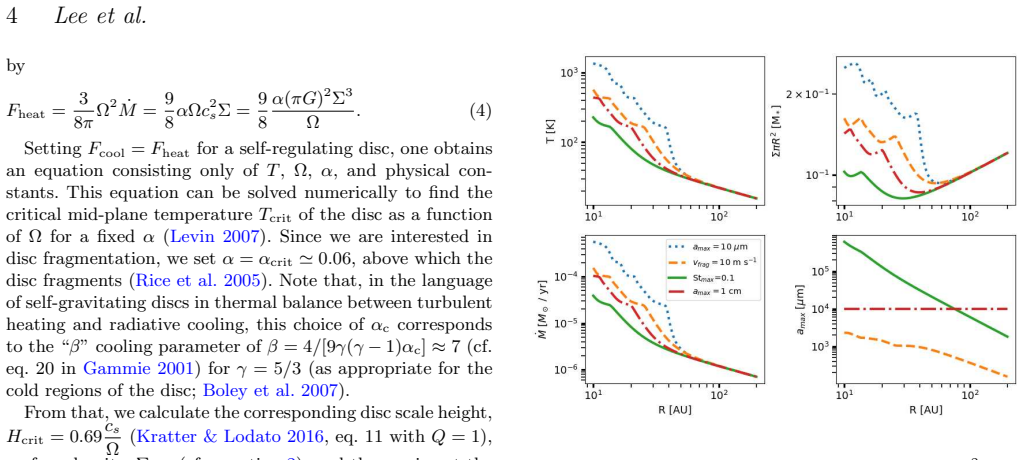
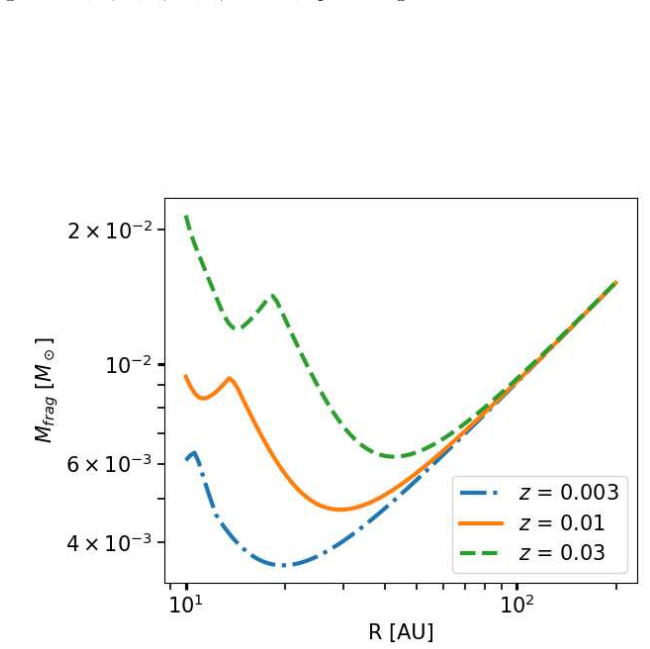
The paper finds that opacity reduction from dust growth enables disc fragmentation in colder, less massive discs at smaller radii. Using a new analytic opacity fit that depends on maximum grain size, the authors show that for grains grown to a Stokes number of 0.1, the minimum fragment mass is about 5 Jupiter masses and occurs near 30 au, compared to about 60 au for ISM-like dust. Even for a conservative 1 cm maximum grain size, the fragmentation radius shifts inward to ~40 au, and planet-mass clumps remain possible at 20–30 au. The critical accretion rate threshold for fragmentation is met at R ~ 20 au in the most favorable case, versus R > 40 au without dust growth.
What carries the argument
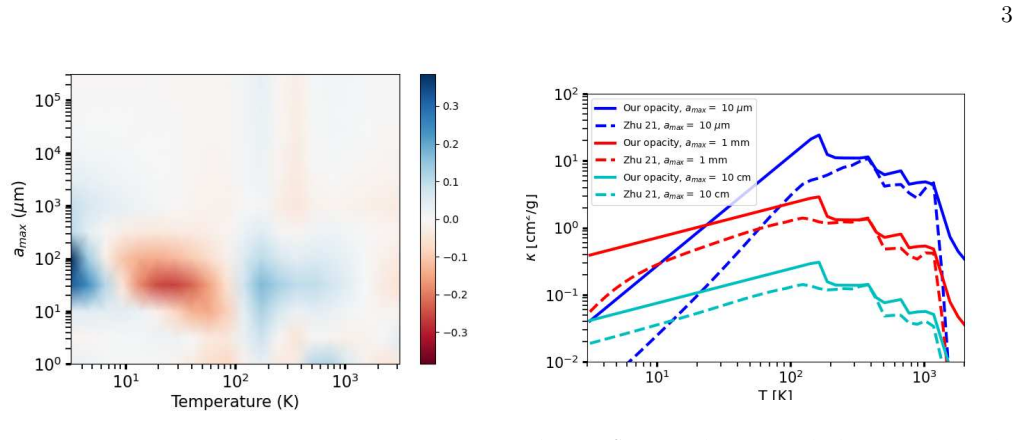
A piecewise power-law Rosseland mean opacity fit κ(amax, T) based on DIANA opacities, with sublimation corrections, is embedded in the standard pseudo-viscous model of a marginally stable disc (Toomre Q ≈ 1). Thermal balance between gravitoturbulent heating and radiative cooling is imposed at the critical viscosity parameter α ≈ 0.06 (β ≈ 7), yielding critical temperature, surface density, accretion rate, and initial fragment mass M_frag = 57 Σ_crit H_crit^2 as functions of radius for four grain-size scenarios.
Load-bearing premise
The calculation assumes that dust grains actually reach the assumed large sizes—most critically the optimistic Stokes-number-0.1 limit—before the disc fragments; if grain growth is stalled at smaller sizes by fragmentation barriers, radial drift, or settling, the opacity remains high and the fragmentation radius stays near 60 au.
What would settle it
A radiation-hydrodynamic simulation of a self-gravitating disc that includes cm-sized dust growth and finds no fragments inside 60 au would refute the inward shift; likewise, observations showing that discs at 20–30 au are too optically thick despite the presence of large grains would do so.
If this is right
- Disc fragmentation can occur inside 30 au, within the typical observed extent of protoplanetary discs, rather than only in the outer regions beyond 50–60 au.
- Critical disc masses and accretion rates required for fragmentation are lower, making gravitational instability a more viable channel for giant planet formation in less extreme discs.
- Initial fragment masses drop into the gas giant regime, with a minimum near 5 Jupiter masses for optimistic grain growth.
- In the 1 cm grain case, the smallest fragments form at 20–30 au, although the radius of minimum mass is about 40 au.
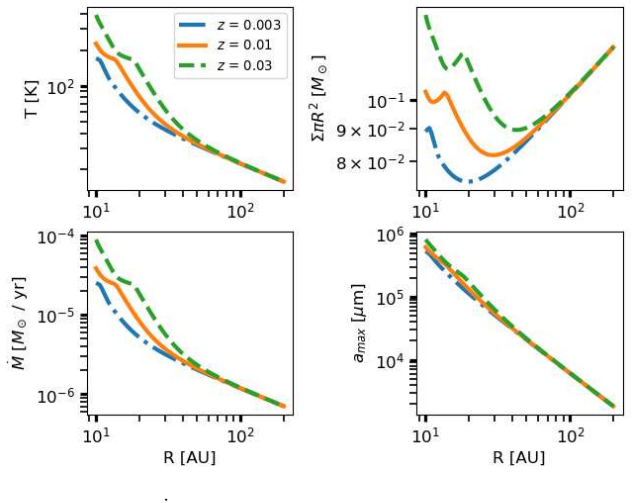
- Fragmentation is further favored around lower-mass stars, in metal-poor discs, and in regions of reduced stellar irradiation.
Where Pith is reading between the lines
- If correct, the model predicts a population of directly imaged giant planets on ~30 au orbits—closer than the >50 au orbits usually attributed to gravitational instability—which future surveys could look for.
- The spatial variation of grain growth implies that opacity, and hence fragmentation likelihood, is not uniform; spiral arms with concentrated dust may fragment differently than the disc average, producing a patchy distribution of clump formation sites.
- The same opacity effect would alter gas accretion onto the newly formed clumps, potentially changing the final planet mass and multiplicity, an extension the paper notes but does not model.
- Observations measuring grain sizes in young discs (e.g., via millimeter spectral indices) could directly test the predicted correlation: discs with evidence of centimeter-sized grains should be more prone to fragmentation and to hosting massive wide-orbit companions.
Editorial analysis
A structured set of objections, weighed in public.
Referee Report
Summary. This Letter develops an analytic Rosseland-mean opacity parameterization as a function of maximum grain size, fit to DIANA opacity tables, and couples it to a standard pseudo-viscous Q=1 gravitoturbulent disc model to derive critical temperature, surface density, accretion rate, and initial fragment mass at the fragmentation boundary. The authors consider four dust scenarios: fixed 10 µm grains, fixed 1 cm grains, a fragmentation-limited case with v_frag=10 m/s, and an optimistic St=0.1 case. They find that if grains grow to cm sizes, fragmentation can occur at radii as small as ~30 au, with a minimum fragment mass of ~5 M_J near that radius, compared with ~60 au and higher masses for ISM-like dust. The paper concludes that GI may form gas giants rather than only brown dwarfs, while cautioning that numerical simulations are required to assess dust dynamics and fragment evolution.
Significance. If the central result is robust, the paper is significant: it challenges the widespread claim that GI operates only beyond ~50 au and that it mostly produces brown-dwarf-mass objects. The strengths are a transparent analytic framework, an opacity fit tested directly against DIANA tables, sensitivity checks against alpha_crit, stellar mass, irradiation, and metallicity, and public code/data. The main weakness, which the authors themselves acknowledge, is that the quantitative headline (R~30 au, M_min~5 M_J) is produced by the St=0.1 case that is explicitly labelled an optimistic upper limit, while the more conservative v_frag=10 m/s model does not show the same inward shift. This is a load-bearing uncertainty rather than a routine parameter variation.
major comments (2)
- [§3.1 and §3.2, Figs. 4-5] The central quantitative result (fragmentation at R_min ~ 30 au with M_min ~ 5 M_J) is generated by the St_max = 0.1 case, which the text itself calls an 'optimistic upper limit'. In the alternative v_frag = 10 m/s case (orange curves, Fig. 4 lower right), amax remains below ~1 mm across the relevant radii, so the opacity is close to the ISM-like case and the fragment-mass minimum stays near ~50 au with M_frag > 10 M_J, as seen in Fig. 5. Since the paper states in §4 that the opacity reduction is significant only for amax > ~1 mm, the inward shift to 30 au does not occur in the conservative growth model. The abstract and §3.2 present the R~30 au result without this caveat. Please either make the v_frag = 10 m/s case the headline and treat the St = 0.1 case explicitly as a speculative upper limit, or provide a quantitative justification that St ~ 0.1 is reached before fragmentation, given
- [§3.1, St=0.1 model] The St=0.1 maximum grain size is imposed via amax = 2 Sigma St / (pi rho_s) rather than derived from a coagulation/fragmentation calculation. The authors correctly state that amax is a non-local quantity, but the paper's main claim effectively assumes that grain growth to cm sizes has already occurred in a marginally stable disc. The cited work (Booth & Clarke 2016; Riols et al. 2017; Booth & Clarke 2019) indicates that correlated motions may suppress collision velocities, but the small-scale turbulence contribution has not been quantified. Without such a quantification, or at least a clear statement that the St=0.1 case is a deliberately best-case scenario, the conclusion 'dust growth may promote fragmentation at ~30 au' is better characterized as a conditional result than as a finding.
minor comments (5)
- [Table 1] For amax >= 10^3 um the table states that pl and ph are constant, but the cells are blank. Please give the constant values explicitly in the table or in the text.
- [Fig. 2 caption] The caption does not state the range/units of the ratio plotted. Please add the color-bar range or state the plotted interval so the deviation values are interpretable.
- [Data availability] The GitHub URL contains a space ('dust growth opacity'); this should be properly encoded or hyphenated so the link is accessible.
- [Footnote 1] The footnote is a long parenthetical fragment that interrupts the main text; consider splitting it into a complete sentence or integrating it into the discussion.
- [§2.2] The sublimation-factor expression is presented with ambiguous parentheses/ spacing; a clearer formulation (e.g., explicitly showing multiplication by f_i + (1-f_i) exp((T-T_i)/10 K)) would improve readability.
Circularity Check
No significant circularity; the fragmentation results are computed from independently fit opacity tables and explicitly declared grain-size scenarios.
full rationale
The paper's derivation chain is self-contained and non-circular. The opacity function (Eq. 1) is explicitly fit to DIANA standard opacities from Woitke et al. (2016), with goodness-of-fit quantified in Fig. 2; the grain-size cases are declared inputs or externally motivated scenarios (10 μm, 1 cm, v_frag from Birnstiel et al. 2009, and St=0.1 as an optimistic upper limit motivated by Booth & Clarke 2016). The critical disc properties T_crit, Σ_crit, Mdot_crit, and M_frag are then outputs of the thermal-balance equations (F_cool = F_heat, Q=1, α=α_crit≈0.06) using literature values, not fitted to the target conclusion. The St=0.1 case is explicitly labeled an optimistic upper limit with caveats about small-scale turbulence, so the headline result is a conditional scenario calculation rather than a prediction forced by the inputs. The only self-citation (Booth & Clarke) supports an assumption that the authors themselves flag as unquantified, and it does not reduce the central derivation to the authors' own previous claims. No fitted parameter is renamed as a prediction, no uniqueness theorem is imported, and no known result is merely renamed. The paper's limitations are acknowledged qualitatively, which further confirms that model dependence is not being disguised as independent derivation.
Axiom & Free-Parameter Ledger
free parameters (6)
- alpha_crit (disc fragmentation threshold) =
0.06
- grain fragmentation velocity v_frag =
10 m/s
- maximum Stokes number St_max =
0.1
- irradiation scaling factor =
0.1
- opacity fit parameters kappa0, pl, ph (per amax) =
Table 1 values for 17 amax values
- grain size distribution parameters =
p=3.5, amin=0.05 micron, rho_s=3 g/cm3
axioms (7)
- domain assumption Marginally stable disc with Toomre Q = 1, giving cs = pi G Sigma / Omega.
- domain assumption Disc is in thermal balance between gravitoturbulent heating and radiative cooling, with fragmentation when alpha = alpha_crit = 0.06.
- domain assumption The pseudo-viscous disc model accurately captures the fragmentation boundary within a factor of order unity.
- domain assumption The DIANA opacity tables and the piecewise power-law fit (eq. 1) with sublimation corrections represent realistic disc opacities.
- domain assumption The grain size scenarios (Birnstiel et al. 2009; St_max = 0.1) are representative or upper limits of dust sizes in the fragmenting disc.
- domain assumption Initial fragment mass is given by M_frag = 57 Sigma H^2 (Xu et al. 2024).
- domain assumption Stellar irradiation heating is T_irr = (0.1 L* / (4 pi r^2 sigma_B))^(1/4).
Cite this review
Pith. "Pith review of Dust growth and planet formation by disc fragmentation." pith.science (2026). https://pith.science/paper/7YVZTRVD
@misc{pith2026250909305,
  author       = {Pith},
  title        = {Pith review of: Dust growth and planet formation by disc fragmentation},
  year         = {2026},
  howpublished = {\url{https://pith.science/paper/7YVZTRVD}},
  note         = {Machine review of arXiv:2509.09305}
}
abstract
It is often argued that gravitational instability of realistic protoplanetary discs is only possible at distances larger than $\sim 50$ au from the central star, requiring high disc masses and accretion rates, and that therefore disc fragmentation results in the production of brown dwarfs rather than gas giant planets. However, the effects of dust growth on opacity can be very significant but have not been taken into account systematically in the models of fragmenting discs. We employ dust opacity that depends on both temperature and maximum grain size to evaluate analytically the properties of a critically fragmenting protoplanetary disc. We find that dust growth may promote disc fragmentation at disc radii as small as $\sim 30$ au. As a result, the critical disc masses and accretion rates are smaller, and the initial fragment masses are in the gas giant planet mass regime. While this suggests that formation of gas giant planets by disc fragmentation may be more likely than usually believed, we caution that numerical models of the process are needed to evaluate the effects not taken into account here, e.g., dust grain mobility and fragment evolution after disc fragmentation.
Figures



Forward citations
Cited by 1 Pith paper
-
Dust Growth in Binary Systems: Inhibition of dust settling and growth in circumbinary discs
Dust grains in circumbinary discs end up five times smaller than in single-star discs, and the conditions for streaming-instability clumping are not met, arguing against in-situ planet formation there.
Reference graph
Works this paper leans on
-
[2]
Baehr H., 2023, @doi [ ] 10.1093/mnras/stad1564 , https://ui.adsabs.harvard.edu/abs/2023MNRAS.523.3348B 523, 3348
-
[3]
R., 1999, @doi [ ] 10.1086/307988 , https://ui.adsabs.harvard.edu/abs/1999ApJ...526..411B 526, 411
Bell K. R., 1999, @doi [ ] 10.1086/307988 , https://ui.adsabs.harvard.edu/abs/1999ApJ...526..411B 526, 411
-
[4]
Bell K. R., Lin D. N. C., 1994, @doi [ ] 10.1086/174206 , http://ukads.nottingham.ac.uk/cgi-bin/nph-bib_query?bibcode=1994ApJ...427..987B&db_key=AST 427, 987
doi:10.1086/174206 1994
-
[5]
Birnstiel T., 2024, @doi [Annual Review of Astronomy and Astrophysics] https://ui.adsabs.harvard.edu/link_gateway/2024ARA&A..62..157B/doi:10.1146/annurev-astro-071221-052705 , 62, 157
-
[6]
P., Brauer F., 2009, @doi [ ] 10.1051/0004-6361/200912452 , https://ui.adsabs.harvard.edu/abs/2009A
Birnstiel T., Dullemond C. P., Brauer F., 2009, @doi [ ] 10.1051/0004-6361/200912452 , https://ui.adsabs.harvard.edu/abs/2009A
-
[7]
Blunt S., et al., 2023, @doi [The Astronomical Journal] https://ui.adsabs.harvard.edu/link_gateway/2023AJ....166..257B/doi:10.3847/1538-3881/ad06b7 , 166
-
[8]
Boley A. C., Durisen R. H., 2010, @doi [ ] 10.1088/0004-637X/724/1/618 , http://adsabs.harvard.edu/abs/2010ApJ...724..618B 724, 618
-
[9]
Boley A. C., Hartquist T. W., Durisen R. H., Michael S., 2007, @doi [ ] 10.1086/512235 , http://adsabs.harvard.edu/abs/2007ApJ...656L..89B 656, L89
doi:10.1086/512235 2007
-
[10]
C., Hayfield T., Mayer L., Durisen R
Boley A. C., Hayfield T., Mayer L., Durisen R. H., 2010, @doi [Icarus] 10.1016/j.icarus.2010.01.015 , http://ukads.nottingham.ac.uk/abs/2010Icar..207..509B 207, 509
-
[11]
Booth R. A., Clarke C. J., 2016, @doi [ ] 10.1093/mnras/stw488 , http://adsabs.harvard.edu/abs/2016MNRAS.458.2676B 458, 2676
-
[12]
Booth R. A., Clarke C. J., 2019, @doi [ ] 10.1093/mnras/sty3340 , https://ui.adsabs.harvard.edu/abs/2019MNRAS.483.3718B 483, 3718
-
[13]
P., 1998, @doi [ ] 10.1086/306036 , http://adsabs.harvard.edu/abs/1998ApJ...503..923B 503, 923
Boss A. P., 1998, @doi [ ] 10.1086/306036 , http://adsabs.harvard.edu/abs/1998ApJ...503..923B 503, 923
-
[14]
Chiang E. I., Goldreich P., 1997, @doi [ ] 10.1086/304869 , http://adsabs.harvard.edu/abs/1997ApJ...490..368C 490, 368
doi:10.1086/304869 1997
-
[15]
Clarke C. J., 2009, @doi [ ] 10.1111/j.1365-2966.2009.14774.x , http://adsabs.harvard.edu/abs/2009MNRAS.396.1066C 396, 1066
arXiv 2009
-
[16]
Clarke C. J., Lodato G., 2009, @doi [ ] 10.1111/j.1745-3933.2009.00695.x , http://adsabs.harvard.edu/abs/2009MNRAS.398L...6C 398, L6
arXiv 2009
-
[18]
Deng H., Mayer L., Meru F., 2017, preprint, http://adsabs.harvard.edu/abs/2017arXiv170600417D ( @eprint arXiv 1706.00417 )
Pith/arXiv arXiv 2017
-
[19]
Dorschner J., Begemann B., Henning T., Jaeger C., Mutschke H., 1995, Astronomy and Astrophysics, 300, 503
1995
-
[20]
Draine B. T., Lee H. M., 1984, @doi [ ] 10.1086/162480 , https://ui.adsabs.harvard.edu/abs/1984ApJ...285...89D 285, 89
doi:10.1086/162480 1984
-
[21]
P., Dominik C., 2005, @doi [ ] 10.1051/0004-6361:20042080 , http://ukads.nottingham.ac.uk/abs/2005A
Dullemond C. P., Dominik C., 2005, @doi [ ] 10.1051/0004-6361:20042080 , http://ukads.nottingham.ac.uk/abs/2005A
-
[22]
Forgan D., Rice K., 2011, @doi [ ] 10.1111/j.1365-2966.2011.19380.x , http://adsabs.harvard.edu/abs/2011MNRAS.417.1928F 417, 1928
arXiv 2011
-
[23]
F., 2001, , http://cdsads.u-strasbg.fr/cgi-bin/nph-bib_query?bibcode=2001ApJ...553..174G&db_key=AST 553, 174
Gammie C. F., 2001, , http://cdsads.u-strasbg.fr/cgi-bin/nph-bib_query?bibcode=2001ApJ...553..174G&db_key=AST 553, 174
2001
-
[25]
Gibbons P. G., Mamatsashvili G. R., Rice W. K. M., 2014, @doi [ ] 10.1093/mnras/stu809 , http://adsabs.harvard.edu/abs/2014MNRAS.442..361G 442, 361
-
[26]
M., van der Marel N., Williams J
Guerra-Alvarado O. M., van der Marel N., Williams J. P., Pinilla P., Mulders G. D., Lambrechts M., Sanchez M., 2025, arXiv e-prints, https://ui.adsabs.harvard.edu/abs/2025arXiv250319504G p. arXiv:2503.19504
Pith/arXiv arXiv 2025
-
[27]
Hall C., Forgan D., Rice K., 2017, @doi [ ] 10.1093/mnras/stx1244 , http://adsabs.harvard.edu/abs/2017MNRAS.470.2517H 470, 2517
-
[28]
Helled R., et al., 2014, @doi [Protostars and Planets VI, University of Arizona Press, Tucson] 10.2458/azu_uapress_9780816531240-ch028 , http://adsabs.harvard.edu/abs/2014prpl.conf..643H pp 643--665
-
[29]
Kratter K. M., Lodato G., 2016, preprint, http://adsabs.harvard.edu/abs/2016arXiv160301280K ( @eprint arXiv 1603.01280 )
Pith/arXiv arXiv 2016
-
[30]
Kratter K. M., Murray-Clay R. A., Youdin A. N., 2010, @doi [ ] 10.1088/0004-637X/710/2/1375 , http://adsabs.harvard.edu/abs/2010ApJ...710.1375K 710, 1375
-
[31]
Kubli N., Mayer L., Deng H., 2023, @doi [ ] 10.1093/mnras/stad2478 , https://ui.adsabs.harvard.edu/abs/2023MNRAS.525.2731K 525, 2731
-
[32]
P., 1951, in J
Kuiper G. P., 1951, in J. A. Hynek ed., 50th Anniversary of the Yerkes Observatory and Half a Century of Progress in Astrophysics. pp 357--+
1951
-
[33]
Kuiper R., Klahr H., Beuther H., Henning T., 2010, @doi [The Astrophysical Journal] https://ui.adsabs.harvard.edu/link_gateway/2010ApJ...722.1556K/doi:10.1088/0004-637X/722/2/1556 , 722, 1556
-
[34]
Levin Y., 2007, @doi [ ] 10.1111/j.1365-2966.2006.11155.x , http://ukads.nottingham.ac.uk/abs/2007MNRAS.374..515L 374, 515
arXiv 2007
-
[35]
Longarini C., Lodato G., Bertin G., Armitage P. J., 2023a, @doi [Monthly Notices of the Royal Astronomical Society] https://ui.adsabs.harvard.edu/link_gateway/2023MNRAS.519.2017L/doi:10.1093/mnras/stac3653 , 519, 2017
-
[36]
Longarini C., Armitage P. J., Lodato G., Price D. J., Ceppi S., 2023b, @doi [Monthly Notices of the Royal Astronomical Society] https://ui.adsabs.harvard.edu/link_gateway/2023MNRAS.522.6217L/doi:10.1093/mnras/stad1400 , 522, 6217
-
[37]
G., Kuiper R., Klahr H., Dullemond C
Malygin M. G., Kuiper R., Klahr H., Dullemond C. P., Henning T., 2014, @doi [ ] 10.1051/0004-6361/201423768 , https://ui.adsabs.harvard.edu/abs/2014A&A...568A..91M 568, A91
-
[38]
Marois C., Macintosh B., Barman T., Zuckerman B., Song I., Patience J., Lafreni \`e re D., Doyon R., 2008, @doi [Science] 10.1126/science.1166585 , http://adsabs.harvard.edu/abs/2008Sci...322.1348M 322, 1348
-
[39]
Marois C., Zuckerman B., Konopacky Q. M., Macintosh B., Barman T., 2010, @doi [ ] 10.1038/nature09684 , http://adsabs.harvard.edu/abs/2010Natur.468.1080M 468, 1080
-
[40]
Meru F., Bate M. R., 2010, @doi [ ] 10.1111/j.1365-2966.2010.16867.x , http://adsabs.harvard.edu/abs/2010MNRAS.406.2279M 406, 2279
arXiv 2010
-
[41]
W., de Koter A., 2005, @doi [Astronomy and Astrophysics] 10.1051/0004-6361:20041920 , 432, 909
Min M., Hovenier J. W., de Koter A., 2005, @doi [Astronomy and Astrophysics] 10.1051/0004-6361:20041920 , 432, 909
-
[42]
Min M., Dullemond C. P., Kama M., Dominik C., 2011, @doi [Icarus] https://ui.adsabs.harvard.edu/link_gateway/2011Icar..212..416M/doi:10.1016/j.icarus.2010.12.002 , 212, 416
-
[43]
Molyarova T., Vorobyov E. I., Akimkin V., Skliarevskii A., Wiebe D., G \"u del M., 2021, @doi [ ] 10.3847/1538-4357/abe2b0 , https://ui.adsabs.harvard.edu/abs/2021ApJ...910..153M 910, 153
-
[44]
Nayakshin S., 2017a, @doi [ ] 10.1017/pasa.2016.55 , http://adsabs.harvard.edu/abs/2017PASA...34....2N 34, e002
-
[45]
Nayakshin S., 2017b, @doi [ ] 10.1093/mnras/stx1351 , http://ukads.nottingham.ac.uk/abs/2017MNRAS.470.2387N 470, 2387
-
[46]
Paardekooper S.-J., 2012, @doi [ ] 10.1111/j.1365-2966.2012.20553.x , http://adsabs.harvard.edu/abs/2012MNRAS.421.3286P 421, 3286
arXiv 2012
-
[47]
B., Hollenbach D., Beckwith S., Simonelli D
Pollack J. B., Hollenbach D., Beckwith S., Simonelli D. P., Roush T., Fong W., 1994, @doi [ ] 10.1086/173677 , http://ukads.nottingham.ac.uk/abs/1994ApJ...421..615P 421, 615
doi:10.1086/173677 1994
-
[48]
B., Hubickyj O., Bodenheimer P., Lissauer J
Pollack J. B., Hubickyj O., Bodenheimer P., Lissauer J. J., Podolak M., Greenzweig Y., 1996, @doi [Icarus] 10.1006/icar.1996.0190 , http://adsabs.harvard.edu/abs/1996Icar..124...62P 124, 62
arXiv 1996
-
[49]
Rafikov R. R., 2005, @doi [ ] 10.1086/428899 , http://ukads.nottingham.ac.uk/cgi-bin/nph-bib_query?bibcode=2005ApJ...621L..69R&db_key=AST 621, L69
doi:10.1086/428899 2005
-
[50]
Rice W. K. M., Lodato G., Pringle J. E., Armitage P. J., Bonnell I. A., 2004, @doi [ ] 10.1111/j.1365-2966.2004.08339.x , http://ukads.nottingham.ac.uk/abs/2004MNRAS.355..543R 355, 543
arXiv 2004
-
[51]
Rice W. K. M., Lodato G., Armitage P. J., 2005, @doi [ ] 10.1111/j.1745-3933.2005.00105.x , http://ukads.nottingham.ac.uk/cgi-bin/nph-bib_query?bibcode=2005MNRAS.364L..56R&db_key=AST 364, L56
arXiv 2005
-
[52]
Riols A., Latter H., Paardekooper S. J., 2017, @doi [ ] 10.1093/mnras/stx1548 , https://ui.adsabs.harvard.edu/abs/2017MNRAS.471..317R 471, 317
-
[53]
Rosotti G. P., Tazzari M., Booth R. A., Testi L., Lodato G., Clarke C., 2019, @doi [ ] 10.1093/mnras/stz1190 , https://ui.adsabs.harvard.edu/abs/2019MNRAS.486.4829R 486, 4829
-
[54]
Rowther S., Nealon R., Meru F., Wurster J., Aly H., Alexander R., Rice K., Booth R. A., 2024, @doi [Monthly Notices of the Royal Astronomical Society] https://ui.adsabs.harvard.edu/link_gateway/2024MNRAS.528.2490R/doi:10.1093/mnras/stae167 , 528, 2490
-
[55]
Semenov D., Henning T., Helling C., Ilgner M., Sedlmayr E., 2003, @doi [ ] 10.1051/0004-6361:20031279 , http://adsabs.harvard.edu/abs/2003A
-
[56]
Stamatellos D., Inutsuka S.-i., 2018, @doi [Monthly Notices of the Royal Astronomical Society] https://ui.adsabs.harvard.edu/link_gateway/2018MNRAS.477.3110S/doi:10.1093/mnras/sty827 , 477, 3110
-
[57]
P., 2008, @doi [ ] 10.1051/0004-6361:20078628 , http://ukads.nottingham.ac.uk/abs/2008A
Stamatellos D., Whitworth A. P., 2008, @doi [ ] 10.1051/0004-6361:20078628 , http://ukads.nottingham.ac.uk/abs/2008A
-
[58]
Stamatellos D., Whitworth A. P., 2009, @doi [ ] 10.1111/j.1365-2966.2008.14069.x , http://adsabs.harvard.edu/abs/2009MNRAS.392..413S 392, 413
arXiv 2009
-
[59]
Toomre A., 1964, , http://esoads.eso.org/cgi-bin/nph-bib_query?bibcode=1964ApJ...139.1217T&db_key=AST 139, 1217
1964
-
[60]
Toon O. B., Ackerman T. P., 1981, @doi [Appl Opt] 10.1364/AO.20.003657 , 20, 3657
-
[61]
Trapman L., Rosotti G., Zhang K., Tabone B., 2023, @doi [The Astrophysical Journal] https://ui.adsabs.harvard.edu/link_gateway/2023ApJ...954...41T/doi:10.3847/1538-4357/ace7d1 , 954
-
[62]
Vigan A., et al., 2021, @doi [ ] 10.1051/0004-6361/202038107 , https://ui.adsabs.harvard.edu/abs/2021A&A...651A..72V 651, A72
-
[63]
Vorobyov E. I., Basu S., 2006, @doi [ ] 10.1086/507320 , http://adsabs.harvard.edu/abs/2006ApJ...650..956V 650, 956
doi:10.1086/507320 2006
-
[64]
Vorobyov E. I., Basu S., 2015, @doi [ ] 10.1088/0004-637X/805/2/115 , https://ui.adsabs.harvard.edu/abs/2015ApJ...805..115V 805, 115
-
[65]
Vorobyov E. I., Elbakyan V. G., 2018, @doi [Astronomy & Astrophysics] https://ui.adsabs.harvard.edu/link_gateway/2018A&A...618A...7V/doi:10.1051/0004-6361/201833226 , 618
-
[66]
Vorobyov E. I., Elbakyan V. G., 2019, @doi [ ] 10.1051/0004-6361/201936132 , https://ui.adsabs.harvard.edu/abs/2019A&A...631A...1V 631, A1
-
[67]
Weidenschilling S. J., 1984, @doi [ ] 10.1016/0019-1035(84)90164-7 , http://adsabs.harvard.edu/abs/1984Icar...60..553W 60, 553
-
[68]
Woitke P., et al., 2016, @doi [ ] 10.1051/0004-6361/201526538 , https://ui.adsabs.harvard.edu/abs/2016A&A...586A.103W 586, A103
-
[69]
Xu W., Armitage P. J., 2023, @doi [The Astrophysical Journal] https://ui.adsabs.harvard.edu/link_gateway/2023ApJ...946...94X/doi:10.3847/1538-4357/acb7e5 , 946
-
[70]
Xu W., Jiang Y.-F., Kunz M. W., Stone J. M., 2024, Global Simulations of Gravitational Instability in Protostellar Disks with Full Radiation Transport. I. Stochastic Fragmentation with Optical-depth-dependent Rate and Universal Fragment Mass ( @eprint arXiv 2410.12042 ), https://arxiv.org/abs/2410.12042
Pith/arXiv arXiv 2024
-
[71]
Zhu Z., Hartmann L., Nelson R. P., Gammie C. F., 2012, @doi [ ] 10.1088/0004-637X/746/1/110 , http://adsabs.harvard.edu/abs/2012ApJ...746..110Z 746, 110
-
[72]
Zhu Z., Jiang Y.-F., Baehr H., Youdin A. N., Armitage P. J., Martin R. G., 2021, @doi [Monthly Notices of the Royal Astronomical Society] https://ui.adsabs.harvard.edu/link_gateway/2021MNRAS.508..453Z/doi:10.1093/mnras/stab2517 , 508, 453
-
[73]
Zubko V. G., Mennella V., Colangeli L., Bussoletti E., 1996, @doi [Monthly Notices of the Royal Astronomical Society] 10.1093/mnras/282.4.1321 , 282, 1321
This paper was first reviewed by deepseek-v4-flash on August 4, 2026.
discussion (0)
Sign in with ORCID, Apple, or X to comment. Anyone can read and Pith papers without signing in.