REVIEW 3 major objections 3 minor 36 references
Language and vision embeddings of a vision-language model are complementary, and a per-class precision rule that picks the more reliable classifier improves image classification beyond either mode alone.
Reviewed by Pith at T0; open to challenge. T0 means a machine referee read the full paper against a public rubric. the ladder, T0–T4 →
T0 review · deepseek-v4-flash
2026-08-04 19:17 UTC pith:EFZKUKOI
load-bearing objection A useful benchmark and a plausible fusion trick, but the headline gain is not yet fully controlled. the 3 major comments →
Image Recognition with Vision and Language Embeddings of VLMs
The pith
A machine-rendered reading of the paper's core claim, the machinery that carries it, and where it could break.
Core claim
The central claim is that language-based and vision-only recognition with the same VLM have complementary strengths, and a precision-based selection rule can capture part of that complementarity. Concretely, on the ImageNet-1k validation set, the fusion reaches 86.90% accuracy, versus 85.09% for the better language-based zero-shot classifier and 86.55% for the better vision-only k-NN classifier; on the Cleaner label-corrected set the fusion gets 93.40%, versus 92.98% and 93.04% for the two components. The paper also reports oracle experiments: a class-level oracle that picks the better classifier per class reaches 91.78% and an image-level oracle reaches 95.60%, which the authors use to argu
What carries the argument
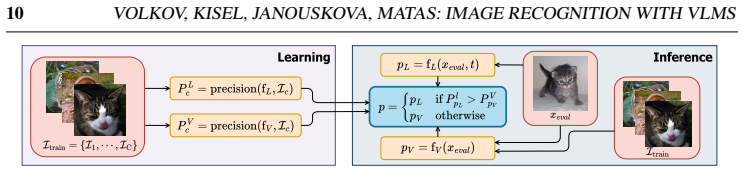
The key mechanism is the precision-based classifier selection rule. In a training phase, the method computes per-class precision—the fraction of a classifier's predictions for class c that are correct on the training set—for both the language classifier f_L and the vision k-NN classifier f_V, and selects the k for k-NN by 10-fold cross-validation. At inference, for an image, it computes the predicted class of each classifier and outputs the class from the classifier whose per-class precision is higher, as in Eq. (5). This hard selection carries the argument: it converts the observed complementarity into a measurable accuracy gain without any learned parameters.
Load-bearing premise
The method assumes that per-class precision measured on the ImageNet training set remains a reliable estimate of a classifier's reliability on the validation distribution, so that the argmax selection in Eq. (5) actually improves accuracy; the paper validates this only on ImageNet-1k and its Cleaner subset.
What would settle it
Re-run the precision-based fusion on a held-out or distribution-shifted dataset using the same 1000 classes (for example, a sketch-image or corrupted-image set), with per-class precision still computed from ImageNet training images. If the fused accuracy no longer exceeds the better of the two individual classifiers, the assumed transfer of training-set precision is falsified.
If this is right
- A training-free fusion rule can lift VLM classification accuracy above both its language-based and vision-only components on the same benchmark.
- Vision-only k-NN with a VLM's image encoder is a strong baseline in its own right, sometimes surpassing the model's zero-shot language classification.
- Prompt template and class-name choices shift zero-shot accuracy by several percent, and these improvements transfer across models of different architectures and training data.
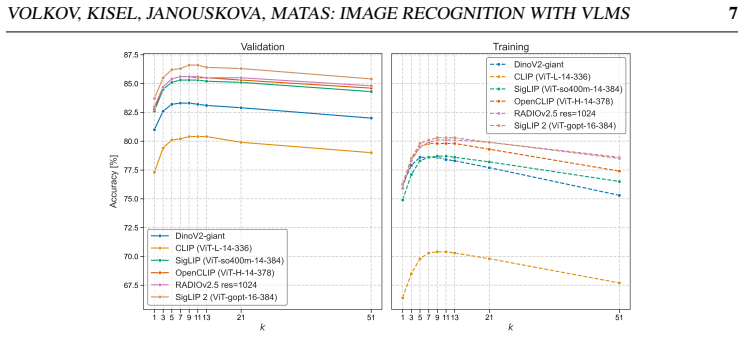
- The optimal number of neighbours in vision k-NN is stable in the 7-11 range across models and reference-set sizes, so practitioners can set k without extensive search.
- Oracle selection shows the two classifiers make largely disjoint errors, so stronger fusion methods could approach 95.6% on ImageNet validation.
Where Pith is reading between the lines
- The per-class precision estimates need not come from the ImageNet training set; recomputing them on a small labelled set from the deployment distribution would test whether the fusion gain is robust to distribution shift, and could serve as a cheap recalibration step.
- The same selection rule could be applied to combine a VLM with a supervised model from the same benchmark, since the oracle evidence suggests complementary errors; a larger gain may be available with a more diverse pair of classifiers.
- Because the image-level oracle upper bound (95.6%) far exceeds the simple precision rule (86.9%), a learnable gating function or class-specific thresholds would likely close much of that gap; the paper's deliberate learning-free constraint leaves this accuracy on the table.
Editorial analysis
A structured set of objections, weighed in public.
Referee Report
Summary. The paper evaluates dual-encoder vision-language models (VLMs) for image classification in two modes: zero-shot language-based classification using prompt ensembling and vision-only k-NN classification on image embeddings. It benchmarks CLIP, SigLIP, SigLIP 2, OpenCLIP, and RADIOv2.5 on ImageNet-1k validation and the authors' Cleaner subset, and analyzes the influence of prompt design, class names, neighborhood size, and reference set size. The main contribution is a precision-based fusion rule that, for each query, selects between the language prediction and the k-NN vision prediction according to per-class precision estimated on the training set. The fusion is reported to improve accuracy from 85.09%/92.98% (VL) and 86.55%/93.04% (V) to 86.90%/93.40% on validation/Cleaner.
Significance. If the fusion result holds, the paper offers a simple, practical combination method and a useful characterization of complementary strengths between language and visual embeddings. The breadth of models tested, including recent SigLIP 2 and RADIOv2.5, and the detailed analyses of prompts and k-NN behavior are valuable. The code release supports reproducibility. However, the central claim of improvement rests on a comparison whose protocol is not fully specified and appears inconsistent; the magnitude and even the direction of the reported gain is not yet robustly established. The method is not circular in a technical sense, but the self-referential use of the authors' Cleaner dataset and class names should be kept in mind.
major comments (3)
- [§3.3–3.4, Table 5] The vision-only baseline in the fusion comparison is inconsistent with the best vision-only result. Table 3 reports SigLIP 2 k-NN at k=9 with 86.61% validation accuracy, while Table 5 lists V=86.55%, the value corresponding to k=11 in Table 7. Section 3.4 states that k is selected by 10-fold CV on the training set. If Table 5's V column is the CV-selected k, this must be stated and the standalone baseline must be evaluated under the same protocol; if it is meant to be the best vision-only result, the numbers do not match. The claimed fusion gain (86.90 vs 86.55) is therefore not compared against the strongest vision-only baseline, and the reported improvement may be an artifact of using a weaker baseline.
- [Eq. (4)] The computation of P_V^c is underspecified. It is not stated whether the k-NN predictions used to compute per-class precision come from held-out folds of the 10-fold cross-validation or from the training set with the query included in the k-NN reference set. In-sample evaluation would inflate P_V^c and bias the selection rule in Eq. (5) toward the vision classifier. The authors should specify the exact protocol and, if in-sample estimates are used, re-run the fusion with out-of-fold precision estimates.
- [§3.3] The global k-NN results are obtained by selecting k that maximizes accuracy on the validation set ('we report the results for k with maximum accuracy on validation set'). This is test-set selection and makes the standalone vision-only baseline asymmetric with the fusion method, which selects k by 10-fold CV on the training set. To establish a fair comparison, the same hyperparameter-selection protocol should be applied to both the standalone and the fusion classifiers, or the sensitivity to the protocol should be reported.
minor comments (3)
- [Eq. (5)] The condition in Eq. (5) is garbled: 'P l pL > P v pV' should read P_L^{p_L} > P_V^{p_V}. Please fix the superscript notation.
- [Abstract/§1] The method is described as 'learning-free' and 'without additional supervision or model tuning,' but it requires computing per-class precision from supervised training labels and cross-validating k. Consider a more precise qualifier such as 'parameter-free' or 'training-free' after tuning k.
- [§3.4] The text says 'the results are far from the oracle used to choose between the two approaches,' but the comparison to the double oracle is not quantified in Table 5. Reporting the oracle numbers next to Table 5 would help calibrate the practical gain.
Circularity Check
No significant circularity: precision-based fusion uses training-set precision to select among classifiers on validation, a legitimate supervised procedure; no step reduces to its inputs.
full rationale
The paper's central claim is that a per-class precision-based fusion rule (Eq. 5) improves over both vision-language and vision-only classifiers. The per-class precisions P_L^c and P_V^c are computed on the ImageNet training set via Eq. (4), and the fusion rule selects the classifier whose predicted class has higher training-set precision. This is a standard supervised model-selection procedure: a parameter (per-class precision) is estimated on labeled training data and applied to held-out validation images. The validation accuracy is not the same quantity as the training precision, and no equation in the paper defines the fusion gain in terms of the fitted precision by construction. Therefore, the core result is not circular. The paper also relies on the authors' own 'Cleaner' dataset [9] for part of the evaluation, but the main comparison is performed on the standard ImageNet-1k validation set with externally established baselines, and the Cleaner dataset is an additional benchmark rather than a load-bearing theoretical premise. The self-citation is minor and does not force the reported conclusions. The reviewer's concern about an uncontrolled comparison in Table 5 (V=86.55 vs. the best k-NN 86.61 in Table 3) is a legitimate experimental-protocol issue, but it is a question of correctness or clarity, not circularity: comparing fusion to a standalone baseline at a cross-validated k is not the same as assuming the result. No step in the derivation chain reduces to its own output, so the circularity score is appropriately low.
Axiom & Free-Parameter Ledger
free parameters (3)
- per-class precision P_L^c and P_V^c =
not reported in paper, computed on ImageNet training set
- k for k-NN =
k=9 for SigLIP 2 in main results, range 7-11 across models
- prompt templates and class names =
7 templates from CLIP [16], OpenAI+ class names from [9]
axioms (4)
- domain assumption Cosine similarity in the shared VLM embedding space is a valid measure of image-text and image-image compatibility.
- domain assumption ImageNet-1k validation labels and the Cleaner variant [9] provide reliable ground truth for accuracy comparison.
- domain assumption The optimal-k range observed on validation transfers to training and to other tested models.
- standard math The 1.28M-image training set is an adequate reference set for k-NN classification.
read the original abstract
Vision-language models (VLMs) have enabled strong zero-shot classification through image-text alignment. Yet, their purely visual inference capabilities remain under-explored. In this work, we conduct a comprehensive evaluation of both language-guided and vision-only image classification with a diverse set of dual-encoder VLMs, including both well-established and recent models such as SigLIP 2 and RADIOv2.5. The performance is compared in a standard setup on the ImageNet-1k validation set and its label-corrected variant. The key factors affecting accuracy are analysed, including prompt design, class diversity, the number of neighbours in k-NN, and reference set size. We show that language and vision offer complementary strengths, with some classes favouring textual prompts and others better handled by visual similarity. To exploit this complementarity, we introduce a simple, learning-free fusion method based on per-class precision that improves classification performance. The code is available at: https://github.com/gonikisgo/bmvc2025-vlm-image-recognition.
Figures



Reference graph
Works this paper leans on
-
[1]
Get- ting vit in shape: Scaling laws for compute-optimal model design, 2024
Ibrahim Alabdulmohsin, Xiaohua Zhai, Alexander Kolesnikov, and Lucas Beyer. Get- ting vit in shape: Scaling laws for compute-optimal model design, 2024. URL https://arxiv.org/abs/2305.13035
Pith/arXiv arXiv 2024
-
[2]
Hénaff, Alexander Kolesnikov, Xiaohua Zhai, and Aäron van den Oord
Lucas Beyer, Olivier J. Hénaff, Alexander Kolesnikov, Xiaohua Zhai, and Aäron van den Oord. Are we done with imagenet?, 2020. URL https://arxiv.org/ abs/2006.07159
Pith/arXiv arXiv 2020
-
[3]
Imagenet: A large-scale hierarchical image database
Jia Deng, Wei Dong, Richard Socher, Li-Jia Li, Kai Li, and Li Fei-Fei. Imagenet: A large-scale hierarchical image database. In 2009 IEEE Conference on Computer Vision and Pattern Recognition, pages 248–255, 2009. doi: 10.1109/CVPR.2009.5206848
arXiv 2009
-
[4]
Eva-02: A visual representation for neon genesis
Yuxin Fang, Quan Sun, Xinggang Wang, Tiejun Huang, Xinlong Wang, and Yue Cao. Eva-02: A visual representation for neon genesis. Image and Vision Computing , 149: 105171, September 2024. ISSN 0262-8856. doi: 10.1016/j.imavis.2024.105171. URL http://dx.doi.org/10.1016/j.imavis.2024.105171
arXiv 2024
-
[5]
Renovating names in open-vocabulary segmentation benchmarks
Andreas Geiger, Dan Zhang, Songyou Peng, and Haiwen Huang. Renovating names in open-vocabulary segmentation benchmarks. 2024
2024
-
[6]
Radiov2.5: Improved baselines for agglomerative vi- sion foundation models, 2025
Greg Heinrich, Mike Ranzinger, Hongxu, Yin, Yao Lu, Jan Kautz, Andrew Tao, Bryan Catanzaro, and Pavlo Molchanov. Radiov2.5: Improved baselines for agglomerative vi- sion foundation models, 2025. URL https://arxiv.org/abs/2412.07679
Pith/arXiv arXiv 2025
-
[7]
Gabriel Ilharco, Mitchell Wortsman, Ross Wightman, Cade Gordon, Nicholas Car- lini, Rohan Taori, Achal Dave, Vaishaal Shankar, Hongseok Namkoong, John Miller, Hannaneh Hajishirzi, Ali Farhadi, and Ludwig Schmidt. Openclip, July 2021. URL https://doi.org/10.5281/zenodo.5143773. If you use this software, please cite it as below
-
[8]
Berg, Wan-Yen Lo, Piotr Dollar, and Ross Girshick
Alexander Kirillov, Eric Mintun, Nikhila Ravi, Hanzi Mao, Chloe Rolland, Laura Gustafson, Tete Xiao, Spencer Whitehead, Alexander C. Berg, Wan-Yen Lo, Piotr Dollar, and Ross Girshick. Segment anything. In Proceedings of the IEEE/CVF In- ternational Conference on Computer Vision (ICCV) , pages 4015–4026, October 2023
2023
-
[9]
Flaws of imagenet, computer vision’s favorite dataset
Nikita Kisel, Illia V olkov, Kate ˇrina Hanzelková, Klara Janouskova, and Jiri Matas. Flaws of imagenet, computer vision’s favorite dataset. In ICLR Blogposts 2025 , 2025. URL https://d2jud02ci9yv69. cloudfront.net/2025-04-28-imagenet-flaws-135/blog/ imagenet-flaws/. https://d2jud02ci9yv69.cloudfront.net/2025-04-28-imagenet- flaws-135/blog/imagenet-flaws/
2025
-
[10]
Visual- text cross alignment: Refining the similarity score in vision-language models
Jinhao Li, Haopeng Li, Sarah Erfani, Lei Feng, James Bailey, and Feng Liu. Visual- text cross alignment: Refining the similarity score in vision-language models. arXiv preprint arXiv:2406.02915, 2024
Pith/arXiv arXiv 2024
-
[11]
Visual instruction tuning,
Haotian Liu, Chunyuan Li, Qingyang Wu, and Yong Jae Lee. Visual instruction tuning,
-
[12]
Northcutt, Anish Athalye, and Jonas Mueller
Curtis G. Northcutt, Anish Athalye, and Jonas Mueller. Pervasive label errors in test sets destabilize machine learning benchmarks, 2021. URL https://arxiv.org/ abs/2103.14749
Pith/arXiv arXiv 2021
-
[13]
Chatgpt: Optimizing language models for dialogue, 2022
OpenAI. Chatgpt: Optimizing language models for dialogue, 2022. URL https: //openai.com/blog/chatgpt
2022
-
[14]
Dinov2: Learning robust visual features without supervision, 2024
Maxime Oquab, Timothée Darcet, Théo Moutakanni, Huy V o, Marc Szafraniec, Vasil Khalidov, Pierre Fernandez, Daniel Haziza, Francisco Massa, Alaaeldin El-Nouby, Mahmoud Assran, Nicolas Ballas, Wojciech Galuba, Russell Howes, Po-Yao Huang, Shang-Wen Li, Ishan Misra, Michael Rabbat, Vasu Sharma, Gabriel Synnaeve, Hu Xu, Hervé Jegou, Julien Mairal, Patrick La...
Pith/arXiv arXiv 2024
-
[15]
Learning to name classes for vision and language models, 2023
Sarah Parisot, Yongxin Yang, and Steven McDonagh. Learning to name classes for vision and language models, 2023. URL https://arxiv.org/abs/2304. 01830
2023
-
[16]
Learning transferable visual models from natural lan- guage supervision, 2021
Alec Radford, Jong Wook Kim, Chris Hallacy, Aditya Ramesh, Gabriel Goh, Sand- hini Agarwal, Girish Sastry, Amanda Askell, Pamela Mishkin, Jack Clark, Gretchen Krueger, and Ilya Sutskever. Learning transferable visual models from natural lan- guage supervision, 2021. URL https://arxiv.org/abs/2103.00020
Pith/arXiv arXiv 2021
-
[17]
Olga Russakovsky, Jia Deng, Hao Su, Jonathan Krause, Sanjeev Satheesh, Sean Ma, Zhiheng Huang, Andrej Karpathy, Aditya Khosla, Michael Bernstein, Alexander C. Berg, and Li Fei-Fei. Imagenet large scale visual recognition challenge, 2015. URL https://arxiv.org/abs/1409.0575
Pith/arXiv arXiv 2015
-
[18]
Evaluating machine accuracy on ImageNet
Vaishaal Shankar, Rebecca Roelofs, Horia Mania, Alex Fang, Benjamin Recht, and Ludwig Schmidt. Evaluating machine accuracy on ImageNet. In Hal Daumé III and Aarti Singh, editors, Proceedings of the 37th International Conference on Machine Learning, volume 119 of Proceedings of Machine Learning Research , pages 8634–
-
[19]
Paligemma 2: A family of versatile vlms for transfer, 2024
Andreas Steiner, André Susano Pinto, Michael Tschannen, Daniel Keysers, Xiao Wang, Yonatan Bitton, Alexey Gritsenko, Matthias Minderer, Anthony Sherbondy, Shangbang Long, Siyang Qin, Reeve Ingle, Emanuele Bugliarello, Sahar Kazemzadeh, Thomas Mesnard, Ibrahim Alabdulmohsin, Lucas Beyer, and Xiaohua Zhai. Paligemma 2: A family of versatile vlms for transfe...
Pith/arXiv arXiv 2024
-
[20]
Mingxing Tan and Quoc V . Le. Efficientnetv2: Smaller models and faster training,
-
[21]
Gemini 1.5: Unlocking multimodal under- standing across millions of tokens of context, 2024
Gemini Team and Petko Georgiev et al. Gemini 1.5: Unlocking multimodal under- standing across millions of tokens of context, 2024. URL https://arxiv.org/ abs/2403.05530. VOLKOV , KISEL, JANOUSKOV A, MA TAS: IMAGE RECOGNITION WITH VLMS 13
Pith/arXiv arXiv 2024
-
[22]
Michael Tschannen, Alexey Gritsenko, Xiao Wang, Muhammad Ferjad Naeem, Ibrahim Alabdulmohsin, Nikhil Parthasarathy, Talfan Evans, Lucas Beyer, Ye Xia, Basil Mustafa, Olivier Hénaff, Jeremiah Harmsen, Andreas Steiner, and Xiaohua Zhai. Siglip 2: Multilingual vision-language encoders with improved semantic understand- ing, localization, and dense features, ...
Pith/arXiv arXiv 2025
-
[23]
From imagenet to image classification: Contextualizing progress on bench- marks, 2020
Dimitris Tsipras, Shibani Santurkar, Logan Engstrom, Andrew Ilyas, and Aleksander Madry. From imagenet to image classification: Contextualizing progress on bench- marks, 2020. URL https://arxiv.org/abs/2005.11295
Pith/arXiv arXiv 2020
-
[24]
When does dough become a bagel? analyzing the remaining mistakes on imagenet, 2022
Vijay Vasudevan, Benjamin Caine, Raphael Gontijo-Lopes, Sara Fridovich-Keil, and Rebecca Roelofs. When does dough become a bagel? analyzing the remaining mistakes on imagenet, 2022. URL https://arxiv.org/abs/2205.04596
Pith/arXiv arXiv 2022
-
[25]
Convnet vs transformer, supervised vs clip: Beyond imagenet accuracy
Kirill Vishniakov, Zhiqiang Shen, and Zhuang Liu. Convnet vs transformer, supervised vs clip: Beyond imagenet accuracy. arXiv preprint arXiv:2311.09215, 2023
Pith/arXiv arXiv 2023
-
[26]
Pytorch image models
Ross Wightman. Pytorch image models. https://github.com/rwightman/ pytorch-image-models, 2019
2019
-
[27]
Qizhe Xie, Minh-Thang Luong, Eduard Hovy, and Quoc V . Le. Self-training with noisy student improves imagenet classification, 2020. URL https://arxiv.org/abs/ 1911.04252
Pith/arXiv arXiv 2020
-
[28]
Leveraging cross-modal neigh- bor representation for improved clip classification
Chao Yi, Lu Ren, De-Chuan Zhan, and Han-Jia Ye. Leveraging cross-modal neigh- bor representation for improved clip classification. In Proceedings of the IEEE/CVF Conference on Computer Vision and Pattern Recognition, pages 27402–27411, 2024
2024
-
[29]
Sigmoid loss for language image pre-training, 2023
Xiaohua Zhai, Basil Mustafa, Alexander Kolesnikov, and Lucas Beyer. Sigmoid loss for language image pre-training, 2023. URL https://arxiv.org/abs/2303. 15343
2023
-
[30]
Vision-language models for vision tasks: A survey
Jingyi Zhang, Jiaxing Huang, Sheng Jin, and Shijian Lu. Vision-language models for vision tasks: A survey. IEEE Transactions on Pattern Analysis and Machine Intelli- gence, 2024
2024
-
[31]
Tip-adapter: Training-free adaption of clip for few-shot classification
Renrui Zhang, Wei Zhang, Rongyao Fang, Peng Gao, Kunchang Li, Jifeng Dai, Yu Qiao, and Hongsheng Li. Tip-adapter: Training-free adaption of clip for few-shot classification. In European conference on computer vision , pages 493–510. Springer, 2022
2022
-
[32]
Conditional prompt learning for vision-language models, 2022
Kaiyang Zhou, Jingkang Yang, Chen Change Loy, and Ziwei Liu. Conditional prompt learning for vision-language models, 2022. URL https://arxiv.org/abs/ 2203.05557
Pith/arXiv arXiv 2022
-
[33]
Kaiyang Zhou, Jingkang Yang, Chen Change Loy, and Ziwei Liu. Learning to prompt for vision-language models. International Journal of Computer Vision, 130(9): 2337–2348, July 2022. ISSN 1573-1405. doi: 10.1007/s11263-022-01653-1. URL http://dx.doi.org/10.1007/s11263-022-01653-1 . 14 VOLKOV , KISEL, JANOUSKOV A, MA TAS: IMAGE RECOGNITION WITH VLMS A Additio...
-
[2021]
URL https://arxiv.org/abs/2104.00298
-
[2023]
12 VOLKOV , KISEL, JANOUSKOV A, MA TAS: IMAGE RECOGNITION WITH VLMS
URL https://arxiv.org/abs/2304.08485. 12 VOLKOV , KISEL, JANOUSKOV A, MA TAS: IMAGE RECOGNITION WITH VLMS
-
[8644]
URL https://proceedings.mlr.press/ v119/shankar20c.html
PMLR, 13–18 Jul 2020. URL https://proceedings.mlr.press/ v119/shankar20c.html
2020
discussion (0)
Sign in with ORCID, Apple, or X to comment. Anyone can read and Pith papers without signing in.