REVIEW 3 major objections 5 minor 1 cited by
Superconductivity in hyperbolic spaces: Regular hyperbolic lattices and Ginzburg-Landau theory
T0 review · 3 major / 5 minor · reviewed 2026-08-04 · deepseek-v4-flash
Pith's one-line read Hyperbolic space allows superconductivity to exist only at the boundary, above the bulk critical temperature.
desk verdict Solid BdG phase diagrams and a clean zero-mode mechanism, but the boundary-only phase above bulk Tc is extrapolated from a tree approximation and the GL 'two types' claim outruns the 1D analysis. read the letter →
The pith
A machine-rendered reading of the paper's core claim, the machinery that carries it, and where it could break.
The reading
What carries the argument
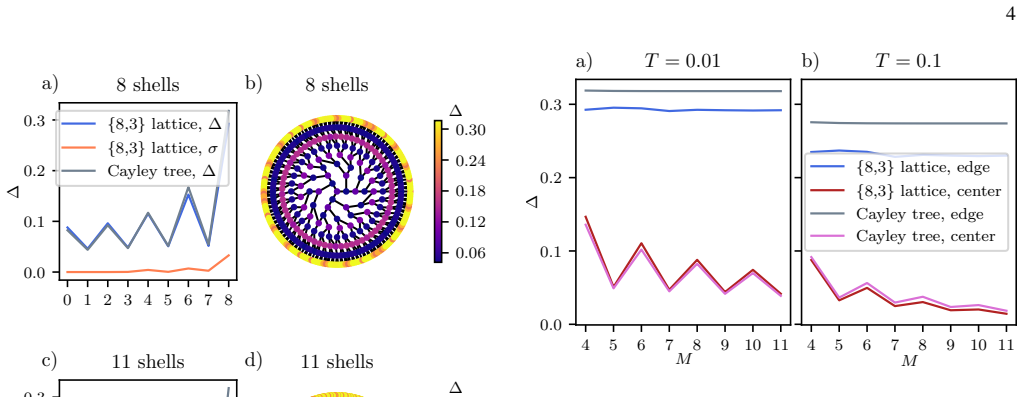
The argument is carried by three objects. First, the hyperbolic lattice as an expander graph: every finite-depth patch of {p,q} has boundary sites proportional to its total sites, which makes boundary effects thermodynamically relevant. Second, the Cayley-tree approximation with effective non-integer connectivity given by the shell ratio N_{l+1}/N_l: by imposing that the Hamiltonian acts on shell-symmetric states as it would on a tree, the authors reduce the BdG equations to block-diagonal form tractable for hundreds of shells, and this is the step that produces the boundary-only phase. Third, the zero-energy modes of dangling-bond triplets: on a site-centered flake with ragged boundary, eac
What would settle it
Full self-consistent BdG exact diagonalization on a large {8,3} flake with ragged boundary at half-filling, T=0.1, U=1: if the boundary order parameter does not remain nonzero after the center has become normal, the boundary-only phase is an approximation artifact; separately, if the zero-energy modes predicted from dangling-bond triplets do not appear in the exact spectrum, the T_c-enhancement mechanism is wrong.
Extended reading notes
Core claim
On a regular hyperbolic lattice {p,q}, a finite flake's boundary contains a finite fraction of all sites no matter how large the flake grows, so the boundary is not a perturbation. The paper's central discovery is that this geometric fact turns the boundary into an independent superconducting subsystem: finite hyperbolic flakes support a boundary-only phase whose order parameter stays nonzero near the edge while the center is normal, and whose critical temperature can exceed the bulk value. The mechanism is encoded in the density of states: the Cayley-tree approximation, in which the lattice is replaced by a tree with a shell-dependent effective connectivity, reproduces the boundary profile
Load-bearing premise
The boundary-only superconducting phase above the bulk T_c is derived from the Cayley-tree approximation, which assumes that the shell-averaged Hamiltonian relations of Eq. (7) hold for hyperbolic lattices with an effective non-integer connectivity; the paper verifies this only for small flakes at half-filling and even p, and explicitly notes the approximation breaks down for odd p or away from half-filling, so the large-system claim rests on an extrapolation.
Editorial extensions
If this is right
- Boundary-only superconducting states should appear on large hyperbolic flakes at temperatures well above the bulk T_c, localized near the edge with nearly zero order parameter in the interior.
- Boundary termination is a control knob: rough boundaries with dangling bonds can raise T_c by several times near half-filling relative to smooth boundaries.
- Phase diagrams of finite hyperbolic flakes closely track the density of states of the corresponding tight-binding model, so geometric choices (p, q) that reshape the density of states also reshape superconductivity.
- In the continuum, finite hyperbolic domains with boundaries support radial condensate variations, and for 4R^2 tau > 1 the superconducting state has oscillating profiles with nodal lines—a zero-field analogue of type-II vortex structure.
- The lattice and continuum results together establish hyperbolic geometry as a platform for engineering boundary-controlled superconductivity, with implications for curved-space condensed matter and holography.
Reading between the lines
- The exact zero-energy modes at dangling-bond triplets are a purely local graph feature, so the same T_c enhancement should appear on any bipartite lattice patch containing these motifs—including flat-space nanoribbons with deliberately ragged edges—not only in hyperbolic geometry.
- The GL result suggests a sharp geometric transition when 4R^2 tau crosses 1; for a fixed material with a fixed coherence length, tuning the local curvature radius of a curved film could switch between monotonic and oscillatory condensate profiles without changing temperature or magnetic field.
- Because the Cayley-tree approximation breaks down for odd p or away from half-filling, exact diagonalization of odd-p flakes could test whether boundary-only superconductivity is a robust geometric effect or an artifact of the tree ansatz; the paper leaves that boundary of validity open.
Editorial analysis
A structured set of objections, weighed in public.
Referee Report
Summary. The paper studies s-wave superconductivity on hyperbolic lattices within BdG mean-field theory for the attractive Hubbard model, complemented by a Ginzburg-Landau analysis on the hyperbolic plane. The authors find that uniform/infinite hyperbolic lattices reproduce conventional BCS bulk behavior; finite flakes with open boundaries exhibit boundary-enhanced superconductivity. A Cayley-tree approximation with shell-dependent effective connectivity is introduced and used to predict boundary-only superconducting order at temperatures above the bulk Tc. Numerical BdG solutions for polygon- and site-centered flakes show phase diagrams correlated with the single-particle density of states, and show that dangling-boundary zero modes can raise Tc severalfold. The GL analysis classifies radial condensate profiles in the half-plane into monotonic and oscillatory regimes separated by the Breitenlohner-Freedman-like condition 4R^2 tau = 1, and identifies boundary-only profiles for tau < 0.
Significance. If correct, the prediction of boundary-only superconductivity above bulk Tc in a finite system with no fitting parameters would be a striking result: hyperbolic lattices, with their finite boundary fraction, would provide a geometric route to boundary-controlled superconductivity. The paper has real strengths: the BdG calculations are internally consistent and benchmarked against exact small flakes; the zero-mode construction for dangling triplets (Eq. 13) is explicit and falsifiable; the GL phase-portrait analysis is transparent; and no fitted parameters are used beyond U. However, the above-bulk-Tc boundary-only phase rests entirely on an approximation that is validated only in a parameter regime where it does not yet produce the claimed effect. The significance is therefore conditional until that gap is closed.
major comments (3)
- [§IIC, Figs. 8-9] The abstract's central claim that boundary-only superconducting states persist above the bulk Tc on hyperbolic lattices is supported only by the Cayley-tree approximation. The approximation's defining Eq. (7) imposes exact tree shell-to-shell relations on a graph with loops; its validation (Figs. 4-7) covers site-centered {8,3} flakes with M=8,11 at mu=0. Fig. 6 shows that at M=8 the central and edge critical temperatures coincide, so no boundary-only window exists at that size. The boundary-only state at T=0.1, an order of magnitude above the bulk Tc≈0.01, appears only after extrapolating to M=100-150 (Figs. 8,9), where no exact hyperbolic-lattice comparison is provided. Because the effect emerges precisely in the regime where the approximation is unchecked, the boundary-only phase may be an artifact of the tree model. Please add a direct test on genuine hyperbolic lattices at intermedi
- [§IIC, Eqs. (10)-(11)] The generalized non-symmetric sectors constitute the majority of the Hilbert space, yet their weight is set by the ad hoc factor K~_lβ - 1. For a genuine tree this factor counts branches minus one; for a hyperbolic lattice with loops there is no exact degeneracy, and the substitution of a non-integer effective connectivity is uncontrolled. This matters because the self-consistent boundary profile in the tree approximation depends on the relative weight of symmetric and non-symmetric sectors (Eq. 11). The paper validates only the radial average of Δ on small flakes (Figs. 4,7), which cannot distinguish errors in the non-symmetric weight from errors in the symmetric part. Please provide a direct test of the non-symmetric spectrum, e.g., compare the projection of exact eigenstates onto the generalized non-symmetric sectors for M=8/11, or derive the degeneracy from the actual branching struc
- [Abstract and §IIIA2] The abstract promises 'two types of superconductivity ... with vortices replaced by lines of vanishing order parameter in the nontrivial type.' The GL section, however, only constructs one-dimensional radial profiles in the half-plane. In the 4R^2 tau > 1 regime, the interpolating solution oscillates in the exponentially small tail (Fig. 17); it is not shown to exist in the disc/annulus with physical boundary conditions, and a radial zero in a 1D profile is not a 'line of vanishing order parameter'. The conclusion also describes this as 'oscillatory behavior,' not as a second type of superconductivity. Moreover, this regime is explicitly outside the usual GL validity (footnote 12), making the claim even more tentative. I recommend either computing genuine 2D (or at least annulus/disc) solutions and characterizing the nodal set, or rewriting the abstract/conclusion to present this regime
minor comments (5)
- [Throughout] There are numerous typos: 'Caylee' in the captions of Figs. 7-8 and in Appendix A, 'bounary' in the conclusion, 'paramaters' in the caption of Fig. 6, and 'approxmation' in §IIC. Please proofread carefully.
- [Eqs. (23)-(24)] Eq. (23) appears to have a missing factor of 1/2 in the eigenvalues at the superconducting fixed points; solving the linearized Eq. (19) gives lambda = (1/(2R))[-1 ± sqrt(1+8R^2 tau)], not (1/R)[...]. Eq. (24) should have sqrt(1 - 4R^2 tau) (which for tau<0 is sqrt(1+4R^2|tau|)), not sqrt(1+4R^2 tau). The qualitative saddle/focus conclusions are unaffected, but the equations should be corrected.
- [Sec. IID, Fig. 15 discussion] The sentence 'in the first case superconductivity is absent, while in the second case we find a peak of Tc' is ambiguous. Specify that the polygon-centered flake (Fig. 15a) has no mu=0 peak, while the smooth-boundary site-centered flake (Fig. 15b) does.
- [Sec. IIIB] The approximation of replacing the disc metric (15) by the half-plane metric (18) for r/R ≥ 1 is stated without a quantitative error estimate. A numerical check of the errors in the radial equation would make the GL comparison with lattice results more convincing.
- [Ref. [40]] Ref. [40] is cited as 'to appear' for key ingredients, including the Cayley-tree gap equations (Appendix A) and the continuous BCS results. If the companion paper is not yet public, readers cannot verify these dependencies; please provide an arXiv number or a fuller derivation of the relied-upon results.
Circularity Check
No significant circularity: the central BdG, Cayley-tree-approximation, and GL computations are performed in-paper; self-citations to the companion paper are motivational/technical rather than load-bearing.
full rationale
The paper's main claims rest on three self-contained computations: exact BdG diagonalization of finite hyperbolic flakes (Secs. IIB, IID), a Cayley-tree approximation whose only hyperbolic-lattice input is the geometric shell count N_l and which is then solved through the in-paper self-consistent Eq. (12), and a phase-portrait analysis of the GL equation in the hyperbolic half-plane (Sec. III) that is solved explicitly from Eqs. (19)-(20). No parameter is fitted to reproduce the claimed boundary-only superconducting state: the effective connectivity K̃_l = N_{l+1}/N_l is a geometric growth factor, not a superconducting fitting constant, and the boundary-only profile in Fig. 8 is a genuine solution of the approximating model. The companion paper [40] is cited for the standard uniform-gap reduction, for the tree analogue of boundary-only superconductivity, and for the symmetry-adapted basis, but the hyperbolic-lattice results and the zero-mode analysis of dangling bonds are derived here rather than imported. The paper also explicitly discloses the approximation's limitations (it works for even p and μ=0, fails for odd p or μ≠0), and the small-flake exact-diagonalization comparisons provide an independent check of the approximation's qualitative validity. The unresolved issue—that the boundary-only window is extrapolated to M=100–150 while the approximation is validated only at M=8,11—is an approximation-validity concern, not a circular reduction of the conclusion to its input. Self-citations are present but not load-bearing, so no significant circularity is identified.
Assumptions & free parameters
free parameters (1)
- Hubbard coupling U =
1 (in units of hopping t)
assumptions (5)
- domain assumption BdG mean-field theory of the attractive Hubbard model correctly describes the superconducting transition on hyperbolic lattices
- ad hoc to paper Ginzburg-Landau theory remains valid in the regime 4 R^2 tau > 1, away from the usual Tc vicinity
- domain assumption The order parameter phase is constant (alpha=0) in the GL solutions
- ad hoc to paper Shell-averaged Hamiltonian relations of Eq. (7) hold approximately for hyperbolic lattices, enabling the non-integer connectivity tree approximation
- domain assumption The Poincare half-plane metric approximates the Poincare disc metric for r/R > ~1 in annulus/disc analyses
Cite this review
Pith. "Pith review of Superconductivity in hyperbolic spaces: Regular hyperbolic lattices and Ginzburg-Landau theory." pith.science (2026). https://pith.science/paper/WM6NA3AA
@misc{pith2026250909330,
  author       = {Pith},
  title        = {Pith review of: Superconductivity in hyperbolic spaces: Regular hyperbolic lattices and Ginzburg-Landau theory},
  year         = {2026},
  howpublished = {\url{https://pith.science/paper/WM6NA3AA}},
  note         = {Machine review of arXiv:2509.09330}
}
abstract
We study $s$-wave superconductivity in hyperbolic spaces using the Bogoliubov-de Gennes theory for discrete hyperbolic lattices and the Ginzburg-Landau theory for the continuous hyperbolic plane. Hyperbolic lattices maintain a finite fraction of boundary sites regardless of system size, thus fundamentally altering superconductivity through enhanced boundary effects absent in flat space. Within the BCS framework for hyperbolic lattices, uniform systems reproduce standard bulk behavior, whereas finite systems with open boundaries, studied through exact diagonalization and Cayley-tree approximations, exhibit boundary-enhanced superconductivity and boundary-only superconducting states that persist above the bulk critical temperature. Numerical studies further reveal that boundary termination critically determines superconducting properties; in particular, rough boundaries with dangling bonds generate zero-energy modes that raise critical temperatures by several times relative to smooth boundaries. Turning to the complementary Ginzburg-Landau analysis of the hyperbolic plane, we find that finite geometries permit radial variations of the condensate absent in infinite space. Owing to the interplay between coherence length and curvature radius, the theory exhibits two types of superconductivity even without magnetic fields, with vortices replaced by lines of vanishing order parameter in the nontrivial type. Our findings establish hyperbolic geometry as a platform for engineering boundary-controlled superconductivity, opening new directions for physics in curved spaces in condensed matter and holography.
Figures


Figures from the paper (16 more)


Forward citations
Cited by 1 Pith paper
-
Topological states and flat bands in exactly solvable decorated Cayley trees
Flat bands on decorated Cayley trees map exactly onto topological edge states of 1D SSH chains, and persist on infinite Bethe lattices by a covering construction.
Reference graph
Works this paper leans on
-
[1]
The exponents at the first fixed point are found to be 𝜆1,2 = 1 2𝑅 −1± √ 1−4𝑅 2𝜏 ,(22) which are both real and negative; therefore, this is a stable fixed point (a stable node)
Poincaré half-plane for4𝑅 2𝜏<1 The system has three fixed points: (𝑞 0, 𝑝0)=(0,0)and(𝑞 0, 𝑝0)=(± √ 2𝜏,0),(21) correspondingtothenormalconductorphaseandtothesuper- conductor phase, respectively. The exponents at the first fixed point are found to be 𝜆1,2 = 1 2𝑅 −1± √ 1−4𝑅 2𝜏 ,(22) which are both real and negative; therefore, this is a stable fixed point (a...
-
[2]
However,theseissuesarenotrelevantinthepresent study, and the regime is physically valid
Poincaré half-plane for4𝑅 2𝜏>1 Next, we lower the temperature even further.12 Note that from the point of view of physics in the hyperbolic plane, the condition4𝑅 2𝜏=1corresponds to the Breitenlohner- Freedman bound [54].13 The phenomena beyond the bound are less discussed since the hyperbolic space is often consid- eredinthecontextoftheantideSitter/Confo...
-
[3]
Materials for theQuantumAge
Poincaré half-plane for𝜏<0 We conclude the analysis of GL equations on the Poincaré half-planebygivingacloserlookatthecaseof𝜏<0,whichin theabsenceofboundariescorrespondstothenormalconductor phase. Indeed, the system (20) admits a single fixed point (𝑞 0, 𝑝0)=(0,0). The exponents are real and of opposite sign, 𝜆1,2 = 1 2𝑅 −1± √ 1+4𝑅 2𝜏 ,(24) FIG. 18. An il...
-
[4]
46 and 40
Eigenstates of Caylee trees In the description of symmetric and nonsymmetric states, we follow Refs. 46 and 40. We consider the Cayley tree with connectivity𝐾and the total number of layers𝑀. Since the central node has𝐾+1branches and the𝑙-th(𝑙=1,···,𝑀) generationofeachbranchhas𝐾 𝑙−1 nodes,thetotalnumberof sites and the dimensionNof the Hilbert space are N=...
-
[5]
The first thing that one can notice is that the kinetic part of the BdG Hamiltonianℎin Eq
Sectors of (non)symmetric states Inthissection,wedescribethesingleparticleHamiltonians of (non)symmetric sectors to prepare the setup for discussing the gap equations in the symmetry-adapted basis. The first thing that one can notice is that the kinetic part of the BdG Hamiltonianℎin Eq. (2) defined on a Cayley tree can be decomposed into a block diagonal...
-
[6]
In this section,wederivethemodifiedgapequationinthesymmetry- adapted basis given by Eq
Modified gap equation In the previous section, we constructed the symmetry- adapted sectors of the single-particle Hamiltonian. In this section,wederivethemodifiedgapequationinthesymmetry- adapted basis given by Eq. (A19). Havingdescribedthe(non)symmetricsectorsandthecorre- sponding blocks of the BdG Hamiltonian, we are set to incor- porate the symmetries...
-
[7]
Thomale, Crystallography of hyperbolic lattices, Phys
I.Boettcher,A.Gorshkov,A.Kollar,J.Maciejko,S.Rayan,and R. Thomale, Crystallography of hyperbolic lattices, Phys. Rev. B105, 125118 (2022)
2022
-
[9]
Maciejko and S
J. Maciejko and S. Rayan, Automorphic bloch theorems for hyperbolic lattices, Proceedings of the National Academy of Sciences119, e2116869119 (2022)
2022
Show all 61 references
-
[10]
P.M.Lenggenhager,J.Maciejko,andT.Bzdušek,Non-Abelian HyperbolicBandTheoryfromSupercells,Phys.Rev.Lett.131, 226401 (2023)
2023
-
[11]
Maciejko and S
J. Maciejko and S. Rayan, Hyperbolic band theory, Science Advances7, eabe9170 (2021)
2021
-
[12]
Nagy and S
Á. Nagy and S. Rayan, On the hyperbolic bloch transform, An- nales Henri Poincaré25, 1713 (2024)
2024
-
[13]
A. Chen, Y. Guan, P. M. Lenggenhager, J. Maciejko, I. Boettcher, and T. Bzdušek, Symmetry and topology of hy- perbolic Haldane models, Phys. Rev. B108, 085114 (2023)
2023
-
[14]
Liu, C.-B
Z.-R. Liu, C.-B. Hua, T. Peng, and B. Zhou, Chern insulator in a hyperbolic lattice, Phys. Rev. B105, 245301 (2022)
2022
-
[15]
Tao and Y
Y.-L. Tao and Y. Xu, Higher-order topological hyperbolic lat- tices, Phys. Rev. B107, 184201 (2023)
2023
-
[16]
T.BzdušekandJ.Maciejko,Flatbandsandband-touchingfrom real-space topology in hyperbolic lattices, Phys. Rev. B106, 155146 (2022)
2022
-
[17]
D. M. Urwyler, P. M. Lenggenhager, I. Boettcher, R. Thomale, T. Neupert, and T. Bzdušek, Hyperbolic topological band insu- lators, Phys. Rev. Lett.129, 246402 (2022)
2022
-
[18]
C. Sun, A. Chen, T. Bzdušek, and J. Maciejko, Topological linear response of hyperbolic Chern insulators, SciPost Phys. 17, 124 (2024)
2024
-
[19]
Attar and I
A. Attar and I. Boettcher, Selberg trace formula in hyperbolic band theory, Phys. Rev. E106, 034114 (2022)
2022
-
[20]
R.MosseriandJ.Vidal,Densityofstatesoftight-bindingmod- els in the hyperbolic plane, Phys. Rev. B108, 035154 (2023)
2023
-
[21]
F. R. Lux and E. Prodan, Spectral and Combinatorial Aspects of Cayley-Crystals, Ann. Henri Poincaré25, 3563 (2024)
2024
-
[22]
F. R. Lux and E. Prodan, Converging periodic boundary con- ditions and detection of topological gaps on regular hyperbolic tessellations, Phys. Rev. Lett.131, 176603 (2023)
2023
-
[23]
Stegmaier, L
A. Stegmaier, L. K. Upreti, R. Thomale, and I. Boettcher, Uni- versality of hofstadter butterflies on hyperbolic lattices, Phys. Rev. Lett.128, 166402 (2022)
2022
-
[24]
Ikeda, S
K. Ikeda, S. Aoki, and Y. Matsuki, Hyperbolic band theory undermagneticfieldanddiracconesonahighergenussurface, Journal of Physics: Condensed Matter33, 485602 (2021)
2021
-
[25]
Xian, Towards explicit discrete holography: Aperiodic spin chains from hyperbolic tilings, SciPost Phys.13, 103 (2022)
P.Basteiro,G.D.Giulio,J.Erdmenger,J.Karl,R.Meyer,andZ.- Y. Xian, Towards explicit discrete holography: Aperiodic spin chains from hyperbolic tilings, SciPost Phys.13, 103 (2022)
2022
-
[26]
15, 218 (2023)
P.Basteiro,R.N.Das,G.D.Giulio,andJ.Erdmenger,Aperiodic spin chains at the boundary of hyperbolic tilings, SciPost Phys. 15, 218 (2023)
2023
-
[27]
Boyle, M
L. Boyle, M. Dickens, and F. Flicker, Conformal quasicrystals and holography, Phys. Rev. X10, 011009 (2020)
2020
-
[28]
Asaduzzaman, S
M. Asaduzzaman, S. Catterall, J. Hubisz, R. Nelson, and J. Unmuth-Yockey, Holography on tessellations of hyperbolic space, Phys. Rev. D102, 034511 (2020)
2020
-
[29]
A. Chen, J. Maciejko, and I. Boettcher, Anderson localization transitionindisorderedhyperboliclattices,Phys.Rev.Lett.133, 066101 (2024)
2024
-
[30]
Shankar and J
G. Shankar and J. Maciejko, Hyperbolic Lattices and Two- Dimensional Yang-Mills Theory, Phys. Rev. Lett.133, 146601 (2024)
2024
-
[31]
A.J.Kollár,M.Fitzpatrick,andA.A.Houck,Hyperboliclattices in circuit quantum electrodynamics, Nature571, 45 (2019)
2019
-
[32]
P. M. Lenggenhager, A. Stegmaier, L. K. Upreti, T. Hofmann, T. Helbig, A. Vollhardt, M. Greiter, C. H. Lee, S. Imhof, H. Brand, T. Kießling, I. Boettcher, T. Neupert, R. Thomale, andT.Bzdušek,Simulatinghyperbolicspaceonacircuitboard, Nature Communications13, 4373 (2022)
2022
-
[33]
Boettcher, P
I. Boettcher, P. Bienias, R. Belyansky, A. J. Kollár, and A. V. Gorshkov,Quantumsimulationofhyperbolicspacewithcircuit quantumelectrodynamics: Fromgraphstogeometry,Phys.Rev. A102, 032208 (2020)
2020
-
[34]
S. Dey, A. Chen, P. Basteiro, A. Fritzsche, M. Greiter, M. Kaminski, P. M. Lenggenhager, R. Meyer, R. Sorbello, A.Stegmaier,R.Thomale,J.Erdmenger,andI.Boettcher,Sim- ulating holographic conformal field theories on hyperbolic lat- tices, Phys. Rev. Lett.133, 061603 (2024)
2024
-
[35]
A. Götz, G. Rein, J. a. C. Inácio, and F. F. Assaad, Hubbard and heisenberg models on hyperbolic lattices: Metal-insulator transitions, global antiferromagnetism, and enhanced boundary fluctuations, Phys. Rev. B110, 235105 (2024)
2024
-
[36]
P. M. Lenggenhager, S. Dey, T. Bzdušek, and J. Maciejko, Hy- perbolic Spin Liquids, Phys. Rev. Lett.135, 076604 (2025)
2025
-
[37]
Dusel, T
F. Dusel, T. Hofmann, A. Maity, R. Mosseri, J. Vidal, Y. Iqbal, M.Greiter,andR.Thomale,Chiralgaplessspinliquidinhyper- bolic space, Phys. Rev. Lett.134, 256604 (2025)
2025
-
[38]
Mosseri, Y
R. Mosseri, Y. Iqbal, R. Vogeler, and J. Vidal, Kitaev model onhurwitzhyperbolictilings: Anon-abeliangappedchiralspin liquid, Phys. Rev. B111, L060408 (2025)
2025
-
[39]
Vidal and R
J. Vidal and R. Mosseri, Kitaev model in regular hyperbolic tilings (2025), arXiv:2506.17981 [cond-mat.str-el]
2025
-
[40]
Gluscevich, A
N. Gluscevich, A. Samanta, S. Manna, and B. Roy, Dynamic mass generation on two-dimensional electronic hyperbolic lat- tices, Phys. Rev. B111, L121108 (2025)
2025
-
[41]
Samoilenka and E
A. Samoilenka and E. Babaev, Boundary states with elevated critical temperatures in Bardeen-Cooper-Schrieffer supercon- ductors, Phys. Rev. B101(2020)
2020
-
[42]
M. D. Croitoru, A. A. Shanenko, Y. Chen, A. Vagov, and J. A. Aguiar, Microscopic description of surface superconductivity, Phys. Rev. B102, 054513 (2020)
2020
-
[43]
C.Hainzl,B.Roos,andR.Seiringer,Boundarysuperconductiv- ity in the BCS model, J. Spectr. Theory12, 1507–1540 (2022)
2022
-
[44]
Barkman, A
M. Barkman, A. Samoilenka, A. Benfenati, and E. Babaev, Elevated critical temperature at BCS superconductor–band in- sulator interfaces, Phys. Rev. B105, 224518 (2022)
2022
-
[45]
A.Talkachov,A.Samoilenka,andE.Babaev,Microscopicstudy of boundary superconducting states on a honeycomb lattice, Phys. Rev. B108, 134507 (2023)
2023
-
[46]
Pavliuk, T
M. Pavliuk, T. Bzdušek, and A. Iliasov, Superconductivity in hyperbolic spaces: Cayley trees, hyperbolic continuum, and BCS theory, (2025), to appear
2025
-
[47]
Zhu,Bogoliubov de Gennes Method and Its Applications (Springer International Publishing, 2016)
J.-X. Zhu,Bogoliubov de Gennes Method and Its Applications (Springer International Publishing, 2016)
2016
-
[48]
Placke, G
B. Placke, G. M. Sommers, N. P. Breuckmann, T. Rakovszky, and V. Khemani, Expansion creates spin-glass order in finite- connectivitymodels: arigorousandintuitiveapproachfromthe theoryofldpccodes, (2025),arXiv:2507.13342[cond-mat.stat- mech]
2025 arXiv
-
[49]
G. D. Mahan, Energy bands of the Bethe lattice, Phys. Rev. B 63, 155110 (2001). 21
2001
-
[50]
D.AryalandS.Kettemann,Completesolutionofthetightbind- ing model on a cayley tree: strongly localised versus extended states, J. Phys. Commun.4, 105010
-
[51]
Ostilli, C
M. Ostilli, C. G. Bezerra, and G. M. Viswanathan, Spectrum ofthetight-bindingmodeloncayleytreesandcomparisonwith bethe lattices, Phys. Rev. E105, 034123
-
[52]
Hamanaka, A
S. Hamanaka, A. A. Iliasov, T. Neupert, T. Bzdušek, and T. Yoshida, Multifractal statistics of non-hermitian skin effect on the cayley tree, Phys. Rev. B111, 075162 (2025)
2025
-
[53]
Wagreich, The growth function of a discrete group, inGroup Actions and Vector Fields, Lecture Notes in Mathematics, Vol
P. Wagreich, The growth function of a discrete group, inGroup Actions and Vector Fields, Lecture Notes in Mathematics, Vol. 956,editedbyJ.B.Carrell(Springer,Berlin,Heidelberg,1982) pp. 125–144
1982
-
[54]
J. W. Cannon and P. Wagreich, Growth functions of surface groups, Mathematische Annalen293, 239 (1992)
1992
-
[55]
Bartholdi and T
L. Bartholdi and T. G. Ceccherini-Silberstein, Growth series and random walks on some hyperbolic graphs, Monatshefte für Mathematik136, 181 (2002)
2002
-
[56]
Gouezel, A numerical lower bound for the spectral radius ofrandomwalksonsurfacegroups,Combinatorics,Probability and Computing24, 838–856 (2015)
S. Gouezel, A numerical lower bound for the spectral radius ofrandomwalksonsurfacegroups,Combinatorics,Probability and Computing24, 838–856 (2015)
2015
-
[57]
Dyn.19, 477–493 (2025)
M.HowarthandT.Nagnibeda,Conetypesandspectralradiusof hyperbolictrianglegroupsandhyperbolictessellations,Groups Geom. Dyn.19, 477–493 (2025)
2025
-
[58]
A.Jahn,Z.Zimborás,andJ.Eisert,Centralchargesofaperiodic holographic tensor-network models, Phys. Rev. A102, 042407 (2020)
2020
-
[59]
Gor’kov, Microscopic derivation of the Ginzburg-Landau equations in the theory of superconductivity, Soviet Physics JET9, 1364–1367 (1959)
L. Gor’kov, Microscopic derivation of the Ginzburg-Landau equations in the theory of superconductivity, Soviet Physics JET9, 1364–1367 (1959)
1959
-
[60]
Breitenlohner and D
P. Breitenlohner and D. Z. Freedman, Stability in gauged ex- tended supergravity, Annals Phys.144, 249 (1982)
1982
-
[61]
Basteiro, F
P. Basteiro, F. Dusel, J. Erdmenger, D. Herdt, H. Hinrichsen, R. Meyer, and M. Schrauth, Breitenlohner-Freedman bound on hyperbolic tilings, Phys. Rev. Lett.130, 091604 (2023)
2023
-
[62]
X.Wang,Z.Nussinov,andG.Ortiz,Emergenceofaboundary- sensitive phase in hyperbolic Ising models, arXiv:2507.21044 [cond-mat.stat-mech]
Reviewed August 4, 2026 · model on record in the stance chip above.
Discussion (0). Continue with ORCID to comment.