Quantum signatures of proper time in optical ion clocks
Pith reviewed 2026-05-18 17:28 UTC · model grok-4.3
The pith
Atomic clocks can detect relativistic effects that require a quantum description of proper time.
A machine-rendered reading of the paper's core claim, the machinery that carries it, and where it could break.
Core claim
We apply a Hamiltonian formalism to derive time dilation effects in harmonically trapped clock atoms and show how second-order Doppler shifts due to the vacuum energy (vSODS), squeezing (sqSODS) and quantum corrections to the dynamics (qSODS) arise. We also demonstrate that the entanglement between motion and clock evolution can become observable in state-of-the-art clocks when the motion of the atoms is strongly squeezed, realizing proper time interferometry. Our results show that experiments with trapped ion clocks are within reach to probe relativistic evolution of clocks for which a quantum description of proper time becomes necessary.
What carries the argument
Hamiltonian formalism for harmonically trapped clock atoms that isolates vacuum, squeezing, and quantum contributions to second-order Doppler shifts and renders motion-clock entanglement observable under strong squeezing.
If this is right
- Vacuum energy produces a measurable contribution to the second-order Doppler shift in trapped clocks.
- Squeezing of the atomic motion generates an additional, observable second-order Doppler shift.
- Quantum corrections to the clock dynamics appear as detectable frequency shifts.
- Strong squeezing renders the entanglement between atomic motion and internal clock evolution measurable, enabling proper time interferometry.
Where Pith is reading between the lines
- Confirmation would supply a concrete metrological route to test how quantum mechanics alters the notion of proper time in relativistic regimes.
- The same squeezing techniques could be adapted to other precision systems such as neutral-atom clocks or matter-wave interferometers.
- Observing these signatures would also benchmark the level of motional control needed for future quantum-relativistic sensing protocols.
Load-bearing premise
State-of-the-art ion traps can achieve the strong squeezing of atomic motion required to make the entanglement between motion and clock evolution observable.
What would settle it
A trapped-ion experiment that reaches the required squeezing level yet measures no deviation from classical proper-time predictions for the second-order Doppler shift or entanglement signature would falsify the claim that quantum proper-time effects are detectable.
Figures

read the original abstract
Optical clocks based on atoms and ions probe relativistic effects with unprecedented sensitivity by resolving time dilation due to atom motion or different positions in the gravitational potential through frequency shifts. However, all measurements of time dilation so far can be explained effectively as the result of dynamics with respect to a classical proper time parameter. Here we show that atomic clocks can probe effects where a classical description of the proper time dynamics is insufficient. We apply a Hamiltonian formalism to derive time dilation effects in harmonically trapped clock atoms and show how second-order Doppler shifts (SODS) due to the vacuum energy (vSODS), squeezing (sqSODS) and quantum corrections to the dynamics (qSODS) arise. We also demonstrate that the entanglement between motion and clock evolution can become observable in state-of-the-art clocks when the motion of the atoms is strongly squeezed, realizing proper time interferometry. Our results show that experiments with trapped ion clocks are within reach to probe relativistic evolution of clocks for which a quantum description of proper time becomes necessary.
Editorial analysis
A structured set of objections, weighed in public.
Referee Report
Summary. The paper applies a Hamiltonian formalism to harmonically trapped optical clock ions to derive relativistic time-dilation corrections beyond classical proper time. It identifies three distinct quantum contributions to second-order Doppler shifts (vSODS from vacuum energy, sqSODS from motional squeezing, and qSODS from quantum dynamics) and argues that strong squeezing of the atomic motion can render motion-clock entanglement observable, enabling proper-time interferometry in state-of-the-art ion traps.
Significance. If the derivations are robust and the experimental parameters are shown to be attainable, the work would provide a concrete route to testing quantum aspects of proper time using precision metrology. The systematic Hamiltonian treatment and the explicit naming of three quantum signatures constitute a clear advance over purely classical treatments of clock time dilation.
major comments (2)
- [Abstract (final paragraph)] The final paragraph of the abstract claims that strong squeezing renders motion-clock entanglement observable in current ion traps, yet no quantitative estimates of achievable squeezing parameters, their compatibility with typical clock interrogation times, or signal-to-noise above decoherence are provided. This assumption is load-bearing for the central experimental claim.
- [Hamiltonian derivation (main text)] The transition from the derived Hamiltonian to the explicit expressions for vSODS, sqSODS and qSODS should be checked for any post-hoc choices or approximations that could alter the claimed quantum character of the corrections; the manuscript does not appear to include a parameter-free derivation or falsifiable prediction that would strengthen this step.
minor comments (2)
- [Notation and definitions] Clarify the precise definition of the quantum proper-time operator versus the classical parameter throughout the derivations to avoid notational ambiguity.
- [Discussion] Add a short discussion or reference to existing experimental limits on motional squeezing in ion traps used for optical clocks.
Simulated Author's Rebuttal
We thank the referee for their careful reading of the manuscript and for the constructive comments. We address each major comment below.
read point-by-point responses
-
Referee: [Abstract (final paragraph)] The final paragraph of the abstract claims that strong squeezing renders motion-clock entanglement observable in current ion traps, yet no quantitative estimates of achievable squeezing parameters, their compatibility with typical clock interrogation times, or signal-to-noise above decoherence are provided. This assumption is load-bearing for the central experimental claim.
Authors: We agree that the experimental claim would be strengthened by quantitative estimates. In the revised manuscript we will add estimates of achievable motional squeezing (drawing on reported values of 10–15 dB in ion traps), discuss compatibility with typical interrogation times of order 1 s, and provide order-of-magnitude signal-to-noise estimates that incorporate known decoherence rates. These additions will be placed in a new paragraph of the main text together with appropriate experimental references. revision: yes
-
Referee: [Hamiltonian derivation (main text)] The transition from the derived Hamiltonian to the explicit expressions for vSODS, sqSODS and qSODS should be checked for any post-hoc choices or approximations that could alter the claimed quantum character of the corrections; the manuscript does not appear to include a parameter-free derivation or falsifiable prediction that would strengthen this step.
Authors: The three contributions emerge directly from a perturbative expansion of the unitary time-evolution operator generated by the Hamiltonian; no additional approximations or post-hoc selections are introduced. The vacuum term (vSODS) arises from the zero-point energy, the squeezing term (sqSODS) from the quadratic squeezing operator, and the dynamical correction (qSODS) from the next order in the Magnus expansion. To make the derivation fully transparent we will insert an expanded step-by-step calculation in the main text (or as a new appendix) that shows each term without intermediate choices. The resulting expressions yield falsifiable signatures: the sqSODS scales linearly with the squeezing parameter while the qSODS exhibits a distinct temperature dependence, both of which can be tested by varying the motional state. revision: partial
Circularity Check
No circularity: standard Hamiltonian derivation with independent observability assumption
full rationale
The paper applies a standard Hamiltonian formalism for harmonically trapped ions to derive vSODS, sqSODS, and qSODS directly from the equations of motion and vacuum energy contributions. These quantities emerge from the relativistic expansion and squeezing operators without being fitted to the target signatures or defined in terms of themselves. The entanglement observability claim is conditioned on an external experimental assumption (strong squeezing in state-of-the-art traps) rather than reducing to a self-referential fit or self-citation chain. No uniqueness theorems, ansatzes smuggled via prior work, or renaming of known results are invoked as load-bearing steps. The derivation remains self-contained against external benchmarks in quantum optics and ion-trap physics.
Axiom & Free-Parameter Ledger
axioms (2)
- domain assumption The motion of the trapped ion can be treated with a quantum harmonic-oscillator Hamiltonian coupled to the internal clock states.
- domain assumption Strong motional squeezing is experimentally achievable in current ion traps without destroying clock coherence.
Lean theorems connected to this paper
-
IndisputableMonolith/Cost/FunctionalEquation.leanwashburn_uniqueness_aczel unclear?
unclearRelation between the paper passage and the cited Recognition theorem.
Hamiltonian Ĥ= Ĥc + ℏω(n̂+1/2) − (ℏω/2mc²) Ĥc P̂² leading to unitary with clock-dependent squeezing and frequency shift ω′c(n̂)
-
IndisputableMonolith/Foundation/RealityFromDistinction.leanreality_from_one_distinction unclear?
unclearRelation between the paper passage and the cited Recognition theorem.
Entanglement and visibility loss V ≃ 1 − (εm ωc t)² / (16 sinh²(2r)) from squeezed vacuum
What do these tags mean?
- matches
- The paper's claim is directly supported by a theorem in the formal canon.
- supports
- The theorem supports part of the paper's argument, but the paper may add assumptions or extra steps.
- extends
- The paper goes beyond the formal theorem; the theorem is a base layer rather than the whole result.
- uses
- The paper appears to rely on the theorem as machinery.
- contradicts
- The paper's claim conflicts with a theorem or certificate in the canon.
- unclear
- Pith found a possible connection, but the passage is too broad, indirect, or ambiguous to say the theorem truly supports the claim.
Reference graph
Works this paper leans on
-
[1]
Table-top ex- periments for fundamental physics
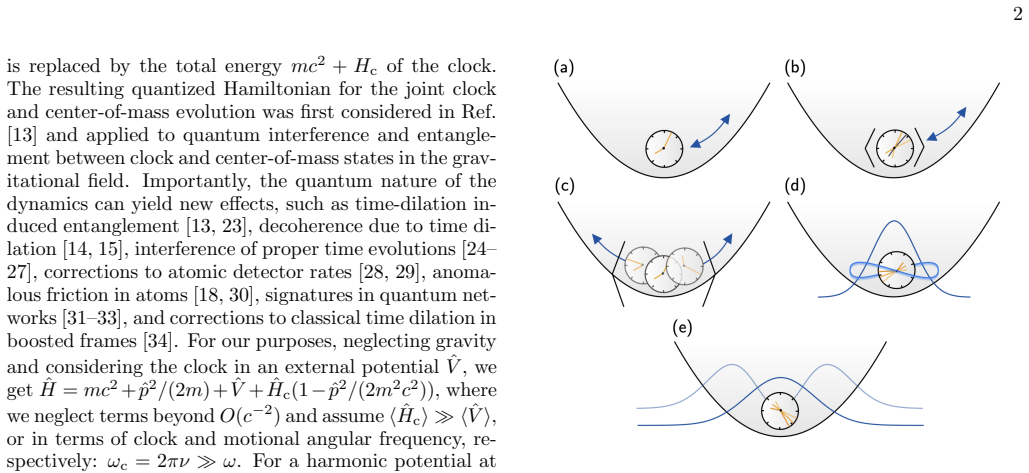
and applied to quantum interference and entangle- ment between clock and center-of-mass states in the grav- itational field. Importantly, the quantum nature of the dynamics can yield new effects, such as time-dilation in- duced entanglement [13, 23], decoherence due to time di- lation [14, 15], interference of proper time evolutions [24– 27], corrections ...
work page 2023
-
[2]
C. W. Chou, D. B. Hume, T. Rosenband, and D. J. Wineland, Optical clocks and relativity, Science329, 1630 (2010)
work page 2010
-
[3]
J. Grotti, S. Koller, S. Vogt, S. H¨ afner, U. Sterr, C. Lis- dat, H. Denker, C. Voigt, L. Timmen, A. Rolland, F. N. Baynes, H. S. Margolis, M. Zampaolo, P. Thoumany, M. Pizzocaro, B. Rauf, F. Bregolin, A. Tampellini, P. Barbieri, M. Zucco, G. A. Costanzo, C. Clivati, F. Levi, and D. Calonico, Geodesy and metrology with a transportable optical clock, Natu...
work page 2018
-
[4]
M. Takamoto, I. Ushijima, N. Ohmae, T. Yahagi, K. Kokado, H. Shinkai, and H. Katori, Test of general relativity by a pair of transportable optical lattice clocks, Nature Photonics14, 411 (2020)
work page 2020
- [5]
-
[6]
T. Bothwell, C. J. Kennedy, A. Aeppli, D. Kedar, J. M. Robinson, E. Oelker, A. Staron, and J. Ye, Resolving the gravitational redshift across a millimetre-scale atomic sample, Nature602, 420 (2022)
work page 2022
-
[7]
J. C. Hafele and R. E. Keating, Around-the-world atomic clocks: Predicted relativistic time gains, Science177, 166 (1972)
work page 1972
-
[8]
A. D. Ludlow, M. M. Boyd, J. Ye, E. Peik, and P. O. Schmidt, Optical atomic clocks, Rev. Mod. Phys.87, 637 (2015)
work page 2015
-
[9]
M. Takamoto, F.-L. Hong, R. Higashi, and H. Katori, An optical lattice clock, Nature435, 321 (2005)
work page 2005
- [10]
- [11]
-
[12]
B. J. Bloom, T. L. Nicholson, J. R. Williams, S. L. Camp- bell, M. Bishof, X. Zhang, W. Zhang, S. L. Bromley, and J. Ye, An optical lattice clock with accuracy and stability at the×10 −18 level, Nature506, 71 (2014)
work page 2014
-
[13]
S. L. Campbell, R. Hutson, G. Marti, A. Goban, N. Dark- wah Oppong, R. McNally, L. Sonderhouse, J. Robinson, W. Zhang, B. Bloom,et al., A Fermi-degenerate three- dimensional optical lattice clock, Science358, 90 (2017)
work page 2017
-
[14]
M. Zych, F. Costa, I. Pikovski, and ˇC. Brukner, Quantum interferometric visibility as a witness of general relativis- tic proper time, Nature Communications2, 1 (2011)
work page 2011
-
[15]
I. Pikovski, M. Zych, F. Costa, and ˇC. Brukner, Time di- lation in quantum systems and decoherence, New Journal of Physics19, 025011 (2017)
work page 2017
-
[16]
I. Pikovski, M. Zych, F. Costa, and ˇC. Brukner, Universal decoherence due to gravitational time dilation, Nature Physics11, 668 (2015)
work page 2015
-
[17]
P. J. Orlando, F. A. Pollock, and K. Modi, How does in- terference fall?, Lectures on general quantum correlations and their applications , 421 (2017)
work page 2017
-
[18]
M. Zych, I. Pikovski, F. Costa, and ˇC. Brukner, General relativistic effects in quantum interference of “clocks”, 6 inJournal of Physics: Conference Series, Vol. 723 (IOP Publishing, 2016) p. 012044
work page 2016
-
[19]
M. Sonnleitner and S. M. Barnett, Mass-energy and anomalous friction in quantum optics, Physical Review A98, 042106 (2018)
work page 2018
-
[20]
P. K. Schwartz and D. Giulini, Post-Newtonian Hamilto- nian description of an atom in a weak gravitational field, Physical Review A100, 052116 (2019)
work page 2019
-
[21]
M. Zych, L. Rudnicki, and I. Pikovski, Gravitational mass of composite systems, Physical Review D99, 104029 (2019)
work page 2019
-
[22]
V. J. Mart´ ınez-Lahuerta, S. Eilers, T. E. Mehlst¨ aubler, P. O. Schmidt, and K. Hammerer, Ab initio quantum theory of mass defect and time dilation in trapped-ion optical clocks, Physical Review A106, 032803 (2022)
work page 2022
-
[23]
J. Hartong, E. Have, N. Obers, and I. Pikovski, A coupling prescription for post-newtonian corrections in quantum mechanics, SciPost Physics16, 088 (2024)
work page 2024
-
[24]
S. Sinha and J. Samuel, Atom interferometry and the gravitational redshift, Classical and Quantum Gravity 28, 145018 (2011)
work page 2011
-
[25]
A. R. H. Smith and M. Ahmadi, Quantum clocks observe classical and quantum time dilation, Nature Communi- cations11, 5360 (2020)
work page 2020
-
[26]
P. T. Grochowski, A. R. Smith, A. Dragan, and K. Deb- ski, Quantum time dilation in atomic spectra, Physical Review Research3, 023053 (2021)
work page 2021
- [27]
- [28]
-
[29]
Y. Hu, M. P. Lock, and M. P. Woods, On the feasibility of detecting quantum delocalization effects on relativis- tic time dilation in optical clocks, Quantum Science and Technology9, 045052 (2024)
work page 2024
-
[30]
C. E. Wood and M. Zych, Quantized mass-energy effects in an Unruh-DeWitt detector, Physical Review D106, 025012 (2022)
work page 2022
-
[31]
M. Sonnleitner, N. Trautmann, and S. M. Barnett, Will a decaying atom feel a friction force?, Physical Review Letters118, 053601 (2017)
work page 2017
- [32]
-
[33]
J. Borregaard and I. Pikovski, Testing quantum theory on curved spacetime with quantum networks, Physical Review Research7, 023192 (2025)
work page 2025
-
[34]
J. P. Covey, I. Pikovski, and J. Borregaard, Probing curved spacetime with a distributed atomic processor clock, PRX Quantum6, 030310 (2025)
work page 2025
-
[35]
A. J. Paige, A. D. K. Plato, and M. S. Kim, Classical and nonclassical time dilation for quantum clocks, Physical Review Letters124, 160602 (2020)
work page 2020
-
[36]
V. Yudin and A. Taichenachev, Mass defect effects in atomic clocks, Laser Physics Letters15, 035703 (2018)
work page 2018
-
[37]
M. C. Marshall, D. A. R. Castillo, W. J. Arthur- Dworschack, A. Aeppli, K. Kim, D. Lee, W. Warfield, J. Hinrichs, N. V. Nardelli, T. M. Fortier,et al., High- stability single-ion clock with 5.5×10 −19 systematic un- certainty, Physical Review Letters135, 033201 (2025)
work page 2025
-
[38]
Mass-energy equivalence in harmonically trapped particles
R. Haustein, G. J. Milburn, and M. Zych, Mass-energy equivalence in harmonically trapped particles (2019), arXiv:1906.03980 [quant-ph]
work page internal anchor Pith review Pith/arXiv arXiv 2019
-
[39]
S. Khandelwal, M. P. Lock, and M. P. Woods, Universal quantum modifications to general relativistic time dila- tion in delocalised clocks, Quantum4, 309 (2020)
work page 2020
-
[40]
M. Zych, F. Costa, I. Pikovski, T. C. Ralph, and ˇC. Brukner, General relativistic effects in quantum inter- ference of photons, Classical and Quantum Gravity29, 224010 (2012)
work page 2012
- [41]
-
[42]
S. Loriani, A. Friedrich, C. Ufrecht, F. Di Pumpo, S. Kleinert, S. Abend, N. Gaaloul, C. Meiners, C. Schu- bert, D. Tell,et al., Interference of clocks: A quantum twin paradox, Science advances5, eaax8966 (2019)
work page 2019
-
[43]
E. Castro-Ruiz, F. Giacomini, A. Belenchia, and ˇC. Brukner, Quantum clocks and the temporal localis- ability of events in the presence of gravitating quantum systems, Nature Communications11, 2672 (2020)
work page 2020
-
[44]
Roura, Gravitational redshift in quantum-clock inter- ferometry, Physical Review X10, 021014 (2020)
A. Roura, Gravitational redshift in quantum-clock inter- ferometry, Physical Review X10, 021014 (2020)
work page 2020
- [45]
-
[46]
I. Meltzer and Y. Sagi, Atomic clock interferometry using optical tweezers, Physical Review A110, 032602 (2024)
work page 2024
-
[47]
Y. Margalit, Z. Zhou, S. Machluf, D. Rohrlich, Y. Japha, and R. Folman, A self-interfering clock as a “which path” witness, Science349, 1205 (2015)
work page 2015
-
[48]
S. Burd, R. Srinivas, J. Bollinger, A. Wilson, D. Wineland, D. Leibfried, D. Slichter, and D. Allcock, Quantum amplification of mechanical oscillator motion, Science364, 1163 (2019). 7 Appendix A: Derivation of the T otal Unitary Operator for Proper Time Evolution of Clocks and Motion The Hamiltonian in Eq. (1) generates the time evolu- tion given by the ...
work page 2019
-
[49]
Quantum signatures of proper time in optical ion clocks
After perform- ing the sum overk, the off-diagonal element in polar form is given by 2ρeg = e−i(ωct−arctan(tan(ε)(2¯n+1))) q cos2(ε) + sin2(ε)(2¯n+ 1)2 (B2) having here definedε=ε cωt/4. We can read off from this expression the frequency shift ∆ω c and the visibility 2|ρeg|. In the regimeε¯n≪1, we obtain toO(ε¯n) the usual SODS as in the main text: 2ρeg ≃...
discussion (0)
Sign in with ORCID, Apple, or X to comment. Anyone can read and Pith papers without signing in.