REVIEW 1 major objections 4 minor 52 references
Phase interference in nonlinear Compton scattering reshapes the spectrum of photons polarized parallel to the laser, while perpendicularly polarized photons remain largely unaffected.
Reviewed by Pith at T0; open to challenge. T0 means a machine referee read the full paper against a public rubric. the ladder, T0–T4 →
T0 review · deepseek-v4-flash
2026-08-04 18:27 UTC pith:QXGVIOSL
load-bearing objection Solid QED derivation of a polarization-dependent double-pulse interference factor; the experimental claim outruns the bunch-averaging check. the 1 major comments →
Polarization-dependent Interference in Nonlinear Compton Scattering
The pith
A machine-rendered reading of the paper's core claim, the machinery that carries it, and where it could break.
Core claim
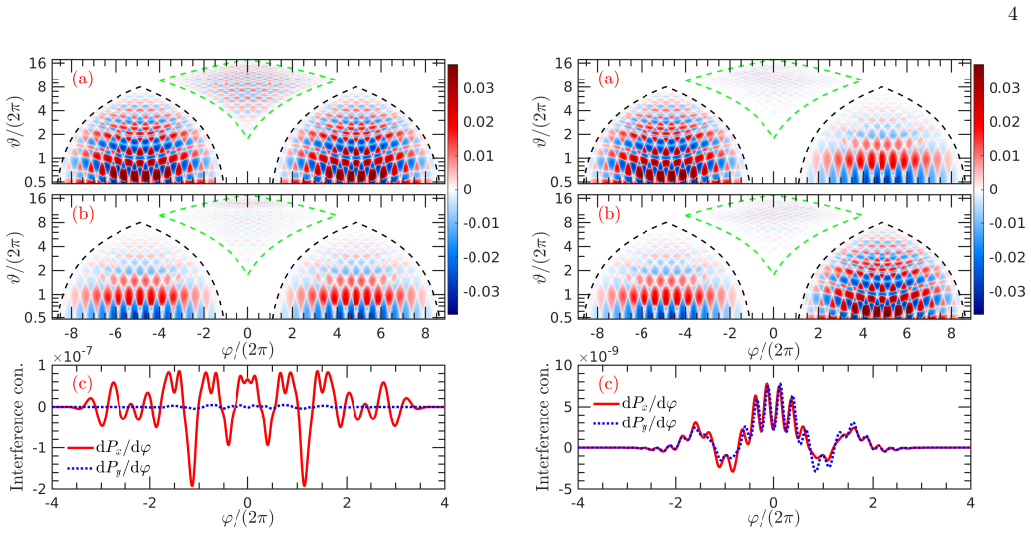
The central result is Eq. (5): for two identical, parallel-polarized pulses, the double-pulse energy-momentum distribution equals 2(1+cos Φ_f) times the single-pulse distribution, where Φ_f is the accumulated phase between the two pulses. Because parallel-polarized photons are emitted with much smaller transverse momenta than perpendicular ones, the interference fringes survive integration over a narrow angular window only for the parallel polarization, reshaping the energy spectrum—most notably splitting the first harmonic peak—while the perpendicular spectrum stays smooth and nearly identical to the single-pulse case. This polarization-dependent survival is the paper's explanation for why
What carries the argument
The key object is the interference factor 2(1+cos Φ_f) linking the double-pulse distribution to the single-pulse distribution, Eq. (5), with the accumulated phase given explicitly for few-cycle pulses as Φ_f = s/[2η(1−s)] [(1+r²)(2Nπ+Δ) + 3Nπξ²/8]. This factor is polarization-independent; what differs between the two polarizations is the transverse-momentum support of the emission, which determines whether the rapid Φ_f oscillations survive the integration over detector acceptance.
Load-bearing premise
The experiment-realizability claim rests on the electron bunch energy spread being narrow enough to resolve the interference-induced spectral fluctuations; the paper states this requirement but does not quantify the allowed spread or simulate a realistic bunch, so the fringes could average out in practice.
What would settle it
A numerical convolution of Eq. (5) with a realistic electron-bunch energy distribution (e.g., a Gaussian spread of a few percent) that shows the interference modulation washing out would refute the experiment-realizability claim; alternatively, a double-pulse collision with a narrow-energy electron beam in which the first harmonic peak does not split or oscillate with the phase gap would falsify the central prediction.
If this is right
- Parallel-polarized photon energy spectra from a double-pulse laser show interference-induced reshaping, including a split first harmonic peak; perpendicular-polarized spectra remain essentially unchanged.
- The interference fringes in the energy-momentum distribution become denser with increasing photon energy, transverse momentum, and pulse separation, and wash out for phase gaps larger than about 20π unless the angular acceptance is narrowed.
- Narrowing the transverse-momentum acceptance (to scattering angles of the order of tens of microradians) amplifies and sustains the spectral modulation for experiment-realizable phase separations.
- Because the interference factor is independent of photon polarization, the total photon spectrum also acquires fringes, and the double-pulse structure only mildly alters the photon polarization degree.
Where Pith is reading between the lines
- The polarization dependence offers a clean experimental knob to switch interference visibility on or off, which could help isolate interference contributions from background or incoherent processes in strong-field QED experiments.
- For few-cycle pulses, the accumulated phase depends on the azimuthal angle, so the azimuthal distribution of emitted photons provides a second observable for the same interference, potentially relaxing the need for extremely narrow energy spread.
- Because Eq. (5) is exact for identical pulses, a double-pulse collision could serve as a calibration tool for the relative phase between two intense laser pulses in the intermediate-intensity regime.
- The same interference mechanism may appear in other nonlinear QED processes with two separated field configurations, such as double-pulse nonlinear Breit-Wheeler pair production, where polarization-dependent fringes could modulate the pair spectrum.
Editorial analysis
A structured set of objections, weighed in public.
Referee Report
Summary. The paper studies polarization-dependent interference effects in nonlinear Compton scattering in a plane-wave laser with a double-pulse structure. The central result is Eq. (5): for two identical, parallel-polarized pulses, the single-electron energy-momentum distribution is multiplied by the factor 2(1+cos Φ_f), where Φ_f is the accumulated phase between the pulses. The paper argues that this common interference factor produces observable spectral fringes mainly for photons polarized parallel to the laser field, because those photons are emitted at smaller transverse momentum and the fringes survive a narrow angular acceptance, while perpendicularly polarized photons have broader transverse-momentum support and the fringes are washed out upon integration. Numerical evaluations of the full QED amplitude are compared with the locally constant field approximation, and a potential experimental setup with an 18 μrad acceptance window at LUXE/E320-type parameters is discussed.
Significance. If the theoretical claims are sound, the paper provides a clean, parameter-free analytic factorization for the double-pulse nonlinear Compton spectrum and a concrete route to observe nonlocal phase interference in upcoming high-intensity laser experiments. The derivation of Eq. (5) from the amplitude splitting is transparent and does not introduce free parameters. The numerical comparison with LCFA and the distinction between polarization channels are valuable. The main weakness is the gap between the single-electron prediction and the stated experiment-realizable claim, which requires a quantitative treatment of electron-bunch energy spread and divergence.
major comments (1)
- [§III.B, Eq. (4)] The paper's abstract and conclusion claim that the interference modulation can be 'experiment-realizable' for a phase gap between two pulses. However, the calculation is performed for a single electron. The phase Φ_f in Eq. (4) depends on η (electron energy) and on r, which includes the electron transverse momentum through p⊥/m. A realistic bunch average over η and p⊥ will replace the factor 2(1+cos Φ_f) by a weighted average and can substantially wash out the fringes. For the quoted parameters (η=0.1, E=8.4 GeV), a transverse divergence of 10 μrad corresponds to p⊥/m ≈ γδθ ≈ 0.16, comparable to the r<0.3 window used in Fig. 6(a,b). No quantitative bound on the allowed energy spread or divergence is given, and no bunch-averaged spectrum is shown. Since the 'experiment-realizable' claim is load-bearing, the authors should either include a bunch-convolution calculation with realistic LUXE/
minor comments (4)
- [§III.B, Eq. (4)] The explicit expression for Φ_f is stated without derivation or a precise pointer to where it is obtained. Since this formula underlies the fringe positions and the Δ dependence shown in Fig. 6, please provide a short derivation or a detailed reference.
- [Throughout] Several typos and stylistic issues: 'an high-energy electron' in the abstract and introduction; 'deconstructive interference' should be 'destructive interference'; 'signalize' is nonstandard; 'LCF A' is sometimes written with a space; reference [22] contains 'K?mpfer' due to a non-ASCII character.
- [Fig. 6 caption] The caption reads 'in the parallel polarization' but the right panels correspond to the perpendicular polarization. Please clarify the wording to avoid confusion.
- [Conclusion] The concluding paragraph correctly acknowledges that electron-bunch effects must be considered, but this point should be introduced earlier and, ideally, supported with a numerical estimate. Without such an estimate, the 'experiment-realizable' phrase in the abstract is stronger than what is demonstrated.
Circularity Check
No circularity: Eq. (5) is a derived factorization from the QED amplitude, not an input; remaining caveats are experimental-resolution issues, not logical circularity.
full rationale
The paper's derivation chain is self-contained and non-circular. The starting point, Eq. (1), is cited to Ref. [47] (a previously published QED formula involving the same author S. Tang), but it is a parameter-free, standard Furry-picture result and is not fitted to, or derived from, the target claim. The double-pulse split in Eq. (3), F=F1+e^{iPhi_f}F2, is an algebraic consequence of splitting the phase integral over two disjoint support regions; the citation to Ref. [33] is attribution of a technique, not a load-bearing uniqueness theorem. Eq. (5) then follows by substituting the two-pulse amplitude into Eq. (1): every quadratic combination |F|^2, |I|^2, S^*I, and |rI-F|^2 acquires the same factor (1+e^{iPhi_f})(1+e^{-iPhi_f})=2(1+cos Phi_f). Thus the central 'prediction' is a mathematical consequence of the stated inputs (two identical parallel-polarized pulses), not a parameter fitted to those inputs. The comparison with LCFA provides an external consistency check. The paper's own admission that the electron bunch energy spread must be narrow enough to resolve the interference-induced spectral fluctuations is an unquantified experimental extrapolation (a validity gap), not a circular step. Self-citations are present but only as background or technique and do not carry the argument.
Axiom & Free-Parameter Ledger
axioms (3)
- domain assumption The laser field is treated as a plane wave with a given vector potential a_mu(phi); transverse focusing and finite spot size are neglected.
- standard math The scattering probability is computed to first order in the fine-structure constant alpha, using Volkov solutions (Furry picture).
- domain assumption The electron is treated as a single particle with definite initial momentum; spin is summed/averaged.
Cite this review
Pith. "Pith review of Polarization-dependent Interference in Nonlinear Compton Scattering." pith.science (2026). https://pith.science/paper/QXGVIOSL
@misc{pith2026250909920,
  author       = {Pith},
  title        = {Pith review of: Polarization-dependent Interference in Nonlinear Compton Scattering},
  year         = {2026},
  howpublished = {\url{https://pith.science/paper/QXGVIOSL}},
  note         = {Machine review of arXiv:2509.09920}
}
read the original abstract
We investigate the phase interference effects in the nonlinear Compton scattering via the collision between an high-energy electron and the laser in the intermediate intensity region, and reveal that the importance of interference effects on the scattered photons depends sensitively on the relative polarization of the scattered photons and laser pulse. For scattered photons polarized parallel to the laser field, the effective distance between two interfered phase points is much larger than that for perpendicularly polarized photons. To signalize the phase interference effect in potential experiments, we introduce the double-pulse scenario for the scattering process, and show that the interference between two phase-separated pulse could significantly modulate the energy-momentum distribution of the scattered photons, leading to the reshaping of the scattered photons' energy spectrum. By narrowing the angular acceptance of the scattered photons, the spectral modulation can be amplified and sustained for an experiment-realizable phase separation between two pulses.
Figures



Reference graph
Works this paper leans on
-
[1]
A. H. Compton, Phys. Rev.21, 483 (1923), URLhttps: //link.aps.org/doi/10.1103/PhysRev.21.483
-
[2]
R. D. Evans,Compton Effect(Springer Berlin Hei- delberg, Berlin, Heidelberg, 1958), pp. 218–298, ISBN 978-3-642-45898-9, URLhttps://doi.org/10. 1007/978-3-642-45898-9_6
1958
-
[3]
R. Hajima, Physics Procedia84, 35 (2016), ISSN 1875- 3892, proceedings of the International Conference ”Syn- chrotron and Free electron laser Radiation: generation and application” (SFR-2016), July 4 - 7, 2016, Novosi- birsk, Russia, URLhttps://www.sciencedirect.com/ science/article/pii/S1875389216303029
2016
-
[4]
V. B. Berestetskii, E. M. Lifshitz, and L. P. Pitaevskii,Quantum Electrodynamics (second edition) (Butterworth-Heinemann, Oxford, 1982)
1982
-
[5]
Greiner and J
W. Greiner and J. Reinhardt,Quantum electrodynamics (Springer Science & Business Media, 2008)
2008
-
[6]
S. K. Lee, H. T. Kim, I. W. Choi, C. M. Kim, and C. H. Nam, Journal of the Korean Physical Society73, 179 (2018)
2018
-
[7]
W. Li, Z. Gan, L. Yu, C. Wang, Y. Liu, Z. Guo, L. Xu, M. Xu, Y. Hang, Y. Xu, et al., Opt. Lett.43, 5681 (2018), URLhttps://opg.optica.org/ol/abstract.cfm?URI= ol-43-22-5681
2018
-
[8]
Olofsson and A
C. Olofsson and A. Gonoskov, High Power Laser Science and Engineering11, e67 (2023)
2023
-
[9]
A. Di Piazza, C. M¨ uller, K. Z. Hatsagortsyan, and C. H. Keitel, Rev. Mod. Phys.84, 1177 (2012), URLhttps: //link.aps.org/doi/10.1103/RevModPhys.84.1177
-
[10]
A. Gonoskov, T. G. Blackburn, M. Marklund, and S. S. Bulanov, Rev. Mod. Phys.94, 045001 (2022), URL https://link.aps.org/doi/10.1103/RevModPhys.94. 045001
-
[11]
Fedotov, A
A. Fedotov, A. Ilderton, F. Karbstein, B. King, D. Seipt, H. Taya, and G. Torgrimsson, Physics Reports1010, 1 (2023), ISSN 0370-1573, advances in QED with intense background fields, URLhttps://www.sciencedirect. com/science/article/pii/S0370157323000352
2023
-
[12]
A. I. Nikishov and V. I. Ritus, Sov. Phys.–JETP19, 529 (1964)
1964
-
[13]
Seipt, arXiv preprint arXiv:1701.03692 (2017)
D. Seipt, arXiv preprint arXiv:1701.03692 (2017)
Pith/arXiv arXiv 2017
-
[15]
C. F. Nielsen, R. Holtzapple, and B. King, Phys. Rev. D 106, 013010 (2022), URLhttps://link.aps.org/doi/ 10.1103/PhysRevD.106.013010
-
[16]
Gonoskov, S
A. Gonoskov, S. Bastrakov, E. Efimenko, A. Ilderton, M. Marklund, I. Meyerov, A. Muraviev, A. Sergeev, I. Surmin, and E. Wallin, Phys. Rev. E92, 023305 (2015), URLhttps://link.aps.org/doi/10. 1103/PhysRevE.92.023305
2015
-
[17]
T. G. Blackburn, B. King, and S. Tang, Physics of Plas- mas30, 093903 (2023), ISSN 1070-664X, URLhttps: //doi.org/10.1063/5.0159963
-
[18]
Tang, Physics Letters B859, 139136 (2024), ISSN 0370-2693, URLhttps://www.sciencedirect
S. Tang, Physics Letters B859, 139136 (2024), ISSN 0370-2693, URLhttps://www.sciencedirect. com/science/article/pii/S0370269324006944
2024
-
[19]
L. S. Brown and T. W. B. Kibble, Phys. Rev.133, A705 (1964)
1964
-
[20]
D. Yu. Ivanov, G. L. Kotkin, and V. G. Serbo, Eur. Phys. J.C36, 127 (2004), hep-ph/0402139
Pith/arXiv arXiv 2004
-
[21]
C. Harvey, T. Heinzl, and A. Ilderton, Phys. Rev. A 79, 063407 (2009), URLhttps://link.aps.org/doi/ 8 10.1103/PhysRevA.79.063407
-
[22]
D. Seipt and B. K?mpfer, Laser Physics23, 075301 (2013), URLhttps://dx.doi.org/10.1088/1054-660X/ 23/7/075301
-
[23]
A. Ilderton, B. King, and D. Seipt, Phys. Rev. A 99, 042121 (2019), URLhttps://link.aps.org/doi/ 10.1103/PhysRevA.99.042121
-
[24]
A. Di Piazza, M. Tamburini, S. Meuren, and C. H. Keitel, Phys. Rev. A99, 022125 (2019), URLhttps://link. aps.org/doi/10.1103/PhysRevA.99.022125
-
[26]
Boca and V
M. Boca and V. Florescu, Phys. Rev. A80, 053403 (2009), URLhttps://link.aps.org/doi/10. 1103/PhysRevA.80.053403
2009
-
[27]
F. Mackenroth, A. Di Piazza, and C. H. Keitel, Phys. Rev. Lett.105, 063903 (2010), URLhttps://link.aps. org/doi/10.1103/PhysRevLett.105.063903
-
[28]
T. Heinzl, D. Seipt, and B. K¨ ampfer, Phys. Rev. A 81, 022125 (2010), URLhttps://link.aps.org/doi/ 10.1103/PhysRevA.81.022125
-
[29]
Mackenroth and A
F. Mackenroth and A. Di Piazza, Phys. Rev. A83, 032106 (2011), URLhttps://link.aps.org/doi/10. 1103/PhysRevA.83.032106
2011
-
[30]
Seipt and B
D. Seipt and B. K¨ ampfer, Phys. Rev. A83, 022101 (2011), URLhttps://link.aps.org/doi/10. 1103/PhysRevA.83.022101
2011
-
[31]
S. Tang, Y. Xin, M. Wen, M. A. Bake, and B. Xie, Matter and Radiation at Extremes9, 037204 (2024), ISSN 2468- 2047, URLhttps://doi.org/10.1063/5.0196125
-
[32]
D. Seipt, D. Del Sorbo, C. P. Ridgers, and A. G. R. Thomas, Phys. Rev. A100, 061402 (2019), URLhttps: //link.aps.org/doi/10.1103/PhysRevA.100.061402
-
[33]
Ilderton, B
A. Ilderton, B. King, and S. Tang, Physics Let- ters B804, 135410 (2020), ISSN 0370-2693, URL https://www.sciencedirect.com/science/article/ pii/S0370269320302148
2020
-
[34]
Bula et al
C. Bula et al. (E144), Phys. Rev. Lett.76, 3116 (1996)
1996
-
[35]
Bamber, S
C. Bamber, S. J. Boege, T. Koffas, T. Kotseroglou, A. C. Melissinos, D. D. Meyerhofer, D. A. Reis, W. Ragg, C. Bula, K. T. McDonald, et al., Phys. Rev. D60, 092004 (1999), URLhttps://link.aps.org/doi/10. 1103/PhysRevD.60.092004
1999
-
[36]
Mirzaie, C
M. Mirzaie, C. Hojbota, D. Kim, V. Pathak, T. Pak, C. Kim, H. W. Lee, J. W. Yoon, S. Lee, Y.-J. Rhee, et al., Nature Photonics18, 1212 (2024)
2024
-
[37]
J. M. Cole, K. T. Behm, E. Gerstmayr, T. G. Black- burn, J. C. Wood, C. D. Baird, M. J. Duff, C. Har- vey, A. Ilderton, A. S. Joglekar, et al., Phys. Rev. X 8, 011020 (2018), URLhttps://link.aps.org/doi/10. 1103/PhysRevX.8.011020
2018
-
[38]
Poder, M
K. Poder, M. Tamburini, G. Sarri, A. Di Piazza, S. Kuschel, C. D. Baird, K. Behm, S. Bohlen, J. M. Cole, D. J. Corvan, et al., Phys. Rev. X8, 031004 (2018), URLhttps://link.aps.org/doi/10. 1103/PhysRevX.8.031004
2018
-
[39]
H. Abramowicz et al., Eur. Phys. J. Spec. Top.230, 2445 (2021), URLhttps://doi.org/10.1140/epjs/ s11734-021-00249-z
doi:10.1140/epjs/ 2021
-
[40]
Meuren, inThird Conference on Extremely High In- tensity Laser Physics (ExHILP)(2019)
S. Meuren, inThird Conference on Extremely High In- tensity Laser Physics (ExHILP)(2019)
2019
-
[41]
F. C. Salgado, N. Cavanagh, M. Tamburini, D. W. Storey, R. Beyer, P. H. Bucksbaum, Z. Chen, A. Di Pi- azza, E. Gerstmayr, Harsh, et al., New Journal of Physics 24, 015002 (2021), ISSN 1367-2630, URLhttp://dx. doi.org/10.1088/1367-2630/ac4283
-
[42]
A. J. Macleod, Journal of Physics: Conference Series 2249, 012022 (2022), URLhttps://dx.doi.org/10. 1088/1742-6596/2249/1/012022
2022
-
[43]
V. I. Ritus, J. Russ. Laser Res.6, 497 (1985)
1985
-
[45]
T. Heinzl, B. King, and A. J. MacLeod, Phys. Rev. A 102, 063110 (2020), URLhttps://link.aps.org/doi/ 10.1103/PhysRevA.102.063110
-
[46]
C. N. Harvey, A. Ilderton, and B. King, Phys. Rev. A 91, 013822 (2015), URLhttps://link.aps.org/doi/ 10.1103/PhysRevA.91.013822
-
[47]
S. Tang, B. King, and H. Hu, Physics Letters B809, 135701 (2020), ISSN 0370-2693, URL https://www.sciencedirect.com/science/article/ pii/S0370269320305049
2020
-
[48]
V. Dinu, C. Harvey, A. Ilderton, M. Marklund, and G. Torgrimsson, Phys. Rev. Lett.116, 044801 (2016), URLhttps://link.aps.org/doi/10.1103/ PhysRevLett.116.044801
2016
-
[49]
T. G. Blackburn, D. Seipt, S. S. Bulanov, and M. Mark- lund, Phys. Rev. A101, 012505 (2020), URLhttps: //link.aps.org/doi/10.1103/PhysRevA.101.012505
-
[50]
D. Seipt, S. G. Rykovanov, A. Surzhykov, and S. Fritzsche, Phys. Rev. A91, 033402 (2015), URLhttps://link.aps.org/doi/10.1103/PhysRevA. 91.033402
doi:10.1103/physreva 2015
-
[51]
B. King, Phys. Rev. D103, 036018 (2021), URLhttps: //link.aps.org/doi/10.1103/PhysRevD.103.036018
-
[52]
S. Tang and B. King, Phys. Rev. D104, 096019 (2021), URLhttps://link.aps.org/doi/10.1103/PhysRevD. 104.096019
doi:10.1103/physrevd 2021
-
[53]
A. Angioi, F. Mackenroth, and A. Di Piazza, Phys. Rev. A93, 052102 (2016), URLhttps://link.aps.org/doi/ 10.1103/PhysRevA.93.052102
-
[54]
Angioi and A
A. Angioi and A. Di Piazza, Phys. Rev. Lett.121, 010402 (2018), URLhttps://link.aps.org/doi/10. 1103/PhysRevLett.121.010402
2018
-
[55]
B. M. Dillon and B. King, Phys. Rev. D99, 035048 (2019), URLhttps://link.aps.org/doi/10. 1103/PhysRevD.99.035048
2019
discussion (0)
Sign in with ORCID, Apple, or X to comment. Anyone can read and Pith papers without signing in.