REVIEW 4 major objections 5 minor 56 references
Unveiling the Role of Solvents in DBTTF:HATCN Ternary Cocrystals
T0 review · 4 major / 5 minor · reviewed 2026-08-04 · deepseek-v4-flash
Pith's one-line read In solvated DBTTF:HATCN cocrystals, solvent molecules act as the primary electron acceptors, accumulating up to -0.35 e and even reversing HATCN's role to a net donor.
desk verdict Six new cocrystal structures with a careful structural story; the solvent-as-acceptor mechanism is a hypothesis that outruns the present evidence. read the letter →
The pith
A machine-rendered reading of the paper's core claim, the machinery that carries it, and where it could break.
The reading
What carries the argument
The analysis rests on two complementary probes. First, the Raman shift of HATCN's cyano (C≡N) stretching mode is used as a charge-transfer meter, decomposed into a charge-transfer contribution (4.81 cm^-1) and a solvent-dipole contribution (1.06 cm^-1 per Debye), calibrated to about 45 cm^-1 per electron from a reference HATCN anion salt to yield 0.11 e. Second, partial-charge partitioning on the experimental crystal structures assigns net charges to DBTTF, HATCN, and each solvent molecule, revealing where the electrons actually sit and showing that the solvent can become the dominant acceptor.
What would settle it
Compute partial charges for the D:A:THF2 structure with an alternative partitioning method, such as Bader or electrostatic-potential fitting, and check whether THF still accumulates about -0.35 e; alternatively, measure the solvent's core-level binding energy by X-ray photoelectron spectroscopy and see whether it shifts as expected for negatively charged THF.
Extended reading notes
Core claim
The central discovery is that in solvated DBTTF:HATCN cocrystals the solvent molecules actively participate in charge transfer as primary electron acceptors. Raman measurements give a consistent degree of charge transfer of 0.11 e in every polymorph, and density-functional theory on solvent-free structures reproduces that value. But when the solvent is included in the simulation, the picture changes: in D:A:THF2 the two THF molecules accumulate -0.35 e total, DBTTF loses 0.26 e, and HATCN loses 0.09 e, making HATCN a net donor. A similar pattern appears with acetone. The authors conclude that charge distribution in these ternary crystals involves the whole atomic network, not just the cyano
Load-bearing premise
The load-bearing premise is that the computational partial-charge scheme correctly assigns electron density between the solvent molecules and the donor-acceptor stack; if that assignment is wrong, the claim that the solvent is the primary electron acceptor fails.
Editorial extensions
If this is right
- Solution-grown 1:1 cocrystals preserve the intrinsic donor-acceptor electronic character: band gaps and absorption onsets stay near 1.4-1.5 eV regardless of solvent inclusion.
- The degree of charge transfer measured by Raman is essentially constant, about 0.11 e, across solvent-free and solvated polymorphs, so the donor-to-acceptor transfer is consistent across processing routes.
- In solvated crystals, charge can flow to the solvent from both donor and acceptor, so HATCN's role is not fixed; in D:A:THF2 it becomes a net electron donor.
- The solvent dipole moment shifts the cyano vibration linearly, allowing the polarity effect and the charge-transfer effect to be separated in Raman data.
- Increasing the number of solvent molecules widens the band gap by roughly 0.1 eV, indicating a subtle but systematic handle for tuning electronic properties.
Reading between the lines
- If solvents genuinely store significant negative charge, then 'degree of charge transfer' measured from the acceptor's vibrational modes is an incomplete metric: it reports the acceptor's net change, not the destination of the electrons, so doping models for solvent-containing films may need revision.
- A testable extension would be to vary the solvent's electron affinity, for example by using fluorinated or nitrile-containing analogues of THF and acetone, and watch whether the Raman shift and band gap respond as the solvent becomes a stronger or weaker acceptor.
- The same reasoning suggests that other 'inert' intercalants, including water or halogenated solvents, might also participate electronically; residual-solvent characterization should become a standard check in donor-acceptor cocrystal studies.
Signed reviews
Editorial analysis
A structured set of objections, weighed in public.
Referee Report
Summary. The paper reports six new DBTTF:HATCN cocrystals: five solvated 1:1 polymorphs grown from THF, acetone, or acetonitrile solution, and one solvent-free 3:2 polymorph grown by horizontal vapor deposition. The authors combine single-crystal X-ray diffraction, Raman spectroscopy, optical absorption, and DFT (PBE/PBE0, FHI-aims) to examine how included solvent molecules affect structure, charge transfer, and electronic/optical properties. They find that the optical gap and the main charge-transfer excitations are largely insensitive to solvent inclusion. From the Raman C≡N shift of HATCN, they extract a degree of charge transfer (DCT) of about 0.11 e via a two-part decomposition: a constant DCT-induced shift of 4.81 cm⁻¹ plus a dipole-induced shift linear in the solvent gas-phase dipole moment (Eq. 2). DFT Hirshfeld charges indicate that in solvated structures the solvent molecules carry substantial negative charge, up to -0.35 e total in D:A:THF2, and in D:A:THF2 and D:A:ACE2 HATCN itself becomes a net electron donor. This leads to the central claim that solvent molecules act as primary electron acceptors rather than passive templates, while the overall electronic structure remains robust.
Significance. If the solvent-as-acceptor mechanism is correct, this is a conceptually interesting result that would expand the design space for ternary organic cocrystals. The paper has clear strengths: six new crystal structures with deposited CCDC numbers, transparent experimental methods, a combined experimental/computational workflow, and a public data repository. The Raman and optical data are reported in a reproducible way. However, the headline claim rests on a single population-analysis scheme (Hirshfeld) and on a two-point linear decomposition whose constancy is partly built into the model. These issues are load-bearing because the abstract and conclusions generalize from the Hirshfeld charges to a 'primary electron acceptor' role for solvents. With additional charge-partitioning cross-checks or an experimental probe of the solvent charge state, the claim could become solid; as it stands, it is not yet established.
major comments (4)
- [Table 2 and 'Partial charge analysis from DFT'] The central claim that solvents are primary electron acceptors rests entirely on Hirshfeld partial charges from PBE0 calculations on PBE-relaxed experimental geometries. Hirshfeld partitioning is promolecule- and basis-set-dependent, and the short solvent contacts (e.g., d_D:sol = 2.54 Å and d_A:sol = 2.77 Å in D:A:THF2, Table 1) place overlapping densities precisely in the region where the partitioning is most ambiguous. The -0.16/-0.19 e on THF and +0.09 e on HATCN in D:A:THF2 are therefore not robust without a second independent scheme. Please provide Bader, DDEC, Hirshfeld-I, or electrostatic-potential-fitted charges, or an experimental probe (solvent vibrational mode, core-level shift, or transport/conductivity signature). If an alternative partitioning changes the sign or magnitude of the solvent charge, the headline mechanism must be revised.
- [Optical Absorption and Electronic Structure (Fig. 5)] The solvent-as-acceptor picture is in tension with the computed electronic structure. The PDOS in Fig. 5 shows THF states only in the deeper valence region, and CT1 is assigned to DBTTF→HATCN transitions. The authors state that DFT 'points to an excess of charge accumulated on the solvent molecule rather than a state-selective charge-transfer,' but Hirshfeld charges do not identify the orbital character of the transferred charge. If THF were truly a primary acceptor with -0.35 e, one would expect acceptor-like states near the frontier; none is shown. This does not disprove the claim, but the paper should explicitly reconcile the PDOS/transition assignment with the large Hirshfeld solvent charges, or soften the 'primary electron acceptor' formulation to 'net electron accumulation according to Hirshfeld partitioning.'
- [Vibrational analysis and DCT (Eq. 2)] Equation (2) decomposes the observed C≡N shift as Δν = 4.81 cm⁻¹ + 1.06 cm⁻¹/D·p, with the intercept taken as the DCT-induced shift and the slope fixed by two points (D3:A2 and D:A:MeCN). This assumes (i) the DCT-induced shift is exactly the same for the solvent-free 3:2 polymorph and all solvated 1:1 polymorphs, and (ii) the dipole-induced shift is strictly linear in the gas-phase dipole moment with zero intercept for zero dipole. Neither assumption is tested; the resulting constancy of the inferred DCT (0.11 e) is largely a consequence of the model structure. Please report uncertainties, use more than two data points to determine the dipole slope, and test the linearity assumption (e.g., with a nonpolar solvent or a wider range of dipole moments).
- [Raman calibration (Ref. 35 and Fig. 3)] The conversion of the 4.81 cm⁻¹ DCT shift to 0.11 e uses a single literature reference point (≈45 cm⁻¹ per electron from a crystal-violet HATCN anion salt). The raw C≡N shifts vary from 4.8 cm⁻¹ (D3:A2) to 9.0 cm⁻¹ (D:A:MeCN), and the measured values depend on peak fitting and on potential contributions from pristine phases (the authors note pristine DBTTF/HATCN in the MeCN-grown sample). An error estimate on the extracted DCT should be given, and the sensitivity of the result to the choice of reference calibration and to the two-point fit should be discussed.
minor comments (5)
- [Eq. (2)] The units in Eq. (2) should be written explicitly: Δν = 4.81 cm⁻¹ + 1.06 cm⁻¹·Debye⁻¹ × p.
- [Fig. 3] The dashed red line labeled 'DCT-induced shift' is drawn as a constant; consider labeling it 'constant DCT contribution (4.81 cm⁻¹)' to avoid implying it is a fitted line.
- [Experimental Methods] Typo in the diffraction software name: 'CrysAlisP rosoftware' should be 'CrysAlisPro software'.
- [Abstract/Conclusions] The phrase 'non-invasive knob' in the conclusions is vague; consider replacing with a more precise description of the tunable structural/electronic parameter.
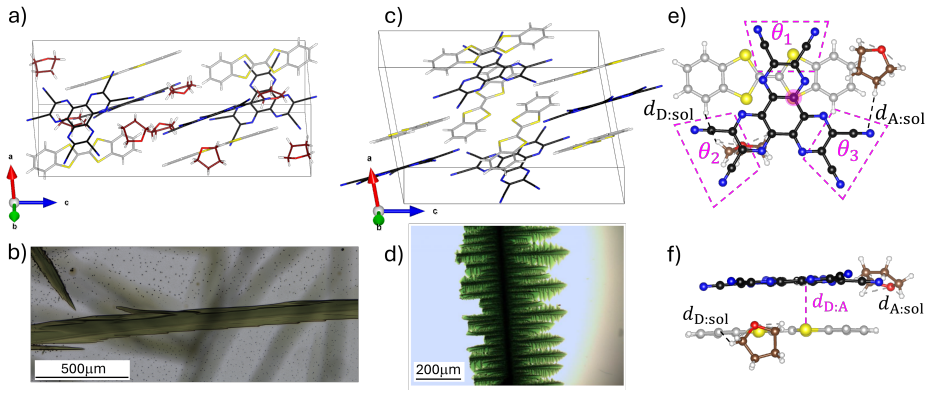
- [Figure 1 caption] The label 'DBTTF:HATCN:soln' in panel (a) is ambiguous; spell out 'THF2' or use the same notation as Table 1.
Circularity Check
Raman 'constant DCT' is an intercept of the model, but the central solvent-acceptor claim remains independent.
-
fitted input called prediction
[Section 'Vibrational analysis and degree of charge transfer', Eqs. (1)-(2) and following paragraph]
"Inserting in Eq. (1) parameters extracted from Figure 3 leads to ∆ν = 4.81 cm−1 + 1.06 cm−1/Debye p, where the contribution due to D:A interaction is 4.81 cm−1, while 1.06 cm−1 per Debye is given by the slope of the line connecting the results for D3:A2 and D:A:MeCN. ... Based on our experimental evidence, the DCT between DBTTF and HATCN is estimated to be about 0.11e, independent of the polymorph and the solvent used for crystallization."
The 4.81 cm−1 term is the fitted intercept of a two-point line (D3:A2 at zero dipole and D:A:MeCN), and Eq. (2) then assigns it to the D:A interaction for every structure. The subsequent claim that the DCT is 0.11e 'independent of the polymorph and the solvent' is therefore an input of the decomposition, not an output: the model defines the DCT shift as a constant and then reports that constancy as a finding. The magnitude 0.11e does retain independent content through the external 45 cm−1/e calibration, but the 'consistent across all structures' statement is forced by construction.
full rationale
The paper's central novel claim—that solvent molecules act as primary electron acceptors in the solvated cocrystals—rests on Hirshfeld partial charges from PBE0 DFT (Table 2). That is not circular: Hirshfeld partitioning is a scheme-dependent computational choice, but the claim is not defined in terms of the conclusion and is not justified by a self-citation. The absence of a Bader/Hirshfeld-I cross-check is a validity weakness, and the paper's own PDOS (Figure 5) showing no solvent frontier states creates tension, but those are support problems, not circularity under the hard rules. There is no load-bearing self-citation: Refs. 43-45 and 56-58 are methodological and do not inject the solvent-acceptor result. The one genuine circularity is in the Raman DCT analysis: Eq. (2) decomposes the measured shift into a constant 'DCT-induced' part and a solvent-dipole part, with the constant taken as the intercept of a line through D3:A2 and D:A:MeCN. Calling the resulting 0.11e 'independent of polymorph and solvent' restates the modeling assumption that the intercept is common to all structures. Because the magnitude is anchored by an external calibration and by solvent-free DFT charges, the circularity is partial rather than total, giving a score of 6.
Assumptions & free parameters
free parameters (2)
- dipole-induced shift slope =
1.06 cm^-1/Debye
- DCT-induced reference shift =
4.81 cm^-1
assumptions (4)
- domain assumption C≡N stretching frequency in HATCN shifts linearly with molecular charge, with a slope fixed by the 45 cm^-1 shift of the HATCN radical anion in a crystal violet salt (Ref. 35).
- ad hoc to paper The observed total shift Δν is the sum of a DCT-induced shift and a dipole-induced shift that is linear in the gas-phase dipole moment of the incorporated solvent.
- domain assumption Hirshfeld atomic populations computed with FHI-aims faithfully partition electron density among DBTTF, HATCN, and solvent fragments, so that the sign and magnitude of molecular partial charges reflect the actual charge redistribution.
- domain assumption PBE-relaxed geometries with fixed experimental lattice parameters and PBE0 single-point electronic structure are adequate to describe frontier bands, gaps, and CT excitations in these molecular cocrystals.
Cite this review
Pith. "Pith review of Unveiling the Role of Solvents in DBTTF:HATCN Ternary Cocrystals." pith.science (2026). https://pith.science/paper/V3YNUHAK
@misc{pith2026250909998,
  author       = {Pith},
  title        = {Pith review of: Unveiling the Role of Solvents in DBTTF:HATCN Ternary Cocrystals},
  year         = {2026},
  howpublished = {\url{https://pith.science/paper/V3YNUHAK}},
  note         = {Machine review of arXiv:2509.09998}
}
abstract
Donor-acceptor (D:A) cocrystals offer a promising platform for next-generation optoelectronic applications, but the impact of residual solvent molecules on their properties remains an open question. We investigate six novel D:A cocrystals of dibenzotetrathiafulvalene (DBTTF) and 1,4,5,8,9,11-hexaazatriphenylenehexacarbo-nitrile (HATCN), prepared via solvent evaporation, yielding 1:1 molar ratios, and horizontal vapor deposition, resulting in solvent-free 3:2 cocrystals. Combining spectroscopy and density-functional theory (DFT) calculations, we find that, while the electronic and optical properties of the cocrystals are largely unaffected by solvent inclusion, the charge transfer mechanism is surprisingly complex. Raman spectroscopy reveals a consistent charge transfer of 0.11 $e$ across all considered structures, corroborated by DFT calculations on solvent-free systems. Partial charge analysis reveals that in solvated cocrystals, solvent molecules actively participate in the charge transfer process as primary electron acceptors. This involvement can perturb the expected D:A behavior, revealing a faceted charge-transfer mechanism in HATCN even beyond the established involvement of its cyano group. Overall, our study demonstrates that while solution-based methods preserve the intrinsic D:A characteristics, solvents can be leveraged as active electronic components, opening new avenues for material design.
Figures


Figures from the paper (3 more)


Reference graph
Works this paper leans on
-
[1]
Luminescence in crystalline organic materials: from molecules to molecular solids
Gierschner, J.; Shi, J.; Mili \'a n-Medina, B.; Roca-Sanju \'a n, D.; Varghese, S.; Park, S. Luminescence in crystalline organic materials: from molecules to molecular solids. Adv.Opt. Mater. 2021, 9, 2002251, DOI: doi:10.1002/adom.202002251
-
[2]
Liu, H.-Y.; Li, Y.-C.; Wang, X.-D. Recent advances in organic donor–acceptor cocrystals: design , synthetic approaches , and optical applications. CrystEngComm 2023, 25, 3126--3141, DOI: doi:10.1039/D3CE00146F
-
[3]
Toward a comprehensive understanding of molecular doping organic semiconductors (review)
Salzmann, I.; Heimel, G. Toward a comprehensive understanding of molecular doping organic semiconductors (review). J. Electron Spectrosc. Relat. Phenom. 2015, 204, 208 -- 222, DOI: doi:10.1016/j.elspec.2015.05.001
-
[4]
Charge-transfer crystallites as molecular electrical dopants
Méndez, H.; Heimel, G.; Winkler, S.; Frisch, J.; Opitz, A.; Sauer, K.; Wegner, B.; Oehzelt, M.; Röthel, C.; Duhm, S.; Többens, D.; Koch, N.; Salzmann, I. Charge-transfer crystallites as molecular electrical dopants. Nat. Commun. 2015, 6, 8560, DOI: doi:10.1038/ncomms9560
-
[5]
Crisenza, G. E. M.; Mazzarella, D.; Melchiorre, P. Synthetic Methods Driven by the Photoactivity of Electron Donor–Acceptor Complexes. J. Am. Chem. Soc. 2020, 142, 5461--5476, DOI: doi:10.1021/jacs.0c01416
-
[6]
Opitz, A.; Duva, G.; Gebhardt, M.; Kim, H.; Meister, E.; Meisel, T.; Beyer, P.; Belova, V.; Kasper, C.; Pflaum, J.; Pithan, L.; Hinderhofer, A.; Schreiber, F.; Brütting, W. Thin films of electron donor–acceptor complexes: characterisation of mixed-crystalline phases and implications for electrical doping. Mater. Adv. 2022, 3, 1017--1034, DOI: doi:10.1039/...
-
[7]
Goetz, K. P.; Iqbal, H. F.; Bittle, E. G.; Hacker, C. A.; Pookpanratana, S.; Jurchescu, O. D. Organic single crystals of charge-transfer complexes: model systems for the study of donor/acceptor interactions. Mater. Horiz. 2022, 9, 271--280, DOI: doi:10.1039/D1MH01214B
-
[8]
Ourgessa, M. K.; McClellan, J. R.; Johnston, D. H.; Mauck, C. M. Molecular p-Doping in Thiophene Diketopyrrolopyrrole Thin Films through Formation of a Charge Transfer Complex. J. Phys. Chem. C 2023, 127, 18694--18705, DOI: doi:10.1021/acs.jpcc.3c03912
Show all 56 references
-
[9]
G.; Vanossi, D.; Fontanesi, C.; Girlando, A.; Brillante, A.; Da Como, E
Salzillo, T.; Masino, M.; Kociok-K \"o hn, G.; Di Nuzzo, D.; Venuti, E.; Della Valle, R. G.; Vanossi, D.; Fontanesi, C.; Girlando, A.; Brillante, A.; Da Como, E. Structure, Stoichiometry, and Charge Transfer in Cocrystals of Perylene with TCNQ-Fx. Cryst. Growth Des. 2016, 16, ...
2016 doi
-
[10]
Impact of Stoichiometry and Fluorine Atoms on the Charge Transport of Perylene–F4TCNQ
Wang, Y.; Zheng, C.; Hao, W.; Zhao, H.; Li, S.; Shen, L.; Zhu, J.; Di, C.-A. Impact of Stoichiometry and Fluorine Atoms on the Charge Transport of Perylene–F4TCNQ. J. Phys. Chem. Lett. 2019, 10, 3376--3380, DOI: doi:10.1021/acs.jpclett.9b01299
2019 doi
-
[11]
Precisely Tailoring the Stoichiometric Stacking of Perylene-TCNQ Co-Crystals towards Different Nano and Microstructures with Varied Optoelectronic Performances
Zhu, W.; Yi, Y.; Zhen, Y.; Hu, W. Precisely Tailoring the Stoichiometric Stacking of Perylene-TCNQ Co-Crystals towards Different Nano and Microstructures with Varied Optoelectronic Performances. Small 2015, 11, 2150--2156, DOI: doi:10.1002/smll.201402330
2015 doi
-
[12]
A Large Variety of Crystal Structures and Conducting Properties in Dimethylbenzoimidazolium Salts of Tetracyanoquinodimethanes
Suzuki, K.; Kiyota, Y.; Yoo, D.; Uekusa, T.; Kawamoto, T.; Mori, T. A Large Variety of Crystal Structures and Conducting Properties in Dimethylbenzoimidazolium Salts of Tetracyanoquinodimethanes. Cryst. Growth Des. 2020, 20, 5940--5946, DOI: doi:10.1021/acs.cgd.0c00624
2020 doi
-
[13]
Molecular insertion regulates the donor-acceptor interactions in cocrystals for the design of piezochromic luminescent materials
Zhai, C.; Yin, X.; Niu, S.; Yao, M.; Hu, S.; Dong, J.; Shang, Y.; Wang, Z.; Li, Q.; Sundqvist, B.; Liu, B. Molecular insertion regulates the donor-acceptor interactions in cocrystals for the design of piezochromic luminescent materials. Nat. Commun. 2021, 12, 2041--1723, DOI: ...
2021 doi
-
[14]
Stimuli-responsive behaviors of organic charge transfer cocrystals: recent advances and perspectives
Sun, L.; Yang, F.; Zhang, X.; Hu, W. Stimuli-responsive behaviors of organic charge transfer cocrystals: recent advances and perspectives. Mater. Chem. Front. 2020, 4, 715--728, DOI: doi:10.1039/C9QM00760A
2020 doi
-
[15]
Brillante, A. et al. The four polymorphic modifications of the semiconductor dibenzo-tetrathiafulvalene. CrystEngComm 2008, 10, 1899--1909, DOI: doi:10.1039/B810993A
2008 doi
-
[16]
Kanakarajan, K.; Czarnik, A. W. Synthesis and some reactions of hexaazatriphenylenehexanitrile, a hydrogen-free polyfunctional heterocycle with D3h symmetry. J. Org. Chem. 1986, 51, 5241--5243, DOI: doi:10.1021/jo00376a036
1986 doi
-
[17]
oker, B.; Hofmann, O. T.; Rangger, G. M.; Frank, P.; Blum, R.-P.; Rieger, R.; Venema, L.; Vollmer, A.; M\
Br\"oker, B.; Hofmann, O. T.; Rangger, G. M.; Frank, P.; Blum, R.-P.; Rieger, R.; Venema, L.; Vollmer, A.; M\"ullen, K.; Rabe, J. P.; Winkler, A.; Rudolf, P.; Zojer, E.; Koch, N. Density-Dependent Reorientation and Rehybridization of Chemisorbed Conjugated Molecules for Contro...
2010 doi
-
[18]
R.; Francis, A
Gallegos, J. R.; Francis, A. H.; Ockwig, N. W.; Rasmussen, P. G.; Raptis, R. G.; Challen, P. R.; Ouedraogo, I. The spectroelectrochemical, magnetic, and structural characterization of reduced hexaazatriphenylenehexacarbonitrile, HAT(CN) _6 . Synth. Met. 2009, 159, 1667--1671, ...
2009 doi
-
[19]
T.; Schottel, B
Chifotides, H. T.; Schottel, B. L.; Dunbar, K. R. The -Accepting Arene HAT(CN)6 as a Halide Receptor through Charge Transfer: Multisite Anion Interactions and Self-Assembly in Solution and the Solid State. Angew. Chem. Int. Ed. 2010, 49, 7202--7207, DOI: doi:10.1002/anie.201001755
2010 doi
-
[20]
T.; Decurtins, S.; Veciana, J.; Rovira, C.; Mas-Torrent, M.; Liu, S.-X
Geng, Y.; Pfattner, R.; Campos, A.; Wang, W.; Jeannin, O.; Hauser, J.; Puigdollers, J.; Bromley, S. T.; Decurtins, S.; Veciana, J.; Rovira, C.; Mas-Torrent, M.; Liu, S.-X. HOMO Stabilisation in -Extended Dibenzotetrathiafulvalene Derivatives for Their Application in Organic Fi...
2014 doi
-
[21]
Theoretical study on charge carrier mobilities of tetrathiafulvalene derivatives
Li, H.-x.; Zheng, R.-h.; Shi, Q. Theoretical study on charge carrier mobilities of tetrathiafulvalene derivatives. Phys. Chem. Chem. Phys. 2011, 13, 5642--5650, DOI: doi:10.1039/C0CP01016B
2011 doi
-
[22]
State-of-Matter-Dependent Charge-Transfer Interactions between Planar Molecules for Doping Applications
Beyer, P.; Pham, D.; Peter, C.; Koch, N.; Meister, E.; Br \"u tting, W.; Grubert, L.; Hecht, S.; Nabok, D.; Cocchi, C.; Draxl, C.; Opitz, A. State-of-Matter-Dependent Charge-Transfer Interactions between Planar Molecules for Doping Applications. Chem. Mater. 2019, 31, 1237--12...
2019 doi
-
[23]
Energy level alignment at a charge generation interface between 4,4´-bis(N-phenyl-1-naphthylamino)biphenyl and 1,4,5,8,9,11-hexaazatriphenylene-hexacarbonitrile
Kim, Y.-K.; Won Kim, J.; Park, Y. Energy level alignment at a charge generation interface between 4,4´-bis(N-phenyl-1-naphthylamino)biphenyl and 1,4,5,8,9,11-hexaazatriphenylene-hexacarbonitrile. Appl. Phys. Lett. 2009, 94, 063305, DOI: doi:10.1063/1.3081409
2009 doi
-
[24]
H.; Yoo, S.-J.; Kim, T
Lee, S.; Lee, J.-H.; Kim, K. H.; Yoo, S.-J.; Kim, T. G.; Kim, J. W.; Kim, J.-J. Determination of the interface energy level alignment of a doped organic hetero-junction using capacitance–voltage measurements. Organic Electronics 2012, 13, 2346--2351, DOI: doi:10.1016/j.orgel.2...
2012 doi
-
[25]
S.; Bloch, A
Chappell, J. S.; Bloch, A. N.; Bryden, W. A.; Maxfield, M.; Poehler, T. O.; Cowan, D. O. Degree of charge transfer in organic conductors by infrared absorption spectroscopy. J. Am. Chem. Soc. 1981, 103, 2442--2443, DOI: doi:10.1021/ja00399a066
1981 doi
-
[26]
Degree of Charge Transfer in Donor–Acceptor Systems of the - Type
Kampar, E.; Neilands, O. Degree of Charge Transfer in Donor–Acceptor Systems of the - Type. Russ. Chem. Rev. 1986, 55, 334, DOI: doi:10.1070/RC1986v055n04ABEH003193
1986 doi
-
[27]
VESTA3 for three-dimensional visualization of crystal, volumetric and morphology data
Momma, K.; Izumi, F. VESTA3 for three-dimensional visualization of crystal, volumetric and morphology data . J. Appl. Cryst. 2011, 44, 1272--1276, DOI: doi:10.1107/S0021889811038970
2011 doi
-
[28]
B.; Oonk, H
Haget, Y.; Chanh, N. B.; Oonk, H. A. J.; Cuevas-Diarte, M. \`A . In Molecular Mixed Crystals; Cuevas-Diarte, M. \`A ., Oonk, H. A. J., Eds.; Springer International Publishing: Cham, 2021; pp 9--26, DOI: doi:10.1007/978-3-030-68727-4_2
2021 doi
-
[29]
K.; Banerjee, S.; Gonnade, R
Ghosh, M.; Sikder, A. K.; Banerjee, S.; Gonnade, R. G. Studies on CL-20/HMX (2:1) Cocrystal: A New Preparation Method and Structural and Thermokinetic Analysis. Cryst. Growth Des. 2018, 18, 3781--3793, DOI: doi:10.1021/acs.cgd.8b00015
2018 doi
-
[30]
The kinetics of growth from solution
Brice, J. The kinetics of growth from solution. J. Cryst. Growth 1967, 1, 218--224, DOI: doi:10.1016/0022-0248(67)90056-5
1967 doi
-
[31]
The role of the solvent in crystal growth from solution
Davey, R. The role of the solvent in crystal growth from solution. J. Cryst. Growth 1986, 76, 637--644, DOI: doi:10.1016/0022-0248(86)90180-6
1986 doi
-
[32]
Vibrational spectroscopy of mixed stack organic semiconductors: comparison with segregated stack systems
Girlando, A.; Pecile, C.; Painelli, A. Vibrational spectroscopy of mixed stack organic semiconductors: comparison with segregated stack systems . J. Phys. Colloques 1983, 44, C3--1547--C3--1550, DOI: doi:10.1051/jphyscol/1983060
1983
-
[33]
Raman spectra of radical ion DBTTF complexes; relation between raman frequency and formal charge
Tanaka, M.; Shimizu, M.; Saito, Y.; Tanaka, J. Raman spectra of radical ion DBTTF complexes; relation between raman frequency and formal charge . Chem. Phys. Lett. 1986, 125, 594--596, DOI: doi:10.1016/0009-2614(86)87106-8
1986 doi
-
[34]
V.; Khasanov, S
Konarev, D. V.; Khasanov, S. S.; Kuzmin, A. V.; Mikhailenko, M. V.; Otsuka, A.; Yamochi, H.; Kitagawa, H.; Lyubovskaya, R. N. Solid-State Properties of Hexaazatriphenylenehexacarbonitrile HAT(CN) _6^ - Radical Anions in Crystalline Salts Containing Cryptand(M ^+ ) and Crystal ...
2020 doi
-
[35]
D.; Lide, D
Nelson, R. D.; Lide, D. R.; Maryott, A. A. Selected values of electric dipole moments for molecules in the gas phase:. National Institute of Standards and Technology, Gaithersburg, MD 1967, DOI: doi:10.6028/NBS.NSRDS.10
1967 doi
-
[36]
Electron-Intramolecular Phonon Coupling in regular and Dimerized Mixed Stack Organic Semiconductors
Girlando, A.; Painelli, A.; Pecile, C. Electron-Intramolecular Phonon Coupling in regular and Dimerized Mixed Stack Organic Semiconductors . Mol. Cryst. Liq. Cryst. 2007, 120, 17--26, DOI: doi:10.1080/00268948508075754
2007 doi
-
[37]
P.; Tsutsumi, J.; Pookpanratana, S.; Chen, J.; Corbin, N
Goetz, K. P.; Tsutsumi, J.; Pookpanratana, S.; Chen, J.; Corbin, N. S.; Behera, R. K.; Coropceanu, V.; Richter, C. A.; Hacker, C. A.; Hasegawa, T.; Jurchescu, O. D. Reply to Comment on Polymorphism in the 1:1 Charge-Transfer Complex DBTTF-TCNQ and Its Effects on Optical and El...
2017 doi
-
[38]
Hirshfeld, F. L. Bonded-Atom Fragments for Describing Molecular Charge Densities. Theor. Chem. Acta 1977, 44, 129--138, DOI: doi:10.1007/BF00549096
1977 doi
-
[39]
Goris, L.; Haenen, K.; Nesl \' a dek, M.; Wagner, P.; Vanderzande, D.; De Schepper , L.; D'haen, J.; Lutsen, L.; Manca, J. V. Absorption phenomena in organic thin films for solar cell applications investigated by photothermal deflection spectroscopy . J. Mater. Sci. 2005, 40, ...
2005 doi
-
[40]
Doping of Organic Semiconductors: Impact of Dopant Strength and Electronic Coupling
M\' e ndez, H.; Heimel, G.; Opitz, A.; Sauer, K.; Barkowski, P.; Oehzelt, M.; Soeda, J.; Okamoto, T.; Takeya, J.; Arlin, J.-B.; Balandier, J.-Y.; Geerts, Y.; Koch, N.; Salzmann, I. Doping of Organic Semiconductors: Impact of Dopant Strength and Electronic Coupling. Angew. Chem...
2013 doi
-
[41]
M.; Cocchi, C
Valencia, A. M.; Cocchi, C. Electronic and Optical Properties of Oligothiophene-F4TCNQ Charge-Transfer Complexes: The Role of the Donor Conjugation Length. J. Phys. Chem. C 2019, 123, 9617--9623, DOI: doi:10.1021/acs.jpcc.9b01390
2019 doi
-
[42]
Optical spectra from molecules to crystals: Insight from many-body perturbation theory
Cocchi, C.; Draxl, C. Optical spectra from molecules to crystals: Insight from many-body perturbation theory. Phys. Rev. B 2015, 92, 205126, DOI: doi:10.1103/PhysRevB.92.205126
2015 doi
-
[43]
T.; Valencia, A
Cocchi, C.; Guerrini, M.; Krumland, J.; Nguyen, N. T.; Valencia, A. M. Modeling the electronic structure of organic materials: a solid-state physicist’s perspective. J. Phys. Mater. 2022, 6, 012001, DOI: doi:10.1088/2515-7639/aca935
2022 doi
-
[44]
Physical vapor growth of organic semiconductors
Laudise, R.; Kloc, C.; Simpkins, P.; Siegrist, T. Physical vapor growth of organic semiconductors. J. Cryst. Growth 1998, 187, 449--454, DOI: doi:10.1016/S0022-0248(98)00034-7
1998 doi
-
[45]
Sheldrick, G. M. SHELXT -- Integrated space-group and crystal-structure determination . Acta Crystallogr. A 2015, 71, 3--8, DOI: doi:10.1107/S2053273314026370
2015 doi
-
[46]
Sheldrick, G. M. Crystal structure refinement with SHELXL . Acta Crystallogr. C 2015, 71, 3--8, DOI: doi:10.1107/S2053229614024218
2015 doi
-
[47]
B.; Sheldrick, G
H \" u bschle, C. B.; Sheldrick, G. M.; Dittrich, B. ShelXle : a Qt graphical user interface for SHELXL . J. Appl. Cryst. 2011, 44, 1281--1284, DOI: doi:10.1107/S0021889811043202
2011 doi
-
[48]
Sheldrick, G. M. SADABS. 1996; University of G\"ottingen, Germany, Standard Software References
1996
-
[49]
Ab initio molecular simulations with numeric atom-centered orbitals
Blum, V.; Gehrke, R.; Hanke, F.; Havu, P.; Havu, V.; Ren, X.; Reuter, K.; Scheffler, M. Ab initio molecular simulations with numeric atom-centered orbitals. Comput. Phys. Commun. 2009, 180, 2175--2196, DOI: doi:10.1016/j.cpc.2009.06.022
2009 doi
-
[50]
Efficient O(N) integration for all-electron electronic structure calculation using numeric basis functions
Havu, V.; Blum, V.; Havu, P.; Scheffler, M. Efficient O(N) integration for all-electron electronic structure calculation using numeric basis functions. J. Comp. Phys. 2009, 228, 8367--8379, DOI: doi:10.1016/j.jcp.2009.08.008
2009 doi
-
[51]
High-throughput electronic band structure calculations: Challenges and tools
Setyawan, W.; Curtarolo, S. High-throughput electronic band structure calculations: Challenges and tools. Comp. Mater. Sci. 2010, 49, 299--312, DOI: doi:10.1016/j.commatsci.2010.05.010
2010 doi
-
[52]
P.; Burke, K.; Ernzerhof, M
Perdew, J. P.; Burke, K.; Ernzerhof, M. Generalized Gradient Approximation Made Simple. Phys. Rev. Lett. 1996, 77, 3865--3868, DOI: doi:10.1103/PhysRevLett.77.3865
1996 doi
-
[53]
P.; Ernzerhof, M.; Burke, K
Perdew, J. P.; Ernzerhof, M.; Burke, K. Rationale for mixing exact exchange with density functional approximations. J. Chem. Phys. 1996, 105, 9982--9985, DOI: doi:10.1063/1.472933
1996 doi
-
[54]
aim ^2 dat
Saßnick, H.-D.; Edzards, J.; Reents, T.; Santana-Andreo, J.; Cocchi, C. aim ^2 dat. https://github.com/aim2dat/aim2dat, 2025; Accessed: 2025-08-22
2025
-
[55]
G.; Valencia, A
Edzards, J.; Sa nick, H.-D.; Buzanich, A. G.; Valencia, A. M.; Emmerling, F.; Beyer, S.; Cocchi, C. Effects of Ligand Substituents on the Character of Zn-Coordination in Zeolitic Imidazolate Frameworks. J. Phys. Chem. C 2023, 127, 21456--21464, DOI: doi:10.1021/acs.jpcc.3c06054
2023 doi
-
[56]
r Dk! h=OHݕg ϷjXPԖli zv 8o ? 1m
Saßnick, H.-D.; Machado Ferreira De Araujo, F.; Edzards, J.; Cocchi, C. Impact of Ligand Substitution and Metal Node Exchange in the Electronic Properties of Scandium Terephthalate Frameworks. Inorg. Chem. 2024, 63, 2098--2108, DOI: doi:10.1021/acs.inorgchem.3c03945 mcitethebi...
2024 doi
Reviewed August 4, 2026 · model on record in the stance chip above.
Discussion (0). Continue with ORCID to comment.