REVIEW 2 major objections 4 minor 3 cited by
Four planets orbit a 12.5-billion-year-old thick-disk star, the paper shows.
Reviewed by Pith at T0; open to challenge. T0 means a machine referee read the full paper against a public rubric. the ladder, T0–T4 →
T0 review · deepseek-v4-flash
2026-08-04 18:05 UTC pith:UFXVYMXB
load-bearing objection Solid characterization paper: three new planets around an old thick-disk star, two with precisely measured masses and radii; the two RV-only planets are the main residual risk, but the evidence is strong. the 2 major comments →
A four-planet system orbiting the old thick disk star TOI-1203
The pith
A machine-rendered reading of the paper's core claim, the machinery that carries it, and where it could break.
Core claim
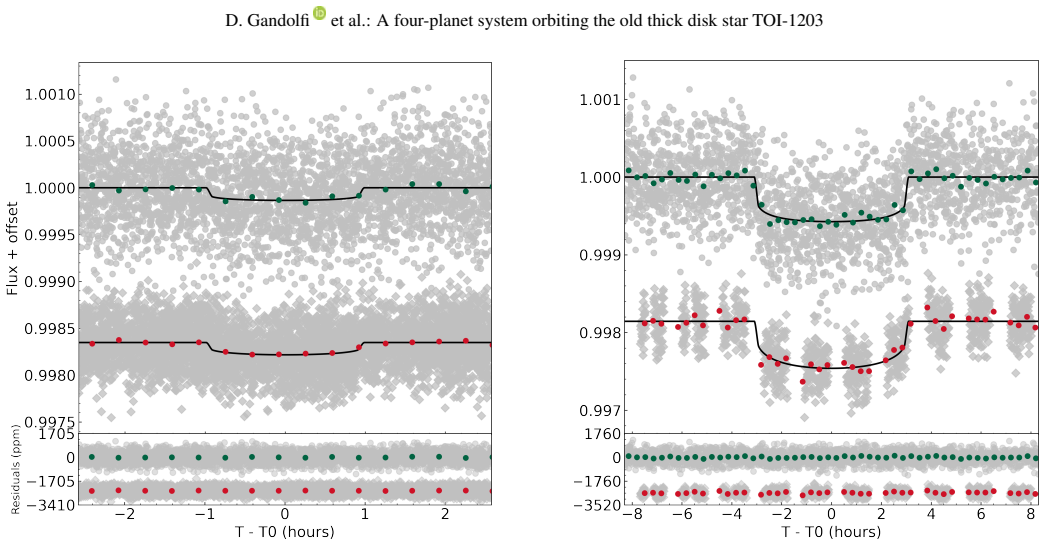
TOI-1203 is a four-planet system. The 25.5-day transiting sub-Neptune previously flagged by TESS is spectroscopically confirmed, with its mass determined (7.39±0.62 M⊕) and radius refined (2.918 R⊕). A new transiting super-Earth, TOI-1203 b, is confirmed by CHEOPS photometry with mass 3.51 M⊕ and radius 1.52 R⊕. Two additional Doppler signals at 13.1 and 204.6 days are attributed to planets with minimum masses 5.46 and 42.10 M⊕; the outer planet is eccentric (e=0.152). The host is an old (12.5 Gyr), metal-poor, alpha-enhanced thick-disk star. Stability maps show the system is stable for Gyr, sits near but not inside mean-motion resonances, and has the pericenters of c and d anti-aligned. A l
What carries the argument
The analysis rests on a joint Markov-chain Monte Carlo fit of TESS and CHEOPS transit light curves together with HARPS radial velocities modeled as four Keplerians, combined with iterative pre-whitening of GLS periodograms to isolate the Doppler signals. The long-period systematic in the HARPS line-profile FWHM is diagnosed by comparing the CCF FWHM against the FWHM of Th-Ar calibration lines, identifying a ~615-day instrumental profile variation. Dynamical stability is assessed with global frequency analysis maps and long symplectic integrations, and internal compositions are inferred from mass-radius modeling.
Load-bearing premise
The 13.1-day and 204.6-day radial-velocity signals are genuine planets, not artifacts of the pre-whitening procedure, stellar activity, or the ~615-day instrumental profile drift whose 230-day alias sits within the frequency resolution of the 204.6-day signal.
What would settle it
Two more years of high-precision radial velocities tracking the 204.6-day signal through at least two additional cycles: if it is not coherent as a single Keplerian, or if modeling the instrument-profile variation removes it, the planetary interpretation of TOI-1203 e collapses. A secondary check would be detecting transits of c or e, which the paper argues are unlikely but which would settle their geometry.
If this is right
- TOI-1203 b becomes one of the rare small planets whose mass and radius are both known to better than ~10%, placing it in the rocky/silicate regime of the mass-radius diagram.
- The system straddles the radius valley, with a rocky super-Earth and a volatile-rich sub-Neptune orbiting the same old star, offering a test of how wide binaries and stellar age affect the valley's location.
- The near-but-not-exact period commensurabilities (3:1, 2:1, 8:1) and the anti-aligned pericenters of c and d provide a benchmark for models of migration, tidal damping, and secular evolution in ancient systems.
- The detected ~615-day instrumental profile variation, with no RV counterpart, shows that symmetric profile changes can hide in line-width diagnostics; monitoring IP shape is therefore essential for RV surveys aiming at 10 cm/s precision.
Where Pith is reading between the lines
- If the 204.6-day signal is confirmed as a planet, TOI-1203 will be a reference for how early-galaxy rocky planets form, since the system assembled when the universe was about 1.3 Gyr old.
- The stability analysis maps out stable niches between b and c and between d and e; additional RV monitoring could test whether those niches are empty or occupied by smaller companions.
- The Th-Ar line-width diagnostic used here could be reapplied to archival HARPS data to flag long-period RV signals that coincide with instrument-profile variations, potentially reclassifying some published planet candidates.
Editorial analysis
A structured set of objections, weighed in public.
Referee Report
Summary. The paper reports the discovery and characterization of a four-planet system around the bright, old, metal-poor G3V star TOI-1203. Using 190 HARPS RVs, TESS and CHEOPS photometry, and a joint MCMC analysis, the authors confirm the previously known transiting sub-Neptune TOI-1203 d (P≈25.5 d, M=7.39±0.62 M⊕, R=2.918±0.045 R⊕), discover and confirm a transiting super-Earth TOI-1203 b (P≈4.16 d, M=3.51±0.33 M⊕, R=1.520±0.045 R⊕), and report two RV-only planets: TOI-1203 c (P≈13.08 d, M sin i=5.46±0.51 M⊕) and TOI-1203 e (P≈204.6 d, M sin i=42.10±1.8 M⊕, e=0.152±0.029). A stability analysis shows that configurations consistent with the data can be stable over Gyr timescales, and an interior-structure analysis of b and d is presented. The paper also identifies a ~615–630 d systematic in the HARPS CCF FWHM, traced to Th-Ar line widths, and attributes it to instrumental profile variations with no counterpart in the RVs.
Significance. If the detections hold, this is a valuable addition to the small sample of precisely characterized multi-planet systems around very old, α-enhanced thick-disk stars. The two transiting planets have masses and radii measured to better than ~10% and ~3%, respectively, placing them on the mass–radius diagram with clear compositional implications. The RV-only planets, especially the 13.1 d signal at K≈1.6 m/s, are the weakest link, and the paper would benefit from a correlated-noise robustness check. The HARPS instrumental-profile finding is an important cautionary result for precision-RV programs. Strengths include the large homogeneous HARPS dataset, the independent CHEOPS confirmation of TOI-1203 b, the use of ancillary activity indicators, the bootstrap FAP calculations, and the explicit forward stability and interior-structure checks that use the fitted parameters as inputs rather than as predictions.
major comments (2)
- [Sects. 4 and 9; Table B.2] The two RV-only signals (TOI-1203 c at 13.08 d with K_c=1.62±0.14 m/s, and TOI-1203 e at 204.6 d) are load-bearing for the four-planet claim. Their detection significance is established through pre-whitening with bootstrap FAPs that assume white noise, and the final fit models all noise with a single white jitter term (σ_HARPS=0.83±0.10 m/s). For a signal whose amplitude is only ~2× the jitter, unmodeled correlated noise could inflate the significance. I request a robustness check, e.g., a joint fit that includes a Gaussian-process or moving-average term for the RVs, or an injection-recovery test with red-noise residuals. This would materially increase confidence in planets c and e.
- [Sect. 9 and Sect. 5] The TESS Sector 36 transits of TOI-1203 b are excluded 'due to the lack of a detectable transit signal' in that sector. This is a post-hoc data selection that could bias the transit parameters and ephemeris if the non-detection is due to an unmodeled systematic rather than noise. Since CHEOPS confirms the transit near the same epoch, the exclusion likely does not affect the planet's existence, but the paper should quantify the consistency, e.g., by performing an injection-recovery test in Sector 36 or by modeling the Sector 36 data with a high-noise term.
minor comments (4)
- [Table B.2] The reported RV semi-amplitude for TOI-1203 d is listed as K_d=1.74±0.014 m/s. Given the values for the other planets and the mass uncertainty, the error bar is likely 0.14 m/s, not 0.014. Please check and correct.
- [Sect. 2] The text 'from 5 January to 2 March 2026, 2025.1' contains a stray '2025.1'; the intended date should be cleaned up.
- [Sect. 8.5] 'Adopting the LRS determination' should read 'LSR determination'.
- [Sect. 9] Typo: 'Markow chains' should be 'Markov chains'.
Circularity Check
No significant circularity found: the planet parameters are fitted directly to independent RV and photometric data, and the stability and interior-structure analyses are forward consistency checks using those fitted parameters as inputs.
full rationale
The paper's central claims are the detection and characterization of four planets around TOI-1203. These are derived by directly fitting a four-Keplerian RV model to HARPS radial velocities and transit models to TESS and CHEOPS photometry (Sect. 9), with no parameter that defines the result being set by the result itself. The two RV-only planets (c and e) are identified by periodogram analysis and pre-whitening (Sect. 4), and their significance is assessed via bootstrap FAPs against the data, not against any output of the final model. The transiting planets b and d are confirmed by independent photometry (CHEOPS and TESS). The stellar parameters (Teff, [Fe/H], [alpha/Fe], age) come from separate spectroscopic, photometric, and isochrone analyses; the thick-disk classification combines these with kinematic probabilities. The stability analysis (Sect. 10) takes the fitted orbital parameters as input and checks whether any dynamically stable configuration exists; it does not generate the orbital parameters. Likewise, the interior-structure analysis (Sect. 11) uses the measured masses and radii as inputs to a forward model. The only predictive step, estimating the radius of non-transiting planet c from a mass-radius relation (Otegi et al. 2020), is an externally calibrated empirical relation used to assess transit detectability, not to define the planet's existence. Self-citations (pyaneti, DST, plaNETic, BICEPS, PIPE, pycheops) are citations to published codes/methods, not to unverified uniqueness theorems or to the present result, and none is load-bearing in a way that reduces the argument to itself. The residual scientific risk (correlated noise affecting the 13.1 d signal) is a data-quality concern, not a circularity. I therefore find no circular step and assign a score of 0.
Axiom & Free-Parameter Ledger
free parameters (2)
- RV jitter sigma_HARPS =
0.83±0.10 m/s
- Limb-darkening coefficients q1 and q2 =
TESS: q1=0.27±0.08, q2=0.22; CHEOPS: q1=0.45, q2=0.32
axioms (4)
- domain assumption The Doppler signals at 4.2, 13.1, and 204.6 d are Keplerian reflex motion from planets, not stellar activity or instrumental artifacts.
- domain assumption The detected transit signals (25.5 d and 4.2 d) are caused by planets transiting TOI-1203 and not by a blended eclipsing binary.
- domain assumption Stellar parameters (T_eff=5737 K, [Fe/H]=-0.39, R*=1.179 R_sun, M*=0.886 M_sun, age=12.5 Gyr) derived from spectroscopy, photometry, and isochrones are accurate.
- domain assumption The 613-629 day signal in HARPS CCF FWHM and Th-Ar line widths is instrumental and does not affect the RVs.
Cite this review
Pith. "Pith review of A four-planet system orbiting the old thick disk star TOI-1203." pith.science (2026). https://pith.science/paper/UFXVYMXB
@misc{pith2026250910136,
  author       = {Pith},
  title        = {Pith review of: A four-planet system orbiting the old thick disk star TOI-1203},
  year         = {2026},
  howpublished = {\url{https://pith.science/paper/UFXVYMXB}},
  note         = {Machine review of arXiv:2509.10136}
}
read the original abstract
TOI-1203 is a bright (V=8.6) G3 V star known to host a transiting warm sub-Neptune on a 25.5 d orbit. Here we report on an intensive high-precision radial velocity and photometric follow-up campaign carried out with the HARPS spectrograph and the CHEOPS space telescope. We found that TOI-1203 has an enhancement of $\alpha$ elements relative to iron of [$\alpha$/Fe]=$0.21\pm0.04$. With an age of $\sim$12.5 Gyr, TOI-1203 belongs to the old, $\alpha$-element enhanced stellar population of the galactic thick disk. We spectroscopically confirmed the planetary nature of the 25.5 d sub-Neptune TOI-1203 d, measured its mass ($M_{d}=7.39\pm0.62~M_{\oplus}$) and refined its radius ($R_{d}=2.918_{-0.045}^{+0.046}~R_{\oplus}$). We discovered the presence of an additional transiting super-Earth on a 4.2 d orbit (TOI-1203 b) with a mass of $M_{b}=3.51_{-0.32}^{+0.33}~M_{\oplus}$ and a radius of $R_{b}=1.520_{-0.046}^{+0.045}~R_{\oplus}$. We also revealed the presence of two additional low-mass planets at 13.1 d and 204.6 d (TOI-1203 c and e), with minimum masses of $5.46_{-0.50}^{+0.51}~M_{\oplus}$ and $42.10_{-1.78}^{+1.83}~M_{\oplus}$. We found that the outer planet TOI-1203 e lies on an eccentric orbit with $e_{e}=0.152\pm0.029$. We performed a stability analysis of the system confirming that there are configurations consistent with the observed parameters that are dynamically stable over billion-year timescales. While analyzing the HARPS time series, we discovered that the FWHM of the HARPS cross-correlation function shows a significant long-period signal ($\sim$615 d) that has no counterpart in the radial velocity data or in the remaining HARPS ancillary time series. We significantly detected the same signal in the FWHM of the Th-Ar calibration lines used to compute the nightly wavelength solution, and attributed this systematic effect to a long-term variation of the HARPS instrumental profile.
Figures







Forward citations
Cited by 3 Pith papers
-
Dynamically Selected Mass-Radius Relationship for Low Mass Exoplanets
Planets inferred to have suffered giant collisions are more massive than pristine ones but retain comparable hydrogen envelope fractions, implying collisions occurred before disk gas dispersal.
-
An Ultra-Short Period Super-Earth and a Sub-Neptune Orbiting the K dwarf TOI-4311
TOI-4311 hosts a 0.99-day super-Earth (1.38 R_earth, 4.5 M_earth) and 15-day sub-Neptune (2.47 R_earth), plus a candidate 38-day planet, with the dense inner planet potentially challenging formation theories given the...
-
A Uniform Determination of the Bulk Metallicities and Alpha Enrichments of Confirmed Exoplanet Systems with TRES
A uniform spectroscopic catalog of 625 exoplanet hosts shows subsolar-metallicity giant-planet hosts are alpha-enhanced relative to both iron-rich hosts and typical metal-poor field stars.
Reference graph
Works this paper leans on
-
[1]
G., et al
Adibekyan , V., Dorn , C., Sousa , S. G., et al. 2021, Science, 374, 330
2021
-
[2]
C., et al
Adibekyan , V., Figueira , P., Santos , N. C., et al. 2015, , 583, A94
2015
-
[3]
Z., Sousa , S
Adibekyan , V. Z., Sousa , S. G., Santos , N. C., et al. 2012, , 545, A32
2012
-
[4]
2014, in Exploring the Formation and Evolution of Planetary Systems, ed
Allard , F. 2014, in Exploring the Formation and Evolution of Planetary Systems, ed. M. Booth , B. C. Matthews , & J. R. Graham , Vol. 299, 271--272
2014
-
[5]
M., et al
Alqasim , A., Grieves , N., Ros \'a rio , N. M., et al. 2024, , 533, 1
2024
-
[6]
W., & O'Neil , M
Ambikasaran , S., Foreman-Mackey , D., Greengard , L., Hogg , D. W., & O'Neil , M. 2015, IEEE Transactions on Pattern Analysis and Machine Intelligence, 38, 252
2015
-
[7]
R., Collier Cameron , A., Hellier , C., et al
Anderson , D. R., Collier Cameron , A., Hellier , C., et al. 2011, , 726, L19
2011
-
[8]
J., Barnes , J., et al
Anglada-Escud \'e , G., Amado , P. J., Barnes , J., et al. 2016, , 536, 437
2016
-
[9]
& Butler , R
Anglada-Escud \'e , G. & Butler , R. P. 2012, , 200, 15
2012
-
[10]
2015, , 450, 1787
Angus , R., Aigrain , S., Foreman-Mackey , D., & McQuillan , A. 2015, , 450, 1787
2015
-
[11]
1994, , 291, 895
Axer , M., Fuhrmann , K., & Gehren , T. 1994, , 291, 895
1994
-
[12]
1996, , 119, 373
Baranne , A., Queloz , D., Mayor , M., et al. 1996, , 119, 373
1996
-
[13]
Barnes , S. A. 2007, , 669, 1167
2007
-
[14]
M., & Zicher , N
Barrag \'a n , O., Aigrain , S., Rajpaul , V. M., & Zicher , N. 2021,
2021
-
[15]
J., Gandolfi , D., et al
Barrag \'a n , O., Armstrong , D. J., Gandolfi , D., et al. 2022, , 514, 1606
2022
-
[16]
2019, , 482, 1017
Barrag \'a n , O., Gandolfi , D., & Antoniciello , G. 2019, , 482, 1017
2019
-
[17]
2021, Experimental Astronomy, 51, 109
Benz , W., Broeg , C., Fortier , A., et al. 2021, Experimental Astronomy, 51, 109
2021
-
[18]
Blackwell , D. E. & Shallis , M. J. 1977, , 180, 177
1977
-
[19]
J., et al
Bonfanti , A., Delrez , L., Hooton , M. J., et al. 2021, , 646, A157
2021
-
[20]
A., et al
Bonfanti , A., Gandolfi , D., Egger , J. A., et al. 2023, , 671, L8
2023
-
[21]
2016, , 585, A5
Bonfanti , A., Ortolani , S., & Nascimbeni , V. 2016, , 585, A5
2016
-
[22]
2015, , 575, A18
Bonfanti , A., Ortolani , S., Piotto , G., & Nascimbeni , V. 2015, , 575, A18
2015
-
[23]
J., Koch , D., Basri , G., et al
Borucki , W. J., Koch , D., Basri , G., et al. 2010, Science, 327, 977
2010
-
[24]
2009, , 496, 527
Bouchy , F., Mayor , M., Lovis , C., et al. 2009, , 496, 527
2009
-
[25]
A., & Morris , B
Brandeker , A., Patel , J. A., & Morris , B. M. 2024, PIPE: Extracting PSF photometry from CHEOPS data , Astrophysics Source Code Library, record ascl:2404.002
2024
-
[26]
R., Quirion , P
Bruntt , H., Bedding , T. R., Quirion , P. O., et al. 2010, , 405, 1907
2010
-
[27]
2012, , 548, A44
Cabrera , J., Csizmadia , S., Erikson , A., Rauer , H., & Kirste , S. 2012, , 548, A44
2012
-
[28]
M., et al
Cabrera , J., Gandolfi , D., Serrano , L. M., et al. 2023, , 675, A183
2023
-
[29]
2020, , 160, 114
Carleo , I., Gandolfi , D., Barrag \'a n , O., et al. 2020, , 160, 114
2020
-
[30]
& Kurucz , R
Castelli , F. & Kurucz , R. L. 2003, in IAU Symposium, Vol. 210, Modelling of Stellar Atmospheres, ed. N. Piskunov , W. W. Weiss , & D. F. Gray , A20
2003
-
[31]
2017, , 600, A30
Claret , A. 2017, , 600, A30
2017
-
[32]
2021, Research Notes of the American Astronomical Society, 5, 13
Claret , A. 2021, Research Notes of the American Astronomical Society, 5, 13
2021
-
[33]
Correia , A. C. M., Couetdic, J., Laskar, J., et al. 2010,
2010
-
[34]
Correia , A. C. M., Udry , S., Mayor , M., et al. 2005, , 440, 751
2005
-
[35]
Couetdic , J., Laskar , J., Correia , A. C. M., Mayor , M., & Udry , S. 2010,
2010
-
[36]
Delisle , J. B. & Laskar , J. 2014, , 570, L7
2014
-
[37]
B., Laskar , J., & Correia , A
Delisle , J. B., Laskar , J., & Correia , A. C. M. 2014, , 566, A137
2014
-
[38]
B., Laskar , J., Correia , A
Delisle , J. B., Laskar , J., Correia , A. C. M., & Bou \'e , G. 2012, , 546, A71
2012
-
[39]
Demangeon , O. D. S., Zapatero Osorio , M. R., Alibert , Y., et al. 2021, , 653, A41
2021
-
[40]
P., Davies , G
Doyle , A. P., Davies , G. R., Smalley , B., Chaplin , W. J., & Elsworth , Y. 2014, , 444, 3592
2014
-
[41]
2011, , 535, A55
Dumusque , X., Lovis , C., S \'e gransan , D., et al. 2011, , 535, A55
2011
-
[42]
Eastman , J., Siverd , R., & Gaudi , B. S. 2010, , 122, 935
2010
-
[43]
A., Osborn , H
Egger , J. A., Osborn , H. P., Kubyshkina , D., et al. 2024, , 688, A223
2024
-
[44]
J., Gandolfi , D., et al
Esposito , M., Armstrong , D. J., Gandolfi , D., et al. 2019, , 623, A165
2019
-
[45]
2013, Celes
Farr \'e s , A., Laskar , J., Blanes , S., et al. 2013, Celes. Mech. Dyn. Astron., 116, 141
2013
-
[46]
D., Montet , B
Feinstein , A. D., Montet , B. T., Foreman-Mackey , D., et al. 2019, , 131, 094502
2019
-
[47]
2014, george: George (v0.2.0)
Foreman-Mackey , D., Hoyer , S., Bernhard , J., & Angus , R. 2014, george: George (v0.2.0)
2014
-
[48]
E., Broeg , C., et al
Fortier , A., Simon , A. E., Broeg , C., et al. 2024, , 687, A302
2024
-
[49]
2020, , 498, 4503
Fridlund , M., Livingston , J., Gandolfi , D., et al. 2020, , 498, 4503
2020
-
[50]
1993, , 271, 451
Fuhrmann , K., Axer , M., & Gehren , T. 1993, , 271, 451
1993
-
[51]
1994, , 285, 585
Fuhrmann , K., Axer , M., & Gehren , T. 1994, , 285, 585
1994
-
[52]
Gaia Collaboration , Vallenari , A., Brown , A. G. A., et al. 2023, , 674, A1
2023
-
[53]
P., et al
Gandolfi , D., Barrag \'a n , O., Hatzes , A. P., et al. 2017, , 154, 123
2017
-
[54]
H., et al
Gandolfi , D., Barrag \'a n , O., Livingston , J. H., et al. 2018, , 619, L10
2018
-
[55]
Y., Persson , C
Georgieva , I. Y., Persson , C. M., Goffo , E., et al. 2023, , 674, A117
2023
-
[56]
D., Jensen , E
Giacalone , S., Dressing , C. D., Jensen , E. L. N., et al. 2021, , 161, 24
2021
-
[57]
2024, , 685, A147
Goffo , E., Chaturvedi , P., Murgas , F., et al. 2024, , 685, A147
2024
-
[58]
A., et al
Goffo , E., Gandolfi , D., Egger , J. A., et al. 2023, , 955, L3
2023
-
[59]
M., Seager , S., Huang , C
Guerrero , N. M., Seager , S., Huang , C. X., et al. 2021, , 254, 39
2021
-
[60]
2008, , 486, 951
Gustafsson , B., Edvardsson , B., Eriksson , K., et al. 2008, , 486, 951
2008
-
[61]
2024, , 681, A96
Haldemann , J., Dorn , C., Venturini , J., Alibert , Y., & Benz , W. 2024, , 681, A96
2024
-
[62]
D., Bakos , G
Hartman , J. D., Bakos , G. \'A ., Bouma , L. G., & Csubry , Z. 2025, , 137, 024501
2025
-
[63]
P., Dvorak , R., Wuchterl , G., et al
Hatzes , A. P., Dvorak , R., Wuchterl , G., et al. 2010, , 520, A93
2010
-
[64]
P., Gandolfi , D., Korth , J., et al
Hatzes , A. P., Gandolfi , D., Korth , J., et al. 2022, , 163, 223
2022
-
[65]
J., et al
Hoyer , S., Gandolfi , D., Armstrong , D. J., et al. 2021, , 505, 3361
2021
-
[66]
2020, , 635, A24
Hoyer , S., Guterman , P., Demangeon , O., et al. 2020, , 635, A24
2020
-
[67]
Jenkins , J. M. 2002, , 575, 493
2002
-
[68]
M., Chandrasekaran , H., McCauliff , S
Jenkins , J. M., Chandrasekaran , H., McCauliff , S. D., et al. 2010, in Society of Photo-Optical Instrumentation Engineers (SPIE) Conference Series, Vol. 7740, Software and Cyberinfrastructure for Astronomy, ed. N. M. Radziwill & A. Bridger , 77400D
2010
-
[69]
M., Tenenbaum , P., Seader , S., et al
Jenkins , J. M., Tenenbaum , P., Seader , S., et al. 2020, Kepler Data Processing Handbook: Transiting Planet Search , Kepler Science Document KSCI-19081-003, id. 9. Edited by Jon M. Jenkins
2020
-
[70]
M., Twicken , J
Jenkins , J. M., Twicken , J. D., McCauliff , S., et al. 2016, in , Vol. 9913, Software and Cyberinfrastructure for Astronomy IV, 99133E
2016
-
[71]
Kipping , D. M. 2013, , 435, 2152
2013
-
[72]
2023, , 519, 5637
Knudstrup , E., Gandolfi , D., Nowak , G., et al. 2023, , 519, 5637
2023
-
[73]
Kuerster , M., Schmitt , J. H. M. M., Cutispoto , G., & Dennerl , K. 1997, , 320, 831
1997
-
[74]
Kurucz , R. L. 1993 a , SYNTHE spectrum synthesis programs and line data
1993
-
[75]
Kurucz , R. L. 1993 b , SYNTHE spectrum synthesis programs and line data (Astrophysics Source Code Library)
1993
-
[76]
1990, , 88, 266
Laskar , J. 1990, , 88, 266
1990
-
[77]
1993, Physica D: Nonlinear Phenomena
Laskar, J. 1993, Physica D: Nonlinear Phenomena
1993
-
[78]
D., et al
Li , J., Tenenbaum , P., Twicken , J. D., et al. 2019, , 131, 024506
2019
-
[79]
J., et al
Lillo-Box , J., Gandolfi , D., Armstrong , D. J., et al. 2023, , 669, A109
2023
-
[80]
2021, , 649, A4
Lindegren , L., Bastian , U., Biermann , M., et al. 2021, , 649, A4
2021
discussion (0)
Sign in with ORCID, Apple, or X to comment. Anyone can read and Pith papers without signing in.