REVIEW 3 major objections 5 minor 1 cited by
Multi-agent LLM system reliably sets up zeolite adsorption simulations and extracts force field parameters from published papers, with most runs correct and runnable.
Reviewed by Pith at T0; open to challenge. T0 means a machine referee read the full paper against a public rubric. the ladder, T0–T4 →
T0 review · deepseek-v4-flash
2026-08-04 18:05 UTC pith:XSVOO4JC
load-bearing objection A credible LLM-agent proof-of-concept for RASPA setup and force field extraction, but the reliability claim runs ahead of the evidence; the evaluation lacks a baseline, physical validation, and enough runs to back 'high reproducibility.' the 3 major comments →
Towards Fully Automated Molecular Simulations: Multi-Agent Framework for Simulation Setup and Force Field Extraction
The pith
A machine-rendered reading of the paper's core claim, the machinery that carries it, and where it could break.
Core claim
The central claim is that LLM-based agents, organized into a supervisor-led setup team and a paper-research team, can autonomously produce correct, runnable RASPA simulations and convert literature force fields into simulation-ready files. Concretely, the setup team completed adsorption isotherm and heat-of-adsorption tasks for one and three adsorbates across one and 500 zeolite structures with success rates of 80–100%, and most generated inputs ran without errors; the research team missed no parameters across six force fields and achieved parameter-overlap scores of 0.9 or above except when the source table used an unconventional layout (EPM2, IoU 0.67). The authors further demonstrate an e
What carries the argument
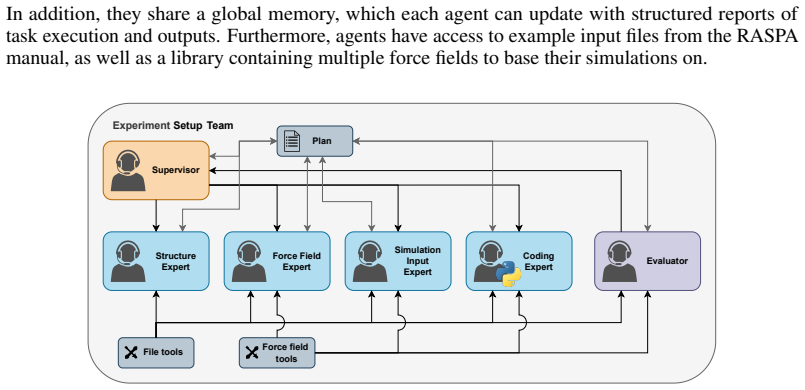
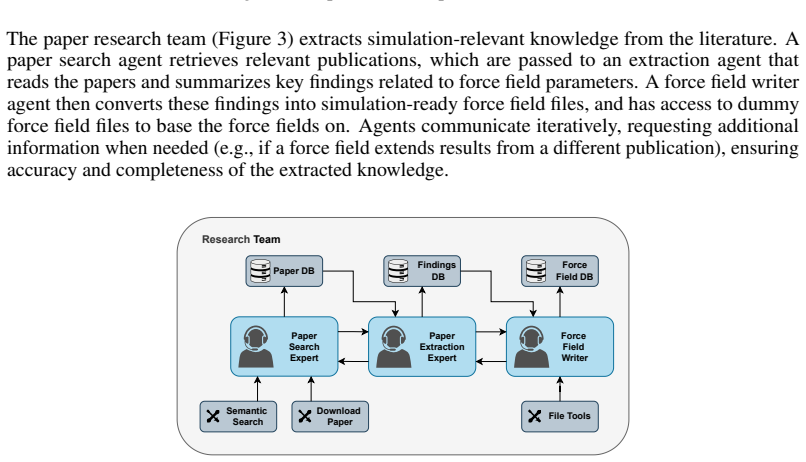
The system is built around two ReAct-based agent teams coordinated by supervisors: an Experiment Setup Team (supervisor, structure expert, force field expert, simulation input expert, coding expert, evaluator) that assembles RASPA input files by templating from manual examples and force field libraries; and a Research Team (paper search, paper extraction, force field writer) that reads publications, summarizes force field parameters, and writes simulation-ready files. The key mechanism is the evaluator agent that inspects each agent's output and gives feedback, plus shared global memory that lets agents record structured reports of their actions.
Load-bearing premise
The reported reliability rests on a small evaluation set—five runs per task—whose gold-standard correctness was judged by the authors' own manual inspection, and on access to curated force field libraries and RASPA manual examples; if those judgments are lenient or the tasks unrepresentative, the claimed reliability would not generalize.
What would settle it
Run the same five-run protocol on a task the authors did not test—for example, extracting parameters from a paper with a rotated or multi-column parameter table, or setting up a flexible-framework simulation with custom charges—and check whether the success rate drops below the reported 80–100%. A more direct check: have two independent experts label the correctness of generated inputs and measure inter-annotator agreement; low agreement would undermine the gold standard.
If this is right
- If reliable, the setup team removes the need for expert hand-writing of RASPA inputs for standard adsorption tasks, including isotherms, heats of adsorption, and multi-adsorbate or multi-structure cases.
- Literature-informed force field extraction can convert published parameters into simulation-ready files with high recall; failures are localized to nonstandard table layouts, which could be addressed by layout-aware parsing.
- The coordinated run shows the two components can be chained: extract a force field from a paper, then use it to set up simulations for a specified structure.
- Such automation could make reproducibility easier, since generated inputs and force fields are recorded and reusable, addressing protocol-variation issues in porous-materials simulation.
- The authors identify that adding semantic and episodic memory could generalize the system beyond the current prompt-encoded knowledge, enabling more adaptive workflows.
Where Pith is reading between the lines
- The evaluation is small (five runs per task) and the gold standard is the authors' own manual inspection, so the stated reliability should be read as an existence proof under favorable conditions rather than a measured error rate for arbitrary tasks.
- A concrete stress test would be running the system on a held-out set of papers with unusual table formats and on adsorption tasks involving framework flexibility or multiple cations, where parameter extraction is known to be harder; success there would strengthen the generalization claim.
- The architecture is model-agnostic in principle, so as LLM capabilities improve, the bottleneck is likely to shift from reasoning to tool-interface quality—especially parsing PDF tables—suggesting investment in structure-aware extraction would pay off.
- If integrated into high-throughput screening, even the current success rates imply that automated validation (executing simulations and checking physical observables) should replace manual correctness checks.
Editorial analysis
A structured set of objections, weighed in public.
Referee Report
Summary. The paper proposes a multi-agent LLM framework for automating molecular simulation setup in RASPA and for extracting force-field parameters from the literature. Two teams are described: an Experiment Setup Team that composes simulation.input files, structures, and force-field definitions for zeolite adsorption tasks, and a Research Team that retrieves papers, extracts force-field parameters, and writes RASPA-compatible force-field files. The evaluation reports high success and execution rates across a small set of tasks (Table 1), high IoU for extracted parameters (Table 2), and one coordinated end-to-end run (Appendix C). The authors conclude that autonomous agents can reliably set up molecular simulations and extract force fields from the literature.
Significance. If the reported performance is representative, the system would be a meaningful step toward semi-automated and eventually autonomous molecular simulation workflows for porous materials. The paper's strengths include a modular agent design, a reproducible code repository, transparent disclosure of failure cases and unusual decisions in Appendix B, and actual execution of generated inputs in RASPA. However, the evaluation is small-scale and partly self-referential, so the reliability claim in Section 4 is stronger than the evidence supports. The work is nevertheless a useful contribution to an emerging area, provided the evaluation is substantially strengthened.
major comments (3)
- [Section 3, Table 1 and Appendix B] The primary correctness metric is a manually judged success rate, but no rubric, inter-annotator agreement, or blind evaluation is described. The execution rate only proves that RASPA runs without error, not that the simulation is physically appropriate. This is load-bearing because the paper explicitly classifies unusual choices (24 Å cutoff, enforced minimum unit cells) as correct without any sensitivity check, while the HOA and multi-adsorbate failures listed in Appendix B show that runnable jobs can still implement the wrong physics. Please add a quantitative comparison of generated setups against reference simulation outputs (e.g., a test set of isotherm/HOA values) or an independent, rubric-based audit.
- [Section 3, Table 2] The Research Team's correctness is measured against ground-truth parameters read from the papers, but several of those papers are authored by the same group (Refs. [5], [18], [24], [27]) and the system has access to a library that contains these force fields. The task is therefore close to retrieving parameters that are already stored internally, and high IoU may reflect memorization or library access rather than robust literature understanding. To support the claim of reliable extraction, evaluate on held-out papers that are not in the system's library, not authored by the group, and verified against an independent gold standard (e.g., a force-field database curated by third parties).
- [Section 3 and Section 4] The central claim that agents 'reliably set up molecular simulations and extract force field parameters' is based on only five runs per task, a hand-picked set of tasks, and a single coordinated run in Appendix C. No confidence intervals, statistical comparisons, or baselines (e.g., single-agent or non-agent pipeline) are provided. A 100% success rate on n=5 is consistent with a true success rate as low as roughly 55% at the 95% confidence level, so the 'reliability' wording in Section 4 is not supported. Please report variance across runs, add more repetitions and tasks, and include at least one baseline comparison.
minor comments (5)
- [Table S3] There is a typo in the column heading: 'Strucutre' should be 'Structure'.
- [Appendix A, Table S1] The model name 'gpt-5' should be specified more precisely, including version and date, since agent behavior is highly sensitive to model version.
- [Section 3] The sentence 'evaluated both manually and by executing them in RASPA' conflates two different checks. Clarify what the manual evaluation consists of and whether the LLM-based Evaluator agent's judgments are included in the success-rate calculation.
- [Appendix C] The trace is useful but heavily summarized. State explicitly which parts of the coordinated run were automatically verified and which required human inspection, since the claim of successful workflow completion rests on this.
- [General] The anonymized repository is mentioned but not accessible in the manuscript. Provide a working link or clear instructions for code access, as reproducibility is central to the paper's contribution.
Circularity Check
No significant circularity: the system is evaluated against external literature and simulator execution, not against its own outputs.
full rationale
The paper makes no formal derivation claims; it presents an empirical evaluation of an LLM-based multi-agent system. The two evaluated components—RASPA input generation and literature force-field extraction—are assessed against external sources: RASPA manual examples, published force-field papers, and execution in the RASPA simulator. The 'success rate' is defined as correct configuration judged by manual inspection and execution, and the Research Team output is compared to the parameters stated in the cited publications. None of these steps is defined in terms of the output being predicted. Although some benchmark force fields [5,18,24,27] are authored or co-authored by the present authors, they are pre-existing published parameter sets used as retrieval targets, not as justifications for the framework's claims; the extraction task requires the agent to locate, interpret, and reformat those parameters, and failures such as the EPM2 table-layout error show the task has independent content. The manual gold standard is a limitation for reliability generalization, but it is not circularity. No equation or construction in the paper reduces a claimed result to its inputs, and no load-bearing self-citation chain is present.
Axiom & Free-Parameter Ledger
axioms (4)
- domain assumption gpt-5 reliably follows instructions and extracts structured data from scientific papers
- domain assumption The RASPA manual examples and provided force field library are sufficient to correctly set up the tested simulations
- domain assumption Manual inspection by the authors is a valid ground truth for correctness
- domain assumption Semantic Scholar returns the correct and complete paper set for retrieval
read the original abstract
Automated characterization of porous materials has the potential to accelerate materials discovery, but it remains limited by the complexity of simulation setup and force field selection. We propose a multi-agent framework in which LLM-based agents can autonomously understand a characterization task, plan appropriate simulations, assemble relevant force fields, execute them and interpret their results to guide subsequent steps. As a first step toward this vision, we present a multi-agent system for literature-informed force field extraction and automated RASPA simulation setup. Initial evaluations demonstrate high correctness and reproducibility, highlighting this approach's potential to enable fully autonomous, scalable materials characterization.
Figures

Forward citations
Cited by 1 Pith paper
-
El Agente Quntur: A research collaborator agent for quantum chemistry
El Agente Quntur is a new multi-agent system that uses reasoning over literature and software documentation to autonomously handle the full workflow of quantum chemistry experiments in ORCA.
Reference graph
Works this paper leans on
-
[1]
Construction of the literature graph in semantic scholar.arXiv preprint arXiv:1805.02262, 2018
Waleed Ammar, Dirk Groeneveld, Chandra Bhagavatula, Iz Beltagy, Miles Crawford, Doug Downey, Jason Dunkelberger, Ahmed Elgohary, Sergey Feldman, Vu Ha, et al. Construction of the literature graph in semantic scholar.arXiv preprint arXiv:1805.02262, 2018
Pith/arXiv arXiv 2018
-
[2]
Trappe-zeo: Transferable potentials for phase equilibria force field for all-silica zeolites.The Journal of Physical Chemistry C, 117(46):24375– 24387, 2013
Peng Bai, Michael Tsapatsis, and J Ilja Siepmann. Trappe-zeo: Transferable potentials for phase equilibria force field for all-silica zeolites.The Journal of Physical Chemistry C, 117(46):24375– 24387, 2013
2013
-
[3]
Autonomous chemical research with large language models.Nature, 624(7992):570–578, 2023
Daniil A Boiko, Robert MacKnight, Ben Kline, and Gabe Gomes. Autonomous chemical research with large language models.Nature, 624(7992):570–578, 2023
2023
-
[4]
Sébastien Bubeck, Varun Chandrasekaran, Ronen Eldan, Johannes Gehrke, Eric Horvitz, Ece Kamar, Peter Lee, Yin Tat Lee, Yuanzhi Li, Scott Lundberg, et al. Sparks of artificial general intelligence: Early experiments with gpt-4.arXiv preprint arXiv:2303.12712, 2023
Pith/arXiv arXiv 2023
-
[5]
Understanding the role of sodium during adsorption: a force field for alkanes in sodium-exchanged faujasites.Journal of the American Chemical Society, 126(36):11377–11386, 2004
Sofía Calero, David Dubbeldam, Rajamani Krishna, Berend Smit, Thijs JH Vlugt, Joeri FM Denayer, Johan A Martens, and Theo LM Maesen. Understanding the role of sodium during adsorption: a force field for alkanes in sodium-exchanged faujasites.Journal of the American Chemical Society, 126(36):11377–11386, 2004
2004
-
[6]
Pengfei Cao, Tianyi Men, Wencan Liu, Jingwen Zhang, Xuzhao Li, Xixun Lin, Dianbo Sui, Yanan Cao, Kang Liu, and Jun Zhao. Large language models for planning: A comprehensive and systematic survey.arXiv preprint arXiv:2505.19683, 2025
Pith/arXiv arXiv 2025
-
[7]
A process-level perspective of the impact of molecular force fields on the computational screening of mofs for carbon capture.Energy & Environmental Science, 16(9):3899–3918, 2023
Conor Cleeton, Felipe Lopes De Oliveira, Rodrigo F Neumann, Amir H Farmahini, Binquan Luan, Mathias Steiner, and Lev Sarkisov. A process-level perspective of the impact of molecular force fields on the computational screening of mofs for carbon capture.Energy & Environmental Science, 16(9):3899–3918, 2023
2023
-
[8]
High-throughput computational screening of metal–organic frameworks.Chemical Society Reviews, 43(16):5735–5749, 2014
Yamil J Colón and Randall Q Snurr. High-throughput computational screening of metal–organic frameworks.Chemical Society Reviews, 43(16):5735–5749, 2014
2014
-
[9]
From microporous to mesoporous molecular sieve materials and their use in catalysis.Chemical reviews, 97(6):2373–2420, 1997
Avelino Corma. From microporous to mesoporous molecular sieve materials and their use in catalysis.Chemical reviews, 97(6):2373–2420, 1997
1997
-
[10]
Responsive metal–organic frameworks and framework materials: under pressure, taking the heat, in the spotlight, with friends.Chemistry of Materials, 27(6):1905– 1916, 2015
François-Xavier Coudert. Responsive metal–organic frameworks and framework materials: under pressure, taking the heat, in the spotlight, with friends.Chemistry of Materials, 27(6):1905– 1916, 2015
1905
-
[11]
Organa: A robotic assistant for automated chemistry experimentation and characterization.Matter, 8(2), 2025
Kourosh Darvish, Marta Skreta, Yuchi Zhao, Naruki Yoshikawa, Sagnik Som, Miroslav Bog- danovic, Yang Cao, Han Hao, Haoping Xu, Alán Aspuru-Guzik, et al. Organa: A robotic assistant for automated chemistry experimentation and characterization.Matter, 8(2), 2025
2025
-
[12]
Raspa: molecular simulation software for adsorption and diffusion in flexible nanoporous materials.Molecular Simulation, 42(2):81–101, 2016
David Dubbeldam, Sofía Calero, Donald E Ellis, and Randall Q Snurr. Raspa: molecular simulation software for adsorption and diffusion in flexible nanoporous materials.Molecular Simulation, 42(2):81–101, 2016
2016
-
[13]
Calculating geometric surface areas as a characterization tool for metal- organic frameworks.The Journal of Physical Chemistry C, 111(42):15350–15356, 2007
Tina Düren, Franck Millange, Gérard Férey, Krista S Walton, and Randall Q Snurr. Calculating geometric surface areas as a characterization tool for metal- organic frameworks.The Journal of Physical Chemistry C, 111(42):15350–15356, 2007
2007
-
[14]
First principles derived, transferable force fields for co 2 adsorption in na- exchanged cationic zeolites.Physical Chemistry Chemical Physics, 15(31):12882–12894, 2013
Hanjun Fang, Preeti Kamakoti, Peter I Ravikovitch, Matthew Aronson, Charanjit Paur, and David S Sholl. First principles derived, transferable force fields for co 2 adsorption in na- exchanged cationic zeolites.Physical Chemistry Chemical Physics, 15(31):12882–12894, 2013
2013
-
[15]
Performance-based screening of porous materials for carbon capture.Chemical Reviews, 121(17):10666–10741, 2021
Amir H Farmahini, Shreenath Krishnamurthy, Daniel Friedrich, Stefano Brandani, and Lev Sarkisov. Performance-based screening of porous materials for carbon capture.Chemical Reviews, 121(17):10666–10741, 2021. 5
2021
-
[16]
John M Findley, Salah Eddine Boulfelfel, Hanjun Fang, Giovanni Muraro, Peter I Ravikovitch, and David S Sholl. A transferable force field for predicting adsorption and diffusion of hydrocarbons and small molecules in silica zeolites with coupled-cluster accuracy.The Journal of Physical Chemistry C, 125(15):8418–8429, 2021
2021
-
[17]
The chemistry and applications of metal-organic frameworks.Science, 341(6149):1230444, 2013
Hiroyasu Furukawa, Kyle E Cordova, Michael O’Keeffe, and Omar M Yaghi. The chemistry and applications of metal-organic frameworks.Science, 341(6149):1230444, 2013
2013
-
[18]
Transferable force field for carbon dioxide adsorption in zeolites.The Journal of Physical Chemistry C, 113(20):8814–8820, 2009
Almudena Garcia-Sanchez, Conchi O Ania, José B Parra, David Dubbeldam, Thijs JH Vlugt, Rajamani Krishna, and Sofia Calero. Transferable force field for carbon dioxide adsorption in zeolites.The Journal of Physical Chemistry C, 113(20):8814–8820, 2009
2009
-
[19]
Carbon dioxide’s liquid-vapor coexistence curve and critical properties as predicted by a simple molecular model.The Journal of Physical Chemistry, 99(31):12021–12024, 1995
Jonathan G Harris and Kwong H Yung. Carbon dioxide’s liquid-vapor coexistence curve and critical properties as predicted by a simple molecular model.The Journal of Physical Chemistry, 99(31):12021–12024, 1995
1995
-
[20]
Understanding the planning of llm agents: A survey.arXiv preprint arXiv:2402.02716, 2024
Xu Huang, Weiwen Liu, Xiaolong Chen, Xingmei Wang, Hao Wang, Defu Lian, Yasheng Wang, Ruiming Tang, and Enhong Chen. Understanding the planning of llm agents: A survey.arXiv preprint arXiv:2402.02716, 2024
Pith/arXiv arXiv 2024
-
[21]
Selective gas adsorption and separation in metal–organic frameworks.Chemical Society Reviews, 38(5):1477–1504, 2009
Jian-Rong Li, Ryan J Kuppler, and Hong-Cai Zhou. Selective gas adsorption and separation in metal–organic frameworks.Chemical Society Reviews, 38(5):1477–1504, 2009
2009
-
[22]
Ziming Luo, Zonglin Yang, Zexin Xu, Wei Yang, and Xinya Du. Llm4sr: A survey on large language models for scientific research.arXiv preprint arXiv:2501.04306, 2025
Pith/arXiv arXiv 2025
-
[23]
Bran, Sam Cox, Oliver Schilter, Carlo Baldassari, Andrew D White, and Philippe Schwaller
Andres M. Bran, Sam Cox, Oliver Schilter, Carlo Baldassari, Andrew D White, and Philippe Schwaller. Augmenting large language models with chemistry tools.Nature Machine Intelli- gence, 6(5):525–535, 2024
2024
-
[24]
Transferable force fields for adsorption of small gases in zeolites.Physical Chemistry Chemical Physics, 17(37):24048–24055, 2015
Ana Martin-Calvo, JJ Gutiérrez-Sevillano, JB Parra, CO Ania, and Sofia Calero. Transferable force fields for adsorption of small gases in zeolites.Physical Chemistry Chemical Physics, 17(37):24048–24055, 2015
2015
-
[25]
Too many materials and too many appli- cations: an experimental problem waiting for a computational solution.ACS central science, 6(11):1890–1900, 2020
Daniele Ongari, Leopold Talirz, and Berend Smit. Too many materials and too many appli- cations: an experimental problem waiting for a computational solution.ACS central science, 6(11):1890–1900, 2020
1900
-
[26]
Shuo Ren, Pu Jian, Zhenjiang Ren, Chunlin Leng, Can Xie, and Jiajun Zhang. Towards scientific intelligence: A survey of llm-based scientific agents.arXiv preprint arXiv:2503.24047, 2025
arXiv 2025
-
[27]
Adsorption of carbon dioxide in non-löwenstein zeolites.Chemistry of Materials, 35(13):5222–5231, 2023
Pablo Romero-Marimon, Juan Jose Gutierrez-Sevillano, and Sofia Calero. Adsorption of carbon dioxide in non-löwenstein zeolites.Chemistry of Materials, 35(13):5222–5231, 2023
2023
-
[28]
An automatic end-to-end chemical synthesis development platform powered by large language models.Nature communications, 15(1):10160, 2024
Yixiang Ruan, Chenyin Lu, Ning Xu, Yuchen He, Yixin Chen, Jian Zhang, Jun Xuan, Jianzhang Pan, Qun Fang, Hanyu Gao, et al. An automatic end-to-end chemical synthesis development platform powered by large language models.Nature communications, 15(1):10160, 2024
2024
-
[29]
Molecular simulations of zeolites: adsorption, diffusion, and shape selectivity.Chemical reviews, 108(10):4125–4184, 2008
Berend Smit and Theo LM Maesen. Molecular simulations of zeolites: adsorption, diffusion, and shape selectivity.Chemical reviews, 108(10):4125–4184, 2008
2008
-
[30]
Cognitive architec- tures for language agents.Transactions on Machine Learning Research, 2023
Theodore Sumers, Shunyu Yao, Karthik Narasimhan, and Thomas Griffiths. Cognitive architec- tures for language agents.Transactions on Machine Learning Research, 2023
2023
-
[31]
Self-driving laboratories for chemistry and materials science.Chemical Reviews, 124(16):9633–9732, 2024
Gary Tom, Stefan P Schmid, Sterling G Baird, Yang Cao, Kourosh Darvish, Han Hao, Stanley Lo, Sergio Pablo-García, Ella M Rajaonson, Marta Skreta, et al. Self-driving laboratories for chemistry and materials science.Chemical Reviews, 124(16):9633–9732, 2024
2024
-
[32]
Bojan Vuji´c and Alexander P Lyubartsev. Transferable force-field for modelling of co2, n2, o2 and ar in all silica and na+ exchanged zeolites.Modelling and simulation in Materials science and Engineering, 24(4):045002, 2016
2016
-
[33]
Executable code actions elicit better llm agents
Xingyao Wang, Yangyi Chen, Lifan Yuan, Yizhe Zhang, Yunzhu Li, Hao Peng, and Heng Ji. Executable code actions elicit better llm agents. InForty-first International Conference on Machine Learning, 2024. 6
2024
-
[34]
Plangenllms: A modern survey of llm planning capabilities.arXiv preprint arXiv:2502.11221, 2025
Hui Wei, Zihao Zhang, Shenghua He, Tian Xia, Shijia Pan, and Fei Liu. Plangenllms: A modern survey of llm planning capabilities.arXiv preprint arXiv:2502.11221, 2025
Pith/arXiv arXiv 2025
-
[35]
Large-scale screening of hypothetical metal–organic frameworks
Christopher E Wilmer, Michael Leaf, Chang Yeon Lee, Omar K Farha, Brad G Hauser, Joseph T Hupp, and Randall Q Snurr. Large-scale screening of hypothetical metal–organic frameworks. Nature chemistry, 4(2):83–89, 2012
2012
-
[36]
Llm4workflow: An llm-based automated workflow model generation tool
Jia Xu, Weilin Du, Xiao Liu, and Xuejun Li. Llm4workflow: An llm-based automated workflow model generation tool. InProceedings of the 39th IEEE/ACM International Conference on Automated Software Engineering, pages 2394–2398, 2024
2024
-
[37]
React: Synergizing reasoning and acting in language models
Shunyu Yao, Jeffrey Zhao, Dian Yu, Nan Du, Izhak Shafran, Karthik Narasimhan, and Yuan Cao. React: Synergizing reasoning and acting in language models. InInternational Conference on Learning Representations (ICLR), 2023
2023
-
[38]
Large language models for chemistry robotics.Autonomous Robots, 47(8):1057–1086, 2023
Naruki Yoshikawa, Marta Skreta, Kourosh Darvish, Sebastian Arellano-Rubach, Zhi Ji, Lasse Bjørn Kristensen, Andrew Zou Li, Yuchi Zhao, Haoping Xu, Artur Kuramshin, et al. Large language models for chemistry robotics.Autonomous Robots, 47(8):1057–1086, 2023
2023
-
[39]
Agent- as-a-judge: Evaluate agents with agents.arXiv preprint arXiv:2410.10934, 2024
Mingchen Zhuge, Changsheng Zhao, Dylan Ashley, Wenyi Wang, Dmitrii Khizbullin, Yunyang Xiong, Zechun Liu, Ernie Chang, Raghuraman Krishnamoorthi, Yuandong Tian, et al. Agent- as-a-judge: Evaluate agents with agents.arXiv preprint arXiv:2410.10934, 2024
Pith/arXiv arXiv 2024
-
[40]
El agente: An autonomous agent for quantum chemistry.Matter, 8(7), 2025
Yunheng Zou, Austin H Cheng, Abdulrahman Aldossary, Jiaru Bai, Shi Xuan Leong, Jorge Ar- turo Campos-Gonzalez-Angulo, Changhyeok Choi, Cher Tian Ser, Gary Tom, Andrew Wang, et al. El agente: An autonomous agent for quantum chemistry.Matter, 8(7), 2025. 7 A System Overview In Table S1, a description of each agent, along with the LLM they are based on, can ...
2025
discussion (0)
Sign in with ORCID, Apple, or X to comment. Anyone can read and Pith papers without signing in.