REVIEW 4 major objections 5 minor
AegisShield: Democratizing Cyber Threat Modeling with Generative AI
T0 review · 4 major / 5 minor · reviewed 2026-08-05 · deepseek-v4-flash
Pith's one-line read A generative AI tool called AegisShield can write threat descriptions that are simpler than experts' and still map to MITRE ATT&CK, making threat modeling accessible.
desk verdict A legitimate tool-building effort whose headline mapping result measures ID validity, not mapping correctness, so the strong claims rest on a weak metric. read the letter →
The pith
A machine-rendered reading of the paper's core claim, the machinery that carries it, and where it could break.
The reading
What carries the argument
AegisShield: a Python/Streamlit tool that orchestrates GPT-4o through structured JSON prompts, injects real-time threat intel from NVD and AlienVault OTX, and maps each STRIDE threat to a MITRE ATT&CK technique using descriptive keywords and a locally stored STIX database. The load-bearing identity is the prompt architecture: it forces the model to output structured threats, then scores them with Flesch-Kincaid readability and SBERT cosine similarity.
What would settle it
Take a random sample of the 6,921 threats counted as 'mapped' and have independent threat-modeling experts judge whether each associated MITRE ATT&CK technique is the semantically appropriate one. If a substantial share (e.g., more than 20%) are judged incorrect, the practical value of the 85.4% figure collapses. A second decisive test: recompute the H2 success rates with a different modern sentence-embedding model than stsb-roberta-large; if fewer than half of case studies still pass the 50%-majority threshold, the semantic-alignment claim depends on a particular embedding model.
Extended reading notes
Core claim
The central claim is that generative AI can automate and standardize the early phases of threat modeling without sacrificing alignment with established frameworks. AegisShield, prompted with system descriptions and live NVD/OTX intelligence, generates STRIDE-categorized threats that are easier to read than expert-written ones, semantically overlap with expert descriptions (cosine similarity ≥0.7 for at least one threat per batch in a majority of runs), and carry valid MITRE ATT&CK technique IDs in 85.4% of cases. The paper operationally defines a successful mapping as any attack pattern with a valid ID; it also acknowledges that 93 of the 8,100 mappings (1.15%) were AI hallucinations.
Load-bearing premise
A threat counts as successfully mapped to MITRE ATT&CK if it carries any valid attack-pattern ID, regardless of whether the chosen technique is the correct one; the paper itself notes 93 of the mappings were hallucinations.
Editorial extensions
If this is right
- Organizations that currently skip threat modeling can generate consistent, framework-aligned threat lists in minutes instead of days, at a fraction of the cost of a senior security architect.
- The standardized, lower-complexity descriptions could be used directly in security-awareness contexts, since they target a high-school reading level rather than a college-experienced one.
- The tool's automated MITRE ATT&CK mapping could feed downstream workflows (e.g., detection engineering or risk registers) with machine-readable technique IDs, if the mapping quality holds up under expert review.
- The 85.4% mapping rate, validated against an 80% Pareto-style threshold, suggests that a generative-AI-first approach can reach the point of practical utility for routine threat modeling even before further prompt tuning.
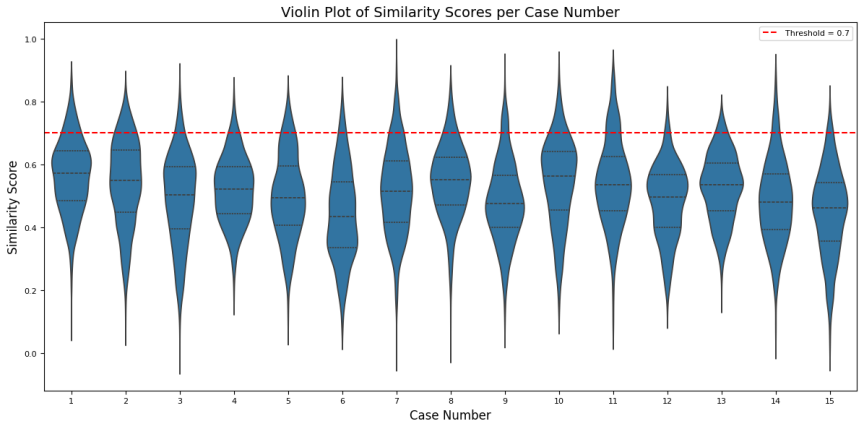
- The semantic-similarity results (with per-case successful batches in 14 of 15 domains) imply the approach is domain-agnostic, not limited to a single industry or system type.
Reading between the lines
- The paper's H3 result depends on counting any valid attack-pattern ID as success; if independent experts instead judged whether the mapped technique is the semantically correct one, the effective mapping accuracy could be materially lower than 85.4%, since the paper itself found 1.15% of IDs to be hallucinations.
- AegisShield's uniform, shorter descriptions (median 13 words vs. 21 for experts) may trade away domain-specific nuance; a follow-up could test whether expert-driven detail improves downstream mitigation quality without hurting readability.
- Because the paper used only GPT-4o and the deprecated stsb-roberta-large embedding model, the headline numbers could shift with different model versions; re-running the pipeline on a newer embedding model is a direct test of whether the 'majority of batches' claim is robust.
- The low correlation between rubric scores and similarity scores (near zero, sometimes moderately negative) suggests the tool leans on generic threat patterns; richer technical inputs might unlock sharper, more context-sensitive threat generation.
Editorial analysis
A structured set of objections, weighed in public.
Referee Report
Summary. The paper presents AegisShield, a generative-AI-enhanced threat modeling tool that operationalizes STRIDE and MITRE ATT&CK, integrates NVD and AlienVault OTX threat intelligence, and produces threats, DREAD scores, mitigations, and test cases. The evaluation uses 15 published STRIDE case studies as expert ground truth, comparing 243 expert threats with 8,100 tool-generated threats across three hypotheses: H1 (reduced complexity via Flesch-Kincaid), H2 (semantic similarity via Sentence-BERT cosine scores), and H3 (mapping to MITRE ATT&CK techniques). The claims are that the tool significantly lowers readability grade levels (p<0.001), produces semantically aligned outputs in 14/15 case studies (p<0.05), and achieves an 85.4% mapping success rate (p<0.001). The paper concludes that AegisShield democratizes threat modeling for under-resourced organizations.
Significance. If the evaluation were fully valid, this would be a useful applied contribution: it provides a concrete, extensible tool artifact, a transparent methodology, and a large dataset of AI-generated threats compared against published expert work. The use of external case studies and the MITRE ATT&CK STIX dataset gives the evaluation an external anchor, and the authors are candid about several limitations (no usability study, single LLM, simulated case studies). The core unresolved issue is that the headline success metrics are author-defined and do not measure what the hypotheses claim to measure. The H3 success definition—any syntactically valid ATT&CK ID—does not establish that the mapped technique is the correct or relevant one, and the H2 batch criterion is a one-hit threshold that lacks a chance-level baseline. These are load-bearing threats to the central democratization/efficacy conclusion, but they are addressable with additional analysis and expert validation.
major comments (4)
- [§3.3.4, §4.5.1, §4.5.3] The H3 success metric counts a threat as mapped whenever its associated attack-pattern ID is valid. This is a syntactical check, not a semantic one: every technique in the ATT&CK STIX dataset has a valid ID, so a procedure that selects an arbitrary technique will frequently satisfy the criterion. The one-proportion test against the 80% benchmark is therefore not informative about whether the chosen TTP is relevant to the STRIDE threat. Section 4.5.3 reports 93 hallucinations, but no expert validation is provided for the remaining 6,921 'successful' mappings. The claim that AegisShield 'systematically maps STRIDE-categorized threats to relevant MITRE ATT&CK TTPs' requires expert-verified correctness, not just valid-ID checking.
- [§3.3.2, §4.4.2, Table 4.10] The H2 success criterion is a single cosine similarity score ≥0.7 among the 18 threat comparisons in a batch, followed by a majority vote over 30 batches. With 18 comparisons per batch, the maximum of 18 cosine scores can exceed 0.7 under the null hypothesis of unrelated text with non-negligible probability; no permutation or random-pair baseline is reported. The 50% batch threshold is arbitrary and does not reflect the central tendency of the similarity distribution. To support the claim that AegisShield's outputs are semantically aligned with expert models, the authors should report the full distribution of scores, compare against a chance baseline generated from unmatched/random pairs, and validate a subset of high-scoring matches by expert judgment.
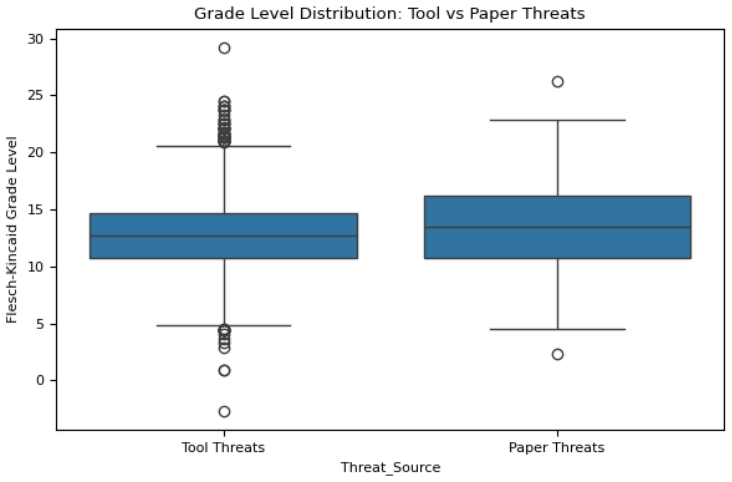
- [§4.3.4.2] The Mann-Whitney U test for H1 is statistically significant (p=0.001), but the reported rank-biserial correlation is r=-0.143, a small effect size, and the median difference is 0.8 grade levels (12.7 vs. 13.5). The statement that AegisShield 'significantly reduces complexity' is technically correct, but the abstract and §5.1 go further, claiming this 'significantly lowers the barrier to entry' and democratizes threat modeling. A grade-level difference of less than one year, with a small effect size, is a modest practical effect. The authors should temper the democratization framing or provide additional evidence, such as user studies with non-experts, that this readability change meaningfully lowers the barrier to entry.
- [§1.8, §3.2.1, §2.7] The paper's central claim is democratization, but the evaluation does not directly measure whether AegisShield lowers the barrier to entry for the intended users. The manuscript acknowledges in §3.2.1 that there were 'no formal studies done on the usability of the interface,' and §2.7 states real-world effectiveness was not tested. The evaluation uses readability as a proxy for accessibility and cosine similarity as a proxy for quality, but these do not capture whether a small organization with limited expertise can actually use the tool successfully. At minimum, the conclusions should explicitly limit the democratization claim to output readability and framework alignment, and the limitations section should be reflected in the abstract's stronger language.
minor comments (5)
- [§4.6] The description 'processed 8,100 threats across 30 batches, each containing 540 threats' is internally inconsistent: 30 × 540 = 16,200. The earlier methodology says 30 runs per case study, each run generating 18 threats, giving 540 threats per case and 8,100 total. Please correct the summary in §4.6.
- [§4.5] The section numbering jumps from 4.5.1 to 4.5.3; there is no §4.5.2. This appears to be an editorial oversight.
- [Table 4.1] The note under Table 4.1 says 'Crit. = Criteria as defined in Table 2.1,' but the rubric is defined in Table 3.2. The cross-reference should be corrected.
- [§3.4] The methodology states that qualitative comparative analysis (QCA) was used, but the reported analysis consists of descriptive statistics, normality tests, Mann-Whitney U tests, proportions, and correlations. No QCA truth-table or configuration analysis is presented. The label 'QCA' should be removed or the actual QCA results should be reported.
- [§4.3.4.2] The duplicate handling is reported only after the main test, but it is not part of the primary pre-registered analysis. The sensitivity check is welcome, but it should be described as an auxiliary result, not post hoc as an afterthought.
Circularity Check
H3's 85.4% mapping 'success' is self-defined as any valid ATT&CK ID; the central mapping claim partly reduces to a validity check.
-
self definitional
[Section 3.3.4 (MITRE ATT&CK Framework); Section 4.5.1 (Overview of the Mapping Results)]
"A threat was considered as mapped if its associated IDs were valid; unmapped threats with the ID 'attack-pattern--00000000-0000-0000-0000-000000000000' and technique TID 'N/A' were excluded."
The paper defines 'mapped' as 'associated IDs were valid', i.e., the chosen attack-pattern ID exists in the MITRE STIX dataset. The tool's own pipeline searches the STIX dataset, returns up to 25 candidates, and 'the AI refined this list ... and chose a single mapping to apply to the threat.' Thus the output is constructed to be a valid STIX ID; validity is an input property of the candidate list, not a measure of whether the selected technique is the relevant one for the threat. The 85.4% success rate and one-proportion p<0.001 therefore largely test whether the model emitted a syntactically valid ID rather than whether it systematically maps threats to relevant TTPs. The H3 claim is self-definitional: 'successful mapping' is defined as the very property the generation pipeline is designe
full rationale
AegisShield is evaluated against external benchmarks (15 expert case studies and the MITRE ATT&CK STIX dataset), and there is no problematic self-citation chain: the tool builds on STRIDE-GPT (Adams, 2024), but that is a normal foundation, not a load-bearing self-citation. H1 and H2 are empirical comparisons: Flesch-Kincaid readability and SBERT cosine similarity are measured independently of the tool's own success thresholds. The thresholds (0.7 cosine, 50% of batches) are author-chosen and lenient, but they are not fitted to the data, so they do not make the derivation circular. The main circularity is in H3. The success criterion for MITRE ATT&CK mapping is 'valid ID', and the tool is prompted to return a single attack-pattern object selected from the MITRE STIX dataset. Consequently, the 85.4% figure is mostly a check that the model emitted a well-formed ID rather than a check of relevance or correctness. The paper's own Section 4.5.3 concedes 93 hallucinated IDs, showing there is some empirical content, but the headline claim of 'systematically map ... to relevant ... TTPs' is not what the metric measures. This is a partial, construction-level circularity: the result is not forced with probability one, but the operational definition makes high success almost tautological. Because H1 and H2 remain independent and the mapping step has some non-circular residual (hallucination rate), a score of 6 is appropriate.
Assumptions & free parameters
free parameters (5)
- Cosine similarity success threshold =
0.7
- Batch success majority threshold =
50% of 30 batches
- MITRE mapping benchmark =
80%
- Number of batches per case study =
30
- Technical output level =
medium
assumptions (5)
- domain assumption The 15 selected case studies are credible, expert-developed STRIDE models.
- domain assumption Cosine similarity between SBERT embeddings captures semantic alignment of threat descriptions.
- domain assumption Flesch-Kincaid grade level is a valid measure of threat description complexity.
- domain assumption A valid MITRE ATT&CK attack-pattern ID indicates a successful mapping.
- domain assumption Inferred industry sectors and compliance requirements are accurate enough for the tool comparison.
Cite this review
Pith. "Pith review of AegisShield: Democratizing Cyber Threat Modeling with Generative AI." pith.science (2026). https://pith.science/paper/PG2U2QHZ
@misc{pith2026250910482,
  author       = {Pith},
  title        = {Pith review of: AegisShield: Democratizing Cyber Threat Modeling with Generative AI},
  year         = {2026},
  howpublished = {\url{https://pith.science/paper/PG2U2QHZ}},
  note         = {Machine review of arXiv:2509.10482}
}
read the original abstract
The increasing sophistication of technology systems makes traditional threat modeling hard to scale, especially for small organizations with limited resources. This paper develops and evaluates AegisShield, a generative AI enhanced threat modeling tool that implements STRIDE and MITRE ATT&CK to automate threat generation and provide systematic assessments. By integrating real time threat intelligence from the National Vulnerability Database and AlienVault Open Threat Exchange, AegisShield produces streamlined and accessible threat descriptions. Our assessment of 243 threats from 15 case studies and over 8000 AI generated threats shows that AegisShield reduces complexity (p less than 0.001), yields outputs semantically aligned with expert developed threats (p less than 0.05), and achieves an 85.4 percent success rate in mapping threats to MITRE ATT&CK techniques (p less than 0.001). Automating and standardizing threat modeling helps under resourced organizations address risk earlier and supports wider adoption of secure by design practices.
Figures



Figures from the paper (13 more)




Reviewed August 5, 2026 · model on record in the stance chip above.
Discussion (0). Sign in to comment.