REVIEW 4 major objections 5 minor 174 references
Large language models and multimodal language models are becoming the state of the art for trajectory prediction in autonomous driving, achieving up to a 4x reduction in collision rates by reasoning about scenes in language.
Reviewed by Pith at T0; open to challenge. T0 means a machine referee read the full paper against a public rubric. the ladder, T0–T4 →
A structured survey of LLM-based trajectory prediction methods, organized into trajectory-language mapping, multimodal fusion, and constraint-based reasoning, with benchmarks, metrics, and future directions.
T0 review reviewed 2026-08-04 challenge →
load-bearing objection Useful survey of LLM trajectory prediction, but the SOTA claim is contradicted by its own tables. the 4 major comments →
Large Foundation Models for Trajectory Prediction in Autonomous Driving: A Comprehensive Survey
The pith
A machine-rendered reading of the paper's core claim, the machinery that carries it, and where it could break.
The reading
Core claim
The paper's central claim is that LLMs and MLLMs shift trajectory prediction from low-level pattern recognition to semantic understanding and cognitive reasoning. It organizes the field into three core methodologies: trajectory-language mapping, which discretizes trajectories into tokens or textual descriptions; multimodal fusion, which aligns kinematic, visual, and linguistic features into a joint semantic space; and constraint-based reasoning, which uses chain-of-thought prompting to enforce traffic rules and physical constraints. On this basis, the survey asserts that LLM-based methods achieve state-of-the-art results: on nuScenes, DriveVLM-Dual and SOLVE-VLM report average collision rate
What carries the argument
The central object is the LLM-centric trajectory prediction framework, built on three pillars: trajectory-language mapping (e.g., discretizing trajectories with vector quantization or curve parameterization, or representing them as floating-point text), multimodal fusion (shared scene encoders, cross-modal attention, and visual-language alignment), and constraint-guided reasoning (chain-of-thought decomposition with traffic rules, causal analysis, and risk assessment). This framework converts continuous kinematics into symbolic representations that LLMs can reason over, aligns them with visual and textual scene semantics, and generates both geometrically precise trajectories and natural-lang
Load-bearing premise
The survey's state-of-the-art conclusion rests on assuming that the raw benchmark numbers it compares across different papers actually measure the same thing under the same protocol—that a nuScenes ego L2 and collision-rate number from an end-to-end planner is comparable to a trajectory prediction number from another, and that ETH-UCY minADE/minFDE values were produced with identical K, data splits, and post-processing; if these numbers are not directly comparable, the centra
What would settle it
Take any leading LLM-based predictor (for example DriveVLM-Dual or GUIDE-CoT) and any top deep-learning baseline, run both on identical data splits with identical sample counts, metrics, and horizon settings, and check whether the reported collision-rate gap (e.g., 0.10% vs 0.33% average) and ETH-UCY gains persist; a smaller or reversed gap under controlled conditions would falsify the survey's state-of-the-art conclusion.
If this is right
- If the survey's central claim holds, LLM- and MLLM-based trajectory predictors become the leading paradigm for motion forecasting in autonomous driving, replacing pure deep learning baselines on accuracy and safety metrics.
- Trajectory prediction becomes inherently more interpretable: models can output step-by-step rationales such as 'yield to pedestrian at crosswalk' alongside predicted coordinates, which supports safety certification and human oversight.
- Safety gains concentrate at longer horizons: reported 3-second collision rates drop to 0.17% for DriveVLM-Dual versus 0.67-0.85% for most deep learning baselines, suggesting language-based reasoning is particularly valuable for complex, multi-step prediction.
- Pedestrian trajectory prediction can be reformulated as a language modeling or question-answering task, matching or beating deep learning models on ETH-UCY benchmarks while providing more consistent performance across different scenes.
- The main practical bottleneck shifts from accuracy to latency: autoregressive decoding in LLMs (often over 100 ms) must be reduced to meet vehicle control cycles (under 50 ms), making efficient inference the critical deployment challenge.
Where Pith is reading between the lines
- A controlled apples-to-apples evaluation is the natural next step: re-running leading LLM-based and deep learning predictors under identical data splits, sample counts, metrics, and sensor inputs could either confirm or overturn the state-of-the-art claim the survey derives from heterogeneous published numbers.
- The safety improvements may stem more from object-level semantic labels and structured reasoning than from the language model per se, which suggests that lighter-weight models trained on semantic annotations could capture much of the benefit at lower computational cost.
- If trajectory-language mapping succeeds, it opens a path toward unifying motion prediction with natural language driver commands, human feedback, and interactive negotiation, enabling more human-like and adjustable driving behavior.
- The reported results are mostly open-loop benchmarks; closed-loop evaluation in simulation would test whether language-grounded predictions also improve actual driving outcomes such as takeover rates and collision avoidance in interactive scenarios.
Editorial analysis
A structured set of objections, weighed in public.
Referee Report
Summary. This survey reviews the emerging use of Large Foundation Models (LFMs), especially LLMs and MLLMs, for trajectory prediction in autonomous driving. It proposes a three-pillar taxonomy — trajectory-language mapping, multimodal fusion, and constraint-based reasoning — and organizes recent work on vehicle, pedestrian, and multi-agent prediction. It also tabulates open-source models, datasets, evaluation metrics, and benchmark results, and discusses challenges such as latency, data scarcity, and robustness. The paper makes strong claims that LFMs improve interpretability, safety, and generalization, that LLM-based methods achieve state-of-the-art trajectory prediction, and that they reduce collision rates by 4× versus deep-learning baselines.
Significance. As a survey, the paper has value as a broad compilation of recent work at the intersection of LLMs/MLLMs and trajectory prediction. Its taxonomy is a useful organizing device, and the tables of open-source models, datasets, and computational resources are likely to be a convenient reference for practitioners. The discussion of open challenges is balanced and points to concrete future directions. However, the central quantitative claims are not supported by the evidence presented in the paper itself. Table IX evaluates open-loop planning metrics rather than trajectory prediction as defined in Section II, and Table X shows that the best LLM-based pedestrian predictors are competitive with, but not clearly better than, leading deep-learning methods. The paper therefore currently provides a useful catalog and taxonomy, but not a substantiated claim of a new state of the art. After the claims are corrected and the benchmark discussion is sharpened, the survey could become a solid reference.
major comments (4)
- [§IV.A, Table IX] The table is titled "Vehicle Trajectory Prediction Models on nuScenes," but the reported metrics — ego-vehicle L2 and collision rate at 1/2/3 s — are open-loop planning metrics used by end-to-end planners such as UniAD, VAD-Base, AD-MLP, and BEV-Planner. These are not trajectory-prediction metrics under the task formulation in §II, which concerns predicting future states of multiple traffic participants and standard evaluation with minADE/minFDE or miss rate. Thus the statements in §IV.A.c that "the results clearly indicate ... LLM-based methods are advancing the state-of-the-art in vehicle trajectory prediction" and in §VI that "LLMs achieve state-of-the-art performance" are unsupported by the data in that table. The paper should either add trajectory-prediction benchmark results (e.g., nuScenes motion forecasting, Waymo Open Motion) or explicitly restrict the claim to open-loop plannin
- [§IV.B, Table X] The text states that "LLMs Pushing the Frontier" and that LLM-based methods establish a new state of the art. The table does not support this. The best LLM-based average minADE/minFDE values are LMTraj-SUP (0.22/0.32) and GUIDE-CoT (0.24/0.31), while several conventional deep-learning methods achieve better or equal minADE values: MoFlow (0.20/0.32), MemoNet (0.21/0.35), NPSN (0.21/0.36), SocialVAE (0.21/0.33), and EigenTrajectory (0.21/0.34). The correct conclusion from Table X is that LLM-based methods are competitive but not state of the art. This affects the paper's central claim and should be revised.
- [§VI, Conclusion and §IV.A.c] The claim that LLM-based methods reduce collision rates by 4× versus baselines is based on Table IX, comparing DriveVLM-Dual's 3 s collision rate of 0.17% with deep-learning planners at 0.67–0.85%. Even if those numbers are reliable, they quantify open-loop ego planning, not trajectory prediction quality or prediction safety as defined in the paper. The conclusion should be qualified to say that certain LLM-based planners report lower collision rates in open-loop nuScenes evaluation, and should not be presented as a general property of LLM-based trajectory prediction.
- [Tables IX and X] The paper compiles benchmark numbers from many different papers without reporting the evaluation protocols needed for comparability. For ETH-UCY, the minADE/minFDE values depend on K (usually 20), observation and prediction horizons, and splits; the table does not state these details for each row. For nuScenes, the set of agents used for L2 planning evaluation, the ego-status definitions, and the collision-checking procedure can differ across methods; indeed, Table IX contains missing values for EMMA, OpenEMMA, and LightEMMA. The SOTA conclusions rest on cross-paper comparability of these numbers. The authors should add a column or footnote stating protocol details, or explicitly describe the comparison as indicative rather than head-to-head.
minor comments (5)
- [Tables throughout] There are several typos and naming inconsistencies: Table I has "porediction" instead of "prediction"; Table VII lists "LC-LMM" where the method name elsewhere is "LC-LLM"; Figure 5 has "Wavpoints" instead of "Waypoints"; Table VI mixes "OpenEMMA" and "ReCogDrive" versus the text's "openEMMA" and "RecogDrive." A careful editing pass would help.
- [§III.A, reference [64]] The citation "Da Yu" is an image-captioning model for unmanned surface vehicles, not a trajectory-prediction method. It appears in the scenario-description part of the survey as an example MLLM, but it is not applied to trajectory prediction. Either remove it or explicitly identify it as a general MLLM example.
- [§III taxonomy] The paper states that the three categories 'exhaustively cover' LLM trajectory prediction methods. Several surveyed methods (e.g., CoT-Drive, GenFollower, iMotion-LLM) fit multiple categories simultaneously. The authors should clarify that the taxonomy is functional and non-exclusive, or give clear decision rules for assignment.
- [Table III and Table IV] Table III reports "breakthrough" claims such as the TCP 37% collision-rate reduction and DriveSuprim's 93.5% PDMS score without specifying benchmark conditions or sources in the table itself. Table IV relies on manufacturer safety reports from Waymo and Tesla; the paper should clarify that these are self-reported industry numbers rather than peer-reviewed independent evaluations.
- [Figure 4] The figure on publication distribution in top-tier venues does not describe the source of the publication list or the search/selection criteria. Adding a sentence on the query used, time frame, and venue selection would make the figure reproducible.
Circularity Check
No circularity: the survey synthesizes external results; no claim reduces to its own inputs or fitted parameters.
full rationale
This is a survey paper with no mathematical derivation chain. The central claims—that LFM/LLM methods improve interpretability and prediction safety—are supported by citing external published systems and benchmark tables (Tables IX and X) that reproduce numbers from independent papers (UniAD, VAD, BEV-Planner++, DriveVLM, EMMA, SOLVE-VLM, LMTraj-SUP, GUIDE-CoT, etc.). No parameter is fitted to a subset of data and then renamed as a prediction; no equation is defined in terms of the quantity it claims to derive. The only formulas are the standard minADE/minFDE definitions (Eqs. 1-2), which are metric definitions, not circular reductions. There are self-citations ([64] Da Yu, [81] CoT-Drive), but they are used as examples/exemplars in a taxonomy, not as load-bearing uniqueness theorems or ansatz justifications; CoT-Drive is peer-reviewed, and the survey's SOTA conclusion rests on the external benchmark rows rather than on those two citations. The strongest concern raised by a reader—that Table IX reports ego-planning L2/collision metrics rather than motion-forecasting minADE/minFDE—is a benchmark-comparability / task-mismatch issue, not a circularity issue: the numbers are not constructed to equal the paper's own inputs, and the tables are transparently reproduced from the cited systems. Therefore no circular step meeting the quoted-evidence standard is present.
Axiom & Free-Parameter Ledger
axioms (3)
- domain assumption Benchmark numbers in Tables IX and X are accurate, complete, and directly comparable across methods and evaluation protocols.
- domain assumption Large language models contain transferable commonsense and traffic-rule knowledge that improves trajectory prediction safety and generalization.
- ad hoc to paper The three-part taxonomy (trajectory-language mapping, multimodal fusion, constraint-based reasoning) exhaustively covers contemporary LLM-based trajectory prediction methods.
Cite this review
Pith. "Pith review of Large Foundation Models for Trajectory Prediction in Autonomous Driving: A Comprehensive Survey." pith.science (2026). https://pith.science/paper/DZVDOW6U
@misc{pith2026250910570,
  author       = {Pith},
  title        = {Pith review of: Large Foundation Models for Trajectory Prediction in Autonomous Driving: A Comprehensive Survey},
  year         = {2026},
  howpublished = {\url{https://pith.science/paper/DZVDOW6U}},
  note         = {Machine review of arXiv:2509.10570}
}
read the original abstract
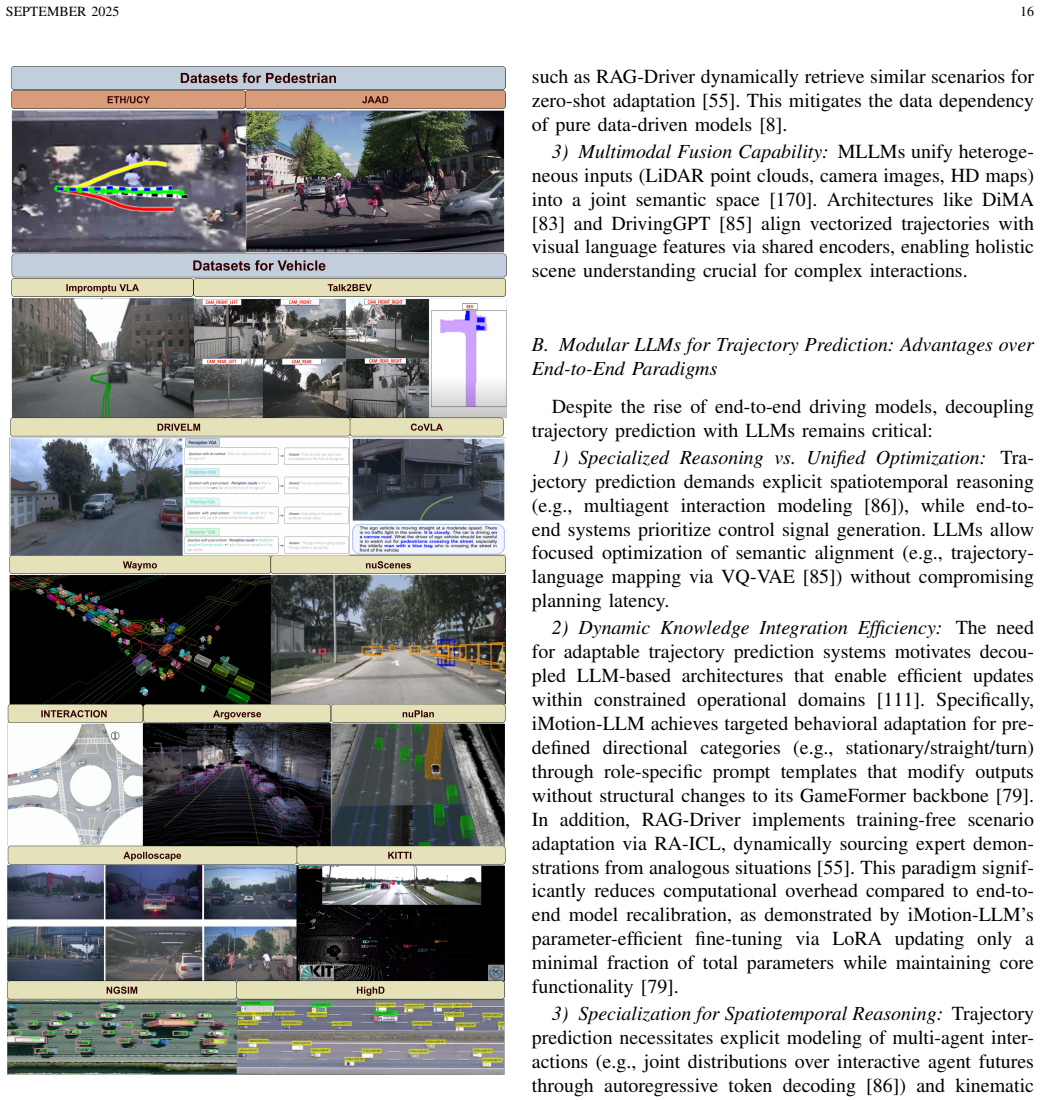
Trajectory prediction serves as a critical functionality in autonomous driving, enabling the anticipation of future motion paths for traffic participants such as vehicles and pedestrians, which is essential for driving safety. Although conventional deep learning methods have improved accuracy, they remain hindered by inherent limitations, including lack of interpretability, heavy reliance on large-scale annotated data, and weak generalization in long-tail scenarios. The rise of Large Foundation Models (LFMs) is transforming the research paradigm of trajectory prediction. This survey offers a systematic review of recent advances in LFMs, particularly Large Language Models (LLMs) and Multimodal Large Language Models (MLLMs) for trajectory prediction. By integrating linguistic and scene semantics, LFMs facilitate interpretable contextual reasoning, significantly enhancing prediction safety and generalization in complex environments. The article highlights three core methodologies: trajectory-language mapping, multimodal fusion, and constraint-based reasoning. It covers prediction tasks for both vehicles and pedestrians, evaluation metrics, and dataset analyses. Key challenges such as computational latency, data scarcity, and real-world robustness are discussed, along with future research directions including low-latency inference, causality-aware modeling, and motion foundation models.
Figures


Reference graph
Works this paper leans on
-
[1]
Multiple futures prediction,
C. Tang and R. R. Salakhutdinov, “Multiple futures prediction,”Ad- vances in neural information processing systems, vol. 32, 2019
2019
-
[2]
Online vehicle trajectory prediction using policy anticipation network and optimization-based context reasoning,
W. Ding and S. Shen, “Online vehicle trajectory prediction using policy anticipation network and optimization-based context reasoning,” in2019 International Conference on Robotics and Automation (ICRA). IEEE, 2019, pp. 9610–9616
2019
-
[3]
Trajectory prediction for autonomous driving based on multi-head attention with joint agent-map representation,
K. Messaoud, N. Deo, M. M. Trivedi, and F. Nashashibi, “Trajectory prediction for autonomous driving based on multi-head attention with joint agent-map representation,” in2021 IEEE intelligent vehicles symposium (IV). IEEE, 2021, pp. 165–170
2021
-
[4]
Trajectory prediction with linguistic representations,
Y .-L. Kuo, X. Huang, A. Barbu, S. G. McGill, B. Katz, J. J. Leonard, and G. Rosman, “Trajectory prediction with linguistic representations,” in2022 International Conference on Robotics and Automation (ICRA). IEEE, 2022, pp. 2868–2875. SEPTEMBER 2025 18 TABLE XI LIST OFABBREVIATIONS Abbreviation Full Term LFMs Large Foundation Models LLMs Large Language M...
2022
-
[5]
Grip: Graph-based interaction-aware trajectory prediction,
X. Li, X. Ying, and M. C. Chuah, “Grip: Graph-based interaction-aware trajectory prediction,” in2019 IEEE Intelligent Transportation Systems Conference (ITSC). IEEE, 2019, pp. 3960–3966
2019
-
[6]
Vehicle trajectory prediction using intention-based conditional variational autoencoder,
X. Feng, Z. Cen, J. Hu, and Y . Zhang, “Vehicle trajectory prediction using intention-based conditional variational autoencoder,” in2019 IEEE Intelligent Transportation Systems Conference (ITSC). IEEE, 2019, pp. 3514–3519
2019
-
[7]
Explainability of deep vision-based autonomous driving systems: Review and chal- lenges,
´E. Zablocki, H. Ben-Younes, P. P ´erez, and M. Cord, “Explainability of deep vision-based autonomous driving systems: Review and chal- lenges,”International Journal of Computer Vision, vol. 130, no. 10, pp. 2425–2452, 2022
2022
-
[8]
Uqnet: Quantifying uncer- tainty in trajectory prediction by a non-parametric and generalizable approach,
G. Li, Z. Li, V . Knoop, and H. van Lint, “Uqnet: Quantifying uncer- tainty in trajectory prediction by a non-parametric and generalizable approach,”Available at SSRN 4241523, 2022
2022
-
[9]
LLM4Drive: A Survey of Large Language Models for Autonomous Driving,
Z. Yang, X. Jia, H. Li, and J. Yan, “LLM4Drive: A Survey of Large Language Models for Autonomous Driving,” Aug. 2024
2024
-
[10]
Towards Large Reasoning Models: A Survey of Reinforced Reasoning with Large Language Models,
F. Xu, Q. Hao, Z. Zong, J. Wang, Y . Zhang, J. Wang, X. Lan, J. Gong, T. Ouyang, F. Meng, C. Shao, Y . Yan, Q. Yang, Y . Song, S. Ren, X. Hu, Y . Li, J. Feng, C. Gao, and Y . Li, “Towards Large Reasoning Models: A Survey of Reinforced Reasoning with Large Language Models,” Jan. 2025
2025
-
[11]
A Comprehensive Review of Multimodal Large Language Models: Performance and Challenges Across Different Tasks,
J. Wang, H. Jiang, Y . Liu, C. Ma, X. Zhang, Y . Pan, M. Liu, P. Gu, S. Xia, W. Li, Y . Zhang, Z. Wu, Z. Liu, T. Zhong, B. Ge, T. Zhang, N. Qiang, X. Hu, X. Jiang, X. Zhang, W. Zhang, D. Shen, T. Liu, and S. Zhang, “A Comprehensive Review of Multimodal Large Language Models: Performance and Challenges Across Different Tasks,” Aug. 2024
2024
-
[12]
Chain- of-Thought for Autonomous Driving: A Comprehensive Survey and Future Prospects,
Y . Cui, H. Lin, S. Yang, Y . Wang, Y . Huang, and H. Chen, “Chain- of-Thought for Autonomous Driving: A Comprehensive Survey and Future Prospects,” May 2025
2025
-
[13]
Foundation models for autonomous driving perception: A survey through core capabilities,
R. Sathyam and Y . Li, “Foundation models for autonomous driving perception: A survey through core capabilities,”IEEE Open Journal of Vehicular Technology, 2025
2025
-
[14]
A survey on trajectory-prediction methods for autonomous driving,
Y . Huang, J. Du, Z. Yang, Z. Zhou, L. Zhang, and H. Chen, “A survey on trajectory-prediction methods for autonomous driving,”IEEE Transactions on Intelligent Vehicles, vol. 7, no. 3, pp. 652–674, 2022
2022
-
[15]
Incorporating driving knowledge in deep learn- ing based vehicle trajectory prediction: A survey,
Z. Ding and H. Zhao, “Incorporating driving knowledge in deep learn- ing based vehicle trajectory prediction: A survey,”IEEE Transactions on Intelligent Vehicles, vol. 8, no. 8, pp. 3996–4015, 2023
2023
-
[16]
Pedestrian trajectory prediction in pedestrian-vehicle mixed envi- ronments: A systematic review,
M. Golchoubian, M. Ghafurian, K. Dautenhahn, and N. L. Azad, “Pedestrian trajectory prediction in pedestrian-vehicle mixed envi- ronments: A systematic review,”IEEE Transactions on Intelligent Transportation Systems, vol. 24, no. 11, pp. 11 544–11 567, 2023
2023
-
[17]
Real time trajectory prediction for collision risk estimation between vehicles,
S. Ammoun and F. Nashashibi, “Real time trajectory prediction for collision risk estimation between vehicles,” in2009 IEEE 5Th in- ternational conference on intelligent computer communication and processing. IEEE, 2009, pp. 417–422
2009
-
[18]
Cooperative path prediction in vehicular environments,
P. Lytrivis, G. Thomaidis, and A. Amditis, “Cooperative path prediction in vehicular environments,” in2008 11th international IEEE conference on intelligent transportation systems. IEEE, 2008, pp. 803–808
2008
-
[19]
Situation assessment of an autonomous emergency brake for arbitrary vehicle-to-vehicle collision scenarios,
N. Kaempchen, B. Schiele, and K. Dietmayer, “Situation assessment of an autonomous emergency brake for arbitrary vehicle-to-vehicle collision scenarios,”IEEE Transactions on Intelligent Transportation Systems, vol. 10, no. 4, pp. 678–687, 2009
2009
-
[20]
Interaction-aware motion prediction for autonomous driving: A mul- tiple model kalman filtering scheme,
V . Lefkopoulos, M. Menner, A. Domahidi, and M. N. Zeilinger, “Interaction-aware motion prediction for autonomous driving: A mul- tiple model kalman filtering scheme,”IEEE Robotics and Automation Letters, vol. 6, no. 1, pp. 80–87, 2020
2020
-
[21]
Trajectory planning and safety assessment of autonomous vehicles based on motion prediction and model predictive control,
Y . Wang, Z. Liu, Z. Zuo, Z. Li, L. Wang, and X. Luo, “Trajectory planning and safety assessment of autonomous vehicles based on motion prediction and model predictive control,”IEEE Transactions on Vehicular Technology, vol. 68, no. 9, pp. 8546–8556, 2019
2019
-
[22]
How would surround vehicles move? a unified framework for maneuver classification and motion prediction,
N. Deo, A. Rangesh, and M. M. Trivedi, “How would surround vehicles move? a unified framework for maneuver classification and motion prediction,”IEEE Transactions on Intelligent Vehicles, vol. 3, no. 2, pp. 129–140, 2018
2018
-
[23]
Online maneuver recognition and multimodal trajectory prediction for intersection assistance using non-parametric regression,
Q. Tran and J. Firl, “Online maneuver recognition and multimodal trajectory prediction for intersection assistance using non-parametric regression,” in2014 ieee intelligent vehicles symposium proceedings. IEEE, 2014, pp. 918–923
2014
-
[24]
Improved driving behaviors prediction based on fuzzy logic-hidden markov model (fl-hmm),
Q. Deng and D. S ¨offker, “Improved driving behaviors prediction based on fuzzy logic-hidden markov model (fl-hmm),” in2018 IEEE Intelligent Vehicles Symposium (IV). IEEE, 2018, pp. 2003–2008
2018
-
[25]
A self-adaptive parameter selection trajectory prediction approach via hidden markov models,
S. Qiao, D. Shen, X. Wang, N. Han, and W. Zhu, “A self-adaptive parameter selection trajectory prediction approach via hidden markov models,”IEEE Transactions on Intelligent Transportation Systems, vol. 16, no. 1, pp. 284–296, 2014
2014
-
[26]
Probabilistic intention prediction and trajectory generation based on dynamic bayesian net- works,
G. He, X. Li, Y . Lv, B. Gao, and H. Chen, “Probabilistic intention prediction and trajectory generation based on dynamic bayesian net- works,” in2019 Chinese Automation Congress (CAC). IEEE, 2019, pp. 2646–2651
2019
-
[27]
Convolutional social pooling for vehicle trajectory prediction,
N. Deo and M. M. Trivedi, “Convolutional social pooling for vehicle trajectory prediction,” inProceedings of the IEEE conference on computer vision and pattern recognition workshops, 2018, pp. 1468– 1476
2018
-
[28]
Multi-head atten- tion based probabilistic vehicle trajectory prediction,
H. Kim, D. Kim, G. Kim, J. Cho, and K. Huh, “Multi-head atten- tion based probabilistic vehicle trajectory prediction,” in2020 IEEE intelligent vehicles symposium (IV). IEEE, 2020, pp. 1720–1725
2020
-
[29]
Vectornet: Encoding hd maps and agent dynamics from vectorized representation,
J. Gao, C. Sun, H. Zhao, Y . Shen, D. Anguelov, C. Li, and C. Schmid, “Vectornet: Encoding hd maps and agent dynamics from vectorized representation,” inProceedings of the IEEE/CVF conference on com- puter vision and pattern recognition, 2020, pp. 11 525–11 533
2020
-
[30]
Deep inverse reinforcement learning for behavior prediction in autonomous driving: Accurate forecasts of vehicle motion,
T. Fernando, S. Denman, S. Sridharan, and C. Fookes, “Deep inverse reinforcement learning for behavior prediction in autonomous driving: Accurate forecasts of vehicle motion,”IEEE Signal Processing Maga- zine, vol. 38, no. 1, pp. 87–96, 2020
2020
-
[31]
Imitating driver behavior with generative adversarial networks,
A. Kuefler, J. Morton, T. Wheeler, and M. Kochenderfer, “Imitating driver behavior with generative adversarial networks,” in2017 IEEE intelligent vehicles symposium (IV). IEEE, 2017, pp. 204–211
2017
-
[32]
Open problems and fundamental limitations of reinforcement learning from human feedback,
S. Casper, X. Davies, C. Shi, T. K. Gilbert, J. Scheurer, J. Rando, R. Freedman, T. Korbak, D. Lindner, P. Freireet al., “Open problems and fundamental limitations of reinforcement learning from human feedback,”arXiv preprint arXiv:2307.15217, 2023. SEPTEMBER 2025 19
Pith/arXiv arXiv 2023
-
[33]
Learning from naturalistic driving data for human-like autonomous highway driving,
D. Xu, Z. Ding, X. He, H. Zhao, M. Moze, F. Aioun, and F. Guillemard, “Learning from naturalistic driving data for human-like autonomous highway driving,”IEEE Transactions on Intelligent Transportation Systems, vol. 22, no. 12, pp. 7341–7354, 2020
2020
-
[34]
Off-road autonomous vehicles traversability analysis and trajectory planning based on deep inverse reinforcement learning,
Z. Zhu, N. Li, R. Sun, D. Xu, and H. Zhao, “Off-road autonomous vehicles traversability analysis and trajectory planning based on deep inverse reinforcement learning,” in2020 IEEE intelligent vehicles symposium (IV). IEEE, 2020, pp. 971–977
2020
-
[35]
Social force models for pedestrian traffic–state of the art,
X. Chen, M. Treiber, V . Kanagaraj, and H. Li, “Social force models for pedestrian traffic–state of the art,”Transport reviews, vol. 38, no. 5, pp. 625–653, 2018
2018
-
[36]
Social force based microscopic modeling of vehicle-crowd interaction,
D. Yang, ¨U. ¨Ozg¨uner, and K. Redmill, “Social force based microscopic modeling of vehicle-crowd interaction,” in2018 IEEE Intelligent Vehicles Symposium (IV). IEEE, 2018, pp. 1537–1542
2018
-
[37]
Pedestrian collision risk assessment based on state estimation and motion prediction,
L. Zhang, K. Yuan, H. Chu, Y . Huang, H. Ding, J. Yuan, and H. Chen, “Pedestrian collision risk assessment based on state estimation and motion prediction,”IEEE Transactions on Vehicular Technology, vol. 71, no. 1, pp. 98–111, 2021
2021
-
[38]
A study of interference between pedestrians and vehicles in drop-off area at railway station based on celluar automata,
J. Cheng and D. Li, “A study of interference between pedestrians and vehicles in drop-off area at railway station based on celluar automata,” in2019 5th International Conference on Transportation Information and Safety (ICTIS). IEEE, 2019, pp. 913–919
2019
-
[39]
Top-view trajectories: A pedestrian dataset of vehicle-crowd interaction from controlled experiments and crowded campus,
D. Yang, L. Li, K. Redmill, and ¨U. ¨Ozg¨uner, “Top-view trajectories: A pedestrian dataset of vehicle-crowd interaction from controlled experiments and crowded campus,” in2019 IEEE Intelligent Vehicles Symposium (IV). IEEE, 2019, pp. 899–904
2019
-
[40]
Agent- based modeling for predicting pedestrian trajectories around an au- tonomous vehicle,
M. Pr ´edhumeau, L. Mancheva, J. Dugdale, and A. Spalanzani, “Agent- based modeling for predicting pedestrian trajectories around an au- tonomous vehicle,”Journal of Artificial Intelligence Research, vol. 73, pp. 1385–1433, 2022
2022
-
[41]
Multi-agent trajectory prediction with spatio- temporal sequence fusion,
Y . Wang and S. Chen, “Multi-agent trajectory prediction with spatio- temporal sequence fusion,”IEEE Transactions on Multimedia, vol. 25, pp. 13–23, 2021
2021
-
[42]
Ltn: Long-term network for long-term motion prediction,
Y . Wang, “Ltn: Long-term network for long-term motion prediction,” in 2021 IEEE International Intelligent Transportation Systems Conference (ITSC). IEEE, 2021, pp. 1845–1852
2021
-
[43]
Dynamic attention- based cvae-gan for pedestrian trajectory prediction,
Z. Zhou, G. Huang, Z. Su, Y . Li, and W. Hua, “Dynamic attention- based cvae-gan for pedestrian trajectory prediction,”IEEE Robotics and Automation Letters, vol. 8, no. 2, pp. 704–711, 2022
2022
-
[44]
Interactive behavior prediction for heterogeneous traffic participants in the urban road: A graph-neural- network-based multitask learning framework,
Z. Li, J. Gong, C. Lu, and Y . Yi, “Interactive behavior prediction for heterogeneous traffic participants in the urban road: A graph-neural- network-based multitask learning framework,”IEEE/ASME Transac- tions on Mechatronics, vol. 26, no. 3, pp. 1339–1349, 2021
2021
-
[45]
A hierarchical framework for interactive behaviour prediction of heterogeneous traffic participants based on graph neural network,
Z. Li, C. Lu, Y . Yi, and J. Gong, “A hierarchical framework for interactive behaviour prediction of heterogeneous traffic participants based on graph neural network,”IEEE Transactions on Intelligent Transportation Systems, vol. 23, no. 7, pp. 9102–9114, 2021
2021
-
[46]
Trajectory forecasting based on prior-aware directed graph convolutional neural network,
Y . Su, J. Du, Y . Li, X. Li, R. Liang, Z. Hua, and J. Zhou, “Trajectory forecasting based on prior-aware directed graph convolutional neural network,”IEEE Transactions on Intelligent Transportation Systems, vol. 23, no. 9, pp. 16 773–16 785, 2022
2022
-
[47]
Loki: Long term and key intentions for trajectory prediction,
H. Girase, H. Gang, S. Malla, J. Li, A. Kanehara, K. Mangalam, and C. Choi, “Loki: Long term and key intentions for trajectory prediction,” inProceedings of the IEEE/CVF International Conference on Computer Vision, 2021, pp. 9803–9812
2021
-
[48]
Trajectory modelling in shared spaces: Expert-based vs. deep learning approach?
H. Cheng, F. T. Johora, M. Sester, and J. P. M ¨uller, “Trajectory modelling in shared spaces: Expert-based vs. deep learning approach?” inInternational Workshop on Multi-Agent Systems and Agent-Based Simulation. Springer, 2020, pp. 13–27
2020
-
[49]
Social gan: Socially acceptable trajectories with generative adversarial networks,
A. Gupta, J. Johnson, L. Fei-Fei, S. Savarese, and A. Alahi, “Social gan: Socially acceptable trajectories with generative adversarial networks,” inProceedings of the IEEE conference on computer vision and pattern recognition, 2018, pp. 2255–2264
2018
-
[50]
An agent-based model for trajectory modelling in shared spaces: A combination of expert-based and deep learning approaches,
F. T. Johora, H. Cheng, J. P. M ¨uller, and M. Sester, “An agent-based model for trajectory modelling in shared spaces: A combination of expert-based and deep learning approaches,” inProceedings of the 19th International Conference on Autonomous Agents and MultiAgent Systems, 2020, pp. 1878–1880
2020
-
[51]
Spatio-temporal graph dual-attention network for multi-agent prediction and tracking,
J. Li, H. Ma, Z. Zhang, J. Li, and M. Tomizuka, “Spatio-temporal graph dual-attention network for multi-agent prediction and tracking,”IEEE Transactions on Intelligent Transportation Systems, vol. 23, no. 8, pp. 10 556–10 569, 2021
2021
-
[52]
Vlm-ad: End-to-end autonomous driving through vision-language model supervision,
Y . Xu, Y . Hu, Z. Zhang, G. P. Meyer, S. K. Mustikovela, S. Srini- vasa, E. M. Wolff, and X. Huang, “Vlm-ad: End-to-end autonomous driving through vision-language model supervision,”arXiv preprint arXiv:2412.14446, 2024
Pith/arXiv arXiv 2024
-
[53]
Drivevlm: The convergence of au- tonomous driving and large vision-language models,
X. Tian, J. Gu, B. Li, Y . Liu, Y . Wang, Z. Zhao, K. Zhan, P. Jia, X. Lang, and H. Zhao, “Drivevlm: The convergence of au- tonomous driving and large vision-language models,”arXiv preprint arXiv:2402.12289, 2024
Pith/arXiv arXiv 2024
-
[54]
Driving with llms: Fusing object- level vector modality for explainable autonomous driving,
L. Chen, O. Sinavski, J. H ¨unermann, A. Karnsund, A. J. Willmott, D. Birch, D. Maund, and J. Shotton, “Driving with llms: Fusing object- level vector modality for explainable autonomous driving,” in2024 IEEE International Conference on Robotics and Automation (ICRA). IEEE, 2024, pp. 14 093–14 100
2024
-
[55]
Rag-driver: Generalisable driving explanations with retrieval-augmented in-context multi-modal large language model learning,
J. Yuan, S. Sun, D. Omeiza, B. Zhao, P. Newman, L. Kunze, and M. Gadd, “Rag-driver: Generalisable driving explanations with retrieval-augmented in-context multi-modal large language model learning,” inRobotics: Science and Systems, 2024
2024
-
[56]
A survey of autonomous driving: Common practices and emerging technologies,
E. Yurtsever, J. Lambert, A. Carballo, and K. Takeda, “A survey of autonomous driving: Common practices and emerging technologies,” IEEE access, vol. 8, pp. 58 443–58 469, 2020
2020
-
[57]
Drivelm: Driving with graph visual question answering,
C. Sima, K. Renz, K. Chitta, L. Chen, H. Zhang, C. Xie, J. Beißwenger, P. Luo, A. Geiger, and H. Li, “Drivelm: Driving with graph visual question answering,” inEuropean Conference on Computer Vision. Springer, 2024, pp. 256–274
2024
-
[58]
A language-driven navigation strategy integrating semantic maps and large language models,
Z. Zhong, Y . He, P. Li, F. Yu, and F. Ma, “A language-driven navigation strategy integrating semantic maps and large language models,” in2024 IEEE/RSJ International Conference on Intelligent Robots and Systems (IROS). IEEE, 2024, pp. 9753–9760
2024
-
[59]
Learning transferable visual models from natural language supervision,
A. Radford, J. W. Kim, C. Hallacy, A. Ramesh, G. Goh, S. Agarwal, G. Sastry, A. Askell, P. Mishkin, J. Clarket al., “Learning transferable visual models from natural language supervision,” inInternational conference on machine learning. PmLR, 2021, pp. 8748–8763
2021
-
[60]
Improved baselines with visual instruction tuning,
H. Liu, C. Li, Y . Li, and Y . J. Lee, “Improved baselines with visual instruction tuning,” inProceedings of the IEEE/CVF Conference on Computer Vision and Pattern Recognition, 2024, pp. 26 296–26 306
2024
-
[61]
Drivegpt4: Interpretable end-to-end autonomous driving via large language model,
Z. Xu, Y . Zhang, E. Xie, Z. Zhao, Y . Guo, K.-Y . K. Wong, Z. Li, and H. Zhao, “Drivegpt4: Interpretable end-to-end autonomous driving via large language model,”IEEE Robotics and Automation Letters, 2024
2024
-
[62]
Hilm-d: Enhancing mllms with multi-scale high-resolution details for autonomous driving,
X. Ding, J. Han, H. Xu, W. Zhang, and X. Li, “Hilm-d: Enhancing mllms with multi-scale high-resolution details for autonomous driving,” International Journal of Computer Vision, pp. 1–17, 2025
2025
-
[63]
Talk2bev: Language-enhanced bird’s-eye view maps for autonomous driving,
T. Choudhary, V . Dewangan, S. Chandhok, S. Priyadarshan, A. Jain, A. K. Singh, S. Srivastava, K. M. Jatavallabhula, and K. M. Krishna, “Talk2bev: Language-enhanced bird’s-eye view maps for autonomous driving,” in2024 IEEE International Conference on Robotics and Automation (ICRA). IEEE, 2024, pp. 16 345–16 352
2024
-
[64]
Da yu: Towards usv-based image captioning for waterway surveillance and scene understanding,
R. Guan, N. Ouyang, T. Xu, S. Liang, W. Dai, Y . Sun, S. Gao, S. Lai, S. Yao, X. Huet al., “Da yu: Towards usv-based image captioning for waterway surveillance and scene understanding,”arXiv preprint arXiv:2506.19288, 2025
Pith/arXiv arXiv 2025
-
[65]
Dynstatf: An efficient feature fusion strategy for lidar 3d object detection,
Y . Rong, X. Wei, T. Lin, Y . Wang, and E. Kasneci, “Dynstatf: An efficient feature fusion strategy for lidar 3d object detection,” in Proceedings of the IEEE/CVF Conference on Computer Vision and Pattern Recognition, 2023, pp. 3238–3247
2023
-
[66]
V2x-vit: Vehicle-to-everything cooperative perception with vision transformer,
R. Xu, H. Xiang, Z. Tu, X. Xia, M.-H. Yang, and J. Ma, “V2x-vit: Vehicle-to-everything cooperative perception with vision transformer,” inEuropean conference on computer vision. Springer, 2022, pp. 107– 124
2022
-
[67]
V2v-llm: Vehicle-to-vehicle cooperative autonomous driving with multi-modal large language models,
H.-k. Chiu, R. Hachiuma, C.-Y . Wang, S. F. Smith, Y .-C. F. Wang, and M.-H. Chen, “V2v-llm: Vehicle-to-vehicle cooperative autonomous driving with multi-modal large language models,”arXiv preprint arXiv:2502.09980, 2025
arXiv 2025
-
[68]
Lmdrive: Closed-loop end-to-end driving with large language models,
H. Shao, Y . Hu, L. Wang, G. Song, S. L. Waslander, Y . Liu, and H. Li, “Lmdrive: Closed-loop end-to-end driving with large language models,” inProceedings of the IEEE/CVF Conference on Computer Vision and Pattern Recognition, 2024, pp. 15 120–15 130
2024
-
[69]
Gaia-1: A generative world model for autonomous driving,
A. Hu, L. Russell, H. Yeo, Z. Murez, G. Fedoseev, A. Kendall, J. Shotton, and G. Corrado, “Gaia-1: A generative world model for autonomous driving,”arXiv preprint arXiv:2309.17080, 2023
Pith/arXiv arXiv 2023
-
[70]
Visiontrap: Vision-augmented trajectory prediction guided by textual descriptions,
S. Moon, H. Woo, H. Park, H. Jung, R. Mahjourian, H.-g. Chi, H. Lim, S. Kim, and J. Kim, “Visiontrap: Vision-augmented trajectory prediction guided by textual descriptions,” inEuropean Conference on Computer Vision. Springer, 2024, pp. 361–379
2024
-
[71]
Drivedreamer-2: Llm-enhanced world models for diverse driving video generation,
G. Zhao, X. Wang, Z. Zhu, X. Chen, G. Huang, X. Bao, and X. Wang, “Drivedreamer-2: Llm-enhanced world models for diverse driving video generation,” inProceedings of the AAAI Conference on Artificial Intelligence, vol. 39, no. 10, 2025, pp. 10 412–10 420
2025
-
[72]
W. Wang, J. Xie, C. Hu, H. Zou, J. Fan, W. Tong, Y . Wen, S. Wu, H. Deng, Z. Liet al., “Drivemlm: Aligning multi-modal large language models with behavioral planning states for autonomous driving,”arXiv preprint arXiv:2312.09245, 2023. SEPTEMBER 2025 20
arXiv 2023
-
[73]
Multimodal trajectory prediction for intelligent connected vehicles in complex road scenar- ios based on causal reasoning and driving cognition characteristics,
Z. Yang, J. Yang, Y . Zhou, Q. Xu, and M. Ou, “Multimodal trajectory prediction for intelligent connected vehicles in complex road scenar- ios based on causal reasoning and driving cognition characteristics,” Scientific Reports, vol. 15, no. 1, p. 7259, 2025
2025
-
[74]
Dualdiff+: Dual-branch diffusion for high-fidelity video generation with reward guidance,
Z. Yang, Z. Qian, X. Li, W. Xu, G. Zhao, R. Yu, L. Zhu, and L. Liu, “Dualdiff+: Dual-branch diffusion for high-fidelity video generation with reward guidance,”arXiv preprint arXiv:2503.03689, 2025
Pith/arXiv arXiv 2025
-
[75]
Lingo-1: Exploring natural language for autonomous driving,
W. AI, “Lingo-1: Exploring natural language for autonomous driving,” https://wayve.ai/thinking/lingo-natural-language-autonomous-driving/, 2023, accessed: 2025-08-14
2023
-
[76]
A. Keysan, A. Look, E. Kosman, G. G ¨ursun, J. Wagner, Y . Yao, and B. Rakitsch, “Can you text what is happening? integrating pre-trained language encoders into trajectory prediction models for autonomous driving,”arXiv preprint arXiv:2309.05282, 2023
Pith/arXiv arXiv 2023
-
[77]
How can large language models understand spatial-temporal data?
L. Liu, S. Yu, R. Wang, Z. Ma, and Y . Shen, “How can large language models understand spatial-temporal data?”arXiv preprint arXiv:2401.14192, 2024
Pith/arXiv arXiv 2024
-
[78]
S4-driver: Scalable self-supervised driving multimodal large language model with spatio-temporal visual representation,
Y . Xie, R. Xu, T. He, J.-J. Hwang, K. Luo, J. Ji, H. Lin, L. Chen, Y . Lu, Z. Lenget al., “S4-driver: Scalable self-supervised driving multimodal large language model with spatio-temporal visual representation,” in Proceedings of the Computer Vision and Pattern Recognition Confer- ence, 2025, pp. 1622–1632
2025
-
[79]
imotion-llm: Motion prediction instruction tuning,
A. Felemban, E. M. Bakr, X. Shen, J. Ding, A. Mohamed, and M. Elhoseiny, “imotion-llm: Motion prediction instruction tuning,” arXiv preprint arXiv:2406.06211, 2024
arXiv 2024
-
[80]
Lc-llm: Explainable lane-change intention and trajectory predictions with large language models,
M. Peng, X. Guo, X. Chen, K. Chen, M. Zhu, L. Chen, and F.-Y . Wang, “Lc-llm: Explainable lane-change intention and trajectory predictions with large language models,”Communications in Transportation Re- search, vol. 5, p. 100170, 2025
2025
This paper was first reviewed by deepseek-v4-flash on August 4, 2026.
discussion (0)
Sign in with ORCID, Apple, or X to comment. Anyone can read and Pith papers without signing in.