REVIEW 3 major objections 6 minor 113 references
Warm exo-Titans orbiting M-dwarf stars should be rare in JWST data because their methane is destroyed in a few hundred thousand years, at least 50 times faster than on Titan.
Reviewed by Pith at T0; open to challenge. T0 means a machine referee read the full paper against a public rubric. the ladder, T0–T4 →
T0 review · deepseek-v4-flash
2026-08-04 17:44 UTC pith:LJDTEZXA
load-bearing objection The robust lifetime result—100x faster CH4 destruction on warm exo-Titans, driven by M-dwarf UV—deserves serious engagement; the absolute detection probability is a softer extrapolation that should not be taken as a direct model output. the 3 major comments →
The Photochemical Plausibility of Warm Exo-Titans Orbiting M-Dwarf Stars
The pith
A machine-rendered reading of the paper's core claim, the machinery that carries it, and where it could break.
Core claim
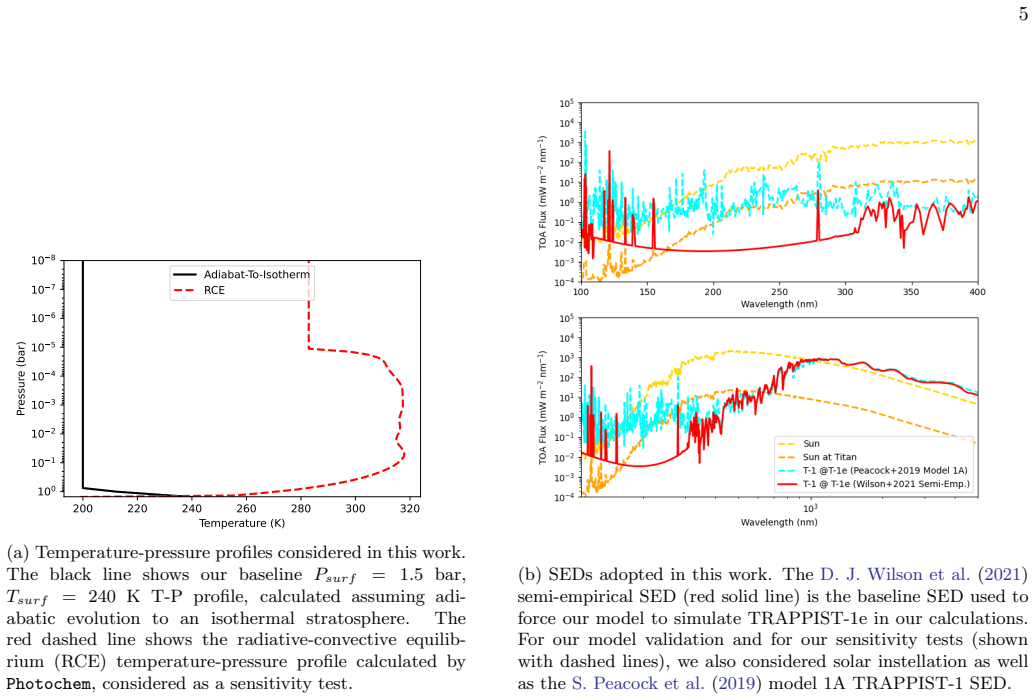
The central claim is that photochemistry makes warm exo-Titans far less plausible than true Titan. For a Titan-like methane partial pressure of 0.03 bar, the methane lifetime on a warm exo-Titan TRAPPIST-1e is 200,000 years, compared to 20 million years on Titan. Across the range of methane pressures considered, the lifetime is at most 0.02 times Titan's, and even under very generous assumptions about methane inventory it stays below 0.1 times Titan's. The shortened lifetime is driven almost entirely by the higher ultraviolet instellation from the M-dwarf host, not by planet size, temperature structure, or haze formation. The authors conclude that the absolute detection probability is below
What carries the argument
The central tool is a one-dimensional photochemical model of a Titan-like N2-CH4 atmosphere, run to steady state for TRAPPIST-1e, that tracks the column-integrated methane loss rate. The controlling identity is the methane lifetime tau = column abundance / loss rate, and the key finding is that the loss rate rises sublinearly with methane surface pressure because ultraviolet photolysis saturates. Organic haze formation is included but does not rescue the lifetime; the model also resolves the nonlinearity that simpler analytic scalings miss.
Load-bearing premise
The absolute detection probability assumes that the chance of catching a warm exo-Titan scales linearly with its methane lifetime and that Titan's methane-rich phase fraction of about 70% is a fair prior; if larger water worlds outgas methane continuously or if high methane pressures stabilize the atmosphere, the low-probability conclusion would not follow.
What would settle it
A robust JWST detection of multiple methane bands on TRAPPIST-1e or another warm super-Earth, confirmed against stellar contamination and independent data-processing pipelines, would falsify the paper's central claim that warm exo-Titans are a priori unlikely.
If this is right
- If correct, any claim of a warm exo-Titan detection from JWST spectra must clear a high bar: robustness to detrending, stellar contamination, multiple methane bands, and independent reduction pipelines.
- The model explains why recent JWST observations have not found methane-dominated atmospheres on warm terrestrial exoplanets.
- Warm exo-Titans should show oxidized carbon species (CO, CO2) alongside methane; their absence would weaken an exo-Titan interpretation.
- Simpler estimates of methane lifetime based on EUV flux scaling or diffusion-limited hydrogen escape misestimate the lifetime by 1-2 orders of magnitude, so full photochemical modeling is needed.
- Methane-rich planets around M-dwarfs are generally photochemically unlikely, so the prior for their detection is low.
Where Pith is reading between the lines
- The paper's lifetime ratio applies to the modeled methane pressures up to 0.15 bar; thicker methane atmospheres (above 0.1-1 bar) remain unmodelled and could behave differently if antigreenhouse cooling stabilizes them.
- If methane is outgassed continuously rather than in a recent catastrophic event, a warm exo-Titan could be caught in a low-methane phase that is even harder to detect, so future searches might target systems with evidence of active outgassing.
- The same photochemical reasoning could be applied to other small planets around M-dwarfs as a quantitative prior in Bayesian retrievals of any methane-rich atmosphere.
- The prediction of oxidized carbon as a corroborating signature is testable: a genuine warm exo-Titan should show both methane and CO/CO2, whereas a stellar-contamination false positive would show only methane-like features.
Editorial analysis
A structured set of objections, weighed in public.
Referee Report
Summary. The paper uses the 1D Photochem model to compute CH4 photochemical lifetimes in N2-CH4 'warm exo-Titan' atmospheres, using TRAPPIST-1e as a case study. For a Titan-like pCH4 of 0.03 bar, the model gives tau_CH4 = 2e5 yr, compared with 2e7 yr for true Titan; sensitivity tests keep this within roughly 3e4-2e5 yr, with the stellar SED as the main control. From the lifetime ratio and Titan's own estimated CH4-rich duty cycle (0.7, from Tobie et al. 2006), the authors infer that the absolute probability of detecting a warm exo-Titan is <0.1 and likely <0.01. They then argue for a high standard of proof for JWST CH4 claims and propose oxidized carbon species as corroborating evidence.
Significance. If the headline probability claim holds, the paper provides a quantitative prior for Bayesian interpretation of JWST transmission spectra of small M-dwarf planets, directly addressing current ambiguity in the TRAPPIST-1e spectrum. The central photochemical result is well supported: the model is validated against Titan, the convergence checks are careful, the sensitivity table is informative, and the code is publicly archived. The finding that tau_CH4 on a warm M-dwarf exo-Titan is orders of magnitude shorter than on Titan is robust and generalizes across representative M-dwarf SEDs. However, the conversion of that lifetime ratio into an absolute detection probability rests on strong interpretive assumptions that the paper acknowledges but does not fully incorporate into its headline claims; this is the main load-bearing weakness.
major comments (3)
- [§4.2 and Abstract] The conversion of the lifetime ratio into an absolute detection probability assumes that detection probability is proportional to tau_CH4 and that CH4-rich atmospheres arise only during a transient post-outgassing duty cycle, normalized by Titan's 0.7 CH4-rich phase fraction. The paper itself presents the Levi et al. (2014) continuous-outgassing channel, under which pCH4 is set by the balance between outgassing and photochemical loss, so detectability is controlled by interior outgassing duration rather than by tau_CH4. The abstract and conclusions state the absolute probability (<0.1, likely <0.01) without this scenario caveat, so the headline is not a consequence of the photochemical model alone. Please either formalize a Bayesian prior over outgassing scenarios or rephrase the probability as conditional on the catastrophic-release scenario.
- [§3.1, §4.2, Appendix A] The headline probability claim does not carry the paper's own pCH4 domain restriction. The model is run only for pCH4 <= 0.15 bar, and §4.2 states the finding is restricted to pCH4 <= 0.1 bar, because for pCH4 > 0.1-1 bar climate models predict a positive feedback with hot, thick CH4 atmospheres. The paper excludes this regime as outside its validated framework. The thermochemical Keq calculation in Appendix A is not a coupled climate-photochemistry model, and the text agrees such modeling is required. Thus 'likely <0.01' is a statement about one branch of parameter space; if high-pCH4 atmospheres are stable, the probability could be much larger. The abstract should be rephrased to make this condition explicit, or the high-pCH4 regime should be modeled.
- [§4.2 / §5] The paper moves fluidly between 'tau ratio' and 'absolute probability of detection,' but the latter additionally requires assuming that Titan's Tobie et al. (2006) duty cycle applies to warm exo-Titans and that CH4 inventory scaling with planet size is the only relevant correction. The text does apply a 7x inventory correction to get the <0.1 bound, but this is an illustrative scaling, not a model of interior outgassing history on a more massive waterworld. The limitations paragraph in §4.4 concedes this. Because the abstract presents the absolute probability as a headline result, the manuscript needs either a formal derivation of the probability from stated priors or a clear statement that this is an upper-limit heuristic for one outgassing scenario.
minor comments (6)
- [§4.1 vs §4.2] The baseline ratio is given as <=1e-2 in §4.1 (2e5/2e7) but <=2e-2 in §4.2 and 'most likely <=0.02' in the abstract. Please reconcile these numbers or explain the provenance of 0.02.
- [§4.2] The multiplication 0.02 x 0.7 = 0.014, not <=0.01 as stated. If the authors are rounding/truncating, say so explicitly.
- [§3.1 vs §4.2] The pCH4 threshold is inconsistent: Methods says pCH4 > 0.15 bar is excluded, while §4.2 says the finding is restricted to pCH4 <= 0.1 bar. Please harmonize the stated domain.
- [Table 1] The footnotes give deposition velocities as 'cm^-2 s^-1'; the correct unit for a velocity is cm s^-1. This appears in both footnotes a and b.
- [Eq. (5)] In the lower-bound chain, the '>' sign after dropping positive terms should be '>=' (or use 'approximately' if that was intended).
- [Figure 3 and §4.3] The notation CO_X is used loosely; in Figure 3 the text refers to CO and CO2 separately. Define CO_X at first use and keep notation consistent.
Circularity Check
No circularity: the photochemical lifetimes are model outputs validated against external Titan constraints, and the absolute-probability conversion is an explicitly stated interpretive prior, not a reduction of the derivation to its inputs.
full rationale
The central claim is derived, not assumed. In Section 3.1, tau_CH4 is defined as N_CH4 / L_CH4 and computed by the Photochem model under explicit boundary conditions (fixed pN2=1.5 bar, pCH4 range 3e-7 to 0.15 bar, fixed pH2O, diffusion-limited H/H2 escape, specified deposition velocities). No exo-Titan observable or target probability is inserted as an input. The model's Titan validation (Wogan et al. 2023) is independent support: it is code-reproduced, targets Titan rather than the warm exo-Titan result, and the resulting 2e7 yr is bracketed by the external Titan lifetime estimates of Yung et al. 1984, Wilson & Atreya 2004, Atreya et al. 2006, and Nixon et al. 2018. The self-citation of Photochem and MEAC is therefore not load-bearing; the MEAC comparison is even explicitly downweighted in the text ('This does not constitute strong independent confirmation'). The lifetime-ratio result is robust because the paper shows the SED is the controlling factor: forcing the same baseline with the solar spectrum at 9.5 AU yields tau_CH4 = 5e6 yr, within a factor of 4 of true Titan, and the exo-Titan value is orders of magnitude shorter across the pCH4 range. The conversion of that lifetime ratio into an absolute detection probability in Section 4.2 is an 'all else being equal' scaling combined with Titan's 0.7 CH4-rich phase fraction from Tobie et al. (2006). This is an interpretive prior, not a photochemical output, and the paper itself flags the assumptions: it calls the probabilities upper limits and explicitly discusses the Levi et al. (2014) continuous-outgassing alternative and the excluded pCH4 > 0.15 bar regime. These are acknowledged modeling assumptions and limitations, not circular reductions. No fitted parameter is renamed as a prediction, and no load-bearing argument reduces to a self-citation chain.
Axiom & Free-Parameter Ledger
free parameters (8)
- p_CH4 baseline =
0.03 bar
- surface/stratosphere temperature =
240 K surface / 200 K stratosphere
- eddy diffusion coefficient KZZ =
1e6 cm2/s
- haze particle radius =
1 µm
- deposition velocities =
CO/O2: 1e-9; CO2: 1e-7; haze species: 1e-5 cm/s
- p_N2 =
1.5 bar
- Titan CH4-rich phase fraction =
0.7
- exo-Titan CH4 inventory enhancement =
up to 7x
axioms (7)
- domain assumption Photochem's neutral HCNO chemistry with haze formation accurately models CH4 loss on Titan-like atmospheres.
- domain assumption CH4 lifetime is controlled by neutral photochemistry, so neglect of ion chemistry is acceptable.
- domain assumption Detection probability of a CH4-rich atmosphere scales linearly with the CH4 lifetime (all else equal).
- domain assumption Titan's current CH4-rich atmosphere is a transient outgassing phase occupying ~70% of its history.
- domain assumption TRAPPIST-1's UV SED is adequately represented by the Wilson et al. 2021 semi-empirical spectrum.
- domain assumption Closed-box boundary conditions with diffusion-limited H/H2 escape and prescribed deposition velocities capture the main CH4 loss channels.
- domain assumption Results at pCH4 <= 0.15 bar generalize to warm exo-Titans as a class because FUV flux, not planet properties, controls tau.
read the original abstract
The James Webb Space Telescope (JWST) has begun to spectrally characterize small exoplanets orbiting M-dwarf stars, but interpretation of these spectra is ambiguous, with stellar, instrumental, or atmospheric origins possible for apparent spectral features. Consequently, interpretation of JWST small exoplanet spectra follows a Bayesian approach, with less theoretically plausible interpretations facing a higher burden of proof. Here, we use photochemical modeling to evaluate the plausibility of warm exo-Titans, exoplanets with N$_2$-CH$_4$ atmospheres analogous to Titan but orbiting closer to their host stars. Consideration of warm exo-Titans is motivated by arguments from planet formation, as well as tentative evidence from observations. Using TRAPPIST-1e as a case study, we show that the higher instellation experienced by warm exo-Titans reduces their CH$_4$ lifetime $\tau_{\text{CH}_{4}}$ relative to true Titan by orders of magnitude, reducing the probability of observing them. We constrain the $\tau_{\text{CH}_{4}}$ on a warm exo-Titan to be $\leq0.1\times$ (and most likely $\leq0.02\times$) true Titan, implying the absolute probability of detecting a warm exo-Titan is $<0.1$ and likely $<0.01$. This finding is consistent with recent JWST nondetections of CH$_4$-dominated atmospheres on warm terrestrial exoplanets. The low prior probability means that the standard of proof required to claim a warm exo-Titan detection is high, and we offer specific suggestions towards such a standard of proof. Observation of oxidized carbon species would corroborate a putative warm exo-Titan detection. Confirmed detection of warm exo-Titans would signal the need to fundamentally rethink our understanding of the structure, dynamics, and photochemistry of Titan-like worlds.
Figures


Reference graph
Works this paper leans on
-
[1]
Adams, D., Luo, Y., & Yung, Y. L. 2022, Frontiers in Astronomy and Space Sciences, 9, 823227, doi: 10.3389/fspas.2022.823227
arXiv 2022
-
[2]
2021, ApJ, 914, 84, doi: 10.3847/1538-4357/abfa99
Aguichine, A., Mousis, O., Deleuil, M., & Marcq, E. 2021, ApJ, 914, 84, doi: 10.3847/1538-4357/abfa99
-
[3]
Arney, G., Domagal-Goldman, S. D., Meadows, V. S., et al. 2016, Astrobiology, 16, 873, doi: 10.1089/ast.2015.1422
arXiv 2016
-
[4]
Atreya, S. K., Adams, E. Y., Niemann, H. B., et al. 2006, Planet. Space Sci., 54, 1177, doi: 10.1016/j.pss.2006.05.028
-
[5]
M., & Kockart, G
Banks, P. M., & Kockart, G. 1973, Aeronomy (Part B) (New York, NY: Academic Press)
1973
-
[6]
Barber, R. J., Strange, J. K., Hill, C., et al. 2014, MNRAS, 437, 1828, doi: 10.1093/mnras/stt2011
-
[7]
E., Mandell, A., Pontoppidan, K., et al
Batalha, N. E., Mandell, A., Pontoppidan, K., et al. 2017, Publications of the Astronomical Society of the Pacific, 129, 64501, doi: 10.1088/1538-3873/aa65b0
-
[8]
M., Hunter Waite, J., Westlake, J
Bell, J. M., Hunter Waite, J., Westlake, J. H., et al. 2014, Journal of Geophysical Research (Space Physics), 119, 4957, doi: 10.1002/2014JA019781
-
[9]
1989, ApJ, 336, 495, doi: 10.1086/167027
Borysow, A., Frommhold, L., & Moraldi, M. 1989, ApJ, 336, 495, doi: 10.1086/167027
doi:10.1086/167027 1989
-
[10]
1988, ApJ, 326, 509, doi: 10.1086/166112
Borysow, J., Frommhold, L., & Birnbaum, G. 1988, ApJ, 326, 509, doi: 10.1086/166112
doi:10.1086/166112 1988
-
[11]
2005,, Tech
Burcat, A., & Ruscic, B. 2005,, Tech. rep., Argonne National Lab.(ANL), Argonne, IL (United States)
2005
-
[12]
Cadieux, C., Doyon, R., MacDonald, R. J., et al. 2024, ApJL, 970, L2, doi: 10.3847/2041-8213/ad5afa
-
[13]
C., & Kasting, J
Catling, D. C., & Kasting, J. F. 2017, Atmospheric evolution on inhabited and lifeless worlds (Cambridge University Press)
2017
-
[14]
C., Krissansen-Totton, J., Kiang, N
Catling, D. C., Krissansen-Totton, J., Kiang, N. Y., et al. 2018, Astrobiology, 18, 709, doi: 10.1089/ast.2017.1737
arXiv 2018
-
[15]
Chakrabarty, A., & Mulders, G. D. 2024, ApJ, 966, 185, doi: 10.3847/1538-4357/ad3802 14
-
[16]
Chatterjee, R. D., & Pierrehumbert, R. T. 2024, arXiv e-prints, arXiv:2412.05188, doi: 10.48550/arXiv.2412.05188
-
[17]
L., Tennyson, J., & Yurchenko, S
Chubb, K. L., Tennyson, J., & Yurchenko, S. N. 2020, MNRAS, 493, 1531, doi: 10.1093/mnras/staa229
-
[18]
Coles, P. A., Yurchenko, S. N., & Tennyson, J. 2019, MNRAS, 490, 4638, doi: 10.1093/mnras/stz2778
-
[19]
Dalgarno, A., & Williams, D. A. 1962, ApJ, 136, 690, doi: 10.1086/147428
doi:10.1086/147428 1962
-
[20]
2024, ApJL, 968, L22, doi: 10.3847/2041-8213/ad5204
Damiano, M., Bello-Arufe, A., Yang, J., & Hu, R. 2024, ApJL, 968, L22, doi: 10.3847/2041-8213/ad5204
-
[21]
Espinoza, N., Allen, N. H., Glidden, A., et al. 2025, The Astrophysical Journal Letters, 990, L52, doi: 10.3847/2041-8213/adf42e
-
[22]
Gibson, N. P., Pont, F., & Aigrain, S. 2011, MNRAS, 411, 2199, doi: 10.1111/j.1365-2966.2010.17837.x
arXiv 2011
-
[23]
2025, The Astrophysical Journal Letters, 990, L53, doi: 10.3847/2041-8213/adf62e
Glidden, A., Ranjan, S., Seager, S., et al. 2025, The Astrophysical Journal Letters, 990, L53, doi: 10.3847/2041-8213/adf62e
-
[24]
Gordon, I. E., Rothman, L. S., Hill, C., et al. 2017, JQSRT, 203, 3, doi: 10.1016/j.jqsrt.2017.06.038
-
[25]
Gressier, A., Espinoza, N., Allen, N. H., et al. 2024, ApJL, 975, L10, doi: 10.3847/2041-8213/ad73d1
-
[26]
Harman, C. E., Schwieterman, E. W., Schottelkotte, J. C., & Kasting, J. F. 2015, Astrophysical Journal, 812, 137, doi: 10.1088/0004-637X/812/2/137
-
[27]
2015, ApJL, 805, L11, doi: 10.1088/2041-8205/805/2/L11 H¨ orst, S
Helled, R., Podolak, M., & Vos, E. 2015, ApJL, 805, L11, doi: 10.1088/2041-8205/805/2/L11 H¨ orst, S. M., Vuitton, V., & Yelle, R. V. 2008, Journal of Geophysical Research (Planets), 113, E10006, doi: 10.1029/2008JE003135
-
[28]
2012, Astrophysical Journal, 761, 166, doi: 10.1088/0004-637X/761/2/166
Hu, R., Seager, S., & Bains, W. 2012, Astrophysical Journal, 761, 166, doi: 10.1088/0004-637X/761/2/166
-
[29]
2024, Nature, 630, 609, doi: 10.1038/s41586-024-07432-x
Hu, R., Bello-Arufe, A., Zhang, M., et al. 2024, Nature, 630, 609, doi: 10.1038/s41586-024-07432-x
-
[30]
2020, SSRv, 216, 7, doi: 10.1007/s11214-019-0633-7
Journaux, B., Kalousov´ a, K., Sotin, C., et al. 2020, SSRv, 216, 7, doi: 10.1007/s11214-019-0633-7
-
[31]
Kasting, J. F. 1988, Icarus, 74, 472, doi: 10.1016/0019-1035(88)90116-9
-
[32]
Kasting, J. F. 1990, Origins of Life and Evolution of the Biosphere, 20, 199, doi: 10.1007/BF01808105
-
[33]
Kite, E. S., Manga, M., & Gaidos, E. 2009, ApJ, 700, 1732, doi: 10.1088/0004-637X/700/2/1732
-
[34]
Koll, D. D. B. 2022, ApJ, 924, 134, doi: 10.3847/1538-4357/ac3b48
-
[35]
Koll, D. D. B., Malik, M., Mansfield, M., et al. 2019, ApJ, 886, 140, doi: 10.3847/1538-4357/ab4c91
-
[36]
Dhaliwal, J. K., & Fortney, J. J. 2021, ApJ, 913, 107, doi: 10.3847/1538-4357/abf560
-
[37]
2023, ApJ, 944, 209, doi: 10.3847/1538-4357/acb49a
Levi, A., Bansal, A., & Sasselov, D. 2023, ApJ, 944, 209, doi: 10.3847/1538-4357/acb49a
-
[38]
Levi, A., & Cohen, R. E. 2019, ApJ, 882, 71, doi: 10.3847/1538-4357/ab2f76
-
[39]
2013, ApJ, 769, 29, doi: 10.1088/0004-637X/769/1/29
Levi, A., Sasselov, D., & Podolak, M. 2013, ApJ, 769, 29, doi: 10.1088/0004-637X/769/1/29
-
[40]
2014, ApJ, 792, 125, doi: 10.1088/0004-637X/792/2/125
Levi, A., Sasselov, D., & Podolak, M. 2014, ApJ, 792, 125, doi: 10.1088/0004-637X/792/2/125
-
[41]
2017, ApJ, 838, 24, doi: 10.3847/1538-4357/aa5cfe
Levi, A., Sasselov, D., & Podolak, M. 2017, ApJ, 838, 24, doi: 10.3847/1538-4357/aa5cfe
-
[42]
2022, AJ, 164, 59, doi: 10.3847/1538-3881/ac75de
Diamond-Lowe, H., et al. 2022, AJ, 164, 59, doi: 10.3847/1538-3881/ac75de
-
[43]
Lincowski, A. P., Meadows, V. S., Crisp, D., et al. 2018, ApJ, 867, 76, doi: 10.3847/1538-4357/aae36a
-
[44]
Lora, J. M., Kataria, T., & Gao, P. 2018, ApJ, 853, 58, doi: 10.3847/1538-4357/aaa132
-
[45]
Lorenz, R. D., McKay, C. P., & Lunine, J. I. 1997, Science, 275, 642, doi: 10.1126/science.275.5300.642
-
[46]
2022, Science, 377, 1211, doi: 10.1126/science.abl7164
Luque, R., & Pall´ e, E. 2022, Science, 377, 1211, doi: 10.1126/science.abl7164
-
[47]
Lustig-Yaeger, J., Meadows, V. S., & Lincowski, A. P. 2019, AJ, 158, 27, doi: 10.3847/1538-3881/ab21e0
-
[48]
Lustig-Yaeger, J., Fu, G., May, E. M., et al. 2023, Nature Astronomy, doi: 10.1038/s41550-023-02064-z
-
[49]
2023, ApJL, 956, L13, doi: 10.3847/2041-8213/acf577
Madhusudhan, N., Sarkar, S., Constantinou, S., et al. 2023, ApJL, 956, L13, doi: 10.3847/2041-8213/acf577
-
[50]
2022, ApJ, 930, 73, doi: 10.3847/1538-4357/ac59bb
Mandt, K., Luspay-Kuti, A., Lustig-Yaeger, J., Felton, R., & Domagal-Goldman, S. 2022, ApJ, 930, 73, doi: 10.3847/1538-4357/ac59bb
-
[51]
Mandt, K. E., Waite, J. H., Teolis, B., et al. 2012, ApJ, 749, 160, doi: 10.1088/0004-637X/749/2/160
-
[52]
P., Yachmenev, A., Tennyson, J., & Yurchenko, S
Mant, B. P., Yachmenev, A., Tennyson, J., & Yurchenko, S. N. 2018, MNRAS, 478, 3220, doi: 10.1093/mnras/sty1239
-
[53]
May, E. M., MacDonald, R. J., Bennett, K. A., et al. 2023, ApJL, 959, L9, doi: 10.3847/2041-8213/ad054f Molli` ere, P., Wardenier, J. P., Van Boekel, R., et al. 2019, Astronomy and Astrophysics, 627, doi: 10.1051/0004-6361/201935470
-
[54]
Moran, S. E., Stevenson, K. B., Sing, D. K., et al. 2023, ApJL, 948, L11, doi: 10.3847/2041-8213/accb9c
-
[55]
V., Kreidberg, L., Rustamkulov, Z., Robinson, T., & Fortney, J
Morley, C. V., Kreidberg, L., Rustamkulov, Z., Robinson, T., & Fortney, J. J. 2017, ApJ, 850, 121, doi: 10.3847/1538-4357/aa927b
-
[56]
V., Modirrousta-Galian, D., Edwards, B., et al
Mugnai, L. V., Modirrousta-Galian, D., Edwards, B., et al. 2021, AJ, 161, 284, doi: 10.3847/1538-3881/abf3c3
-
[57]
Murphy, D. M., & Koop, T. 2005, Quarterly Journal of the Royal Meteorological Society, 131, 1539, doi: 10.1256/qj.04.94 15
doi:10.1256/qj.04.94 2005
-
[58]
2022, ApJ, 937, 72, doi: 10.3847/1538-4357/ac86ca
Nakayama, A., Ikoma, M., & Terada, N. 2022, ApJ, 937, 72, doi: 10.3847/1538-4357/ac86ca
-
[59]
2025, arXiv e-prints, arXiv:2506.12144, doi: 10.48550/arXiv.2506.12144
Sousa-Silva, C. 2025, arXiv e-prints, arXiv:2506.12144, doi: 10.48550/arXiv.2506.12144
-
[60]
Nixon, C. A., Lorenz, R. D., Achterberg, R. K., et al. 2018, Planet. Space Sci., 155, 50, doi: 10.1016/j.pss.2018.02.009
-
[61]
Peacock, S., Barman, T., Shkolnik, E. L., Hauschildt, P. H., & Baron, E. 2019, ApJ, 871, 235, doi: 10.3847/1538-4357/aaf891
-
[62]
Pierrehumbert, R. T. 2010, Principles of planetary climate (Cambridge University Press)
2010
-
[63]
Rackham, B. V., Apai, D., & Giampapa, M. S. 2018, ApJ, 853, 122, doi: 10.3847/1538-4357/aaa08c
-
[64]
V., Espinoza, N., Berdyugina, S
Rackham, B. V., Espinoza, N., Berdyugina, S. V., et al. 2023, RAS Techniques and Instruments, 2, 148, doi: 10.1093/rasti/rzad009
-
[65]
Ramirez, R. M., & Kaltenegger, L. 2018, ApJ, 858, 72, doi: 10.3847/1538-4357/aab8fa
-
[66]
Ramirez, R. M., & Levi, A. 2018, MNRAS, 477, 4627, doi: 10.1093/mnras/sty761
-
[67]
2022, ApJ, 930, 131, doi: 10.3847/1538-4357/ac5749
Ranjan, S., Seager, S., Zhan, Z., et al. 2022, ApJ, 930, 131, doi: 10.3847/1538-4357/ac5749
-
[68]
2025,, v1.0.0-submit Zenodo, doi: 10.5281/zenodo.17080690
Ranjan, S., & Wogan, N. 2025,, v1.0.0-submit Zenodo, doi: 10.5281/zenodo.17080690
-
[69]
Richard, C., Gordon, I. E., Rothman, L. S., et al. 2012, JQSRT, 113, 1276, doi: 10.1016/j.jqsrt.2011.11.004
-
[70]
Rimmer, P. B., & Helling, C. 2016, ApJS, 224, 9, doi: 10.3847/0067-0049/224/1/9
-
[71]
D., Maltagliati, L., Marley, M
Robinson, T. D., Maltagliati, L., Marley, M. S., & Fortney, J. J. 2014, Proceedings of the National Academy of Science, 111, 9042, doi: 10.1073/pnas.1403473111
-
[72]
Rothman, L. S., Gordon, I. E., Barber, R. J., et al. 2010, JQSRT, 111, 2139, doi: 10.1016/j.jqsrt.2010.05.001
-
[73]
Rothman, L. S., Gordon, I. E., Babikov, Y., et al. 2013, JQSRT, 130, 4, doi: 10.1016/j.jqsrt.2013.07.002
-
[74]
Scarsdale, N., Wogan, N., Wakeford, H. R., et al. 2024, AJ, 168, 276, doi: 10.3847/1538-3881/ad73cf
-
[75]
Schmidt, S. P., MacDonald, R. J., Tsai, S.-M., et al. 2025, arXiv e-prints, arXiv:2501.18477, doi: 10.48550/arXiv.2501.18477
-
[76]
Seager, S., & Shapiro, A. I. 2024, ApJ, 970, 155, doi: 10.3847/1538-4357/ad509a
-
[77]
Segura, A., Kasting, J. F., Meadows, V., et al. 2005, Astrobiology, 5, 706, doi: 10.1089/ast.2005.5.706
-
[78]
Sergeev, D. E., Fauchez, T. J., Turbet, M., et al. 2022, PSJ, 3, 212, doi: 10.3847/PSJ/ac6cf2
-
[79]
Strobel, D. F. 2008, Icarus, 193, 588, doi: 10.1016/j.icarus.2007.08.014
-
[80]
Strobel, D. F. 2009, Icarus, 202, 632, doi: 10.1016/j.icarus.2009.03.007
discussion (0)
Sign in with ORCID, Apple, or X to comment. Anyone can read and Pith papers without signing in.