REVIEW 2 major objections 5 minor 1 cited by
Precession in black-hole binaries becomes detectable when the orbital plane sweeps through "plus nulls" where the non-precessing signal vanishes, and a new toy waveform parameterized by precession amplitude and frequency shows this can happ
Reviewed by Pith at T0; open to challenge. T0 means a machine referee read the full paper against a public rubric. the ladder, T0–T4 →
A new toy inspiral waveform parameterized directly by precession amplitude and frequency predicts that precession is most detectable at 'plus nulls' and in a majority of isotropic maximal-spin black-hole binaries out to redshift z about 0.3.
T0 review reviewed 2026-08-04 challenge →
load-bearing objection Useful toy model and a genuinely new geometric observation, but the detectability numbers are optimistic because the NP template is not searched over. the 2 major comments →
Detecting regular precession using a new gravitational waveform model directly parameterized by both precession amplitude and frequency
The pith
A machine-rendered reading of the paper's core claim, the machinery that carries it, and where it could break.
The reading
Core claim
The central claim is that a regularly precessing binary can be distinguished from a non-precessing template whenever the mismatch epsilon satisfies epsilon >= 1/(2 rho^2), with rho the signal-to-noise ratio, and that under this criterion precession is most detectable when the orbital angular momentum L precesses through "+ nulls": binary orientations and sky locations where F_+ = 0 and the non-precessing signal vanishes because the detector is blind to the only polarization emitted. At such configurations the precessing source still produces a signal, so the mismatch with the vanishing non-precessing waveform is large. Applying this to a toy waveform in which the dimensionless precession amp
What carries the argument
The carrying object is a toy frequency-domain waveform built from the quadrupole approximation, in which the orbital angular momentum L precesses around the total angular momentum J with a cone opening angle and precession frequency set by two constant dimensionless parameters, theta-tilde and Omega-tilde. These parameters enter the waveform through the polarization angle, the GW amplitude, and a phase correction, producing characteristic oscillations in amplitude and phase. The detectability of precession is assessed with the Lindblom criterion, which compares the mismatch between the precessing and non-precessing waveforms against the inverse-square of the signal-to-noise ratio. The "+ nul
Load-bearing premise
The whole analysis rests on the assumption that the precession amplitude and frequency follow their lowest post-Newtonian frequency scalings throughout the inspiral, so the dimensionless parameters theta-tilde and Omega-tilde stay constant; the toy waveform is never compared with a full post-Newtonian or numerical-relativity waveform.
What would settle it
Take a binary with specified masses and spins, generate its full post-Newtonian or numerical-relativity waveform, and compare it to the toy model with the same effective theta-tilde and Omega-tilde; if the mismatch between the two is comparable to or larger than 1/(2 rho^2) at typical network signal-to-noise ratios, the paper's detectable-fraction estimates would need revision.
If this is right
- Precession detection becomes a quantitative model-selection problem: a binary is claimed precessing when the mismatch with a non-precessing template exceeds 1/(2 rho^2).
- Observational searches should focus on binaries whose orientation and sky location put them near + nulls, where precession imprint is largest.
- Populations with maximal, isotropically oriented spins are the most promising targets, with detectable precession out to z ~ 0.3 for chirp masses 10-40 solar masses.
- Reduced spin magnitudes, spin alignment, or strongly unequal masses shrink the redshift reach, often below z ~ 0.1.
- A detector network or future third-generation detectors would raise the detectable fractions beyond the single-detector estimates presented here.
Where Pith is reading between the lines
- The + null concept extends naturally to detector networks: because different detectors have different beam-pattern nulls, a network would spread the most-detectable orientations across a larger fraction of parameter space, an effect the paper notes but does not quantify.
- The toy model could be stress-tested against existing catalog events: if known precessing candidates lie near predicted + nulls, that would support the criterion; if not, the constant-theta-tilde approximation may be the culprit.
- A Bayesian evidence comparison between the precessing and non-precessing families would likely replace the Lindblom threshold in practice; the paper suggests such degeneracies are small, so the detectability fractions could be robust, but this remains untested.
- Relaxing the constant theta-tilde and Omega-tilde assumption—for example, letting them evolve with frequency as higher-order post-Newtonian corrections suggest—would directly test whether the reported redshift reach survives in real waveforms.
Editorial analysis
A structured set of objections, weighed in public.
Referee Report
Summary. The paper proposes a frequency-domain toy waveform model for regularly precessing binary black holes, directly parameterized by a dimensionless precession amplitude theta-tilde and precession frequency Omega-tilde, plus a precessional phase gamma_p. The model is built from the quadrupole waveform with L precessing about J under the assumption that theta-tilde and Omega-tilde are constant throughout the inspiral. The authors compute mismatches between these RP waveforms and non-precessing templates with otherwise identical parameters, apply the Lindblom criterion epsilon >= 1/(2 rho^2), and identify '+ nulls' (configurations where F_+ = 0 and L·N = 0 for the NP system) as regions of enhanced precession detectability. They report detectability fractions as functions of redshift for fixed precession parameters and for populations drawn from spin distributions, claiming that precession is detectable in a majority of isotropic maximal-spin systems out to z ~ 0.3 for chirp masses 10-40 solar masses and q >= 0.5.
Significance. If the quantitative claims are robust, this work would provide a useful new parameterization of precessing waveforms and a concrete population-level forecast for detecting precession in LVK data. The paper is clearly written, the derivations are transparent, and the authors release code and a web app, which are strengths. The identification of + nulls as particularly favorable orientations is a new and interesting observation. However, the central detectability claim currently rests on two unvalidated ingredients: the toy waveform is not compared against full post-Newtonian or numerical-relativity precessing waveforms, and the mismatch is not minimized over the non-precessing template family. Both issues directly affect the numerical fractions in Tables II and III, so the significance of the paper, as it stands, is primarily methodological rather than a robust astrophysical prediction.
major comments (2)
- [Sec. IV, Eqs. (24)-(26) and (29); Tables II and III] The Lindblom criterion is applied to the mismatch between the RP waveform and an NP template with 'otherwise identical parameters', i.e., the same total-angular-momentum direction and sky location, with L aligned with J. This is not the best-matching NP template. In a real search, the NP template bank would be maximized over orientation and sky location as well as over time and coalescence phase. At the + nulls highlighted as the main new result, the fixed NP template has exactly zero strain (F_+ = 0 and L·N = 0), so epsilon = 1 and IP > 0 for any rho > 1/sqrt(2). A different NP template with a slightly different L direction could produce a much larger overlap with the RP signal, reducing epsilon below the Lindblom threshold. Since the paper never minimizes over NP parameters, the detectability fractions in Tables II and III, and the prominence of + nulls in Figs. 8-10, are not yet quant
- [Sec. III, Eq. (18); Appendix B] The load-bearing assumption that theta-tilde and Omega-tilde are constant throughout the inspiral is checked in Appendix B by examining the precession-averaged parameters as functions of separation. However, the paper never validates the resulting full waveform against an existing precessing waveform model (e.g., IMRPhenomXPHM or SEOBNRv4PHM) or against numerical relativity. The mismatches computed in Secs. IV and V are therefore internal to the toy model. If the true evolution of the precession cone, or the higher-order phase corrections, differ from Eq. (18), the computed epsilon and hence the reported detectability fractions will change. At minimum, the paper should state more clearly that all quantitative detectability estimates are conditional on the toy-model assumption, and ideally include a comparison at the waveform level with a standard precessing model for a few benchmark syst
minor comments (5)
- [Abstract and Sec. IV] The phrase 'otherwise identical parameters' is used repeatedly, but the precise definition of the NP template is not stated until one infers it from the construction: same masses, same J direction, same sky location, and L aligned with J. This should be made explicit at first use.
- [Fig. 2] The axis labels in the bottom panels ('cos L' and 'L') appear clipped or misaligned in the submitted version; please enlarge fonts and clean up the panel labels.
- [Table III] The table is very wide and the column headers are dense. Consider splitting the precession-parameter percentiles and the detectability fractions into separate tables, or rotating the table, to improve readability.
- [Appendix A, Eq. (A25)] The Taylor expansion leading to Eq. (A25) is concise but would benefit from a sentence stating the order at which terms are retained and why the expansion remains valid when L is exactly aligned with N.
- [Sec. VI] The statement that 'preliminary studies suggest that such degeneracies are small' is not backed by a reference or a figure. Given the central role of degeneracies with NP parameters, this claim should either be substantiated or removed.
Circularity Check
No significant circularity; derivation is self-contained forward modeling.
full rationale
The paper's derivation chain is not circular. The regularly precessing (RP) waveform is an explicit toy model built from the quadrupole approximation (Eqs. 1-12), a precession taxonomy from prior work [40], and an explicit assumption about the frequency scaling of the precession parameters (Eq. 18). This assumption is transparently stated and independently checked in Appendix B using the precession package, which is code-reproduced and not merely a citation. No parameters are fitted to any target result: the precession amplitude theta-tilde and frequency Omega-tilde are either varied directly or drawn from spin distributions via the precession package, and the mismatch and Lindblom criterion (Eqs. 24-29) are applied as defined. The resulting detectability fractions in Tables II and III are forward-model calculations, not predictions forced by fitted inputs. The enhanced detectability at '+ nulls' is a mathematical consequence of the definition of the non-precessing (NP) template (zero detector response when F_+ = 0 and L·N = 0) and the mismatch definition; while the exact + null point gives epsilon = 1 by construction, this is not the load-bearing element of the majority detectability claim, which averages over orientations. The main caveat is the choice to compare against an NP template with 'otherwise identical parameters' rather than a maximized NP template bank; this is a robustness concern acknowledged only qualitatively in Sec. VI, but it is a limitation of the analysis, not a circular step. The self-citations to [40] and the precession package provide independently derived inputs and do not by themselves force the conclusions.
Axiom & Free-Parameter Ledger
free parameters (3)
- theta-tilde
- Omega-tilde
- gamma_p
axioms (4)
- standard math The inspiral gravitational wave is described by the lowest-order quadrupole-moment approximation of Eq. 5.
- domain assumption Simple precession applies, with J nearly constant and L precessing uniformly about J as parameterized by precession-averaged quantities.
- ad hoc to paper The precession amplitude and frequency retain their lowest post-Newtonian frequency scalings through merger, so theta-tilde and Omega-tilde are constant.
- domain assumption The Lindblom criterion, epsilon >= 1/(2 rho^2), determines when precession is detectable.
Cite this review
Pith. "Pith review of Detecting regular precession using a new gravitational waveform model directly parameterized by both precession amplitude and frequency." pith.science (2026). https://pith.science/paper/7PY6KFBA
@misc{pith2026250910628,
  author       = {Pith},
  title        = {Pith review of: Detecting regular precession using a new gravitational waveform model directly parameterized by both precession amplitude and frequency},
  year         = {2026},
  howpublished = {\url{https://pith.science/paper/7PY6KFBA}},
  note         = {Machine review of arXiv:2509.10628}
}
read the original abstract
Nearly 210 binary black hole (BBH) mergers have been observed by the LIGO-Virgo-KAGRA network during its four observing runs. Generic BBHs are spinning, and their spins are misaligned with the orbital angular momentum $\vec{L}$. These misaligned spins cause $\vec{L}$ to precess in a cone with dimensionless precession amplitude $\tilde{\theta}$ and frequency $\tilde{\Omega}$ about the nearly constant direction of the total angular momentum. This precession modulates the observed GWs. We propose a model of regularly precessing (RP) waveforms that incorporates $\tilde{\theta}$ and $\tilde{\Omega}$ directly as parameters. We investigate how these waveforms vary as functions of these precessional parameters, as well as binary orientation and sky location. We use the Lindblom criterion to estimate that precession can be detected in a RP source with signal-to-noise ratio $\rho$ when the mismatch $\epsilon$ with a non-precessing (NP) source with otherwise identical parameters exceeds $1/2\rho^2$. Precession is most detectable when $\vec{L}$ precesses through configurations we call +~nulls during the inspiral. At +~nulls, a NP source only emits +-polarization to which the GW detector is insensitive. The large mismatch between a RP source and this vanishing NP signal enhances the detectability of precession. We also explore the detectability of precession as a function of redshift $z$ for different BBH populations. We find that for BBHs with isotropically oriented maximal spins, precession is detectable in a majority of systems out to $z \approx 0.3$ for chirp masses $10 \lesssim M_c/M_\odot \lesssim 40$ and mass ratios $q \gtrsim 0.5$. Reduced spin magnitudes or greater alignment between the spins and $\vec{L}$ make it difficult to observe beyond $z \approx 0.1$. (abridged)
Figures


Forward citations
Cited by 1 Pith paper
-
Modern tidal interaction models for rapid binary population synthesis: II. Binary black hole formation, mergers, and spins
Simulations with a new tidal model in COMPAS predict that merging binary black holes from isolated evolution are strongly biased to low effective spins, with one third below 0.05 and only 3% above 0.5, but the high-sp...
Reference graph
Works this paper leans on
-
[1]
This sky location implies a beam-pattern amplitude C = 3 /4and phase α = 0according to Eq. (4). The left, middle, and right columns correspond to the three different choices of the direction of the total angular mo- mentumJlisted as Systems 1, 2, and 3 in Table I. We plot the ratio of the regularly precessing (RP) to the non-precessing (NP) amplitude to f...
-
[2]
Sky frame Thesky frameis chosen such that ˆN points into the plane of the sky (opposite to the direction of GW propa- gation), ˆV points towards the zenith, andˆH = ˆV× ˆN is parallel to the horizon: ˆH=−sinϕ S ˆXD + cosϕ S ˆYD ,(A2a) ˆV=−cosθ S(cosϕ S ˆXD + sinϕ S ˆYD) + sinθS ˆZD . (A2b)
-
[3]
All BBHs are at redshiftz = 0.3. The solid (dashed) contours in the middle and bottom rows enclose 50% (90%) of the parameter distributions for isotropically oriented BBH spins with equal dimensionless magnitudesχi = 0.2(red),0 .5(cyan), and 1 (white). mass systems in the bottom row have distributions of the precession parameters that extend more deeply i...
2019
-
[4]
Detector frame Thedetector frameis chosen such that its basis vectors ˆXD and ˆYD point along the arms of the interferometer, and ˆZD = ˆXD × ˆYD points towards the zenith at the detector location. The sky location of the binary ˆN and the direction of the total angular momentumˆJ are specified respectively by the angles(θS, ΦS)and( θJ , ΦJ ) with respect...
-
[5]
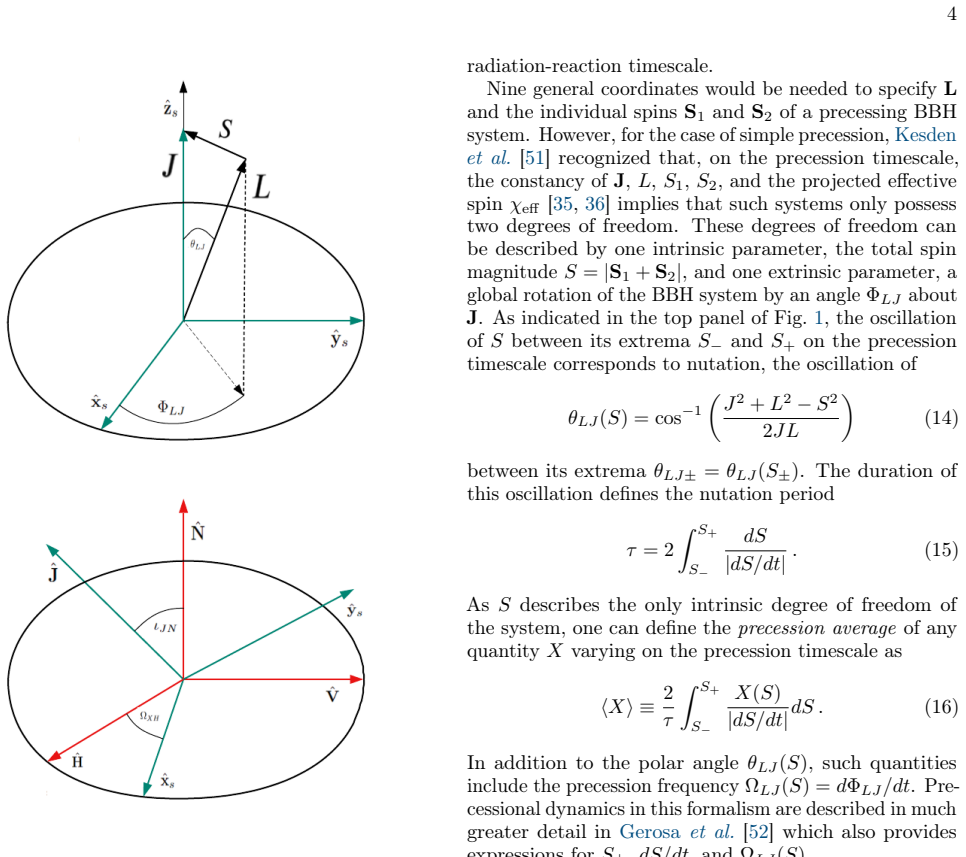
Source frame Thesource frameis chosen such that ˆZS points along the direction of the total angular momentumˆJ, ˆXS = ˆN× ˆJ | ˆN× ˆJ| (A3) points along the line of ascending node of the plane per- pendicular toJwith respect to the sky plane spanned by ˆH and ˆV, and ˆYS = ˆZS × ˆXS. We define the inclination ιJN as the angle betweenˆJand ˆN, cosι JN = ˆJ...
-
[6]
ˆL· ˆN 1−( ˆL· ˆN)2 # (ˆL× ˆN)· ˆdL d f =
GW strain The observed GW strain given by Eq. (1) depends on the relative orientation of these three frames through the GW fields h+ and h× of Eq. (5) and the detector beam- pattern coefficients F+ and F× of Eq. (2). The latter depend on the polarization angleψ of Eq. (3) which is given in terms of the above angles as ˆL· ˆZD = sinθ LJ [cos ΦLJ sin ΩXH si...
-
[7]
B. Abbott, R. Abbott, T. Abbott, M. Abernathy, F. Ac- ernese, K. Ackley, C. Adams, T. Adams, P. Addesso, R. Adhikari, and et al., Physical Review Letters116, 10.1103/physrevlett.116.061102 (2016)
-
[8]
T. L. S. Collaboration, J. Aasi, B. P. Abbott, R. Abbott, T. Abbott, and M. R. Abernathy, Classical and Quantum Gravity32, 074001 (2015)
2015
-
[9]
Acernese, M
F. Acernese, M. Agathos, K. Agatsuma, D. Aisa, N. Alle- mandou, A. Allocca, J. Amarni, P. Astone, G. Balestri, G. Ballardin, F. Barone, J.-P. Baronick, M. Barsuglia, A. Basti, F. Basti, and T. S. B. et.al., Classical and Quan- tum Gravity32, 024001 (2014)
2014
-
[10]
The LIGO Scientific Collaboration, the Virgo Collab- oration, the KAGRA Collaboration, R. Abbott, T. D. Abbott, F. Acernese, K. Ackley,et al., Physical Review X13, 041039 (2023), arXiv:2111.03606 [gr-qc]
Pith/arXiv arXiv 2023
-
[11]
org/superevents/public/O4/(2025)
LIGO, Virgo, and KAGRA Collaborations, Public alerts during the o4 observing run, https://gracedb.ligo. org/superevents/public/O4/(2025)
2025
-
[12]
The LIGO Scientific Collaboration, The Virgo Collabo- ration, and the KAGRA Collaboration, arXiv e-prints , arXiv:2508.18082 (2025), arXiv:2508.18082 [gr-qc]
Pith/arXiv arXiv 2025
-
[13]
Somiya, Classical and Quantum Gravity29, 124007 (2012)
K. Somiya, Classical and Quantum Gravity29, 124007 (2012). 24
2012
-
[14]
Y. Aso, Y. Michimura, K. Somiya, M. Ando, O. Miyakawa, T. Sekiguchi, D. Tatsumi, and H. Yamamoto (The KA- GRA Collaboration), Phys. Rev. D88, 043007 (2013)
2013
- [15]
-
[16]
Maggiore, C
M. Maggiore, C. V. D. Broeck, N. Bartolo, E. Belgacem, D. Bertacca, M. A. Bizouard, M. Branchesi, S. Clesse, S. Foffa, J. García-Bellido, S. Grimm, J. Harms, T. Hin- derer, S. Matarrese, C. Palomba, M. Peloso, A. Ricciar- done, and M. Sakellariadou, Journal of Cosmology and Astroparticle Physics2020(03), 050
-
[17]
M. Evans, R. X. Adhikari, C. Afle, S. W. Ballmer, S. Bis- coveanu, S. Borhanian, D. A. Brown, Y. Chen, R. Eisen- stein, A. Gruson, A. Gupta, E. D. Hall, R. Huxford, B. Kamai, R. Kashyap, J. S. Kissel, K. Kuns, P. Landry, A. Lenon, G. Lovelace, L. McCuller, K. K. Y. Ng, A. H. Nitz, J. Read, B. S. Sathyaprakash, D. H. Shoemaker, B. J. J. Slagmolen, J. R. Sm...
Pith/arXiv arXiv 2021
-
[18]
S. Kawamura, M. Ando, N. Seto, S. Sato, M. Musha, I. Kawano, J. Yokoyama, T. Tanaka, K. Ioka, T. Akutsu, T. Takashima, K. Agatsuma, A. Araya, N. Aritomi, H. Asada, T. Chiba, S. Eguchi, M. Enoki, M.-K. Fu- jimoto, R. Fujita, T. Futamase,et al., Progress of Theo- retical and Experimental Physics2021, 05A105 (2021), arXiv:2006.13545 [gr-qc]
Pith/arXiv arXiv 2021
-
[19]
Amaro-Seoaneet al., arXiv e-prints , arXiv:1702.00786 (2017), arXiv:1702.00786 [astro-ph.IM]
P. Amaro-Seoaneet al., arXiv e-prints , arXiv:1702.00786 (2017), arXiv:1702.00786 [astro-ph.IM]
Pith/arXiv arXiv 2017
-
[20]
Hanna, S
C. Hanna, S. Caudill, C. Messick, A. Reza, S. Sachdev, L. Tsukada, K. Cannon, K. Blackburn, J. D. E. Creighton, H. Fong, P. Godwin, S. Kapadia, T. G. F. Li, R. Magee, D. Meacher, D. Mukherjee, A. Pace, S. Privitera, R. K. L. Lo, and L. Wade, Phys. Rev. D101, 022003 (2020)
2020
-
[21]
Messick, K
C. Messick, K. Blackburn, P. Brady, P. Brockill, K. Can- non, R. Cariou, S. Caudill, S. J. Chamberlin, J. D. E. Creighton, R. Everett, C. Hanna, D. Keppel, R. N. Lang, T. G. F. Li, D. Meacher, A. Nielsen, C. Pankow, S. Priv- itera, H. Qi, S. Sachdev, L. Sadeghian, L. Singer, E. G. Thomas, L. Wade, M. Wade, A. Weinstein, and K. Wies- ner, Phys. Rev. D95, 0...
2017
-
[22]
K. Cannon, S. Caudill, C. Chan, B. Cousins, J. D. E. Creighton, B. Ewing, H. Fong, P. Godwin, C. Hanna, S. Hooper, R. Huxford, R. Magee, D. Meacher, C. Messick, S. Morisaki, D. Mukherjee, H. Ohta, A. Pace, S. Privitera, I. de Ruiter, S. Sachdev, L. Singer, D. Singh, R. Tapia, L. Tsukada, D. Tsuna, T. Tsutsui, K. Ueno, A. Viets, L. Wade, and M. Wade, Softw...
Pith/arXiv arXiv 2021
-
[23]
T. Adams, D. Buskulic, V. Germain, G. M. Guidi, F. Marion, M. Montani, B. Mours, F. Piergiovanni, and G. Wang, Classical and Quantum Gravity33, 175012 (2016), arXiv:1512.02864 [gr-qc]
Pith/arXiv arXiv 2016
-
[24]
F. Aubin, F. Brighenti, R. Chierici, D. Estevez, G. Greco, G. M. Guidi, V. Juste, F. Marion, B. Mours, E. Nitoglia, O. Sauter, and V. Sordini, Classical and Quantum Gravity 38, 095004 (2021), arXiv:2012.11512 [gr-qc]
Pith/arXiv arXiv 2021
-
[25]
S. A. Usman, A. H. Nitz, I. W. Harry, C. M. Biwer, D. A. Brown, M. Cabero, C. D. Capano, T. D. Canton, T. Dent, S. Fairhurst, M. S. Kehl, D. Keppel, B. Krishnan, A. Lenon, A. Lundgren, A. B. Nielsen, L. P. Pekowsky, H. P. Pfeiffer, P. R. Saulson, M. West, and J. L. Willis, Classical and Quantum Gravity33, 215004 (2016)
2016
-
[26]
A. H. Nitz, T. Dent, T. D. Canton, S. Fairhurst, and D. A. Brown, The Astrophysical Journal849, 118 (2017)
2017
-
[27]
Klimenko and G
S. Klimenko and G. Mitselmakher, Classical and Quantum Gravity21, S1819 (2004)
2004
-
[28]
Klimenko, G
S. Klimenko, G. Vedovato, M. Drago, F. Salemi, V. Tiwari, G. A. Prodi, C. Lazzaro, K. Ackley, S. Tiwari, C. F. Da Silva, and G. Mitselmakher, Phys. Rev. D93, 042004 (2016)
2016
-
[29]
L. A. Wainstein and V. D. Zubakov,Extraction of Signals from Noise((Prentice-Hall, Englewood Cliffs, NJ, 1970)
1970
-
[30]
B. J. Owen and B. S. Sathyaprakash, Phys. Rev. D60, 022002 (1999)
1999
-
[31]
R. Abbott, T. D. Abbott, F. Acernese, K. Ackley, and et al., Physical Review X13, 011048 (2023), arXiv:2111.03634 [astro-ph.HE]
Pith/arXiv arXiv 2023
-
[32]
T. A. Apostolatos, C. Cutler, G. J. Sussman, and K. S. Thorne, Phys. Rev. D49, 6274 (1994)
1994
-
[33]
X. Zhao, M. Kesden, and D. Gerosa, Phys. Rev. D96, 024007 (2017)
2017
-
[34]
Cutler and E
C. Cutler and E. E. Flanagan, Phys. Rev. D49, 2658 (1994)
1994
-
[35]
K. S. Thorne, Rev. Mod. Phys.52, 299 (1980)
1980
-
[36]
L. E. Kidder, Phys. Rev. D77, 044016 (2008)
2008
-
[37]
G. Pratten, C. García-Quirós, M. Colleoni, A. Ramos- Buades, H. Estellés, M. Mateu-Lucena, R. Jaume, M. Haney, D. Keitel, J. E. Thompson, and S. Husa, Phys. Rev. D103, 104056 (2021), arXiv:2004.06503 [gr- qc]
Pith/arXiv arXiv 2021
-
[38]
Ossokine, A
S. Ossokine, A. Buonanno, S. Marsat, R. Cotesta, S. Babak, T. Dietrich, R. Haas, I. Hinder, H. P. Pfeiffer, M. Pürrer, C. J. Woodford, M. Boyle, L. E. Kidder, M. A. Scheel, and B. Szilágyi, Phys. Rev. D102, 044055 (2020)
2020
-
[39]
Varma, S
V. Varma, S. E. Field, M. A. Scheel, J. Blackman, D. Gerosa, L. C. Stein, L. E. Kidder, and H. P. Pfeif- fer, Phys. Rev. Res.1, 033015 (2019)
2019
-
[40]
C. Hoy, S. Fairhurst, M. Hannam, and V. Tiwari, Astro- phys. J.928, 75 (2022), arXiv:2110.13542 [gr-qc]
Pith/arXiv arXiv 2022
-
[41]
Damour, Phys
T. Damour, Phys. Rev. D64, 124013 (2001)
2001
-
[42]
Racine, Phys
E. Racine, Phys. Rev. D78, 044021 (2008)
2008
-
[43]
Hannam, P
M. Hannam, P. Schmidt, A. Bohé, L. Haegel, S. Husa, F. Ohme, G. Pratten, and M. Pürrer, Phys. Rev. Lett. 113, 151101 (2014)
2014
-
[44]
Schmidt, F
P. Schmidt, F. Ohme, and M. Hannam, Phys. Rev. D91, 024043 (2015)
2015
-
[45]
D. Gerosa, M. Mould, D. Gangardt, P. Schmidt, G. Prat- ten, and L. M. Thomas, Phys. Rev. D103, 064067 (2021), arXiv:2011.11948 [gr-qc]
Pith/arXiv arXiv 2021
-
[46]
Gangardt, N
D. Gangardt, N. Steinle, M. Kesden, D. Gerosa, and E. Stoikos, Phys. Rev. D103, 124026 (2021)
2021
-
[47]
S. Fairhurst, R. Green, M. Hannam, and C. Hoy, Phys. Rev. D102, 041302 (2020), arXiv:1908.00555 [gr- qc]
Pith/arXiv arXiv 2020
-
[48]
S. Fairhurst, R. Green, C. Hoy, M. Hannam, and A. Muir, Phys. Rev. D102, 024055 (2020), arXiv:1908.05707 [gr- qc]
Pith/arXiv arXiv 2020
-
[49]
C. Hoy, S. Fairhurst, and I. Mandel, Phys. Rev. D111, 023037 (2025), arXiv:2408.03410 [gr-qc]
Pith/arXiv arXiv 2025
-
[50]
Lindblom, B
L. Lindblom, B. J. Owen, and D. A. Brown, Phys. Rev. D78, 124020 (2008)
2008
-
[51]
Planck Collaboration, N. Aghanim, Y. Akrami, M. Ash- down, J. Aumont, C. Baccigalupi, M. Ballardini, A. J. Banday, R. B. Barreiro, N. Bartolo, S. Basak, R. Battye, K. Benabed, J. P. Bernard, M. Bersanelli, P. Bielewicz, 25 J. J. Bock, J. R. Bond, J. Borrill, F. R. Bouchet, F. Boulanger, M. Bucher, C. Burigana, R. C. Butler, E. Calabrese, J. F. Cardoso, J....
Pith/arXiv arXiv 2020
-
[52]
L. S. Finn and D. F. Chernoff, Phys. Rev. D47, 2198 (1993)
1993
-
[53]
Takahashi and T
R. Takahashi and T. Nakamura, The Astrophysical Jour- nal595, 1039–1051 (2003)
2003
-
[54]
R. L. Forward, Phys. Rev. D17, 379 (1978)
1978
-
[55]
Poisson and C
E. Poisson and C. M. Will, Phys. Rev. D52, 848 (1995)
1995
-
[56]
Bildsten and C
L. Bildsten and C. Cutler, Astrophys. J.400, 175 (1992)
1992
-
[57]
Kesden, D
M. Kesden, D. Gerosa, R. O’Shaughnessy, E. Berti, and U. Sperhake, Phys. Rev. Lett.114, 081103 (2015)
2015
-
[58]
Gerosa, M
D. Gerosa, M. Kesden, U. Sperhake, E. Berti, and R. O’Shaughnessy, Phys. Rev. D92, 064016 (2015)
2015
-
[59]
L. S. Finn, Phys. Rev. D46, 5236 (1992)
1992
-
[60]
A. G. Wiseman, Phys. Rev. D46, 1517 (1992)
1992
-
[61]
A. Nitz, I. Harry, D. Brown, C. M. Biwer, J. Willis, T. D. Canton, C. Capano, T. Dent, L. Pekowsky, A. R. Williamson, S. De, M. Cabero, B. Machenschalk, D. Macleod, P. Kumar, S. Reyes, dfinstad, F. Pannarale, S. Kumar, T. Massinger, M. Tápai, L. Singer, G. S. C. Davies, S. Khan, S. Fairhurst, A. Nielsen, S. Singh, K. Chandra, shasvath, and veronica villa,...
2022
-
[62]
B. S. Sathyaprakash and B. F. Schutz, Living Reviews in Relativity12, 2 (2009), arXiv:0903.0338 [gr-qc]
Pith/arXiv arXiv 2009
-
[63]
D. Gerosa, R. O’Shaughnessy, M. Kesden, E. Berti, and U. Sperhake, Phys. Rev. D89, 124025 (2014), arXiv:1403.7147 [gr-qc]
Pith/arXiv arXiv 2014
-
[64]
D. Gerosa, G. Fumagalli, M. Mould, G. Cavallotto, D. P. Monroy, D. Gangardt, and V. De Renzis, Phys. Rev. D 108, 024042 (2023), arXiv:2304.04801 [gr-qc]
Pith/arXiv arXiv 2023
-
[65]
R. S. Chandramouli, K. Prokup, E. Berti, and N. Yunes, Phys. Rev. D111, 044026 (2025), arXiv:2410.06254 [gr- qc]
Pith/arXiv arXiv 2025
-
[66]
Singh, M
T. Singh, M. Kesden, and L. King, in preparation
-
[67]
M. J. Benacquista and J. M. B. Downing, Living Reviews in Relativity16, 4 (2013), arXiv:1110.4423 [astro-ph.SR]
Pith/arXiv arXiv 2013
-
[68]
C. L. Rodriguez, M. Zevin, C. Pankow, V. Kalogera, and F. A. Rasio, Astrophys. J. Lett.832, L2 (2016), arXiv:1609.05916 [astro-ph.HE]
Pith/arXiv arXiv 2016
-
[69]
V. Kalogera, Astrophys. J.541, 319 (2000), arXiv:astro- ph/9911417 [astro-ph]
arXiv 2000
-
[70]
K. A. Postnov and L. R. Yungelson, Living Reviews in Relativity17, 3 (2014), arXiv:1403.4754 [astro-ph.HE]
Pith/arXiv arXiv 2014
-
[71]
D. Gerosa and M. Fishbach, Nature Astronomy5, 749 (2021), arXiv:2105.03439 [astro-ph.HE]
Pith/arXiv arXiv 2021
-
[72]
N. Steinle and M. Kesden, Phys. Rev. D106, 063028 (2022), arXiv:2206.00391 [astro-ph.HE]
Pith/arXiv arXiv 2022
-
[73]
Stanzione, B
D. Stanzione, B. Barth, N. Gaffney, K. Gaither, C. Hempel, T. Minyard, S. Mehringer, E. Wernert, H. Tufo, D. Panda, and P. Teller, inPractice and Ex- perience in Advanced Research Computing 2017: Sustain- ability, Success and Impact, PEARC ’17 (Association for Computing Machinery, New York, NY, USA, 2017)
2017
-
[74]
Astropy Collaboration, T. P. Robitaille, E. J. Tollerud, P. Greenfield, M. Droettboom, E. Bray, T. Aldcroft, M. Davis, A. Ginsburg, A. M. Price-Whelan, W. E. Kerzendorf, A. Conley, N. Crighton, K. Barbary, D. Muna, H. Ferguson, F. Grollier, M. M. Parikh, P. H. Nair, H. M. Unther, C. Deil, J. Woillez, S. Conseil, R. Kramer, J. E. H. Turner, L. Singer, R. F...
Pith/arXiv arXiv 2013
-
[75]
Astropy Collaboration, A. M. Price-Whelan, B. M. Sipőcz, H. M. Günther, P. L. Lim, S. M. Crawford, S. Conseil, D. L. Shupe, M. W. Craig, N. Dencheva, A. Ginsburg, J. T. Vand erPlas, L. D. Bradley, D. Pérez-Suárez, M. de Val-Borro, T. L. Aldcroft, K. L. Cruz, T. P. Robitaille, E. J. Tollerud, C. Ardelean, T. Babej, Y. P. Bach, M. Ba- chetti, A. V. Bakanov,...
Pith/arXiv arXiv 2018
-
[76]
Astropy Collaboration, A. M. Price-Whelan, P. L. Lim, N. Earl, N. Starkman, L. Bradley, D. L. Shupe, A. A. Patil, L. Corrales, C. E. Brasseur, M. N"othe, A. Donath, E. Tollerud, B. M. Morris, A. Ginsburg, E. Vaher, B. A. Weaver, J. Tocknell, W. Jamieson, M. H. van Kerkwijk, T. P. Robitaille, B. Merry, M. Bachetti, H. M. G"unther, T. L. Aldcroft, J. A. Alv...
Pith/arXiv arXiv 2022
-
[77]
J. D. Hunter, Computing in Science & Engineering9, 90 (2007)
2007
-
[78]
C. R. Harris, K. J. Millman, S. J. van der Walt, R. Gom- mers, P. Virtanen, D. Cournapeau, E. Wieser, J. Tay- lor, S. Berg, N. J. Smith, R. Kern, M. Picus, S. Hoyer, M. H. van Kerkwijk, M. Brett, A. Haldane, J. F. del Río, M. Wiebe, P. Peterson, P. Gérard-Marchant, K. Sheppard, T. Reddy, W. Weckesser, H. Abbasi, C. Gohlke, and T. E. Oliphant, Nature585, 3...
2020
-
[79]
Virtanen, R
P. Virtanen, R. Gommers, T. E. Oliphant, M. Haber- land, T. Reddy, D. Cournapeau, E. Burovski, P. Peterson, W. Weckesser, J. Bright, S. J. van der Walt, M. Brett, J. Wilson, K. J. Millman, N. Mayorov, A. R. J. Nel- son, E. Jones, R. Kern, E. Larson, C. J. Carey, İ. Polat, Y. Feng, E. W. Moore, J. VanderPlas, D. Laxalde, J. Perk- told, R. Cimrman, I. Henri...
2020
-
[80]
Gommers, P
R. Gommers, P. Virtanen, M. Haberland, E. Burovski, W. Weckesser, T. Reddy, T. E. Oliphant, D. Cournapeau, A. Nelson, alexbrc, P. Roy, P. Peterson, I. Polat, J. Wilson, endolith, N. Mayorov, S. van der Walt, M. Brett, D. Lax- alde, E. Larson, A. Sakai, J. Millman, Lars, peterbell10, C. Carey, P. van Mulbregt, eric jones, N. McKibben, Kai, and R. Kern, sci...
2024
This paper was first reviewed by deepseek-v4-flash on August 4, 2026.
discussion (0)
Sign in with ORCID, Apple, or X to comment. Anyone can read and Pith papers without signing in.