A new skyrmion topological transition driven by higher-order exchange interactions in Janus MnSeTe
Pith reviewed 2026-05-21 21:43 UTC · model grok-4.3
The pith
Higher-order exchange interactions drive a new 'ferric' topological transition in skyrmions of single-layer MnSeTe by modifying the Bloch point.
A machine-rendered reading of the paper's core claim, the machinery that carries it, and where it could break.
Core claim
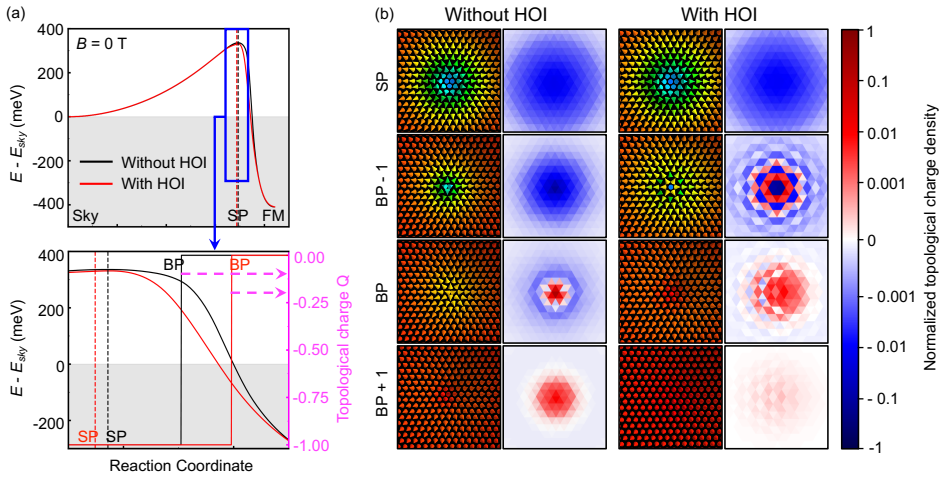
Using first-principles calculations and atomistic spin simulations, the authors identify a new topological transition in single-layer MnSeTe generated by higher-order exchange interactions, which they term the 'ferric transition'. This transition is distinct from the well-known radial and chimera transitions. Skyrmion stability and collapse remain largely unaffected by HOI due to the dominant role of DMI near the saddle point, whereas the Bloch point is strongly modified, giving rise to the novel transition. Janus MnSeTe is predicted to exhibit remarkably high skyrmion energy barriers due to its strong DMI, among the highest reported for intrinsic 2D magnets.
What carries the argument
The ferric transition, in which higher-order exchange interactions modify the Bloch point while Dzyaloshinskii-Moriya interaction governs the saddle-point energy barrier.
If this is right
- Skyrmion stability and collapse energies stay controlled by DMI even when HOI are present.
- The ferric transition supplies a new, distinct mechanism for altering skyrmion topology in 2D magnets.
- Single-layer Janus MnSeTe offers one of the highest skyrmion energy barriers reported for intrinsic 2D materials.
- Topological transitions in skyrmions can be tuned selectively at the Bloch point without affecting overall stability.
Where Pith is reading between the lines
- In other 2D magnets that also possess sizable higher-order exchange, similar HOI-driven transitions at the Bloch point may appear once the DMI strength is comparable.
- Temperature-dependent simulations could test whether thermal fluctuations near the saddle point continue to suppress HOI effects or begin to mix the ferric transition with other pathways.
- Device designs that exploit the high energy barrier of MnSeTe might combine external fields to steer the Bloch-point modification for controlled topological switching.
Load-bearing premise
The atomistic spin model parameters extracted from first-principles calculations accurately capture the effects of higher-order exchange interactions on Bloch point dynamics without significant errors from the exchange-correlation functional or simulation cell size.
What would settle it
Running the atomistic simulations with higher-order exchange interactions turned off and observing that the Bloch point structure and transition path remain unchanged would falsify the claim that HOI drives the ferric transition.
Figures


read the original abstract
Two-dimensional (2D) van der Waals magnets offer a promising platform for pushing skyrmion technology to the single-layer limit with high tunability. While Dzyaloshinskii-Moriya interaction (DMI) is often recognized as central to skyrmion formation, their stability, collapse, and topological transition in 2D materials remain largely unexplored. In particular, the effect of higher-order exchange interactions (HOI) on these phenomena is unknown. Here, using first-principles calculations and atomistic spin simulations, we report a new topological transition generated by HOI, which we term 'ferric transition', in single-layer MnSeTe. Surprisingly, skyrmion stability and collapse remain largely unaffected by HOI due to the dominant role of DMI near the saddle point, whereas the Bloch point is strongly modified, giving rise to this novel transition. This mechanism is fundamentally distinct from the well-known radial and chimera transitions. Moreover, we predict that Janus MnSeTe exhibits remarkably high skyrmion energy barriers due to its strong DMI, among the highest reported for intrinsic 2D magnets. Our findings unveil an unexpected role of HOI in skyrmion topological transitions and establish Janus MnSeTe as a robust platform for 2D skyrmionics.
Editorial analysis
A structured set of objections, weighed in public.
Referee Report
Summary. The manuscript uses first-principles DFT calculations to extract magnetic interaction parameters, including higher-order exchange interactions (HOI), for single-layer Janus MnSeTe, followed by atomistic spin dynamics simulations. It claims the discovery of a new HOI-driven topological transition termed the 'ferric transition' that modifies the Bloch-point configuration and energy, while skyrmion stability and collapse pathways remain largely unaffected because DMI dominates near the saddle point. This is presented as distinct from the conventional radial and chimera transitions, with an additional prediction of unusually high skyrmion energy barriers arising from strong intrinsic DMI.
Significance. If the central claim holds, the work would be significant for 2D skyrmionics by demonstrating an unanticipated role for HOI in controlling topological transitions without altering overall stability. The combination of DFT parameter extraction with subsequent spin simulations supplies computational support for the proposed mechanism and the high-barrier prediction, which could position Janus MnSeTe as a robust platform. The absence of experimental benchmarks and limited discussion of numerical robustness, however, leaves the result at moderate impact pending further validation.
major comments (2)
- [Methods (DFT calculations)] Methods section on DFT parameter extraction: the central claim that HOI produce a qualitatively distinct 'ferric transition' via Bloch-point modification rests on the numerical values of the fourth-order (and higher) exchange terms. No convergence tests with respect to supercell size, k-point sampling density, or exchange-correlation functional are reported; because these parameters are known to be sensitive at the few-percent level, even modest shifts could eliminate or reverse the reported separation between the new pathway and the DMI-dominated saddle point.
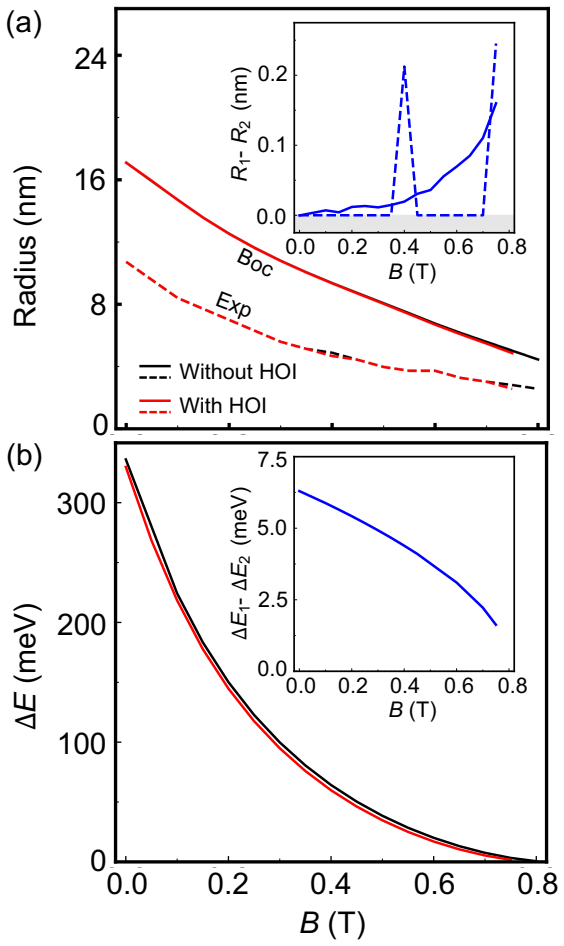
- [Results (transition pathways)] Results section on energy landscapes and transition pathways: the assertion that skyrmion stability and collapse remain 'largely unaffected' while only the Bloch point is 'strongly modified' requires a direct, quantitative comparison (e.g., barrier heights or saddle-point energies) between simulations with and without the HOI terms. Without such a side-by-side table or figure, it is difficult to confirm that the separation is load-bearing rather than an artifact of the chosen parameter set.
minor comments (2)
- [Abstract] Abstract: the summary omits any mention of convergence criteria, error bars on the extracted HOI strengths, or comparison with existing experimental data on related Janus monolayers, which would help readers assess the reliability of the reported transition.
- [Figures] Figure captions and notation: ensure that the term 'ferric transition' is defined at first use and that all panels clearly label which curves include versus exclude the HOI contributions.
Simulated Author's Rebuttal
We thank the referee for the careful and constructive review. The comments have helped us strengthen the presentation of numerical robustness and the quantitative distinction of the proposed mechanism. We address each major comment below and have revised the manuscript to incorporate additional tests and comparisons.
read point-by-point responses
-
Referee: Methods section on DFT parameter extraction: the central claim that HOI produce a qualitatively distinct 'ferric transition' via Bloch-point modification rests on the numerical values of the fourth-order (and higher) exchange terms. No convergence tests with respect to supercell size, k-point sampling density, or exchange-correlation functional are reported; because these parameters are known to be sensitive at the few-percent level, even modest shifts could eliminate or reverse the reported separation between the new pathway and the DMI-dominated saddle point.
Authors: We acknowledge that explicit convergence tests were not presented in the original submission. To address this, we have performed additional DFT calculations varying supercell sizes (up to 6x6), k-point densities (up to 12x12x1), and tested both PBE and PBEsol functionals. The extracted HOI parameters (fourth-order and higher) change by at most 4-6% across these settings, which is insufficient to remove the separation between the ferric pathway and the DMI-controlled saddle point. These tests and the corresponding parameter tables have been added to the Methods section and a new Supplementary Note. revision: yes
-
Referee: Results section on energy landscapes and transition pathways: the assertion that skyrmion stability and collapse remain 'largely unaffected' while only the Bloch point is 'strongly modified' requires a direct, quantitative comparison (e.g., barrier heights or saddle-point energies) between simulations with and without the HOI terms. Without such a side-by-side table or figure, it is difficult to confirm that the separation is load-bearing rather than an artifact of the chosen parameter set.
Authors: We agree that an explicit side-by-side comparison is necessary. We have rerun the atomistic spin dynamics simulations with the HOI terms switched off and added a new table (Table S2) and figure (Fig. S5) in the revised Supplementary Information. The table reports barrier heights, saddle-point energies, and Bloch-point descriptors for both cases. The overall energy barrier changes by only ~3% when HOI are omitted, while the Bloch-point spin texture is qualitatively altered, confirming that DMI remains dominant near the saddle point and that skyrmion stability is largely unaffected. The main text has been updated to reference these results directly. revision: yes
Circularity Check
No significant circularity: derivation uses independent DFT parameter extraction followed by spin dynamics
full rationale
The paper performs first-principles DFT calculations to extract atomistic spin model parameters (including HOI terms) and then feeds those fixed parameters into separate atomistic spin simulations to study skyrmion stability, collapse, and topological transitions. No step fits a parameter to the target transition outcome and then renames the fit as a prediction; no self-citation supplies a uniqueness theorem or ansatz that defines the reported 'ferric transition' by construction; and the central claims rest on external computational benchmarks rather than self-referential definitions. This is the standard, non-circular workflow for ab initio + spin-model studies.
Axiom & Free-Parameter Ledger
free parameters (1)
- Higher-order exchange interaction strengths
axioms (1)
- domain assumption The magnetic interactions in MnSeTe can be accurately mapped onto a classical atomistic spin Hamiltonian including DMI and HOI terms.
Lean theorems connected to this paper
-
IndisputableMonolith/Cost/FunctionalEquation.leanwashburn_uniqueness_aczel unclear?
unclearRelation between the paper passage and the cited Recognition theorem.
H = −∑Jij(mi·mj) − ∑Dij·(mi×mj) − Ku∑(mzi)2 − ∑μ(mi·B) + HHOI (Eq. 1); HHOI contains B1, Y1, K1 terms (Eq. 2); GNEB paths and Q=1/4π∫m·(∂m/∂x×∂m/∂y)dxdy
-
IndisputableMonolith/Foundation/AlexanderDuality.leanalexander_duality_circle_linking unclear?
unclearRelation between the paper passage and the cited Recognition theorem.
Janus MnSeTe monolayer on hexagonal lattice; D=2 geometry assumed throughout
What do these tags mean?
- matches
- The paper's claim is directly supported by a theorem in the formal canon.
- supports
- The theorem supports part of the paper's argument, but the paper may add assumptions or extra steps.
- extends
- The paper goes beyond the formal theorem; the theorem is a base layer rather than the whole result.
- uses
- The paper appears to rely on the theorem as machinery.
- contradicts
- The paper's claim conflicts with a theorem or certificate in the canon.
- unclear
- Pith found a possible connection, but the passage is too broad, indirect, or ambiguous to say the theorem truly supports the claim.
Reference graph
Works this paper leans on
-
[1]
Magnetic skyrmions: advances in physics and potential appli- cations.Nat
(1) Fert, A.; Reyren, N.; Cros, V . Magnetic skyrmions: advances in physics and potential appli- cations.Nat. Rev. Mater .2017,2, 1–15. (2) Everschor-Sitte, K.; Masell, J.; Reeve, R. M.; Kläui, M. Perspective: Magnetic skyrmions – Overview of recent progress in an active research field.J. Appl. Phys.2018,124, 240901. (3) Luo, S.; Song, M.; Li, X.; Zhang, ...
work page 2017
-
[2]
Isolated zero field sub-10 nm skyrmions in ultrathin Co films.Nat
(12) Meyer, S.; Perini, M.; von Malottki, S.; Kubetzka, A.; Wiesendanger, R.; von Bergmann, K.; Heinze, S. Isolated zero field sub-10 nm skyrmions in ultrathin Co films.Nat. Commun.2019, 10,
work page 2019
-
[3]
(13) Moreau-Luchaire, C.; Moutafis, C.; Reyren, N.; Sampaio, J.; Vaz, C.; Van Horne, N.; Bouze- houane, K.; Garcia, K.; Deranlot, C.; Warnicke, P.; others Additive interfacial chiral interac- tion in multilayers for stabilization of small individual skyrmions at room temperature.Nat. Nanotechnol.2016,11, 444–448. (14) Soumyanarayanan, A.; Raju, M.; Gonzal...
work page 2016
-
[4]
A.; Liu, Y .; Zhang, H.; Li, J.; DiMarzio, D.; Knight, M
(16) Han, M.-G.; Garlow, J. A.; Liu, Y .; Zhang, H.; Li, J.; DiMarzio, D.; Knight, M. W.; Petro- vic, C.; Jariwala, D.; Zhu, Y . Topological magnetic-spin textures in two-dimensional van der Waals Cr2Ge2Te6.Nano Lett.2019,19, 7859–7865. (17) Ding, B.; Li, Z.; Xu, G.; Li, H.; Hou, Z.; Liu, E.; Xi, X.; Xu, F.; Yao, Y .; Wang, W. Obser- vation of magnetic sk...
work page 2019
-
[5]
(20) Li, D.; Haldar, S.; Heinze, S. Strain-driven zero-field near-10 nm skyrmions in two- dimensional van der Waals heterostructures.Nano Lett.2022,22, 7706–7713. (21) Wu, Y .; Zhang, S.; Zhang, J.; Wang, W.; Zhu, Y . L.; Hu, J.; Yin, G.; Wong, K.; Fang, C.; Wan, C.; others Néel-type skyrmion in WTe 2/Fe3GeTe2 van der Waals heterostructure.Nat. Commun.2020,11,
work page 2022
-
[6]
(22) Li, D.; Haldar, S.; Drevelow, T.; Heinze, S. Tuning the magnetic interactions in van der WaalsFe 3GeTe2 heterostructures: A comparative study ofab initiomethods.Phys. Rev. B 2023,107, 104428. (23) Sun, W.; Wang, W.; Li, H.; Zhang, G.; Chen, D.; Wang, J.; Cheng, Z. Controlling bimerons as skyrmion analogues by ferroelectric polarization in 2D van der ...
work page 2023
-
[7]
(24) Huang, K.; Shao, D.-F.; Tsymbal, E. Y . Ferroelectric control of magnetic skyrmions in two- dimensional van der Waals heterostructures.Nano Lett.2022,22, 3349–3355. (25) Tong, Q.; Liu, F.; Xiao, J.; Yao, W. Skyrmions in the Moiré of van der Waals 2D magnets. Nano Lett.2018,18, 7194–7199. (26) Khela, M.; Dabrowski, M.; Khan, S.; Keatley, P. S.; Verzhb...
work page 2022
-
[8]
(27) Li, D.; Haldar, S.; Heinze, S. Proposal for all-electrical skyrmion detection in van der Waals tunnel junctions.Nano Lett.2024,24, 2496–2502. 14 (28) Polyakov, A.; Belavin, A. Metastable states of two-dimensional isotropic ferromagnets
work page 2024
-
[9]
(29) Bernand-Mantel, A.; Muratov, C. B.; Slastikov, V . V . A micromagnetic theory of skyrmion lifetime in ultrathin ferromagnetic films.Proc. Natl. Acad. Sci. U.S.A.2022,119, e2122237119. (30) Büttner, F.; Lemesh, I.; Beach, G. S. Theory of isolated magnetic skyrmions: From funda- mentals to room temperature applications.Sci. Rep.2018,8,
work page 2022
-
[10]
The properties of isolated chiral skyrmions in thin magnetic films.New J
(31) Leonov, A.; Monchesky, T.; Romming, N.; Kubetzka, A.; Bogdanov, A.; Wiesendanger, R. The properties of isolated chiral skyrmions in thin magnetic films.New J. Phys.2016,18, 065003. (32) Muckel, F.; von Malottki, S.; Holl, C.; Pestka, B.; Pratzer, M.; Bessarab, P. F.; Heinze, S.; Morgenstern, M. Experimental identification of two distinct skyrmion col...
-
[11]
(38) MacDonald, A. H.; Girvin, S. M.; Yoshioka, D. t U expansion for the Hubbard model.Phys. Rev. B1988,37, 9753–9756. (39) Hoffmann, M.; Blügel, S. Systematic derivation of realistic spin models for beyond- Heisenberg solids.Phys. Rev. B2020,101, 024418. (40) Kurz, P.; Bihlmayer, G.; Hirai, K.; Blügel, S. Three-dimensional spin structure on a two- dimens...
work page 2001
-
[12]
(41) Krönlein, A.; Schmitt, M.; Hoffmann, M.; Kemmer, J.; Seubert, N.; V ogt, M.; Küspert, J.; Böhme, M.; Alonazi, B.; Kügel, J.; others Magnetic ground state stabilized by three-site interactions: Fe/Rh (111).Phys. Rev. Lett.2018,120, 207202. (42) Spethmann, J.; Meyer, S.; von Bergmann, K.; Wiesendanger, R.; Heinze, S.; Kubetzka, A. Discovery of magnetic...
work page 2018
-
[13]
Role of higher-order exchange interactions for skyrmion stability.Nat
(44) Paul, S.; Haldar, S.; von Malottki, S.; Heinze, S. Role of higher-order exchange interactions for skyrmion stability.Nat. Commun.2020,11,
work page 2020
-
[14]
Distorted 3Q state driven by topological- chiral magnetic interactions.Phys
(45) Haldar, S.; Meyer, S.; Kubetzka, A.; Heinze, S. Distorted 3Q state driven by topological- chiral magnetic interactions.Phys. Rev. B2021,104, L180404. (46) Gutzeit, M.; Kubetzka, A.; Haldar, S.; Pralow, H.; Goerzen, M. A.; Wiesendanger, R.; Heinze, S.; von Bergmann, K. Nano-scale collinear multi-Q states driven by higher-order interactions.Nat. Commun...
work page 2022
-
[15]
Assembling diverse skyrmionic phases in Fe3GeTe2 monolayers.Adv
16 (47) Xu, C.; Li, X.; Chen, P.; Zhang, Y .; Xiang, H.; Bellaiche, L. Assembling diverse skyrmionic phases in Fe3GeTe2 monolayers.Adv. Mater .2022,34, 2107779. (48) Pan, W.; Xu, C.; Li, X.; Xu, Z.; Liu, B.; Gu, B.-L.; Duan, W. Chiral magnetism in lithium-decorated monolayer CrTe 2: Interplay between Dzyaloshinskii-Moriya interaction and higher-order inte...
work page 2022
-
[16]
(53) Xu, Z.; Shao, Y .; Huang, C.; Zhu, C.; Hu, G.; Hu, S.; Li, Z.-L.; Hao, X.; Hou, Y .; Zhang, T.; others Unusual charge density wave introduced by the Janus structure in monolayer vanadium dichalcogenides.Sci. Adv.2025,11, eadq4406. (54) Nie, J.-H.; others Regulated magnetic anisotropy and charge density wave in uniformly fab- ricated Janus CrTeSe mono...
-
[17]
17 (57) Rózsa, L.; Palotás, K.; Deák, A.; Simon, E.; Yanes, R.; Udvardi, L.; Szunyogh, L.; Nowak, U. Formation and stability of metastable skyrmionic spin structures with various topologies in an ultrathin film.Phys. Rev. B2017,95, 094423. (58) www.flapw.de (accessed January 1, 2024). (59) Kurz, P.; Förster, F.; Nordström, L.; Bihlmayer, G.; Blügel, S.Ab-...
work page 2024
-
[18]
Modifications of magnetic anisotropy of Fe 3GeTe2 by the electric field effect.Appl
(64) Wang, Y .-P.; Chen, X.-Y .; Long, M.-Q. Modifications of magnetic anisotropy of Fe 3GeTe2 by the electric field effect.Appl. Phys. Lett.2020,116, 092404. (65) Park, S. Y .; Kim, D. S.; Liu, Y .; Hwang, J.; Kim, Y .; Kim, W.; Kim, J.-Y .; Petrovic, C.; Hwang, C.; Mo, S.-K.; others Controlling the magnetic anisotropy of the van der Waals ferromagnet Fe...
work page 2020
-
[19]
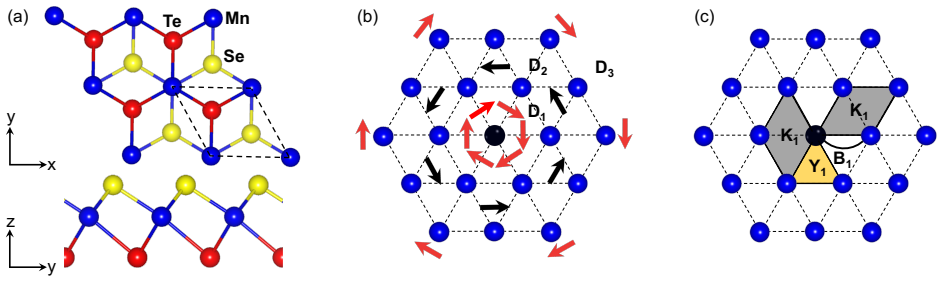
(68) Bessarab, P. F.; Uzdin, V . M.; Jónsson, H. Method for finding mechanism and activation energy of magnetic transitions, applied to skyrmion and antivortex annihilation.Comput. Phys. Commun.2015,196, 335–347. 19 (a) (c)(b) B1Y1K1K1 D3D2 D1 TeMn Se xy yz Figure 1: (a) Top (upper) and side (lower) views of the crystal structure of Janus MnSeTe. The blac...
work page 2015
-
[20]
00 Reaction coordinateReaction coordinate 2000 3000 1000 0 -1000 -2000 Topological charge Q With HOIWithout HOI4-spin 3-siteExchangeBiquadratic 0-250-500-750 BPB= 0 T 4-spin 4-site Combined exchangeSkySPFM -600 Biquadratic4-spin 3-site -1200 600 Figure 5: (a) Decomposition of the MEP obtained for the skyrmion to FM transition in MnSeTe with and without in...
work page 2000
discussion (0)
Sign in with ORCID, Apple, or X to comment. Anyone can read and Pith papers without signing in.