REVIEW 3 major objections 5 minor 55 references
Whole-slide cancer classification improves when entire clusters of non-diagnostic patches are pruned, not just individual patches.
Reviewed by Pith at T0; open to challenge. T0 means a machine referee read the full paper against a public rubric. the ladder, T0–T4 →
2026-08-04 17:11 UTC pith:ROO6M5OX
load-bearing objection Cluster-level sparsity is a sensible idea, but the headline SOTA is picked on the test set and the theory is standard Lasso; salvageable, not publishable as is. the 3 major comments →
Cluster-Level Sparse Multi-Instance Learning for Whole-Slide Images
The pith
A machine-rendered reading of the paper's core claim, the machinery that carries it, and where it could break.
Core claim
The central claim is that sparse selection of cluster-level prototypes—not instance-level attention alone—is what makes weakly supervised whole-slide classification robust. csMIL creates K global cluster centers from all training patches, assigns each bag's patches to those centers, computes attention-weighted prototypes per cluster, and sums the prototypes with a K-dimensional weight vector β regularized by ℓ1. In the learned model, clusters whose β components shrink to zero are discarded, so each slide is classified from a small set of diagnostically relevant tissue patterns. The paper reports that this beats attention-based and instance-selection baselines on CAMELYON16 (0.905 accuracy, 0
What carries the argument
The load-bearing object is the cluster-level sparse aggregation: K global cluster centers, within-cluster attention (ABMIL-style) that produces one prototype per cluster, and a shared sparse weight vector β with ℓ1 regularization. The zero or near-zero entries of β are the selection mechanism: they mark clusters of patches the model discards. The theory maps this to Lasso and compressed sensing, with the bag-level cluster prototypes as the design matrix and a restricted eigenvalue or incoherence condition as the bridge.
Load-bearing premise
The method assumes that diagnostically relevant and irrelevant tissue patches sort into distinct clusters, and that the cluster-aggregated features satisfy the restricted eigenvalue and incoherence conditions; if either fails, the sparsity-based pruning and the O(s log K) guarantee collapse.
What would settle it
Run csMIL on a synthetic MIL dataset where positive instances are deliberately spread across every cluster; if recovering the signal requires more than O(s log K) bags or forces nonzero weights on all clusters, the separation assumption is falsified. On real slides, a simpler check: take a trained model, remove all patches from zero-weight clusters on held-out slides, and see whether predictions stay the same—if they shift, the sparsity mask is not truly selecting irrelevant tissue.
If this is right
- If the central claim holds, whole-slide classifiers can drop entire non-diagnostic tissue classes without retraining, because β learns to zero them out.
- The O(s log K) recovery statement means the number of slides needed scales only logarithmically with the number of clusters, so finer-grained clustering does not force proportionally more data.
- Cluster-level sparsity maps give pathologists a direct visual: retained clusters are diagnostic regions, zero-weight clusters are noise, which is the paper's interpretability story.
- Because K is much smaller than the number of instances, the per-step cost avoids the quadratic instance-pair cost of transformer MIL and the instance-level scoring cost of selection-based MIL.
Where Pith is reading between the lines
- Editorial inference: If the separation premise holds, the same cluster-pruning idea could transfer to other weakly labeled bag problems where relevant and irrelevant patterns are spatially coherent—a testable extension the paper does not run.
- Editorial inference: The bound's dependence on learned features is the key gap; since the prototypes are data-dependent, the restricted eigenvalue and incoherence constants are not guaranteed, so a natural extension is to verify the eigengap on real feature embeddings.
- Editorial inference: The paper's K-sensitivity results suggest a practical heuristic: choose K by the stability of β's support rather than final accuracy, since over-segmentation diluted features at K = 5 and K = 10.
Editorial analysis
A structured set of objections, weighed in public.
Referee Report
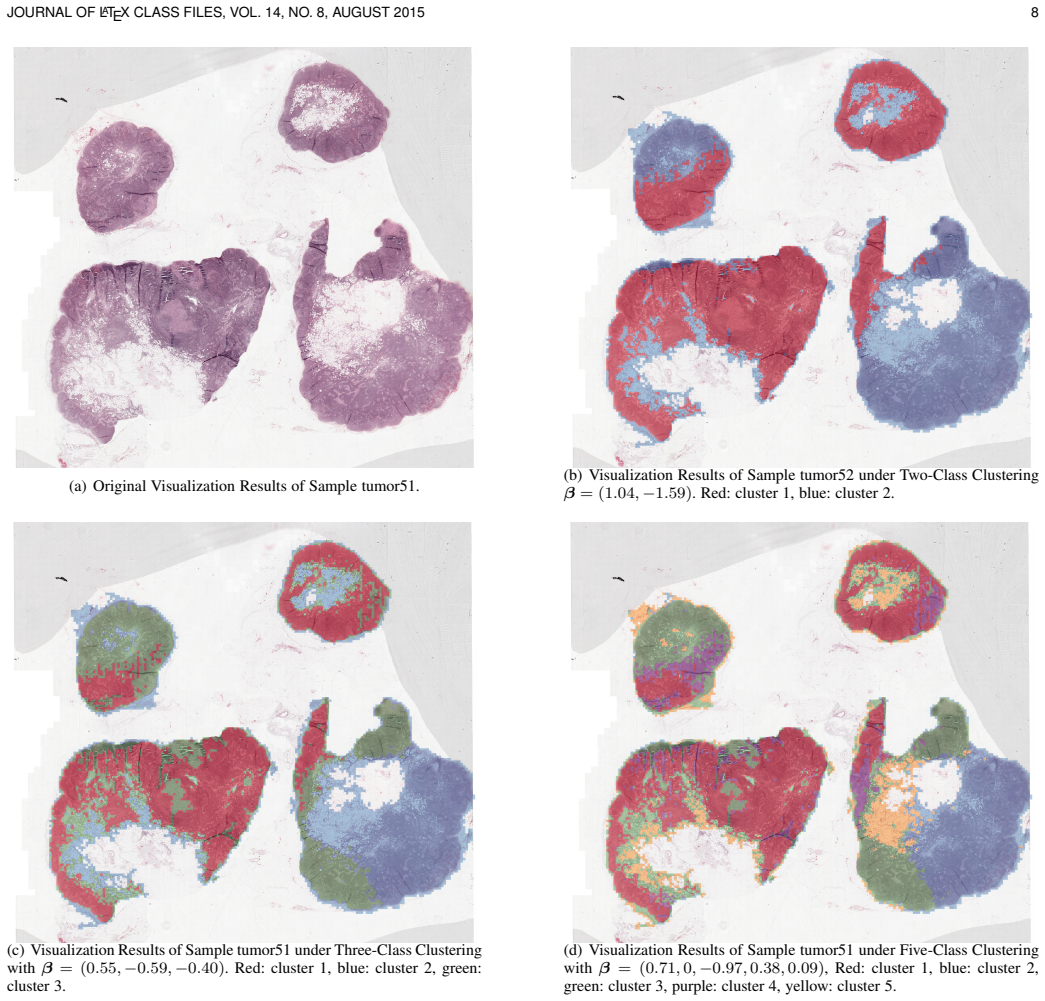
Summary. The paper proposes csMIL, a multi-instance learning framework for whole-slide images that combines global K-means clustering over all instances, local assignment of each bag's instances to the K global centers, within-cluster attention pooling into K prototypes, and a bag-level aggregation z_i = sum_k beta_k z_i^k with an l1 penalty on beta. The authors argue that cluster-level sparsity discards irrelevant instance cohorts, improves interpretability, and reduces computational cost. They state a sparse-recovery guarantee (Theorem 1: O(s log K) bags suffice to recover s relevant clusters) and report state-of-the-art accuracy/F1/AUC on CAMELYON16 (0.905/0.876/0.951) and TCGA-NSCLC (0.854/0.855/0.933), together with qualitative pathology-informed visualizations of cluster weights.
Significance. If the empirical claim were supported, csMIL would be a simple and attractive addition to attention-based MIL: it repurposes standard K-means and l1 regularization into an interpretable cluster-selection mechanism, and the qualitative maps in Section 5.5 are a genuinely useful clinical-interpretability direction. The paper, however, does not currently provide a sound empirical foundation for the SOTA claim. The lack of a validation split and the explicit test-set-driven sweeps over K and gamma (Tables 3–4, Figure 5) bias the headline numbers upward. The theoretical section is also not a derivation for the actual model: the proof assumes squared-error linear regression and assumes, rather than establishes, restricted eigenvalue and incoherence conditions on learned cluster features; the appendix itself concedes that nonlinear dependencies and poor clustering invalidate the bound. The central insight is potentially publishable, but the current evidence is not sufficient.
major comments (3)
- [§5.1, §5.4, §5.6; Tables 1–4; Fig. 5] The reported SOTA is obtained by test-set-driven hyperparameter selection. The protocol in §5.1 has only training and test folds (4:1), with no validation split. §5.4 sweeps K in {2,3,5,10} and reports test-fold Acc/F1/AUC (Tables 3–4); §5.6 sweeps 15 values of gamma and reports test accuracy (Figure 5). The final Tables 1–2 then use K=3 and the best gamma found in these sweeps. Selecting hyperparameters on the same test folds used for comparison makes the headline numbers optimistically biased and makes comparisons to baselines unfair. The paper must either use a proper validation/nested-CV procedure or clearly report the selection mechanism and per-fold variance; without this, the SOTA claim is unsupported.
- [§4.3 and Appendix (Proof of Theorem 1)] Theorem 1 as stated does not follow from the actual objective. The appendix proof analyzes the Lasso problem min_beta (1/(2M)) sum_i (Y_i - beta^T z_i)^2 + gamma ||beta||_1, while the method's loss in Eq. (4) is sum_i CE(g(z_i), Y_i) + gamma ||beta||_1, with g mapping z_i to a probability simplex. The theorem is therefore a generic Lasso sample-complexity statement, not a recovery guarantee for csMIL as implemented. Moreover, the restricted eigenvalue and incoherence conditions are assumed on learned cluster-aggregated features rather than verified; the appendix itself states that nonlinear dependencies and poor clustering invalidate the bound. The authors should either prove the bound for the actual cross-entropy objective under explicit, checkable assumptions or substantially reframe the theoretical contribution.
- [§3.2 and §4.3] The method and the theory both rest on the assumption that diagnostically relevant and irrelevant instances reside in different clusters. The only support offered is the qualitative bar plot in Figure 1, with no cluster-purity, silhouette, or other cluster-quality metric, and no ablation in which this assumption is artificially violated. Since the pruning logic and the O(s log K) guarantee collapse if clusters mix relevant and irrelevant patterns or if learned features are collinear, the paper should quantify cluster quality on the actual learned features and test robustness to imperfect clustering.
minor comments (5)
- [Eq. (3) and §3.3] The notation in Eq. (3) is hard to parse (h_n^T inside tanh), and the summation index in z_i^k = sum_{i=1}^{C_i^k} alpha_i^k h_i reuses i for both the bag index and the instance index. Please reindex instances (e.g., j) and clarify the dimensions.
- [§5.4] The opening sentence says the K-sweep is 'shown in Table 1 and 2 respectively,' but the actual K-sweep results are in Tables 3 and 4. Please correct the cross-reference.
- [Figure 5 and §5.6] The caption is missing the gamma symbol ('Model Accuracy vs. [gamma]'), and the text says 'accuracy increases from 0.750 to 0.900' when it presumably means accuracy rises over the gamma range. Please clarify the axis description and the direction of the claim.
- [References and dataset description] The TCGA-NSCLC dataset description (§5.1) does not match reference [54], which is a breast-cancer TCGA paper; a lung-cancer TCGA reference should be cited. Also, the abstract contains 'CAMEL YON16' (spacing typo).
- [Appendix] The appendix contains a placeholder sentence 'Appendix two text goes here' followed by the acknowledgment line. This should be removed before submission.
Circularity Check
Reported SOTA is selected on the test set: K and γ are tuned on the same folds used for evaluation, so Tables 1-2 overstate csMIL's advantage; the theoretical bound is standard Lasso with explicitly assumed conditions.
specific steps
-
fitted input called prediction
[Section 5.4 (Tables 3-4), Section 5.6 (Fig. 5), feeding Section 5.3 Tables 1-2; protocol Section 5.1]
"The number of clusters, K, is a hyperparameter that will be selected based on the final classification performance of the bags. ... First, the optimal number of clusters, denoted as K = 3, achieves the highest performance across all evaluated metrics, specifically an accuracy of 0.905, an F1 score of 0.876, and an AUC of 0.951. ... Parameter γ selection via network search."
Section 5.1 partitions each dataset into only training and test sets (4:1) with no validation set. Section 3.3 says K is selected based on final classification performance; Section 5.4 sweeps K and reports the best row, and Section 5.6 sweeps γ on the same data (Figure 5). Tables 1-2 then report the K=3 and best-γ result as 'Our method'. Hence the headline Acc/F1/AUC are the maximum of a hyperparameter sweep evaluated on the same test folds used for comparison, not independent out-of-sample predictions. The reported numbers are fitted to the test labels by construction, so the SOTA claim is statistically forced.
full rationale
One concrete circularity is present in the empirical headline claim. The protocol (Sec. 5.1) has only train/test splits, and Sec. 3.3 states K is chosen by final classification performance; Sec. 5.4 then sweeps K and identifies K=3 as the best on the same test folds, and Sec. 5.6 sweeps γ on the same data. Tables 1-2 report the K=3 row and the best-γ result as 'Our method,' so the reported SOTA is the maximum of a hyperparameter search on the evaluation data. That is a fitted-input-called-prediction pattern: the prediction (test accuracy) is, by construction, the outcome used to select the hyperparameters, making the headline numbers optimistically biased and not independent predictions. The theoretical O(s log K) claim is different: it is a direct restatement of standard Lasso sample-complexity bounds, with the paper's own Appendix explicitly limiting the claim to the case where the learned cluster features satisfy RE/incoherence and a linear label model. This is an assumption, not a circular derivation, so I do not count it as a separate circular step. The self-citations ([14], [41]) are background and not load-bearing. Score 6: the empirical central claim reduces, in part, to test-set-driven selection; the architecture and the conditional theory retain independent content.
Axiom & Free-Parameter Ledger
free parameters (2)
- K (number of clusters) =
3 (selected as best on both datasets)
- γ (ℓ1 regularization weight) =
Not stated explicitly; selected from grid {1e-4, ..., 0.1} by accuracy on the test set
axioms (4)
- domain assumption Positive and negative instances reside in distinct clusters.
- ad hoc to paper Learned cluster-aggregated features satisfy the Restricted Eigenvalue and incoherence conditions.
- ad hoc to paper Bag labels are linearly predicted by cluster prototypes: Y_i = β^T z_i + ε_i.
- domain assumption Global K-means centers transfer to each bag for local cluster assignment.
read the original abstract
Multi-Instance Learning (MIL) is pivotal for analyzing complex, weakly labeled datasets, such as whole-slide images (WSIs) in computational pathology, where bags comprise unordered collections of instances with sparse diagnostic relevance. Traditional MIL approaches, including early statistical methods and recent attention-based frameworks, struggle with instance redundancy and lack explicit mechanisms for discarding non-informative instances, limiting their robustness and interpretability. We propose Cluster-level Sparse MIL (csMIL), a novel framework that integrates global-local instance clustering, within-cluster attention, and cluster-level sparsity induction to address these challenges. Our csMIL first performs global clustering across all bags to establish $K$ cluster centers, followed by local clustering within each bag to assign cluster labels. Attention scores are computed within each cluster, and sparse regularization is applied to cluster weights, enabling the selective retention of diagnostically relevant clusters while discarding irrelevant ones. This approach enhances robustness to noisy instances, improves interpretability by identifying critical regions, and reduces computational complexity. Theoretical analysis demonstrates that csMIL requires $O(s log K)$ bags to recover $s$ relevant clusters, aligning with compressed sensing principles. Empirically, csMIL achieves state-of-the-art performance on two public histopathology benchmarks (CAMELYON16, TCGA-NSCLC).
Figures




Reference graph
Works this paper leans on
-
[1]
Data-efficient and weakly supervised computational pathology on whole-slide images,
M. Y . Lu, D. F. Williamson, T. Y . Chen, R. J. Chen, M. Barbieri, and F. Mahmood, “Data-efficient and weakly supervised computational pathology on whole-slide images,” Nature Biomedical Engineering , vol. 5, no. 6, pp. 555–570, 2021
2021
-
[2]
Multiple instance learning for digital pathology: A review of the state-of-the-art, limitations & future potential,
M. Gadermayr and M. Tschuchnig, “Multiple instance learning for digital pathology: A review of the state-of-the-art, limitations & future potential,” Computerized Medical Imaging and Graphics , vol. 112, p. 102337, 2024. [Online]. Available: https://www.sciencedirect.com/science/article/pii/S0895611124000144
2024
-
[3]
Pseudo-bag mixup augmentation for multiple instance learning-based whole slide image classification,
P. Liu, L. Ji, X. Zhang, and F. Ye, “Pseudo-bag mixup augmentation for multiple instance learning-based whole slide image classification,” IEEE Transactions on Medical Imaging, vol. 43, no. 5, pp. 1841–1852, 2024
2024
-
[4]
Advmil: Adversarial multiple instance learning for the survival analysis on whole-slide images,
P. Liu, L. Ji, F. Ye, and B. Fu, “Advmil: Adversarial multiple instance learning for the survival analysis on whole-slide images,” Medical Image Analysis, vol. 91, p. 103020, 2024
2024
-
[5]
A framework for multiple-instance learning,
O. Maron and T. Lozano-P ´erez, “A framework for multiple-instance learning,” Advances in neural information processing systems , vol. 10, 1997
1997
-
[6]
Support vector ma- chines for multiple-instance learning,
S. Andrews, I. Tsochantaridis, and T. Hofmann, “Support vector ma- chines for multiple-instance learning,” Advances in neural information processing systems, vol. 15, 2002
2002
-
[7]
Multiple instance learning convolutional neural networks for object recognition,
M. Sun, T. X. Han, M.-C. Liu, and A. Khodayari-Rostamabad, “Multiple instance learning convolutional neural networks for object recognition,” in 2016 23rd International Conference on Pattern Recognition (ICPR) . IEEE, 2016, pp. 3270–3275
2016
-
[8]
Attention-based deep multiple instance learning,
M. Ilse, J. Tomczak, and M. Welling, “Attention-based deep multiple instance learning,” in Proceedings of the 35th International Conference on Machine Learning , ser. Proceedings of Machine Learning Research, J. Dy and A. Krause, Eds., vol. 80. PMLR, 10–15 Jul 2018, pp. 2127– 2136
2018
-
[9]
Loss-based attention for deep multiple instance learning,
X. Shi, F. Xing, Y . Xie, Z. Zhang, L. Cui, and L. Yang, “Loss-based attention for deep multiple instance learning,” inProceedings of the AAAI conference on artificial intelligence , vol. 34, no. 04, 2020, pp. 5742– 5749
2020
-
[10]
Multi- instance partial-label learning with margin adjustment,
W. Tang, Y .-F. Yang, Z. Wang, W. Zhang, and M.-L. Zhang, “Multi- instance partial-label learning with margin adjustment,” Advances in Neural Information Processing Systems , vol. 37, pp. 26 331–26 354, 2024
2024
-
[11]
Miles: Multiple-instance learning via embedded instance selection,
Y . Chen, J. Bi, and J. Wang, “Miles: Multiple-instance learning via embedded instance selection,” IEEE Transactions on Pattern Analysis and Machine Intelligence, vol. 28, no. 12, pp. 1931–1947, 2006
1931
-
[12]
Adaptis: Adaptive instance selection network,
K. Sofiiuk, O. Barinova, and A. Konushin, “Adaptis: Adaptive instance selection network,” in Proceedings of the IEEE/CVF international con- ference on computer vision, 2019, pp. 7355–7363
2019
-
[13]
Deep multiple instance selection,
X.-C. Li, D.-C. Zhan, J.-Q. Yang, and Y . Shi, “Deep multiple instance selection,” Science China Information Sciences, vol. 64, pp. 1–15, 2021
2021
-
[14]
Sparse multiple instance learning for elderly people balance ability,
Y . Zhang, D. Su, X. Zhao, and Y . Tian, “Sparse multiple instance learning for elderly people balance ability,” Procedia Computer Science, vol. 199, pp. 621–628, 2022
2022
-
[15]
Primary mucinous ovarian tumors vs. ovarian metastases from gastrointestinal tract, pancreas and biliary tree: a review of current problematics,
P. Dundr, N. Singh, B. No ˇziˇckov´a, K. N ˇemejcov´a, M. B ´art˚u, and I. Struˇzinsk´a, “Primary mucinous ovarian tumors vs. ovarian metastases from gastrointestinal tract, pancreas and biliary tree: a review of current problematics,” Diagnostic pathology, vol. 16, pp. 1–17, 2021
2021
-
[16]
Pathology of primary and metastatic mucinous ovarian neoplasms,
S. L. S. Leen and N. Singh, “Pathology of primary and metastatic mucinous ovarian neoplasms,” Journal of Clinical Pathology , vol. 65, no. 7, pp. 591–595, 2012
2012
-
[17]
Dtfd-mil: Double-tier feature distillation multiple instance learning for histopathology whole slide image classification,
H. Zhang, Y . Meng, Y . Zhao, Y . Qiao, X. Yang, S. E. Coupland, and Y . Zheng, “Dtfd-mil: Double-tier feature distillation multiple instance learning for histopathology whole slide image classification,” in Pro- ceedings of the IEEE/CVF conference on computer vision and pattern recognition, 2022, pp. 18 802–18 812
2022
-
[18]
Clinical-grade computational pathology using weakly supervised deep learning on whole slide images,
G. Campanella, M. G. Hanna, L. Geneslaw, A. Miraflor, V . Werneck Krauss Silva, K. J. Busam, E. Brogi, V . E. Reuter, D. S. Klimstra, and T. J. Fuchs, “Clinical-grade computational pathology using weakly supervised deep learning on whole slide images,” Nature Medicine, vol. 25, no. 8, pp. 1301–1309, 2019
2019
-
[19]
Solving the multi- ple instance problem with axis-parallel rectangles,
T. G. Dietterich, R. H. Lathrop, and T. Lozano-P ´erez, “Solving the multi- ple instance problem with axis-parallel rectangles,”Artificial intelligence, vol. 89, no. 1-2, pp. 31–71, 1997
1997
-
[20]
Multi instance neural networks,
J. Ramon and L. De Raedt, “Multi instance neural networks,” in Pro- ceedings of the ICML-2000 workshop on attribute-value and relational learning, 2000, pp. 53–60
2000
-
[21]
Key instance detection in multi-instance learning,
G. Liu, J. Wu, and Z.-H. Zhou, “Key instance detection in multi-instance learning,” in Asian conference on machine learning . PMLR, 2012, pp. 253–268
2012
-
[22]
Multiple instance learning: A survey of problem characteristics and applications,
M.-A. Carbonneau, V . Cheplygina, E. Granger, and G. Gagnon, “Multiple instance learning: A survey of problem characteristics and applications,” Pattern recognition, vol. 77, pp. 329–353, 2018
2018
-
[23]
From group to individual labels using deep features,
D. Kotzias, M. Denil, N. De Freitas, and P. Smyth, “From group to individual labels using deep features,” in Proceedings of the 21th ACM SIGKDD international conference on knowledge discovery and data mining, 2015, pp. 597–606
2015
-
[24]
Support vector ma- chines for multiple-instance learning,
S. Andrews, I. Tsochantaridis, and T. Hofmann, “Support vector ma- chines for multiple-instance learning,” in Proceedings of the 16th In- ternational Conference on Neural Information Processing Systems , ser. NIPS’02. Cambridge, MA, USA: MIT Press, 2002, p. 577–584
2002
-
[25]
Em-dd: An improved multiple-instance learning technique,
Q. Zhang and S. Goldman, “Em-dd: An improved multiple-instance learning technique,” Advances in neural information processing systems, vol. 14, 2001
2001
-
[26]
Deep sets,
M. Zaheer, S. Kottur, S. Ravanbakhsh, B. Poczos, R. R. Salakhutdinov, and A. J. Smola, “Deep sets,” Advances in neural information processing systems, vol. 30, 2017
2017
-
[27]
Deep multiple instance learning for image classification and auto-annotation,
J. Wu, Y . Yu, C. Huang, and K. Yu, “Deep multiple instance learning for image classification and auto-annotation,” in Proceedings of the IEEE conference on computer vision and pattern recognition, 2015, pp. 3460– 3469
2015
-
[28]
Trans- MIL: Transformer based correlated multiple instance learning for whole slide image classification,
Z. Shao, H. Bian, Y . Chen, Y . Wang, J. Zhang, X. Ji et al. , “Trans- MIL: Transformer based correlated multiple instance learning for whole slide image classification,” Advances in neural information processing systems, vol. 34, pp. 2136–2147, 2021
2021
-
[29]
Multi-view multi-instance learning based on joint sparse representation and multi-view dictionary learning,
B. Li, C. Yuan, W. Xiong, W. Hu, H. Peng, X. Ding, and S. Maybank, “Multi-view multi-instance learning based on joint sparse representation and multi-view dictionary learning,” IEEE Transactions on Pattern Anal- ysis and Machine Intelligence, vol. 39, no. 12, pp. 2554–2560, 2017
2017
-
[30]
Weakly supervised object lo- calization with multi-fold multiple instance learning,
R. G. Cinbis, J. Verbeek, and C. Schmid, “Weakly supervised object lo- calization with multi-fold multiple instance learning,” IEEE transactions on pattern analysis and machine intelligence, vol. 39, no. 1, pp. 189–203, 2016
2016
-
[31]
Multi-layer multi-instance learning for video concept detection,
Z. Gu, T. Mei, X.-S. Hua, J. Tang, and X. Wu, “Multi-layer multi-instance learning for video concept detection,” IEEE Transactions on Multimedia, vol. 10, no. 8, pp. 1605–1616, 2008
2008
-
[32]
Video anomaly detection with ntcn-ml: A novel tcn for multi-instance learning,
W. Shao, R. Xiao, P. Rajapaksha, M. Wang, N. Crespi, Z. Luo, and R. Minerva, “Video anomaly detection with ntcn-ml: A novel tcn for multi-instance learning,” Pattern Recognition, vol. 143, p. 109765, 2023
2023
-
[33]
Text representation and classification based on multi-instance learning,
W. He and Y . Wang, “Text representation and classification based on multi-instance learning,” in 2009 International Conference on Manage- ment Science and Engineering. IEEE, 2009, pp. 34–39
2009
-
[34]
Multiple instance learning for classification of dementia in brain mri,
T. Tong, R. Wolz, Q. Gao, R. Guerrero, J. V . Hajnal, D. Rueckert, A. D. N. Initiative et al. , “Multiple instance learning for classification of dementia in brain mri,” Medical image analysis , vol. 18, no. 5, pp. 808–818, 2014
2014
-
[35]
P. Courtiol, E. W. Tramel, M. Sanselme, and G. Wainrib, “Classification and disease localization in histopathology using only global labels: A weakly-supervised approach,” arXiv preprint arXiv:1802.02212, 2018
Pith/arXiv arXiv 2018
-
[36]
Whole slide images based cancer survival prediction using attention guided deep JOURNAL OF LATEX CLASS FILES, VOL. 14, NO. 8, AUGUST 2015 12 multiple instance learning networks,
J. Yao, X. Zhu, J. Jonnagaddala, N. Hawkins, and J. Huang, “Whole slide images based cancer survival prediction using attention guided deep JOURNAL OF LATEX CLASS FILES, VOL. 14, NO. 8, AUGUST 2015 12 multiple instance learning networks,” Medical image analysis, vol. 65, p. 101789, 2020
2015
-
[37]
Dual-stream multiple instance learn- ing network for whole slide image classification with self-supervised contrastive learning,
B. Li, Y . Li, and K. W. Eliceiri, “Dual-stream multiple instance learn- ing network for whole slide image classification with self-supervised contrastive learning,” in Proceedings of the IEEE/CVF conference on computer vision and pattern recognition, 2021, pp. 14 318–14 328
2021
-
[38]
Murcl: Multi-instance reinforcement contrastive learning for whole slide image classification,
Z. Zhu, L. Yu, W. Wu, R. Yu, D. Zhang, and L. Wang, “Murcl: Multi-instance reinforcement contrastive learning for whole slide image classification,” IEEE Transactions on Medical Imaging , vol. 42, no. 5, pp. 1337–1348, 2022
2022
-
[39]
J. Wang, Y . Mao, N. Guan, and C. J. Xue, “Advances in multiple instance learning for whole slide image analysis: Techniques, challenges, and future directions,” arXiv preprint arXiv:2408.09476, 2024
Pith/arXiv arXiv 2024
-
[40]
L. Cai, S. Huang, Y . Zhang, J. Lu, and Y . Zhang, “Rethinking attention-based multiple instance learning for whole-slide pathological image classification: An instance attribute viewpoint,” arXiv preprint arXiv:2404.00351, 2024
Pith/arXiv arXiv 2024
-
[41]
Y . Zhang, Z. Shui, Y . Sun, H. Li, J. Li, C. Zhu, and L. Yang, “Aem: At- tention entropy maximization for multiple instance learning based whole slide image classification,” arXiv preprint arXiv:2406.15303, 2024
Pith/arXiv arXiv 2024
-
[42]
Rethinking multiple instance learning for whole slide image classification: A good instance classifier is all you need,
L. Qu, Y . Ma, X. Luo, Q. Guo, M. Wang, and Z. Song, “Rethinking multiple instance learning for whole slide image classification: A good instance classifier is all you need,” IEEE Transactions on Circuits and Systems for Video Technology, vol. 34, no. 10, pp. 9732–9744, 2024
2024
-
[43]
X. Liu, W. Zhang, and M.-L. Zhang, “Attention is not what you need: Revisiting multi-instance learning for whole slide image classification,” arXiv preprint arXiv:2408.09449, 2024
arXiv 2024
-
[44]
Hmil: Hierarchical multi- instance learning for fine-grained whole slide image classification,
C. Jin, L. Luo, H. Lin, J. Hou, and H. Chen, “Hmil: Hierarchical multi- instance learning for fine-grained whole slide image classification,”IEEE Transactions on Medical Imaging, vol. 44, no. 4, pp. 1796–1808, 2025
2025
-
[45]
Camil: channel attention-based multiple instance learning for whole slide image classification,
J. Mao, J. Xu, X. Tang, Y . Liu, H. Zhao, G. Tian, and J. Yang, “Camil: channel attention-based multiple instance learning for whole slide image classification,” Bioinformatics, vol. 41, no. 2, p. btaf024, 2025
2025
-
[46]
Targeting tumor heterogeneity: multiplex- detection-based multiple instance learning for whole slide image clas- sification,
Z. Wang, Y . Bi, T. Pan, X. Wang, C. Bain, R. Bassed, S. Imoto, J. Yao, R. J. Daly, and J. Song, “Targeting tumor heterogeneity: multiplex- detection-based multiple instance learning for whole slide image clas- sification,” Bioinformatics, vol. 39, no. 3, p. btad114, 2023
2023
-
[47]
Camil: Causal multiple instance learning for whole slide image classification,
K. Chen, S. Sun, and J. Zhao, “Camil: Causal multiple instance learning for whole slide image classification,” in Proceedings of the AAAI Con- ference on Artificial Intelligence, vol. 38, no. 2, 2024, pp. 1120–1128
2024
-
[48]
Multiple instance learning with random sampling for whole slide image classification,
H. Keshvarikhojasteh, J. P. Pluim, and M. Veta, “Multiple instance learning with random sampling for whole slide image classification,” in Medical Imaging 2024: Digital and Computational Pathology , vol. 12933. SPIE, 2024, pp. 372–376
2024
-
[49]
Learning with ℓ1-graph for image analysis,
B. Cheng, J. Yang, S. Yan, Y . Fu, and T. S. Huang, “Learning with ℓ1-graph for image analysis,” IEEE Transactions on Image Processing , vol. 19, no. 4, pp. 858–866, 2010
2010
-
[50]
Multi-instance learning by treating instances as non-i.i.d. samples,
Z.-H. Zhou, Y .-Y . Sun, and Y .-F. Li, “Multi-instance learning by treating instances as non-i.i.d. samples,” in Proceedings of the 26th Annual Inter- national Conference on Machine Learning , ser. ICML ’09. New York, NY , USA: Association for Computing Machinery, 2009, p. 1249–1256
2009
-
[51]
Adaptive prototype learning and allocation for few-shot segmentation,
G. Li, V . Jampani, L. Sevilla-Lara, D. Sun, J. Kim, and J. Kim, “Adaptive prototype learning and allocation for few-shot segmentation,” in Proceedings of the IEEE/CVF conference on computer vision and pattern recognition, 2021, pp. 8334–8343
2021
-
[52]
Enhancing sparsity by reweighted l 1 minimization,
E. J. Candes, M. B. Wakin, and S. P. Boyd, “Enhancing sparsity by reweighted l 1 minimization,” Journal of Fourier analysis and applica- tions, vol. 14, pp. 877–905, 2008
2008
-
[53]
Diagnostic assessment of deep learning algorithms for detection of lymph node metastases in women with breast cancer,
B. E. Bejnordi, M. Veta, P. J. Van Diest, B. Van Ginneken, N. Karsse- meijer, G. Litjens, J. A. Van Der Laak, M. Hermsen, Q. F. Manson, M. Balkenhol et al., “Diagnostic assessment of deep learning algorithms for detection of lymph node metastases in women with breast cancer,” Jama, vol. 318, no. 22, pp. 2199–2210, 2017
2017
-
[54]
Comprehensive molecular portraits of human breast tumours,
C. G. A. Network, “Comprehensive molecular portraits of human breast tumours,” Nature, vol. 490, no. 7418, pp. 61–70, 2012
2012
-
[55]
Set trans- former: A framework for attention-based permutation-invariant neural networks,
J. Lee, Y . Lee, J. Kim, A. Kosiorek, S. Choi, and Y . W. Teh, “Set trans- former: A framework for attention-based permutation-invariant neural networks,” in International conference on machine learning . PMLR, 2019, pp. 3744–3753
2019
This paper was first reviewed by deepseek-v4-flash on August 4, 2026.
discussion (0)
Sign in with ORCID, Apple, or X to comment. Anyone can read and Pith papers without signing in.