REVIEW 4 major objections 5 minor 12 references
A zero-shot SAM2 platform tracks cyst growth in kidney organoid videos, but its own failure analysis shows early-frame population metrics are unreliable.
Reviewed by Pith at T0; open to challenge. T0 means a machine referee read the full paper against a public rubric. the ladder, T0–T4 →
A SAM2-based open-source GUI with inverse temporal tracking for quantifying kidney organoid cyst growth in bright-field videos, demonstrated on two videos with noted early-frame failures.
T0 review reviewed 2026-08-04 challenge →
load-bearing objection A genuinely useful open-source GUI tool for tracking kidney organoid cysts, but the paper's own §4.2 shows its headline formation-rate and density metrics are invalid as computed, so the abstract overstates what the platform delivers. the 4 major comments →
Organoid Tracker: A SAM2-Powered Platform for Zero-shot Cyst Analysis in Human Kidney Organoid Videos
The pith
A machine-rendered reading of the paper's core claim, the machinery that carries it, and where it could break.
The reading
Core claim
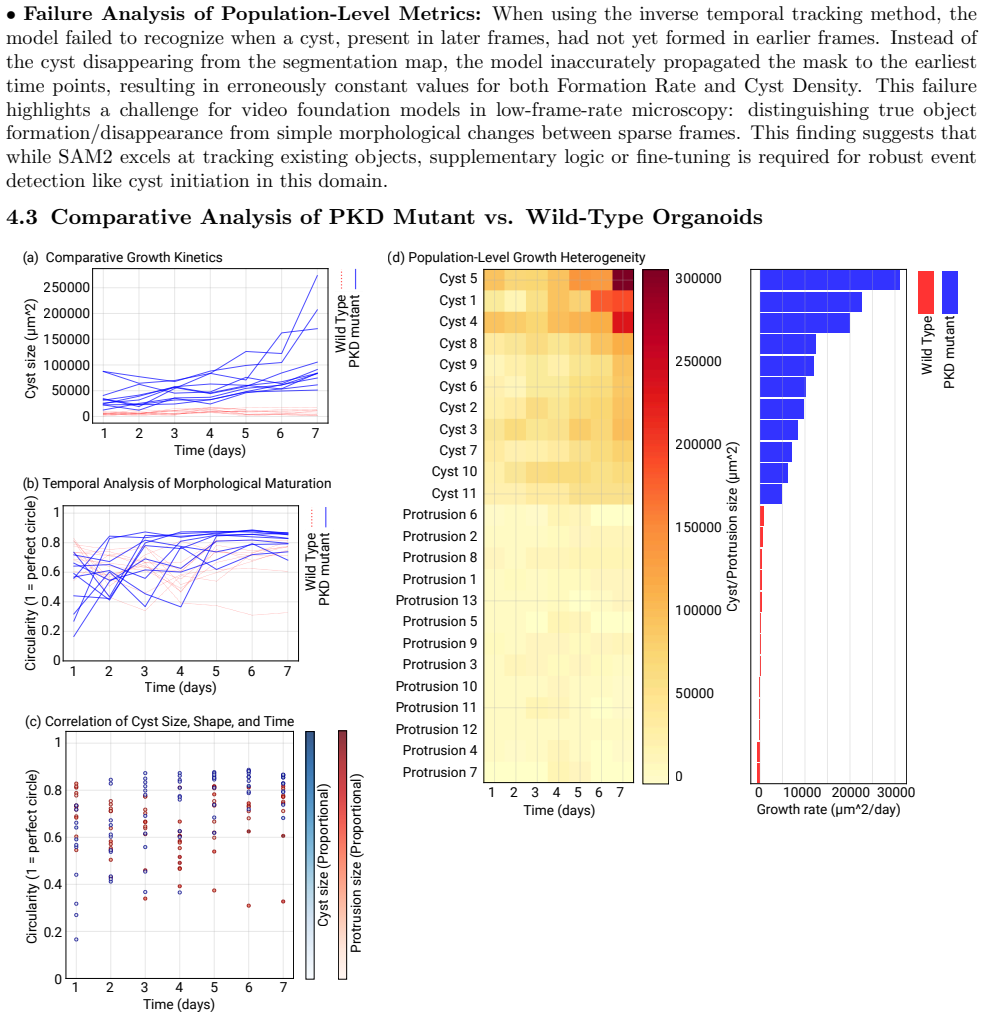
The central claim is that a foundation-model-based tool can turn raw bright-field organoid videos into quantitative, longitudinal cyst phenotypes with zero-shot segmentation. The paper argues that annotating only the final frame and tracking backward in time avoids the difficulty of detecting nascent cysts, enabling automated extraction of growth trajectories, morphological maturation, and population statistics. The case study demonstrates that PKD mutant cysts grow and become rounded while wild-type protrusions stay small and irregular. The paper also documents that in the first two chronological frames, the model fails to recognize that a cyst does not yet exist, propagating masks and prod
What carries the argument
The central mechanism is inverse temporal tracking with SAM2: the user draws bounding boxes on the final frame, SAM2 propagates instance masks backward through the video, and the data are chronologically reversed for analysis. The bounding-box prompt gives a spatial prior for low-contrast microscopy, and the reverse direction exploits SAM2's temporal memory on the clearest view. The proof-of-concept uses a 7-frame daily bright-field video of PKD mutant and wild-type kidney organoids.
Load-bearing premise
The load-bearing assumption is that propagating a cyst's mask backward from the final frame correctly represents the cyst's true absence before it forms; the paper's own results show this assumption fails, so the population-level metrics are unreliable.
What would settle it
Manually count the cysts in the first two frames of the provided PKD video and compare with the platform's propagated masks; the paper already reports that masks persist into those frames, so a direct count discrepancy would confirm that the Formation Rate and Cyst Density outputs are not trustworthy.
If this is right
- If the central claim holds, researchers can replace manual hit/non-hit scoring with quantitative growth and shape trajectories from standard bright-field videos, without programming expertise.
- The platform's comparative case study can distinguish PKD mutant cysts from wild-type protrusions by growth rate, circularity, and the correlation between size and shape.
- Automated population metrics such as Formation Rate and Cyst Density could become primary endpoints for drug-screening platforms, provided the early-frame existence problem is fixed.
- The open-source GUI makes SAM2-based video segmentation accessible to biologists, lowering the barrier to longitudinal phenotyping.
- The paper's own failure analysis implies that a supplementary existence-check or fine-tuning step is required before the platform can be trusted for cyst-initiation studies.
Where Pith is reading between the lines
- Editorial inference: A testable extension would be to add an object-existence filter that suppresses masks with low confidence in early frames; one could then check whether the recovered Formation Rate curve matches manually annotated first-appearance days.
- Editorial inference: The same inverse-tracking failure likely affects any longitudinal video where objects appear or disappear, because SAM2's temporal memory assumes persistent objects; the paper's approach may need event-aware logic for general use.
- Editorial inference: The term 'cyst' versus 'protrusion' in the wild-type case is defined partly by trajectory behavior (growth and circularity), suggesting the platform could be extended to classify objects by their temporal shape rather than by a single-frame label.
- Editorial inference: The 7-frame daily sampling is a worst case for temporal propagation; with denser time-lapse imaging, the domain gap and mask-persistence problem may shrink, which is a concrete experimental condition worth testing.
Editorial analysis
A structured set of objections, weighed in public.
Referee Report
Summary. The paper presents Organoid Tracker, a GUI platform built on SAM2 for zero-shot segmentation and tracking of cysts in bright-field time-lapse videos of human kidney organoids. The user annotates cysts on the final frame, and the platform performs inverse temporal tracking to propagate masks backward in time, then computes individual cyst area trajectories, circularity, growth rates, and population-level metrics including cyst formation rate and cyst density. A proof-of-concept case study on one PKD mutant video and one wild-type video is used to demonstrate the workflow, with qualitative comparison of mutant and wild-type phenotypes. The central claim is that the platform automates longitudinal quantitative phenotyping, replacing coarse hit/non-hit classification.
Significance. If the central claims hold, Organoid Tracker would address a real bottleneck in PKD drug screening by providing open-source, GUI-based longitudinal morphometric analysis of bright-field organoid videos. The paper has concrete strengths: the platform is publicly released, the morphometric formulas are standard and correctly stated, and the modular plugin architecture is a sensible design choice for extensibility. The use of a pretrained foundation model with bounding-box prompts is a practical approach, and the paper does not engage in circular reasoning. However, the central claim that the platform quantifies cyst formation rate is directly contradicted by the paper's own failure analysis (§4.2), which states that masks are propagated to frames before cysts actually form, producing erroneously constant formation rate and density. Since formation rate is a primary screening endpoint, this constitutes a load-bearing limitation that must be resolved before the platform's advertised utility can be accepted.
major comments (4)
- [§4.2, Failure Analysis of Population-Level Metrics] The paper's own failure analysis states: 'the model failed to recognize when a cyst, present in later frames, had not yet formed in earlier frames. Instead of the cyst disappearing from the segmentation map, the model inaccurately propagated the mask to the earliest time points, resulting in erroneously constant values for both Formation Rate and Cyst Density.' This directly invalidates the abstract's claim that the platform 'quantifies key metrics such as cyst formation rate.' Because FormationRate(t) = NOrganoidWithCysts(t)/NTotalOrganoids depends on the first appearance of a cyst, propagating masks before cyst formation makes the numerator constant over time. The paper offers no alternative event-detection logic and no validation of formation time against manual annotation. This is not a minor caveat; it is a failure of a central advertised endpoint. The authors must either add explic
- [§4.1 and §4.2] No quantitative validation of the segmentation and tracking is provided anywhere in the paper. The evaluation is qualitative (visual inspection of Figure 4) and the quantitative figures (Figures 5 and 6) are generated directly from SAM2 masks without comparison to ground truth. Given that the paper explicitly acknowledges degraded performance in the first two chronological frames, the reported area trajectories, growth rates, and circularity values in those frames are of unknown reliability. The authors should report overlap metrics (e.g., Dice/Jaccard) against manual annotations and tracking identity metrics (e.g., ID switches, MOTA) for at least a few videos. Without this, the platform's quantitative outputs cannot be considered trustworthy.
- [§4.3, Comparative Analysis of PKD Mutant vs. Wild-Type Organoids] The comparative analysis is based on exactly one PKD mutant video and one wild-type video (n=1 each). The text makes strong claims such as 'unambiguous summary of the experiment' and 'large, positive growth rates for every mutant cyst' without any statistical testing or replication. This is insufficient to support conclusions about the platform's ability to distinguish biological conditions. At minimum, the authors should temper the language, present the results as a case study, and, ideally, validate on multiple videos per condition with appropriate statistical tests.
- [§4.2, Heatmap of Cyst Growth] The paper acknowledges that the initial-frame segmentation issues manifest as 'potentially misleading color blocks at the start of the time course, which may make it difficult to definitively distinguish between cysts with genuinely slow-growing phenotypes and those whose growth appears slow due to initial detection failures.' This directly undermines the heatmap-based identification of 'fast', 'medium', and 'slow' growth phenotypes, which is presented as a key population-level output. The classification of growth phenotypes is therefore confounded by detection artifacts in early frames. The authors should either fix the underlying segmentation for the early frames or explicitly exclude/flag unreliable early time points in the growth-rate calculation and phenotype labels.
minor comments (5)
- [Abstract and §2.1] The paper calls the method 'zero-shot segmentation', but the workflow requires the user to manually draw bounding boxes on the final frame. This is more accurately described as interactive or promptable zero-shot segmentation. 'Zero-shot' may mislead readers into thinking no user annotation is required. Please clarify.
- [§4.2] There is a typographical error: 'Fig. 55' should be 'Fig. 5'. Also, the text contains '¿ 0.6' where the intended meaning is likely '> 0.6' (the character is corrupted).
- [§2.2] The heading 'Inverse T emporal Tracking' has an erroneous space in 'Temporal'. Please correct throughout.
- [§5] The conclusion states that the tool 'successfully automates the extraction of key morphometric data' despite the acknowledged failure in early frames. This overstates the success; the conclusion should be revised to reflect the limitations identified in §4.2.
- [Figure 6] The figure legends use 'Protrusion' for wild-type structures, but the text in §4.3 states that these are 'termed protrusions rather than cysts due to their distinct morphology.' This terminology is fine, but the definition of cyst vs. protrusion should be stated clearly and operationally, as it may affect how the segmentation masks are interpreted.
Circularity Check
No significant circularity: Organoid Tracker's metrics are standard mask-based definitions, SAM2 checkpoints are external, and self-citations are contextual.
full rationale
The paper's claimed outputs—cyst area, circularity, formation rate, cyst density, growth rates—are computed directly from segmentation masks via explicit formulas (Section 2.3), not from fitted parameters that are then presented as predictions. The method section introduces inverse temporal tracking as a design choice to mitigate forward-tracking difficulties; it is not derived from, nor justified by, the paper's own prior results. The reliance on SAM2 is external pretrained checkpoints (Section 3), and SAM2 itself is cited from an independent group; no uniqueness or ansatz is imported from the authors' own prior work. Citations to the authors' earlier organoid platform (e.g., ref. [4]) motivate the need for quantitative analysis but are not load-bearing in the derivation of any metric. The paper's own limitation in Section 4.2—that mask propagation to frames before cyst formation yields erroneously constant Formation Rate and Cyst Density—is explicitly acknowledged and is a validity/reliability concern, not circularity: it does not make an output equivalent to an input by definition. Because there is no self-definitional reduction, no fitted input renamed as a prediction, and no load-bearing self-citation chain, the appropriate circularity score is 0.
Axiom & Free-Parameter Ledger
free parameters (2)
- Growth phenotype percentile thresholds =
not stated (likely 33rd/66th)
- User-provided spatial conversion factor =
user-supplied µm/pixel
axioms (3)
- domain assumption SAM2 pretrained on natural images transfers to bright-field microscopy without fine-tuning
- standard math Standard morphometric formulas (area, circularity) are appropriate readouts for cyst phenotype
- domain assumption Manual bounding-box prompts on the final frame correctly identify all cysts to track
Cite this review
Pith. "Pith review of Organoid Tracker: A SAM2-Powered Platform for Zero-shot Cyst Analysis in Human Kidney Organoid Videos." pith.science (2026). https://pith.science/paper/P7XWJRQN
@misc{pith2026250911063,
  author       = {Pith},
  title        = {Pith review of: Organoid Tracker: A SAM2-Powered Platform for Zero-shot Cyst Analysis in Human Kidney Organoid Videos},
  year         = {2026},
  howpublished = {\url{https://pith.science/paper/P7XWJRQN}},
  note         = {Machine review of arXiv:2509.11063}
}
read the original abstract
Recent advances in organoid models have revolutionized the study of human kidney disease mechanisms and drug discovery by enabling scalable, cost-effective research without the need for animal sacrifice. Here, we present a kidney organoid platform optimized for efficient screening in polycystic kidney disease (PKD). While these systems generate rich spatial-temporal microscopy video datasets, current manual approaches to analysis remain limited to coarse classifications (e.g., hit vs. non-hit), often missing valuable pixel-level and longitudinal information. To help overcome this bottleneck, we developed Organoid Tracker, a graphical user interface (GUI) platform designed with a modular plugin architecture, which empowers researchers to extract detailed, quantitative metrics without programming expertise. Built on the cutting-edge vision foundation model Segment Anything Model 2 (SAM2), Organoid Tracker enables zero-shot segmentation and automated analysis of spatial-temporal microscopy videos. It quantifies key metrics such as cyst formation rate, growth velocity, and morphological changes, while generating comprehensive reports. By providing an extensible, open-source framework, Organoid Tracker offers a powerful solution for improving and accelerating research in kidney development, PKD modeling, and therapeutic discovery. The platform is publicly available as open-source software at https://github.com/hrlblab/OrganoidTracker.
Figures


Reference graph
Works this paper leans on
-
[1]
P., Fu, J., Park, S
Cable, J., Lutolf, M. P., Fu, J., Park, S. E., Apostolou, A., Chen, S., Song, C. J., Spence, J. R., Liberali, P., Lancaster, M., et al., ``Organoids as tools for fundamental discovery and translation—a keystone symposia report,'' Annals of the New York Academy of Sciences 1518 (1), 196--208 (2022)
2022
-
[2]
Liu, M., Cardilla, A., Ngeow, J., Gong, X., and Xia, Y., ``Studying kidney diseases using organoid models,'' Frontiers in cell and developmental biology 10 , 845401 (2022)
2022
-
[3]
M., Song, X., Czerniecki, S
Cruz, N. M., Song, X., Czerniecki, S. M., Gulieva, R. E., Churchill, A. J., Kim, Y. K., Winston, K., Tran, L. M., Diaz, M. A., Fu, H., et al., ``Organoid cystogenesis reveals a critical role of microenvironment in human polycystic kidney disease,'' Nature materials 16 (11), 1112--1119 (2017)
2017
-
[4]
J., Nguyen, T., Cheng, S.-Y., McMahon, J
Tran, T., Song, C. J., Nguyen, T., Cheng, S.-Y., McMahon, J. A., Yang, R., Guo, Q., Der, B., Lindstr \"o m, N. O., Lin, D. C.-H., et al., ``A scalable organoid model of human autosomal dominant polycystic kidney disease for disease mechanism and drug discovery,'' Cell Stem Cell 29 (7), 1083--1101 (2022)
2022
-
[5]
Ravi, N., Gabeur, V., Hu, Y.-T., Hu, R., Ryali, C., Ma, T., Khedr, H., R \"a dle, R., Rolland, C., Gustafson, L., et al., ``Sam 2: Segment anything in images and videos,'' arXiv preprint arXiv:2408.00714 (2024)
Pith/arXiv arXiv 2024
-
[6]
Y., Lee, S
Park, K., Lee, J. Y., Lee, S. Y., Jeong, I., Park, S.-Y., Kim, J. W., Nam, S. A., Kim, H. W., Kim, Y. K., and Lee, S., ``Deep learning predicts the differentiation of kidney organoids derived from human induced pluripotent stem cells,'' Kidney Research and Clinical Practice 42 (1), 75 (2022)
2022
-
[7]
Monaco, S., Bussola, N., Butt \`o , S., Sona, D., Giobergia, F., Jurman, G., Xinaris, C., and Apiletti, D., ``Ai models for automated segmentation of engineered polycystic kidney tubules,'' Scientific Reports 14 (1), 2847 (2024)
2024
-
[8]
Deininger, L., Jung-Klawitter, S., Mikut, R., Richter, P., Fischer, M., Karimian-Jazi, K., Breckwoldt, M. O., Bendszus, M., Heiland, S., Kleesiek, J., et al., ``An ai-based segmentation and analysis pipeline for high-field mr monitoring of cerebral organoids,'' Scientific Reports 13 (1), 21231 (2023)
2023
-
[9]
Zhang, Y. and Shen, Z., ``Unleashing the potential of sam2 for biomedical images and videos: A survey,'' arXiv preprint arXiv:2408.12889 (2024)
Pith/arXiv arXiv 2024
-
[10]
Ma, J., Kim, S., Li, F., Baharoon, M., Asakereh, R., Lyu, H., and Wang, B., ``Segment anything in medical images and videos: Benchmark and deployment,'' arXiv preprint arXiv:2408.03322 (2024)
Pith/arXiv arXiv 2024
-
[11]
Zhu, J., Hamdi, A., Qi, Y., Jin, Y., and Wu, J., ``Medical sam 2: Segment medical images as video via segment anything model 2,'' arXiv preprint arXiv:2408.00874 (2024)
Pith/arXiv arXiv 2024
-
[12]
write newline
" write newline "" before.all 'output.state := FUNCTION blank.sep after.quote 'output.state := FUNCTION fin.entry output.state after.quoted.block = 'skip 'add.period if write newline FUNCTION new.block output.state before.all = 'skip output.state after.quote = after.quoted.block 'output.state := after.block 'output.state := if if FUNCTION new.sentence out...
This paper was first reviewed by deepseek-v4-flash on August 4, 2026.
discussion (0)
Sign in with ORCID, Apple, or X to comment. Anyone can read and Pith papers without signing in.