REVIEW 2 major objections 4 minor 1 cited by
SAMP fuses robot and environment SDFs on a shared spatial anchor grid to plan collision-free manipulator motions.
Reviewed by Pith at T0; open to challenge. T0 means a machine referee read the full paper against a public rubric. the ladder, T0–T4 →
T0 review · deepseek-v4-flash
2026-08-04 16:57 UTC pith:22FNX45O
load-bearing objection Load-bearing coordinate-frame inconsistency in the robot SDF module undermines the central claim, though the architecture and ablations are otherwise solid. the 2 major comments →
SAMP: Spatial Anchor-based Motion Policy for Collision-Aware Robotic Manipulators
The pith
A machine-rendered reading of the paper's core claim, the machinery that carries it, and where it could break.
Core claim
The core discovery is that collision-aware motion can be generated end-to-end by co-encoding the environment and the robot's true geometry as signed distance fields sampled on a common grid of spatial anchors. The environment SDF grid provides obstacle distances at every anchor; the robot SDF network, trained once on all link meshes normalized and offset into one composite volume, predicts distances for the sampled robot points under each joint configuration. Joint grid sampling extracts environmental features at the robot point locations and fuses them with the robot SDF features and a point-cloud encoding, so the policy simultaneously reasons about free space and robot shape. The authors a
What carries the argument
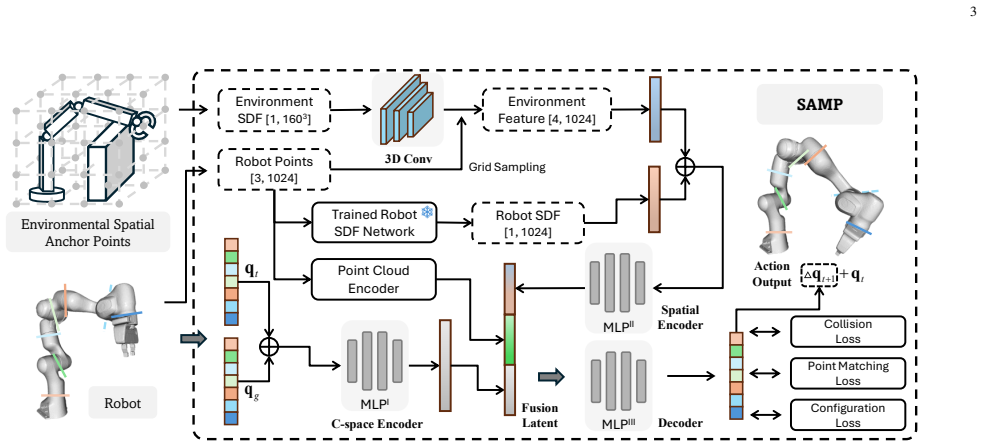
The central object is the spatial anchor grid: a fixed 3D lattice over the workspace where the environment SDF is evaluated. Around it, the method samples M points near the robot links and transforms them to workspace coordinates for the current joint configuration. Two SDF sources—the precomputed environment field (via a neural or voxel SDF) and a trained robot SDF network—are brought into agreement by trilinear interpolation of environment features at the transformed robot point coordinates (the 'joint grid sampling'). The resulting fused latent, along with a configuration-space MLP encoding and a point-cloud encoder, is decoded into a joint displacement. This machinery lets the network pe
Load-bearing premise
The robot SDF network's training domain (normalized link meshes offset into a canonical volume) must match the query domain (workspace points transformed by arbitrary joint configurations) at inference, but the paper does not describe the mapping that makes this match.
What would settle it
Train the robot SDF as described, then query it on workspace-transformed points sampled from thousands of random joint configurations and compare predicted distances to ground-truth distances computed from the true meshes; if the errors are large or the collision-loss weights become uninformative, the shared-anchor fusion loses its collision-avoidance benefits.
If this is right
- Neural planning policies no longer need simplified robot geometry; exact link shapes can be incorporated with a dedicated SDF network.
- Increasing the spatial anchor resolution monotonically improves success rate and reduces collisions, though at greater training and inference cost.
- The collision loss and point-cloud encoder are each essential to the success; removing either degrades performance, as shown in the paper's ablations.
- Because the method accepts any SDF source for the environment, it can work with neural reconstructions from real depth sensors, enabling direct policy execution without post-processing.
- The end-to-end design yields sub-0.09 s solution times, making near-real-time planning feasible.
Where Pith is reading between the lines
- The robot SDF network is trained on normalized and offset link meshes but queried at workspace coordinates at inference; the paper does not specify the coordinate normalization or per-link mapping, so without an additional alignment step the robot SDF features may be out-of-distribution for arbitrary joint configurations.
- The anchor-grid representation might transfer to new workcells by re-initializing the environment SDF at the same anchor points, potentially allowing quick retargeting without retraining the policy.
- A natural test is to use the robot SDF predictions as a classical collision checker, replacing geometric primitives, and measure whether planning success improves in high-DOF arms.
- The weighting scheme w_i = exp(-(d_i - d_target)) could be made adaptive to link thickness; this is not explored in the paper.
Editorial analysis
A structured set of objections, weighed in public.
Referee Report
Summary. The paper proposes SAMP, an imitation-learning motion policy for 7-DOF manipulators that encodes both environment and robot geometry using signed distance fields anchored at spatial grid points. The environment is represented by an SDF grid over anchor points; the robot is represented by a dedicated neural SDF model trained on normalized, offset link meshes. These features are fused with joint-state encoding and a point-cloud encoder, and the policy is trained from cuRobo expert demonstrations with point-matching, collision, and configuration losses. Experiments in simulation and on a real Panda robot report higher success rates and lower collision rates than MPNet, SIMPNet, and MPiNet.
Significance. If the reported results are reliable, the paper would make a useful contribution by showing that a unified spatial-anchor representation of both robot and environment can improve neural motion planning. The manuscript includes algorithm pseudocode, detailed architecture descriptions, ablations, and real-world validation, which are strengths. However, a load-bearing coordinate-frame inconsistency in the robot SDF network undermines the validity of the robot-geometry features and the collision loss as currently described. The evaluation metric for collision rate is also underspecified, leaving the main claim only partially supported.
major comments (2)
- [Section IV-A2/IV-A3, Eq. (8), Algorithm 2] The robot SDF network is trained in a normalized composite frame: each link mesh is normalized to [-1,1]^3 and offset by t_i (Eqs. 1-2, Algorithm 1). At inference, however, Eq. (8) and Algorithm 2 (lines 3-4) feed T_q(P_robot) — workspace coordinates under the current joint configuration — directly into f^r_theta. No inverse normalization, per-link offset removal, or configuration conditioning is described. A multiresolution hash grid plus MLP is not invariant to rigid transformations or to the composite offset, so these queries are out-of-distribution. Consequently, the predicted distances d_i used in the collision-loss weights w_i = exp(-(d_i - d_target)) (Eq. 15) and in the robot feature F_robot are not valid as written. This is not a matter of tuning; the described pipeline lacks a necessary coordinate transformation. The authors should either add the missing inverse mapping or clari
- [Section V-A2, Table III] The 'Collision Rate' metric is not defined in terms of any specific collision checker. If the learned environment SDF or the learned robot SDF is used as the evaluation oracle, the metric is partly circular, since those same representations are used in the training loss and feature extraction. The paper should specify the collision checker used to compute Table III (e.g., a mesh-based or cuRobo-based checker), and report whether the same oracle is used for all baselines. Without this, the reported collision rates cannot be independently assessed.
minor comments (4)
- [Section V-D1] The discussion of learning curves says 'deeper models consistently outperform shallower ones,' but the comparison varies anchor resolution, not network depth. Please correct the wording or clarify what 'deeper' refers to.
- [Equation (15)] Typo: 'denotes SDF value of the obstacles at the i-th robot sample point and and w_i' has a duplicated 'and.'
- [Algorithm 1, line 21] The notation Φ(p) = ⊕_{l=1}^L ϕ_l(p) is inconsistent with the earlier definition of ϕ_l as the per-level embedding; please clarify the concatenation notation.
- [References] Reference [10] and [28] are the same paper; please merge or differentiate.
Circularity Check
No significant circularity found: SAMP's derivation chain is self-contained and its evaluations are externally grounded.
full rationale
The paper does not exhibit a circular derivation in the sense defined by the analysis protocol. The robot SDF network is trained on mesh-derived signed distances (Section IV-A2, Eqs. 1-3) and separately evaluated against ground-truth SDF values in Table II; this is an independent accuracy check, not a fitted parameter being relabeled as a prediction. The collision loss (Eq. 15) uses the environment SDF for the occupancy term C_i and the robot SDF only to form per-point weights w_i, so the loss is not defined in terms of the metric it is supposed to predict. The motion policy is trained on cuRobo expert demonstrations, and cuRobo is explicitly reported as a baseline in Table III; comparing against the expert that generated the data is transparent and standard for imitation learning, rather than circular. The Collision Rate metric is only described as 'the percentage of trajectories that result in collisions' (Section V-A2), and the paper does not state that the learned SDF is used as the evaluation oracle; without that statement, any claim that the collision metric is circular is speculative and cannot be established from the text. The paper's self-citations ([25], [29]) appear in background or contrastive statements and are not load-bearing for the central contribution. The coordinate-domain mismatch between the normalized composite robot SDF training inputs and workspace queries is an internal-validity concern, not a circularity: it may invalidate the learned features, but it does not make the derived result equivalent to its inputs by construction. Accordingly, no step meets the evidentiary standard for a circularity finding.
Axiom & Free-Parameter Ledger
free parameters (5)
- Anchor resolution n_e =
160
- Safety margin d_margin =
0.09 m
- Target margin d_target =
0.015 m
- Translation offset t =
3
- Loss weights lambda1, lambda2, lambda3 =
not reported
axioms (3)
- domain assumption The environment SDF representation accurately reflects true obstacle geometry in all training and test scenes.
- ad hoc to paper The robot SDF network, trained on a fixed composite of normalized link meshes, produces valid distance values for arbitrary workspace coordinates under varying joint configurations.
- domain assumption Expert trajectories from cuRobo provide sufficient coverage of safe behavior in the 40 environments.
read the original abstract
Neural-based motion planning methods have achieved remarkable progress for robotic manipulators, yet a fundamental challenge lies in simultaneously accounting for both the robot's physical shape and the surrounding environment when generating safe and feasible motions. Moreover, existing approaches often rely on simplified robot models or focus primarily on obstacle representation, which can lead to incomplete collision detection and degraded performance in cluttered scenes. To address these limitations, we propose spatial anchor-based motion policy (SAMP), a unified framework that simultaneously encodes the environment and the manipulator using signed distance field (SDF) anchored on a shared spatial grid. SAMP incorporates a dedicated robot SDF network that captures the manipulator's precise geometry, enabling collision-aware reasoning beyond coarse link approximations. These representations are fused on spatial anchors and used to train a neural motion policy that generates smooth, collision-free trajectories in the proposed efficient feature alignment strategy. Experiments conducted in both simulated and real-world environments consistently show that SAMP outperforms existing methods, delivering an 11% increase in success rate and a 7% reduction in collision rate. These results highlight the benefits of jointly modelling robot and environment geometry, demonstrating its practical value in challenging real-world environments.
Figures


Forward citations
Cited by 1 Pith paper
-
EmbodiSteer: Steering Embodiment-Agnostic Visuomotor Policies with Joint-Space Guidance for Zero-Shot Cross-Embodiment Deployment
EmbodiSteer steers embodiment-agnostic Cartesian diffusion policies into joint space with Jacobian-based collision guidance after each denoising step for zero-shot cross-embodiment deployment.
Reference graph
Works this paper leans on
-
[1]
Path planning for robotic manip- ulator in complex multi-obstacle environment based on Improved_RRT,
L. Jiang, S. Liu, Y . Cui, and H. Jiang, “Path planning for robotic manip- ulator in complex multi-obstacle environment based on Improved_RRT,” IEEE/ASME Trans. Mech., vol. 27, no. 6, pp. 4774–4785, 2022
2022
-
[2]
CuRobo: Parallelized collision-free robot motion genera- tion,
B. Sundaralingam, S. K. S. Hari, A. Fishman, C. Garrett, K. Van Wyk, V . Blukis, A. Millane, H. Oleynikova, A. Handa, F. Ramos, N. Ratliff, and D. Fox, “CuRobo: Parallelized collision-free robot motion genera- tion,” inProc. IEEE Int. Conf. Robot. Automat., 2023, pp. 8112–8119
2023
-
[3]
Environment-adaptive path planning method for industrial robot ma- nipulators,
H. Wen, X. Yang, J. Wang, Z. Xu, Y . Xu, K. Hu, and H. Shi, “Environment-adaptive path planning method for industrial robot ma- nipulators,”IEEE/ASME Trans. Mech., pp. 1–10, 2025
2025
-
[4]
Reactive collision-free motion generation in joint space via dynamical systems and sampling-based mpc,
M. Koptev, N. Figueroa, and A. Billard, “Reactive collision-free motion generation in joint space via dynamical systems and sampling-based mpc,”Int. J. Robot. Res., vol. 43, no. 13, pp. 2049–2069, 2024
2049
-
[5]
Motion policy networks,
A. Fishman, A. Murali, C. Eppner, B. Peele, B. Boots, and D. Fox, “Motion policy networks,” inProc. Conf. Robot Learn., 2023, pp. 967– 977
2023
-
[6]
Neural manipulation planning on constraint manifolds,
A. H. Qureshi, J. Dong, A. Choe, and M. C. Yip, “Neural manipulation planning on constraint manifolds,”IEEE Robot. Automat. Lett., vol. 5, no. 4, pp. 6089–6096, 2020
2020
-
[7]
Dynamically constrained motion planning networks for non-holonomic robots,
J. J. Johnson, L. Li, F. Liu, A. H. Qureshi, and M. C. Yip, “Dynamically constrained motion planning networks for non-holonomic robots,” in Proc. IEEE/RSJ Int. Conf. Intell. Robots Syst, 2020, pp. 6937–6943
2020
-
[8]
Integrating uncertainty-aware human motion prediction into graph-based manipu- lator motion planning,
W. Liu, K. Eltouny, S. Tian, X. Liang, and M. Zheng, “Integrating uncertainty-aware human motion prediction into graph-based manipu- lator motion planning,”IEEE/ASME Trans. Mech., vol. 29, no. 4, pp. 3128–3136, 2024
2024
-
[9]
Constrained motion planning networks x,
A. H. Qureshi, J. Dong, A. Baig, and M. C. Yip, “Constrained motion planning networks x,”IEEE Trans. Robot., vol. 38, no. 2, pp. 868–886, 2022
2022
-
[11]
Globally-guided geometric fabrics for reactive mobile manipulation in dynamic environments,
T. Merva, S. Bakker, M. Spahn, D. Zhao, I. Virgala, and J. Alonso-Mora, “Globally-guided geometric fabrics for reactive mobile manipulation in dynamic environments,”IEEE Robot. Automat. Lett., vol. 10, no. 6, pp. 5553–5560, 2025
2025
-
[12]
CHOMP: Covariant hamiltonian optimization for motion planning,
M. Zucker, N. Ratliff, A. D. Dragan, M. Pivtoraiko, M. Klingensmith, C. M. Dellin, J. A. Bagnell, and S. S. Srinivasa, “CHOMP: Covariant hamiltonian optimization for motion planning,”Int. J. Robot. Res., vol. 32, no. 9-10, pp. 1164–1193, 2013
2013
-
[13]
SIMPNet: Spatial- informed motion planning network,
D. Soleymanzadeh, X. Liang, and M. Zheng, “SIMPNet: Spatial- informed motion planning network,”IEEE Robot. Automat. Lett., vol. 10, no. 3, pp. 2870–2877, 2025
2025
-
[14]
Motion planning networks: Bridging the gap between learning-based and classical motion planners,
A. H. Qureshi, Y . Miao, A. Simeonov, and M. C. Yip, “Motion planning networks: Bridging the gap between learning-based and classical motion planners,”IEEE Trans. Robot., vol. 37, no. 1, pp. 48–66, 2021
2021
-
[15]
Efficient motion planning based on kinodynamic model for quadruped robots following persons in confined spaces,
Z. Zhang, J. Yan, X. Kong, G. Zhai, and Y . Liu, “Efficient motion planning based on kinodynamic model for quadruped robots following persons in confined spaces,”IEEE/ASME Trans. Mech., vol. 26, no. 4, pp. 1997–2006, 2021
1997
-
[16]
Neural MP: A generalist neural motion planner,
M. Dalal, J. Yang, R. Mendonca, Y . Khaky, R. Salakhutdinov, and D. Pathak, “Neural MP: A generalist neural motion planner,” arXiv:2409.05864, 2024
Pith/arXiv arXiv 2024
-
[17]
NTFields: Neural time fields for physics- informed robot motion planning,
R. Ni and A. H. Qureshi, “NTFields: Neural time fields for physics- informed robot motion planning,” inProc. Int. Conf. Learn. Represent., 2023
2023
-
[18]
RMMI: Enhanced obstacle avoidance for reactive mobile manipulation using an implicit neural map,
N. Marticorena, T. Fischer, J. Haviland, and N. Suenderhauf, “RMMI: Enhanced obstacle avoidance for reactive mobile manipulation using an implicit neural map,”arXiv:2408.16206, 2024
Pith/arXiv arXiv 2024
-
[19]
Aggressive collision-inclusive motion planning,
H. Yu, C. Hu, J. Wang, G. Lu, J. Tu, Z. Zheng, J. Li, and F. Gao, “Aggressive collision-inclusive motion planning,”IEEE/ASME Trans. Mech., vol. 30, no. 2, pp. 1412–1423, 2025
2025
-
[20]
V oxblox: Incremental 3D euclidean signed distance fields for on-board MA V planning,
H. Oleynikova, Z. Taylor, M. Fehr, R. Siegwart, and J. Nieto, “V oxblox: Incremental 3D euclidean signed distance fields for on-board MA V planning,” inProc. IEEE/RSJ Int. Conf. Intell. Robots Syst., 2017, pp. 1366–1373
2017
-
[21]
V oxfield: Non-projective signed distance fields for online 11 planning and 3D reconstruction,
Y . Pan, Y . Kompis, L. Bartolomei, R. Mascaro, C. Stachniss, and M. Chli, “V oxfield: Non-projective signed distance fields for online 11 planning and 3D reconstruction,” inProc. IEEE/RSJ Int. Conf. Intell. Robots Syst., 2022, pp. 5331–5338
2022
-
[22]
nvblox: Gpu-accelerated incremental signed distance field mapping,
A. Millane, H. Oleynikova, E. Wirbel, R. Steiner, V . Ramasamy, D. Tingdahl, and R. Siegwart, “nvblox: Gpu-accelerated incremental signed distance field mapping,” inProc. IEEE Int. Conf. Robot. Au- tomat., 2024, pp. 2698–2705
2024
-
[23]
iSDF: Real-time neural signed distance fields for robot perception,
J. Ortiz, A. Clegg, J. Dong, E. Sucar, D. Novotny, M. Zollhoefer, and M. Mukadam, “iSDF: Real-time neural signed distance fields for robot perception,” inProc. Robot.: Sci. Syst., 2022
2022
-
[24]
SHINE-Mapping: Large- scale 3D mapping using sparse hierarchical implicit neural representa- tions,
X. Zhong, Y . Pan, J. Behley, and C. Stachniss, “SHINE-Mapping: Large- scale 3D mapping using sparse hierarchical implicit neural representa- tions,” inProc. IEEE Int. Conf. Robot. Automat., 2023, pp. 8371–8377
2023
-
[25]
G2-sdf: Geometry-guided neural signed distance fields for scalable and detailed reconstruction,
K. Chen, J. Cao, Y . Li, H. Li, and J. Ma, “G2-sdf: Geometry-guided neural signed distance fields for scalable and detailed reconstruction,” IEEE Robot. Automat. Lett., vol. 10, no. 8, pp. 8498–8505, 2025
2025
-
[26]
A collision-free mpc for whole-body dynamic locomotion and manipula- tion,
J. R. Chiu, J. P. Sleiman, M. Mittal, F. Farshidian, and M. Hutter, “A collision-free mpc for whole-body dynamic locomotion and manipula- tion,” inProc. IEEE Int. Conf. Robot. Automat., 2022, pp. 4686–4693
2022
-
[27]
Avoid everything: Model-free collision avoidance with expert-guided fine-tuning,
A. Fishman, A. Walsman, M. Bhardwaj, W. Yuan, B. Sundaralingam, B. Boots, and D. Fox, “Avoid everything: Model-free collision avoidance with expert-guided fine-tuning,” inProc. Conf. Robot Learn., 2024
2024
-
[28]
Collision-free motion generation based on stochastic optimization and composite signed distance field networks of articulated robot,
B. Liu, G. Jiang, F. Zhao, and X. Mei, “Collision-free motion generation based on stochastic optimization and composite signed distance field networks of articulated robot,”IEEE Robot. Automat. Lett., vol. 8, no. 11, pp. 7082–7089, 2023
2023
-
[29]
Perceptual local collision-free motion generation for manipulators,
G. Zhao, J. Wu, and Z. Xiong, “Perceptual local collision-free motion generation for manipulators,”IEEE Robot. Automat. Lett., vol. 10, no. 1, pp. 208–215, 2025
2025
-
[30]
A constrained motion planning method exploiting learned latent space for high-dimensional state and constraint spaces,
S. Park, S. Jeon, and J. Park, “A constrained motion planning method exploiting learned latent space for high-dimensional state and constraint spaces,”IEEE/ASME Trans. Mech., vol. 29, no. 4, pp. 3001–3009, 2024
2024
-
[31]
Motion planning diffusion: Learning and adapting robot motion planning with diffusion models,
J. Carvalho, A. T. Le, P. Kicki, D. Koert, and J. Peters, “Motion planning diffusion: Learning and adapting robot motion planning with diffusion models,”IEEE Trans. on Robot., vol. 41, pp. 4881–4901, 2025
2025
-
[32]
Adaptive trajectory learning with obstacle awareness for motion planning,
H. Zheng, Z. Tan, J. Wang, and M. Tavakoli, “Adaptive trajectory learning with obstacle awareness for motion planning,”IEEE Robot. Automat. Lett., vol. 10, no. 4, pp. 3884–3891, 2025
2025
-
[33]
Representing robot geometry as distance fields: Applications to whole-body manipulation,
Y . Li, Y . Zhang, A. Razmjoo, and S. Calinon, “Representing robot geometry as distance fields: Applications to whole-body manipulation,” inProc. IEEE Int. Conf. Robot. Automat., 2024, pp. 15 351–15 357
2024
-
[34]
Instant neural graphics primitives with a multiresolution hash encoding,
T. Müller, A. Evans, C. Schied, and A. Keller, “Instant neural graphics primitives with a multiresolution hash encoding,”ACM Trans. Graph., vol. 41, no. 4, pp. 1–15, 2022
2022
-
[35]
Spatial transformer networks,
M. Jaderberg, K. Simonyan, A. Zissermanet al., “Spatial transformer networks,”Proc. Int. Conf. Neural Inf. Process. Syst., vol. 28, 2015
2015
-
[36]
PointNet: Deep learning on point sets for 3D classification and segmentation,
R. Q. Charles, H. Su, M. Kaichun, and L. J. Guibas, “PointNet: Deep learning on point sets for 3D classification and segmentation,” inProc. IEEE/CVF Conf. Comput. Vis. Pattern Recognit., 2017, pp. 77–85
2017
discussion (0)
Sign in with ORCID, Apple, or X to comment. Anyone can read and Pith papers without signing in.