REVIEW 3 major objections 5 minor 64 references
Pretraining on 75 hectares of synthetic forest scans lets a single real plot match full-scale training.
Reviewed by Pith at T0; open to challenge. T0 means a machine referee read the full paper against a public rubric. the ladder, T0–T4 →
T0 review · deepseek-v4-flash
2026-08-04 16:56 UTC pith:PJGNA7EB
load-bearing objection A genuinely useful synthetic-data pipeline for forest LiDAR segmentation, but the 'one real plot suffices' claim is quantitatively under-supported by single-run F1 scores. the 3 major comments →
Scaling Up Forest Vision with Synthetic Data
The pith
A machine-rendered reading of the paper's core claim, the machinery that carries it, and where it could break.
Core claim
A 3D instance-segmentation network pretrained on 11 synthetic forest scenes (187 plots, 75 hectares) and fine-tuned on a single real plot recovers nearly all the accuracy of training on all real plots: one coniferous region reaches 77.1 F1 versus 79.8 with full real data, and one deciduous region reaches 69.3 versus 69.9. Training from scratch on the corresponding few-shot subsets collapses to 50.5 and 31.6. Ablations show F1 rising from 5.4 to 42.6 when LiDAR-simulated points replace raw mesh nodes, to 81.5 when scene diversity is added, and to 87.0 when dataset scale increases.
What carries the argument
The load-bearing mechanism is a fully automated synthetic-data pipeline: procedural foliage generation grows large forest stands from a small set of tree meshes; a Python bridge exports each tree with a unique instance ID; and a ray-tracing LiDAR simulator performs a virtual UAV survey, producing point clouds whose density and occlusion patterns match real UAV laser scans. This combination supplies the physics, diversity, and scale that the ablations rank as the three drivers of successful sim-to-real transfer.
Load-bearing premise
The premise that game-engine procedural forests, built from a limited set of tree meshes, reproduce the structural statistics of real forests in the ways that matter for learning tree segmentation—canopy overlap, branch occlusion, understory density, and stem visibility—carries the whole transfer result.
What would settle it
Apply the same one-plot fine-tuning protocol to an independent real UAV-LiDAR dataset that was not part of the paper's experiments, covering different species and scanner settings. If the fine-tuned F1 falls back to within a few points of training from scratch, rather than within a few points of the full-data result, the transfer claim fails.
If this is right
- A new forest region can reach near-full-data segmentation accuracy with a single annotated plot, cutting annotation cost and time by orders of magnitude.
- Fine-tuning a pretrained model needs 60 epochs versus 120 from scratch, so synthetic pretraining also cuts deployment compute in half.
- Scene diversity produces larger gains than simply adding more plots per scene, pointing dataset-construction effort toward new forest types rather than more samples of the same type.
- The released pipeline lets researchers generate unlimited labelled forest scans for new regions or sensors, including terrestrial, mobile, and airborne LiDAR.
- The transfer holds for both coniferous and deciduous forests, showing the learned representation is not locked to one forest type.
Where Pith is reading between the lines
- If the scaling trend continues past 75 hectares, the synthetic-data approach should combine well with larger transformer-style segmentation models, since those architectures keep improving with data volume.
- The reusability argument implies that a library of tree meshes digitized from a few field plots can be procedurally recombined to generate training data for any new region, amortizing each annotated campaign many times over.
- The paper explicitly limits its synthetic labels to binary tree/non-tree and reports an unexplained drop on one deciduous test region; extending synthetic annotations to leaf-wood or five-class labels is the natural experiment to see whether the remaining gap closes.
- The same synthetic corpus could serve as a balanced evaluation benchmark for comparing tree-segmentation algorithms across forest types, since real benchmarks are heavily skewed toward coniferous plots.
Editorial analysis
A structured set of objections, weighed in public.
Referee Report
Summary. The paper introduces a synthetic data generation pipeline for 3D forest point clouds, combining Unreal Engine procedural foliage generation with the HELIOS LiDAR simulator. The authors generate a 75-hectare, 12-scene annotated dataset, pretrain a simplified version of the ForAINet segmentation model on it, and then fine-tune on small subsets of the real FOR-Instance dataset. The central claim is that fine-tuning the pretrained model on a single real plot of less than 0.1 hectare yields segmentations competitive with a model trained on the full-scale real data. Additional experiments attribute the synthetic-data benefit to three factors: physics-based LiDAR simulation, scene diversity, and dataset scale. Mixed training with synthetic and real data is also evaluated and honestly reported as matching, but not surpassing, prior state-of-the-art.
Significance. If the central claim holds, this is a substantial contribution: the dataset and pipeline could materially reduce the annotation burden for individual-tree segmentation, and the paper identifies concrete factors that make synthetic forest data useful. The manuscript is strengthened by the use of an external benchmark (FOR-Instance) and an independent algorithm (ForAINet), by a relatively clean ablation design for the diversity-versus-scale comparison, and by the open-sourcing of the pipeline and dataset. The mixed-training section is notably honest in reporting parity rather than gains. However, the headline equivalence claim currently rests on single-run point estimates without uncertainty quantification, which is a load-bearing weakness. The external-validity assumption about procedural forest scenes representing real forest structure is also asserted rather than demonstrated.
major comments (3)
- [§4.1, Figures 12/20/21] Every reported F1/precision/recall value is a single point estimate from one training run. The abstract and §4.1 claim that fine-tuning on one real plot is 'competitive' with training on full-scale Real6,42; the supporting gaps are as small as 0.6 points (Deciduous-R: 69.3 vs 69.9) and as large as 6.3 points (Coniferous-C: 87.1 vs 93.4). Training is stochastic (TreeMix3D random replacement, random cylinder sampling, network initialization and optimizer noise), so the parity claim is not assessable without multiple seeds or repeated trials. Please report mean ± std over at least 3–5 seeds, or rephrase the claim as 'not distinguishable' only if statistically supported. This is load-bearing because the headline conclusion is an equivalence claim.
- [§4.2, Figure 16/22] The 'physics' factor compares Nodal4,20 (tree-mesh nodal points, 100–200 pts/m²) with Sim4,20 (HELIOS LiDAR simulation, >1000 pts/m²). These differ not only in ray-tracing physics but also in point density, occlusion patterns, and sampling distribution. The large F1 gains could be due to density or coverage rather than physically correct LiDAR returns. To support the statement that 'physics-based simulation is critical,' the ablation should control point density (e.g., densify nodal points to matched density, or decimate simulated clouds) and ideally hold scene geometry fixed while varying the forward model.
- [§3.1 and §5.1, Figure 19] The general sim-to-real transfer claim rests on the assumption that UE procedural forests are structurally representative of real forests. This is asserted via 'broadly consistent with ecological theory' rather than demonstrated quantitatively. The Deciduous3 scene, for example, uses 17 base meshes for 2,053 trees, and the dataset is built from a small set of gaming assets. I recommend adding a quantitative comparison of structural statistics (e.g., tree density, canopy overlap, stem visibility, branch occlusion) or point-cloud distributions between synthetic scenes and FOR-Instance regions, and/or evaluating on an additional real dataset such as Wytham Woods. Without this, the results on five regions may be dataset-specific rather than a general capability.
minor comments (5)
- [§3.3] The semantic remapping text reads: 'tree: woody branches, live branches, low-vegetation. non-tree: low-vegetation, ground.' This assigns low-vegetation to both classes. Presumably the tree class should be stem, woody branches, and live branches. Please correct and confirm the binary mapping actually used in training.
- [§3.3] The list of coniferous regions is given as 'Coniferous-N, Coniferous-S, Coniferous-S'; the second should be Coniferous-C.
- [§4.1] The statement that extreme few-shot training 'drops just a couple of percentage points on F1' understates the Coniferous-C result, where the gap is 6.3 points (87.1 vs 93.4). Please qualify the claim with region-specific gaps.
- [§4.2] The text says 'Sim 11,20 adds three deciduous and four coniferous scenes not in Sim4,20 and Sim4,20' — this should presumably read 'Sim11,55' and the sentence is garbled. Please correct.
- [§4.3, Figure 18] The Deciduous-T discrepancy (47.4 vs 69.4 reported in Xiang et al.) is attributed to 'random seed effects or the small size of the test set,' but no supporting evidence is provided. This is another manifestation of the missing uncertainty quantification; at minimum, acknowledge the inconsistency more explicitly.
Circularity Check
No significant circularity: the sim-to-real claim is tested on an external benchmark (FOR-Instance) and no fitted quantity is repackaged as a prediction.
full rationale
The paper's derivation chain is empirical: Unreal Engine scenes combined with HELIOS LiDAR simulation produce the synthetic dataset Sim11,187; ForAINet is pretrained on it, fine-tuned on small FOR-Instance subsets, and evaluated on held-out FOR-Instance test plots. No equation defines the reported F1 scores in terms of the synthetic-data inputs, no parameter is fitted to the test metric, and the test benchmark (Puliti et al.) and base algorithm (Xiang et al.) are external to the authors. The only notable self-citation is the SPREAD dataset (Feng et al. 2025), from which five scenes are adapted; that citation is data provenance and is not used to justify the central sim-to-real claim, which is instead supported by the present experiments on real data. The paper's own caveats—e.g., Section 4.3 attributing the Deciduous-T drop possibly to 'random seed effects or the small size of the test set,' and Section 5.2 calling binary labels 'a limitation of our generated data'—are statistical or scope limitations, not circularity. The ablations on physics/diversity/scale are partially confounded (adding scenes also increases data volume), and results are single runs without error bars, but these are correctness/robustness concerns rather than reductions of outputs to inputs by construction. No circular step is present, so the circularity score is 0.
Axiom & Free-Parameter Ledger
free parameters (2)
- APFG procedural foliage parameters (overstory and understory) =
Overstory: density 3.0, collision 250-300 cm, shade 400-500 cm; understory: density 2.0, collision 50-100 cm (Fig. 3)
- Virtual UAV-LiDAR survey parameters =
RIEGL VUX-1 UAV, 100 kHz, 15 returns, criss-cross, 20 m spacing, 5 m/s, 60 m altitude (120 m Redwood)
axioms (6)
- domain assumption Game-engine forests generated by Unreal Engine's procedural foliage algorithm, from a limited set of tree assets, are structurally representative of real forests (canopy overlap, branch occlusion, understory density) for learning transfer.
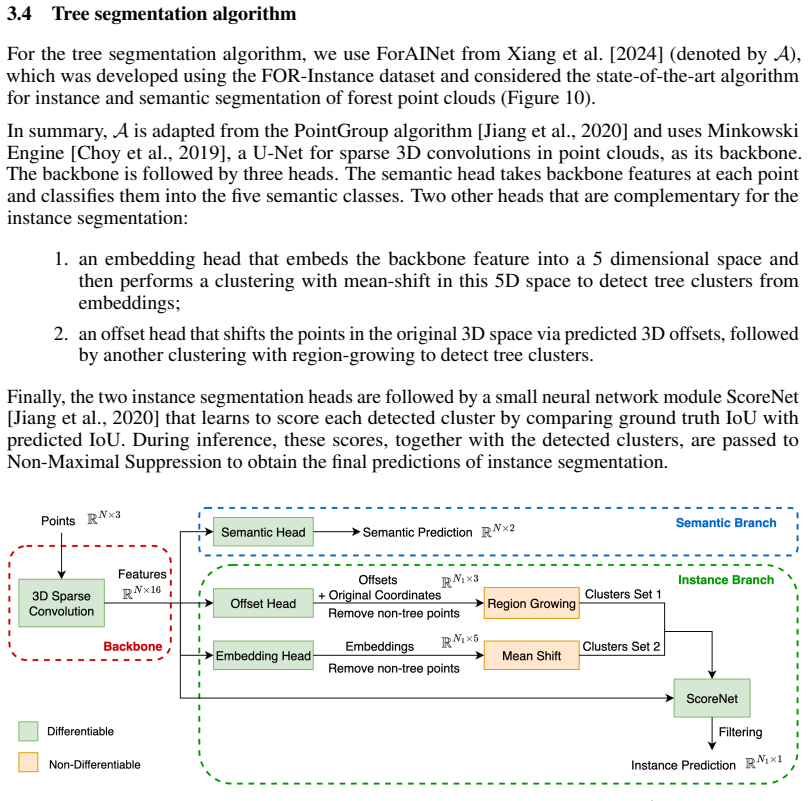
- domain assumption HELIOS ray-tracing LiDAR simulation faithfully reproduces the relevant statistics of real UAV laser scans (point density, multi-return, occlusion), sufficient for representation learning.
- domain assumption Per-tree unique IDs assigned to game-engine tree meshes correspond to the same 'individual tree' notion that FOR-Instance annotators label; trained instance discrimination transfers across this gap.
- domain assumption Pretraining on synthetic data followed by fine-tuning on real data transfers (domain randomization / meta-learning assumption).
- domain assumption The binary tree/non-tree remapping of FOR-Instance labels preserves the instance segmentation task well enough for the central claims.
- domain assumption Point density above 1000 pts/m2 is adequate for effective tree segmentation learning.
Cite this review
Pith. "Pith review of Scaling Up Forest Vision with Synthetic Data." pith.science (2026). https://pith.science/paper/PJGNA7EB
@misc{pith2026250911201,
  author       = {Pith},
  title        = {Pith review of: Scaling Up Forest Vision with Synthetic Data},
  year         = {2026},
  howpublished = {\url{https://pith.science/paper/PJGNA7EB}},
  note         = {Machine review of arXiv:2509.11201}
}
read the original abstract
Accurate tree segmentation is a key step in extracting individual tree metrics from forest laser scans, and is essential to understanding ecosystem functions in carbon cycling and beyond. Over the past decade, tree segmentation algorithms have advanced rapidly due to developments in AI. However existing, public, 3D forest datasets are not large enough to build robust tree segmentation systems. Motivated by the success of synthetic data in other domains such as self-driving, we investigate whether similar approaches can help with tree segmentation. In place of expensive field data collection and annotation, we use synthetic data during pretraining, and then require only minimal, real forest plot annotation for fine-tuning. We have developed a new synthetic data generation pipeline to do this for forest vision tasks, integrating advances in game-engines with physics-based LiDAR simulation. As a result, we have produced a comprehensive, diverse, annotated 3D forest dataset on an unprecedented scale. Extensive experiments with a state-of-the-art tree segmentation algorithm and a popular real dataset show that our synthetic data can substantially reduce the need for labelled real data. After fine-tuning on just a single, real, forest plot of less than 0.1 hectare, the pretrained model achieves segmentations that are competitive with a model trained on the full scale real data. We have also identified critical factors for successful use of synthetic data: physics, diversity, and scale, paving the way for more robust 3D forest vision systems in the future. Our data generation pipeline and the resulting dataset are available at https://github.com/yihshe/CAMP3D.git.
Figures








Reference graph
Works this paper leans on
-
[1]
The future of tropical forests under the united nations sustainable development goals
Latha Swamy, Erika Drazen, Whitney R Johnson, and Jacob J Bukoski. The future of tropical forests under the united nations sustainable development goals. Journal of sustainable forestry, 37 0 (2): 0 221--256, 2018
2018
-
[2]
The shape of trees: Reimagining forest ecology in three dimensions with remote sensing
Emily Rebecca Lines, Fabian J \"o rg Fischer, Harry Jon Foord Owen, and Tommaso Jucker. The shape of trees: Reimagining forest ecology in three dimensions with remote sensing. Journal of Ecology, 110 0 (8): 0 1730--1745, 2022
2022
-
[3]
Close-range remote sensing of forests: The state of the art, challenges, and opportunities for systems and data acquisitions
Xinlian Liang, Antero Kukko, Ivan Balenovi \'c , Ninni Saarinen, Samuli Junttila, Ville Kankare, Markus Holopainen, Martin Mokro s , Peter Surov \`y , Harri Kaartinen, et al. Close-range remote sensing of forests: The state of the art, challenges, and opportunities for systems and data acquisitions. IEEE Geoscience and Remote Sensing Magazine, 10 0 (3): 0...
2022
-
[4]
The global ecosystem dynamics investigation: High-resolution laser ranging of the earth’s forests and topography
Ralph Dubayah, James Bryan Blair, Scott Goetz, Lola Fatoyinbo, Matthew Hansen, Sean Healey, Michelle Hofton, George Hurtt, James Kellner, Scott Luthcke, et al. The global ecosystem dynamics investigation: High-resolution laser ranging of the earth’s forests and topography. Science of remote sensing, 1: 0 100002, 2020
2020
-
[5]
Global canopy height regression and uncertainty estimation from gedi lidar waveforms with deep ensembles
Nico Lang, Nikolai Kalischek, John Armston, Konrad Schindler, Ralph Dubayah, and Jan Dirk Wegner. Global canopy height regression and uncertainty estimation from gedi lidar waveforms with deep ensembles. Remote Sensing of Environment, 268: 0 112760, 2022
2022
-
[6]
Area-based vs tree-centric approaches to mapping forest carbon in southeast asian forests from airborne laser scanning data
David A Coomes, Michele Dalponte, Tommaso Jucker, Gregory P Asner, Lindsay F Banin, David FRP Burslem, Simon L Lewis, Reuben Nilus, Oliver L Phillips, Mui-How Phua, et al. Area-based vs tree-centric approaches to mapping forest carbon in southeast asian forests from airborne laser scanning data. Remote Sensing of Environment, 194: 0 77--88, 2017
2017
-
[7]
Stefano Puliti, Emily R Lines, Jana M \"u llerov \'a , Julian Frey, Zoe Schindler, Adrian Straker, Matthew J Allen, Lukas Winiwarter, Nataliia Rehush, Hristina Hristova, et al. Benchmarking tree species classification from proximally-sensed laser scanning data: introducing the for-species20k dataset. arXiv preprint arXiv:2408.06507, 2024
Pith/arXiv arXiv 2024
-
[8]
Monitoring ash dieback (hymenoscyphus fraxineus) in british forests using hyperspectral remote sensing
Aland HY Chan, Chloe Barnes, Tom Swinfield, and David A Coomes. Monitoring ash dieback (hymenoscyphus fraxineus) in british forests using hyperspectral remote sensing. Remote Sensing in Ecology and Conservation, 7 0 (2): 0 306--320, 2021
2021
-
[9]
o r \"a l \
Xinlian Liang, Yunsheng Wang, Jiri Py \"o r \"a l \"a , Matti Lehtom \"a ki, Xiaowei Yu, Harri Kaartinen, Antero Kukko, Eija Honkavaara, Aimad EI Issaoui, Olli Nevalainen, et al. Forest in situ observations using unmanned aerial vehicle as an alternative of terrestrial measurements. Forest ecosystems, 6 0 (1): 0 1--16, 2019
2019
-
[10]
Towards a worldwide wood economics spectrum
Jerome Chave, David Coomes, Steven Jansen, Simon L Lewis, Nathan G Swenson, and Amy E Zanne. Towards a worldwide wood economics spectrum. Ecology letters, 12 0 (4): 0 351--366, 2009
2009
-
[11]
Crown plasticity and competition for canopy space: a new spatially implicit model parameterized for 250 north american tree species
Drew W Purves, Jeremy W Lichstein, and Stephen W Pacala. Crown plasticity and competition for canopy space: a new spatially implicit model parameterized for 250 north american tree species. PloS one, 2 0 (9): 0 e870, 2007
2007
-
[12]
Global atmospheric methane uptake by upland tree woody surfaces
Vincent Gauci, Sunitha Rao Pangala, Alexander Shenkin, Josep Barba, David Bastviken, Viviane Figueiredo, Carla Gomez, Alex Enrich-Prast, Emma Sayer, Tain \'a Stauffer, et al. Global atmospheric methane uptake by upland tree woody surfaces. Nature, 631 0 (8022): 0 796--800, 2024
2024
-
[13]
Instance segmentation of individual tree crowns with yolov5: A comparison of approaches using the forinstance benchmark lidar dataset
Adrian Straker, Stefano Puliti, Johannes Breidenbach, Christoph Kleinn, Grant Pearse, Rasmus Astrup, and Paul Magdon. Instance segmentation of individual tree crowns with yolov5: A comparison of approaches using the forinstance benchmark lidar dataset. ISPRS Open Journal of Photogrammetry and Remote Sensing, 9: 0 100045, 2023
2023
-
[14]
Accurate tropical forest individual tree crown delineation from aerial rgb imagery using mask r-cnn
James GC Ball, Sebastian HM Hickman, Tobias D Jackson, Xian Jing Koay, James Hirst, William Jay, M \'e laine Aubry-Kientz, Gr \'e goire Vincent, and David A Coomes. Accurate tropical forest individual tree crown delineation from aerial rgb imagery using mask r-cnn. bioRxiv, pages 2022--07, 2022
2022
-
[15]
Point2tree (p2t)—framework for parameter tuning of semantic and instance segmentation used with mobile laser scanning data in coniferous forest
Maciej Wielgosz, Stefano Puliti, Phil Wilkes, and Rasmus Astrup. Point2tree (p2t)—framework for parameter tuning of semantic and instance segmentation used with mobile laser scanning data in coniferous forest. Remote Sensing, 15 0 (15): 0 3737, 2023
2023
-
[16]
Automated forest inventory: analysis of high-density airborne lidar point clouds with 3d deep learning
Binbin Xiang, Maciej Wielgosz, Theodora Kontogianni, Torben Peters, Stefano Puliti, Rasmus Astrup, and Konrad Schindler. Automated forest inventory: analysis of high-density airborne lidar point clouds with 3d deep learning. Remote Sensing of Environment, 305: 0 114078, 2024
2024
-
[17]
Maciej Wielgosz, Stefano Puliti, Binbin Xiang, Konrad Schindler, and Rasmus Astrup. Segmentanytree: A sensor and platform agnostic deep learning model for tree segmentation using laser scanning data. arXiv preprint arXiv:2401.15739, 2024
Pith/arXiv arXiv 2024
-
[18]
The bitter lesson
Richard Sutton. The bitter lesson. Incomplete Ideas (blog), 13 0 (1): 0 38, 2019
2019
-
[19]
a fer, Lukas Winiwarter, Nina Kra s ovec, Fabian E Fassnacht, and Bernhard H \
Hannah Weiser, Jannika Sch \"a fer, Lukas Winiwarter, Nina Kra s ovec, Fabian E Fassnacht, and Bernhard H \"o fle. Individual tree point clouds and tree measurements from multi-platform laser scanning in german forests. Earth System Science Data, 14 0 (7): 0 2989--3012, 2022
2022
-
[20]
Laser scanning reveals potential underestimation of biomass carbon in temperate forest
Kim Calders, Hans Verbeeck, Andrew Burt, Niall Origo, Joanne Nightingale, Yadvinder Malhi, Phil Wilkes, Pasi Raumonen, Robert GH Bunce, and Mathias Disney. Laser scanning reveals potential underestimation of biomass carbon in temperate forest. Ecological Solutions and Evidence, 3 0 (4): 0 e12197, 2022
2022
-
[21]
Stefano Puliti, Grant Pearse, Peter Surov \`y , Luke Wallace, Markus Hollaus, Maciej Wielgosz, and Rasmus Astrup. For-instance: a uav laser scanning benchmark dataset for semantic and instance segmentation of individual trees. arXiv preprint arXiv:2309.01279, 2023
Pith/arXiv arXiv 2023
-
[22]
Dataset meta-level and statistical features affect machine learning performance
Shahadat Uddin and Haohui Lu. Dataset meta-level and statistical features affect machine learning performance. Scientific Reports, 14 0 (1): 0 1670, 2024
2024
-
[23]
Real-time human pose recognition in parts from single depth images
Jamie Shotton, Andrew Fitzgibbon, Mat Cook, Toby Sharp, Mark Finocchio, Richard Moore, Alex Kipman, and Andrew Blake. Real-time human pose recognition in parts from single depth images. In CVPR 2011, pages 1297--1304. Ieee, 2011
2011
-
[24]
Haar: Text-conditioned generative model of 3d strand-based human hairstyles
Vanessa Sklyarova, Egor Zakharov, Otmar Hilliges, Michael J Black, and Justus Thies. Haar: Text-conditioned generative model of 3d strand-based human hairstyles. arXiv preprint arXiv:2312.11666, 2023
Pith/arXiv arXiv 2023
-
[25]
Virtual worlds as proxy for multi-object tracking analysis
Adrien Gaidon, Qiao Wang, Yohann Cabon, and Eleonora Vig. Virtual worlds as proxy for multi-object tracking analysis. In Proceedings of the IEEE conference on computer vision and pattern recognition, pages 4340--4349, 2016
2016
-
[26]
Hypersim: A photorealistic synthetic dataset for holistic indoor scene understanding
Mike Roberts, Jason Ramapuram, Anurag Ranjan, Atulit Kumar, Miguel Angel Bautista, Nathan Paczan, Russ Webb, and Joshua M Susskind. Hypersim: A photorealistic synthetic dataset for holistic indoor scene understanding. In Proceedings of the IEEE/CVF international conference on computer vision, pages 10912--10922, 2021
2021
-
[27]
Synthetic datasets for autonomous driving: A survey
Zhihang Song, Zimin He, Xingyu Li, Qiming Ma, Ruibo Ming, Zhiqi Mao, Huaxin Pei, Lihui Peng, Jianming Hu, Danya Yao, et al. Synthetic datasets for autonomous driving: A survey. IEEE Transactions on Intelligent Vehicles, 9 0 (1): 0 1847--1864, 2023
2023
-
[28]
Unreal engine environment generation (pcg): a comparative overview of existing tools
Nora Holmberg. Unreal engine environment generation (pcg): a comparative overview of existing tools. 2025
2025
-
[29]
Tree detection and diameter estimation based on deep learning
Vincent Grondin, Jean-Michel Fortin, François Pomerleau, and Philippe Giguère. Tree detection and diameter estimation based on deep learning. Forestry: An International Journal of Forest Research, 96 0 (2): 0 264–276, October 2022. ISSN 1464-3626. doi:10.1093/forestry/cpac043. URL http://dx.doi.org/10.1093/forestry/cpac043
-
[30]
M2fnet: Multi-modal forest monitoring network on large-scale virtual dataset
Yawen Lu, Yunhan Huang, Su Sun, Tansi Zhang, Xuewen Zhang, Songlin Fei, and Victor Chen. M2fnet: Multi-modal forest monitoring network on large-scale virtual dataset. arXiv preprint arXiv:2402.04534, 2024
Pith/arXiv arXiv 2024
-
[31]
Spread: A large-scale, high-fidelity synthetic dataset for multiple forest vision tasks
Zhengpeng Feng, Yihang She, and Srinivasan Keshav. Spread: A large-scale, high-fidelity synthetic dataset for multiple forest vision tasks. Ecological Informatics, 87: 0 103085, 2025
2025
-
[32]
Infinite nature: Perpetual view generation of natural scenes from a single image
Andrew Liu, Richard Tucker, Varun Jampani, Ameesh Makadia, Noah Snavely, and Angjoo Kanazawa. Infinite nature: Perpetual view generation of natural scenes from a single image. In Proceedings of the IEEE/CVF International Conference on Computer Vision, pages 14458--14467, 2021
2021
-
[33]
Virtual laser scanning with helios++: A novel take on ray tracing-based simulation of topographic full-waveform 3d laser scanning
Lukas Winiwarter, Alberto Manuel Esmor \' s Pena, Hannah Weiser, Katharina Anders, Jorge Mart \' nez S \'a nchez, Mark Searle, and Bernhard H \"o fle. Virtual laser scanning with helios++: A novel take on ray tracing-based simulation of topographic full-waveform 3d laser scanning. Remote Sensing of Environment, 269: 0 112772, 2022
2022
-
[34]
Unsupervised semantic and instance segmentation of forest point clouds
Di Wang. Unsupervised semantic and instance segmentation of forest point clouds. ISPRS Journal of Photogrammetry and Remote Sensing, 165: 0 86--97, 2020
2020
-
[35]
Domain adaptation of deep neural networks for tree part segmentation using synthetic forest trees
Mitch Bryson, Ahalya Ravendran, Celine Mercier, Tancred Frickey, Sadeepa Jayathunga, Grant Pearse, and Robin JL Hartley. Domain adaptation of deep neural networks for tree part segmentation using synthetic forest trees. ISPRS Open Journal of Photogrammetry and Remote Sensing, 14: 0 100078, 2024
2024
-
[36]
Domain randomization for transferring deep neural networks from simulation to the real world
Josh Tobin, Rachel Fong, Alex Ray, Jonas Schneider, Wojciech Zaremba, and Pieter Abbeel. Domain randomization for transferring deep neural networks from simulation to the real world. In 2017 IEEE/RSJ international conference on intelligent robots and systems (IROS), pages 23--30. IEEE, 2017
2017
-
[37]
Structured domain randomization: Bridging the reality gap by context-aware synthetic data
Aayush Prakash, Shaad Boochoon, Mark Brophy, David Acuna, Eric Cameracci, Gavriel State, Omer Shapira, and Stan Birchfield. Structured domain randomization: Bridging the reality gap by context-aware synthetic data. In 2019 International Conference on Robotics and Automation (ICRA), pages 7249--7255. IEEE, 2019
2019
-
[38]
Model-agnostic meta-learning for fast adaptation of deep networks
Chelsea Finn, Pieter Abbeel, and Sergey Levine. Model-agnostic meta-learning for fast adaptation of deep networks. In International conference on machine learning, pages 1126--1135. PMLR, 2017
2017
-
[39]
Jing Liu, Duanchu Wang, Haoran Gong, Chongyu Wang, Jihua Zhu, and Di Wang. Advancing the understanding of fine-grained 3d forest structures using digital cousins and simulation-to-reality: Methods and datasets. arXiv preprint arXiv:2501.03637, 2025
Pith/arXiv arXiv 2025
-
[40]
A high-resolution canopy height model of the earth
Nico Lang, Walter Jetz, Konrad Schindler, and Jan Dirk Wegner. A high-resolution canopy height model of the earth. Nature Ecology & Evolution, pages 1--12, 2023
2023
-
[41]
3d modeling and reconstruction of plants and trees: A cross-cutting review across computer graphics, vision, and plant phenotyping
Fumio Okura. 3d modeling and reconstruction of plants and trees: A cross-cutting review across computer graphics, vision, and plant phenotyping. Breeding Science, 72 0 (1): 0 31--47, 2022
2022
-
[42]
Enhancing uav--sfm 3d model accuracy in high-relief landscapes by incorporating oblique images
Paul Ryan Nesbit and Christopher H Hugenholtz. Enhancing uav--sfm 3d model accuracy in high-relief landscapes by incorporating oblique images. Remote Sensing, 11 0 (3): 0 239, 2019
2019
-
[43]
Technological advances in close range sensors and methodological complexities for measuring forest structure and disturbance
W Flynn. Technological advances in close range sensors and methodological complexities for measuring forest structure and disturbance. 2024
2024
-
[44]
Towards accurate instance segmentation in large-scale lidar point clouds
Binbin Xiang, Torben Peters, Theodora Kontogianni, Frawa Vetterli, Stefano Puliti, Rasmus Astrup, and Konrad Schindler. Towards accurate instance segmentation in large-scale lidar point clouds. arXiv preprint arXiv:2307.02877, 2023
Pith/arXiv arXiv 2023
-
[45]
a , Harri Kaartinen, Matti Lehtom \
Xinlian Liang, Juha Hyypp \"a , Harri Kaartinen, Matti Lehtom \"a ki, Jiri Py \"o r \"a l \"a , Norbert Pfeifer, Markus Holopainen, G \'a bor Brolly, Pirotti Francesco, Jan Hackenberg, et al. International benchmarking of terrestrial laser scanning approaches for forest inventories. ISPRS journal of photogrammetry and remote sensing, 144: 0 137--179, 2018
2018
-
[46]
Large-area virtual forests from terrestrial laser scanning data
Kim Calders, Andrew Burt, Niall Origo, Mathias Disney, J Nightingale, Pasi Raumonen, and Philip Lewis. Large-area virtual forests from terrestrial laser scanning data. In 2016 IEEE international geoscience and remote sensing symposium (IGARSS), pages 1765--1767. IEEE, 2016
2016
-
[47]
Carla: An open urban driving simulator
Alexey Dosovitskiy, German Ros, Felipe Codevilla, Antonio Lopez, and Vladlen Koltun. Carla: An open urban driving simulator. In Conference on robot learning, pages 1--16. PMLR, 2017
2017
-
[48]
Airsim-w: A simulation environment for wildlife conservation with uavs
Elizabeth Bondi, Debadeepta Dey, Ashish Kapoor, Jim Piavis, Shital Shah, Fei Fang, Bistra Dilkina, Robert Hannaford, Arvind Iyer, Lucas Joppa, et al. Airsim-w: A simulation environment for wildlife conservation with uavs. In Proceedings of the 1st ACM SIGCAS Conference on Computing and Sustainable Societies, pages 1--12, 2018
2018
-
[49]
Deep learning with simulated laser scanning data for 3d point cloud classification
Alberto M Esmor \' s, Hannah Weiser, Lukas Winiwarter, Jose C Cabaleiro, and Bernhard H \"o fle. Deep learning with simulated laser scanning data for 3d point cloud classification. ISPRS Journal of Photogrammetry and Remote Sensing, 215: 0 192--213, 2024
2024
-
[50]
a fer, Hannah Weiser, Lukas Winiwarter, Bernhard H \
Jannika Sch \"a fer, Hannah Weiser, Lukas Winiwarter, Bernhard H \"o fle, Sebastian Schmidtlein, and Fabian Ewald Fassnacht. Generating synthetic laser scanning data of forests by combining forest inventory information, a tree point cloud database and an open-source laser scanning simulator. Forestry: An International Journal of Forest Research, 96 0 (5):...
2023
-
[51]
Implications of 3d forest stand reconstruction methods for radiative transfer modeling: A case study in the temperate deciduous forest
Chang Liu, Kim Calders, F \'e licien Meunier, JP Gastellu-Etchegorry, J Nightingale, M Disney, N Origo, W Woodgate, and Hans Verbeeck. Implications of 3d forest stand reconstruction methods for radiative transfer modeling: A case study in the temperate deciduous forest. Journal of Geophysical Research: Atmospheres, 127 0 (14): 0 e2021JD036175, 2022
2022
-
[52]
Essay on the architecture and dynamics of growth of tropical trees
Francis Hall \'e and Roelof AA Oldeman. Essay on the architecture and dynamics of growth of tropical trees. 1970
1970
-
[53]
Forest models defined by field measurements: estimation, error analysis and dynamics
Stephen W Pacala, Charles D Canham, John Saponara, John A Silander Jr, Richard K Kobe, and Eric Ribbens. Forest models defined by field measurements: estimation, error analysis and dynamics. Ecological monographs, 66 0 (1): 0 1--43, 1996
1996
-
[54]
Semantic classification in uncolored 3d point clouds using multiscale features
Michael Neumann, Dorit Borrmann, and Andreas N \"u chter. Semantic classification in uncolored 3d point clouds using multiscale features. In International Conference on Intelligent Autonomous Systems, pages 342--359. Springer, 2022
2022
-
[55]
Pointgroup: Dual-set point grouping for 3d instance segmentation
Li Jiang, Hengshuang Zhao, Shaoshuai Shi, Shu Liu, Chi-Wing Fu, and Jiaya Jia. Pointgroup: Dual-set point grouping for 3d instance segmentation. In Proceedings of the IEEE/CVF conference on computer vision and Pattern recognition, pages 4867--4876, 2020
2020
-
[56]
4d spatio-temporal convnets: Minkowski convolutional neural networks
Christopher Choy, JunYoung Gwak, and Silvio Savarese. 4d spatio-temporal convnets: Minkowski convolutional neural networks. In Proceedings of the IEEE Conference on Computer Vision and Pattern Recognition, pages 3075--3084, 2019
2019
-
[57]
Umap: Uniform manifold approximation and projection for dimension reduction
Leland McInnes, John Healy, and James Melville. Umap: Uniform manifold approximation and projection for dimension reduction. arXiv preprint arXiv:1802.03426, 2018
Pith/arXiv arXiv 2018
-
[58]
3d gaussian splatting for real-time radiance field rendering
Bernhard Kerbl, Georgios Kopanas, Thomas Leimk \"u hler, and George Drettakis. 3d gaussian splatting for real-time radiance field rendering. ACM Transactions on Graphics, 42 0 (4): 0 1--14, 2023
2023
-
[59]
Towards multimodal open-set domain generalization and adaptation through self-supervision
Hao Dong, Eleni Chatzi, and Olga Fink. Towards multimodal open-set domain generalization and adaptation through self-supervision. In European Conference on Computer Vision, pages 270--287. Springer, 2024
2024
-
[60]
Multimodal cross-domain few-shot learning for egocentric action recognition
Masashi Hatano, Ryo Hachiuma, Ryo Fujii, and Hideo Saito. Multimodal cross-domain few-shot learning for egocentric action recognition. In European Conference on Computer Vision, pages 182--199. Springer, 2024
2024
-
[61]
Point transformer v3: Simpler faster stronger
Xiaoyang Wu, Li Jiang, Peng-Shuai Wang, Zhijian Liu, Xihui Liu, Yu Qiao, Wanli Ouyang, Tong He, and Hengshuang Zhao. Point transformer v3: Simpler faster stronger. In Proceedings of the IEEE/CVF conference on computer vision and pattern recognition, pages 4840--4851, 2024
2024
-
[62]
Forestformer3d: A unified framework for end-to-end segmentation of forest lidar 3d point clouds
Binbin Xiang, Maciej Wielgosz, Stefano Puliti, Kamil Kr \'a l, Martin Kr u c ek, Azim Missarov, and Rasmus Astrup. Forestformer3d: A unified framework for end-to-end segmentation of forest lidar 3d point clouds. arXiv preprint arXiv:2506.16991, 2025
Pith/arXiv arXiv 2025
-
[63]
Scaling vision transformers
Xiaohua Zhai, Alexander Kolesnikov, Neil Houlsby, and Lucas Beyer. Scaling vision transformers. In Proceedings of the IEEE/CVF conference on computer vision and pattern recognition, pages 12104--12113, 2022
2022
-
[64]
Weighing trees with lasers: advances, challenges and opportunities
Mathias I Disney, Matheus Boni Vicari, Andrew Burt, Kim Calders, Simon L Lewis, Pasi Raumonen, and Phil Wilkes. Weighing trees with lasers: advances, challenges and opportunities. Interface Focus, 8 0 (2): 0 20170048, 2018
2018
discussion (0)
Sign in with ORCID, Apple, or X to comment. Anyone can read and Pith papers without signing in.