REVIEW 4 major objections 6 minor 35 references
CIFNet: An Analytic Neural Learning Framework for Efficient and Calibrated Class-Incremental Learning
T0 review · 4 major / 6 minor · reviewed 2026-08-04 · deepseek-v4-flash
Pith's one-line read CIFNet shows class-incremental learning can be solved with closed-form classifier updates on frozen features, matching iterative baselines at a fraction of the energy.
desk verdict CIFNet's efficiency story is plausible, but the core ROLANN algorithm in the supplementary contradicts the main equations, and the ImageNet-100 comparison looks unfair. read the letter →
The pith
A machine-rendered reading of the paper's core claim, the machinery that carries it, and where it could break.
The reading
What carries the argument
The central object is ROLANN (Regularized One-Layer Neural Network), a non-iterative single-layer classifier that computes its output weights via a closed-form ridge regression solution: it applies SVD to the input matrix weighted by activation derivatives, maintains a moment matrix M, and obtains W = U (S S^T + λ I)^{-1} U^T M. For incrementally arriving tasks, ROLANN stores per-class knowledge triples (U, S, M) and combines new task partitions by concatenating the SVD decompositions and summing moment matrices, so weights are updated in one step without epochs. The second mechanism is the expansion buffer: a random subset of past-class embeddings (not raw images) is kept, and before each t
What would settle it
Run CIFAR-100 with 5-class increments using the expansion buffer but replacing the replication oversampling with simple class-size normalization (no replication). If final accuracy stays near the 19.42 no-buffer ablation, then the buffer itself is not the driver—the replication ratio is. Alternatively, shrink the buffer size progressively and check whether accuracy degrades continuously; a sharp drop would indicate a threshold dependence rather than a smooth calibration effect.
Extended reading notes
Core claim
CIFNet's central claim is that incremental class learning can be solved as a sequence of deterministic, closed-form classifier updates in a stationary embedding space. Rather than fine-tuning the backbone with backpropagation, CIFNet freezes a pretrained feature extractor and expands a one-layer network one neuron per new class. Each output neuron's weights are computed in closed form through Regularised Recursive Least-Squares (ROLANN), which combines SVD-decomposed knowledge from previous tasks with the new task's data via moment accumulation. Because the sigmoid output neurons are trained independently, newly added neurons have an initialization bias that makes them over-activate on old c
Load-bearing premise
The load-bearing assumption is that replicating a random subset of past-class embeddings until each matches the size of the current largest class is enough to create balanced, calibrated decision boundaries for the independently trained sigmoid neurons; the paper provides no theory for this, and the ablation shows that without the buffer accuracy collapses from 59.26 to 19.42.
Editorial extensions
If this is right
- Class-incremental learning on frozen features is solvable without backpropagation or iterative convergence, so the computation per task is a single deterministic weight update.
- Energy and training-time reductions of up to about 20x are achievable without sacrificing accuracy relative to iterative baselines on the reported benchmarks.
- Storing embeddings instead of raw images cuts replay-buffer memory dramatically (e.g., about 75x for ImageNet-100-sized inputs), making the approach practical in memory-limited settings.
- CIFNet is hyperparameter-free apart from the regularization constant and buffer size, which simplifies deployment compared to methods with many training hyperparameters.
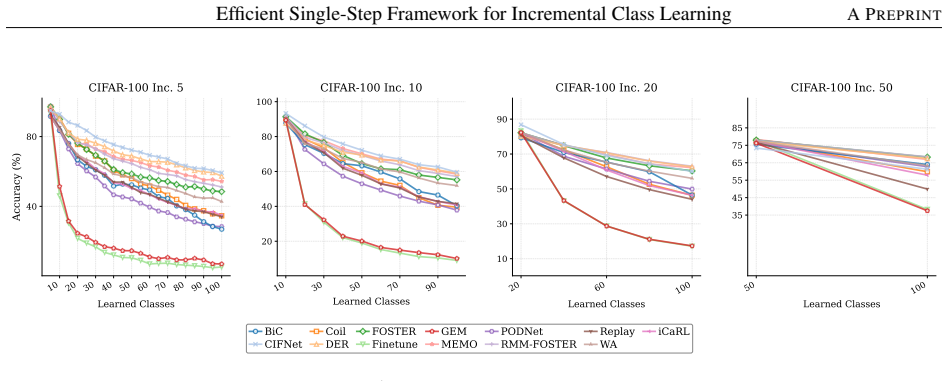
- Accuracy remains stable as the number of increments grows, so the method does not exhibit the characteristic collapse that several baselines show when tasks become smaller.
Reading between the lines
- If the approach holds, it implies that in domains with strong pretrained features, continual learning becomes primarily a calibration problem rather than a representation-learning problem; a testable extension is to attach CIFNet's buffer and oversampling to other frozen-backbone linear probes (e.g., logistic regression on CLIP or SimCLR features) to see if the same gain appears.
- The ablation shows the expansion buffer is indispensable, which suggests the specific random-sampling and replication heuristic is the true driver of performance; one could test whether herding or distance-based selection beats random sampling for the same number of stored embeddings.
- The energy and time figures are measured on a particular GPU/CPU setup and exclude the cost of pretraining the frozen backbone; a fair cross-method comparison would need to account for how each baseline's total energy includes backbone fine-tuning, and how the pretraining cost changes the sustainability picture.
- Because the method assumes the frozen features stay discriminative for all future classes (the authors acknowledge this limitation for medical and satellite imagery), a natural stress test is to evaluate CIFNet on domain-shifted benchmarks to find the point where the closed-form classifier breaks even with calibration.
Editorial analysis
A structured set of objections, weighed in public.
Referee Report
Summary. CIFNet proposes a class-incremental learning (CIL) method that combines a frozen pre-trained feature extractor with a regularized one-layer neural network (ROLANN) classifier, claiming to update classifier weights through a closed-form ridge-regression solution rather than iterative gradient descent. To handle the bias introduced by newly added sigmoid output neurons, the method stores a compressed embedding buffer of past-class features and uses density-aware oversampling. Experiments on CIFAR-100 and ImageNet-100 report accuracy comparable or superior to iterative CIL baselines, with substantial reductions in training time, energy consumption, and memory footprint (e.g., Tables 1–6). An ablation study (Table 7) indicates both the expansion buffer and oversampling are important for the reported accuracy.
Significance. If the closed-form update and calibration mechanism perform as described, CIFNet would be a practically valuable CIL method for settings where a strong frozen backbone is available, with raw efficiency gains that are meaningful for edge deployment and sustainability. The empirical results are notably strong on ImageNet-100 (e.g., 78.10% final accuracy in the Inc5 setting, Table 5) and the energy reduction claims are large. The paper also provides standard benchmarks, an ablation, and a code link, which are welcome practices. However, the central mathematical derivation contains an inconsistency that affects every experiment: the printed Algorithm 2 cannot be the algorithm that produced the results if the classifier uses binary sigmoid targets. Until this is resolved, the main contribution—the exact, closed-form, non-iterative update—is not established as written.
major comments (4)
- [Section 3.2, Eq. (4); Appendix A, Algorithm 2] Algorithm 2 is inconsistent with Eq. (4). Eq. (4) defines M = X (f' ⊙ f' ⊙ dbar), where dbar is the pre-activation value. In Algorithm 2, line 7 sets f' = f'(Y_p), where Y_p is the desired output, and line 11 computes M as X_p (f' ⊙ f' ⊙ Y_p). For the sigmoid activation used in Eq. (9), f'(Y_p) = Y_p(1 - Y_p). When Y_p are binary 0/1 targets, as is standard for independent sigmoid output neurons, every entry of F_p in line 8 is zero and M in line 11 is zero, so the SVD in line 10 is applied to a zero matrix. If Y_p is instead meant to be the post-activation network output, then line 11 uses the wrong variable and f^{-1}(Y_p) in line 6 is undefined for binary targets. The paper does not state that targets are clipped or soft, and the claimed 'exact closed-form ridge-regression solution' is therefore not defined as written. This affects every experiment and the central claim of the paper.
- [Section 5.1, 'Hyperparameters'; Section 3.2, Eq. (5)] The statement 'our method is hyperparameter-free' is not supported. The ROLANN update in Eq. (5) depends on a regularization parameter λ, the expansion buffer size m is a user-chosen hyperparameter, and the pretrained backbone is a design choice. The authors do not report how λ and m were selected or whether results are sensitive to them. This is not fatal, but the hyperparameter-free claim should be removed or qualified to 'no per-task tuning'.
- [Section 5.4, Table 7] The ablation shows the expansion buffer is load-bearing: removing it drops final accuracy on CIFAR-100 Inc5 from 59.26 to 19.42, a 40-point degradation. The paper justifies the buffer with a heuristic argument (random sampling plus oversampling until past classes match the largest current class size) but provides no formal guarantee that this produces 'globally balanced decision boundaries.' Given the magnitude of the effect, the calibration step deserves a more rigorous justification or an analysis of when the heuristic succeeds or fails, rather than only an empirical ablation.
- [Section 5.1, 'Backbone Selection and Training'; Tables 1–6] The comparison with iterative baselines may be confounded by initialization. CIFNet uses an ImageNet-pretrained ResNet-18 or ResNet-32 that is frozen; the paper does not state whether the baseline methods from Zhou et al. use the same pretrained initialization or are trained from scratch. If the baselines are not pretrained, much of the accuracy gap (especially on ImageNet-100, e.g., Table 5) could be attributed to the backbone rather than the CIFNet update scheme. The authors should clarify the baseline initialization and, ideally, include a comparison using the same frozen pretrained backbone.
minor comments (6)
- [Section 3.1] Typo: 'A major challenge in this process in this process is catastrophic forgetting' duplicates 'in this process'.
- [Appendix A, Algorithm 2] The variable \bar{Y}_p computed in line 6 is never used afterward. Either it is part of a missing computation or it should be removed to avoid confusion.
- [Section 2, Related Work] The method taxonomy is duplicated: GEM and DER appear under both 'Data Replay' and 'Data Regularization' (and DER under 'Knowledge Distillation' and 'Dynamic Networks' as well). Please clarify which category is primary for each method.
- [Figures 4 and 6] Figure 6 includes Inc20 and Inc50 markers for ImageNet-100, but Section 5.3 states these settings were omitted. The legend or the figure should be adjusted to match the experiments actually run.
- [Section 5.1] The repeated headings 'Selected Methods' and '5.1.1 Selected Methods' should be merged. Also, the sentence 'while the selected methods are based on CNNs' is a fragment.
- [Tables 1–6] The text says 'arrows indicating the improvement direction for each metric,' but the tables do not visibly contain arrows. Either add arrows as footnotes or remove the sentence.
Circularity Check
No significant circularity: the closed-form update is stated explicitly and performance is benchmarked externally; the ROLANN self-citation is not load-bearing.
full rationale
CIFNet's derivation chain is not circular. The closed-form ROLANN update (Eqs. 2-8) is presented directly in the paper rather than being inferred from a fitted quantity, and the complete system is evaluated on standard external benchmarks (CIFAR-100, ImageNet-100). The expansion buffer and oversampling are heuristic calibration components whose contribution is measured by an independent ablation (Table 7), not assumed by construction. No parameter is fitted to the reported accuracy and then renamed a prediction. The only self-citation is ROLANN [23], whose authors overlap with the present paper, but the paper restates the update equations and validates the full CIFNet system on external benchmarks, so the citation is not load-bearing in a circular sense. The noted inconsistency between Eq. (4) (which uses pre-activation d-bar) and Algorithm 2 (which uses Y_p in the moment matrix) is a mathematical correctness concern about whether the printed algorithm realizes the stated ridge-regression objective; it is not a case of a result reducing to its own inputs by definition. The conclusion also acknowledges the limitation of relying on fixed pre-trained features, further confirming that the performance claims are empirical rather than definitional.
Assumptions & free parameters
free parameters (3)
- Regularization parameter lambda in ROLANN =
not reported
- Buffer size per class m (total 2000) =
2000 total items
- Pretrained backbone choice =
ResNet-32 for CIFAR-100, ResNet-18 for ImageNet-100
assumptions (5)
- domain assumption ROLANN's update equations (Eq. 5-8) yield the correct regularized least squares solution for the sigmoid one-layer classifier.
- domain assumption Frozen ImageNet-pretrained features remain discriminative for all classes across the incremental sequence.
- domain assumption Random sampling of embeddings plus temporal oversampling is sufficient to calibrate newly added output neurons and prevent catastrophic bias.
- domain assumption Imported baselines from Zhou et al. [25] are trained comparably enough to CIFNet for a fair accuracy and efficiency comparison.
- standard math MSE surrogate loss for classification with sigmoid outputs approximates cross-entropy sufficiently for competitive accuracy.
Cite this review
Pith. "Pith review of CIFNet: An Analytic Neural Learning Framework for Efficient and Calibrated Class-Incremental Learning." pith.science (2026). https://pith.science/paper/O2X2VTVX
@misc{pith2026250911285,
  author       = {Pith},
  title        = {Pith review of: CIFNet: An Analytic Neural Learning Framework for Efficient and Calibrated Class-Incremental Learning},
  year         = {2026},
  howpublished = {\url{https://pith.science/paper/O2X2VTVX}},
  note         = {Machine review of arXiv:2509.11285}
}
abstract
Class-Incremental Learning (CIL) in deep neural networks is conventionally framed as an iterative gradient-based optimization problem, incurring high computational cost, hyperparameter sensitivity, and risk of catastrophic forgetting. In this work, we demonstrate that when leveraging frozen pre-trained representations, CIL can be solved as a sequence of deterministic, closed-form classifier adaptations without backpropagation or iterative convergence. We propose CIFNet, an analytic neural learning framework built upon Regularised Recursive Least-Squares (RRLS). CIFNet updates classifier weights via an exact, closed-form ridge-regression solution operating in a stationary embedding space. To counteract the structural initialisation bias that arises when newly expanded output neurons are introduced without exposure to past-class evidence, CIFNet incorporates a lightweight calibration buffer in latent space alongside density-aware oversampling, ensuring globally balanced decision boundaries without raw image storage or gradient updates. Extensive evaluations across CIFAR-100, ImageNet-100, and CORe50 show that CIFNet achieves predictive accuracy competitive with iterative CIL baselines while maintaining strictly monotonic, smooth learning trajectories free from intermediate performance collapse. Furthermore, by replacing epoch-wise backpropagation with closed-form moment accumulation, CIFNet achieves up to 20$\times$ reduction in energy consumption. These findings establish calibrated analytic learning as an efficient, stable, and mathematically grounded paradigm for continual adaptation in neural networks.
Figures


Figures from the paper (5 more)



Reference graph
Works this paper leans on
-
[1]
A case study of incremental concept induction
Jeffrey C Schlimmer and Douglas Fisher. A case study of incremental concept induction. InProceedings of the Fifth AAAI National Conference on Artificial Intelligence, pages 496–501, 1986
1986
-
[2]
Sylvestre Alvise Rebuffi, Alexander Kolesnikov, Georg Sperl, and Christoph H. Lampert. icarl: Incremental classifier and representation learning.Proceedings - 30th IEEE Conference on Computer Vision and Pattern Recognition, CVPR 2017, 2017-January:5533–5542, 11 2017
2017
-
[3]
Michael McCloskey and Neal J. Cohen. Catastrophic interference in connectionist networks: The sequential learning problem.Psychology of Learning and Motivation - Advances in Research and Theory, 24:109–165, 1 1989
1989
-
[4]
Learn to grow: A continual structure learning framework for overcoming catastrophic forgetting
Xilai Li, Yingbo Zhou, Tianfu Wu, Richard Socher, and Caiming Xiong. Learn to grow: A continual structure learning framework for overcoming catastrophic forgetting. InInternational conference on machine learning, pages 3925–3934. PMLR, 2019
2019
-
[5]
On tiny episodic memories in continual learning.arXiv preprint arXiv:1902.10486, 2019
Arslan Chaudhry, Marcus Rohrbach, Mohamed Elhoseiny, Thalaiyasingam Ajanthan, Puneet K Dokania, Philip HS Torr, and Marc’Aurelio Ranzato. On tiny episodic memories in continual learning.arXiv preprint arXiv:1902.10486, 2019
arXiv 1902
-
[6]
Dark experience for general continual learning: a strong, simple baseline.Advances in neural information processing systems, 33:15920–15930, 2020
Pietro Buzzega, Matteo Boschini, Angelo Porrello, Davide Abati, and Simone Calderara. Dark experience for general continual learning: a strong, simple baseline.Advances in neural information processing systems, 33:15920–15930, 2020. 16 Efficient Single-Step Framework for Incremental Class LearningA PREPRINT
2020
-
[7]
Revisiting class-incremental learning with pre-trained models: Generalizability and adaptivity are all you need.International Journal of Computer Vision, 133(3):1012–1032, 2025
Da-Wei Zhou, Zi-Wen Cai, Han-Jia Ye, De-Chuan Zhan, and Ziwei Liu. Revisiting class-incremental learning with pre-trained models: Generalizability and adaptivity are all you need.International Journal of Computer Vision, 133(3):1012–1032, 2025
2025
-
[8]
Imagenet: A large-scale hierarchical image database
Jia Deng, Wei Dong, Richard Socher, Li-Jia Li, Kai Li, and Li Fei-Fei. Imagenet: A large-scale hierarchical image database. In2009 IEEE conference on computer vision and pattern recognition, pages 248–255. Ieee, 2009
2009
Show all 35 references
-
[9]
Tiny imagenet visual recognition challenge.CS 231N, 7(7):3, 2015
Ya Le and Xuan Yang. Tiny imagenet visual recognition challenge.CS 231N, 7(7):3, 2015
2015
-
[10]
Parisi, Ronald Kemker, Jose L
German I. Parisi, Ronald Kemker, Jose L. Part, Christopher Kanan, and Stefan Wermter. Continual lifelong learning with neural networks: A review, 5 2019
2019
-
[11]
Memory-efficient incremental learning through feature adaptation
Ahmet Iscen, Jeffrey Zhang, Svetlana Lazebnik, and Cordelia Schmid. Memory-efficient incremental learning through feature adaptation. InComputer Vision–ECCV 2020: 16th European Conference, Glasgow, UK, August 23–28, 2020, Proceedings, Part XVI 16, pages 699–715. Springer, 2020
2020
-
[12]
Lifelong learning with dynamically expandable networks.arXiv preprint arXiv:1708.01547, 2017
Jaehong Yoon, Eunho Yang, Jeongtae Lee, and Sung Ju Hwang. Lifelong learning with dynamically expandable networks.arXiv preprint arXiv:1708.01547, 2017
2017 arXiv
-
[13]
Class-incremental learning: survey and performance evaluation on image classification.IEEE Transactions on Pattern Analysis and Machine Intelligence, 45(5):5513–5533, 2022
Marc Masana, Xialei Liu, Bartłomiej Twardowski, Mikel Menta, Andrew D Bagdanov, and Joost Van De Weijer. Class-incremental learning: survey and performance evaluation on image classification.IEEE Transactions on Pattern Analysis and Machine Intelligence, 45(5):5513–5533, 2022
2022
-
[14]
A neural network account of memory replay and knowledge consolidation
Daniel N Barry and Bradley C Love. A neural network account of memory replay and knowledge consolidation. Cerebral Cortex, 33(1):83–95, 2023
2023
-
[15]
Gradient based sample selection for online continual learning.Advances in neural information processing systems, 32, 2019
Rahaf Aljundi, Min Lin, Baptiste Goujaud, and Yoshua Bengio. Gradient based sample selection for online continual learning.Advances in neural information processing systems, 32, 2019
2019
-
[16]
Continual learning with deep generative replay
Hanul Shin, Jung Kwon Lee, Jaehong Kim, and Jiwon Kim. Continual learning with deep generative replay. Advances in neural information processing systems, 30, 2017
2017
-
[17]
Generative replay with feedback connections as a general strategy for continual learning.arXiv preprint arXiv:1809.10635, 2018
Gido M Van de Ven and Andreas S Tolias. Generative replay with feedback connections as a general strategy for continual learning.arXiv preprint arXiv:1809.10635, 2018
2018 arXiv
-
[18]
Class-incremental learning with generative classifiers
Gido M Van De Ven, Zhe Li, and Andreas S Tolias. Class-incremental learning with generative classifiers. In Proceedings of the IEEE/CVF Conference on Computer Vision and Pattern Recognition, pages 3611–3620, 2021
2021
-
[19]
Progressive neural networks.arXiv preprint arXiv:1606.04671, 2016
Andrei A Rusu, Neil C Rabinowitz, Guillaume Desjardins, Hubert Soyer, James Kirkpatrick, Koray Kavukcuoglu, Razvan Pascanu, and Raia Hadsell. Progressive neural networks.arXiv preprint arXiv:1606.04671, 2016
2016 arXiv
-
[20]
Packnet: Adding multiple tasks to a single network by iterative pruning
Arun Mallya and Svetlana Lazebnik. Packnet: Adding multiple tasks to a single network by iterative pruning. In Proceedings of the IEEE conference on Computer Vision and Pattern Recognition, pages 7765–7773, 2018
2018
-
[21]
Steven C. Y . Hung, Jia-Hong Lee, Timmy S. T. Wan, Chein-Hung Chen, Yi-Ming Chan, and Chu-Song Chen. Increasingly packing multiple facial-informatics modules in a unified deep-learning model via lifelong learning. InProceedings of the 2019 on International Conference on Multim...
2019
-
[22]
Generating instance-level prompts for rehearsal- free continual learning
Dahuin Jung, Dongyoon Han, Jihwan Bang, and Hwanjun Song. Generating instance-level prompts for rehearsal- free continual learning. InProceedings of the IEEE/CVF International Conference on Computer Vision, pages 11847–11857, 2023
2023
-
[23]
Regularized one-layer neural networks for distributed and incremental environments
Oscar Fontenla-Romero, Bertha Guijarro-Berdiñas, and Beatriz Pérez-Sánchez. Regularized one-layer neural networks for distributed and incremental environments. InAdvances in Computational Intelligence: 16th International Work-Conference on Artificial Neural Networks, IWANN 202...
2021
-
[24]
Deep residual learning for image recognition
Kaiming He, Xiangyu Zhang, Shaoqing Ren, and Jian Sun. Deep residual learning for image recognition. In Proceedings of the IEEE conference on computer vision and pattern recognition, pages 770–778, 2016
2016
-
[25]
Class-incremental learning: A survey.IEEE Transactions on Pattern Analysis and Machine Intelligence, 46(12):9851–9873, 2024
Da-Wei Zhou, Qi-Wei Wang, Zhi-Hong Qi, Han-Jia Ye, De-Chuan Zhan, and Ziwei Liu. Class-incremental learning: A survey.IEEE Transactions on Pattern Analysis and Machine Intelligence, 46(12):9851–9873, 2024
2024
-
[26]
Connectionist models of recognition memory: constraints imposed by learning and forgetting functions.Psychological review, 97(2):285, 1990
Roger Ratcliff. Connectionist models of recognition memory: constraints imposed by learning and forgetting functions.Psychological review, 97(2):285, 1990
1990
-
[27]
Rmm: Reinforced memory management for class-incremental learning.Advances in Neural Information Processing Systems, 34:3478–3490, 2021
Yaoyao Liu, Bernt Schiele, and Qianru Sun. Rmm: Reinforced memory management for class-incremental learning.Advances in Neural Information Processing Systems, 34:3478–3490, 2021
2021
-
[28]
Gradient episodic memory for continual learning.Advances in neural information processing systems, 30, 2017
David Lopez-Paz and Marc’Aurelio Ranzato. Gradient episodic memory for continual learning.Advances in neural information processing systems, 30, 2017
2017
-
[29]
Foster: Feature boosting and compression for class-incremental learning
Fu-Yun Wang, Da-Wei Zhou, Han-Jia Ye, and De-Chuan Zhan. Foster: Feature boosting and compression for class-incremental learning. InEuropean conference on computer vision, pages 398–414. Springer, 2022. 17 Efficient Single-Step Framework for Incremental Class LearningA PREPRINT
2022
-
[30]
A model or 603 exemplars: Towards memory- efficient class-incremental learning.arXiv preprint arXiv:2205.13218, 2022
Da-Wei Zhou, Qi-Wei Wang, Han-Jia Ye, and De-Chuan Zhan. A model or 603 exemplars: Towards memory- efficient class-incremental learning.arXiv preprint arXiv:2205.13218, 2022
2022 arXiv
-
[31]
Der: Dynamically expandable representation for class incremental learning
Shipeng Yan, Jiangwei Xie, and Xuming He. Der: Dynamically expandable representation for class incremental learning. InProceedings of the IEEE/CVF conference on computer vision and pattern recognition, pages 3014–3023, 2021
2021
-
[32]
Podnet: Pooled outputs distillation for small-tasks incremental learning
Arthur Douillard, Matthieu Cord, Charles Ollion, Thomas Robert, and Eduardo Valle. Podnet: Pooled outputs distillation for small-tasks incremental learning. InComputer vision–ECCV 2020: 16th European conference, Glasgow, UK, August 23–28, 2020, proceedings, part XX 16, pages 8...
2020
-
[33]
Co-transport for class-incremental learning
Da-Wei Zhou, Han-Jia Ye, and De-Chuan Zhan. Co-transport for class-incremental learning. InProceedings of the 29th ACM International Conference on Multimedia, pages 1645–1654, 2021
2021
-
[34]
Large scale incremental learning
Yue Wu, Yinpeng Chen, Lijuan Wang, Yuancheng Ye, Zicheng Liu, Yandong Guo, and Yun Fu. Large scale incremental learning. InProceedings of the IEEE/CVF conference on computer vision and pattern recognition, pages 374–382, 2019
2019
-
[35]
Maintaining discrimination and fairness in class incremental learning
Bowen Zhao, Xi Xiao, Guojun Gan, Bin Zhang, and Shu-Tao Xia. Maintaining discrimination and fairness in class incremental learning. InProceedings of the IEEE/CVF conference on computer vision and pattern recognition, pages 13208–13217, 2020. A ROLANN training algorithm The tra...
2020
Reviewed August 4, 2026 · model on record in the stance chip above.
Discussion (0). Sign in to comment.