Geometric Analysis of Magnetic Labyrinthine Stripe Evolution via U-Net Segmentation
Pith reviewed 2026-05-18 17:11 UTC · model grok-4.3
The pith
U-Net segmentation of magneto-optical images enables geometric tracking of magnetic stripe evolution and reveals two polarity-linked modes during annealing.
A machine-rendered reading of the paper's core claim, the machinery that carries it, and where it could break.
Core claim
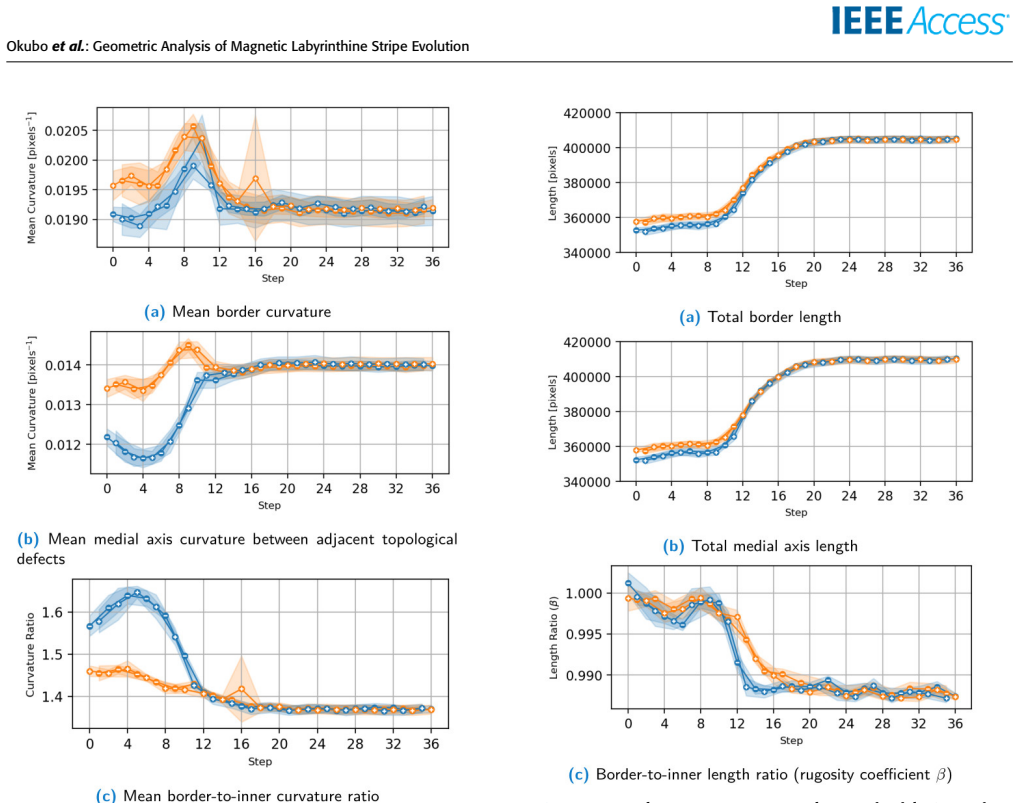
A U-Net trained exclusively on synthetic degradations including additive white Gaussian and Simplex noise segments experimental magneto-optical images of magnetic stripes in Bi:YIG films with sufficient accuracy for downstream analysis. Skeletonization, graph mapping, and spline fitting then quantify local stripe propagation through length and curvature. When applied to 444 images from 12 annealing protocol trials, the measurements show a transition from the quenched state to a more parallel annealed state and distinguish two evolution modes, Type A and Type B, that are linked to field polarity.
What carries the argument
The U-Net model for segmenting noisy magneto-optical images, combined with skeletonization, graph mapping, and spline fitting to extract stripe length and curvature measurements.
If this is right
- The method quantifies the geometric and topological changes during the transition from quenched to annealed states.
- Two distinct evolution modes, Type A and Type B, are linked to the polarity of the applied magnetic field.
- Local measurements of stripe length and curvature provide concrete data on structural evolution in labyrinthine patterns.
- The pipeline establishes a general tool for analyzing complex labyrinthine systems beyond this specific material.
Where Pith is reading between the lines
- The same segmentation-plus-geometry approach could be applied to time-series data to track individual stripe motion rather than ensemble statistics.
- If the two modes prove robust, targeted field protocols might be designed to favor one mode for applications requiring specific pattern alignments.
- Similar deep-learning segmentation could be tested on other imaging modalities in materials science where noise and occlusions obscure linear features.
Load-bearing premise
The U-Net model trained exclusively on synthetic degradations produces segmentations of real experimental images that are sufficiently accurate and unbiased for reliable geometric measurements of length and curvature.
What would settle it
Manually annotating a representative subset of the 444 experimental images, recomputing the length and curvature statistics, and checking whether the reported differences between Type A and Type B modes or between quenched and annealed states remain statistically significant.
Figures






read the original abstract
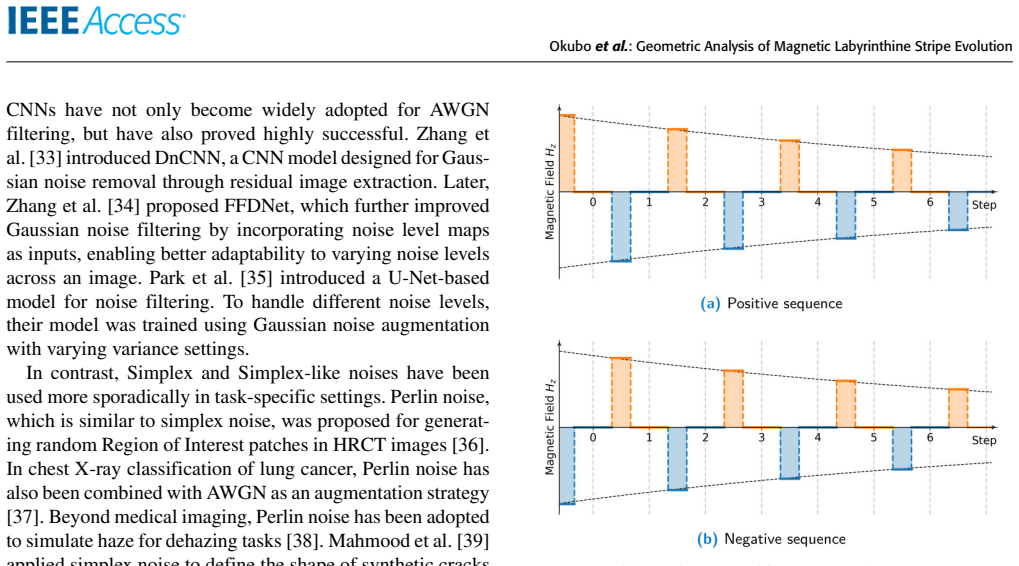
Labyrinthine stripe patterns are common in many physical systems, yet their lack of long-range order makes quantitative characterization challenging. We investigate the evolution of such patterns in bismuth-doped yttrium iron garnet (Bi:YIG) films subjected to a magnetic field annealing protocol. A U-Net deep learning model, trained with synthetic degradations including additive white Gaussian and Simplex noise, enables robust segmentation of experimental magneto-optical images despite noise and occlusions. Building on this segmentation, we develop a geometric analysis pipeline based on skeletonization, graph mapping, and spline fitting, which quantifies local stripe propagation through length and curvature measurements. Applying this framework to 444 images from 12 annealing protocol trials, we analyze the transition from the "quenched" state to a more parallel and coherent "annealed" state, and identify two distinct evolution modes (Type A and Type B) linked to field polarity. Our results provide a quantitative analysis of geometric and topological properties in magnetic stripe patterns and offer new insights into their local structural evolution, and establish a general tool for analyzing complex labyrinthine systems.
Editorial analysis
A structured set of objections, weighed in public.
Referee Report
Summary. The paper develops a U-Net segmentation model trained exclusively on synthetic additive white Gaussian and Simplex noise degradations to process magneto-optical images of labyrinthine stripe patterns in Bi:YIG films. It then applies a geometric pipeline (skeletonization, graph mapping, spline fitting) to extract length and curvature metrics from 444 images across 12 annealing trials, identifying a transition from quenched to annealed states and two distinct evolution modes (Type A and Type B) linked to field polarity.
Significance. If the segmentation step proves accurate and unbiased on real data, the work supplies a practical quantitative toolkit for characterizing disordered magnetic stripe patterns, enabling reproducible measurements of local propagation and topology that are otherwise difficult in labyrinthine systems. The scale of the experimental dataset (444 images) and the identification of polarity-linked modes represent a concrete advance in applying image-based geometric analysis to materials-science problems.
major comments (2)
- [Methods (U-Net subsection)] Methods section on U-Net training and validation: The model is trained solely on synthetic noise degradations, yet the manuscript reports no quantitative metrics (IoU, Dice, boundary F1, or pixel-wise error) and no direct comparison against manual annotations on actual Bi:YIG magneto-optical images. Because the central claims—identification of Type A versus Type B modes and the quenched-to-annealed transition—rest entirely on downstream length and curvature statistics derived from these segmentations, the absence of real-image validation is load-bearing and must be addressed before the geometric conclusions can be trusted.
- [Results (mode identification)] Results section describing mode classification: The distinction between Type A and Type B evolution modes is asserted to be linked to field polarity, but without reported error bars, statistical tests, or sensitivity analysis on the curvature/length distributions, it is unclear whether the separation survives plausible segmentation errors (e.g., boundary shifts of a few pixels). A concrete test—re-running the pipeline on a small manually annotated subset and showing that mode labels remain stable—would be required to substantiate the claim.
minor comments (2)
- [Abstract] Abstract: The phrase 'robust segmentation … despite noise and occlusions' is stated without supporting numbers; a brief parenthetical reference to any internal synthetic-test metrics would improve clarity.
- [Throughout] Figure captions and text: Several instances of undefined abbreviations (e.g., exact definition of 'quenched' versus 'annealed' state thresholds) appear; a short glossary or explicit definition in the first use would aid readability.
Simulated Author's Rebuttal
We thank the referee for their constructive and detailed comments on our manuscript. We have addressed each major comment point by point below, with revisions incorporated where appropriate to strengthen the validation and robustness of our findings.
read point-by-point responses
-
Referee: [Methods (U-Net subsection)] Methods section on U-Net training and validation: The model is trained solely on synthetic noise degradations, yet the manuscript reports no quantitative metrics (IoU, Dice, boundary F1, or pixel-wise error) and no direct comparison against manual annotations on actual Bi:YIG magneto-optical images. Because the central claims—identification of Type A versus Type B modes and the quenched-to-annealed transition—rest entirely on downstream length and curvature statistics derived from these segmentations, the absence of real-image validation is load-bearing and must be addressed before the geometric conclusions can be trusted.
Authors: We acknowledge that quantitative validation on real experimental images is important to support the reliability of the segmentation step and the downstream geometric conclusions. The original manuscript presented qualitative visual comparisons of segmented outputs on experimental magneto-optical images to demonstrate performance. To directly address this point, the revised manuscript now includes a dedicated validation subsection in Methods. This reports quantitative metrics (IoU and Dice scores) computed against manual annotations on a subset of real Bi:YIG images, along with a direct comparison to establish accuracy. These additions confirm that the segmentation quality is sufficient for the reported length and curvature statistics. revision: yes
-
Referee: [Results (mode identification)] Results section describing mode classification: The distinction between Type A and Type B evolution modes is asserted to be linked to field polarity, but without reported error bars, statistical tests, or sensitivity analysis on the curvature/length distributions, it is unclear whether the separation survives plausible segmentation errors (e.g., boundary shifts of a few pixels). A concrete test—re-running the pipeline on a small manually annotated subset and showing that mode labels remain stable—would be required to substantiate the claim.
Authors: We agree that additional statistical rigor and sensitivity checks are needed to substantiate the mode distinction and its link to field polarity. In the revised manuscript, we have added error bars to the length and curvature distribution plots (representing variation across trials) and included statistical tests (two-sample t-tests) to quantify the significance of differences between Type A and Type B modes. We have also performed a sensitivity analysis by applying controlled boundary perturbations to the segmentations and re-running the pipeline, confirming that mode assignments remain stable. Furthermore, we re-ran the full geometric analysis on a small manually annotated subset of real images and verified that the identified modes are consistent with those from the larger dataset. These results are now reported in the Results section with an accompanying supplementary figure. revision: yes
Circularity Check
No circularity: empirical pipeline is self-contained data analysis
full rationale
The paper describes an applied image-processing workflow: a U-Net is trained exclusively on synthetic degradations and then used to segment real experimental magneto-optical images, after which skeletonization, graph mapping, and spline fitting produce length and curvature statistics that are inspected across 444 frames to label Type A versus Type B evolution modes. No equation or claim reduces a reported result to the same fitted quantity by construction, no uniqueness theorem is imported via self-citation, and no ansatz is smuggled in. The central observations are direct measurements on the experimental dataset and therefore remain independent of the inputs used to train the segmenter.
Axiom & Free-Parameter Ledger
axioms (2)
- domain assumption Synthetic noise degradations (additive white Gaussian and Simplex) are sufficient to train a model that generalizes to real magneto-optical images.
- domain assumption Skeletonization followed by graph mapping and spline fitting produces length and curvature values that accurately reflect physical stripe propagation.
Lean theorems connected to this paper
-
IndisputableMonolith/Foundation/Cost.leanJcost uniqueness / washburn_uniqueness_aczel unclear?
unclearRelation between the paper passage and the cited Recognition theorem.
A U-Net deep learning model, trained with synthetic degradations including additive white Gaussian and Simplex noise, enables robust segmentation... geometric analysis pipeline based on skeletonization, graph mapping, and spline fitting, which quantifies local stripe propagation through length and curvature measurements.
-
IndisputableMonolith/Foundation/AlexanderDuality.leanalexander_duality_circle_linking / D=3 forcing unclear?
unclearRelation between the paper passage and the cited Recognition theorem.
Applying this framework to 444 images from 12 annealing protocol trials... identify two distinct evolution modes (Type A and Type B) linked to field polarity.
What do these tags mean?
- matches
- The paper's claim is directly supported by a theorem in the formal canon.
- supports
- The theorem supports part of the paper's argument, but the paper may add assumptions or extra steps.
- extends
- The paper goes beyond the formal theorem; the theorem is a base layer rather than the whole result.
- uses
- The paper appears to rely on the theorem as machinery.
- contradicts
- The paper's claim conflicts with a theorem or certificate in the canon.
- unclear
- Pith found a possible connection, but the passage is too broad, indirect, or ambiguous to say the theorem truly supports the claim.
Reference graph
Works this paper leans on
-
[1]
G. Nicolis and I. Prigogine,Self Organization in Non Equilibrium Systems. Wiley, 1977
work page 1977
-
[2]
M. C. Cross and P . C. Hohenberg, ‘‘Pattern formation outside of equilibrium,’’Rev. Mod. Phys., vol. 65, pp. 851–1112, Jul 1993. [Online]. Available: https://link.aps.org/doi/10.1103/RevModPhys.65.851
-
[3]
A. J. Koch and H. Meinhardt, ‘‘Biological pattern formation: from basic mechanisms to complex structures,’’Rev. Mod. Phys., vol. 66, pp. 1481–1507, Oct 1994. [Online]. Available: https://link.aps.org/doi/10. 1103/RevModPhys.66.1481
work page 1994
-
[4]
Pismen,Patterns and Interfaces in Dissipative Dynamics
L. Pismen,Patterns and Interfaces in Dissipative Dynamics. Springer, 2006
work page 2006
-
[5]
M. Cross and H. Greenside,Pattern F ormation and Dynamics in Non- Equilibrium Systems. Cambridge University Press, 2009
work page 2009
-
[6]
Q. Ouyang and H. L. Swinney, ‘‘Transition from a uniform state to hexagonal and striped turing patterns,’’Nature, vol. 352, no. 6336, pp. 610– 612, Aug 1991. [Online]. Available: https://doi.org/10.1038/352610a0
-
[7]
K. R. Elder, J. Viñals, and M. Grant, ‘‘Dynamic scaling and quasiordered states in the two-dimensional swift-hohenberg equation,’’Phys. Rev. A, vol. 46, pp. 7618–7629, Dec 1992. [Online]. Available: https: //link.aps.org/doi/10.1103/PhysRevA.46.7618
-
[8]
M. C. Cross and D. I. Meiron, ‘‘Domain coarsening in systems far from equilibrium,’’Phys. Rev. Lett., vol. 75, pp. 2152–2155, Sep 1995. [Online]. Available: https://link.aps.org/doi/10.1103/PhysRevLett.75.2152
-
[9]
J. J. Christensen and A. J. Bray, ‘‘Pattern dynamics of rayleigh- bénard convective rolls and weakly segregated diblock copolymers,’’ Phys. Rev. E, vol. 58, pp. 5364–5370, Nov 1998. [Online]. Available: https://link.aps.org/doi/10.1103/PhysRevE.58.5364
-
[10]
S. Echeverría-Alar and M. G. Clerc, ‘‘Labyrinthine patterns transitions,’’ Phys. Rev. Res., vol. 2, p. 042036, Dec 2020. [Online]. Available: https://link.aps.org/doi/10.1103/PhysRevResearch.2.042036
-
[11]
G. H. Gunaratne, R. E. Jones, Q. Ouyang, and H. L. Swinney, ‘‘An invariant measure of disorder in patterns,’’Phys. Rev. Lett., vol. 75, pp. 3281–3284, Oct 1995. [Online]. Available: https://link.aps.org/doi/10. 1103/PhysRevLett.75.3281
work page 1995
-
[12]
S. Hu, D. I. Goldman, D. J. Kouri, D. K. Hoffman, H. L. Swinney, and G. H. Gunaratne, ‘‘Stages of relaxation of patterns and the role of stochasticity in the final stage,’’Nonlinearity, vol. 17, no. 4, p. 1535, may
-
[13]
Available: https://dx.doi.org/10.1088/0951-7715/17/4/021
[Online]. Available: https://dx.doi.org/10.1088/0951-7715/17/4/021
-
[14]
G. Nathan and G. Gunaratne, ‘‘Set of measures to analyze the dynamics of nonequilibrium structures,’’Phys. Rev. E, vol. 71, p. 035101, Mar 2005. [Online]. Available: https://link.aps.org/doi/10.1103/PhysRevE.71.035101
-
[15]
S. Hu, G. Nathan, D. J. Kouri, D. K. Hoffman, and G. H. Gunaratne, ‘‘Statistical characterizations of spatiotemporal patterns generated in the Swift–Hohenberg model,’’Chaos: An Interdisciplinary Journal of Nonlinear Science, vol. 15, no. 4, p. 043701, 11 2005. [Online]. Available: https://doi.org/10.1063/1.2046487
-
[16]
Q. Hou, S. Sasa, and N. Goldenfeld, ‘‘Dynamical scaling behavior of the swift-hohenberg equation following a quench to the modulated state,’’ Physica A: Statistical Mechanics and its Applications, vol. 239, no. 1, pp. 219–226, 1997. [Online]. Available: https://www.sciencedirect.com/ science/article/pii/S0378437196004803
work page 1997
-
[17]
M. Seul and R. Wolfe, ‘‘Evolution of disorder in two-dimensional stripe patterns: ‘‘smectic’’ instabilities and disclination unbinding,’’Phys. Rev. Lett., vol. 68, pp. 2460–2463, Apr 1992. [Online]. Available: https://link.aps.org/doi/10.1103/PhysRevLett.68.2460
-
[18]
——, ‘‘Evolution of disorder in magnetic stripe domains. ii. hairpins and labyrinth patterns versus branches and comb patterns formed by growing minority component,’’Phys. Rev. A, vol. 46, pp. 7534–7547, Dec 1992. [Online]. Available: https://link.aps.org/doi/10.1103/PhysRevA.46.7534
-
[19]
L. R. M. M. Seul and L. O’Gorman, ‘‘Pattern analysis of magnetic stripe domains morphology and topological defects in the disordered state,’’ Philosophical Magazine B, vol. 66, no. 4, pp. 471–506, 1992. [Online]. Available: https://doi.org/10.1080/13642819208220116
-
[20]
V . Y . Okubo, K. Shimizu, B. S. Shivaram, and H. Y ong Kim, ‘‘Characteri- zation of magnetic labyrinthine structures through junctions and terminals detection using template matching and cnn,’’IEEE Access, vol. 12, pp. 92 419–92 430, 2024
work page 2024
-
[21]
K. Shimizu, V . Y . Okubo, R. Knight, Z. Wang, J. Burton, H. Y . Kim, G.-W. Chern, and B. Shivaram, ‘‘Machine learning assisted characterization of labyrinthine pattern transitions,’’arXiv preprint arXiv:2311.10558, 2023
-
[22]
J. Long, E. Shelhamer, and T. Darrell, ‘‘Fully convolutional networks for semantic segmentation,’’ inProceedings of the IEEE conference on computer vision and pattern recognition, 2015, pp. 3431–3440
work page 2015
-
[23]
O. Ronneberger, P . Fischer, and T. Brox, ‘‘U-net: Convolutional networks for biomedical image segmentation,’’ inMedical image computing and computer-assisted intervention–MICCAI 2015: 18th international confer- ence, Munich, Germany, October 5-9, 2015, proceedings, part III 18. Springer, 2015, pp. 234–241
work page 2015
-
[24]
R. Azad, E. K. Aghdam, A. Rauland, Y . Jia, A. H. Avval, A. Bozorgpour, S. Karimijafarbigloo, J. P . Cohen, E. Adeli, and D. Merhof, ‘‘Medical image segmentation review: The success of u-net,’’IEEE Transactions on Pattern Analysis and Machine Intelligence, 2024
work page 2024
-
[25]
J. Wu, W. Liu, C. Li, T. Jiang, I. M. Shariful, Y . Y ao, H. Sun, X. Li, X. Li, X. Huang, and M. Grzegorzek, ‘‘A state-of-the-art survey of U-Net in microscopic image analysis: from simple usage to structure mortification,’’ Neural Computing and Applications, vol. 36, no. 7, pp. 3317–3346, Mar. 2024
work page 2024
- [26]
-
[27]
D. Guo, Y . Pei, K. Zheng, H. Y u, Y . Lu, and S. Wang, ‘‘Degraded image semantic segmentation with dense-gram networks,’’IEEE Transactions on Image Processing, vol. 29, pp. 782–795, 2019
work page 2019
-
[28]
A. Rajagopalanet al., ‘‘Improving robustness of semantic segmentation to motion-blur using class-centric augmentation,’’ inProceedings of the IEEE/CVF Conference on Computer Vision and Pattern Recognition, 2023, pp. 10 470–10 479
work page 2023
-
[29]
F. Zhao, J. Feng, J. Zhao, W. Y ang, and S. Y an, ‘‘Robust lstm-autoencoders for face de-occlusion in the wild,’’IEEE Transactions on Image Process- ing, vol. 27, no. 2, pp. 778–790, 2017
work page 2017
-
[30]
T. Matsui and M. Ikehara, ‘‘Single-image fence removal using deep con- volutional neural network,’’IEEE Access, vol. 8, pp. 38 846–38 854, 2019
work page 2019
-
[31]
C. Sakaridis, D. Dai, and L. V an Gool, ‘‘Semantic foggy scene understand- ing with synthetic data,’’International Journal of Computer Vision, vol. 126, pp. 973–992, 2018
work page 2018
-
[32]
Z. Hao, S. Y ou, Y . Li, K. Li, and F. Lu, ‘‘Learning from synthetic photo- realistic raindrop for single image raindrop removal,’’ inProceedings of the IEEE/CVF International Conference on Computer Vision Workshops, 2019, pp. 0–0
work page 2019
-
[33]
H. C. Burger, C. J. Schuler, and S. Harmeling, ‘‘Image denoising: Can plain neural networks compete with bm3d?’’ in2012 IEEE conference on computer vision and pattern recognition. IEEE, 2012, pp. 2392–2399
work page 2012
- [34]
- [35]
-
[36]
B. Park, S. Y u, and J. Jeong, ‘‘Densely connected hierarchical network for image denoising,’’ inProceedings of the IEEE/CVF conference on computer vision and pattern recognition workshops, 2019, pp. 0–0
work page 2019
-
[37]
H.-J. Bae, C.-W. Kim, N. Kim, B. Park, N. Kim, J. B. Seo, and S. M. Lee, ‘‘A perlin noise-based augmentation strategy for deep learning with small 12 VOLUME 11, 2023 Okuboet al.: Geometric Analysis of Magnetic Labyrinthine Stripe Evolution data samples of hrct images,’’Scientific Reports, vol. 8, no. 1, p. 17687, Dec
work page 2023
-
[38]
Available: https://doi.org/10.1038/s41598-018-36047-2
[Online]. Available: https://doi.org/10.1038/s41598-018-36047-2
-
[39]
M. Haekal, R. Septiawan, F. Haryanto, and I. Arif, ‘‘A comparison on the use of perlin-noise and gaussian noise based augmentation on x-ray classification of lung cancer patient,’’Journal of Physics: Conference Series, vol. 1951, no. 1, p. 012064, jun 2021. [Online]. Available: https://dx.doi.org/10.1088/1742-6596/1951/1/012064
-
[40]
Y . Zheng, J. Su, S. Zhang, M. Tao, and L. Wang, ‘‘Unpaired remote sensing image dehazing using enhanced skip attention-based generative adversarial networks with rotation invariance,’’Remote Sensing, vol. 16, no. 15, 2024. [Online]. Available: https://www.mdpi.com/2072-4292/16/15/2707
work page 2024
-
[41]
F. Mahmood, M. Inglezou, P . Chatzakos, and A. Porichis, ‘‘Enhancing crack segmentation with limited data: Singan-based synthesis and blending of textures and cracks,’’IEEE Access, vol. 13, pp. 104 555–104 564, 2025
work page 2025
-
[42]
J. Li, M. Li, S. Huang, G. Wang, and X. Zhao, ‘‘Industrial image anomaly detection via synthetic-anomaly contrastive distillation,’’Sensors, vol. 25, no. 12, 2025. [Online]. Available: https://www.mdpi.com/1424-8220/25/ 12/3721
work page 2025
-
[43]
An Image is Worth 16x16 Words: Transformers for Image Recognition at Scale
A. Dosovitskiy, ‘‘An image is worth 16x16 words: Transformers for image recognition at scale,’’arXiv preprint arXiv:2010.11929, 2020
work page internal anchor Pith review Pith/arXiv arXiv 2010
-
[44]
R. Strudel, R. Garcia, I. Laptev, and C. Schmid, ‘‘Segmenter: Transformer for semantic segmentation,’’ inProceedings of the IEEE/CVF international conference on computer vision, 2021, pp. 7262–7272
work page 2021
-
[45]
S. Zheng, J. Lu, H. Zhao, X. Zhu, Z. Luo, Y . Wang, Y . Fu, J. Feng, T. Xiang, P . H. Torret al., ‘‘Rethinking semantic segmentation from a sequence-to- sequence perspective with transformers,’’ inProceedings of the IEEE/CVF conference on computer vision and pattern recognition, 2021, pp. 6881– 6890
work page 2021
-
[46]
Z. Liu, Y . Lin, Y . Cao, H. Hu, Y . Wei, Z. Zhang, S. Lin, and B. Guo, ‘‘Swin transformer: Hierarchical vision transformer using shifted windows,’’ in Proceedings of the IEEE/CVF international conference on computer vi- sion, 2021, pp. 10 012–10 022
work page 2021
-
[47]
H. Chen, Y . Wang, T. Guo, C. Xu, Y . Deng, Z. Liu, S. Ma, C. Xu, C. Xu, and W. Gao, ‘‘Pre-trained image processing transformer,’’ inProceedings of the IEEE/CVF conference on computer vision and pattern recognition, 2021, pp. 12 299–12 310
work page 2021
- [48]
-
[49]
S. W. Zamir, A. Arora, S. Khan, M. Hayat, F. S. Khan, and M.-H. Y ang, ‘‘Restormer: Efficient transformer for high-resolution image restoration,’’ inProceedings of the IEEE/CVF conference on computer vision and pat- tern recognition, 2022, pp. 5728–5739
work page 2022
-
[50]
P . Isola, J.-Y . Zhu, T. Zhou, and A. A. Efros, ‘‘Image-to-image translation with conditional adversarial networks,’’ inProceedings of the IEEE con- ference on computer vision and pattern recognition, 2017, pp. 1125–1134
work page 2017
-
[51]
I. Goodfellow, J. Pouget-Abadie, M. Mirza, B. Xu, D. Warde- Farley, S. Ozair, A. Courville, and Y . Bengio, ‘‘Generative adversarial nets,’’ inAdvances in Neural Information Processing Systems, Z. Ghahramani, M. Welling, C. Cortes, N. Lawrence, and K. Weinberger, Eds., vol. 27. Curran Associates, Inc.,
-
[52]
[Online]. Available: https://proceedings.neurips.cc/paper_files/ paper/2014/file/5ca3e9b122f61f8f06494c97b1afccf3-Paper.pdf
work page 2014
-
[53]
M. Majurski, P . Manescu, S. Padi, N. Schaub, N. Hotaling, C. Simon Jr, and P . Bajcsy, ‘‘Cell image segmentation using generative adversarial networks, transfer learning, and augmentations,’’ inProceedings of the IEEE/CVF conference on computer vision and pattern recognition workshops, 2019, pp. 0–0
work page 2019
- [54]
- [55]
- [56]
-
[57]
R. Qian, R. T. Tan, W. Y ang, J. Su, and J. Liu, ‘‘Attentive generative adver- sarial network for raindrop removal from a single image,’’ inProceedings of the IEEE conference on computer vision and pattern recognition, 2018, pp. 2482–2491
work page 2018
-
[58]
J. Dong, L. Zhang, H. Zhang, and W. Liu, ‘‘Occlusion-aware gan for face de-occlusion in the wild,’’ in2020 IEEE International conference on multimedia and expo (ICME). IEEE Computer Society, 2020, pp. 1–6
work page 2020
-
[59]
O. Angah and A. Y . Chen, ‘‘Removal of occluding construction workers in job site image data using u-net based context encoders,’’Automation in Construction, vol. 119, p. 103332, 2020
work page 2020
-
[60]
I. B. Puchalska, G. A. Jones, and H. Jouve, ‘‘A new aspect on the observation of domain structure in garnet epilayers,’’Journal of Physics D: Applied Physics, vol. 11, no. 15, p. L175, oct 1978. [Online]. Available: https://dx.doi.org/10.1088/0022-3727/11/15/002
-
[61]
N. Otsu, ‘‘A threshold selection method from gray-level histograms,’’IEEE Transactions on Systems, Man, and Cybernetics, vol. 9, no. 1, pp. 62–66, 1979
work page 1979
-
[62]
K. Perlin, ‘‘Improving noise,’’ inProceedings of the 29th annual confer- ence on Computer graphics and interactive techniques, 2002, pp. 681–682
work page 2002
-
[63]
S. Suzuki and K. Abe, ‘‘Topological structural analysis of digitized binary images by border following,’’Computer Vision, Graphics, and Image Processing, vol. 30, no. 1, pp. 32–46, 1985. [Online]. Available: https://www.sciencedirect.com/science/article/pii/0734189X85900167
-
[64]
html#smoothing-splines-with-automatic-knot-selection, accessed: 2025- 08-24
SciPy Community, ‘‘Scipy v1.16.1 reference guide: Smoothing splines,’’ https://docs.scipy.org/doc/scipy/tutorial/interpolate/smoothing_splines. html#smoothing-splines-with-automatic-knot-selection, accessed: 2025- 08-24. VINÍCIUS YU OKUBOwas born in Campinas, Brazil, in 1999. He completed his B.S. in electri- cal engineering from the University of São Pau...
work page 2025
discussion (0)
Sign in with ORCID, Apple, or X to comment. Anyone can read and Pith papers without signing in.