Improving the efficiency of finite-time memory erasure with potential barrier shaping
Pith reviewed 2026-05-18 16:45 UTC · model grok-4.3
The pith
Asymmetric potential wells allow finite-time memory erasure to release less heat than the Landauer limit.
A machine-rendered reading of the paper's core claim, the machinery that carries it, and where it could break.
Core claim
In a model where binary memory states correspond to wells in an asymmetric bistable potential separated by an asymmetric barrier, the work required for finite-time erasure decreases with greater asymmetry, allowing values below kT ln 2, while the effective free energy change of the process provides the true lower bound for the dissipated heat, recovering the Landauer limit only in the symmetric case.
What carries the argument
The asymmetric bistable potential with tunable well widths and barrier asymmetry, which models different phase-space volumes for energetically equivalent states and enables reduced dissipation in erasure protocols.
If this is right
- The heat released in finite-time erasure can be minimized by optimizing the asymmetry parameters of the potential.
- The deviation from the Landauer bound increases with the degree of asymmetry in the well widths and barrier.
- The effective free energy change serves as a general lower bound for work or heat in such processes.
- Symmetric setups recover the approach to the Landauer limit as asymmetry goes to zero.
Where Pith is reading between the lines
- Designers of low-power memory devices could incorporate controlled asymmetry in potential landscapes to achieve better efficiency at high speeds.
- This approach might extend to other information-processing tasks like logical operations where finite-time constraints apply.
- Experimental tests in colloidal systems or optical traps could verify the reduced heat by shaping the trapping potential asymmetrically.
Load-bearing premise
The asymmetry in the potential can be introduced and controlled without incurring additional work costs beyond those calculated in the stochastic thermodynamics framework.
What would settle it
Performing a finite-time erasure experiment in an asymmetric double-well potential and observing whether the measured heat dissipation falls below kT ln 2 for nonzero asymmetry.
Figures






read the original abstract
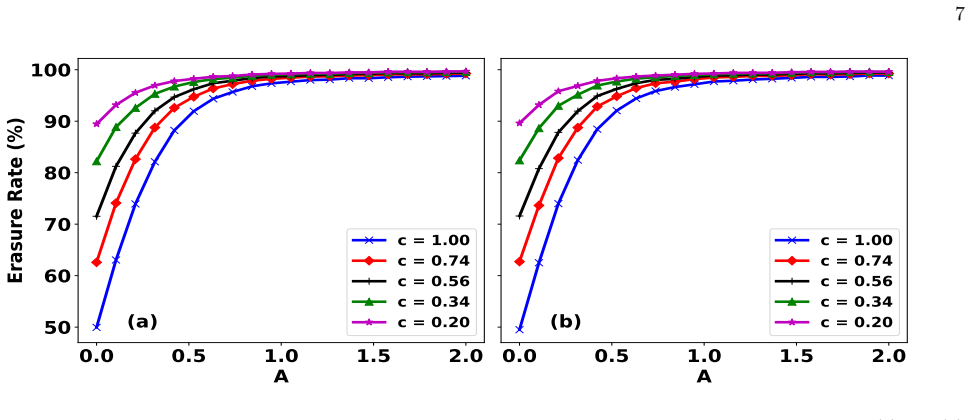
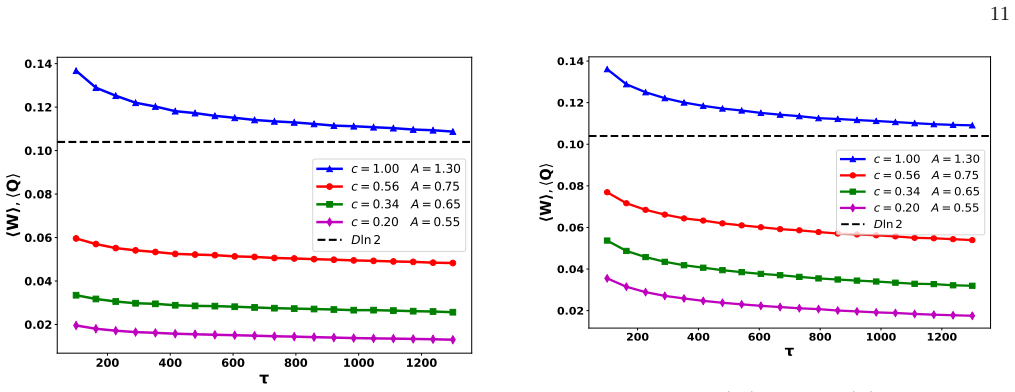
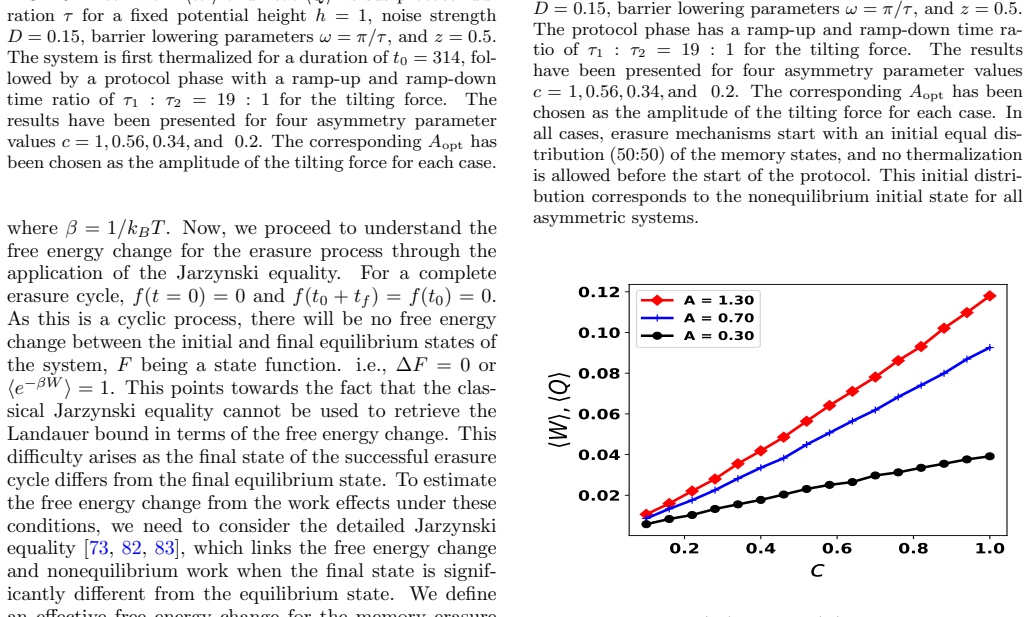
Erasure of the binary memory, 0 or 1, is an essential step for digital computation involving irreversible logic operations. The erasure of a bit of a classical bit of memory is accompanied by the evolution of a minimum amount of heat set by the Landauer bound kTln2, achieved in the asymptotic limit. However, the erasure of memory needs to be completed within a finite time for practical computation. The higher the speed of erasure, the greater the amount of heat released, which is unfavorable to the environment. Therefore, this is a fundamental challenge to reduce the evolved heat related to finite-time memory erasure. Here, we address this crucial aspect of information thermodynamics. We proceed by considering the model where the two memory states correspond to the two wells of a bistable potential that is asymmetric in terms of the width of its two wells. Moreover, they are separated by an asymmetric barrier. This type of asymmetry models the two binary memory states occupying different phase-space volumes, but are energetically equivalent. We examine the effect of the degree of asymmetry on the success rate of the erasure process and the work done or heat released associated with it. We find that this characteristic asymmetry in the underlying potential plays a very significant role in improving the efficiency of the erasure process. Our study establishes the fact that one can reach below the Landauer bound in an appropriate asymmetric setup. Importantly, it develops a quantitative understanding of the deviation from the Landauer limit as a function of the degree of asymmetry in the governing potential. We identify the effective free energy change for the finite-time bit erasure process as a general lower bound for the work done or evolved heat even when the departure from the Landauer limit is observed. We retrieve the approach towards the Landauer limit under the symmetric setup.
Editorial analysis
A structured set of objections, weighed in public.
Referee Report
Summary. The paper models classical bit erasure in finite time using a bistable potential whose wells have unequal widths and whose separating barrier is asymmetric. These features are said to alter phase-space volumes while keeping the states energetically equivalent. The authors report that increasing the degree of asymmetry raises the erasure success rate and reduces the dissipated work (or evolved heat) below the Landauer value kT ln 2. They further identify an effective free-energy change associated with the finite-time process as a general lower bound that remains valid even when the Landauer limit is violated, and recover the symmetric-case limit as asymmetry vanishes.
Significance. If the effective free-energy bound is shown to be independent of the asymmetry parameters and if the stochastic work and heat integrals properly account for all control costs, the result would supply a concrete, tunable route to sub-Landauer finite-time erasure. Such a bound could serve as a practical design principle for low-dissipation logic and would extend the reach of stochastic thermodynamics beyond symmetric double-well models.
major comments (2)
- [model and results sections] The abstract and model description present the effective free-energy change as an independent lower bound, yet give no explicit derivation or statement of whether this quantity is obtained from the same asymmetry parameters (well-width ratio and barrier tilt) that are varied to produce the sub-Landauer result. If the bound is constructed by re-expressing the driving protocol or by fitting to the observed trajectories, it cannot be regarded as a general, a-priori limit; this circularity must be resolved before the central claim can be accepted.
- [stochastic thermodynamics calculation] The skeptic concern is load-bearing: the manuscript treats the asymmetry parameters as fixed features of the potential whose only effect is to change phase-space volumes and success probabilities. No additional work term appears in the stochastic thermodynamics integrals when the asymmetry is imposed or maintained. If realizing a chosen degree of asymmetry requires a separate control step whose dissipated work is omitted from the reported heat, the net cost could exceed the claimed effective bound even if the erasure segment alone appears sub-Landauer.
minor comments (2)
- [abstract and methods] The abstract states that asymmetry improves efficiency but supplies neither error bars on the reported work values nor the precise functional form of the time-dependent driving protocol; these details are required for reproducibility.
- [results] Notation for the effective free-energy change should be introduced with an explicit equation and distinguished from the standard Landauer free-energy difference.
Simulated Author's Rebuttal
We thank the referee for the detailed and constructive report. We address the two major comments below, clarifying the a-priori nature of the effective free-energy bound and the treatment of fixed asymmetry in the stochastic thermodynamics. We will incorporate explicit derivations and clarifications in the revised manuscript.
read point-by-point responses
-
Referee: [model and results sections] The abstract and model description present the effective free-energy change as an independent lower bound, yet give no explicit derivation or statement of whether this quantity is obtained from the same asymmetry parameters (well-width ratio and barrier tilt) that are varied to produce the sub-Landauer result. If the bound is constructed by re-expressing the driving protocol or by fitting to the observed trajectories, it cannot be regarded as a general, a-priori limit; this circularity must be resolved before the central claim can be accepted.
Authors: The effective free-energy change is obtained solely from the equilibrium partition functions of the two wells in the static asymmetric potential, prior to any time-dependent driving. It is defined as ΔF_eff = −kT ln(Z_1/Z_0), where Z_i are the configurational integrals over each well (accounting for widths and barrier tilt) evaluated at the initial temperature. This expression depends only on the fixed potential parameters and is independent of the erasure protocol λ(t) or any trajectory data. We will add an explicit derivation subsection in the model section, together with the statement that the bound holds for any protocol that starts from equilibrium in the initial asymmetric state. revision: yes
-
Referee: [stochastic thermodynamics calculation] The skeptic concern is load-bearing: the manuscript treats the asymmetry parameters as fixed features of the potential whose only effect is to change phase-space volumes and success probabilities. No additional work term appears in the stochastic thermodynamics integrals when the asymmetry is imposed or maintained. If realizing a chosen degree of asymmetry requires a separate control step whose dissipated work is omitted from the reported heat, the net cost could exceed the claimed effective bound even if the erasure segment alone appears sub-Landauer.
Authors: The asymmetry parameters enter only as fixed features of the time-independent part of the potential V(x; asymmetry). The stochastic work and heat are evaluated with the standard expressions involving only the time-dependent control parameter (barrier height or tilt) that performs the erasure; no extra work term is required because the well widths and barrier shape are not varied during the protocol. This modeling choice is standard for fixed-potential devices in the literature. We disagree that an omitted control cost must be added to the erasure thermodynamics, but we will insert a clarifying paragraph stating that the reported quantities refer exclusively to the erasure stage under a given fixed asymmetric potential. revision: partial
Circularity Check
No significant circularity; derivation remains self-contained
full rationale
The paper defines an asymmetric bistable potential with independent well-width and barrier parameters that fix the phase-space volumes of the two memory states. It then applies a separate time-dependent driving protocol to perform finite-time erasure and computes the stochastic work/heat via standard thermodynamic integrals. The effective free-energy change is obtained directly from the equilibrium volumes set by those fixed asymmetry parameters (prior to driving), yielding a lower bound that is strictly less than kT ln 2 when asymmetry is present. The reported work values are shown to lie above this independently computed bound, recovering the Landauer limit only in the symmetric case. No step reduces a fitted quantity to a prediction, invokes a self-citation for a uniqueness theorem, or smuggles an ansatz; the central claim follows from the model definitions and stochastic thermodynamics without circular reduction.
Axiom & Free-Parameter Ledger
free parameters (1)
- degree of asymmetry
axioms (1)
- domain assumption The memory states evolve according to overdamped Langevin dynamics in a time-dependent potential whose asymmetry can be prescribed independently of the erasure protocol.
Reference graph
Works this paper leans on
- [1]
- [2]
-
[3]
C. E. Shannon, The Bell System Technical Journal27, 379 (1948)
work page 1948
-
[4]
G. Manzano, G. Karde¸ s, E. Rold´ an, and D. H. Wolpert, Phys. Rev. X14, 021026 (2024)
work page 2024
-
[5]
Landauer, IBM Journal of Research and Development 5, 183 (1961)
R. Landauer, IBM Journal of Research and Development 5, 183 (1961)
work page 1961
- [6]
-
[7]
C. H. Bennett, IBM Journal of Research and Develop- ment17, 525 (1973)
work page 1973
-
[8]
C. H. Bennett, International Journal of Theoretical Physics21, 905 (1982)
work page 1982
-
[9]
D. Mandal and C. Jarzynski, Proceedings of the National Academy of Sciences109, 11641 (2012)
work page 2012
- [10]
-
[11]
P. Chattopadhyay, A. Misra, T. Pandit, and G. Paul, Reports on Progress in Physics (2025)
work page 2025
-
[12]
A. M. Timpanaro, J. P. Santos, and G. T. Landi, Phys. Rev. Lett.124, 240601 (2020)
work page 2020
-
[13]
A. d. O. Junior, J. B. Brask, and R. Chaves, PRX Quan- tum6, 030201 (2025)
work page 2025
-
[14]
J. Sanders, M. Baldovin, and P. Muratore-Ginanneschi, Phys. Rev. E111, 034127 (2025)
work page 2025
-
[15]
R. Dillenschneider and E. Lutz, Phys. Rev. Lett.102, 210601 (2009)
work page 2009
-
[16]
A. B´ erut, A. Arakelyan, A. Petrosyan, S. Ciliberto, R. Dillenschneider, and E. Lutz, Nature483, 187 (2012)
work page 2012
- [17]
-
[19]
K. Proesmans, J. Ehrich, and J. Bechhoefer, Phys. Rev. Lett.125, 100602 (2020)
work page 2020
-
[20]
K. Proesmans, J. Ehrich, and J. Bechhoefer, Phys. Rev. E102, 032105 (2020)
work page 2020
- [21]
- [22]
-
[23]
J. Hong, B. Lambson, S. Dhuey, and J. Bokor, Science advances2, e1501492 (2016)
work page 2016
- [24]
- [25]
-
[26]
J. M. Parrondo, J. M. Horowitz, and T. Sagawa, Nature physics11, 131 (2015)
work page 2015
-
[27]
J. M. Horowitz and M. Esposito, Phys. Rev. X4, 031015 (2014)
work page 2014
- [28]
- [29]
- [30]
-
[31]
L. Martini, M. Pancaldi, M. Madami, P. Vavassori, G. Gubbiotti, S. Tacchi, F. Hartmann, M. Emmerling, S. H¨ ofling, L. Worschech, and G. Carlotti, Nano Energy 19, 108 (2016)
work page 2016
-
[32]
D. H. Wolpert, J. Korbel, C. W. Lynn, F. Tasnim, J. A. Grochow, G. Karde¸ s, J. B. Aimone, V. Balasubramanian, E. De Giuli, D. Doty,et al., Proceedings of the National Academy of Sciences121, e2321112121 (2024)
work page 2024
- [33]
- [34]
- [35]
-
[36]
N. Shiraishi, K. Funo, and K. Saito, Phys. Rev. Lett. 121, 070601 (2018)
work page 2018
-
[37]
H. J. D. Miller, G. Guarnieri, M. T. Mitchison, and J. Goold, Phys. Rev. Lett.125, 160602 (2020)
work page 2020
-
[38]
´E. Rold´ an, I. A. Martinez, J. M. Parrondo, and D. Petrov, Nature Physics10, 457 (2014)
work page 2014
- [39]
-
[40]
J. S. Lee, S. Lee, H. Kwon, and H. Park, Phys. Rev. Lett. 129, 120603 (2022)
work page 2022
- [41]
-
[42]
Y.-Z. Zhen, D. Egloff, K. Modi, and O. Dahlsten, Phys. Rev. Lett.127, 190602 (2021)
work page 2021
-
[43]
M. Konopik, T. Korten, E. Lutz, and H. Linke, Nature Communications14, 447 (2023)
work page 2023
- [44]
-
[45]
S. Dago, J. Pereda, S. Ciliberto, and L. Bellon, Journal of Statistical Mechanics: Theory and Experiment2022, 053209 (2022)
work page 2022
- [46]
-
[47]
S. Talukdar, S. Bhaban, and M. V. Salapaka, Phys. Rev. E95, 062121 (2017)
work page 2017
-
[48]
Konopik, M., Friedenberger, A., Kiesel, N., and Lutz, E., EPL131, 60004 (2020)
work page 2020
-
[49]
M. A. Ciampini, T. Wenzl, M. Konopik, G. Thalhammer, M. Aspelmeyer, E. Lutz, and N. Kiesel, arXiv preprint arXiv:2107.04429 10.48550/arXiv.2107.0442 (2021)
- [50]
- [51]
- [52]
-
[53]
M. Esposito and C. Van den Broeck, Europhysics Letters 95, 40004 (2011)
work page 2011
-
[54]
M. Innerbichler and C. Dellago, Proceedings of the National Academy of Sciences117, 2238 (2020), https://www.pnas.org/doi/pdf/10.1073/pnas.1921425117
-
[55]
M. c. v. Gavrilov and J. Bechhoefer, Phys. Rev. Lett. 117, 200601 (2016)
work page 2016
- [56]
-
[57]
P. R. Zulkowski and M. R. DeWeese, Phys. Rev. E89, 052140 (2014)
work page 2014
-
[58]
W. H. Press, S. A. Teukolsky, W. T. Vetterling, and B. P. Flannery, The art of scientific computing1(1992)
work page 1992
-
[59]
R. Dillenschneider and E. Lutz, Phys. Rev. Lett.102, 210601 (2009). 16
work page 2009
-
[60]
Y. Jun, M. c. v. Gavrilov, and J. Bechhoefer, Phys. Rev. Lett.113, 190601 (2014)
work page 2014
- [61]
-
[62]
K. Sekimoto, Progress of Theoretical Physics Supplement 130, 17 (1998), https://academic.oup.com/ptps/article- pdf/doi/10.1143/PTPS.130.17/5213518/130-17.pdf
-
[63]
Seifert, Reports on Progress in Physics75, 126001 (2012)
U. Seifert, Reports on Progress in Physics75, 126001 (2012)
work page 2012
-
[64]
L. T. Giorgini, R. Eichhorn, M. Das, W. Moon, and J. S. Wettlaufer, Phys. Rev. Res.5, 023084 (2023)
work page 2023
-
[65]
A. Gomez-Marin, T. Schmiedl, and U. Seifert, The Journal of Chemical Physics129, 024114 (2008), https://pubs.aip.org/aip/jcp/article- pdf/doi/10.1063/1.2948948/6770253/024114 1 online.pdf
-
[66]
L. Peliti and S. Pigolotti,Stochastic thermodynamics: an introduction(Princeton University Press, 2021)
work page 2021
- [67]
- [68]
-
[69]
H.-H. Hasegawa, J. Ishikawa, K. Takara, and D. Driebe, Physics Letters A374, 1001 (2010)
work page 2010
- [70]
-
[71]
K. S. Olsen, D. Gupta, F. Mori, and S. Krishnamurthy, Phys. Rev. Res.6, 033343 (2024)
work page 2024
- [72]
-
[73]
A. B´ erut, A. Petrosyan, and S. Ciliberto, Europhysics Letters103, 60002 (2013)
work page 2013
- [74]
- [75]
- [76]
- [77]
-
[78]
Jarzynski, Journal of Statistical Mechanics: Theory and Experiment2004, P09005 (2004)
C. Jarzynski, Journal of Statistical Mechanics: Theory and Experiment2004, P09005 (2004)
work page 2004
- [79]
-
[80]
L. Buffoni and M. Campisi, Journal of Statistical Physics 186, 31 (2022)
work page 2022
-
[81]
L. A. Williamson, Phys. Rev. E111, L012102 (2025)
work page 2025
discussion (0)
Sign in with ORCID, Apple, or X to comment. Anyone can read and Pith papers without signing in.