REVIEW 4 major objections 5 minor 234 references
Black Hole Gravitational Phenomena in Higher-Order Curvature-Scalar Gravity
T0 review · 4 major / 5 minor · reviewed 2026-08-04 · deepseek-v4-flash
Pith's one-line read This paper argues that the deformation parameter ξ of a higher-order curvature-scalar gravity black hole is tightly constrained by shadow-size measurements: for M87* the bound is ξ/M² ≲ 0.091, with a similar but looser bound from Sgr A*.
desk verdict Competent but rushed phenomenology: the Sgr A* shadow bound is not a black-hole constraint, since part of its allowed ξ range has no horizon. read the letter →
The pith
A machine-rendered reading of the paper's core claim, the machinery that carries it, and where it could break.
The reading
What carries the argument
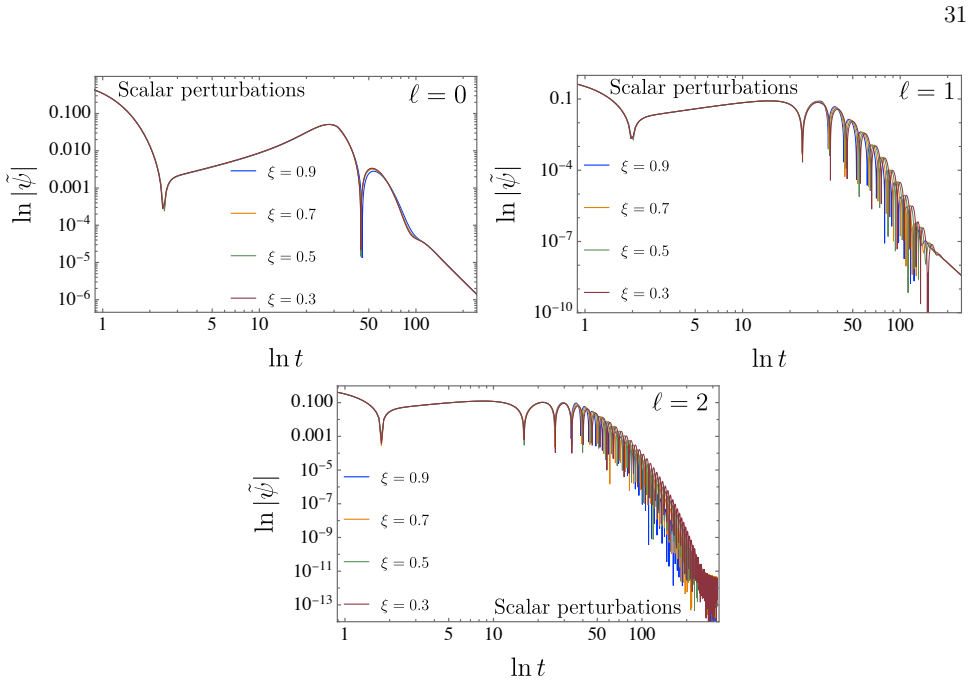
The metric (1), whose g_tt resembles Reissner-Nordström with ξ playing the role of Q² and whose g_rr is deformed by a term 2M ξ^{3/2}/r^4; the effective potentials from the Klein-Gordon, Maxwell, axial gravitational, and Dirac equations, solved with the WKB method and time-domain integration; the null-geodesic impact parameter b_c = √(D/A)|_{r_photon}; the Gauss-Bonnet theorem for the weak deflection angle; and the strong-deflection expansion about the photon sphere. The single parameter ξ carries all deviations from Schwarzschild and is the quantity constrained.
What would settle it
Compute the odd-parity perturbation equations directly from the HOCG field equations (or from the effective fluid's action) and check whether δT_10, δT_12, δT_13 really vanish. If they do not vanish, the tensor QNM frequencies in Section III.C are wrong. Also, a future measurement of the M87* angular shadow diameter with a precision better than ~0.5 μas would test the relation Ω_sh = 39.612 − 6.602(ξ/M²) − 1.28372(ξ/M²)² μas: if the diameter exceeded 40.3 μas while the mass/distance values used here hold, the bound ξ/M² ≲ 0.091 would be violated.
Extended reading notes
Core claim
The authors compute that the photon sphere sits at r_ph = (3M + √(9M² − 8ξ))/2 and the shadow radius is R = 3√3 M − √3 ξ/(2M) − 7ξ²/(24√3 M³). Using the angular-diameter formula Ω_sh = 6.191165×10^(−8) γ/(π D/Mpc) (b_c/M) μas, they obtain for M87*: Ω_sh = 39.612 − 6.602(ξ/M²) − 1.28372(ξ/M²)² μas, so the observed lower bound of 39.00 μas forces 0 ≤ ξ/M² ≲ 0.091; for Sgr A* the analogous expression gives ξ/M² ≲ 0.963. They also find that increasing ξ makes all quasinormal modes longer-lived and that the weak-field deflection angle grows with ξ while the strong-field deflection angle shrinks.
Load-bearing premise
The paper takes the metric (1) as a given solution of higher-order curvature-scalar gravity and assumes that in axial perturbations the supporting anisotropic fluid contributes nothing to the stress-energy tensor; if either fails, the quasinormal-mode and shadow predictions built on them are not valid.
Editorial extensions
If this is right
- For M87*, the observed angular shadow diameter puts an upper limit ξ/M² ≲ 0.091; for Sgr A*, ξ/M² ≲ 0.963.
- Quasinormal modes of all spins (0, 1, 2, 1/2) become less damped as ξ grows, so ringdown signals would ring longer than in Schwarzschild.
- The photon sphere radius and shadow radius both decrease as ξ increases, yielding a smaller apparent silhouette than for a Schwarzschild black hole of the same mass.
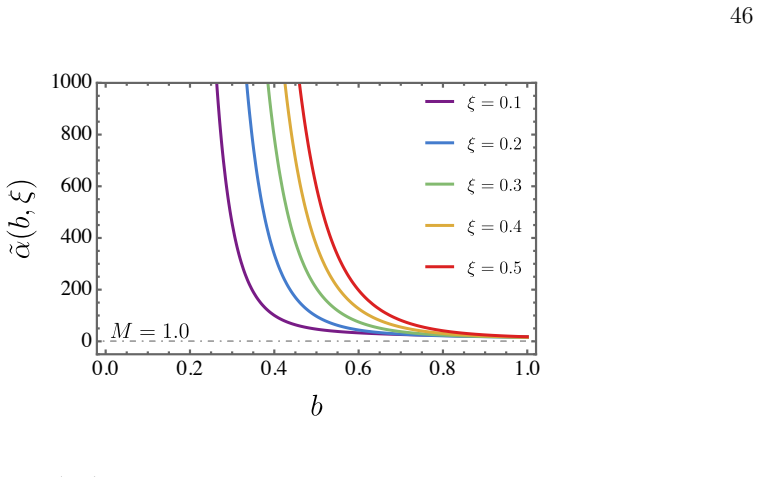
- Weak-field light deflection is enhanced relative to Schwarzschild, while strong-field deflection is diminished.
- Solar System tests yield: Mercury perihelion precession −9.15×10^18 m² ≤ ξ ≤ 1.83×10^18 m²; light deflection −1.94×10^13 m² ≤ ξ ≤ 3.87×10^12 m²; Shapiro time delay |ξ| ≤ 2.04×10^14 m².
Reading between the lines
- The dimensionless M87* bound (ξ/M² ≲ 0.091) is much tighter than the Sgr A* bound; future high-precision shadow measurements of more massive or closer black holes could push this down significantly.
- The formal analogy between ξ and Q² in g_tt means these shadow and QNM predictions double as a template for Reissner-Nordström-like black holes with a specific effective charge, offering cross-checks with charged-black-hole probes.
- Because the tensor perturbation analysis assumes the anisotropic fluid does not source axial modes (δT10=δT12=δT13=0), the tensor QNM branch is the most fragile prediction; re-deriving axial perturbations from the explicit HOCG field equations would confirm or refute it.
- The Solar System bounds, converted to dimensionless form for solar-mass objects, are orders of magnitude looser than the shadow bound, suggesting strong-field observations dominate the currently accessible parameter space.
Editorial analysis
A structured set of objections, weighed in public.
Referee Report
Summary. This paper studies the static, spherically symmetric metric (1) proposed in [91] as a black hole solution of higher-order curvature-scalar gravity. The metric has g_tt = 1 - 2M/r + ξ/r² and g_rr = 1/(1 - 2M/r + 2M ξ^{3/2}/r⁴). The authors compute event and Cauchy horizons, scalar, vector, tensor and spinor quasinormal modes by WKB and time-domain integration, photon spheres and shadows, weak- and strong-field lensing, and use EHT measurements of M87* and Sgr A*, together with Mercury precession, light deflection, and Shapiro delay, to constrain ξ. The headline numerical results are the EHT constraints 0 ≤ ξ/M² ≲ 0.091 (M87*) and 0 ≤ ξ/M² ≲ 0.963 (Sgr A*), plus the Solar System bounds in Table XVII.
Significance. The paper assembles a broad set of standard tools in a recognizable way and, if the calculations were correct, would provide a useful phenomenological catalog for this metric. The shadow, QNM, and lensing formulas are explicit and, given the imported metric and the chosen standard methods, depend on a single free parameter ξ. However, the quantitative conclusions are not currently reliable: the Sgr A* bound is internally inconsistent with Eq. (76), the allowed interval includes spacetimes without an event horizon, and the weak-deflection formula contains a factor-π error. These issues are load-bearing for the central claims and require correction.
major comments (4)
- [VII.B, Eq. (76)] Eq. (76) is printed as Ωsh = 53.23368.87226 - (ξ/M²) - 1.72516(ξ/M²)², which is not a valid expression. If the intended formula is 53.2336 - 8.87226 x - 1.72516 x², then setting Ωsh = 41.7 μas gives x ≈ 1.08, not 0.963 as claimed in the text. The displayed equation therefore does not support the headline Sgr A* constraint; the coefficient and the crossing point must be re-derived and corrected.
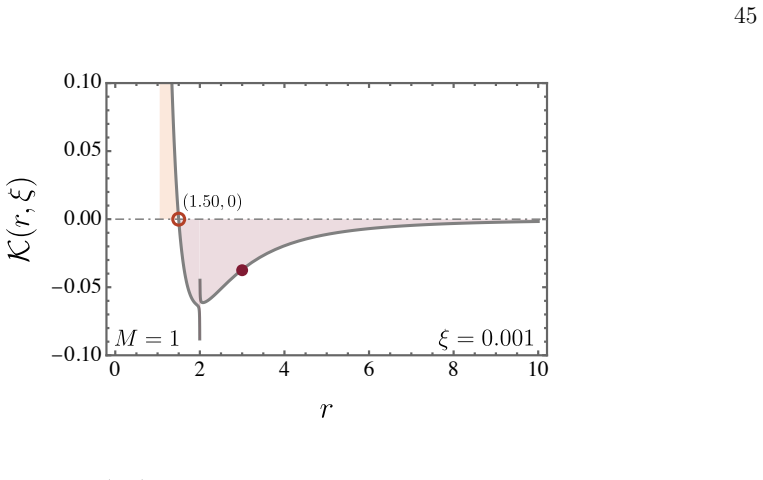
- [II, Eq. (4); IV; VII.B] The metric has B(r)=1-2M/r+2Mξ^{3/2}/r⁴. For x=r/M, B=0 iff x⁴-2x³+2(ξ/M²)^{3/2}=0. The minimum of x⁴-2x³ is -27/16 at x=3/2, so real positive roots exist only for ξ/M² < (27/32)^{2/3} ≈ 0.893. For ξ/M²=0.963, B(3M/2)≈0.04>0, so the spacetime has no event horizon. The approximate r_h in Eq. (4) is a small-ξ expansion and misses the horizon disappearance. Thus the Sgr A* interval 0 ≤ ξ/M² ≲ 0.963 is not a black-hole constraint and must be capped near 0.893. Moreover, the time-domain evolutions in Section IV use ξ=0.9 for M=1, above this threshold, so those profiles are not black-hole waveforms.
- [VIII.B, Eq. (81)] The weak-deflection formula begins with 4πM/b. The standard Gauss-Bonnet result for Schwarzschild in geometric units is 4M/b, and the paper's own Solar System derivation in Eq. (136) uses 4M/b. No convention is stated that would introduce a factor π. Consequently, the ξ-dependent terms in Eq. (81) need to be re-derived; as written, the leading ξ correction is negative, which also contradicts the text's statement that increasing ξ enhances the weak-field deflection.
- [III.C, Eq. (35)] The tensor-perturbation analysis imports the background metric from Ref. [91] and models the source as an effective anisotropic fluid. The axial sector is then closed by setting δT10=δT12=δT13=0 in Eq. (35). This is a nontrivial assumption: for the actual higher-order curvature-scalar theory, the scalar field and curvature couplings could source axial perturbations, and no field equations or perturbation equations from [91] are given to verify the decoupling. Unless the axial-sector decoupling is established, the tensor QNM frequencies in Tables IX-XI and the corresponding time-domain results are not demonstrably those of the theory. The manuscript should state this limitation explicitly or supply the missing derivation.
minor comments (5)
- [Eq. (76)] The printed formula '53.23368.87226-' is garbled; a coefficient is missing even apart from the crossing-point inconsistency.
- [X] Section X appears to use Planck units (M_sun=9.138×10^37, a=3.583×10^45), but this is never stated. Table XVII reports bounds in m², so the conversion convention should be explicit.
- [Eqs. (13), (38), (118)] Several equations have mangled notation: Eq. (13) contains unresolved 'r6 s' factors, Eq. (38) mixes ξ and ξ² inconsistently, and Eq. (118) contains (z-1)^4 terms whose convergence is not discussed.
- [Table IX] The table header says ℓ=1 at M=1.0, but all rows list M=0.5; the mass labeling should be harmonized.
- [References] Reference [65?] in the Introduction and [195?] in Section VII are malformed citations; the bibliography needs cleanup.
Circularity Check
No significant circularity: central predictions are derived from an externally sourced metric and constrained by independent observations; self-citations are methodological only.
full rationale
The derivation chain is open: Eq. (1) is taken from the independent external solution [91] (Nashed–Zafar–Bamba), and all subsequent quantities—horizons, QNM potentials, photon sphere, shadow radius, lensing angles, and Solar-System bounds—are computed from that metric using standard, reproducible methods. No parameter is fitted to the quantity later called a prediction: the EHT bounds in Sec. VII are obtained by evaluating the analytic Ω_sh(ξ) expression and comparing it with independent measurements (42±3 μas for M87*, 48.7±7 μas for Sgr A*), which is parameter estimation against external data, not a fit disguised as a test. The Solar-System constraints in Sec. X are similarly derived from geodesic equations and matched to independent Mercury-precession, light-deflection, and Cassini time-delay data; they are not inputs to the shadow or QNM computations. Multiple self-citations appear (e.g., [172], [210], [213], [217]), but only for standard methodology—WKB approximation, axial Regge–Wheeler potential, Gaussian-curvature lensing, spinor potentials—and are not load-bearing for uniqueness or for a pre-fit result. The note in the Conclusion announcing an imminent companion paper does not affect the derivation chain. The apparent inconsistency that the Sgr A* bound 0≤ξ/M²≲0.963 extends beyond the horizon-existence threshold (~0.893) is a correctness/internal-consistency concern, not a circularity, since the bound is derived from the same metric without re-importing the conclusion.
Assumptions & free parameters
free parameters (1)
- ξ =
0 ≤ ξ/M² ≲ 0.091 (M87*); 0 ≤ ξ/M² ≲ 0.963 (Sgr A*, numerically inconsistent); -9.15×10^18 m² ≤ ξ ≤ 1.83×10^18 m² (Mercur
assumptions (6)
- domain assumption Metric (1) is a valid black hole solution of higher-order curvature-scalar gravity supported by an effective anisotropic fluid
- domain assumption Perturbing fields (scalar, vector, tensor, spinor) evolve as test fields on the fixed background without backreaction
- domain assumption Axial (odd-parity) metric perturbations decouple from the anisotropic fluid matter sector
- standard math The optical metric and Gauss-Bonnet theorem apply to the weak-field deflection integral with the stated integration domain
- standard math Tsukamoto's strong-deflection formalism for asymptotically flat, static, spherically symmetric spacetimes applies to this metric
- domain assumption The Solar System exterior is described by the same metric (1) with the same parameter ξ, and the perturbative expansion in ξ and M/L is valid
Cite this review
Pith. "Pith review of Black Hole Gravitational Phenomena in Higher-Order Curvature-Scalar Gravity." pith.science (2026). https://pith.science/paper/KXSHNAM4
@misc{pith2026250911985,
  author       = {Pith},
  title        = {Pith review of: Black Hole Gravitational Phenomena in Higher-Order Curvature-Scalar Gravity},
  year         = {2026},
  howpublished = {\url{https://pith.science/paper/KXSHNAM4}},
  note         = {Machine review of arXiv:2509.11985}
}
abstract
This work aims to explore the gravitational consequences of a recently proposed black hole solution presented in the literature [Phys. Dark Univ. 50 (2025) 102061]. We initiate our analyzes by taking into account the horizon structure, focusing on both the event and Cauchy horizons. Subsequently, we examine the quasinormal modes by considering all types of perturbations -- scalar, vector, tensor, and spinorial. To strengthen these results, we also compute the time-domain for each perturbation. Next, we turn to the study of optical properties of the black hole. In particular, we investigate null geodesics, the photon sphere and its stability, as well as the corresponding black hole shadows. Following this, we analyze gravitational lensing phenomena in two regimes: the weak-field limit, utilizing the Gauss-Bonnet theorem, and the strong deflection limit, employing Tsukamoto's approach. In addition, we confront the lensing observables with Event Horizon Telescope (EHT) data for $Sgr A^{*}$ and $M87^{*}$. Finally, constraints on the parameter $\xi$ -- which is introduced by higher-order curvature-scalar gravity, thereby differing from the Schwarzschild solution -- are estimated using Solar System measurements such as the precession of Mercury's orbit, gravitational light bending, and time delay (or Shapiro effect).
Figures


Figures from the paper (22 more)





Reference graph
Works this paper leans on
-
[91]
G. G. L. Nashed, Usman Zafar, and Kazuharu Bamba. An innovative black hole solution and thermodynamic properties in higher-order curvature gravity with a scalar field.Physics of the Dark Universe, 50:102061, 2025
2025
-
[1]
Gravitational collapse and spacetime singularities.Physical Review Letters, 14(3):57, 1965
Roger Penrose. Gravitational collapse and spacetime singularities.Physical Review Letters, 14(3):57, 1965
1965
-
[2]
Cambridge university press, 2023
Stephen W Hawking and George FR Ellis.The large scale structure of space-time. Cambridge university press, 2023
2023
-
[3]
Cambridge University Press, 2007
Pankaj S Joshi.Gravitational collapse and spacetime singularities. Cambridge University Press, 2007
2007
-
[4]
Gw170817: observation of gravitational waves from a binary neutron star inspiral.Physical review letters, 119(16):161101, 2017
Benjamin P Abbott, Rich Abbott, Thomas D Abbott, Fausto Acernese, Kendall Ackley, Carl Adams, Thomas Adams, Paolo Addesso, Rana X Adhikari, Vaishali B Adya, et al. Gw170817: observation of gravitational waves from a binary neutron star inspiral.Physical review letters, 119(16):161101, 2017
2017
-
[5]
First M87 ∗ event horizon telescope results
The Event Horizon Telescope Collaboration. First M87 ∗ event horizon telescope results. i. the shadow of the supermassive black hole.The Astrophysical Journal Letters, 875(1):L1, 2019
2019
-
[6]
First sagittarius a∗ event horizon telescope results
Kazunori Akiyama, Antxon Alberdi, Walter Alef, Juan Carlos Algaba, Richard Anantua, Keiichi Asada, Rebecca Azulay, Uwe Bach, Anne-Kathrin Baczko, David Ball, et al. First sagittarius a∗ event horizon telescope results. i. the shadow of the supermassive black hole in the center of the milky way.The Astrophysical Journal Letters, 930(2):L12, 2022. 63
2022
-
[7]
Antonio De Felice and Shinji Tsujikawa.f(R) theories.Living Reviews in Relativity, 13(1):1–161, 2010
2010
Show all 234 references
-
[8]
Thomas P Sotiriou and Valerio Faraoni.f(R) theories of gravity.Reviews of Modern Physics, 82(1):451–497, 2010
2010
-
[9]
Introduction to modified gravity and gravitational alternative for dark energy.International Journal of Geometric Methods in Modern Physics, 4(01):115–145, 2007
Shin’Ichi Nojiri and Sergei D Odintsov. Introduction to modified gravity and gravitational alternative for dark energy.International Journal of Geometric Methods in Modern Physics, 4(01):115–145, 2007
2007
-
[10]
f(T) teleparallel gravity and cosmology.Reports on Progress in Physics, 79(10):106901, 2016
Yi-Fu Cai, Salvatore Capozziello, Mariafelicia De Laurentis, and Emmanuel N Saridakis. f(T) teleparallel gravity and cosmology.Reports on Progress in Physics, 79(10):106901, 2016
2016
-
[11]
Odintsov, and Vasilis K
Shin’ichi Nojiri, Sergei D. Odintsov, and Vasilis K. Oikonomou. Modified gravity theories on a nutshell: Inflation, bounce and late-time evolution.Physics Reports, 692:1–104, 2017
2017
-
[12]
Odintsov, and Vasilis K
Shin’ichi Nojiri, Sergei D. Odintsov, and Vasilis K. Oikonomou. k-essencef(R) gravity inflation. Nuclear Physics B, 941:11–27, 2019
2019
-
[13]
Schwarzschild solution in extended teleparallel gravity.Europhysics Letters, 105(1):10001, 2014
Gamal GL Nashed. Schwarzschild solution in extended teleparallel gravity.Europhysics Letters, 105(1):10001, 2014
2014
-
[14]
Springer, 2011
Valerio Faraoni and Salvatore Capozziello.Beyond Einstein gravity: a survey of gravitational theories for cosmology and astrophysics. Springer, 2011
2011
-
[15]
Extended theories of gravity.Physics Reports, 509(4-5):167–321, 2011
Salvatore Capozziello and Mariafelicia De Laurentis. Extended theories of gravity.Physics Reports, 509(4-5):167–321, 2011
2011
-
[16]
Reconstruction of f(T)-gravity in the absence of matter
W El Hanafy and Gamal GL Nashed. Reconstruction of f(T)-gravity in the absence of matter. Astrophysics and Space Science, 361(6):197, 2016
2016
-
[17]
Vacuum non–singular black hole solutions in tetrad theory of gravitation
Gamal GL Nashed. Vacuum non–singular black hole solutions in tetrad theory of gravitation. General Relativity and Gravitation, 34(7):1047–1058, 2002
2002
-
[18]
Phase portraits of general f (t) cosmology.Journal of Cosmology and Astroparticle Physics, 2018(02):052, 2018
Adel Awad, W El Hanafy, GGL Nashed, and Emmanuel N Saridakis. Phase portraits of general f (t) cosmology.Journal of Cosmology and Astroparticle Physics, 2018(02):052, 2018
2018
-
[19]
Constant-roll infla- tion in f(T) teleparallel gravity.Journal of Cosmology and Astroparticle Physics, 2018(07):026, 2018
Adel Awad, W El Hanafy, GGL Nashed, SD Odintsov, and VK Oikonomou. Constant-roll infla- tion in f(T) teleparallel gravity.Journal of Cosmology and Astroparticle Physics, 2018(07):026, 2018
2018
-
[20]
Kerr-nut black hole thermodynamics in f(T) gravity theories.The European Physical Journal Plus, 130(7):124, 2015
Gamal GL Nashed. Kerr-nut black hole thermodynamics in f(T) gravity theories.The European Physical Journal Plus, 130(7):124, 2015
2015
-
[21]
Analytic models of anisotropic strange stars in f (t) gravity with off-diagonal tetrad.Astrophysics and Space Science, 361(1):27, 2016
M Zubair and G Abbas. Analytic models of anisotropic strange stars in f (t) gravity with off-diagonal tetrad.Astrophysics and Space Science, 361(1):27, 2016
2016
-
[22]
Possible formation of compact stars in f(R,T) gravity
M Zubair, G Abbas, and I Noureen. Possible formation of compact stars in f(R,T) gravity. Astrophysics and Space Science, 361(1), 2015. 64
2015
-
[23]
f (r, t) gravity
Tiberiu Harko, Francisco SN Lobo, Shin’ichi Nojiri, and Sergei D Odintsov. f (r, t) gravity. Physical Review D, 84(2):024020, 2011
2011
-
[24]
Interior solutions of compact stars in f (t, t) gravity under karmarkar condition.Physics of the Dark Universe, 30:100592, 2020
Rabia Saleem, Faisal Kramat, and M Zubair. Interior solutions of compact stars in f (t, t) gravity under karmarkar condition.Physics of the Dark Universe, 30:100592, 2020
2020
-
[25]
Dark energy in modified gauss-bonnet gravity: Late-time acceleration and¡? format?¿ the hierarchy problem.Physical Review D, 73(8):084007, 2006
Guido Cognola, Emilio Elizalde, Shin’ichi Nojiri, Sergei D Odintsov, and Sergio Zerbini. Dark energy in modified gauss-bonnet gravity: Late-time acceleration and¡? format?¿ the hierarchy problem.Physical Review D, 73(8):084007, 2006
2006
-
[26]
Charged black hole solutions in f(R,T) gravity coupled to nonlinear electrodynamics
Gabriel I R´ ois, Jos´ e Tarciso SS Junior, Francisco SN Lobo, Manuel E Rodrigues, and Tiberiu Harko. Charged black hole solutions in f(R,T) gravity coupled to nonlinear electrodynamics. Physical Review D, 111(12):124044, 2025
2025
-
[27]
A Ara´ ujo Filho, N Heidari, I
A. A Ara´ ujo Filho, N Heidari, I. P Lobo, and VB Bezerra. Gravitational signatures of a nonlinear electrodynamics in f (r, t) gravity.Journal of Cosmology and Astroparticle Physics, 2025(09):015, 2025
2025
-
[28]
Constrainingf(R) gravity by the large-scale structure.Universe, 1(2):123–157, 2015
Ivan De Martino, Mariafelicia De Laurentis, and Salvatore Capozziello. Constrainingf(R) gravity by the large-scale structure.Universe, 1(2):123–157, 2015
2015
-
[29]
Spectrum of relict gravitational radiation and the early state of the universe
AA Starobinskii. Spectrum of relict gravitational radiation and the early state of the universe. JETP Letters, 30(11):682–685, 1979
1979
-
[30]
Neutron and quark stars inf(R) gravity
Artyom V Astashenok. Neutron and quark stars inf(R) gravity. InInternational Journal of Modern Physics: Conference Series, volume 41, page 1660130. World Scientific, 2016
2016
-
[31]
Astashenok, Salvatore Capozziello, and Sergei D
Artyom V. Astashenok, Salvatore Capozziello, and Sergei D. Odintsov. Maximal neutron star mass and the resolution of the hyperon puzzle in modified gravity.Physical Review D, 89(10):103509, 2014
2014
-
[33]
The realistic models of relativistic stars inf(R) =R+αR 2 gravity.Classical and Quantum Gravity, 34(20):205008, 2017
Artyom V Astashenok, Sergei D Odintsov, and Alvaro De la Cruz-Dombriz. The realistic models of relativistic stars inf(R) =R+αR 2 gravity.Classical and Quantum Gravity, 34(20):205008, 2017
2017
-
[34]
Astashenok, Salvatore Capozziello, and Sergei D
Artyom V. Astashenok, Salvatore Capozziello, and Sergei D. Odintsov. Nonperturbative models of quark stars inf(R) gravity.Physics Letters B, 742:160–166, 2015
2015
-
[35]
Thermodynam- ical correspondence off(R) gravity in the jordan and einstein frames.International Journal of Modern Physics D, 29(13):2050090, 2020
Gamal GL Nashed, W El Hanafy, Sergei D Odintsov, and Vasilis K Oikonomou. Thermodynam- ical correspondence off(R) gravity in the jordan and einstein frames.International Journal of Modern Physics D, 29(13):2050090, 2020
2020
-
[36]
Anisotropic compact stars inf(R) gravity.The 65 European Physical Journal C, 81(5):481, 2021
Gamal GL Nashed and Salvatore Capozziello. Anisotropic compact stars inf(R) gravity.The 65 European Physical Journal C, 81(5):481, 2021
2021
-
[37]
Conformal transformations and weak field limit of scalar-tensor gravity.Physical Review D, 88(12):124011, 2013
An Stabile and S Capozziello. Conformal transformations and weak field limit of scalar-tensor gravity.Physical Review D, 88(12):124011, 2013
2013
-
[38]
Cosmological perfect- fluids inf(R) gravity.International Journal of Geometric Methods in Modern Physics, 16(01):1950008, 2019
Salvatore Capozziello, Carlo Alberto Mantica, and Luca Guido Molinari. Cosmological perfect- fluids inf(R) gravity.International Journal of Geometric Methods in Modern Physics, 16(01):1950008, 2019
2019
-
[39]
Effects of spatial curvature on thef(R) gravity phase space: no inflationary attractor?Classical and Quantum Gravity, 36(6):065008, 2019
SD Odintsov and VK Oikonomou. Effects of spatial curvature on thef(R) gravity phase space: no inflationary attractor?Classical and Quantum Gravity, 36(6):065008, 2019
2019
-
[40]
Physical Review D, 99(6):064049, 2019
SD Odintsov and VK Oikonomou.f(R) gravity inflation with string-corrected axion dark matter. Physical Review D, 99(6):064049, 2019
2019
-
[41]
Parth Shah and Gauranga C. Samanta. Stability analysis for cosmological models inf(R) gravity using dynamical system analysis.The European Physical Journal C, 79(5):414, 2019
2019
-
[42]
Piattella, and J´ ulio C
Tays Miranda, Celia Escamilla-Rivera, Oliver F. Piattella, and J´ ulio C. Fabris. Generic slow- roll and non-gaussianity parameters inf(R) theories.Journal of Cosmology and Astroparticle Physics,, 05:028, 2019
2019
-
[43]
J. R. Nascimento, Gonzalo J. Olmo, P. J. Porfirio, A. Yu. Petrov, and A. R. Soares. Global Monopole in Palatinif(R) gravity.Physical Review D, 99(6):064053, 2019
2019
-
[44]
Odintsov, Tanmoy Paul, and Diego S´ aez-Chill´ on G´ omez
Emilio Elizalde, Sergei D. Odintsov, Tanmoy Paul, and Diego S´ aez-Chill´ on G´ omez. Inflation- ary universe inF(R) gravity with antisymmetric tensor fields and their suppression during its evolution.Physical Review D, 99(6):063506, 2019
2019
-
[45]
Elizalde, S
E. Elizalde, S. D. Odintsov, V. K. Oikonomou, and Tanmoy Paul. Logarithmic-correctedR 2 Gravity Inflation in the Presence of Kalb-Ramond Fields.Journal of Cosmology and Astropar- ticle Physics,, 02:017, 2019
2019
-
[46]
Dynamical analysis of loop quantumR 2 cosmology.Physical Review D, 99(6):064025, 2019
Long Chen. Dynamical analysis of loop quantumR 2 cosmology.Physical Review D, 99(6):064025, 2019
2019
-
[47]
Piattella, and Sergio E
Fulvio Sbis` a, Oliver F. Piattella, and Sergio E. Jor´ as. Pressure effects in the weak-field limit of f(R) =R+αR 2 gravity.Physical Review D, 99(10):104046, 2019
2019
-
[48]
Samanta and Nisha Godani
Gauranga C. Samanta and Nisha Godani. Validation of energy conditions in wormhole geometry within viablef(R) gravity.The European Physical Journal C, 79(7):623, 2019
2019
-
[49]
Big bounce cosmology for PalatiniR 2 gravity with a Nieh–Yan term.The European Physical Journal C, 79(5):405, 2019
Flavio Bombacigno and Giovanni Montani. Big bounce cosmology for PalatiniR 2 gravity with a Nieh–Yan term.The European Physical Journal C, 79(5):405, 2019
2019
-
[50]
Grav- itational collapse in general relativity and in r 2-gravity: A comparative study.International Journal of Geometric Methods in Modern Physics, 16(03):1950035, 2019
Artyom V Astashenok, Karim Mosani, Sergey D Odintsov, and Gauranga C Samanta. Grav- itational collapse in general relativity and in r 2-gravity: A comparative study.International Journal of Geometric Methods in Modern Physics, 16(03):1950035, 2019. 66
2019
-
[51]
Charged solution with equal metric ansatz in gauss–bonnet theory coupled to scalar field.Physics of the Dark Universe, 41:101260, 2023
GGL Nashed. Charged solution with equal metric ansatz in gauss–bonnet theory coupled to scalar field.Physics of the Dark Universe, 41:101260, 2023
2023
-
[52]
Nojiri, S
S. Nojiri, S. D. Odintsov, V. K. Oikonomou, and Arkady A. Popov. Ghost-freeF(R,G) gravity. Nuclear Physics B, 973:115617, 2021
2021
-
[53]
Finite-time cosmological singularities and the possible fate of the universe.Physics Reports, 1034:1–114, 2023
Jaume de Haro, Shin’ichi Nojiri, Sergei D Odintsov, Vasilis K Oikonomou, and Supriya Pan. Finite-time cosmological singularities and the possible fate of the universe.Physics Reports, 1034:1–114, 2023
2023
-
[54]
Salvatore Capozziello and G. G. L. Nashed. Charged spherically symmetric black holes in scalar- tensor gauss–bonnet gravity.Classical and Quantum Gravity, 40(20):205023, 2023
2023
-
[55]
Global dynamics in einstein- gauss-bonnet scalar field cosmology with matter.Physical Review D, 108(2):023519, 2023
Alfredo D Millano, Genly Leon, and Andronikos Paliathanasis. Global dynamics in einstein- gauss-bonnet scalar field cosmology with matter.Physical Review D, 108(2):023519, 2023
2023
-
[56]
F (q) f(q) gravity with gauss–bonnet corrections: From early-time inflation to late-time acceleration.Fortschritte der Physik, 72(9-10):2400113, 2024
Shin’ichi Nojiri and Sergei D Odintsov. F (q) f(q) gravity with gauss–bonnet corrections: From early-time inflation to late-time acceleration.Fortschritte der Physik, 72(9-10):2400113, 2024
2024
-
[57]
Traversable wormholes with static spherical symmetry and their stability in higher-curvature gravity.Journal of Cosmology and Astroparticle Physics, 2023(10):038, 2023
M Ilyas and Kazuharu Bamba. Traversable wormholes with static spherical symmetry and their stability in higher-curvature gravity.Journal of Cosmology and Astroparticle Physics, 2023(10):038, 2023
2023
-
[58]
Gauss–Bonnet AdS planar and spherical black hole thermodynamics and holography.Classical Quantum and Gravity, 41(23):235010, 2024
Souvik Paul, Sunandan Gangopadhyay, and Ashis Saha. Gauss–Bonnet AdS planar and spherical black hole thermodynamics and holography.Classical Quantum and Gravity, 41(23):235010, 2024
2024
-
[59]
G. G. L. Nashed. Spherically symmetric charged black holes inf(R) gravitational theories.The European Physical Journal Plus, 133(1):18, 2018
2018
-
[60]
G. G. L. Nashed. Higher dimensional charged black hole solutions inf(R) gravitational theories. Advances in High Energy Physics, 2018:7323574, 2018
2018
-
[61]
Spherically symmetric solutions of modified field equations inf(R) theories of gravity.Physical Review D, 74(6):064022, 2006
T Multam¨ aki and Iiro Vilja. Spherically symmetric solutions of modified field equations inf(R) theories of gravity.Physical Review D, 74(6):064022, 2006
2006
-
[62]
Rotating charged black hole spacetimes in quadraticf(R) gravitational theories
GGL Nashed. Rotating charged black hole spacetimes in quadraticf(R) gravitational theories. International Journal of Modern Physics D, 27(07):1850074, 2018
2018
-
[63]
Noether symmetries and analytical solutions in f(T) cosmology: A complete study.Physical Review D, 88(10):103526, 2013
S Basilakos, Salvatore Capozziello, M De Laurentis, A Paliathanasis, and M Tsamparlis. Noether symmetries and analytical solutions in f(T) cosmology: A complete study.Physical Review D, 88(10):103526, 2013
2013
-
[64]
Extended theories of gravity and their cosmo- logical and astrophysical applications.General Relativity and Gravitation, 40(2):357–420, 2008
Salvatore Capozziello and Mauro Francaviglia. Extended theories of gravity and their cosmo- logical and astrophysical applications.General Relativity and Gravitation, 40(2):357–420, 2008
2008
-
[65]
Charged spherically symmetric black holes in f(R) gravity and their stability analysis.Physical Review D, 99(10):104018, 2019
Gamal GL Nashed and Salvatore Capozziello. Charged spherically symmetric black holes in f(R) gravity and their stability analysis.Physical Review D, 99(10):104018, 2019. 67
2019
-
[66]
de la Cruz-Dombriz, A
A. de la Cruz-Dombriz, A. Dobado, and A. L. Maroto. Black holes inf(R) theories.Physical Review D, 80(12):124011, 2009
2009
-
[67]
A no-hair theorem for spherically symmetric black holes inR 2 gravity.General Relativity and Gravitation, 50(11):137, 2018
Joseph Sultana and Demosthenes Kazanas. A no-hair theorem for spherically symmetric black holes inR 2 gravity.General Relativity and Gravitation, 50(11):137, 2018
2018
-
[68]
A no-hair theorem for black holes inf(R) gravity.Classical and Quantum Gravity, 35(2):025018, 2017
Pedro Ca˜ nate. A no-hair theorem for black holes inf(R) gravity.Classical and Quantum Gravity, 35(2):025018, 2017
2017
-
[69]
On static and spherically symmetric solutions of starobinsky model.Research in Astronomy and Astrophysics, 18(12):157, 2018
Shuang Yu, Chang-Jun Gao, and Ming-Jun Liu. On static and spherically symmetric solutions of starobinsky model.Research in Astronomy and Astrophysics, 18(12):157, 2018
2018
-
[70]
Black hole solutions inR 2 gravity.Journal of High Energy Physics, 2015(5):1–20, 2015
Alex Kehagias, Costas Kounnas, Dieter L¨ ust, and Antonio Riotto. Black hole solutions inR 2 gravity.Journal of High Energy Physics, 2015(5):1–20, 2015
2015
-
[71]
Static solutions for fourth order gravity.Physical Review D, 82(10):104026, 2010
William Nelson. Static solutions for fourth order gravity.Physical Review D, 82(10):104026, 2010
2010
-
[72]
Spherically symmetric black holes inf(R) gravity: is geometric scalar hair supported?Classical and Quantum Gravity, 33(15):155005, 2016
Pedro Ca˜ nate, Luisa G Jaime, and Marcelo Salgado. Spherically symmetric black holes inf(R) gravity: is geometric scalar hair supported?Classical and Quantum Gravity, 33(15):155005, 2016
2016
-
[73]
On neutron stars inf(R) theories: Small radii, large masses and large energy emitted in a merger.Physics of the dark universe, 13:147–161, 2016
Miguel Aparicio Resco, ´Alvaro de la Cruz-Dombriz, Felipe J Llanes Estrada, and V ´ ıctor Zapatero Castrillo. On neutron stars inf(R) theories: Small radii, large masses and large energy emitted in a merger.Physics of the dark universe, 13:147–161, 2016
2016
-
[74]
Static and slowly rotating neutron stars in scalar–tensor theory with self-interacting massive scalar field
Kalin V Staykov, Dimitar Popchev, Daniela D Doneva, and Stoytcho S Yazadjiev. Static and slowly rotating neutron stars in scalar–tensor theory with self-interacting massive scalar field. The European Physical Journal C, 78(7):586, 2018
2018
-
[75]
Rapidly rotating neutron stars with a massive scalar field—structure and universal relations.Journal of Cosmology and Astroparticle Physics, 2016(11):019, 2016
Daniela D Doneva and Stoytcho S Yazadjiev. Rapidly rotating neutron stars with a massive scalar field—structure and universal relations.Journal of Cosmology and Astroparticle Physics, 2016(11):019, 2016
2016
-
[76]
Constraints on perturbativef(R) gravity via neutron stars.Journal of Cosmology and Astroparticle Physics, 2011(07):020, 2011
Sava¸ s Arapo˘ glu, Cemsinan Deliduman, and K Yavuz Ek¸ si. Constraints on perturbativef(R) gravity via neutron stars.Journal of Cosmology and Astroparticle Physics, 2011(07):020, 2011
2011
-
[77]
Equation-of-state of neutron stars with junction conditions in the starobinsky model.International Journal of Modern Physics D, 27(01):1750186, 2018
Wei-Xiang Feng, Chao-Qiang Geng, Win-Fun Kao, and Ling-Wei Luo. Equation-of-state of neutron stars with junction conditions in the starobinsky model.International Journal of Modern Physics D, 27(01):1750186, 2018
2018
-
[78]
Neutron stars in the starobinsky model.Physical Review D, 89(6):064019, 2014
Apratim Ganguly, Radouane Gannouji, Rituparno Goswami, and Subharthi Ray. Neutron stars in the starobinsky model.Physical Review D, 89(6):064019, 2014
2014
-
[79]
Slowly rotating neutron stars in scalar-tensor theories with a massive scalar field.Physical Review D, 93(8):084038, 2016
Stoytcho S Yazadjiev, Daniela D Doneva, and Dimitar Popchev. Slowly rotating neutron stars in scalar-tensor theories with a massive scalar field.Physical Review D, 93(8):084038, 2016
2016
-
[80]
Rapidly rotating neutron 68 stars in r-squared gravity.Physical Review D, 91(8):084018, 2015
Stoytcho S Yazadjiev, Daniela D Doneva, and Kostas D Kokkotas. Rapidly rotating neutron 68 stars in r-squared gravity.Physical Review D, 91(8):084018, 2015
2015
-
[81]
Non- perturbative and self-consistent models of neutron stars in r-squared gravity.Journal of Cos- mology and Astroparticle Physics, 2014(06):003, 2014
Stoytcho S Yazadjiev, Daniela D Doneva, Kostas D Kokkotas, and Kalin V Staykov. Non- perturbative and self-consistent models of neutron stars in r-squared gravity.Journal of Cos- mology and Astroparticle Physics, 2014(06):003, 2014
2014
-
[82]
Further stable neutron star models fromf(R) gravity.Journal of Cosmology and Astroparticle Physics, 2013(12):040, 2013
Artyom V Astashenok, Salvatore Capozziello, and Sergei D Odintsov. Further stable neutron star models fromf(R) gravity.Journal of Cosmology and Astroparticle Physics, 2013(12):040, 2013
2013
-
[83]
Struc- ture of neutron stars in-squared gravity.General Relativity and Gravitation, 45(4):771–783, 2013
Mariana Orellana, Federico Garc ´ ıa, Florencia A Teppa Pannia, and Gustavo E Romero. Struc- ture of neutron stars in-squared gravity.General Relativity and Gravitation, 45(4):771–783, 2013
2013
-
[84]
Mass- radius relation for neutron stars inf(R) gravity.Physical Review D, 93(2):023501, 2016
Salvatore Capozziello, Mariafelicia De Laurentis, Ruben Farinelli, and Sergei D Odintsov. Mass- radius relation for neutron stars inf(R) gravity.Physical Review D, 93(2):023501, 2016
2016
-
[85]
Neutron stars inf(R) gravity with per- turbative constraints.Physical Review D—Particles, Fields, Gravitation, and Cosmology, 82(6):064033, 2010
Alan Cooney, Simon DeDeo, and Dimitrios Psaltis. Neutron stars inf(R) gravity with per- turbative constraints.Physical Review D—Particles, Fields, Gravitation, and Cosmology, 82(6):064033, 2010
2010
-
[86]
Intermediate-range gravity: a generally covariant model.Physical Review Letters, 29(2):137, 1972
John O’Hanlon. Intermediate-range gravity: a generally covariant model.Physical Review Letters, 29(2):137, 1972
1972
-
[87]
1/Rgravity and scalar-tensor gravity.Physics Letters B, 575(1):1–3, 2003
Takeshi Chiba. 1/Rgravity and scalar-tensor gravity.Physics Letters B, 575(1):1–3, 2003
2003
-
[88]
Gravity stabilizes itself.The European Physical Journal C, 77(3):166, 2017
Sumanta Chakraborty and Soumitra SenGupta. Gravity stabilizes itself.The European Physical Journal C, 77(3):166, 2017
2017
-
[89]
Carl Brans and Robert H. Dicke. Mach’s principle and a relativistic theory of gravitation. Physical Review, 124(3):925, 1961
1961
-
[90]
Solving higher curvature gravity theories.The European Physical Journal C, 76(10):552, 2016
Sumanta Chakraborty and Soumitra SenGupta. Solving higher curvature gravity theories.The European Physical Journal C, 76(10):552, 2016
2016
-
[92]
Mavromatos, John Rizos, Kyriakos Tamvakis, and Elizabeth Winstan- ley
Panagiota Kanti, Nick E. Mavromatos, John Rizos, Kyriakos Tamvakis, and Elizabeth Winstan- ley. Dilatonic black holes in higher curvature string gravity.Physical Review D, 54(8):5049–5058, 1996
1996
-
[93]
Odintsov
Shin’ichi Nojiri and Sergei D. Odintsov. Modified gauss-bonnet theory as gravitational alterna- tive for dark energy.Physics Letters B, 631(1):1–6, 2005
2005
-
[94]
Observation of gravitational waves from a binary black hole merger
et al Abbott, Benjamin P. Observation of gravitational waves from a binary black hole merger. Physical review letters, 116(6):061102, 2016. 69
2016
-
[95]
Lensing efficiency for gravitational wave mergers.Monthly Notices of the Royal Astronomical Society, 492(3):3359–3363, 2020
O Contigiani. Lensing efficiency for gravitational wave mergers.Monthly Notices of the Royal Astronomical Society, 492(3):3359–3363, 2020
2020
-
[96]
Probing the theory of gravity with gravitational lensing of gravitational waves and galaxy surveys.Monthly Notices of the Royal Astronomical Society, 494(2):1956–1970, 2020
Suvodip Mukherjee, Benjamin D Wandelt, and Joseph Silk. Probing the theory of gravity with gravitational lensing of gravitational waves and galaxy surveys.Monthly Notices of the Royal Astronomical Society, 494(2):1956–1970, 2020
1956
-
[97]
The gravity field of a particle.Proceedings of the Royal Society of London
Charles Galton Darwin. The gravity field of a particle.Proceedings of the Royal Society of London. Series A. Mathematical and Physical Sciences, 249(1257):180–194, 1959
1959
-
[98]
On light tracks near a very massive star.Astronomical Journal, Vol
Robert d’Escourt Atkinson. On light tracks near a very massive star.Astronomical Journal, Vol. 70, p. 517, 70:517, 1965
1965
-
[99]
Strong lensing effect and quasinormal modes of oscillations of black holes inf(R, T) gravity theory
Gayatri Mohan, Ronit Karmakar, Rupam Jyoti Borah, and Umananda Dev Goswami. Strong lensing effect and quasinormal modes of oscillations of black holes inf(R, T) gravity theory. arXiv preprint arXiv:2503.08402, 2025
2025 arXiv
-
[100]
Cunningham and James M
Christopher T. Cunningham and James M. Bardeen. The Optical Appearance of a Star Orbiting an Extreme Kerr Black Hole.The Astrophysical Journal, 183:237–264, 1973
1973
-
[101]
Viewing the shadow of the black hole at the galac- ticcenter.The Astrophysical Journal, 528(1):L13, 1999
Heino Falcke, Fulvio Melia, and Eric Agol. Viewing the shadow of the black hole at the galac- ticcenter.The Astrophysical Journal, 528(1):L13, 1999
1999
-
[102]
Firouzjaee
Mohsen Khodadi, Sunny Vagnozzi, and Javad T. Firouzjaee. Event Horizon Telescope obser- vations exclude compact objects in baseline mimetic gravity.Scientific Reports, 14(1):26932, 2024
2024
-
[103]
Alireza Allahyari, Mohsen Khodadi, Sunny Vagnozzi, and David F. Mota. Magnetically charged black holes from non-linear electrodynamics and the Event Horizon Telescope.Journal of Cos- mology and Astroparticle Physics,, 02:003, 2020
2020
-
[104]
Odintsov
Shin’ichi Nojiri and Sergei D. Odintsov. Improving mimetic gravity with non-trivial scalar potential: Cosmology, black holes, shadow and photon sphere.Physics of the Dark Universe, 46:101669, 2024
2024
-
[105]
Parameter estimation of hairy kerr black holes from its shadow and constraints from M87 ∗.Monthly Notices of the Royal Astronomical Society, 504(4):5927–5940, 2021
Misba Afrin, Rahul Kumar, and Sushant G Ghosh. Parameter estimation of hairy kerr black holes from its shadow and constraints from M87 ∗.Monthly Notices of the Royal Astronomical Society, 504(4):5927–5940, 2021
2021
-
[106]
Mohsen Khodadi, Gaetano Lambiase, and David F. Mota. No-hair theorem in the wake of Event Horizon Telescope.Journal of Cosmology and Astroparticle Physics,, 09:028, 2021
2021
-
[107]
Testing horndeski gravity from eht observational results for rotating black holes.The Astrophysical Journal, 932(1):51, 2022
Misba Afrin and Sushant G Ghosh. Testing horndeski gravity from eht observational results for rotating black holes.The Astrophysical Journal, 932(1):51, 2022
2022
-
[108]
Probing Lorentz symmetry violation using the first image of Sagittarius A*: Constraints on standard-model extension coefficients.Physical Review 70 D, 106(10):104050, 2022
Mohsen Khodadi and Gaetano Lambiase. Probing Lorentz symmetry violation using the first image of Sagittarius A*: Constraints on standard-model extension coefficients.Physical Review 70 D, 106(10):104050, 2022
2022
-
[109]
Ghosh, and Anzhong Wang
Rahul Kumar, Sushant G. Ghosh, and Anzhong Wang. Gravitational deflection of light and shadow cast by rotating Kalb-Ramond black holes.Physical Review D, 101(10):104001, 2020
2020
-
[110]
Tests of loop quantum gravity from the event horizon telescope results of Sgr A ∗.The Astrophysical Journal, 944(2):149, 2023
Misba Afrin, Sunny Vagnozzi, and Sushant G Ghosh. Tests of loop quantum gravity from the event horizon telescope results of Sgr A ∗.The Astrophysical Journal, 944(2):149, 2023
2023
-
[111]
Eht observables as a tool to estimate parameters of su- permassive black holes.Monthly Notices of the Royal Astronomical Society, 524(3):3683–3691, 2023
Misba Afrin and Sushant G Ghosh. Eht observables as a tool to estimate parameters of su- permassive black holes.Monthly Notices of the Royal Astronomical Society, 524(3):3683–3691, 2023
2023
-
[112]
Gravitational lensing by a black hole in effective loop quantum gravity.Physical Review D, 105(6):064020, 2022
Qi-Ming Fu and Xin Zhang. Gravitational lensing by a black hole in effective loop quantum gravity.Physical Review D, 105(6):064020, 2022
2022
-
[113]
An upper limit on the charge of the black hole Sgr A ∗ from eht observations.The Astrophysical Journal, 944(2):174, 2023
Sushant G Ghosh and Misba Afrin. An upper limit on the charge of the black hole Sgr A ∗ from eht observations.The Astrophysical Journal, 944(2):174, 2023
2023
-
[114]
Hunting for extra dimensions in the shadow of M87 ∗
Sunny Vagnozzi and Luca Visinelli. Hunting for extra dimensions in the shadow of M87 ∗. Physical Review D, 100(2):024020, 2019
2019
-
[115]
Shadow of slowly rotating Kalb-Ramond black holes
Wentao Liu, Di Wu, and Jieci Wang. Shadow of slowly rotating Kalb-Ramond black holes. Journal of Cosmology and Astroparticle Physics,, 05:017, 2025
2025
-
[116]
Shin’ichi Nojiri and S. D. Odintsov. Black holes and their shadows inF(R) gravity.Physics of the Dark Universe, 47:101785, 2025
2025
-
[117]
Shin’ichi Nojiri and S. D. Odintsov. Black holes, photon sphere, and cosmology in ghost-free f(G) gravity.Physics of the Dark Universe, 46:101702, 2024
2024
-
[118]
Testing the rotational nature of the supermassive object M87 ∗ from the circularity and size of its first image.Physical Review D, 100(4):044057, 2019
Cosimo Bambi, Katherine Freese, Sunny Vagnozzi, and Luca Visinelli. Testing the rotational nature of the supermassive object M87 ∗ from the circularity and size of its first image.Physical Review D, 100(4):044057, 2019
2019
-
[119]
Ghosh, and Anzhong Wang
Misba Afrin, Sushant G. Ghosh, and Anzhong Wang. Testing EGB gravity coupled to bumblebee field and black hole parameter estimation with EHT observations.Physics of the Dark Universe, 46:101642, 2024
2024
-
[120]
Schwarzschild black hole lensing.Physical Review D, 62(8):084003, 2000
Kumar Shwetketu Virbhadra and George FR Ellis. Schwarzschild black hole lensing.Physical Review D, 62(8):084003, 2000
2000
-
[121]
Theoretical gravitational lensing–beyond the weak-field small-angle approxima- tion
Volker Perlick. Theoretical gravitational lensing–beyond the weak-field small-angle approxima- tion. InThe Eleventh Marcel Grossmann Meeting: On Recent Developments in Theoretical and Experimental General Relativity, Gravitation and Relativistic Field Theories (In 3 Volumes), ...
2008
-
[122]
Strong field limit of black hole gravitational lensing.General Relativity and Gravitation, 33:1535–1548, 2001
Valerio Bozza, Salvatore Capozziello, Gerardo Iovane, and Gaetano Scarpetta. Strong field limit of black hole gravitational lensing.General Relativity and Gravitation, 33:1535–1548, 2001. 71
2001
-
[123]
Gravitational lensing in the strong field limit.Physical Review D, 66(10):103001, 2002
Valerio Bozza. Gravitational lensing in the strong field limit.Physical Review D, 66(10):103001, 2002
2002
-
[124]
Spacetime perspective of schwarzschild lensing.Physical Review D, 61(6):064021, 2000
Simonetta Frittelli, Thomas P Kling, and Ezra T Newman. Spacetime perspective of schwarzschild lensing.Physical Review D, 61(6):064021, 2000
2000
-
[125]
The strong gravitational lens finding challenge.Astronomy & Astrophysics, 625:A119, 2019
R Benton Metcalf, MASSIMO Meneghetti, Camille Avestruz, Fabio Bellagamba, Cl´ ecio R Bom, Emmanuel Bertin, R´ emi Cabanac, F Courbin, Andrew Davies, Etienne Decenci` ere, et al. The strong gravitational lens finding challenge.Astronomy & Astrophysics, 625:A119, 2019
2019
-
[126]
Strong gravitational lensing of gravitational waves: A review.Universe, 9(5):200, 2023
Margherita Grespan and Marek Biesiada. Strong gravitational lensing of gravitational waves: A review.Universe, 9(5):200, 2023
2023
-
[127]
Strong gravitational lensing and shadow constraint from M87∗ of slowly rotating kerr-like black hole.Annals of Physics, 447:169147, 2022
Xiao-Mei Kuang and Ali ¨Ovg¨ un. Strong gravitational lensing and shadow constraint from M87∗ of slowly rotating kerr-like black hole.Annals of Physics, 447:169147, 2022
2022
-
[128]
Testing dynamical torsion effects on the charged black hole’s shadow, deflection angle and greybody with M87 ∗ and Sgr A ∗ from eht.Annals of Physics, 448:169197, 2023
Reggie C Pantig and Ali ¨Ovg¨ un. Testing dynamical torsion effects on the charged black hole’s shadow, deflection angle and greybody with M87 ∗ and Sgr A ∗ from eht.Annals of Physics, 448:169197, 2023
2023
-
[129]
Light deflection by Damour-Solodukhin wormholes and Gauss-Bonnet theorem
Ali ¨Ovg¨ un. Light deflection by Damour-Solodukhin wormholes and Gauss-Bonnet theorem. Physical Review D, 98(4):044033, 2018
2018
-
[130]
Strong gravitational lensing—a probe for extra dimensions and kalb-ramond field.Journal of Cosmology and Astroparticle Physics, 2017(07):045, 2017
Sumanta Chakraborty and Soumitra SenGupta. Strong gravitational lensing—a probe for extra dimensions and kalb-ramond field.Journal of Cosmology and Astroparticle Physics, 2017(07):045, 2017
2017
-
[131]
A Ara´ ujo Filho
A. A Ara´ ujo Filho. Antisymmetric tensor influence on charged black hole lensing phenomena and time delay.Journal of High Energy Astrophysics, page 100401, 2025
2025
-
[132]
Gravitational lensing by scalar-tensor wormholes and the energy conditions.Physical Review D, 96(4):044037, 2017
Rajibul Shaikh and Sayan Kar. Gravitational lensing by scalar-tensor wormholes and the energy conditions.Physical Review D, 96(4):044037, 2017
2017
-
[133]
A Ara´ ujo Filho, J
A. A Ara´ ujo Filho, J. R Nascimento, A. Yu Petrov, and P. J Porf ´ ırio. Gravitational lensing by a lorentz-violating black hole.arXiv preprint arXiv:2404.04176, 2024
2024
-
[134]
A Ara´ ujo Filho, J Kriz, S Zare, and PJ Porf ´ ırio
N Heidari, H Hassanabadi, A. A Ara´ ujo Filho, J Kriz, S Zare, and PJ Porf ´ ırio. Gravitational signatures of a non–commutative stable black hole.Physics of the Dark Universe, page 101382, 2023
2023
-
[135]
Exact traversable wormhole solution in bumblebee gravity.Physical Review D, 99(2):024042, 2019
Ali ¨Ovg¨ un, Kimet Jusufi, and˙Izzet Sakallı. Exact traversable wormhole solution in bumblebee gravity.Physical Review D, 99(2):024042, 2019
2019
-
[136]
Can we distinguish between black holes and wormholes by their einstein-ring systems?Physical Review D, 86(10):104062, 2012
Naoki Tsukamoto, Tomohiro Harada, and Kohji Yajima. Can we distinguish between black holes and wormholes by their einstein-ring systems?Physical Review D, 86(10):104062, 2012
2012
-
[137]
Strong gravitational lensing by wormholes.Journal of Cosmology and Astroparticle Physics,, 2019(07):028, 2019
Rajibul Shaikh, Pritam Banerjee, Suvankar Paul, and Tapobrata Sarkar. Strong gravitational lensing by wormholes.Journal of Cosmology and Astroparticle Physics,, 2019(07):028, 2019. 72
2019
-
[138]
The application of weierstrass elliptic functions to schwarzschild null geodesics.Classical and Quantum Gravity, 29(6):065016, 2012
Gary W Gibbons and Martin Vyska. The application of weierstrass elliptic functions to schwarzschild null geodesics.Classical and Quantum Gravity, 29(6):065016, 2012
2012
-
[139]
Retrolensing by a wormhole at deflection anglesπand 3π.Physical Review D, 95(8):084021, 2017
Naoki Tsukamoto. Retrolensing by a wormhole at deflection anglesπand 3π.Physical Review D, 95(8):084021, 2017
2017
-
[140]
Lobo, Martin G
Iarley P. Lobo, Martin G. Richarte, J. P. Morais Gra¸ ca, and H. Moradpour. Thin-shell wormholes in Rastall gravity.Eur. Phys. J. Plus, 135(7):550, 2020
2020
-
[141]
Strong deflection limit analysis and gravitational lensing of an ellis wormhole
Naoki Tsukamoto. Strong deflection limit analysis and gravitational lensing of an ellis wormhole. Physical Review D, 94(12):124001, 2016
2016
-
[142]
Conservation of distortion of gravitationally lensed images.Physical Review D, 109(12):124004, 2024
KS Virbhadra. Conservation of distortion of gravitationally lensed images.Physical Review D, 109(12):124004, 2024
2024
-
[143]
R. A. Konoplya and A. Zhidenko. Decay of a charged scalar and Dirac fields in the Kerr- Newman-de Sitter background.Physical Review D, 76(8):084018, 2007. [Erratum: Phys.Rev.D 90, 029901 (2014)]
2007
-
[144]
R. A. Konoplya and A. Zhidenko. Massive charged scalar field in the Kerr-Newman background I: quasinormal modes, late-time tails and stability.Physical Review D, 88:024054, 2013
2013
-
[145]
Quasinormal modes, thermodynamics and shadow of black holes in Hu–Sawickif(R) gravity theory.The European Physical Journal C, 84(9):969, 2024
Ronit Karmakar and Umananda Dev Goswami. Quasinormal modes, thermodynamics and shadow of black holes in Hu–Sawickif(R) gravity theory.The European Physical Journal C, 84(9):969, 2024
2024
-
[146]
Higher order wkb formula for quasinormal modes and grey-body factors: recipes for quick and accurate calculations.Classical and Quantum Gravity, 36(15):155002, 2019
RA Konoplya, A Zhidenko, and AF Zinhailo. Higher order wkb formula for quasinormal modes and grey-body factors: recipes for quick and accurate calculations.Classical and Quantum Gravity, 36(15):155002, 2019
2019
-
[147]
Quasinormal modes and thermodynamic properties of gup-corrected schwarzschild black hole surrounded by quintessence
Ronit Karmakar, Dhruba Jyoti Gogoi, and Umananda Dev Goswami. Quasinormal modes and thermodynamic properties of gup-corrected schwarzschild black hole surrounded by quintessence. International Journal of Modern Physics A, 37(28n29):2250180, 2022
2022
-
[148]
Quasinormal modes of black holes: From astro- physics to string theory.Reviews of Modern Physics, 83(3):793–836, 2011
Roman A Konoplya and Alexander Zhidenko. Quasinormal modes of black holes: From astro- physics to string theory.Reviews of Modern Physics, 83(3):793–836, 2011
2011
-
[149]
K. D. Kokkotas, R. A. Konoplya, and A. Zhidenko. Quasinormal modes, scattering and Hawking radiation of Kerr-Newman black holes in a magnetic field.Physical Review D, 83:024031, 2011
2011
-
[150]
Connection Between the Shadow Radius and Quasinormal Modes in Rotating Spacetimes.Physical Review D, 101(12):124063, 2020
Kimet Jusufi. Connection Between the Shadow Radius and Quasinormal Modes in Rotating Spacetimes.Physical Review D, 101(12):124063, 2020
2020
-
[151]
Correspondence between grey-body factors and quasinormal frequencies for rotating black holes.Physics Letters B, 861:139288, 2025
RA Konoplya and A Zhidenko. Correspondence between grey-body factors and quasinormal frequencies for rotating black holes.Physics Letters B, 861:139288, 2025
2025
-
[152]
R. A. Konoplya and A. Zhidenko. Correspondence between grey-body factors and quasinormal modes.Journal of Cosmology and Astroparticle Physics,, 09:068, 2024. 73
2024
-
[153]
Springer, 2024
Nicola Franchini and Sebastian H V¨ olkel.Testing general relativity with black hole quasi-normal modes, pages 361–416. Springer, 2024
2024
-
[154]
Quantum oppenheimer-snyder and swiss cheese models.Physical Review Letters, 130(10):101501, 2023
Jerzy Lewandowski, Yongge Ma, Jinsong Yang, and Cong Zhang. Quantum oppenheimer-snyder and swiss cheese models.Physical Review Letters, 130(10):101501, 2023
2023
-
[155]
Circular orbits and accre- tion disk around a deformed-Schwarzschild black hole in loop quantum gravity.Physics of the Dark Universe, 49:102027, 2025
Kourosh Nozari, Sara Saghafi, Milad Hajebrahimi, and Kimet Jusufi. Circular orbits and accre- tion disk around a deformed-Schwarzschild black hole in loop quantum gravity.Physics of the Dark Universe, 49:102027, 2025
2025
-
[156]
Black-hole normal modes: A wkb approach
Sai Iyer and Clifford M Will. Black-hole normal modes: A wkb approach. i. foundations and application of a higher-order wkb analysis of potential-barrier scattering.Physical Review D, 35(12):3621, 1987
1987
-
[157]
Black-hole normal modes: A wkb approach
Sai Iyer. Black-hole normal modes: A wkb approach. ii. schwarzschild black holes.Physical Review D, 35(12):3632, 1987
1987
-
[158]
Quasinormal behavior of the d-dimensional schwarzschild black hole and the higher order wkb approach.Physical Review D, 68(2):024018, 2003
RA Konoplya. Quasinormal behavior of the d-dimensional schwarzschild black hole and the higher order wkb approach.Physical Review D, 68(2):024018, 2003
2003
-
[159]
Oxford university press, 1998
Subrahmanyan Chandrasekhar.The mathematical theory of black holes, volume 69. Oxford university press, 1998
1998
-
[160]
A consistent model of non-singular Schwarzschild black hole in loop quantum gravity and its quasinormal modes.Journal of Cosmology and Astroparticle Physics,, 07:066, 2020
Mariam Bouhmadi-L´ opez, Suddhasattwa Brahma, Che-Yu Chen, Pisin Chen, and Dong-han Yeom. A consistent model of non-singular Schwarzschild black hole in loop quantum gravity and its quasinormal modes.Journal of Cosmology and Astroparticle Physics,, 07:066, 2020
2020
-
[161]
Koussour
Dhruba Jyoti Gogoi, Ali ¨Ovg¨ un, and M. Koussour. Quasinormal modes of black holes in f(Q) gravity.The European Physical Journal C, 83(8):700, 2023
2023
-
[162]
Expansion formulas and addition theo- rems for gegenbauer functions.Journal of Mathematical Physics, 17(11):1933–1948, 1976
Loyal Durand, Paul M Fishbane, and LM Simmons Jr. Expansion formulas and addition theo- rems for gegenbauer functions.Journal of Mathematical Physics, 17(11):1933–1948, 1976
1933
-
[163]
Gegenbauer polynomials and bi- univalent functions.Palestine Journal of Mathematics, 10(2):625–632, 2021
Ala Amourah, A Alamoush, and Mohammad Al-Kaseasbeh. Gegenbauer polynomials and bi- univalent functions.Palestine Journal of Mathematics, 10(2):625–632, 2021
2021
-
[164]
Inequalities for legendre functions and gegenbauer functions.Journal of approx- imation theory, 64(2):226–234, 1991
Georg Loh¨ ofer. Inequalities for legendre functions and gegenbauer functions.Journal of approx- imation theory, 64(2):226–234, 1991
1991
-
[165]
On a generalization of the generating function for gegenbauer polynomials
Howard S Cohl. On a generalization of the generating function for gegenbauer polynomials. Integral Transforms and special functions, 24(10):807–816, 2013
2013
-
[166]
Asymptotics of the generalized gegenbauer functions of fractional degree.Journal of Approximation Theory, 253:105378, 2020
Wenjie Liu and Li-Lian Wang. Asymptotics of the generalized gegenbauer functions of fractional degree.Journal of Approximation Theory, 253:105378, 2020
2020
-
[167]
Quantum extension of the kruskal spacetime.Physical Review D, 98(12):126003, 2018
Abhay Ashtekar, Javier Olmedo, and Parampreet Singh. Quantum extension of the kruskal spacetime.Physical Review D, 98(12):126003, 2018
2018
-
[168]
Quantum transfiguration of kruskal 74 black holes.Physical review letters, 121(24):241301, 2018
Abhay Ashtekar, Javier Olmedo, and Parampreet Singh. Quantum transfiguration of kruskal 74 black holes.Physical review letters, 121(24):241301, 2018
2018
-
[170]
Anshuman Baruah, Yassine Sekhmani, Sunil Kumar Maurya, Atri Deshamukhya, and Mah- mood Khalid Jasim. Quasinormal modes, greybody factors, and Hawking radiation sparsity of black holes influenced by a global monopole charge in Kalb-Ramond gravity.Journal of Cosmology and Astrop...
2025
-
[171]
Gravitational perturbations of nonsingular black holes in confor- mal gravity.Physical Review D, 99(10):104003, 2019
Che-Yu Chen and Pisin Chen. Gravitational perturbations of nonsingular black holes in confor- mal gravity.Physical Review D, 99(10):104003, 2019
2019
-
[172]
A Ara´ ujo Filho
A. A Ara´ ujo Filho. How does non-metricity affect particle creation and evaporation in bumblebee gravity?Journal of Cosmology and Astroparticle Physics, 2025(06):026, 2025
2025
-
[173]
An approach to gravitational radiation by a method of spin coefficients.Journal of Mathematical Physics, 3(3):566–578, 1962
Ezra Newman and Roger Penrose. An approach to gravitational radiation by a method of spin coefficients.Journal of Mathematical Physics, 3(3):566–578, 1962
1962
-
[174]
The mathematical theory of black holes
Subrahmanijan Chandrasekhar. The mathematical theory of black holes. InGeneral Relativity and Gravitation: Invited Papers and Discussion Reports of the 10th International Conference on General Relativity and Gravitation, Padua, July 3–8, 1983, pages 5–26. Springer, 1984
1983
-
[175]
Saulo Albuquerque, Iarley P Lobo, and Valdir B Bezerra. Massless dirac perturbations in a consistent model of loop quantum gravity black hole: quasinormal modes and particle emission rates.Classical and Quantum Gravity, 40(17):174001, 2023
2023
-
[176]
Massless dirac perturbations of black holes in f (q) gravity: quasinormal modes and a weak deflection angle.Communications in Theoretical Physics, 76(9):095403, 2024
Ahmad Al-Badawi and Sohan Kumar Jha. Massless dirac perturbations of black holes in f (q) gravity: quasinormal modes and a weak deflection angle.Communications in Theoretical Physics, 76(9):095403, 2024
2024
-
[177]
Hawk- ing radiation by spherically-symmetric static black holes for all spins: Teukolsky equations and potentials.Physical Review D, 103(10):104010, 2021
Alexandre Arbey, J´ er´ emy Auffinger, Marc Geiller, Etera R Livine, and Francesco Sartini. Hawk- ing radiation by spherically-symmetric static black holes for all spins: Teukolsky equations and potentials.Physical Review D, 103(10):104010, 2021
2021
-
[178]
Saraswati Devi, Rittick Roy, and Sayan Chakrabarti. Quasinormal modes and greybody factors of the novel four dimensional gauss–bonnet black holes in asymptotically de sitter space time: scalar, electromagnetic and dirac perturbations.The European Physical Journal C, 80(8):760, 2020
2020
-
[179]
Price, and Jorge Pullin
Carsten Gundlach, Richard H. Price, and Jorge Pullin. Late time behavior of stellar collapse and explosions: 1. Linearized perturbations.Physical Review D, 49:883–889, 1994
1994
-
[180]
Ringing of extreme regular black holes.Gravitation and Cosmology, 30(3):279–288, 2024
Milena Skvortsova. Ringing of extreme regular black holes.Gravitation and Cosmology, 30(3):279–288, 2024
2024
-
[181]
S. V. Bolokhov. Late time decay of scalar and Dirac fields around an asymptotically de Sit- 75 ter black hole in the Euler–Heisenberg electrodynamics.The European Physical Journal C, 84(6):634, 2024
2024
-
[182]
Quasinormal modes and greybody factor of a Lorentz- violating black hole.Journal of Cosmology and Astroparticle Physics,, 07:008, 2024
Wen-Di Guo, Qin Tan, and Yu-Xiao Liu. Quasinormal modes and greybody factor of a Lorentz- violating black hole.Journal of Cosmology and Astroparticle Physics,, 07:008, 2024
2024
-
[183]
Echoes of massless scalar field induced from hairy schwarzschild black hole.Physics Letters B, 853:138688, 2024
Zhen-Hao Yang, Cheng Xu, Xiao-Mei Kuang, Bin Wang, and Rui-Hong Yue. Echoes of massless scalar field induced from hairy schwarzschild black hole.Physics Letters B, 853:138688, 2024
2024
-
[184]
Quasinormal modes and bounding greybody factors of GUP-corrected black holes in Kalb–Ramond gravity.Annals of Physics, 455:169393, 2023
Anshuman Baruah, Ali ¨Ovg¨ un, and Atri Deshamukhya. Quasinormal modes and bounding greybody factors of GUP-corrected black holes in Kalb–Ramond gravity.Annals of Physics, 455:169393, 2023
2023
-
[185]
Cai-Ying Shao, Cong Zhang, Wei Zhang, and Cheng-Gang Shao. Scalar fields around a loop quantum gravity black hole in de Sitter spacetime: Quasinormal modes, late-time tails and strong cosmic censorship.Physical Review D, 109(6):064012, 2024
2024
-
[186]
Thermodynamics and shadows of quantum-corrected reissner– nordstr¨ om black hole surrounded by quintessence.Physics of the Dark Universe, 42:101293, 2023
Bilel Hamil and BC L¨ utf¨ uo˘ glu. Thermodynamics and shadows of quantum-corrected reissner– nordstr¨ om black hole surrounded by quintessence.Physics of the Dark Universe, 42:101293, 2023
2023
-
[187]
Charged black holes with yukawa potential.Physics of the Dark Universe, 46:101711, 2024
Adailton Azevedo Ara´ ujo Filho, Kimet Jusufi, Bertha Cuadros-Melgar, Genly Leon, Abdul Jawad, and CE Pellicer. Charged black holes with yukawa potential.Physics of the Dark Universe, 46:101711, 2024
2024
-
[188]
The shadows and observational appearance of a noncommutative black hole surrounded by various profiles of accretions.Nuclear Physics B, 974:115639, 2022
Xiao-Xiong Zeng, Guo-Ping Li, and Ke-Jian He. The shadows and observational appearance of a noncommutative black hole surrounded by various profiles of accretions.Nuclear Physics B, 974:115639, 2022
2022
-
[189]
A Ara´ ujo Filho
A. A Ara´ ujo Filho. Remarks on a nonlinear electromagnetic extension in ads reissner-nordstr¨ om spacetime.Journal of Cosmology and Astroparticle Physics, 2025(01):072, 2025
2025
-
[190]
First M87∗ event horizon telescope results
David Ball, Chi-kwan Chan, Pierre Christian, Buell T Jannuzi, Junhan Kim, Daniel P Marrone, Lia Medeiros, Feryal Ozel, Dimitrios Psaltis, Mel Rose, et al. First M87∗ event horizon telescope results. i. the shadow of the supermassive black hole.The Astrophysical Journal Letters, 2019
2019
-
[191]
Can the eht M87 ∗ results be used to test general relativity.Physical Review D, 103(2):024023, 2021
Samuel E Gralla. Can the eht M87 ∗ results be used to test general relativity.Physical Review D, 103(2):024023, 2021
2021
-
[192]
First M87∗ event horizon telescope results
Kazunori Akiyama, Antxon Alberdi, Walter Alef, Keiichi Asada, Rebecca Azulay, Anne-Kathrin Baczko, David Ball, Mislav Balokovi´ c, John Barrett, Dan Bintley, et al. First M87∗ event horizon telescope results. v. physical origin of the asymmetric ring.The Astrophysical Journal ...
2019
-
[193]
First sagittarius 76 a* event horizon telescope results
Kazunori Akiyama, Antxon Alberdi, Walter Alef, Juan Carlos Algaba, Richard Anantua, Keiichi Asada, Rebecca Azulay, Uwe Bach, Anne-Kathrin Baczko, David Ball, et al. First sagittarius 76 a* event horizon telescope results. iv. variability, morphology, and black hole mass.The As...
2022
-
[194]
First sagittarius a* event horizon telescope results
Kazunori Akiyama, Antxon Alberdi, Walter Alef, Juan Carlos Algaba, Richard Anantua, Keiichi Asada, Rebecca Azulay, Uwe Bach, Anne-Kathrin Baczko, David Ball, et al. First sagittarius a* event horizon telescope results. vi. testing the black hole metric.The Astrophysical Journa...
2022
-
[195]
Calculating black hole shadows: Review of analytical studies.Physics Reports, 947:1–39, 2022
Volker Perlick and Oleg Yu Tsupko. Calculating black hole shadows: Review of analytical studies.Physics Reports, 947:1–39, 2022
2022
-
[196]
Rotating black holes in 4d einstein-gauss-bonnet gravity and its shadow.Journal of Cosmology and Astroparticle Physics, 2020(07):053, 2020
Rahul Kumar and Sushant G Ghosh. Rotating black holes in 4d einstein-gauss-bonnet gravity and its shadow.Journal of Cosmology and Astroparticle Physics, 2020(07):053, 2020
2020
-
[197]
Optical appearance and shadow of kalb–ramond black hole: effects of plasma and accretion models.The European Physical Journal C, 85(6):676, 2025
Mou Xu, Ruonan Li, Jianbo Lu, Shining Yang, and Shu-Min Wu. Optical appearance and shadow of kalb–ramond black hole: effects of plasma and accretion models.The European Physical Journal C, 85(6):676, 2025
2025
-
[198]
Effect of quintessence dark energy on the shadow of hayward black holes with spherical accretion.Indian Journal of Physics, 98(8):3019–3032, 2024
Malihe Heydari-Fard. Effect of quintessence dark energy on the shadow of hayward black holes with spherical accretion.Indian Journal of Physics, 98(8):3019–3032, 2024
2024
-
[199]
The acs fornax cluster survey
John P Blakeslee, Andr´ es Jord´ an, Simona Mei, Patrick Cˆ ot´ e, Laura Ferrarese, Leopoldo Infante, Eric W Peng, John L Tonry, and Michael J West. The acs fornax cluster survey. v. measure- ment and recalibration of surface brightness fluctuations and a precise value of the ...
2009
-
[200]
The black hole mass in M87 ∗ from gemini/nifs adaptive optics observations.The Astrophysical Journal, 729(2):119, 2011
Karl Gebhardt, Joshua Adams, Douglas Richstone, Tod R Lauer, SM Faber, Kayhan G¨ ultekin, Jeremy Murphy, and Scott Tremaine. The black hole mass in M87 ∗ from gemini/nifs adaptive optics observations.The Astrophysical Journal, 729(2):119, 2011
2011
-
[201]
The inner halo of M87 ∗: a first direct view of the red-giant population.Astronomy & Astrophysics, 524:A71, 2010
Sarah Bird, William E Harris, John P Blakeslee, and Chris Flynn. The inner halo of M87 ∗: a first direct view of the red-giant population.Astronomy & Astrophysics, 524:A71, 2010
2010
-
[202]
First M87∗ event horizon telescope results
Kazunori Akiyama, Antxon Alberdi, Walter Alef, Keiichi Asada, Rebecca Azulay, Anne-Kathrin Baczko, David Ball, Mislav Balokovi´ c, John Barrett, Dan Bintley, et al. First M87∗ event horizon telescope results. vi. the shadow and mass of the central black hole.The Astrophysical ...
2019
-
[203]
Mass distribution in the galactic center based on interferometric astrometry of multiple stellar orbits.Astronomy & Astrophysics, 657:L12, 2022
R Abuter, N Aimar, A Amorim, J Ball, M Baub¨ ock, JP Berger, H Bonnet, G Bourdarot, W Brandner, V Cardoso, et al. Mass distribution in the galactic center based on interferometric astrometry of multiple stellar orbits.Astronomy & Astrophysics, 657:L12, 2022
2022
-
[204]
Detection of the schwarzschild precession in the orbit of the star s2 near the galactic centre massive black hole.Astronomy & Astrophysics, 636:L5, 2020
R Abuter, A Amorim, M Baub¨ ock, JP Berger, H Bonnet, W Brandner, V Cardoso, Y Cl´ enet, PT De Zeeuw, J Dexter, et al. Detection of the schwarzschild precession in the orbit of the star s2 near the galactic centre massive black hole.Astronomy & Astrophysics, 636:L5, 2020. 77
2020
-
[205]
Do shadows of Sgr A ∗ and M87 ∗ indicate black holes with a magnetic monopole charge?arXiv preprint arXiv:2207.06034, 2022
Indrani Banerjee, Subhadip Sau, and Soumitra SenGupta. Do shadows of Sgr A ∗ and M87 ∗ indicate black holes with a magnetic monopole charge?arXiv preprint arXiv:2207.06034, 2022
2022 arXiv
-
[206]
G. W. Gibbons and M. C. Werner. Applications of the Gauss-Bonnet theorem to gravitational lensing.Classical and Quantum Gravity, 25:235009, 2008
2008
-
[207]
Geometric approach to circular photon orbits and black hole shadows.Physical Review D, 106(2):L021501, 2022
Chen-Kai Qiao and Ming Li. Geometric approach to circular photon orbits and black hole shadows.Physical Review D, 106(2):L021501, 2022
2022
-
[208]
Heidari, A
N. Heidari, A. A. Ara´ ujo Filho, and Iarley P. Lobo. Non-commutativity in Hayward spacetime. 3 2025
2025
-
[209]
Curvatures, photon spheres, and black hole shadows.Physical Review D, 106(8):084060, 2022
Chen-Kai Qiao. Curvatures, photon spheres, and black hole shadows.Physical Review D, 106(8):084060, 2022
2022
-
[210]
A Ara´ ujo Filho, N Heidari, J
A. A Ara´ ujo Filho, N Heidari, J. A. A. S Reis, and H Hassanabadi. The impact of an antisym- metric tensor on charged black holes: evaporation process, geodesics, deflection angle, scattering effects and quasinormal modes.Classical and Quantum Gravity, 42(6):065026, 2025
2025
-
[211]
The existence and distribution of photon spheres near spherically symmetric black holes–a geometric analysis.arXiv preprint arXiv:2407.14035, 2024
Chen-Kai Qiao. The existence and distribution of photon spheres near spherically symmetric black holes–a geometric analysis.arXiv preprint arXiv:2407.14035, 2024
2024 arXiv
-
[212]
A Ara´ ujo Filho
A. A Ara´ ujo Filho. Analysis of a nonlinear electromagnetic generalization of the reissner– nordstr¨ om black hole.The European Physical Journal C, 85(4):454, 2025
2025
-
[213]
A. A. Ara´ ujo Filho, N. Heidari, Iarley P. Lobo, and Yuxuan Shi. Optical Phenomena in a Non-Commutative Kalb-Ramond Black Hole Spacetime. 8 2025
2025
-
[214]
A Ara´ ujo Filho, J
A. A Ara´ ujo Filho, J. R Nascimento, A Yu Petrov, P. J Porf ´ ırio, and Ali ¨Ovg¨ un. Effects of non-commutative geometry on black hole properties.Physics of the Dark Universe, 46:101630, 2024
2024
-
[215]
Gravitational signatures of a non- linear electrodynamics in f(R,T) gravity.Journal of Cosmology and Astroparticle Physics, 2025(09):015, 2025
AA Ara´ ujo Filho, N Heidari, IP Lobo, and VB Bezerra. Gravitational signatures of a non- linear electrodynamics in f(R,T) gravity.Journal of Cosmology and Astroparticle Physics, 2025(09):015, 2025
2025
-
[216]
A Ara´ ujo Filho, N Heidari, and Ali ¨Ovg¨ un
A. A Ara´ ujo Filho, N Heidari, and Ali ¨Ovg¨ un. Geodesics, accretion disk, gravitational lensing, time delay, and effects on neutrinos induced by a non-commutative black hole.Journal of Cosmology and Astroparticle Physics, 2025(06):062, 2025
2025
-
[217]
Heidari, A
N. Heidari, A. A. Ara´ ujo Filho, R. C. Pantig, and A. ¨Ovg¨ un. Absorption, scattering, geodesics, shadows and lensing phenomena of black holes in effective quantum gravity.Physics of the Dark Universe, 47:101815, 2025
2025
-
[218]
Deflection angle in the strong deflection limit in a general asymptotically flat, static, spherically symmetric spacetime.Physical Review D, 95(6):064035, 2017
Naoki Tsukamoto. Deflection angle in the strong deflection limit in a general asymptotically flat, static, spherically symmetric spacetime.Physical Review D, 95(6):064035, 2017
2017
-
[219]
Gravitational lensing in spherically symmetric static space- 78 times with centrifugal force reversal.Gen
Wolfgang Hasse and Volker Perlick. Gravitational lensing in spherically symmetric static space- 78 times with centrifugal force reversal.Gen. Rel. Grav., 34:415–433, 2002
2002
-
[220]
Quantum gravity phenomenology at the dawn of the multi-messenger era—a review.Progress in Particle and Nuclear Physics, 125:103948, 2022
P Jetzer, J Alvarez-Muniz, R Alves Batista, G Amelino-Camelia, V Antonelli, M Arzano, M Asorey, JL Atteia, S Bahamonde, F Bajardi, et al. Quantum gravity phenomenology at the dawn of the multi-messenger era—a review.Progress in Particle and Nuclear Physics, 125:103948, 2022
2022
-
[221]
Alves Batista et al
R. Alves Batista et al. White paper and roadmap for quantum gravity phenomenology in the multi-messenger era.Classical and Quantum Gravity, 42(3):032001, 2025
2025
-
[222]
Quantum-Spacetime Phenomenology.Living Rev
Giovanni Amelino-Camelia. Quantum-Spacetime Phenomenology.Living Rev. Rel., 16:5, 2013
2013
-
[223]
Casana, A
R. Casana, A. Cavalcante, F. P. Poulis, and E. B. Santos. Exact Schwarzschild-like solution in a bumblebee gravity model.Physical Review D, 97(10):104001, 2018
2018
-
[224]
Static and spherically symmetric black holes in gravity with a background Kalb-Ramond field.Physical Review D, 108(12):124004, 2023
Ke Yang, Yue-Zhe Chen, Zheng-Qiao Duan, and Ju-Ying Zhao. Static and spherically symmetric black holes in gravity with a background Kalb-Ramond field.Physical Review D, 108(12):124004, 2023
2023
-
[225]
Addison-Wesley, San Francisco, USA, 3rd edition, 2002
Herbert Goldstein, Charles Poole, and John Safko.Classical Mechanics. Addison-Wesley, San Francisco, USA, 3rd edition, 2002
2002
-
[226]
Improved determination ofγby vlbi.Astronomy & Astrophysics, 529:A70, 2011
SB Lambert and Chr Le Poncin-Lafitte. Improved determination ofγby vlbi.Astronomy & Astrophysics, 529:A70, 2011
2011
-
[227]
Irwin I. Shapiro. Fourth Test of General Relativity.Physical Review Letters, 13:789–791, 1964
1964
-
[228]
Estimating the strength of Lorentzian distribution in non-commutative geometry by solar system tests
Rui-Bo Wang, Shi-Jie Ma, Jian-Bo Deng, and Xian-Ru Hu. Estimating the strength of Lorentzian distribution in non-commutative geometry by solar system tests. 11 2024
2024
-
[229]
Bertotti, L
B. Bertotti, L. Iess, and P. Tortora. A test of general relativity using radio links with the Cassini spacecraft.Nature, 425:374–376, 2003
2003
-
[230]
The confrontation between general relativity and experiment.Living reviews in relativity, 17(1):1–117, 2014
Clifford M Will. The confrontation between general relativity and experiment.Living reviews in relativity, 17(1):1–117, 2014
2014
-
[231]
A Ara´ ujo Filho, J Furtado, J
A. A Ara´ ujo Filho, J Furtado, J. A. A. S Reis, and J. E. G Silva. Thermodynamical properties of an ideal gas in a traversable wormhole.Classical and Quantum Gravity, 40(24):245001, 2023
2023
-
[232]
J Furtado, H Hassanabadi, J. A. A. S Reis, et al. Thermal analysis of photon-like particles in rainbow gravity.arXiv preprint arXiv:2305.08587, 2023
2023 arXiv
-
[233]
A Ara´ ujo Filho and J
A. A Ara´ ujo Filho and J. A. A. S Reis. How does geometry affect quantum gases?International Journal of Modern Physics A, 37(11n12):2250071, 2022
2022
-
[234]
A Ara´ ujo Filho, J
A. A Ara´ ujo Filho, J. A. A. S Reis, and Ali ¨Ovg¨ un. Modified particle dynamics and thermo- dynamics in a traversable wormhole in bumblebee gravity.The European Physical Journal C, 85(1):83, 2025
2025
-
[235]
A Ara´ ujo Filho
A. A Ara´ ujo Filho. Particle creation and evaporation in kalb-ramond gravity.Journal of Cos- 79 mology and Astroparticle Physics, 2025(04):076, 2025
2025
-
[236]
A Ara´ ujo Filho
A. A Ara´ ujo Filho. Particle production induced by a lorentzian non–commutative spacetime. Annals of Physics, page 170167, 2025
2025
Reviewed August 4, 2026 · model on record in the stance chip above.
Discussion (0). Sign in to comment.