REVIEW 4 major objections 5 minor 1 cited by
MedFact: Benchmarking the Fact-Checking Capabilities of Large Language Models on Chinese Medical Texts
T0 review · 4 major / 5 minor · reviewed 2026-08-04 · deepseek-v4-flash
Pith's one-line read This paper introduces MedFact, a 2,116-example Chinese medical fact-checking benchmark, and argues that LLMs exhibit 'over-criticism'—flagging correct medical text as erroneous—which more reasoning and multi-agent collaboration make worse.
desk verdict A solid new Chinese medical fact-checking benchmark with a plausible over-criticism finding; the missing inter-annotator agreement is the main thing to fix before I'd fully trust the headline. read the letter →
The pith
A machine-rendered reading of the paper's core claim, the machinery that carries it, and where it could break.
The reading
What carries the argument
The load-bearing mechanism is the MedFact benchmark itself: 2,116 expert-annotated real-world Chinese medical texts, balanced 1,058 correct / 1,058 incorrect, each incorrect text carrying one error span, a correction, an error-type label (eight types), a writing style (four types), and a difficulty level. Its construction combines a multi-LLM majority filter with iterative expert feedback, hard-case mining, similarity deduplication, LLM paraphrase and de-identification, and final professional review; a text-completion ROUGE check is used to argue the data are unseen. The evaluation contrasts veracity classification (whole-text correct/incorrect) with error localization (span-level identifica
What would settle it
A concrete check: recruit a second, independent panel of clinicians to re-label a random sample of, say, 200 MedFact texts. If their disagreement with the original labels is high (low kappa), or if they side with the models' 'wrong' calls on texts MedFact labels correct, then 'over-criticism' may be label noise rather than a model failure mode.
Extended reading notes
Core claim
The paper's central claim is that MedFact, a 2,116-instance Chinese medical fact-checking benchmark assembled from non-public real-world texts, is a valid, difficult instrument for measuring LLM fact-checking, and that on it current LLMs display a specific failure mode the paper names over-criticism: labeling correct medical statements as erroneous. Across 20 models, veracity-classification F1 scores cluster around or below 0.70, error-localization F1 scores are lower, and the best localization score (0.6858 with chain-of-thought prompting) falls short of the human baseline (0.7012). Multi-agent collaboration and budget-forced inference-time scaling raise recall but lower precision, exactly
Load-bearing premise
The benchmark's gold labels and its human baseline come from the same three clinicians, and agreement among them is not reported; if their judgments are noisy or systematically biased, the model-versus-human gaps and the 'over-criticism' reading could be partly artifacts of the labels.
Editorial extensions
If this is right
- Medical AI pipelines that add multi-agent debate or longer inference without adding new evidence may see false-positive fact-check rates rise; precision, not just recall, should be tracked.
- Retrieval-augmented fact-checking improves scores when the retrieved references are on-point, while generic authoritative references can reduce recall below zero-shot; retrieval quality is decisive.
- Error localization is a stricter and more knowledge-dependent test than whole-text veracity classification, so span-level annotation should be part of medical safety evaluations.
- The low ROUGE scores on the text-completion contamination probe support treating MedFact results as measuring generalization rather than memorization.
- The authors bound the result to Chinese-language medical content and note error-localization scores rely on an LLM judge, so findings should be re-checked in other languages and with expert validation.
Reading between the lines
- Editorial extension: if over-criticism scales with reasoning budget, then a testable prediction is that the false-positive rate rises monotonically as models are forced to reason longer; this could be checked on any subset of MedFact.
- Editorial extension: because the same three clinicians produced gold labels and the human baseline, the human-versus-model gap may be overstated; an independent clinician panel would give a fairer reference point.
- Editorial extension: the internal-medicine-heavy distribution leaves open whether over-criticism is uniform across specialties; stratifying results by the 13 specialties would show whether uncertainty-prone fields drive the effect.
- Editorial extension: 'correct-for-the-wrong-reason' cases suggest that flagging an error is not the same as understanding it; scoring models on the clinical adequacy of their suggested corrections could be a sharper benchmark than span localization.
Editorial analysis
A structured set of objections, weighed in public.
Referee Report
Summary. MedFact introduces a 2,116-instance Chinese medical fact-checking benchmark with expert-annotated veracity labels, error spans, an 8-category error taxonomy, 13 specialties, 4 writing styles, and 5 difficulty levels. The construction pipeline combines seven-LLM filtering with three medical professionals' annotations, hard-case mining, similarity filtering, and LLM-based augmentation. The paper evaluates 20 LLMs on veracity classification (VC) and error localization (EL), reporting that models are better at VC than EL, that RAG improves performance, and that multi-agent collaboration and inference-time scaling reduce precision, a pattern the authors term 'over-criticism.' The central claim is that LLMs, especially with advanced reasoning strategies, tend to misclassify correct medical texts as erroneous.
Significance. If the benchmark is valid, MedFact is a useful, uncontaminated, real-world Chinese medical fact-checking resource, and the over-criticism phenomenon would be a practically important caution about reasoning-heavy LLM deployment. The paper's strengths include a proprietary text source with a contamination check, evaluation of 20 current models, a real-world genre and specialty spread, and explicit discussion of limitations. The main risk is that the benchmark's reference standard is not independently validated: no inter-annotator agreement is reported for the gold labels or error spans, the same three annotators also form the human baseline, and EL scoring relies on GPT-4o as judge with only a 10% human-validated sample. Because hard-case mining deliberately retains instances where models disagree with annotators, the over-criticism finding could in principle be an artifact of label noise rather than a genuine model failure mode. The central claim is defensible but requires additional reliability evidence.
major comments (4)
- [§3.2, §4.1] The over-criticism claim rests on false positives against gold 'correct' labels, but no inter-annotator agreement is reported for the three medical professionals' binary veracity judgments or error spans, and the same three professionals serve as the human baseline (Table 1). Hard-case Mining removes instances all models classified correctly, so the surviving 'correct' set is enriched for model-annotator disagreement; any label noise in that set directly inflates measured model false positives. If some 'correct' texts actually contain errors, models flagging them are right, and multi-agent or inference-time scaling could be improving detection rather than inducing over-criticism. Please report Fleiss/Cohen's kappa for the veracity labels, span-level agreement statistics, and a re-annotation of a random sample by independent experts, and show the over-criticism result on a high-confidence
- [§4.1] EL F1 is a central metric and also defines the difficulty levels in §3.3, yet it is scored by GPT-4o as judge, with reliability assessed on only a random 10% sample against human experts. A single LLM judge can have systematic biases in span granularity or in rewarding plausible but incomplete localizations; 10% validation leaves the behavior on 90% of the data unexamined. Please provide judge agreement on a larger held-out sample, or validate the main conclusions under alternative span-matching criteria and with human adjudication on a random subset.
- [§5.1, Table 3] The claim that inference-time scaling exacerbates over-criticism is supported only by budget-forcing experiments on two fine-tuned models, s1.1-32B and m1-32B-1K, and the comparison is confounded. s1.1-32B is a general-purpose reasoning model that already suffers a large EL degradation due to lack of medical knowledge, so its budget-forcing precision drop may reflect general reasoning instability rather than a medical fact-checking-specific over-criticism. Please report controlled budget-forcing comparisons on more medically capable base models, with multiple budget levels, and ideally a per-instance analysis of whether the newly introduced false positives are actually correct labels.
- [§4.1, Table 1] The claim that top models fall short of human performance ('top model F1 ... falls below the human baseline of 0.7012') is based on the average of the same three annotators who created the gold labels. This is not an independent human ceiling: it measures annotators' consistency with their own labels, not a separate expert judgment, and no per-annotator variance or significance testing is reported. With n=3, small differences such as 0.6858 vs 0.7012 may not be meaningful. Please report per-annotator scores, confidence intervals, and, ideally, an independent expert panel for the human baseline.
minor comments (5)
- [§5.3, Figures 5, 8, 9] Several figures appear corrupted in the text, particularly Figure 5 and related radar/figure panels containing long unicode-escape sequences. These need to be regenerated or re-embedded.
- [§4.2, Table 2] The RAG corpus is described as '6,405 expert-annotated source texts from our data curation process.' It is unclear whether this corpus overlaps with the source texts of the test instances (before paraphrasing/augmentation). If retrieval can return near-duplicates of the test input, the RAG gains may be inflated. Please clarify the overlap and whether retrieved documents contain the gold error spans.
- [§3.3 Difficulty Grading] Difficulty levels are defined by the model suite's own error-localization success rates. This is reasonable for stratification, but it makes statements about 'difficulty' model-dependent; the paper should avoid implying that difficulty is a property of the texts independent of the model family used to define it.
- [§5.4 Data Contamination] The ROUGE-based completion test is a useful sanity check, but low ROUGE can also result from models producing a plausible alternative continuation rather than from absence of memorization. A brief caveat would help; stronger evidence would include exact-match or perplexity-based tests on first/last halves.
- [§3.2 Human Annotation] Please report the qualifications, experience, and annotation procedure in more detail, including whether each text was annotated by one professional or multiple professionals, and how disagreements were resolved. This is relevant to the reliability issue raised above.
Circularity Check
Hard-case mining encodes the over-criticism finding into the benchmark; the central claim is partially self-definitional.
-
self definitional
[Abstract (over-criticism claim) vs. Section 3.2 Quality Enhancement / Hard-case Mining]
"Hard-case Mining: We evaluated all instances with our model suite and removed those all models classified correctly, filtering for more challenging cases."
For 'correct' instances, 'classified correctly' means the model correctly said 'correct'. Removing all such instances leaves only correct texts that at least one of the seven suite models misclassified as incorrect. The paper's headline result—'a tendency for models to misidentify correct information as erroneous'—is therefore guaranteed to appear in the resulting benchmark: the false-positive behavior was used as the selection filter and then reported as a discovered phenomenon. The exacerbation by multi-agent collaboration or inference-time scaling is not fully forced, but the base over-criticism observation is baked in by construction, so the claim is partly a restatement of the dataset definition.
-
fitted input called prediction
[Section 3.3 Difficulty Grading]
"Instances in MedFact are stratified into five difficulty levels based on the aggregated success rate of our model suite on the error localization task (metrics are detailed in the Experiments Section)."
The difficulty levels are defined by the same model suite that is later evaluated on MedFact. Saying that the benchmark 'enables fine-grained differentiation of performance across a broad spectrum of model capabilities' at these levels is therefore a relabeling of that suite's own error-localization outcomes: the difficulty ordering is fitted to the evaluated models, not an independent property of the texts. This is a construction choice rather than a discovered result, but it is self-referential.
full rationale
MedFact is a benchmark-construction paper, not a formal derivation, and much of it is self-contained: the collection pipeline, expert annotation, contamination check via ROUGE text completion, and the multi-agent/RAG comparisons are externally meaningful. No load-bearing self-citation chain was found. However, the paper's most distinctive claim—the 'over-criticism' phenomenon—is partially circular. Hard-case mining explicitly removes every instance that the seven-model suite classified correctly, which for the 'correct' half of the dataset means removing exactly the texts on which the suite did not show false positives. The retained 'correct' texts are thus selected for over-criticism, and reporting that models misidentify correct information as erroneous is in part reporting the selection criterion. The difficulty grading is similarly defined by the same model suite's error-localization success, making the difficulty ladder fitted to the evaluated models. The human-baseline and GPT-4o-judge issues are real validity concerns, but they are not reductions by construction in the same sense. Overall, the central finding survives only partially as an independent empirical result, so the analysis rates 6 rather than 0.
Assumptions & free parameters
free parameters (2)
- cosine similarity threshold =
0.9
- difficulty level boundaries =
0-20%, 20-40%, 40-60%, 60-80%, 80-100% model success rates
assumptions (3)
- domain assumption Ground truth labels and error spans from three medical professionals are correct.
- domain assumption GPT-4o as an automated judge for error localization is sufficiently reliable for all instances.
- domain assumption Proprietary source texts are unlikely to appear in LLM pretraining data.
Cite this review
Pith. "Pith review of MedFact: Benchmarking the Fact-Checking Capabilities of Large Language Models on Chinese Medical Texts." pith.science (2026). https://pith.science/paper/2HRXIDWM
@misc{pith2026250912440,
  author       = {Pith},
  title        = {Pith review of: MedFact: Benchmarking the Fact-Checking Capabilities of Large Language Models on Chinese Medical Texts},
  year         = {2026},
  howpublished = {\url{https://pith.science/paper/2HRXIDWM}},
  note         = {Machine review of arXiv:2509.12440}
}
read the original abstract
Deploying Large Language Models (LLMs) in medical applications requires fact-checking capabilities to ensure patient safety and regulatory compliance. We introduce MedFact, a challenging Chinese medical fact-checking benchmark with 2,116 expert-annotated instances from diverse real-world texts, spanning 13 specialties, 8 error types, 4 writing styles, and 5 difficulty levels. Construction uses a hybrid AI-human framework where iterative expert feedback refines AI-driven, multi-criteria filtering to ensure high quality and difficulty. We evaluate 20 leading LLMs on veracity classification and error localization, and results show models often determine if text contains errors but struggle to localize them precisely, with top performers falling short of human performance. Our analysis reveals the "over-criticism" phenomenon, a tendency for models to misidentify correct information as erroneous, which can be exacerbated by advanced reasoning techniques such as multi-agent collaboration and inference-time scaling. MedFact highlights the challenges of deploying medical LLMs and provides resources to develop factually reliable medical AI systems.
Figures


Figures from the paper (42 more)


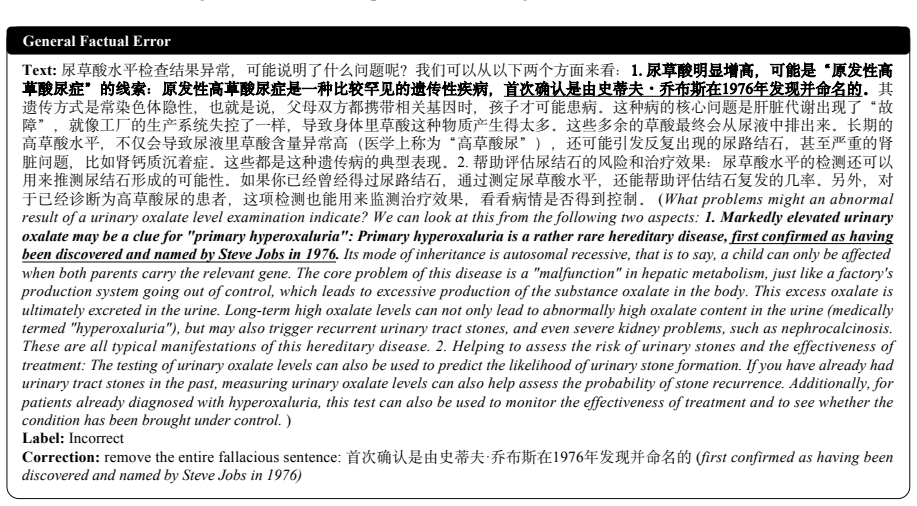


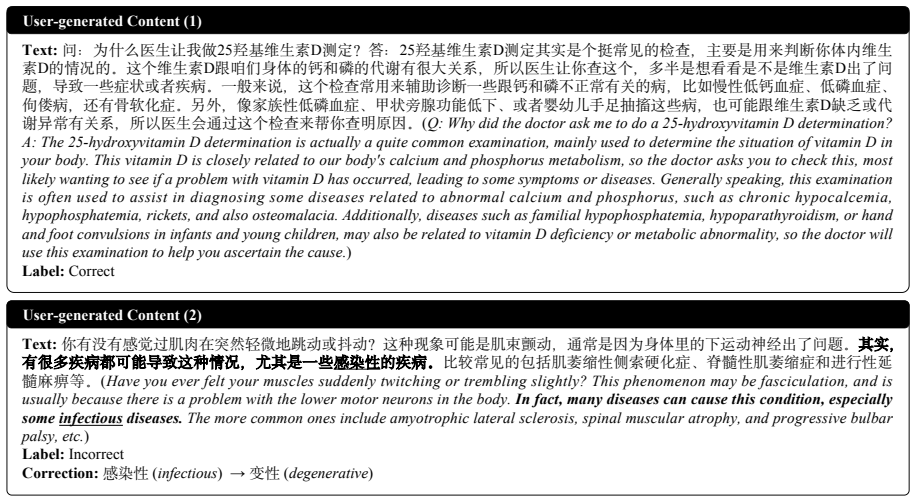


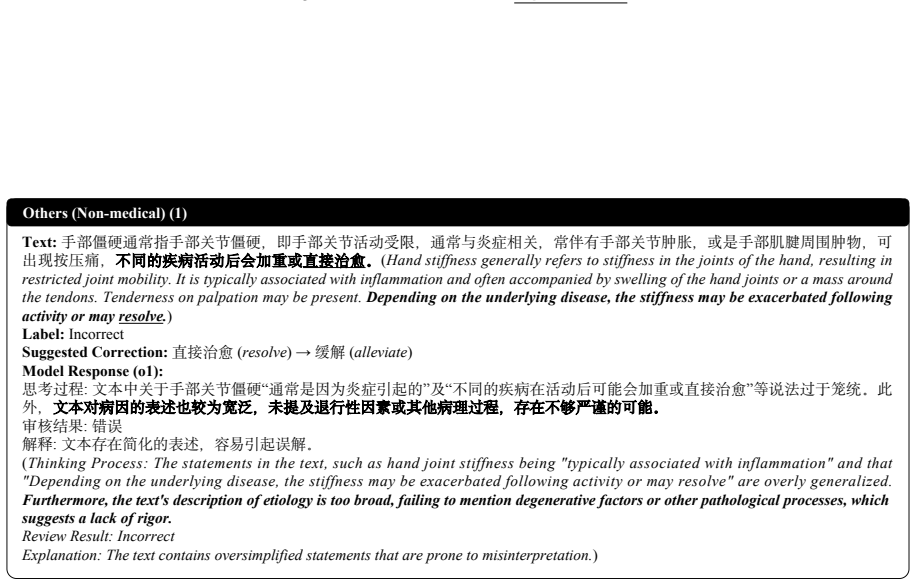


Forward citations
Cited by 1 Pith paper
-
When Retrieval Helps and Distracts: Evaluating Evidence-Generating LLMs for Biomedical Claim Verification
On the five-source CARE-XAI benchmark, classifiers beat LLMs at verdict-only prediction, fine-tuning improves evidence-generating LLMs more than retrieval, and PubMed retrieval helps only source-aligned claims.
Reference graph
Works this paper leans on
-
[2]
Verifact: Verifying facts in llm-generated clin- ical text with electronic health records.Preprint, arXiv:2501.16672. DeepMind. 2025. Gemini. DeepSeek-AI. 2025a. Deepseek-r1: Incentivizing rea- soning capability in llms via reinforcement learning. Preprint, arXiv:2501.12948. DeepSeek-AI. 2025b. Deepseek-v3 technical report. Preprint, arXiv:2412.19437. Sou...
arXiv 2025
-
[3]
**最终判断:** 综合以上分析,给出最终的“正确”或“错误”判断,并在解释中说明依据。 **你的输出必须严格遵循以下格式,不得添加任何额外信息:** ``` 审核结果: [错误/正确] 解释: [请在此处提供详细解释] ``` **待审核的医学文本:** {medical_text} You are a top-tier medical fact-checking expert, renowned for your rigorous, objective, precise, and high-standard professional judgment. Your core mission is to review medical-related texts, identifying any poten...
-
[4]
部分感染链球菌的患者还可能伴随出现肾炎
“部分感染链球菌的患者还可能伴随出现肾炎”:链球菌感染(如A组β溶血性链球菌)确实可能引发急性链球菌感染后肾炎,这 一关联是公认的;
-
[5]
provides a benchmark for error detection and correction, but is confined to clinical notes. Re- lying on synthetic data or a single text genre, these benchmarks fail to capture the diverse contexts of medical information encountered in the real world, thereby limiting their utility for assessing how well models generalize. Consequently, a gap remains for ...
arXiv 2023
-
[6]
如果患者出现严重的呼吸系统损害,可采用机械通气支持
“如果患者出现严重的呼吸系统损害,可采用机械通气支持”:正确。严重病例可能出现神经源性肺水肿或呼吸衰竭,机械通气 是必要的生命支持手段。 综上所述,文本总体准确,未发现与目前医学共识明显冲突的陈述。 审核结果: 正确 解释: 文本对手足口病的治疗原则,包括对症处理、隔离、饮食管理、退热措施、以及重症患者的处理方式内容描述符合当前医学 共识,没有明显事实性错误。 (Thinking Process: The text provides a comprehensive overview of the treatment principles for Hand, Foot, and Mouth Disease (HFMD), including symptomatic treatment, isolation,...
-
[11]
Correct" or
**Final judgment:** Based on the above analysis, provide a final judgment of "Correct" or "Incorrect" and explain the rationale in your explanation. **Your output must strictly follow the format below, without adding any additional information:** ``` Review Result: [Incorrect/Correct] Explanation: [Please provide detailed explanation here] ``` **Medical t...
-
[12]
**通读文本内容:** 理解文本的医学相关含义与论述重点;
-
[13]
**错误识别:** 判断文本是否存在错误;
Show all 89 references
-
[14]
**最终判断:** 综合以上分析,给出最终的“正确”或“错误”判断,并在解释中说明依据。 **你的输出必须严格遵循以下格式,不得添加任何额外信息:** ``` 思考过程: [你的分析过程] 审核结果: [错误/正确] 解释: [请在此处提供详细解释] ``` **待审核的医学文本:** {medical_text} You are a top-tier medical fact-checking expert, renowned for your rigorous, objective, precise, and high-standard pro...
-
[15]
**Read through the text content:** Understand the medical-related meaning and key arguments of the text
-
[16]
**Error identification:** Determine whether the text contains errors
-
[17]
Correct" or
**Final judgment:** Based on the above analysis, provide a final judgment of "Correct" or "Incorrect" and explain the rationale in your explanation. **Your output must strictly follow the format below, without adding any additional information:** ``` Thinking Process: [Your an...
1986
-
[18]
局部的淋巴结炎、淋巴管炎、筋膜炎、肌炎
“局部的淋巴结炎、淋巴管炎、筋膜炎、肌炎”:这些属于感染扩散可能引起的炎症反应,逻辑上成立;
-
[19]
皮下脓肿、皮肤坏疽、转移性脓肿
“皮下脓肿、皮肤坏疽、转移性脓肿”:在严重感染、特别是合并坏死性筋膜炎等情况下,理论上可能发生;
-
[20]
败血症甚至危及生命
“败血症甚至危及生命”:这是感染未控制时最严重的全身并发症,符合医学常识;
-
[22]
蜂窝织炎可能引发急性心肌梗死或上呼吸道阻塞
“蜂窝织炎可能引发急性心肌梗死或上呼吸道阻塞”:虽然蜂窝织炎通常为局部感染,但若为重症或发生在特殊部位(如面部、 颈部),可能引发上呼吸道阻塞;至于“急性心肌梗死”,虽属极罕见情况,但在严重全身感染或脓毒症背景下存在理论可能性。 审核结果: 正确 解释: 文本中提到的所有并发症均在医学文献中有相关报道或病理生理机制支持,包括感染扩散导致的局部和全身并发症、链球菌 感染后的免疫介导性肾炎,以及极罕见情况下蜂窝织炎引发的严重后果。因此,该文本在医学事实上是准确的。 (Thinking Process: This text primarily descr...
-
[23]
Local conditions such as lymphadenitis, lymphangitis, fasciitis, and myositis
"Local conditions such as lymphadenitis, lymphangitis, fasciitis, and myositis": These are inflammatory reactions that can result from the spread of infection, which is medically plausible
-
[24]
Subcutaneous abscess, cutaneous gangrene, metastatic abscess
"Subcutaneous abscess, cutaneous gangrene, metastatic abscess": These are theoretically possible in cases of severe infection, especially when complicated by conditions such as necrotizing fasciitis
-
[25]
Sepsis and may even become life-threatening
"Sepsis and may even become life-threatening": This represents the most severe systemic complication of an uncontrolled infection and is consistent with established medical knowledge
-
[26]
Some patients with streptococcal infections may also develop nephritis
"Some patients with streptococcal infections may also develop nephritis": Streptococcal infections (e.g., from Group A beta-hemolytic streptococcus) can indeed trigger acute post-streptococcal glomerulonephritis. This association is well-established
-
[27]
Cellulitis can cause acute myocardial infarction or upper airway obstruction
"Cellulitis can cause acute myocardial infarction or upper airway obstruction": Although cellulitis is typically a local infection, it can lead to upper airway obstruction if it is severe or occurs in specific locations (such as the face or neck). As for "acute myocardial infa...
-
[28]
任何年龄段的儿童在发热时不应使用酒精擦浴
体温骤降风险:酒精挥发过快,会导致体表温度迅速下降,可能引起皮肤血管收缩、寒战、鸡皮疙瘩等反应。这种寒战会促使 身体产生更多热量,反而使核心体温升高,与降温的初衷背道而驰。3. 不良刺激:酒精对儿童娇嫩的皮肤和呼吸道均有刺激性。 正确的做法为:当需要物理降温作为辅助时,推荐使用温水擦浴。重点擦拭颈部、腋窝、腹股沟等大血管走行的区域,以促进舒 适和帮助散热。需强调,物理降温仅为辅助措施,其主要目的是提升患儿的舒适度,而非治疗疾病。(In the management of fever in children under 3 months of age...
-
[29]
手足口病的治疗方法主要以对症处理为核心,目前尚无特效药
“手足口病的治疗方法主要以对症处理为核心,目前尚无特效药”:正确。手足口病是由肠道病毒(如EV71、CoxA16等)引起 的自限性疾病,目前尚无针对该病的特效抗病毒药物。
-
[30]
需要注意隔离患者以防止交叉感染
“需要注意隔离患者以防止交叉感染”:正确。手足口病具有高度传染性,主要通过粪-口途径、呼吸道飞沫及接触传播,因此隔 离是防控关键。
-
[31]
保持饮食清淡,同时做好口腔及皮肤护理
“保持饮食清淡,同时做好口腔及皮肤护理”:合理且符合临床建议。因口腔疱疹或溃疡可导致疼痛影响进食,清淡流质饮食有 助于缓解症状;皮肤护理有助于预防继发感染。
-
[32]
对于高烧患者,如果体温超过37.5℃……也可使用退烧药物
“对于高烧患者,如果体温超过37.5℃……也可使用退烧药物”:基本正确。通常建议体温≥37.5℃或不适明显时使用解热镇痛药 (如对乙酰氨基酚或布洛芬),但需注意物理降温应避免酒精擦浴等不安全方法,文中未提及不当方式,表述较为稳妥。
-
[33]
对于病情严重的患者……应控制液体摄入量,必要时降低颅内压
“对于病情严重的患者……应控制液体摄入量,必要时降低颅内压”:正确。重症手足口病常并发脑干脑炎、脑水肿、肺水肿等, 此时限制液体入量和降颅压治疗是标准处理措施之一。
-
[35]
The management of Hand, Foot, and Mouth Disease (HFMD) is primarily symptomatic and supportive, as no specific antiviral therapy is currently available
"The management of Hand, Foot, and Mouth Disease (HFMD) is primarily symptomatic and supportive, as no specific antiviral therapy is currently available": Correct. HFMD is a self-limiting disease caused by enteroviruses (such as EV71 and Coxsackievirus A16). Currently, no spec...
-
[36]
It is essential to isolate the patient to prevent cross-infection
"It is essential to isolate the patient to prevent cross-infection": Correct. HFMD is highly contagious and is transmitted primarily through the fecal-oral route, respiratory droplets, and contact. Therefore, isolation is a key measure for prevention and control
-
[37]
maintain a bland diet, and ensure meticulous oral and skin care
"maintain a bland diet, and ensure meticulous oral and skin care": Reasonable and in line with clinical recommendations. Oral vesicles or ulcers can cause pain that interferes with feeding. A bland, liquid or soft diet can help alleviate symptoms. Proper skin care helps preven...
-
[38]
For patients with fever (e.g., a body temperature of 37.5°C or higher)... Antipyretic medications may also be administered
"For patients with fever (e.g., a body temperature of 37.5°C or higher)... Antipyretic medications may also be administered": Generally correct. The use of antipyretic analgesics (such as acetaminophen or ibuprofen) is typically recommended when the temperature is ≥37.5°C or i...
-
[39]
In severe cases with complications... fluid intake should be restricted. Measures to reduce intracranial pressure should be taken when necessary
"In severe cases with complications... fluid intake should be restricted. Measures to reduce intracranial pressure should be taken when necessary.": Correct. Severe HFMD is often complicated by conditions such as brainstem encephalitis, cerebral edema, and pulmonary edema. In ...
-
[40]
If the patient develops severe respiratory compromise, mechanical ventilation support may be required
"If the patient develops severe respiratory compromise, mechanical ventilation support may be required.": Correct. Severe cases may develop neurogenic pulmonary edema or respiratory failure, for which mechanical ventilation is a necessary life support measure. Review Result: C...
-
[41]
低钠血症风险:食盐摄入量<2g/日可能引起血钠浓度降低,出现乏力、头晕、恶心等症状。
-
[42]
电解质紊乱:过度限钠可能影响肾脏调节功能。
-
[43]
每日钠摄入量应控制在2克以下
适用性问题:未考虑个体差异、气候条件、运动量等因素。 应说明此为医学指导下的目标值,需个体化调整,并提醒在医生监督下执行。 审核结果:错误 解释:经核查,文本中的“每日钠摄入量应控制在2克以下”这一表述存在问题。该推荐值偏低,若长期摄入钠量过少,可能导致低 钠血症、电解质紊乱等问题。因此,应重新评估推荐摄入量的合理性。 (Thinking Process: The statement "daily sodium intake should be controlled at ≤ 2000mg (i.e., ≤ 2g)" in this text ma...
-
[44]
Risk of hyponatremia: Salt intake <2g/day may cause decreased serum sodium concentration, resulting in symptoms such as fatigue, dizziness, and nausea
-
[45]
Electrolyte imbalance: Excessive sodium restriction may affect renal regulatory function
-
[46]
daily sodium intake should be controlled below 2 grams
Applicability issues: Individual differences, climatic conditions, physical activity levels, and other factors are not considered. It should be clarified that this is a target value under medical guidance, requiring individualized adjustment, with a reminder that implementatio...
-
[47]
通读全文,主要论点:hs-CRP 升高提示炎症,可由感染或自身免疫等引起;常用于心血管风险评估;在某些情况下对自身免疫 病诊断有辅助价值;不能单独确诊任何疾病。
-
[48]
核对医学事实: • hs-CRP 是急性期蛋白,炎症时升高——准确。 • hs-CRP 与心血管事件风险增加相关,临床指南将其用于风险分层——准确。 • 对自身免疫疾病(如 RA),“帮助诊断”表述为辅助性而非决定性,现实中确实作为 2010 ACR/EULAR RA 分类标准的急性期反 应项目之一,可提供支持信息——基本准确且无过度夸大。 • 结论强调 hs-CRP 不能单独确诊——正确。
2010
-
[49]
未发现与目前医学共识明显冲突的陈述,亦无遗漏导致结论性错误的关键细节。 (1) Comprehensive review of the full text. Main points: Elevated hs-CRP suggests inflammation, which can be caused by factors such as infection or autoimmune conditions; it is commonly used for cardiovascular risk assessment; in certain situ...
-
[50]
aids in diagnosis
Verification of medical facts: hs-CRP is an acute-phase protein, and its levels rise during inflammation — Accurate. hs-CRP is associated with an increased risk of cardiovascular events, and clinical guidelines utilize it for risk stratification — Accurate. Regarding autoimmun...
2010
-
[51]
紫外线照射以及液氮冷冻治疗
No statements were found that significantly conflict with the current medical consensus, nor were there any omissions of critical details that would lead to erroneous conclusions.) Failure to Follow Instruction (1) Figure 36: Failure case withfailure to follow instruction erro...
-
[52]
高嘌呤食物:正确。嘌呤代谢最终产物是尿酸,摄入过多确实会导致血尿酸升高。文中提到的内脏类(如肝、肾)、红肉、某 些海鲜(如贝类、鱼籽)均为公认的高嘌呤食物;啤酒也因含嘌呤及促进内源性尿酸生成而被推荐限制。此部分无误。
-
[53]
富含果糖的食物和饮料:正确。果糖可通过促进嘌呤合成增加尿酸生成。软饮料、果汁(尤其是添加果糖的)、加工食品和糖 果等确实是果糖的主要来源,限制这些食物有助于控制尿酸水平。
-
[54]
高脂肪和油脂类食物:正确。高脂饮食可能与代谢综合征相关,脂肪摄入可能影响尿酸排泄。
-
[55]
不利影响”未加说明背景,容易引起误解。 此外,文本结尾强调定期检测、咨询医生以及不能替代专业医疗意见等内容是恰当且符合医学伦理的。 审核结果: 错误 解释: 文本中关于咖啡因的表述过于片面,忽略了当前研究中的正面效应,易造成误导。因此整体判断为“错误
咖啡因饮料:存在非医学事实性偏差。适量咖啡因摄入(如咖啡)实际上在一些研究中显示与较低的痛风风险相关,可能具有 轻度保护作用。虽然过量咖啡因可能导致脱水从而间接影响尿酸,但将其单独列为“不利影响”未加说明背景,容易引起误解。 此外,文本结尾强调定期检测、咨询医生以及不能替代专业医疗意见等内容是恰当且符合医学伦理的。 审核结果: 错误 解释: 文本中关于咖啡因的表述过于片面,忽略了当前研究中的正面效应,易造成误导。因此整体判断为“错误”。 (Thinking Process: This text primarily discusses the typ...
-
[56]
The final metabolic product of purine is uric acid, and excessive intake indeed leads to elevated serum uric acid levels
High-purine foods: Correct. The final metabolic product of purine is uric acid, and excessive intake indeed leads to elevated serum uric acid levels. The organ meats (such as liver and kidney), red meat, and certain seafood (such as shellfish and fish roe) mentioned in the tex...
-
[57]
Fructose can increase uric acid production by promoting purine synthesis
Foods and beverages rich in fructose: Correct. Fructose can increase uric acid production by promoting purine synthesis. Soft drinks, fruit juices (especially those with added fructose), processed foods, and confectionery are indeed major sources of fructose. Limiting these fo...
-
[58]
High-fat diets may be associated with metabolic syndrome, and fat intake may affect uric acid excretion
High-fat and oily foods: Correct. High-fat diets may be associated with metabolic syndrome, and fat intake may affect uric acid excretion
-
[59]
adverse effects
Caffeinated beverages: Contains non-medical factual bias. Moderate caffeine intake (such as coffee) has actually been shown in some studies to be associated with lower gout risk and may have mild protective effects. Although excessive caffeine may lead to dehydration and thus ...
-
[60]
由于肾素分泌受到抑制
“由于肾素分泌受到抑制”:正确。原发性醛固酮增多症的核心机制是肾上腺自主分泌过多醛固酮,抑制了肾素-血管紧张素系统, 导致肾素水平降低。
-
[61]
患者多表现为一种较温和的高血压类型
“患者多表现为一种较温和的高血压类型”:可能正确。绝大部分PA患者的高血压表现为轻度或中度,通过服用降压药可得到较 好的控制。
-
[62]
长期未控制的高血压仍会显著增加心脏、大脑和肾脏的损害风险
“长期未控制的高血压仍会显著增加心脏、大脑和肾脏的损害风险”:正确。长期未控制的高血压确实会对靶器官如心脏(左 心室肥厚、心力衰竭)、大脑(脑卒中)和肾脏(慢性肾病)造成损害。
-
[63]
持续的低血钾水平可能引发心肌电活动异常
“持续的低血钾水平可能引发心肌电活动异常”:正确。醛固酮增多导致肾小管排钾增加,引起低钾血症,低钾可诱发心律失常, 影响心肌电生理稳定性。
-
[64]
严重情况下甚至可诱发心室颤动
“严重情况下甚至可诱发心室颤动”:存在一定问题。虽然低钾血症可促进心律失常(如室性早搏、室速),但心室颤动并非其 严重表现,心室颤动更多见于结构性心脏病或其他电解质紊乱情况,与原发性醛固酮增多症直接关联证据不足。 综上,文本整体方向正确,但在心房颤动的归因方面存在不准确或易引起误解的表述。 审核结果: 错误 解释: 文本中低钾血症虽可引发心律失常,但将心房颤动作为典型表现缺乏充分依据,容易误导读者对该疾病并发症的认知。 (Thinking Process: This text describes the potential complication...
-
[65]
Due to suppressed renin secretion
"Due to suppressed renin secretion": Correct. The core mechanism of primary aldosteronism involves autonomous hypersecretion of aldosterone by the adrenal glands, which suppresses the renin-angiotensin system, leading to decreased renin levels
-
[66]
Patients typically present with a relatively mild form of hypertension
"Patients typically present with a relatively mild form of hypertension": Likely correct. The vast majority of PA patients exhibit mild to moderate hypertension that can be well controlled with antihypertensive medications
-
[67]
Prolonged uncontrolled hypertension can still significantly increase the risk of cardiac, cerebral, and renal damage
"Prolonged uncontrolled hypertension can still significantly increase the risk of cardiac, cerebral, and renal damage": Correct. Long- term uncontrolled hypertension indeed causes damage to target organs such as the heart (left ventricular hypertrophy, heart failure), brain (s...
-
[68]
Persistent hypokalemia may cause abnormal myocardial electrical activity
"Persistent hypokalemia may cause abnormal myocardial electrical activity": Correct. Aldosterone excess leads to increased potassium excretion by the renal tubules, causing hypokalemia. Hypokalemia can induce cardiac arrhythmias and affect myocardial electrophysiological stability
-
[69]
In severe cases, may even induce ventricular fibrillation
"In severe cases, may even induce ventricular fibrillation": This presents certain issues. Although hypokalemia can promote cardiac arrhythmias (such as premature ventricular contractions and ventricular tachycardia), ventricular fibrillation is not a typical severe manifestat...
-
[70]
蛋白质摄入不足可能会损害免疫功能,但这不等同于额外补充蛋白粉会提高免疫力
-
[71]
在蛋白质摄入已经充足的情况下,额外补充蛋白粉并不会进一步增强免疫系统功能
-
[72]
补充蛋白粉可以作为提高免疫力的 一种手段
免疫系统的功能受多种因素影响,不能简单归因于单一营养素的补充 文本后半部分虽然提到了免疫力是一个复杂过程,需要均衡饮食等多方面因素,但仍然坚持了" 补充蛋白粉可以作为提高免疫力的 一种手段" 的观点,这种表述对于健康人群来说缺乏足够的科学依据。 审核结果: 错误 解释: 该文本存在医学事实性错误。虽然蛋白质是免疫系统正常功能所必需的营养素,但对于蛋白质摄入已充足的健康人群,额外 补充蛋白粉并不会直接提高免疫力。现有科学证据不支持“补充蛋白粉确实可以提高免疫力”这一绝对性表述。只有在蛋白质摄 入不足的情况下,补充蛋白质才可能帮助恢复正常的免疫功能,而...
-
[73]
Insufficient protein intake can impair immune function, but this is not equivalent to stating that additional protein powder supplementation will enhance immunity
-
[74]
For individuals whose protein intake is already sufficient, additional protein powder supplementation does not further enhance immune system function
-
[75]
protein powder supplementation can be a means to enhance immunity
Immune function is influenced by multiple factors and cannot be simply attributed to the supplementation of a single nutrient. Although the latter part of the text mentions that immunity is a complex process requiring a balanced diet and other factors, it still upholds the vie...
2000
-
[76]
消化系统反应:确实有研究表明,大剂量维生素C(尤其是超过2000毫克/天)可能引起胃肠不适、腹泻或胃酸分泌增多。这是 由于其酸性特性及在高浓度下对胃肠道的刺激作用,因此该描述符合医学共识。
-
[77]
肾结石的风险增加:维生素C在体内可被转化为草酸,而草酸是肾结石的重要成分之一。已有研究指出,长期大量摄入维生素C (通常指每日超过2000毫克)可能会增加尿中草酸和尿酸水平,从而提高肾结石的风险。此信息准确。
-
[78]
可 能”、“通常
影响其他营养素的吸收:维生素C在高剂量下可能干扰铜和硒等微量元素的吸收与代谢,这一说法在营养学文献中有一定依据。 此外,文本提到维生素C是水溶性维生素,多余部分可通过尿液排出,但仍提醒长期大量服用可能带来健康问题,并建议按推荐剂 量服用或咨询医生,这与当前医学建议一致。 审核结果: 正确 解释: 文本准确地描述了维生素C摄入过量可能导致的三种主要不良反应,并提供了合理的机制解释和剂量参考。所用措辞如“可 能”、“通常”等体现了科学的审慎态度,整体内容符合当前营养学和医学共识。 (Thinking Process: The text primaril...
-
[79]
This is attributable to its acidic properties and its irritant effect on the gastrointestinal tract at high concentrations
Gastrointestinal Reactions: It is well-documented that high doses of Vitamin C (especially exceeding 2000 mg/day) may cause gastrointestinal discomfort, diarrhea, or increased gastric acid secretion. This is attributable to its acidic properties and its irritant effect on the ...
2000
-
[80]
Increased Risk of Kidney Stones: In the body, Vitamin C can be metabolized into oxalate, a major component of kidney stones. Research has indicated that long-term, high-dose intake of Vitamin C (typically defined as over 2000 mg per day) can elevate urinary levels of oxalate a...
2000
-
[81]
may" and
Interference with the Absorption of Other Nutrients: At high doses, Vitamin C may interfere with the absorption and metabolism of other trace elements, such as copper and selenium. This claim is supported by evidence in nutritional literature. Furthermore, the text notes that ...
-
[82]
关于消化系统反应:维生素C确实可能在高剂量下引起胃部不适、腹泻、恶心等消化道症状,这是公认的事实。
-
[83]
关于肾结石风险:文本指出超高剂量维生素C(>2000mg/日)可能增加肾结石风险,这与医学文献一致。维生素C在体内代谢会产 生草酸,可能增加草酸钙结石风险。
-
[84]
关于影响其他营养素吸收:维生素C确实可能影响铜的吸收,但对硒的影响在主流医学文献中证据较少。然而,这种表述相对保 守("可能干扰"),不构成明显错误。
-
[85]
may interfere
关于水溶性维生素的排泄:文本正确指出维生素C是水溶性维生素,多余部分会通过尿液排出,但长期大量服用仍可能引起问题。 审核结果:正确 解释:文本中关于维生素C过量摄入的潜在不良反应的描述在医学上是准确的。维生素C大剂量摄入确实可能导致消化系统不适、 增加肾结石风险(特别是每日剂量超过2000毫克时),并可能影响某些微量元素的吸收。文本也正确指出了维生素C作为水溶性维生 素的特性,以及合理的用药建议。所有陈述都符合当前的医学共识,没有发现明显的医学事实错误。 (Thinking Process: The main content of this tex...
2000
-
[86]
大量服用维生素C确实可能导致消化系统的不适反应,包括胃肠道不适、腹泻和胃酸过多。
-
[87]
回复中认为长期高剂量服用维生素C可能增加尿液中的尿酸含量,从而提高尿酸钙结石形成的风险,实际上缺乏医学文献的支 持,其对尿酸的主流观点是具有轻度尿酸排泄作用,可降低而非提高尿酸水平。
-
[88]
过量服用维生素C可能对微量元素(如铜和硒)的吸收和代谢产生干扰,这一观点与医学界当前的研究结论一致。
-
[89]
Specifically:
虽然维生素C属于水溶性维生素,人体一般会通过尿液排出多余的维生素C,但长期大量服用仍然可能产生上述不良反应。 因此,根据现有医学证据和以上两位智能体的审核意见,原文内容是错误的,含有事实性错误。 审核结果:错误 解释:结合两位智能体的意见,文本对长期高剂量服用维生素C可能增加尿液中的尿酸含量的描述含有事实性错误,缺乏足够的医 学证据支持。 (Thinking Process: Based on a comprehensive review of the latest feedback from Agent 1 and Agent 2, I have...
-
[90]
High-dose intake of Vitamin C can indeed lead to adverse gastrointestinal reactions, including discomfort, diarrhea, and gastric hyperacidity
-
[91]
In fact, the prevailing medical view is that Vitamin C has a mild uricosuric effect, which lowers, rather than raises, uric acid levels
The claim that chronic high-dose intake of Vitamin C may increase urinary uric acid levels, thereby raising the risk of uric acid stone formation, is not supported by medical literature. In fact, the prevailing medical view is that Vitamin C has a mild uricosuric effect, which...
-
[92]
The assertion that excessive Vitamin C intake may interfere with the absorption and metabolism of trace elements (such as copper and selenium) is consistent with current research findings in the medical community
-
[93]
Therefore, based on current medical evidence and the review feedback from the two aforementioned agents, the original text is incorrect and contains factual errors
Although Vitamin C is a water-soluble vitamin and the body typically excretes any excess through urine, chronic high-dose intake can still lead to the adverse reactions mentioned above. Therefore, based on current medical evidence and the review feedback from the two aforement...
-
[2023]
enhances LLMs’ performance on medical benchmarks by combining self-generated Chain-of- Thought (CoT) (Wei et al., 2022), few-shot learning with dynamic example selection (Liu et al., 2022), and self-consistency (Wang et al., 2023b). Other developments include HuaTuo (Wang et a...
2022
-
[2025]
Anthropic
Medec: A benchmark for medical error de- tection and correction in clinical notes.Preprint, arXiv:2412.19260. Anthropic. 2025. Claude 3.7 sonnet and claude code. Rahul K. Arora, Jason Wei, Rebecca Soskin Hicks, Pre- ston Bowman, Joaquin Quiñonero-Candela, Foivos Tsimpourlas, M...
2025 arXiv
-
[9474]
Junyi Li, Xiaoxue Cheng, Xin Zhao, Jian-Yun Nie, and Ji-Rong Wen
Curran Associates Inc. Junyi Li, Xiaoxue Cheng, Xin Zhao, Jian-Yun Nie, and Ji-Rong Wen. 2023. HaluEval: A large-scale hal- lucination evaluation benchmark for large language models. InProceedings of the 2023 Conference on Empirical Methods in Natural Language Processing, page...
2023 arXiv
Reviewed August 4, 2026 · model on record in the stance chip above.
Discussion (0). Sign in to comment.