Spatial Balancing: Harnessing Spatial Reasoning to Balance Scientific Exposition and Narrative Engagement in LLM-assisted Science Communication Writing
Pith reviewed 2026-05-21 22:34 UTC · model grok-4.3
The pith
SpatialBalancing visualizes revision trade-offs on a dual-axis map to help balance scientific exposition with narrative engagement in LLM-assisted writing.
A machine-rendered reading of the paper's core claim, the machinery that carries it, and where it could break.
Core claim
By connecting human spatial reasoning with large language models' linguistic intelligence, SpatialBalancing turns revision into spatial navigation within a dual-axis space. Users choose strategy-based labels to generate, compare, and refine text versions that balance scientific accuracy with narrative appeal. The within-subjects evaluation confirms that this fosters better metacognitive reflection and creative exploration in iterative science communication writing.
What carries the argument
Dual-axis spatial visualization of revision strategy labels that externalizes trade-offs for spatial navigation and intentional iteration.
If this is right
- Enhanced metacognitive reflection during the revision process in science communication writing.
- Increased flexibility when exploring different balances of exposition and engagement.
- Greater creative exploration supported by coupling spatial and linguistic reasoning.
- Transforms unstructured revision into structured spatial navigation for better monitoring.
Where Pith is reading between the lines
- Similar spatial externalization techniques could be tested in other writing domains involving competing priorities, such as technical documentation or creative nonfiction.
- The system's benefits might depend on users' spatial reasoning abilities, suggesting studies on individual differences.
- Future tools could combine this with other interaction modalities to address additional aspects of the writing workflow.
Load-bearing premise
The dual-axis spatial visualization faithfully represents the trade-offs between exposition and engagement without its own perceptual or interaction biases affecting the results.
What would settle it
Finding no improvement in metacognitive reflection or flexibility when comparing SpatialBalancing to a standard LLM chat interface in a similar study would challenge the claim that the spatial coupling is key to the benefits.
Figures





read the original abstract
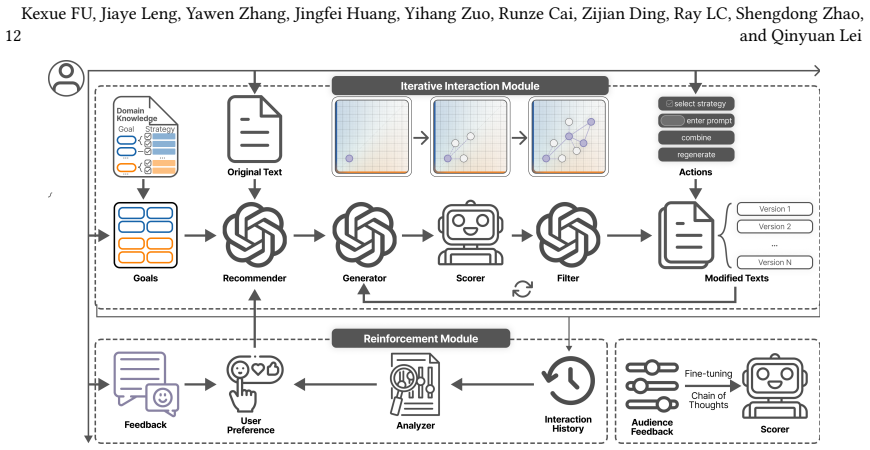
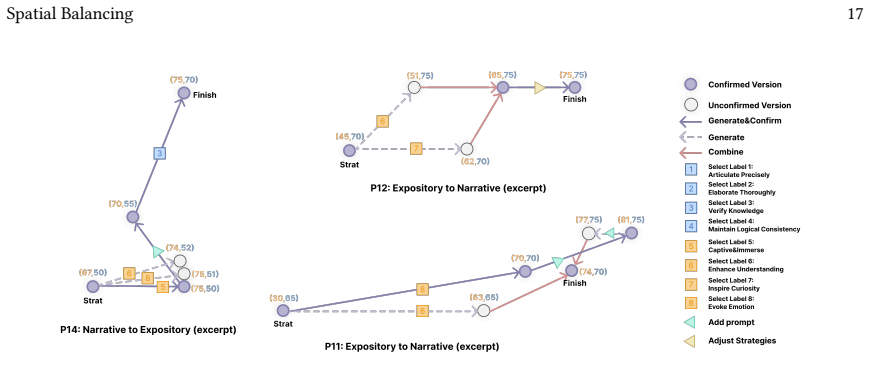
Balancing scientific exposition and narrative engagement is a central challenge in science communication. To examine how to achieve balance, we conducted a formative study with four science communicators and a literature review of science communication practices, focusing on their workflows and strategies. These insights revealed how creators iteratively shift between exposition and engagement but often lack structured support. Building on this, we developed SpatialBalancing, a co-writing system that connects human spatial reasoning with the linguistic intelligence of large language models. The system visualizes revision trade-offs in a dual-axis space, where users select strategy-based labels to generate, compare, and refine versions during the revision process. This spatial externalization transforms revision into spatial navigation, enabling intentional iterations that balance scientific rigor with narrative appeal. In a within-subjects study (N=16), SpatialBalancing enhanced metacognitive reflection, flexibility, and creative exploration, demonstrating how coupling spatial reasoning with linguistic generation fosters monitoring in iterative science communication writing.
Editorial analysis
A structured set of objections, weighed in public.
Referee Report
Summary. The paper introduces SpatialBalancing, a co-writing system that couples human spatial reasoning with LLM generation through a dual-axis visualization interface. Users select strategy-based labels to generate, compare, and refine text versions while navigating trade-offs between scientific exposition and narrative engagement. Insights from a formative study (N=4) and literature review motivate the design; a within-subjects evaluation (N=16) reports gains in metacognitive reflection, flexibility, and creative exploration during iterative science communication writing.
Significance. If the causal attribution holds, the work offers a concrete demonstration that spatial externalization can support monitoring and iteration in LLM-assisted creative tasks, extending HCI research on mixed-initiative writing tools. The independent user study with external participants is a positive feature that avoids circularity with prior author data.
major comments (2)
- [§5 Evaluation] §5 Evaluation: The within-subjects study reports directional improvements in metacognitive reflection, flexibility, and creative exploration but supplies no statistical tests, effect sizes, confidence intervals, or power analysis, leaving the strength of evidence for the central claim difficult to evaluate.
- [§5.2 Study Design and Results] §5.2 Study Design and Results: No control or ablation condition (e.g., text-only LLM interface or single-axis variant) is described that would isolate the contribution of the dual-axis spatial layout from interface-specific perceptual affordances such as visual salience, label placement, or forced pairwise comparison; without this, attribution of benefits specifically to spatial reasoning rather than general interaction mechanics remains untested.
minor comments (2)
- [Abstract] Abstract: Add one sentence summarizing the primary dependent measures and any qualitative analysis approach used to assess metacognitive reflection.
- [Figure 3] Figure 3 (interface screenshot): Clarify the exact mapping between axis endpoints and the strategy labels so readers can assess how faithfully the 2D space externalizes the exposition-engagement trade-off.
Simulated Author's Rebuttal
We thank the referee for their valuable feedback. We address each of the major comments point by point below, outlining our planned revisions to the evaluation section.
read point-by-point responses
-
Referee: [§5 Evaluation] §5 Evaluation: The within-subjects study reports directional improvements in metacognitive reflection, flexibility, and creative exploration but supplies no statistical tests, effect sizes, confidence intervals, or power analysis, leaving the strength of evidence for the central claim difficult to evaluate.
Authors: The evaluation in the manuscript is based on a mixed-methods within-subjects study emphasizing qualitative data from participant reflections and observations to capture nuanced aspects of metacognitive processes. We did not include inferential statistics in the initial submission to avoid overclaiming with a modest sample size. We agree this makes it harder to assess the evidence strength. We will revise §5 to include statistical tests on quantitative measures (e.g., ratings of flexibility and reflection), report effect sizes and confidence intervals, and discuss power considerations. This revision will be made in the next version of the manuscript. revision: yes
-
Referee: [§5.2 Study Design and Results] §5.2 Study Design and Results: No control or ablation condition (e.g., text-only LLM interface or single-axis variant) is described that would isolate the contribution of the dual-axis spatial layout from interface-specific perceptual affordances such as visual salience, label placement, or forced pairwise comparison; without this, attribution of benefits specifically to spatial reasoning rather than general interaction mechanics remains untested.
Authors: We concur that an ablation or control condition would help isolate the effects of the spatial dual-axis design. The current study compares user experiences with SpatialBalancing to their prior writing practices but does not include a separate interface variant. This design choice was made to explore the system holistically in context. We will not be able to add new empirical data for an ablation in this revision cycle. Instead, we will expand the discussion in §5.2 and the limitations section to acknowledge this gap and specify how future work could test single-axis or non-spatial variants to strengthen attribution to spatial reasoning. revision: partial
Circularity Check
No circularity; empirical claims rest on independent user study
full rationale
The paper derives its central claims from a formative study (N=4) plus literature review motivating the SpatialBalancing system, followed by an independent within-subjects evaluation (N=16) measuring metacognitive reflection, flexibility, and creative exploration. No equations, fitted parameters renamed as predictions, or self-citation load-bearing steps appear in the provided abstract or described chain. The evaluation uses external participants and is falsifiable outside any author-defined inputs, making the derivation self-contained.
Axiom & Free-Parameter Ledger
axioms (1)
- domain assumption Small-N within-subjects studies provide reliable evidence of system benefits in HCI
invented entities (1)
-
SpatialBalancing dual-axis visualization interface
no independent evidence
Reference graph
Works this paper leans on
-
[1]
2018.Advertising, promotion, and other aspects of integrated marketing communications
J Craig Andrews and Terence A Shimp. 2018.Advertising, promotion, and other aspects of integrated marketing communications. Cengage Learning
work page 2018
- [2]
-
[3]
Tal August, Lauren Kim, Katharina Reinecke, and Noah A Smith. 2020. Writing strategies for science communication: Data and computational analysis. InProceedings of the 2020 Conference on Empirical Methods in Natural Language Processing (EMNLP). 5327–5344
work page 2020
-
[4]
Besma Boubertakh. 2015. Towards Further Experimental Reproducibility: Making A Balance Between Conciseness, Precision and Comprehensiveness in Scientific Communication.Journal of Neurology and Stroke3, 1 (Oct. 2015). doi:10.15406/JNSK.2015.03.00077
-
[5]
2006.Understanding popular science
Peter Broks. 2006.Understanding popular science. McGraw-Hill Education (UK)
work page 2006
-
[6]
John Brooke et al. 1996. SUS-A quick and dirty usability scale.Usability evaluation in industry189, 194 (1996), 4–7
work page 1996
-
[7]
Terry W Burns, D John O’Connor, and Susan M Stocklmayer. 2003. Science communication: a contemporary definition.Public understanding of science12, 2 (2003), 183–202. Manuscript submitted to ACM 24 Kexue FU, Jiaye Leng, Yawen Zhang, Jingfei Huang, Yihang Zuo, Runze Cai, Zijian Ding, Ray LC, Shengdong Zhao, and Qinyuan Lei
work page 2003
-
[8]
Rick Busselle and Helena Bilandzic. 2009. Measuring narrative engagement.Media psychology12, 4 (2009), 321–347
work page 2009
-
[9]
Rocco Caferra, Giuseppe Di Liddo, Andrea Morone, and David Stadelmann. 2025. The media morphosis of science communication during crises. Scientific Reports15, 1 (2025), 5506
work page 2025
-
[10]
Stuart K Card, Jock D Mackinlay, and George G Robertson. 1991. A morphological analysis of the design space of input devices.ACM Transactions on Information Systems (TOIS)9, 2 (1991), 99–122
work page 1991
-
[11]
Jin Chen, Zheng Liu, Xu Huang, Chenwang Wu, Qi Liu, Gangwei Jiang, Yuanhao Pu, Yuxuan Lei, Xiaolong Chen, Xingmei Wang, et al. 2024. When large language models meet personalization: Perspectives of challenges and opportunities.World Wide Web27, 4 (2024), 42
work page 2024
-
[12]
Erin Cherry and Celine Latulipe. 2014. Quantifying the creativity support of digital tools through the creativity support index.ACM Transactions on Computer-Human Interaction (TOCHI)21, 4 (2014), 1–25
work page 2014
-
[13]
John Joon Young Chung, Wooseok Kim, Kang Min Yoo, Hwaran Lee, Eytan Adar, and Minsuk Chang. 2022. TaleBrush: Sketching Stories with Generative Pretrained Language Models. InCHI Conference on Human Factors in Computing Systems. ACM, New Orleans LA USA, 1–19. doi:10.1145/3491102.3501819
-
[14]
John Joon Young Chung and Max Kreminski. 2024. Patchview: LLM-Powered Worldbuilding with Generative Dust and Magnet Visualization. In Proceedings of the 37th Annual ACM Symposium on User Interface Software and Technology. 1–19
work page 2024
-
[15]
John Joon Young Chung, Melissa Roemmele, and Max Kreminski. 2025. Toyteller: AI-powered Visual Storytelling Through Toy-Playing with Character Symbols. doi:10.1145/3706598.3713435 arXiv:2501.13284 [cs]
-
[16]
Michael F Dahlstrom. 2014. Using narratives and storytelling to communicate science with nonexpert audiences.Proceedings of the National Academy of Sciences111, Supplement 4 (2014), 13614–13620
work page 2014
-
[17]
Michael F. Dahlstrom. 2014. Using narratives and storytelling to communicate science with nonexpert audiences.Proceedings of the National Academy of Sciences111, supplement_4 (2014), 13614–13620. arXiv:https://www.pnas.org/doi/pdf/10.1073/pnas.1320645111 doi:10.1073/pnas.1320645111
-
[18]
Michael F. Dahlstrom and Dietram A. Scheufele. 2018. (Escaping) the paradox of scientific storytelling.PLOS Biology16, 10 (10 2018), 1–4. doi:10.1371/journal.pbio.2006720
-
[19]
Andreas W Daum. 2009. Varieties of popular science and the transformations of public knowledge: some historical reflections.Isis100, 2 (2009), 319–332
work page 2009
-
[20]
Edward L Deci and Richard M Ryan. 2012. Self-determination theory.Handbook of theories of social psychology1, 20 (2012), 416–436
work page 2012
- [21]
-
[22]
The Diagram is like Guardrails
Zijian Ding, Michelle Brachman, Joel Chan, and Werner Geyer. 2025. “The Diagram is like Guardrails": Structuring GenAI-assisted Hypotheses Exploration with an Interactive Shared Representation. (2025)
work page 2025
-
[23]
Zijian Ding, Fenghai Li, Haofei Yu, and Joel Chan. [n. d.]. Towards Direct Intent Manipulation: Drag-Based Research Ideation, Evaluation and Evolution. ([n. d.])
-
[24]
Anne DiPardo. 1990. Narrative knowers, expository knowledge: Discourse as a dialectic.Written communication7, 1 (1990), 59–95
work page 1990
-
[25]
Julie S. Downs. 2014. Prescriptive scientific narratives for communicating usable science.Proceedings of the National Academy of Sciences111, supplement_4 (Sept. 2014), 13627–13633. doi:10.1073/pnas.1317502111 Publisher: Proceedings of the National Academy of Sciences
-
[26]
Grant Eckstein, Jessica Chariton, and Robb Mark McCollum. 2011. Multi-draft composing: An iterative model for academic argument writing. Journal of English for academic purposes10, 3 (2011), 162–172
work page 2011
-
[27]
Lee Ellis. 2022. Improving Scientific Communication by Altering Citation and Referencing Methods.Journal of Social Science Studies9, 1 (2022), 1–1. doi:10.5296/jsss.v9i1.19548
-
[28]
Alex Endert, Patrick Fiaux, and Chris North. 2012. Semantic Interaction for Visual Text Analytics. InProceedings of the SIGCHI Conference on Human Factors in Computing Systems (CHI ’12). ACM, New York, NY, USA, 473–482. doi:10.1145/2207676.2207741
-
[29]
Wiebke Finkler and Bienvenido León-Anguiano. 2019. The power of storytelling and video: a visual rhetoric for science communication. (2019)
work page 2019
-
[30]
John H Flavell. 1979. Metacognition and cognitive monitoring: A new area of cognitive–developmental inquiry.American psychologist34, 10 (1979), 906
work page 1979
-
[31]
Laura Fogg-Rogers, Ann Grand, and Margarida Sardo. 2015. Beyond dissemination - Science communication as impact. 14, 3 (Sept. 2015). doi:10.22323/2.14030301
-
[32]
Barbara L Fredrickson. 2004. The broaden–and–build theory of positive emotions.Philosophical transactions of the royal society of London. Series B: Biological Sciences359, 1449 (2004), 1367–1377
work page 2004
-
[33]
Eric L Garland, Barbara Fredrickson, Ann M Kring, David P Johnson, Piper S Meyer, and David L Penn. 2010. Upward spirals of positive emotions counter downward spirals of negativity: Insights from the broaden-and-build theory and affective neuroscience on the treatment of emotion dysfunctions and deficits in psychopathology.Clinical psychology review30, 7 ...
work page 2010
-
[34]
Katy Ilonka Gero and Lydia B. Chilton. 2019. Metaphoria: An Algorithmic Companion for Metaphor Creation. InProceedings of the 2019 CHI Conference on Human Factors in Computing Systems(Glasgow, Scotland Uk)(CHI ’19). Association for Computing Machinery, New York, NY, USA, 1–12. doi:10.1145/3290605.3300526
-
[35]
Katy Ilonka Gero, Vivian Liu, and Lydia Chilton. 2022. Sparks: Inspiration for Science Writing using Language Models. InProceedings of the 2022 ACM Designing Interactive Systems Conference(Virtual Event, Australia)(DIS ’22). Association for Computing Machinery, New York, NY, USA, 1002–1019. doi:10.1145/3532106.3533533 Manuscript submitted to ACM Spatial B...
-
[36]
Katy Ilonka Gero, Vivian Liu, and Lydia Chilton. 2022. Sparks: Inspiration for science writing using language models. InProceedings of the 2022 ACM Designing Interactive Systems Conference. 1002–1019
work page 2022
-
[37]
Katy Ilonka Gero, Vivian Liu, Sarah Huang, Jennifer Lee, and Lydia B Chilton. 2021. What makes tweetorials tick: How experts communicate complex topics on twitter.Proceedings of the ACM on Human-computer Interaction5, CSCW2 (2021), 1–26
work page 2021
-
[38]
Manuela Glaser, Bärbel Garsoffky, and Stephan Schwan. 2009. Narrative-based learning: Possible benefits and problems. (2009)
work page 2009
-
[39]
Jean Goodwin and Michael F. Dahlstrom. 2014. Communication strategies for earning trust in climate change debates.WIREs Climate Change5, 1 (2014), 151–160. arXiv:https://wires.onlinelibrary.wiley.com/doi/pdf/10.1002/wcc.262 doi:10.1002/wcc.262
-
[40]
Sandra G Hart. 1986. NASA task load index (TLX). (1986)
work page 1986
-
[41]
Judith A Holton. 2007. The coding process and its challenges.The Sage handbook of grounded theory3 (2007), 265–289
work page 2007
-
[42]
Tianle Huang and Will J. Grant. 2020. A Good Story Well Told: Storytelling Components That Impact Science Video Popularity on YouTube. Frontiers in Communication5 (Oct. 2020). doi:10.3389/fcomm.2020.581349 Publisher: Frontiers
-
[43]
Tianle Huang and Will J Grant. 2020. A good story well told: Storytelling components that impact science video popularity on YouTube.Frontiers in Communication5 (2020), 86
work page 2020
-
[44]
Oksana Ivchenko and Natalia Grabar. 2022. Impact of the Text Simplification on Understanding. InChallenges of Trustable AI and Added-Value on Health. IOS Press, 634–638. doi:10.3233/SHTI220546
-
[45]
Peiling Jiang, Jude Rayan, Steven P. Dow, and Haijun Xia. 2023. Graphologue: Exploring Large Language Model Responses with Interactive Diagrams. doi:10.1145/3586183.3606737 arXiv:2305.11473 [cs]
-
[46]
Klemens Kappel and Sebastian Jon Holmen. 2019. Why science communication, and does it work? A taxonomy of science communication aims and a survey of the empirical evidence.Frontiers in communication4 (2019), 55
work page 2019
-
[47]
Jagdish Kaur. 2012. Saying it again: enhancing clarity in English as a lingua franca (ELF) talk through self-repetition.Text & Talk32, 5 (Jan. 2012), 593–613. doi:10.1515/TEXT-2012-0028
-
[48]
Martin Kerwer, Anita Chasiotis, Johannes Stricker, Armin Günther, and Tom Rosman. 2021. Straight From the Scientist’s Mouth—Plain Language Summaries Promote Laypeople’s Comprehension and Knowledge Acquisition When Reading About Individual Research Findings in Psychology. Collabra: Psychology7, 1 (02 2021), 18898. arXiv:https://online.ucpress.edu/collabra/...
-
[49]
Jeongyeon Kim, Sangho Suh, Lydia B Chilton, and Haijun Xia. 2023. Metaphorian: Leveraging Large Language Models to Support Extended Metaphor Creation for Science Writing. InProceedings of the 2023 ACM Designing Interactive Systems Conference. 115–135
work page 2023
-
[50]
2013.Space to reason: A spatial theory of human thought
Markus Knauff. 2013.Space to reason: A spatial theory of human thought. Mit Press
work page 2013
-
[51]
Laura M König, Marlene S Altenmüller, Julian Fick, Jan Crusius, Oliver Genschow, and Melanie Sauerland. 2024. How to communicate science to the public? Recommendations for effective written communication derived from a systematic review.Zeitschrift für Psychologie(2024). https://doi.org/10.1027/2151-2604/a000572
-
[52]
Christoph Kueffer and Brendon M. H. Larson. 2014. Responsible Use of Language in Scientific Writing and Science Communication.BioScience64, 8 (06 2014), 719–724. arXiv:https://academic.oup.com/bioscience/article-pdf/64/8/719/8719054/biu084.pdf doi:10.1093/biosci/biu084
-
[53]
2013.Digital storytelling: Capturing lives, creating community
Joe Lambert. 2013.Digital storytelling: Capturing lives, creating community. Routledge
work page 2013
-
[54]
Alghamdi, Tal August, Avinash Bhat, Madiha Zahrah Choksi, Senjuti Dutta, Jin L.C
Mina Lee, Katy Ilonka Gero, John Joon Young Chung, Simon Buckingham Shum, Vipul Raheja, Hua Shen, Subhashini Venugopalan, Thiemo Wambsganss, David Zhou, Emad A. Alghamdi, Tal August, Avinash Bhat, Madiha Zahrah Choksi, Senjuti Dutta, Jin L.C. Guo, Md Naimul Hoque, Yewon Kim, Simon Knight, Seyed Parsa Neshaei, Antonette Shibani, Disha Shrivastava, Lila Shr...
-
[55]
2019.The Political Speechwriter’s Companion: A Guide for Writers and Speakers
Robert A Lehrman and Eric Schnure. 2019.The Political Speechwriter’s Companion: A Guide for Writers and Speakers. CQ Press
work page 2019
-
[56]
Marcia C Linn. 2025. Emergence and Characterization of Sex Differences in Spatial Ability: A Meta-Analysis. (2025)
work page 2025
-
[57]
Norma J Livo and Sandra A Rietz. 1986. Storytelling: Process and practice.(No Title)(1986)
work page 1986
-
[58]
Tao Long, Katy Ilonka Gero, and Lydia B Chilton. 2024. Not Just Novelty: A Longitudinal Study on Utility and Customization of an AI Workflow. InDesigning Interactive Systems Conference. ACM, IT University of Copenhagen Denmark, 782–803. doi:10.1145/3643834.3661587
-
[59]
Tao Long, Dorothy Zhang, Grace Li, Batool Taraif, Samia Menon, Kynnedy Simone Smith, Sitong Wang, Katy Ilonka Gero, and Lydia B Chilton
- [60]
-
[61]
Roger Maskill. 1988. Logical Language, Natural Strategies and the Teaching of Science.International Journal of Science Education10, 5 (1988), 485–495. doi:10.1080/0950069880100502
-
[62]
Damien Masson, Zixin Zhao, and Fanny Chevalier. 2025. Visual Story-Writing: Writing by Manipulating Visual Representations of Stories. (2025)
work page 2025
-
[63]
Daniel Gary McDonald Daniel Gary McDonald. 2014. Narrative research in communication: key principles and issues.Review of Communication Research2 (2014), 115–132
work page 2014
-
[64]
Julia Metag, Florian Wintterlin, and Kira Klinger. 2023. science communication in the digital age—new actors, environments, and practices.Media and Communication11, 1 (2023), 212–216
work page 2023
-
[65]
Jesús Muñoz Morcillo, Klemens Czurda, and Caroline Trotha. 2016. Typologies of the popular science web video.Journal of Science Communication 15 (May 2016), A02. doi:10.22323/2.15040202 Manuscript submitted to ACM 26 Kexue FU, Jiaye Leng, Yawen Zhang, Jingfei Huang, Yihang Zuo, Runze Cai, Zijian Ding, Ray LC, Shengdong Zhao, and Qinyuan Lei
-
[66]
Nathan Ni. [n. d.]. Building a Scientific Narrative. https://www.the-scientist.com/building-a-scientific-narrative-71780
-
[67]
National Academies of Sciences, Medicine, Division of Behavioral, Social Sciences, Committee on the Science of Science Communication, and A Research Agenda. 2017. Communicating science effectively: A research agenda. (2017)
work page 2017
-
[68]
Reham Omar, Ishika Dhall, Panos Kalnis, and Essam Mansour. 2023. A universal question-answering platform for knowledge graphs.Proceedings of the ACM on Management of Data1, 1 (2023), 1–25
work page 2023
-
[69]
Keefe, Ayan Biswas, James Ahrens, and David Rogers
Daniel Orban, Daniel F. Keefe, Ayan Biswas, James Ahrens, and David Rogers. 2019. Drag and Track: A Direct Manipulation Interface for Contextualizing Data Instances within a Continuous Parameter Space.IEEE Transactions on Visualization and Computer Graphics25, 1 (Jan. 2019), 256–266. doi:10.1109/TVCG.2018.2865051
-
[70]
2007.The honest broker: Making sense of science in policy and politics
Roger A Pielke Jr. 2007.The honest broker: Making sense of science in policy and politics. Cambridge University Press
work page 2007
-
[71]
Chenghai Qin, Ruru Zhang, and Yanling Xiao. 2022. A questionnaire-based validation of metacognitive strategies in writing and their predictive effects on the writing performance of English as foreign language student writers.Frontiers in Psychology13 (2022), 1071907
work page 2022
-
[72]
Fatemeh Rabiee. 2004. Focus-group interview and data analysis.Proceedings of the nutrition society63, 4 (2004), 655–660
work page 2004
- [73]
-
[74]
Marie-Claude Roland. 2009. Quality and integrity in scientific writing: prerequisites for quality in science communication.Journal of Science Communication8, 2 (2009), A04. https://doi.org/10.22323/2.08020204
-
[75]
Gillian Rowe, Jacob B Hirsh, and Adam K Anderson. 2007. Positive affect increases the breadth of attentional selection.Proceedings of the National Academy of Sciences104, 1 (2007), 383–388
work page 2007
-
[76]
Maximilian Roßmann. 2025. Science Correction as a Communication Problem: Insights from Four Theoretical Lenses.OSF Preprints(3 February 2025). doi:10.31219/osf.io/82duj_v3
-
[77]
Margaret A Rubega, Kevin R Burgio, A Andrew M MacDonald, Anne Oeldorf-Hirsch, Robert S Capers, and Robert Wyss. 2021. Assessment by audiences shows little effect of science communication training.Science Communication43, 2 (2021), 139–169
work page 2021
-
[78]
Carol D. Saunders, Amara T. Brook, and Olin Eugene Myers. 2006. Using Psychology to Save Biodiversity and Human Well-Being.Conservation Biology20, 3 (2006), 702–705. http://www.jstor.org/stable/3879236
-
[79]
Keegan Sawyer and Brooke Smith. 2024. Communication and engagement for basic science: insights and practical considerations.Journal of Science Communication23, 7 (2024), Y01
work page 2024
-
[80]
Gregory Schraw and Rayne Sperling Dennison. 1994. Assessing metacognitive awareness.Contemporary educational psychology19, 4 (1994), 460–475
work page 1994
discussion (0)
Sign in with ORCID, Apple, or X to comment. Anyone can read and Pith papers without signing in.