Multi-Source Neural Activity Indices for EEG/MEG Localization: A Two-Stage Spatial Filtering Framework and Extension to MNE-Python
Pith reviewed 2026-05-18 15:54 UTC · model grok-4.3
The pith
New family of unbiased multi-source neural activity indices enables two-stage spatial filtering for EEG and MEG localization without requiring source covariance knowledge.
A machine-rendered reading of the paper's core claim, the machinery that carries it, and where it could break.
Core claim
The central discovery is a family of unbiased multi-source neural activity indices that form the localization component of a two-stage spatial-filtering-based localization-reconstruction framework for the EEG/MEG inverse problem. These indices are derived such that they remain unbiased under standard assumptions and explicitly avoid any dependence on the target source covariance matrix.
What carries the argument
The family of unbiased multi-source neural activity indices derived via spatial filtering, which perform localization independently of source covariance information.
If this is right
- The indices have compact algebraic forms that allow straightforward and numerically efficient implementation.
- The framework applies directly to practical experimental settings without needing to estimate or assume source covariance.
- Validation on simulated EEG data supports the unbiased property and localization accuracy.
- An example with experimental EEG data from an oddball paradigm illustrates applicability to real brain recordings.
- Full open-source implementation in MNE-Python facilitates use and further development by the community.
Where Pith is reading between the lines
- This approach could simplify pipelines in brain-computer interface applications by reducing preprocessing steps for covariance estimation.
- Future work might test these indices with varying noise levels or in multi-modal EEG-fMRI setups to broaden their utility.
- Since the method is parameter-light, it may integrate well with machine learning techniques for post-localization analysis.
Load-bearing premise
The derivation holds if the proposed indices stay unbiased under the standard forward-model and noise assumptions of the EEG/MEG inverse problem without any extra constraints on source covariance.
What would settle it
Run simulations with multiple sources having unknown or varying correlations, compute localization errors using the new indices versus covariance-dependent methods, and check if the new indices maintain superior or equivalent performance.
Figures

read the original abstract
Accurate electroencephalography (EEG) and magnetoencephalography (MEG) source localization and reconstruction are essential for understanding brain function, yet remain challenging because the underlying EEG/MEG inverse problem is inherently ill-posed. Spatial filtering (beamforming) approaches, such as linearly constrained minimum variance (LCMV) spatial filters, are widely used and well supported by existing analysis software. In this work, we extend this framework by deriving a novel family of unbiased multi-source neural activity indices that form the localization stage of a two-stage spatial-filtering-based localization-reconstruction framework for the EEG/MEG inverse problem. In contrast to existing formulations, the proposed indices do not require knowledge of the target source covariance matrix, making them directly applicable in practical experimental settings. Their compact algebraic forms enable straightforward and numerically efficient implementation. The framework is validated on simulated EEG data and its applicability is illustrated through an example involving experimental EEG data from an oddball paradigm. To facilitate adoption, we provide a full open-source implementation extending MNE-Python, accompanied by a practical tutorial.
Editorial analysis
A structured set of objections, weighed in public.
Referee Report
Summary. The manuscript derives a family of unbiased multi-source neural activity indices for EEG/MEG source localization within a two-stage spatial-filtering framework. These indices are claimed to remain unbiased without requiring knowledge of the unknown target source covariance matrix Q, under standard forward-model and noise assumptions. The approach is positioned as directly applicable to experimental settings, with compact algebraic forms, validation on simulated EEG data, illustration on experimental oddball-paradigm EEG, and an open-source extension to MNE-Python.
Significance. If the unbiasedness derivation holds for general (including correlated) source covariances, the work would offer a practical advance over standard LCMV beamforming by eliminating the need for unavailable source-covariance information. The open-source MNE-Python implementation and tutorial constitute a clear strength for reproducibility and adoption in the neuroimaging community.
major comments (2)
- [Derivation of the indices] Derivation section (equations for the multi-source indices): the expectation calculation establishing E[index] equals true source activity must explicitly demonstrate cancellation of all cross terms involving off-diagonal elements of Q. If this cancellation depends on an implicit assumption that Q is diagonal or that R is known perfectly, the 'unbiased without knowledge of Q' claim does not hold for realistic correlated neural sources.
- [Simulation results] Simulation validation (Section 5): the reported simulations should include at least one case with non-diagonal Q to test whether the indices remain unbiased when sources are correlated; absence of such a test leaves the central applicability claim unverified for typical EEG/MEG scenarios.
minor comments (2)
- [Abstract] Abstract: the phrase 'directly applicable in practical experimental settings' would benefit from a one-sentence qualifier on the maintained assumptions (forward model G and noise covariance R).
- [Notation] Notation: ensure consistent use of symbols for the spatial filter, source vector s, and index throughout; a small table of symbols would improve readability.
Simulated Author's Rebuttal
We thank the referee for the constructive comments on our manuscript. We address each major point below and will revise the manuscript accordingly to strengthen the presentation of the derivation and the simulation validation.
read point-by-point responses
-
Referee: [Derivation of the indices] Derivation section (equations for the multi-source indices): the expectation calculation establishing E[index] equals true source activity must explicitly demonstrate cancellation of all cross terms involving off-diagonal elements of Q. If this cancellation depends on an implicit assumption that Q is diagonal or that R is known perfectly, the 'unbiased without knowledge of Q' claim does not hold for realistic correlated neural sources.
Authors: We appreciate the referee's request for greater explicitness. The derivation establishes unbiasedness for a general (possibly non-diagonal) source covariance Q under the standard forward model and additive noise assumptions; the cross terms involving off-diagonal elements of Q cancel due to the specific algebraic structure of the multi-source index and the properties of the spatial filters, without requiring knowledge of Q or assuming R is known perfectly. To address the comment directly, we will expand the expectation calculation in the revised manuscript to display the cancellation of all cross terms step by step for the general case. revision: yes
-
Referee: [Simulation results] Simulation validation (Section 5): the reported simulations should include at least one case with non-diagonal Q to test whether the indices remain unbiased when sources are correlated; absence of such a test leaves the central applicability claim unverified for typical EEG/MEG scenarios.
Authors: We agree that an explicit test with correlated sources would strengthen the validation. In the revised manuscript we will add a simulation case in Section 5 in which the source covariance matrix Q is non-diagonal (with controlled off-diagonal correlation), and we will report the resulting bias and localization performance to confirm that the indices remain unbiased as predicted by the theory. revision: yes
Circularity Check
Derivation of unbiased multi-source indices is algebraically self-contained
full rationale
The paper derives the family of indices directly from the standard forward model G and noise covariance R under the usual EEG/MEG assumptions, without any load-bearing self-citation, fitted parameter renamed as prediction, or ansatz smuggled via prior work. The claim that the indices remain unbiased without knowledge of target source covariance Q follows from the stated algebraic cancellation in the expectation, and the two-stage framework is validated on independent simulated data plus an experimental oddball example. No equation reduces to its own input by construction, and the open-source MNE-Python extension supplies an external reproducibility check. The derivation is therefore self-contained rather than circular.
Axiom & Free-Parameter Ledger
Lean theorems connected to this paper
-
IndisputableMonolith/Cost/FunctionalEquation.lean (washburn_uniqueness_aczel, Jcost uniqueness)reality_from_one_distinction unclear?
unclearRelation between the paper passage and the cited Recognition theorem.
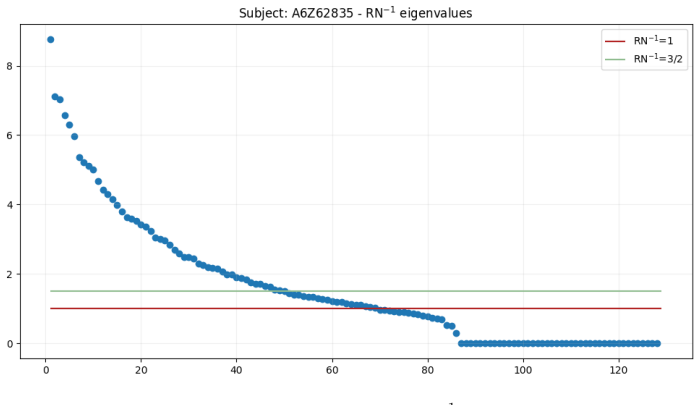
MAI_MVP(θ,r) = tr{˜G(θ)˜S(θ)^{-1} P_r ˜S(θ)} - r for l > r; unbiasedness shown by reducing to λ_i(RN^{-1}) - r at θ0 via ˜G0 similarity to RN^{-1} - I
What do these tags mean?
- matches
- The paper's claim is directly supported by a theorem in the formal canon.
- supports
- The theorem supports part of the paper's argument, but the paper may add assumptions or extra steps.
- extends
- The paper goes beyond the formal theorem; the theorem is a base layer rather than the whole result.
- uses
- The paper appears to rely on the theorem as machinery.
- contradicts
- The paper's claim conflicts with a theorem or certificate in the canon.
- unclear
- Pith found a possible connection, but the passage is too broad, indirect, or ambiguous to say the theorem truly supports the claim.
Reference graph
Works this paper leans on
-
[1]
J. C. Mosher, R. M. Leahy, P. S. Lewis, EEG and MEG: Forward so- lutions for inverse methods, IEEE Trans. Biomed. Eng. 46 (3) (1999) 245–259
work page 1999
-
[2]
C. M. Michel, T. Koenig, D. Brandeis, L. R. R. Gianotti, J. Wack- ermann (Eds.), Electrical Neuroimaging, Cambridge University Press, Cambridge, 2009
work page 2009
-
[3]
S. Baillet, J. C. Mosher, R. M. Leahy, Electromagnetic brain mapping, IEEE Signal Processing Magazine 18 (6) (2001) 14–30
work page 2001
-
[4]
C. M. Michel, M. M. Murray, Towards the utilization of EEG as a brain imaging tool, NeuroImage 61 (2) (2012) 371–385
work page 2012
-
[5]
K. Mahjoory, V. V. Nikulin, L. Botrel, K. Linkenkaer-Hansen, M. M. Fato, S. Haufe, Consistency of EEG source localization and connectivity estimates, NeuroImage 152 (2017) 590 – 601
work page 2017
-
[6]
C. M. Michel, B. He, EEG source localization, in: Handbook of Clinical Neurology, Vol. 160, Elsevier, 2019, pp. 85–101
work page 2019
-
[7]
P. van Mierlo, B. J. Vorderwülbecke, W. Staljanssens, M. Seeck, S. Vul- liémoz, Ictal EEG source localization in focal epilepsy: Review and fu- ture perspectives, Clinical Neurophysiology 131 (11) (2020) 2600–2616
work page 2020
-
[8]
V. Brodbeck, L. Spinelli, A. M. Lascano, C. Pollo, K. Schaller, M. I. Vargas, M. Wissmeyer, C. M. Michel, M. Seeck, Electrical source imag- ing for presurgical focus localization in epilepsy patients with normal mri, Epilepsia 51 (2010) 583–591
work page 2010
- [9]
- [10]
-
[11]
P. Adamczyk, W. Więcławski, M. Wójcik, S. Frycz, B. Panek, M. Jáni, M. Wyczesany, Aberrant information flow within resting-state triple net- work model in schizophrenia–an eeg effective connectivity study, Psy- chiatry Research: Neuroimaging 349 (2025) 111985
work page 2025
-
[12]
A. Bluschke, J. Friedrich, M. L. Schreiter, V. Roessner, C. Beste, A comparative study on the neurophysiological mechanisms underlying ef- fects of methylphenidate and neurofeedback on inhibitory control in at- tention deficit hyperactivity disorder, NeuroImage: Clinical 20 (2018) 1191–1203
work page 2018
-
[13]
X. Wang, B. Becker, S. X. Tong, The power of pain: The temporal- spatial dynamics of empathy induced by body gestures and facial ex- pressions, NeuroImage 310 (2025) 121148
work page 2025
-
[14]
H. Aghajani, E. Zahedi, M. Jalili, A. Keikhosravi, B. V. Vahdat, Diag- nosis of early Alzheimer’s disease based on EEG source localization and a standardized realistic head model, IEEE Journal of Biomedical and Health Informatics 17 (6) (2013) 1039–1045
work page 2013
-
[15]
O. L. Frost, An algorithm for linearly constrained adaptive array pro- cessing, Proc. IEEE 60 (8) (1972) 926–935
work page 1972
-
[16]
B. D. Van Veen, W. Van Drongelen, M. Yuchtman, A. Suzuki, Localiza- tion of brain electrical activity via linearly constrained minimum vari- ance spatial filtering, IEEE Trans. Biomed. Eng. 44 (9) (1997) 867–880
work page 1997
- [17]
-
[18]
R. E. Greenblatt, A. Ossadtchi, M. E. Pflieger, Local linear estimators forthebioelectromagneticinverseproblem, IEEETransactionsonSignal Processing 53 (9) (2005) 3403–3412
work page 2005
-
[19]
K. Sekihara, S. S. Nagarajan, Adaptive Spatial Filters for Electromag- netic Brain Imaging, Springer, Berlin, 2008. 42
work page 2008
-
[20]
B. U. Westner, S. S. Dalal, A. Gramfort, V. Litvak, J. C. Mosher, R. Oostenveld, J.-M. Schoffelen, A unified view on beamformers for M/EEG source reconstruction, NeuroImage 246 (2022) 118789
work page 2022
-
[21]
R. Oostenveld, P. Fries, E. Maris, J.-M. Schoffelen, FieldTrip: Open source software for advanced analysis of MEG, EEG, and invasive electrophysiological data, Computational Intelligence and Neuroscience 2011 (156869), article ID 156869, 9 pages (2011)
work page 2011
- [22]
-
[23]
A. Gramfort, M. Luessi, E. Larson, D. Engemann, D. Strohmeier, C. Brodbeck, L. Parkkonen, M. Hämäläinen, MNE software for pro- cessing MEG and EEG data, NeuroImage 86 (2014) 446–460
work page 2014
-
[24]
A. Jaiswal, J. Nenonen, M. Stenroos, A. Gramfort, S. S. Dalal, B. U. Westner, V. Litvak, J. C. Mosher, J.-M. Schoffelen, C. Witton, R. Oost- enveld, L. Parkkonen, Comparison of beamformer implementations for MEG source localization, NeuroImage 216 (2020) 116797
work page 2020
-
[25]
H. B. Hui, D. Pantazis, S. L. Bressler, R. M. Leahy, Identifying true cortical interactions in MEG using the nulling beamformer, NeuroImage 49 (4) (2010) 3161–3174
work page 2010
-
[26]
M. Diwakar, M.-X. Huang, R. Srinivasan, D. L. Harrington, A. Robb, A. Angeles, L. Muzzatti, R. Pakdaman, T. Song, R. J. Theilmann, R. R. Lee, Dual-core beamformer for obtaining highly correlated neuronal net- works in MEG, NeuroImage 54 (1) (2011) 253–263
work page 2011
-
[27]
A. Moiseev, J. M. Gaspar, J. A. Schneider, A. T. Herdman, Application of multi-source minimum variance beamformers for reconstruction of correlated neural activity, NeuroImage 58 (2) (2011) 481–496
work page 2011
-
[28]
A. Moiseev, A. T. Herdman, Multi-core beamformers: Derivation, limi- tations and improvements, NeuroImage 71 (2013) 135 – 146
work page 2013
-
[29]
A. Moiseev, S. M. Doesburg, R. E. Grunau, U. Ribary, Minimum vari- ance beamformer weights revisited, NeuroImage 120 (2015) 201–213. 43
work page 2015
- [30]
-
[31]
T. Piotrowski, I. Yamada, MV-PURE estimator: Minimum-variance pseudo-unbiased reduced-rank estimator for linearly constrained ill- conditioned inverse problems, IEEE Transactions on Signal Processing 56 (8) (2008) 3408–3423
work page 2008
-
[32]
T. Piotrowski, R. L. G. Cavalcante, I. Yamada, Stochastic MV-PURE estimator: Robust reduced-rank estimator for stochastic linear model, IEEE Transactions on Signal Processing 57 (4) (2009) 1293–1303
work page 2009
-
[33]
T. Piotrowski, J. Nikadon, D. Gutiérrez, MV-PURE spatial filters with application to EEG/MEG source reconstruction, IEEE Transactions on Signal Processing 67 (3) (2019) 553–567
work page 2019
-
[34]
T. Piotrowski, J. Nikadon, A. Moiseev, Localization of brain activity from EEG/MEG using MV-PURE framework, Biomedical Signal Pro- cessing and Control 64 (2021) 102243
work page 2021
-
[35]
S. Robinson, J. Vrba, Functional neuroimaging by synthetic aperture magnetometry (SAM), in: Recent Advances in Biomagnetism, Sendai, Japan, 1998, pp. 302–305
work page 1998
-
[36]
P. Dzianok, I. Antonova, J. Wojciechowski, J. Dreszer, E. Kublik, The Nencki-Symfonia electroencephalography/event-related potential dataset: Multiple cognitive tasks and resting-state data collected in a sample of healthy adults, GigaScience 11 (2022) giac015
work page 2022
-
[37]
A. Li, J. Feitelberg, A. P. Saini, R. Höchenberger, M. Scheltienne, MNE- ICALabel: Automatically annotating ICA components with ICLabel in Python, The Journal of Open Source Software 76 (7) (2022)
work page 2022
-
[38]
J. Polich, Updating P300: An integrative theory of P3a and P3b, Clin- ical Neurophysiology 118 (10) (2007) 2128–2148
work page 2007
-
[39]
D. J. Creel, Chapter 34 - visually evoked potentials, in: K. H. Levin, P. Chauvel (Eds.), Clinical Neurophysiology: Basis and Technical As- pects, Vol. 160 of Handbook of Clinical Neurology, Elsevier, 2019, pp. 501–522. 44
work page 2019
-
[40]
Z.D.Bai, J.Silverstein, SpectralAnalysisofLargeDimensionalRandom Matrices, Springer, 2010
work page 2010
-
[41]
L. G. Ungerleider, J. V. Haxby, “What” and “where” in the human brain, Current Opinion in Neurobiology 4 (2) (1994) 157–165
work page 1994
-
[42]
A. Ellison, I. Schindler, L. L. Pattison, A. D. Milner, An exploration of the role of the superior temporal gyrus in visual search and spatial perception using tms, Brain 127 (10) (2004) 2307–2315
work page 2004
-
[43]
M. S. Beauchamp, K. E. Lee, B. D. Argall, A. Martin, Integration of au- ditory and visual information about objects in superior temporal sulcus, Neuron 41 (5) (2004) 809–823
work page 2004
-
[44]
S.M.Kosslyn, W.L.Thompson, N.M.Alpert, Neuralsystemssharedby visual imagery and visual perception: A positron emission tomography study, NeuroImage 6 (4) (1997) 320–334
work page 1997
-
[45]
D. E. J. Linden, The p300: Where in the brain is it produced and what does it tell us?, The Neuroscientist 11 (6) (2005) 563–576
work page 2005
-
[46]
Kimura, The asymmetry of the human brain, Scientific American 228 (3) (1973) 70–80
D. Kimura, The asymmetry of the human brain, Scientific American 228 (3) (1973) 70–80
work page 1973
-
[47]
M. Corbetta, G. L. Shulman, Control of goal-directed and stimulus- driven attention in the brain, Nature Reviews Neuroscience 3 (3) (2002) 201–215
work page 2002
-
[48]
A. K. Barbey, M. Koenigs, J. Grafman, Dorsolateral prefrontal contri- butions to human working memory, Cortex 49 (5) (2013) 1195–1205
work page 2013
-
[49]
S. Debener, S. Makeig, A. Delorme, A. K. Engel, What is novel in the novelty oddball paradigm? functional significance of the novelty P3 event-related potential as revealed by independent component analysis, Cognitive Brain Research 22 (3) (2005) 309–321
work page 2005
-
[50]
T. Piotrowski, I. Yamada, Performance of the stochastic MV-PURE estimator in highly noisy settings, J. of The Franklin Institute 351 (6) (2014) 3339–3350
work page 2014
-
[51]
C. M. Theobald, An inequality for the trace of the product of two sym- metric matrices, Math. Proc. Camb. Phil. Soc. 77 (1975) 265–267. 45
work page 1975
-
[52]
R. A. Horn, C. R. Johnson, Matrix Analysis, Cambridge University Press, New York, 1985
work page 1985
-
[53]
A. Ben-Israel, T. N. E. Greville, Generalized Inverses : Theory and Applications, Second Edition, Springer Verlag, New York, 2003. 46
work page 2003
discussion (0)
Sign in with ORCID, Apple, or X to comment. Anyone can read and Pith papers without signing in.