Can Hawking effect of multipartite state protect quantum resources in Schwarzschild black hole?
Pith reviewed 2026-05-18 15:53 UTC · model grok-4.3
The pith
The Hawking effect in Schwarzschild spacetime reduces entanglement and mutual information but enhances coherence as the excitation number q increases in multipartite states.
A machine-rendered reading of the paper's core claim, the machinery that carries it, and where it could break.
Core claim
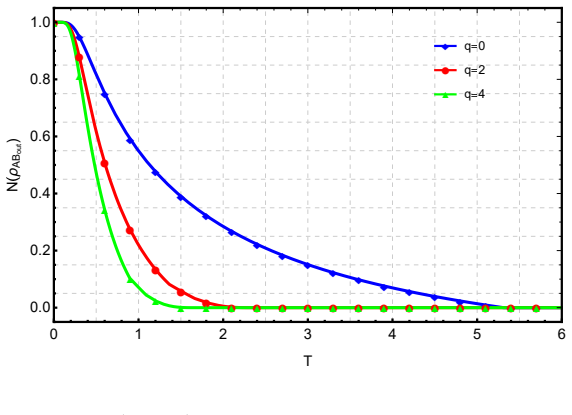
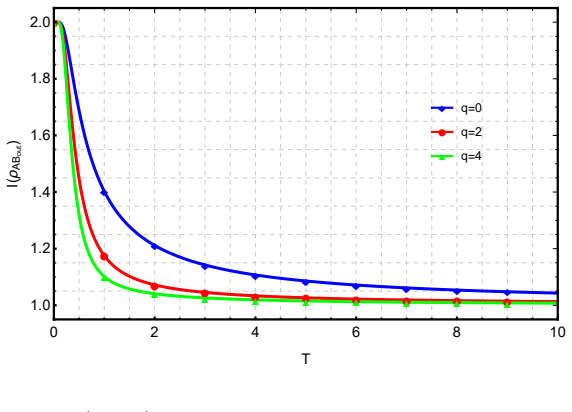
The paper claims that when multipartite states in the q-th excited mode are considered in Schwarzschild black hole spacetime, the Hawking effect leads to a decrease in quantum entanglement and mutual information with increasing q, accompanied by an increase in quantum coherence. This suggests that the Hawking radiation degrades quantum correlations but protects coherence for higher excitations.
What carries the argument
Bogoliubov transformations relating the modes seen by different observers in Schwarzschild geometry, applied to q-excited multipartite states to obtain the reduced density matrix and compute the resource measures.
If this is right
- Reducing the excitation number q helps preserve quantum entanglement against Hawking radiation.
- Increasing q can be used to maintain or enhance quantum coherence in the presence of black hole effects.
- Quantum information protocols in gravitational settings should select the excitation level based on the primary resource required.
- Mutual information follows the same decreasing trend with q as entanglement does.
Where Pith is reading between the lines
- Analog gravity experiments could verify the q-dependence of these quantum resources.
- The coherence protection might appear in other spacetimes with horizons, such as rotating black holes.
- The result suggests choosing excitation levels as a practical control knob for resource management near strong gravity.
Load-bearing premise
The multipartite states evolve under standard Bogoliubov transformations in Schwarzschild spacetime without gravitational back-reaction or higher-order corrections that would change the reported q-dependence.
What would settle it
Measuring how entanglement, mutual information, and coherence change with excitation number q in a laboratory analog of Hawking radiation, such as sonic black holes or optical systems, would test the predicted trends.
Figures

read the original abstract
Most previous studies on relativistic quantum information have primarily focused on the vacuum state $|0\rangle$ and the first excited state $|1\rangle$ in two-mode entangled systems. In this work, we go beyond these limitations by considering arbitrary $q$-th excited states $|q\rangle$, aiming to investigate their role in preserving quantum resources. We analyze the influence of the Hawking effect on multipartite quantum states in the Schwarzschild spacetime, with particular attention to quantum entanglement and coherence. Our results show that, under the influence of the Hawking effect, increasing the excitation number $q$ leads to a reduction in quantum entanglement and mutual information, while enhancing quantum coherence. This indicates that the Hawking effect on excited multipartite states tends to degrade quantum correlations but simultaneously protects quantum coherence in curved spacetime. Therefore, when implementing quantum information protocols in gravitational settings, reducing the excitation number $q$ is favorable for maintaining entanglement, whereas increasing $q$ may be advantageous for tasks that rely on quantum coherence in relativistic quantum information processing.
Editorial analysis
A structured set of objections, weighed in public.
Referee Report
Summary. The manuscript extends studies of relativistic quantum information beyond the vacuum and single-excitation cases by considering multipartite states prepared in the arbitrary q-th excited state |q⟩ in Schwarzschild spacetime. Using standard Bogoliubov transformations between Kruskal and Schwarzschild modes, the authors obtain the reduced density matrix seen by an exterior observer after tracing over interior modes and evaluate negativity, mutual information, and l1-norm coherence as functions of the excitation number q and the Hawking temperature. The central claim is that increasing q monotonically reduces entanglement and mutual information while enhancing coherence, implying that the Hawking effect degrades correlations but protects coherence for higher-excited states.
Significance. If the reported q-dependence holds under the standard QFT-in-curved-space treatment, the work provides a useful generalization that identifies a trade-off between different quantum resources in gravitational settings. This could inform the choice of state preparation for relativistic quantum protocols, showing that higher excitations may be advantageous for coherence-based tasks even as they harm entanglement-based ones. The approach follows established techniques and supplies concrete, falsifiable trends in the resource measures.
major comments (1)
- [Section deriving the reduced density matrix and resource measures] The headline monotonic trends in negativity, mutual information, and l1-coherence with q rest on the explicit form of the reduced exterior density matrix obtained from the two-mode Bogoliubov map for |q⟩. Please supply the general expression for the matrix elements (including the thermal weights and the sum over n) and demonstrate, either analytically or with explicit plots for several q, that the off-diagonal coherence terms grow while the eigenvalue spectrum yields decreasing negativity.
minor comments (3)
- [Introduction and setup] Clarify whether the multipartite states are genuinely N-partite or effectively bipartite with q excitations; the abstract and title use 'multipartite' while the mode analysis appears two-mode.
- [Numerical results or analytic expressions] Add a brief discussion of the range of q and Hawking temperature parameter for which the numerical or analytic results were obtained, and state any truncation or approximation used in the trace over interior modes.
- [Throughout] Ensure consistent notation for the surface-gravity parameter and the excitation number q across equations and figures.
Simulated Author's Rebuttal
We thank the referee for the positive evaluation and the constructive request for additional detail on the reduced density matrix. We address the comment below and will incorporate the suggested clarifications in the revised manuscript.
read point-by-point responses
-
Referee: [Section deriving the reduced density matrix and resource measures] The headline monotonic trends in negativity, mutual information, and l1-coherence with q rest on the explicit form of the reduced exterior density matrix obtained from the two-mode Bogoliubov map for |q⟩. Please supply the general expression for the matrix elements (including the thermal weights and the sum over n) and demonstrate, either analytically or with explicit plots for several q, that the off-diagonal coherence terms grow while the eigenvalue spectrum yields decreasing negativity.
Authors: We agree that an explicit general expression strengthens the presentation. In the revised version we will insert the full form of the reduced exterior density matrix for arbitrary excitation number q. The matrix elements are obtained by applying the standard Bogoliubov transformation between Kruskal and Schwarzschild modes to the initial state |q⟩_A |0⟩_B, tracing over the interior modes, and summing over the thermal occupation numbers n with weights (1−e^{−ω/T_H}) e^{−n ω/T_H}. We will also add a short analytical argument showing that the off-diagonal coherence terms scale with q while the smallest eigenvalue of the partial transpose decreases monotonically, together with numerical plots for q=1,2,3,5 that explicitly confirm the reported trends in negativity, mutual information, and l1-norm coherence. revision: yes
Circularity Check
No circularity: derivation uses external standard Bogoliubov transformations without self-referential reduction or fitted predictions.
full rationale
The paper computes effects of Hawking radiation on q-excited multipartite states by applying the standard two-mode Bogoliubov map for Schwarzschild modes, tracing over interior degrees of freedom, and evaluating negativity, mutual information, and l1-coherence on the resulting reduced density matrices. These steps rely on the established QFT-in-curved-spacetime framework whose validity is external to the paper rather than derived or fitted internally. No equations redefine a quantity in terms of itself, no parameters are fitted to a data subset and then relabeled as predictions, and no load-bearing uniqueness or ansatz is imported via self-citation. The reported q-dependence therefore constitutes an independent calculation from the input transformations, yielding a self-contained derivation with no circular steps.
Axiom & Free-Parameter Ledger
axioms (1)
- domain assumption Quantum fields in Schwarzschild spacetime obey the standard Bogoliubov transformations that relate Boulware and Unruh modes.
Lean theorems connected to this paper
-
IndisputableMonolith/Foundation/RealityFromDistinction.leanreality_from_one_distinction unclear?
unclearRelation between the paper passage and the cited Recognition theorem.
We analyze the influence of the Hawking effect on multipartite quantum states in the Schwarzschild spacetime... increasing the excitation number q leads to a reduction in quantum entanglement and mutual information, while enhancing quantum coherence.
What do these tags mean?
- matches
- The paper's claim is directly supported by a theorem in the formal canon.
- supports
- The theorem supports part of the paper's argument, but the paper may add assumptions or extra steps.
- extends
- The paper goes beyond the formal theorem; the theorem is a base layer rather than the whole result.
- uses
- The paper appears to rely on the theorem as machinery.
- contradicts
- The paper's claim conflicts with a theorem or certificate in the canon.
- unclear
- Pith found a possible connection, but the passage is too broad, indirect, or ambiguous to say the theorem truly supports the claim.
Forward citations
Cited by 1 Pith paper
-
Noise is not always detrimental: the capacity of quantum batteries is enhanced in black holes
Hawking radiation enhances quantum battery capacity in black hole spacetimes, counter to typical noise effects, with degradation patterns depending on noise type.
Reference graph
Works this paper leans on
-
[1]
J. Akin, Y . Zhao, P . G. Kwiat, E. A. Goldschmidt, and K. Fan g, Faithful Quantum Teleportation via a Nanophotonic Nonlinear Bell State Analyzer, Phys. Rev. Let t. 134, 160802 (2025)
work page 2025
-
[2]
J. Zhao, et al. , Enhancing quantum teleportation efficacy with noiseless l inear amplification, Nat. Commun. 14, 4745 (2023)
work page 2023
-
[3]
J. Grebel, et al. , Bidirectional Multiphoton Communication between Remote Superconducting Nodes, Phys. Rev. Lett. 132, 047001 (2024)
work page 2024
-
[4]
A. Z. Ding, et al. , Quantum Control of an Oscillator with a Kerr-cat Qubit, Nat . Commun. 16, 5279 (2025)
work page 2025
-
[5]
C. Zhang, et al. , Experimental Side-Channel-Secure Quantum Key Distribution, Phys. Rev. Lett. 128, 190503 (2022)
work page 2022
- [6]
-
[7]
Y . Zhao, et al. , Direct photo-patterning of halide perovskites toward mac hine-learning-assisted erasable photonic cryptography, Nat. Commun. 16, 3316 (2025)
work page 2025
-
[8]
R. Horodecki, P . Horodecki, M. Horodecki, and K. Horodec ki, Quantum entanglement, Rev. Mod. 14 Phys. 81, 865 (2009)
work page 2009
-
[9]
E. Chitambar, G. Gour, Quantum resource theories, Rev. M od. Phys. 91, 025001 (2019)
work page 2019
-
[10]
A. J. Leggett, Macroscopic quantum systems and the quan tum theory of measurement, Prog. Theor. Phys. Suppl. 69, 80 (1980)
work page 1980
- [11]
-
[12]
H. L. Shi, S. Ding, Q. K. Wan, X. H. Wang, and W. L. Y ang, Ent anglement, Coherence, and Ex- tractable Work in Quantum Batteries, Phys. Rev. Lett. 129, 130602 (2022)
work page 2022
-
[13]
F. Ahnefeld, T. Theurer, D. Egloff, J. M. Matera, and M. B . Plenio, Coherence as a Resource for Shor’s Algorithm, Phys. Rev. Lett. 129, 120501 (2022)
work page 2022
-
[14]
Y . Karli, et al ., Controlling the photon number coherence of solid-state q uantum light sources for quantum cryptography, Npj Quantum Inf. 10, 17 (2024)
work page 2024
-
[15]
A. Y amauchi, S. Fujiwara, N. Kimizuka, et al ., Modulation of triplet quantum coherence by guest- induced structural changes in a flexible metal-organic fram ework. Nat. Commun. 15, 7622 (2024)
work page 2024
-
[16]
Y . Wang, Y . Hu, J. P . Guo, J. Gao, B. Song, L. Jiang, A physi cal derivation of high-flux ion transport in biological channel via quantum ion coherence, Nat. Commu n. 15, 7189 (2024)
work page 2024
-
[17]
A. Streltsov, G. Adesso, and M. B. Plenio, Colloquium: Quantum coherence as a resource, Rev. Mod. Phys. 89, 041003 (2017)
work page 2017
-
[18]
C. Cepollaro, et al. , Sum of Entanglement and Subsystem Coherence Is Invariant u nder Quantum Reference Frame Transformations, Phys. Rev. L 135, 010201 (2025)
work page 2025
-
[19]
H. J. Kim, S. Lee, Relation between quantum coherence an d quantum entanglement in quantum mea- surements, Phys. Rev. A 106, 022401 (2022)
work page 2022
-
[20]
I. Fuentes-Schuller and R. B. Mann, Alice falls into a bl ack hole: Entanglement in non-inertial frames, Phys. Rev. Lett. 95, 120404 (2005)
work page 2005
-
[21]
P . M. Alsing, I. Fuentes-Schuller, R. B. Mann and T. E. Te ssier, Entanglement of Dirac fields in noninertial frames, Phys. Rev. A 74, 032326 (2006)
work page 2006
- [22]
-
[23]
S. M. Wu, X. W. Fan, R. D. Wang, H. Y . Wu, X. L. Huang and H. S. Zeng, Does Hawking effect always degrade fidelity of quantum teleportation in Schwarz schild spacetime?, J. High Energy Phys. 2023, 232 (2023). 15
work page 2023
-
[24]
A. Ali, S. Al-Kuwari, M. Ghominejad, M. T. Rahim, D. Wang and S. Haddadi, Quantum characteris- tics near event horizons, Phys. Rev. D 110, 064001 (2024)
work page 2024
-
[25]
W. Liu, C. Wen, J. Wang, Lorentz violation alleviates gr avitationally induced entanglement degrada- tion, J. High Energ. Phys. 2025, 184 (2025)
work page 2025
-
[26]
J. K. Basak, D. Giataganas, S. Mondal and W. Y . Wen, Reflec ted entropy and Markov gap in noniner- tial frames, Phys. Rev. D 108, 125009 (2023)
work page 2023
-
[27]
E. Mart´ ın-Mart´ ınez, L. J. Garay and J. Le´ on, Unveiling quantum entanglement degradation near a Schwarzschild black hole, Phys. Rev. D 82, 064006 (2010)
work page 2010
-
[28]
W. M. Li, S. M. Wu, Bosonic and fermionic coherence of N-p artite states in the background of a dilaton black hole, J. High Energ. Phys. 2024, 144 (2024)
work page 2024
-
[29]
S. Elghaayda, X. Zhou, M. Mansour, Distribution of dist ance-based quantum resources outside a radiating Schwarzschild black hole, Class. Quantum Grav. 41, 195010 (2024)
work page 2024
-
[30]
S. Sen, A. Mukherjee and S. Gangopadhyay, Entanglement degradation as a tool to detect signatures of modified gravity, Phys. Rev. D 109, 046012 (2024)
work page 2024
-
[31]
S. Banerjee, A. K. Alok, S. Omkar and R. Srikanth, Charac terization of Unruh channel in the context of open quantum systems, J. High Energy Phys. 2017, 82 (2017)
work page 2017
-
[32]
S. Elghaayda, A. Ali, M. Y . Abd-Rabbou, M. Mansour, S. Al -Kuwari, Quantum correlations and metrological advantage among Unruh-DeWitt detectors in de Sitter spacetime, Eur. Phys. J. C 85, 447 (2025)
work page 2025
-
[33]
S. M. Wu, C. X. Wang, D. D. Liu, X. L. Huang, H. S. Zeng, Woul d quantum coherence be increased by curvature effect in de Sitter space?, J. High Energ Phys. 2023, 115 (2023)
work page 2023
-
[34]
S. Harikrishnan, S. Jambulingam, P . P . Rohde and C. Radh akrishnan, Accessible and inaccessible quantum coherence in relativistic quantum systems, Phys. R ev. A 105, 052403 (2022)
work page 2022
-
[35]
S. M. Wu and H. S. Zeng, Genuine tripartite nonlocality a nd entanglement in curved spacetime, Eur. Phys. J. C 82, 4 (2022)
work page 2022
-
[36]
H. Dolatkhah, A. Czerwinski, A. Ali, S. Al-Kuwari and S. Haddadi, Tripartite measurement uncer- tainty in Schwarzschild space-time, Eur. Phys. J. C 84, 1162 (2024)
work page 2024
-
[37]
S. Haddadi, M. A. Y urischev, M. Y . Abd-Rabbou, M. Azizi, M. R. Pourkarimi and M. Ghominejad, Quantumness near a Schwarzschild black hole, Eur. Phys. J. C 84, 42 (2024)
work page 2024
-
[38]
S. M. Wu, X. W. Teng, J. X. Li, S. H. Li, T. H. Liu and J. C. Wan g, Genuinely accessible and inaccessible entanglement in Schwarzschild black hole, Ph ys. Lett. B 848, 138334 (2024). 16
work page 2024
-
[39]
M. M. Du, H. W. Li, S. T. Shen, X. J. Y an, X. Y . Li, L. Zhou, W. Zhong, and Y . B. Sheng, Maximal steered coherence in the background of Schwarzschild space -time, Eur. Phys. J. C 84, 450 (2024)
work page 2024
-
[40]
A. Chakraborty, L. Hackl, M. Zych, Entanglement harves ting in quantum superposed spacetime, Phys. Rev. D 111, 104052 (2025)
work page 2025
- [41]
-
[42]
X. L. Huang, X. Y . Jiang, Y . X. Wang, S. Y . Liu, Z. Wang, S. M . Wu, Can boundary configuration be tuned to optimize directional quantum steering harvesting ?, J. High Energ. Phys. 2025, 23 (2025)
work page 2025
- [43]
- [44]
- [45]
-
[46]
L. J. Li, X. K. Song, L. Y e, and D. Wang, Quantifying quant umness in (A)dS spacetimes with Unruh- DeWitt detector, Phys. Rev. D 111, 065007 (2025)
work page 2025
-
[47]
Y . K. Zhang, L. J. Li, X. K. Song, L. Y e, D. Wang, Entropic u ncertainty and quantum non-classicality of Unruh-Dewitt detectors in relativity, Phys. Lett. B 858, 139063 (2024)
work page 2024
-
[48]
S. H. Li, S. H. Shang, S. M. Wu, Does acceleration always d egrade quantum entanglement for tetra- partite Unruh-DeWitt detectors?, J. High Energ. Phys. 2025, 214 (2025)
work page 2025
-
[49]
S. M. Wu, R. D. Wang, X. L. Huang, Z. Wang, Does gravitatio nal wave assist vacuum steering and Bell nonlocality?, J. High Energy Phys. 2024, 155 (2024)
work page 2024
-
[50]
T. Gonzalez-Raya, S. Pirandola and M. Sanz, Satellite- based entanglement distribution and quantum teleportation with continuous variables, Commun. Phys. 7, 126 (2024)
work page 2024
-
[51]
W. Izquierdo, J. Beltran, E. Arias, Enhancement of harv esting vacuum entanglement in Cosmic String Spacetime, J. High. Phys. 2025, 049 (2025)
work page 2025
-
[52]
R. Li, Z. Zhao, Entanglement harvesting of circularly a ccelerated detectors with a reflecting boundary, J. High. Phys. 2025, 185 (2025)
work page 2025
-
[53]
Y . Ji, J. Zhang, H. Y u, Entanglement harvesting in cosmi c string spacetime, J. High. Phys. 2024, 161 (2024)
work page 2024
- [54]
-
[55]
Z. Tian, X. Liu, J. Wang, J. Jing, Dissipative dynamics o f an open quantum battery in the BTZ space- time, J. High Energ. Phys. 2025, 188 (2025)
work page 2025
-
[56]
Q. Liu, T. Liu, C. Wen, and J. Wang, Optimal quantum strat egy for locating Unruh channels, Phys. Rev. A 110, 022428 (2024)
work page 2024
- [57]
-
[58]
X. Liu, W. Liu, Z. Liu, J. Wang, Harvesting correlations from BTZ black hole coupled to a Lorentz- violating vector field, J. High Energ. Phys. 2025 094 (2025)
work page 2025
- [59]
- [60]
-
[61]
Y . H. Shi, et al ., Quantum simulation of Hawking radiation and curved space time with a supercon- ducting on-chip black hole, Nat Commun 14, 3263 (2023)
work page 2023
-
[62]
Z. Tian, J. Jing, and A. Dragan, Analog cosmological par ticle generation in a superconducting circuit, Phys. Rev. D 95, 125003 (2017)
work page 2017
-
[63]
J. Steinhauer, M. Abuzarli, T. Aladjidi, T. Bienaim´ e, C. Piekarski, W. Liu, E. Giacobino, A. Bra- mati, Q. Glorieux, Analogue cosmological particle creatio n in an ultracold quantum fluid of light, Nat Commun 13, 2890 (2022)
work page 2022
-
[64]
J. Steinhauer, Observation of quantum Hawking radiati on and its entanglement in an analogue black hole, Nat. Phys. 12, 959 (2016)
work page 2016
-
[65]
Z. Liu, R. Q. Y ang, H. Fan, J. Wang, Simulation of the mass less Dirac field in 1+1D curved spacetime, Sci. China Phys. Mech. Astron. 68, 290411 (2025)
work page 2025
-
[66]
A. J. Brady, I. Agullo, D. Kranas, Symplectic circuits, entanglement, and stimulated Hawking radia- tion in analogue gravity, Phys. Rev. D 106, 105021 (2022)
work page 2022
- [67]
-
[68]
Li, et al., Microsatellite-based real-time quantum key distributi on, Nature 640, 47 (2025)
Y . Li, et al., Microsatellite-based real-time quantum key distributi on, Nature 640, 47 (2025)
work page 2025
-
[69]
H. N. Wu, et al., Single-Photon Interference over 8.4 km Urban Atmosphere : Toward Testing Quan- tum Effects in Curved Spacetime with Photons, Phys. Rev. Let t. 133, 020201 (2024). 18
work page 2024
-
[70]
P . Xu, et al., Satellite testing of a gravitationally induced quantum d ecoherence model, Science 366, 132 (2019)
work page 2019
-
[71]
T. Damoar and R. Ruffini, Black-hole evaporation in the K lein-Sauter-Heisenberg-Euler formalism, Phys. Rev. D 14, 332 (1976)
work page 1976
-
[72]
S. M. Wu, H. Y . Wu, Y . X. Wang, J. Wang, Gaussian tripartit e steering in Schwarzschild black hole, Phys. Lett. B 865, 139493 (2025)
work page 2025
-
[73]
M. B. Plenio, Logarithmic Negativity: A Full Entanglem ent Monotone That is not Convex, Phys. Rev. Lett. 95, 090503 (2005)
work page 2005
-
[74]
M. A. Nielsen and I. L. Chuang, Quantum Computation and Q uantum Information (Cambridge Uni- versity, Cambridge, 2000)
work page 2000
-
[75]
T. Baumgratz, M. Cramer, and M. B. Plenio, Quantifying c oherence, Phys. Rev. Lett. 113, 140401 (2014). 19
work page 2014
discussion (0)
Sign in with ORCID, Apple, or X to comment. Anyone can read and Pith papers without signing in.