Mapping Microstructure: Manifold Construction for Accelerated Materials Exploration
Pith reviewed 2026-05-21 22:51 UTC · model grok-4.3
The pith
Distribution-based descriptors recover a two-dimensional latent structure from microstructure that aligns with processing parameters.
A machine-rendered reading of the paper's core claim, the machinery that carries it, and where it could break.
Core claim
Using phase-field simulations of spinodal decomposition as a model system, distribution-based descriptors recover a two-dimensional latent structure aligned with the true processing parameters, yielding an invertible and physically interpretable mapping between processing and microstructure. In contrast, descriptors that do not account for variability either overestimate dimensionality or lose predictive fidelity. The material manifold is locally continuous.
What carries the argument
The material manifold, a low-dimensional latent space constructed from distribution-based descriptors of stochastic microstructure instances, which enables the invertible mapping from processing conditions.
If this is right
- The material manifold is locally continuous such that small changes in process variables lead to smooth changes in microstructure descriptors.
- This provides a quantitative foundation for microstructure-informed process design.
- It paves the way toward closed-loop optimization of processing-structure-property relationships.
- Distribution-based descriptors outperform non-distribution ones in recovering low dimensionality and predictive fidelity.
Where Pith is reading between the lines
- This approach could be extended to experimental microstructures to test if the manifold holds in real data rather than simulations.
- Integrating this manifold with property prediction models would allow full optimization of processing for desired properties.
- Similar manifold constructions might apply to other material systems beyond spinodal decomposition.
Load-bearing premise
Microstructural outcomes lie on a low-dimensional latent space controlled by only a few processing parameters.
What would settle it
If applying the same descriptors to the spinodal decomposition data yields a latent space with dimensionality higher than two or misaligned with the known processing parameters, the central claim would be falsified.
Figures






read the original abstract
Accelerating materials development requires quantitative linkages between processing, microstructure, and properties. In this work, we introduce a framework for mapping microstructure onto a low-dimensional material manifold that is parametrized by processing conditions. A key innovation is treating microstructure as a stochastic process, defined as a distribution of microstructural instances rather than a single image, enabling the extraction of material state descriptors that capture the essential process-dependent features. We leverage the manifold hypothesis to assert that microstructural outcomes lie on a low-dimensional latent space controlled by only a few parameters. Using phase-field simulations of spinodal decomposition as a model material system, we compare multiple microstructure descriptors (two-point statistics, chord-length distributions, and persistent homology) in terms of two criteria: (1) intrinsic dimensionality of the latent space, and (2) invertibility of the processing-to-structure mapping. The results demonstrate that distribution-based descriptors can recover a two-dimensional latent structure aligned with the true processing parameters, yielding an invertible and physically interpretable mapping between processing and microstructure. In contrast, descriptors that do not account for microstructure variability either overestimate dimensionality or lose predictive fidelity. The constructed material manifold is shown to be locally continuous, wherein small changes in process variables correspond to smooth changes in microstructure descriptors. This data-driven manifold mapping approach provides a quantitative foundation for microstructure-informed process design and paves the way toward closed-loop optimization of processing--structure--property relationships in an integrated materials engineering context.
Editorial analysis
A structured set of objections, weighed in public.
Referee Report
Summary. The manuscript introduces a framework for mapping microstructure onto a low-dimensional material manifold parametrized by processing conditions. Treating microstructure as a stochastic process rather than single images, the authors extract distribution-based descriptors (two-point statistics, chord-length distributions, persistent homology) from phase-field simulations of spinodal decomposition. They report that these descriptors recover an intrinsic dimensionality of two whose axes align with the known processing parameters, yield an invertible mapping, and exhibit local continuity, whereas single-instance descriptors overestimate dimensionality or lose fidelity.
Significance. If the quantitative results hold, the work supplies a concrete, data-driven route to invertible processing-to-microstructure linkages that could support microstructure-informed process design. The controlled simulation ensemble with a priori known ground-truth parameter count provides a clean validation testbed for the recovered latent space, strengthening the demonstration that distribution descriptors capture essential variability.
major comments (1)
- Abstract and Results: the claim that distribution-based descriptors recover a two-dimensional latent structure aligned with processing parameters and satisfy invertibility is central, yet the text supplies no quantitative details on the dimensionality estimation procedure (e.g., which manifold-learning algorithm and selection criterion), the metric used to quantify invertibility or alignment, error bars, or sensitivity to simulation parameters. These omissions are load-bearing for assessing the strength of the headline result.
minor comments (2)
- Introduction: the manifold hypothesis is invoked as motivation; a short paragraph clarifying why it is expected to hold for this specific two-parameter spinodal system would improve context without presupposing the outcome.
- Figure captions and legends: ensure every panel explicitly labels the processing-parameter values and the descriptor type (distribution-based vs. single-instance) to aid immediate readability.
Simulated Author's Rebuttal
We thank the referee for their constructive feedback on our manuscript. We have carefully considered the major comment and provide a point-by-point response below, along with revisions to address the concerns raised.
read point-by-point responses
-
Referee: Abstract and Results: the claim that distribution-based descriptors recover a two-dimensional latent structure aligned with processing parameters and satisfy invertibility is central, yet the text supplies no quantitative details on the dimensionality estimation procedure (e.g., which manifold-learning algorithm and selection criterion), the metric used to quantify invertibility or alignment, error bars, or sensitivity to simulation parameters. These omissions are load-bearing for assessing the strength of the headline result.
Authors: We agree with the referee that more quantitative details are essential for rigorously supporting our claims. In the revised manuscript, we have expanded the 'Methods' and 'Results' sections to include: (1) The use of the Isomap algorithm for manifold learning, with intrinsic dimensionality selected by identifying the elbow in the residual variance curve as a function of embedding dimension. (2) Invertibility quantified via the coefficient of determination (R²) from a supervised regression model predicting processing parameters from the latent coordinates, achieving R² > 0.95. Alignment assessed through canonical correlation analysis between latent axes and processing variables. (3) Error bars representing standard deviations over 20 independent simulation ensembles. (4) Sensitivity analysis showing robustness to variations in phase-field grid size and time step. These details are now presented in a new subsection titled 'Quantitative Assessment of Manifold Properties' and supported by additional supplementary figures. revision: yes
Circularity Check
No significant circularity; derivation applies standard techniques to controlled simulation data
full rationale
The paper generates phase-field simulation ensembles with exactly two known processing parameters, treats microstructure as a stochastic distribution, extracts descriptors (two-point statistics, chord-length, persistent homology), and applies standard manifold-learning methods to recover an estimated intrinsic dimensionality of two whose axes align with the ground-truth parameters. This recovery and the reported invertibility follow directly from the experimental design and the choice of distribution-based descriptors; no equation reduces the latent structure or mapping to a fitted parameter chosen to produce the desired outcome. The manifold hypothesis appears only as initial motivation and is tested rather than presupposed. No self-citations are load-bearing for the central claims, and the work remains self-contained against the external benchmark of the known simulation parameters.
Axiom & Free-Parameter Ledger
axioms (1)
- domain assumption Microstructural outcomes lie on a low-dimensional latent space controlled by only a few parameters.
invented entities (2)
-
material manifold
no independent evidence
-
material state descriptors
no independent evidence
Reference graph
Works this paper leans on
-
[1]
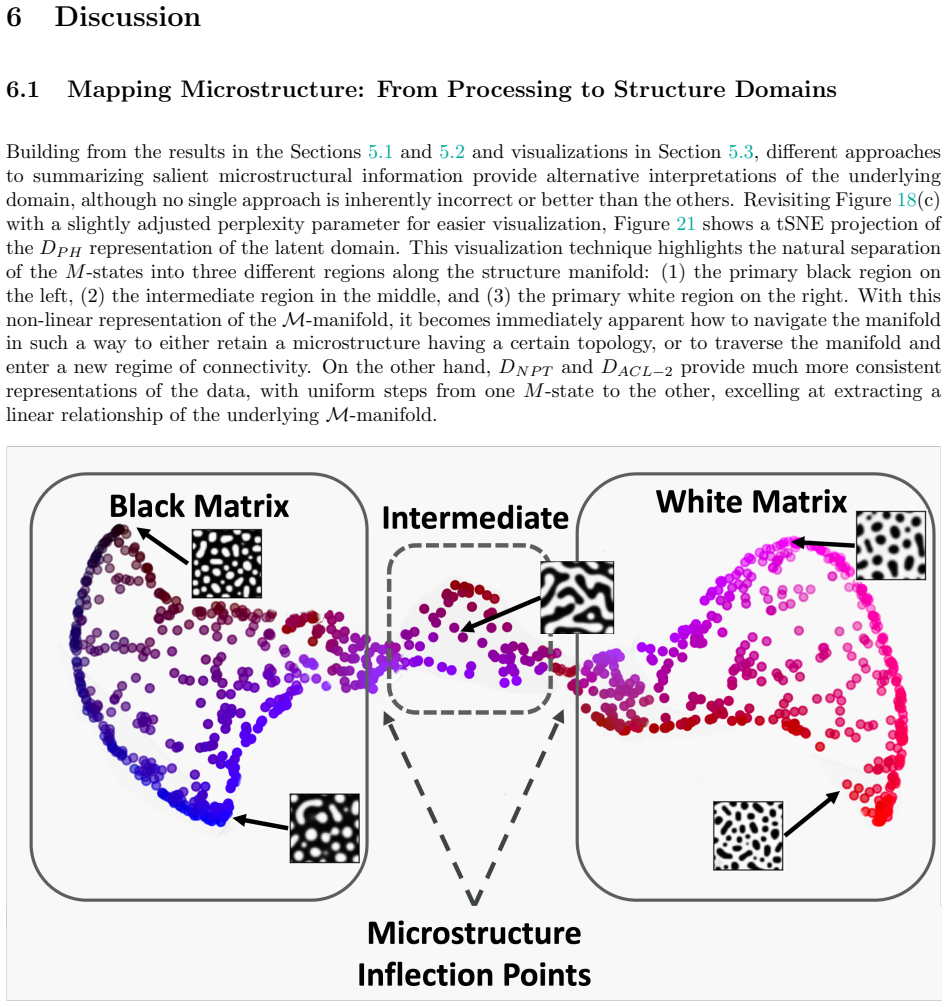
and is a quick method for exploring linear relationships in the embedded microstructure domain. t-distributed stochastic neighbor embedding (tSNE) was chosen as a manifold projection technique as it constructs a non-linear manifold based on the local similarities between data points [39]. This was appealing for our method, as the pre-calculated MDDs betwe...
-
[2]
Transition from metallurgy to materials science,
R. W. Cahn, “Transition from metallurgy to materials science,” inMaterials Science and Engineering, CRC Press, 2024, pp. 73–80. [2]Accelerating Technology Transition: Bridging the Valley of Death for Materials and Processes in De- fense Systems. Washington, D.C.: National Academies Press, Oct. 2004, p. 11 108,isbn: 978-0-309- 09317-0
work page 2024
-
[3]
Microstructure sensitive design for performance optimization,
D. T. Fullwood, S. R. Niezgoda, B. L. Adams, and S. R. Kalidindi, “Microstructure sensitive design for performance optimization,”Progress in Materials Science, vol. 55, no. 6, pp. 477–562, Aug. 2010
work page 2010
-
[4]
O. Wodo, S. Broderick, and K. Rajan, “Microstructural informatics for accelerating the discovery of processing–microstructure–property relationships,”MRS Bulletin, vol. 41, no. 08, pp. 603–609, Aug. 2016
work page 2016
-
[5]
Stochastic representation of microstructure via higher-order statistics: Theory and application,
S. R. Niezgoda, “Stochastic representation of microstructure via higher-order statistics: Theory and application,” Doctor of Philosophy, Drexel University, Jun. 2010
work page 2010
-
[6]
Algorithms for manifold learning,
L. Cayton et al., “Algorithms for manifold learning,”Univ. of California at San Diego Tech. Rep, vol. 12, no. 1-17, p. 1, 2005
work page 2005
-
[7]
D. Shim, “Effects of process parameters on additive manufacturing of aluminum porous materials and their optimization using response surface method,”Journal of Materials Research and Technology, vol. 15, pp. 119–134, Nov. 2021
work page 2021
-
[8]
D. Bugas and B. Runnels, “Grain boundary network plasticity: Reduced-order modeling of deformation- driven shear-coupled microstructure evolution,” en,Journal of the Mechanics and Physics of Solids, vol. 184, p. 105 541, Mar. 2024
work page 2024
-
[9]
M. Groeber, “A framework for automated analysis and simulation of 3D polycrystalline microstruc- tures.Part 1: Statistical characterization,”Acta Materialia, vol. 56, no. 6, pp. 1257–1273, Apr. 2008
work page 2008
-
[10]
M. Groeber, “A framework for automated analysis and simulation of 3D polycrystalline microstruc- tures. Part 2: Synthetic structure generation,”Acta Materialia, vol. 56, no. 6, pp. 1274–1287, Apr. 2008
work page 2008
-
[11]
STATISTICAL DESCRIPTION OF MICROSTRUCTURES,
S. Torquato, “STATISTICAL DESCRIPTION OF MICROSTRUCTURES,”Annu. Rev. Mater. Res, vol. 32, pp. 77–111, 2002
work page 2002
-
[12]
Microstructure informatics using Higher-order statistics and efficient data-mining Protocols,
S. R. Kalidindi, S. R. Niezgoda, and A. A. Salem, “Microstructure informatics using Higher-order statistics and efficient data-mining Protocols,” Tech. Rep., 2011, p. 34
work page 2011
-
[13]
Topological microstructure analysis using persistence landscapes,
P. D lotko and T. Wanner, “Topological microstructure analysis using persistence landscapes,”Physica D: Nonlinear Phenomena, vol. 334, pp. 60–81, 2016
work page 2016
-
[14]
A computer vision approach for automated analysis and classification of microstructural image data,
B. L. DeCost and E. A. Holm, “A computer vision approach for automated analysis and classification of microstructural image data,”Computational Materials Science, vol. 110, pp. 126–133, Dec. 2015
work page 2015
-
[15]
A. Lenau,Physics-Informed Deep Learning Networks for Increased Accuracy and Reliability of Material Simulations. The Ohio State University, 2024
work page 2024
-
[16]
Machine Learning in Materials Science: Recent Progress and Emerging Applications,
T. Mueller, A. G. Kusne, and R. Ramprasad, “Machine Learning in Materials Science: Recent Progress and Emerging Applications,” inReviews in Computational Chemistry, A. L. Parrill and K. B. Lip- kowitz, Eds., Hoboken, NJ: John Wiley & Sons, Inc, May 2016, pp. 186–273,isbn: 978-1-119-14873-9 978-1-119-10393-6
work page 2016
-
[17]
B. L. DeCost, T. Francis, and E. A. Holm, “Exploring the microstructure manifold: Image texture representations applied to ultrahigh carbon steel microstructures,”Acta Materialia, vol. 133, pp. 30– 40, Jul. 2017
work page 2017
-
[18]
Entropy-isomap: Manifold learning for high-dimensional dynamic processes,
F. Schoeneman, V. Chandola, N. Napp, O. Wodo, and J. Zola, “Entropy-isomap: Manifold learning for high-dimensional dynamic processes,” in2018 IEEE International Conference on Big Data (Big Data), IEEE, 2018, pp. 1655–1660
work page 2018
-
[19]
V. Sundararaghavan, M. N. Shah, and J. P. Simmons,Towards Microstructural State Variables in Materials Systems, Jan. 2023. arXiv:2301.04261 [cond-mat]. 26
-
[20]
Abel et al.,Exploring the Manifold of Neural Networks Using Diffusion Geometry, Dec
E. Abel et al.,Exploring the Manifold of Neural Networks Using Diffusion Geometry, Dec. 2024. arXiv: 2411.12626 [cs]
-
[21]
Solidification Microstructure-Processing Maps: Theory and Application,
W. Kurz, “Solidification Microstructure-Processing Maps: Theory and Application,”Advanced Engi- neering Materials, vol. 3, no. 7, pp. 443–452, Jul. 2001
work page 2001
-
[22]
J. P. Simmons, L. F. Drummy, C. A. Bouman, and M. De Graef,Statistical methods for materials science: the data science of microstructure characterization. CRC Press, 2019
work page 2019
-
[23]
Distance measures for quantifying the differences in microstructures,
P. G. Callahan, “Distance measures for quantifying the differences in microstructures,” inStatistical Methods for Materials Science, CRC Press, 2019, pp. 291–304
work page 2019
-
[24]
J. D. Carroll and P. Arabie, “Multidimensional scaling,”Measurement, judgment and decision making, pp. 179–250, 1998
work page 1998
-
[25]
Microstructure classification and the poly- crystalline microstructure state space,
D. Miley, E. Suwandi, B. Schweinhart, and J. K. Mason, “Microstructure classification and the poly- crystalline microstructure state space,” en,Acta Materialia, vol. 296, p. 121 219, Sep. 2025
work page 2025
-
[26]
COMODO: Configurable morphology dis- tance operator,
P. Desai, N. Juneja, V. Chandola, J. Zola, and O. Wodo, “COMODO: Configurable morphology dis- tance operator,”Computational Materials Science, vol. 244, p. 113 208, Sep. 2024
work page 2024
-
[27]
The continuum field approach to modeling microstructural evolution,
L.-Q. Chen and Y. Wang, “The continuum field approach to modeling microstructural evolution,” JOM, vol. 48, no. 12, pp. 13–18, Dec. 1996
work page 1996
-
[28]
Spinodal Decompositionfor the Cahn–Hilliard–Cook Equation:
D. Bl¨ omker, S. Maier-Paape, and T. Wanner, “Spinodal Decompositionfor the Cahn–Hilliard–Cook Equation:”Communications in Mathematical Physics, vol. 223, no. 3, pp. 553–582, Nov. 2001
work page 2001
-
[29]
Computing persistent homology,
A. Zomorodian and G. Carlsson, “Computing persistent homology,”Discrete and Computational Ge- ometry, vol. 33, no. 2, pp. 249–274, 2005
work page 2005
-
[30]
Stochastic convergence of persis- tence landscapes and silhouettes,
F. Chazal, B. T. Fasy, F. Lecci, A. Rinaldo, and L. Wasserman, “Stochastic convergence of persis- tence landscapes and silhouettes,” inProceedings of the thirtieth annual symposium on Computational geometry, 2014, pp. 474–483
work page 2014
-
[31]
T. G. Project,GUDHI User and Reference Manual, 3.10.1. GUDHI Editorial Board, 2024
work page 2024
-
[32]
Giotto-tda:: A topological data analysis toolkit for machine learning and data exploration,
G. Tauzin et al., “Giotto-tda:: A topological data analysis toolkit for machine learning and data exploration,”Journal of Machine Learning Research, vol. 22, no. 39, pp. 1–6, 2021
work page 2021
-
[33]
S. R. Niezgoda, D. M. Turner, D. T. Fullwood, and S. R. Kalidindi, “Optimized structure based rep- resentative volume element sets reflecting the ensemble-averaged 2-point statistics,”Acta Materialia, vol. 58, no. 13, pp. 4432–4445, 2010
work page 2010
-
[34]
Porespy: A python toolkit for quantitative analysis of porous media images,
J. T. Gostick et al., “Porespy: A python toolkit for quantitative analysis of porous media images,” Journal of Open Source Software, vol. 4, no. 37, p. 1296, 2019
work page 2019
-
[35]
Maximum likelihood estimation of intrinsic dimension,
E. Levina and P. Bickel, “Maximum likelihood estimation of intrinsic dimension,”Advances in neural information processing systems, vol. 17, 2004
work page 2004
-
[36]
Scikit-learn: Machine learning in Python,
F. Pedregosa et al., “Scikit-learn: Machine learning in Python,”Journal of Machine Learning Research, vol. 12, pp. 2825–2830, 2011
work page 2011
-
[37]
S. Wold, K. Esbensen, and P. Geladi, “Principal component analysis,”Chemometrics and intelligent laboratory systems, vol. 2, no. 1-3, pp. 37–52, 1987
work page 1987
-
[38]
Understanding and visualizing microstructure and microstructure variance as a stochastic process,
S. R. Niezgoda, Y. C. Yabansu, and S. R. Kalidindi, “Understanding and visualizing microstructure and microstructure variance as a stochastic process,”Acta Materialia, vol. 59, no. 16, pp. 6387–6400, Sep. 2011
work page 2011
-
[39]
Visualizing data using t-sne.,
L. Van der Maaten and G. Hinton, “Visualizing data using t-sne.,”Journal of machine learning re- search, vol. 9, no. 11, 2008
work page 2008
-
[40]
V. L. Berdichevsky, “Entropy of microstructure,” en,Journal of the Mechanics and Physics of Solids, vol. 56, no. 3, pp. 742–771, Mar. 2008
work page 2008
-
[41]
Stability of persistence diagrams,
D. Cohen-Steiner, H. Edelsbrunner, and J. Harer, “Stability of persistence diagrams,” inProceedings of the twenty-first annual symposium on Computational geometry, 2005, pp. 263–271. 27
work page 2005
-
[42]
Torquato et al.,Random heterogeneous materials: microstructure and macroscopic properties
S. Torquato et al.,Random heterogeneous materials: microstructure and macroscopic properties. Springer, 2002, vol. 16
work page 2002
-
[43]
mapping microstructure: Manifold construction for accelerated materials exploration
S. Mason, M. Shah, J. Simmons, D. Dimiduk, and S. Niezgoda,Dataset for “mapping microstructure: Manifold construction for accelerated materials exploration”, 2025. 28
work page 2025
discussion (0)
Sign in with ORCID, Apple, or X to comment. Anyone can read and Pith papers without signing in.