REVIEW 4 major objections 4 minor 6 references
Interpretable Nanoporous Materials Design with Symmetry-Aware Networks
T0 review · 4 major / 4 minor · reviewed 2026-08-04 · deepseek-v4-flash
Pith's one-line read A machine-learning model predicts nanoporous-material performance site by site, then reveals which local geometries cause it.
desk verdict Useful new dataset and a plausible site-level interpretation scheme, but the abstract overclaims SOTA and inverse design, and the per-site attribution is underdetermined by the training loss. read the letter →
The pith
A machine-rendered reading of the paper's core claim, the machinery that carries it, and where it could break.
The reading
What carries the argument
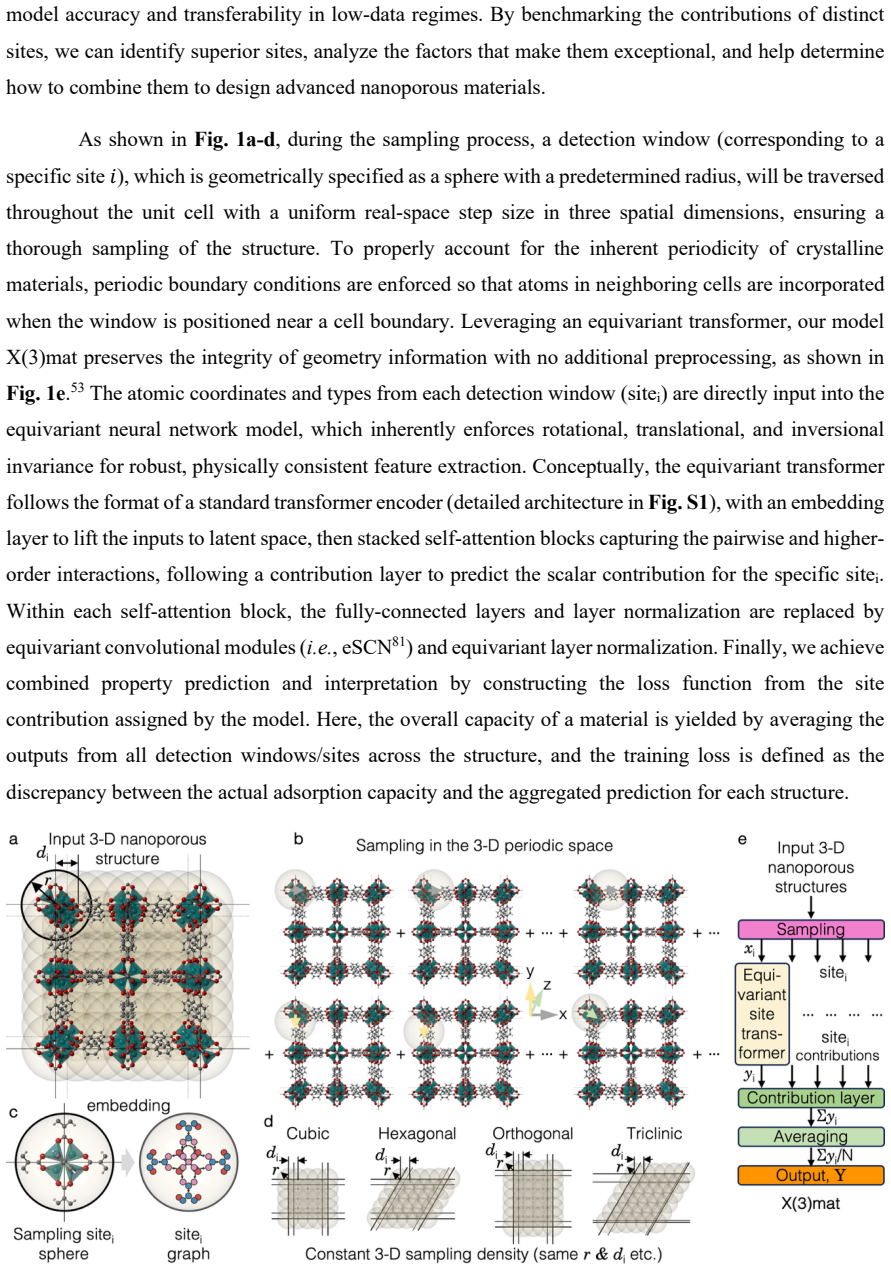
The mechanism is periodic-space sampling: a spherical detection window of roughly 6–8 Å radius is stepped through the unit cell on a 2 Å grid with periodic boundary conditions, converting a large framework into a set of local site graphs. Each window is fed into an equivariant transformer whose rotational and translational invariance is built in, and whose output is a single site contribution; the loss is the discrepancy between the average of all site contributions and the observed property. Site identity for motif mining is established by Weisfeiler-Lehman graph hashes of the local graph, allowing the model to rank recurring local geometries by average contribution.
What would settle it
Compute the predicted site contributions for a known conductor/insulator pair, then in one structure delete the top-contribution site (e.g., replace an enediolate-cobalt motif with a spectator linker) and measure the band gap; if the gap change is not roughly equal to the assigned contribution, the additivity hypothesis fails. A cheaper check: retrain the same model with window radii 4, 6, 8, and 12 Å and observe whether the total-property accuracy and the identity of the top sites remain stable; instability indicates the decomposition is an artifact of window size.
Extended reading notes
Core claim
The central claim is that decomposing a reticular structure into overlapping spherical windows, and training an equivariant transformer to output one scalar contribution per window, yields a model whose per-window outputs are physically meaningful: the mean of the window contributions equals the material property, and the spatial distribution of those contributions correlates with ground-truth adsorption density and DFT electron delocalization. The paper reports that this model outperforms prior nanoporous-material representations on gas storage, gas separation, and band-gap prediction, generalizes from small training sets, and that the identified high-contribution sites are chemically sensi
Load-bearing premise
The load-bearing premise is that a material's total property equals the arithmetic average of independent contributions from each local 6–8 Å spherical window; if inter-site interactions beyond that window matter—especially for nonlinear electronic properties like band gaps—then the site attribution maps are not trustworthy.
Editorial extensions
If this is right
- If the averaging claim holds, the same network can be applied to other reticular or molecular crystal families, such as covalent organic frameworks, hydrogen-bonded organic frameworks, or coordination polymers, without redesigning the representation.
- Design becomes local: a materials designer can search for frameworks that contain many copies of high-contribution sites rather than optimizing a global fingerprint.
- The contribution histograms provide a direct check of whether a material is one strong site away from a target property, since the full distribution of site contributions is predicted.
- Because the model needs less data than voxel or graph baselines, it can be retrained quickly on new adsorbates or properties with modest datasets.
- The identified top sites—open metal centers, nitrogen-rich aromatic linkers, and metal–nitrogen coordination motifs—can serve as explicit building-block rules for synthetic efforts.
Reading between the lines
- Editorial extension: the window-average construction resembles a coarse-grained local-property field; for properties like adsorption that are approximately additive this interpretation is natural, but for properties that depend on long-range coherence, such as band gaps or conductivity, the site contributions should be tested against perturbation calculations before being used for inverse design.
- Editorial extension: one could turn the contribution maps into differentiable objectives for a generative model, rewarding candidates that contain many high-contribution sites—something the paper gestures toward but does not implement.
- Editorial extension: the 6–8 Å window radius is chosen empirically; a systematic study varying the window with respect to the physical interaction range (e.g., pore diameter or Lennard-Jones cutoff) would reveal where the local additivity hypothesis breaks down.
- Editorial extension: identifying sites by graph hash treats two sites with identical local graphs as equivalent, ignoring the electronic influence of the wider framework, so similar coordination environments in different linkers may be mis-ranked when their remote chemistry matters.
Editorial analysis
A structured set of objections, weighed in public.
Referee Report
Summary. The paper introduces X(3)mat, an equivariant graph-transformer model for nanoporous materials that samples the periodic structure with spherical detection windows, predicts a global property as the average of per-site contributions, and uses the resulting site-resolved outputs to infer local structure-property relationships. The method is applied to N2 storage in zeolites and MOFs, CO2/N2 separation in MOFs, and band-gap prediction in QMOF, with benchmarks against persistent homology, energy histograms, 3-D voxel models, CGCNN, and MOFormer. The authors also report a new GCMC dataset for CO2/N2 separation in CoRE MOFs and present qualitative comparisons of predicted site contributions against GCMC density maps and DFT isosurfaces. The abstract further claims record-high inverse-designed N2 storage, strong CO2/N2 separation, and near-zero band gaps validated by physics-based simulations, although no inverse-design section appears in the main text.
Significance. If the claims were fully supported, the paper would offer a useful addition to the nanoporous-materials ML toolbox: a symmetry-aware, site-resolved representation that is both predictive and interpretable, with a new open dataset and an open-source implementation. The strengths are the rigorous benchmarking setup (fixed random seed, Optuna-tuned baselines), the construction of a new CO2/N2 GCMC dataset, and the clear visual comparisons between learned site contributions and physics-based density maps. However, the central claims currently exceed the evidence: the SOTA statement is contradicted by Table 1 on one task, the inverse-design results are absent from the main text, and the per-site decomposition is underdetermined without quantitative local validation. These issues are fixable with targeted revision, so the core idea is defensible but not yet established at the level claimed.
major comments (4)
- [Abstract; Table 1] The abstract claims 'state-of-the-art accuracy ... across gas storage, gas separation, and electronic-property prediction tasks.' Table 1 shows X(3)mat's MOF N2 storage MAE is 24.03 g/L, which is worse than the 2-D energy histogram's 20.77 g/L. The main text acknowledges that the model is 'marginally outperformed' on this task, but the abstract makes an unqualified statement. This discrepancy should be corrected by either limiting the SOTA claim to the tasks where it holds or providing a justified aggregate criterion.
- [Abstract; main text (no inverse-design section)] The abstract states that leveraging learned motifs enables inverse design of new MOFs exhibiting 'record-high N2 storage, strong CO2/N2 separation performance, and near-zero electronic band gaps, validated by physics-based simulations.' No section, figure, table, or methods entry in the main text describes the inverse-design procedure, the generated structures, or the validation results. This part of the central claim is currently unsupported. The authors should either add a complete inverse-design section with details and validation, or remove the claim from the abstract.
- [Equivariant graph neural networks for interpretable nanoporous materials design; Demonstrating model interpretability] The per-site contribution y_i is trained only through the global average: the loss supervises the mean of the window outputs against the total property. Consequently, the spatial decomposition is underdetermined—infinitely many site-wise functions can reproduce the same average. The interpretability claims therefore require quantitative local validation. The visual agreement with GCMC density maps in Fig. 3a-b and DFT isosurfaces in Fig. 4a-b is suggestive but not quantified, and the overlapping windows (2 Å step with 6–8 Å radius) plus radial smoothing make smooth spatial correlation a weak test. Please report quantitative metrics (e.g., normalized cross-correlation, structural similarity, or overlap of extrema) and, ideally, an ablation or external local probe that validates the site attributions independently.
- [Electrical conduction; Figure 4b] For band-gap prediction, the decomposition into additive local 'band gap contributions' is a modeling assumption rather than a physically established fact; band gaps are nonlocal properties of the periodic electronic structure. The negative contribution on the cobalt node (y_i = -0.40) is interpreted as a local metallic conduction motif, but without independent evidence—such as projected densities of states, band-decomposed charge densities, or site-removal/replacement calculations—this causal reading is not justified. The paper should either provide such validation or explicitly label the site contributions as a heuristic attribution whose physical interpretation is a hypothesis.
minor comments (4)
- [Methods, Section 1] The sentence 'The gradient bin width and gradient bin width are 25 kJ/mol/Å and 0~150 kJ/mol/Å' contains a duplicated phrase. Presumably the second item should refer to the gradient bin range or number of bins; please correct.
- [Identification of prevalent strong contribution sites] The text says 'The top five conductive sites as identified are shown in Tab. S4,' but later mentions 'Sites 4 and 6 are large, coplanar fused aromatics.' A top-five list should not contain site 6; please reconcile the numbering or clarify that the table lists more than five sites.
- [Introduction] The sentence 'as demonstrated by SmVA E a n d M O F o r m e r' has broken spacing and appears to be a typographical artifact. Please fix the formatting.
- [Identification of prevalent strong contribution sites] For pure-silica zeolites, the site identity is computed after removing oxygen atoms, and the text then refers to an '8-membered ring (i.e., 8 Si atoms) pore window.' Since the graph has been Si-only, the ring size may not correspond to the actual crystallographic ring; please clarify how the ring size is defined in this reduced representation.
Circularity Check
Site-attribution interpretability is partially self-definitional: per-site outputs are supervised only through their average, so the claimed 'high-contribution sites' are partly the model's own decomposition; property prediction itself is independently benchmarked.
-
self definitional
[Section 'Equivariant graph neural networks for interpretable nanoporous materials design' (page 5, no equation number)]
"Finally, we achieve combined property prediction and interpretation by constructing the loss function from the site contribution assigned by the model. Here, the overall capacity of a material is yielded by averaging the outputs from all detection windows/sites across the structure, and the training loss is defined as the discrepancy between the actual adsorption capacity and the aggregated prediction for each structure."
The per-site outputs y_i are never supervised individually; only their arithmetic mean is matched to the global GCMC/DFT property. Thus the site-wise 'contributions' are a free, non-identifiable decomposition of the fitted global prediction. Later passages treat these outputs as physically identified contributions, e.g., 'the top five strong N2 adsorption sites in the IZA zeolite dataset detected by X(3)mat' and the claim that the model 'provides a smooth map for illustrating the contributions of all local sites'. Because 'contribution' is defined as the model's per-window output and the global property is defined as their average, ranking high-contribution sites is partly a readout of the model's own decomposition by construction, not an independently derived per-site result. Qualitative
full rationale
The property-prediction claims are supported by benchmarks against independent physics-based data (GCMC for adsorption/separation, DFT for band gaps) and against external baselines; no load-bearing self-citation chain is present (the only author self-citation, ref. 26, is background context). The circular component is the site-wise interpretability claim: because the total property is defined as the average of per-site outputs and only that average is supervised, the per-site 'contributions' are not uniquely determined and are partly the model's own decomposition. External qualitative comparisons to GCMC density maps and DFT isosurfaces provide some independent grounding, but they are not quantified, so this is a partial, not total, circularity. The abstract's unsupported inverse-design claims (record-high storage, near-zero band gaps) are a completeness/evidence issue, not a circularity issue.
Assumptions & free parameters
free parameters (3)
- Detection window radius =
6 Å (gas adsorption) / 8 Å (band gap)
- Sampling step size =
2 Å
- Equivariant transformer hyperparameters =
not fully listed in main text
assumptions (5)
- domain assumption GCMC with UFF/TraPPE force fields and PACMOF2 charges gives correct N2 and CO2 adsorption labels.
- domain assumption PBE-DFT band gaps are a valid target for ranking electrical conduction.
- ad hoc to paper Total property equals the average of independent site contributions.
- ad hoc to paper Spherical windows of 6-8 Å capture all relevant information for the target property.
- domain assumption Weisfeiler-Lehman graph hashing on H-removed graphs identifies chemically equivalent sites.
invented entities (1)
-
Site contribution score (yi)
Cite this review
Pith. "Pith review of Interpretable Nanoporous Materials Design with Symmetry-Aware Networks." pith.science (2026). https://pith.science/paper/2W2GFWGS
@misc{pith2026250915908,
  author       = {Pith},
  title        = {Pith review of: Interpretable Nanoporous Materials Design with Symmetry-Aware Networks},
  year         = {2026},
  howpublished = {\url{https://pith.science/paper/2W2GFWGS}},
  note         = {Machine review of arXiv:2509.15908}
}
read the original abstract
Reticular frameworks hold promise for diverse sustainable applications, yet their immense chemical space limits efficient and systematic design. While machine learning provides a compelling pathway to accelerate exploration, existing approaches often lack either interpretability or fidelity in linking crystal geometry to emergent properties. Here, we introduce a site-resolved equivariant learning framework based on three-dimensional periodic space sampling, which decomposes reticular structures into local geometric environments for simultaneous property prediction and site-wise contribution analysis. Trained on a combination of constructed and retrieved datasets, the model achieves state-of-the-art accuracy and data efficiency across gas storage, gas separation, and electronic-property prediction tasks. Importantly, the framework reveals interpretable local structure-property relationships by identifying transferable high-contribution sites across diverse frameworks. Leveraging these learned motifs, we further demonstrate inverse design of new metal-organic frameworks exhibiting record-high N2 storage, strong CO2/N2 separation performance, and near-zero electronic band gaps, validated by physics-based simulations.
Figures

Reference graph
Works this paper leans on
-
[14]
Shi, R. et al. Nitrogen-rich covalent organic frameworks with multiple carbonyls for high-performance sodium batteries. Nature Communications 11, 1–10 (2020). 15. Chi, X. et al. A highly stable and flexible zeolite electrolyte solid-state Li-air battery. Nature 592, 551–557 (2021). 16. Kreno, L. E. et al. Metal–Organic Framework Materials as Chemical Sens...
arXiv 2020
-
[33]
Park, J. H. et al. Superacid counteranion as flexible-coordinating ligand for asymmetric organo-bismuth catalysis. Nature Communications 16, 1–13 (2025). 34. Wang, R., Zhong, Y., Bi, L., Yang, M. & Xu, D. Accelerating Discovery of Metal-Organic Frameworks for Methane Adsorption with Hierarchical Screening and Deep Learning. ACS Appl Mater Interfaces 12, 5...
arXiv 2025
-
[51]
Geiger, M. & Smidt, T. e3nn: Euclidean neural networks. Preprint at arXiv:2207.09453 (2022). 52. Liao, Y.-L. & Smidt, T. Equiformer: equivariant graph attention transformer for 3D atomistic graphs. Preprint at arXiv:2206.11990 (2022). 53. Liao, Y.-L., Wood, B., Das, A. & Smidt, T. EquiformerV2: improved equivariant transformer for scaling to higher-degree...
arXiv 2022
-
[70]
Schütt, K. T., Sauceda, H. E., Kindermans, P.-J., Tkatchenko, A. & Müller, K.-R. SchNet - A deep learning architecture for molecules and materials. J. Chem. Phys. 148, 241722 (2018). 71. Jha, D. et al. ElemNet: Deep learning the chemistry of materials from only elemental composition. Sci. Rep. 8, 17593 (2018). 72. Wang, A. Y.-T., Kauwe, S. K., Murdock, R....
arXiv 2018
-
[90]
Day, R. W. et al. Single crystals of electrically conductive two-dimensional metal-organic frameworks: Structural and electrical transport properties. ACS Cent. Sci. 5, 1959–1964 (2019). 91. Mähringer, A. et al. Oriented thin films of electroactive triphenylene catecholate-based two-dimensional metal-organic frameworks. ACS Nano 13, 6711–6719 (2019). 92. ...
arXiv 1959
-
[108]
K., Casewit, C
Rappe, A. K., Casewit, C. J., Colwell, K. S., Goddard, W. A., III & Skiff, W. M. UFF, a full periodic table force field for molecular mechanics and molecular dynamics simulations. J. Am. Chem. Soc. 114, 10024–10035 (1992). 109. Zhang, L. & Siepmann, J. I. Direct calculation of Henry’s law constants from Gibbs ensemble Monte Carlo simulations: nitrogen, ox...
1992
Reviewed August 4, 2026 · model on record in the stance chip above.
Discussion (0). Sign in to comment.