Interpretable Clinical Classification with Kolmogorov-Arnold Networks
Pith reviewed 2026-05-18 14:59 UTC · model grok-4.3
The pith
Kolmogorov-Arnold Networks match or exceed baseline performance in clinical classification while remaining fully interpretable.
A machine-rendered reading of the paper's core claim, the machinery that carries it, and where it could break.
Core claim
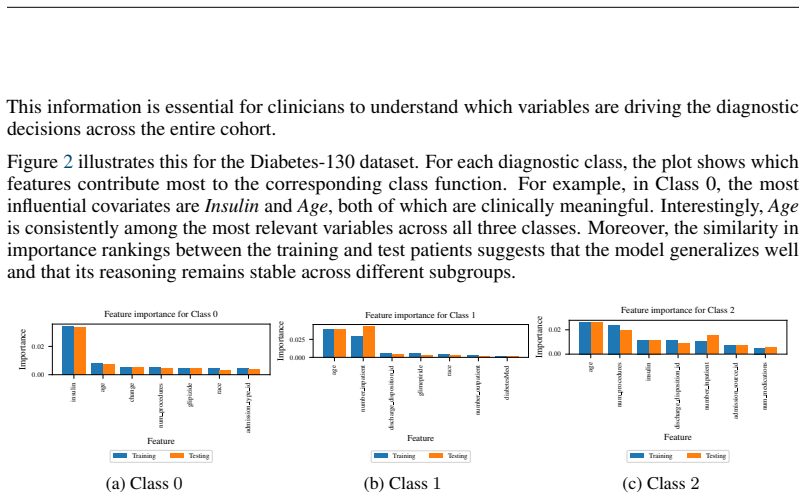
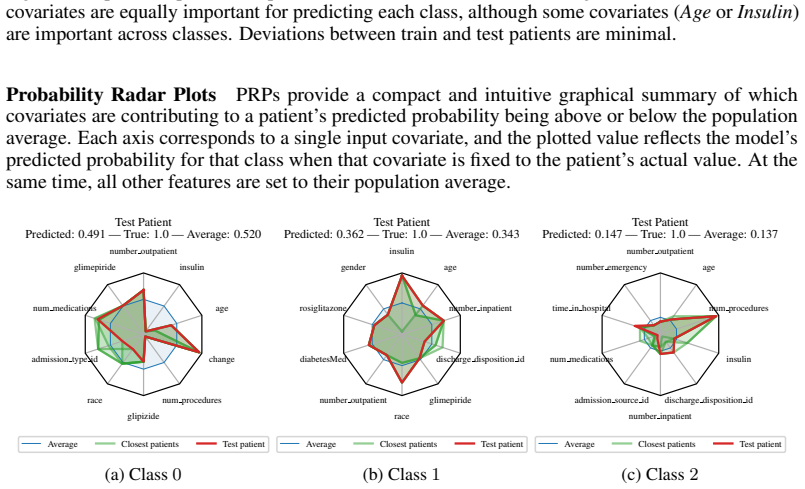
Kolmogorov-Arnold Networks, through the Logistic KAN and Kolmogorov-Arnold Additive Model variants, achieve predictive performance comparable to or exceeding that of standard linear, tree-based, and neural baselines on clinical tabular datasets while delivering full interpretability via symbolic representations, feature-wise decomposability, patient-level visualizations, and nearest-patient retrieval.
What carries the argument
Kolmogorov-Arnold Networks, which learn univariate functions on edges rather than fixed activations, with KAAM enforcing additive feature-wise decomposition to produce explicit symbolic expressions for each prediction.
If this is right
- Logistic KAN offers a direct, interpretable generalization of logistic regression for clinical tasks.
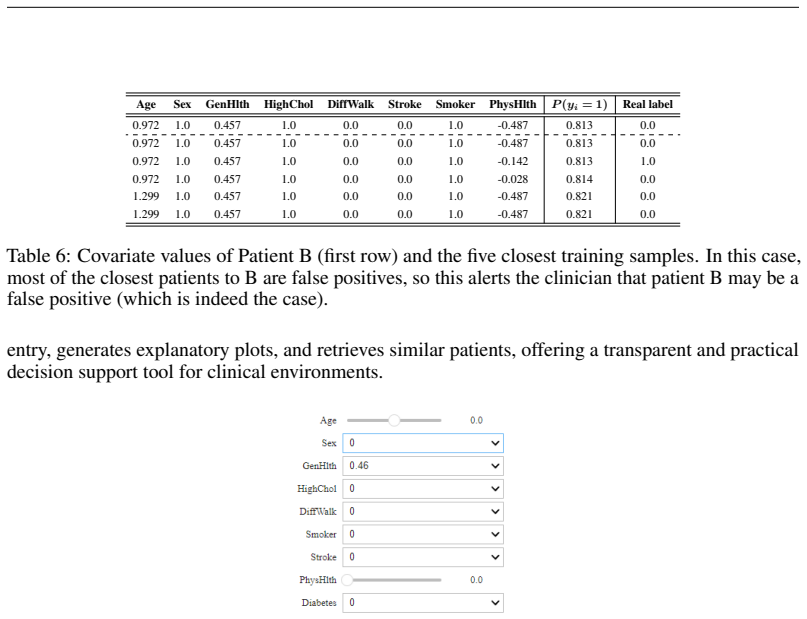
- KAAM enables patient-level visualizations and nearest-patient retrieval without additional explanation methods.
- The models reduce reliance on post-hoc interpretability techniques in healthcare applications.
- Transparent symbolic outputs support auditable and potentially actionable clinical decision support.
- Performance parity with black-box models is maintained across multiple public health datasets.
Where Pith is reading between the lines
- If the learned symbolic forms remain stable across new patient cohorts they could suggest previously unnoticed feature relationships for clinical study.
- Embedding these models in electronic health record systems could allow real-time inspection of why a risk score was assigned.
- Direct comparisons with other additive interpretable models such as generalized additive models would clarify whether the KAN edge functions provide unique advantages.
- Prospective trials measuring changes in physician decisions when using the visualizations would test real-world impact.
Load-bearing premise
The symbolic formulas and feature contributions produced by the models are clinically meaningful and actionable for physicians without further expert validation in real workflows.
What would settle it
A review in which practicing clinicians examine the extracted symbolic expressions and visualizations on real patient cases and consistently rate them as medically implausible or unhelpful for decisions would show the interpretability claim does not hold in practice.
Figures




read the original abstract
The increasing use of machine learning in clinical decision support has been limited by the lack of transparency of many high-performing models. In clinical settings, predictions must be interpretable, auditable, and actionable. This study investigates Kolmogorov-Arnold Networks (KANs) as intrinsically interpretable alternatives to conventional black-box models for clinical classification of tabular health data, aiming to balance predictive performance with clinically meaningful transparency. We introduce two KAN-based models: the Logistic KAN, a flexible generalization of logistic regression, and the Kolmogorov-Arnold Additive Model (KAAM), an additive variant that yields transparent symbolic representations through feature-wise decomposability. Both models are evaluated on multiple public clinical datasets and compared with standard linear, tree-based, and neural baselines. Across all datasets, the proposed models achieve predictive performance comparable to or exceeding that of commonly used baselines while remaining fully interpretable. Logistic-KAN obtains the highest overall ranking across evaluation metrics, with a mean reciprocal rank of 0.76, indicating consistently strong performance across tasks. KAAM provides competitive accuracy while offering enhanced transparency through feature-wise decomposability, patient-level visualizations, and nearest-patient retrieval, enabling direct inspection of individual predictions. KAN-based models provide a practical and trustworthy alternative to black-box models for clinical classification, offering a strong balance between predictive performance and interpretability for clinical decision support. By enabling transparent, patient-level reasoning and clinically actionable insights, the proposed models represent a promising step toward trustworthy AI in healthcare (code: https://github.com/Patricia-A-Apellaniz/classification_with_kans).
Editorial analysis
A structured set of objections, weighed in public.
Referee Report
Summary. The paper proposes Logistic KAN (a flexible generalization of logistic regression) and Kolmogorov-Arnold Additive Model (KAAM, an additive variant yielding feature-wise decomposable symbolic representations) as intrinsically interpretable models for clinical classification on tabular health data. It evaluates both against linear, tree-based, and neural baselines on multiple public datasets, claiming comparable or superior predictive performance (with Logistic-KAN achieving the highest mean reciprocal rank of 0.76) while providing transparency via symbolic formulas, patient-level visualizations, and nearest-patient retrieval, positioning them as practical alternatives for trustworthy clinical decision support.
Significance. If the performance parity and interpretability claims hold under rigorous controls, the work offers a concrete step toward balancing accuracy and transparency in healthcare ML, with the public code release supporting reproducibility. The emphasis on feature-wise decomposability and visualizations addresses a key barrier to adoption of ML in clinical settings, though the clinical actionability of the outputs remains unverified.
major comments (2)
- [Abstract and §5] Abstract and §5 (Discussion/Conclusion): The central claim that the models enable 'clinically actionable insights' and represent 'a promising step toward trustworthy AI in healthcare' rests on an untested translation from mathematical decomposability to clinical utility. No physician review, usability study, or workflow integration test is reported to confirm that the KAAM symbolic representations or Logistic-KAN univariate functions would be trusted or used in real decision support, which directly undermines the paper's motivation and conclusions.
- [§3 and §4] §3 (Methods) and §4 (Results): Insufficient detail is provided on hyperparameter search procedures, statistical significance testing across runs, and explicit handling of class imbalance or missing data. These omissions make it difficult to assess whether the reported performance advantages (or parity) are robust, which is load-bearing for the claim of consistent outperformance or parity across datasets.
minor comments (2)
- [Figures] Figure captions and axis labels in the visualization sections could be expanded to explicitly link the plotted univariate functions or symbolic terms back to the original clinical feature names for easier reader interpretation.
- [§4] The mean reciprocal rank calculation and ranking methodology across metrics and datasets should be described with a small example or pseudocode to improve clarity.
Simulated Author's Rebuttal
We thank the referee for their constructive and detailed feedback, which has prompted us to strengthen the clarity, rigor, and appropriate scoping of our claims. We address each major comment below and indicate the revisions we will make to the manuscript.
read point-by-point responses
-
Referee: [Abstract and §5] Abstract and §5 (Discussion/Conclusion): The central claim that the models enable 'clinically actionable insights' and represent 'a promising step toward trustworthy AI in healthcare' rests on an untested translation from mathematical decomposability to clinical utility. No physician review, usability study, or workflow integration test is reported to confirm that the KAAM symbolic representations or Logistic-KAN univariate functions would be trusted or used in real decision support, which directly undermines the paper's motivation and conclusions.
Authors: We agree that the current wording in the abstract and §5 overstates the immediate clinical utility without supporting evidence from physician review or usability testing. The manuscript demonstrates mathematical decomposability and visualization tools that are designed to enable inspection of predictions, but we did not perform any clinical validation studies. In the revised manuscript we will update the abstract and §5 to state that the models provide interpretable representations with the potential to yield clinically actionable insights, while explicitly noting that empirical validation of trust and workflow integration in real clinical settings remains an important direction for future work. This revision will align the conclusions more closely with the evidence presented. revision: yes
-
Referee: [§3 and §4] §3 (Methods) and §4 (Results): Insufficient detail is provided on hyperparameter search procedures, statistical significance testing across runs, and explicit handling of class imbalance or missing data. These omissions make it difficult to assess whether the reported performance advantages (or parity) are robust, which is load-bearing for the claim of consistent outperformance or parity across datasets.
Authors: We accept that greater experimental detail is required to allow readers to evaluate robustness. In the revised §3 we will add a complete description of the hyperparameter search procedure, including the optimization method, search ranges, and final selected values for each model and dataset. We will also report statistical significance testing (e.g., paired Wilcoxon signed-rank tests across multiple random seeds or cross-validation folds with p-values) in §4. Finally, we will explicitly document the preprocessing steps for class imbalance (class-weighted loss) and missing data (imputation strategy) in the methods. These additions will be incorporated without altering the reported performance numbers. revision: yes
Circularity Check
No circularity in empirical evaluation or interpretability claims
full rationale
The paper introduces Logistic KAN and KAAM as architectural variants of Kolmogorov-Arnold Networks, then evaluates predictive performance on held-out portions of public clinical datasets using standard metrics and comparisons to linear, tree, and neural baselines. Reported results such as mean reciprocal rank of 0.76 for Logistic-KAN arise directly from training and testing procedures rather than any equation that re-derives accuracy from the fitted parameters themselves. Feature-wise decomposability and patient-level visualizations follow immediately from the additive structure of KAAM by definition of the model, without requiring a separate derivation step that collapses back to the same fitted values. No self-citation chain is invoked to justify uniqueness or to forbid alternatives, and the evaluation remains externally falsifiable through the released code and public data. The central claims therefore remain independent of the inputs they are measured against.
Axiom & Free-Parameter Ledger
free parameters (1)
- KAN grid size and spline order
axioms (2)
- standard math Kolmogorov-Arnold representation theorem guarantees that multivariate functions can be expressed as sums of univariate functions.
- domain assumption Tabular clinical datasets are representative of the target clinical population for the reported metrics.
Lean theorems connected to this paper
-
IndisputableMonolith/Cost/FunctionalEquation.leanwashburn_uniqueness_aczel unclear?
unclearRelation between the paper passage and the cited Recognition theorem.
KAAM ... explicitly enforces an additive structure ... f^p_φ(x_i) = α^p + Σ g^p_j(x^j_i) ... logit matrix Δ^p
-
IndisputableMonolith/Foundation/AlphaCoordinateFixation.leancostAlphaLog_high_calibrated_iff unclear?
unclearRelation between the paper passage and the cited Recognition theorem.
KANs learn mappings via compositions of univariate spline functions ... symbolic formulas
What do these tags mean?
- matches
- The paper's claim is directly supported by a theorem in the formal canon.
- supports
- The theorem supports part of the paper's argument, but the paper may add assumptions or extra steps.
- extends
- The paper goes beyond the formal theorem; the theorem is a base layer rather than the whole result.
- uses
- The paper appears to rely on the theorem as machinery.
- contradicts
- The paper's claim conflicts with a theorem or certificate in the canon.
- unclear
- Pith found a possible connection, but the passage is too broad, indirect, or ambiguous to say the theorem truly supports the claim.
Reference graph
Works this paper leans on
-
[1]
author Bindra, S. & author Jain, R. title Artificial intelligence in medical science: a review . journal Irish Journal of Medical Science (1971-) volume 193 , pages 1419--1429 ( year 2024 )
work page 1971
-
[2]
author Xie, Y. , author Zhai, Y. & author Lu, G. title Evolution of artificial intelligence in healthcare: a 30-year bibliometric study . journal Frontiers in Medicine volume 11 , pages 1505692 ( year 2025 )
work page 2025
-
[3]
author Xu, H. & author Shuttleworth, K. M. J. title Medical artificial intelligence and the black box problem: a view based on the ethical principle of “do no harm” . journal Intelligent Medicine volume 4 , pages 52--57 ( year 2024 )
work page 2024
-
[4]
author Ghassemi, M. , author Oakden-Rayner, L. & author Beam, A. L. title The false hope of current approaches to explainable artificial intelligence in health care . journal The Lancet Digital Health volume 3 , pages e745--e750 ( year 2021 )
work page 2021
-
[5]
author Frasca, M. , author La Torre, D. , author Pravettoni, G. & author Cutica, I. title Explainable and interpretable artificial intelligence in medicine: a systematic bibliometric review . journal Discover Artificial Intelligence volume 4 , pages 15 ( year 2024 )
work page 2024
-
[6]
author Lundberg, S. M. & author Lee, S.-I. title A unified approach to interpreting model predictions . journal Advances in neural information processing systems volume 30 ( year 2017 )
work page 2017
-
[7]
author Mosca, E. , author Szigeti, F. , author Tragianni, S. , author Gallagher, D. & author Groh, G. title Shap-based explanation methods: a review for nlp interpretability ( year 2022 )
work page 2022
-
[8]
author Ribeiro, M. T. , author Singh, S. & author Guestrin, C. title "why should i trust you?" explaining the predictions of any classifier ( year 2016 )
work page 2016
-
[9]
author Covert, I. , author Lundberg, S. M. & author Lee, S.-I. title Understanding global feature contributions with additive importance measures . journal Advances in Neural Information Processing Systems volume 33 , pages 17212--17223 ( year 2020 )
work page 2020
-
[10]
author Selvaraju, R. R. et al. title Grad-cam: visual explanations from deep networks via gradient-based localization . journal International journal of computer vision volume 128 , pages 336--359 ( year 2020 )
work page 2020
-
[11]
author Alaa, A. M. & author Van der Schaar, M. title Demystifying black-box models with symbolic metamodels . journal Advances in neural information processing systems volume 32 ( year 2019 )
work page 2019
-
[12]
, author Matar Abdulla Almadhaani, H
author Alkhanbouli, R. , author Matar Abdulla Almadhaani, H. , author Alhosani, F. & author Simsekler, M. C. E. title The role of explainable artificial intelligence in disease prediction: a systematic literature review and future research directions . journal BMC Medical Informatics and Decision Making volume 25 , pages 110 ( year 2025 )
work page 2025
-
[13]
author Lipton, Z. C. title The mythos of model interpretability: In machine learning, the concept of interpretability is both important and slippery. journal Queue volume 16 , pages 31--57 ( year 2018 )
work page 2018
-
[14]
author Chen, H. , author Gomez, C. , author Huang, C.-M. & author Unberath, M. title Explainable medical imaging ai needs human-centered design: guidelines and evidence from a systematic review . journal NPJ digital medicine volume 5 , pages 156 ( year 2022 )
work page 2022
-
[15]
author Pahud de Mortanges, A. et al. title Orchestrating explainable artificial intelligence for multimodal and longitudinal data in medical imaging . journal NPJ digital medicine volume 7 , pages 195 ( year 2024 )
work page 2024
-
[16]
author Bienefeld, N. et al. title Solving the explainable ai conundrum by bridging clinicians’ needs and developers’ goals . journal NPJ Digital Medicine volume 6 , pages 94 ( year 2023 )
work page 2023
-
[17]
author Liu, Z. et al. title Kan: Kolmogorov-arnold networks . journal arXiv preprint arXiv:2404.19756 ( year 2024 )
work page internal anchor Pith review Pith/arXiv arXiv 2024
-
[18]
KAN 2.0: Kolmogorov-Arnold networks meet science,
author Liu, Z. , author Ma, P. , author Wang, Y. , author Matusik, W. & author Tegmark, M. title Kan 2.0: Kolmogorov-arnold networks meet science . journal arXiv preprint arXiv:2408.10205 ( year 2024 )
-
[19]
author Yu, R. , author Yu, W. & author Wang, X. title Kan or mlp: A fairer comparison . journal arXiv preprint arXiv:2407.16674 ( year 2024 )
- [20]
- [21]
-
[22]
author Genet, R. & author Inzirillo, H. title A temporal kolmogorov-arnold transformer for time series forecasting . journal ArXiv ( year 2024 )
work page 2024
- [23]
-
[24]
title Kolmogorov-arnold convolutions: Design principles and empirical studies
author Drokin, I. title Kolmogorov-arnold convolutions: Design principles and empirical studies . journal arXiv preprint arXiv:2407.01092 ( year 2024 )
- [25]
-
[26]
author Zhang, F. & author Zhang, X. title Graphkan: Enhancing feature extraction with graph kolmogorov arnold networks . journal arXiv preprint arXiv:2406.13597 ( year 2024 )
- [27]
-
[28]
author Kich, V. A. et al. title Kolmogorov-arnold networks for online reinforcement learning ( year 2024 )
work page 2024
-
[29]
author Ji, T. , author Hou, Y. & author Zhang, D. title A comprehensive survey on kolmogorov arnold networks (kan) . journal arXiv preprint arXiv:2407.11075 ( year 2024 )
-
[30]
author Somvanshi, S. , author Javed, S. A. , author Islam, M. M. , author Pandit, D. & author Das, S. title A survey on kolmogorov-arnold network . journal arXiv preprint arXiv:2411.06078 ( year 2024 )
-
[31]
author Yang, Z. , author Zhang, J. , author Luo, X. , author Lu, Z. & author Shen, L. title Medkan: An advanced kolmogorov-arnold network for medical image classification . journal arXiv preprint arXiv:2502.18416 ( year 2025 )
-
[32]
author Agarwal, R. et al. title Neural additive models: Interpretable machine learning with neural nets . journal Advances in neural information processing systems volume 34 , pages 4699--4711 ( year 2021 )
work page 2021
-
[33]
title Behavioral Risk Factor Surveillance System (BRFSS) 2022 Data ( year 2023 )
author Centers for Disease Control and Prevention (CDC) . title Behavioral Risk Factor Surveillance System (BRFSS) 2022 Data ( year 2023 ). note Accessed: August 13, 2025
work page 2022
-
[34]
author Xie, Z. , author Nikolayeva, O. , author Luo, J. & author Li, D. title Building risk prediction models for type 2 diabetes using machine learning techniques . journal Preventing chronic disease volume 16 , pages E130 ( year 2019 )
work page 2019
-
[35]
author Clore, J. , author Cios, K. , author DeShazo, J. & author Strack, B. title Diabetes 130-US Hospitals for Years 1999-2008 . howpublished UCI Machine Learning Repository ( year 2014 )
work page 1999
-
[36]
author Palechor, F. M. & author De la Hoz Manotas, A. title Dataset for estimation of obesity levels based on eating habits and physical condition in individuals from colombia, peru and mexico . journal Data in brief volume 25 , pages 104344 ( year 2019 )
work page 2019
-
[37]
author Weinstein, J. N. et al. title The cancer genome atlas pan-cancer analysis project . journal Nature genetics volume 45 , pages 1113--1120 ( year 2013 )
work page 2013
-
[38]
author Loftus, J. , author Bynum, L. & author Hansen, S. title Causal dependence plots . journal Advances in Neural Information Processing Systems volume 37 , pages 112656--112683 ( year 2024 )
work page 2024
-
[39]
author Hornik, K. , author Stinchcombe, M. & author White, H. title Multilayer feedforward networks are universal approximators . journal Neural networks volume 2 , pages 359--366 ( year 1989 )
work page 1989
-
[40]
title Neural networks: a comprehensive foundation ( publisher Prentice Hall PTR , year 1994 )
author Haykin, S. title Neural networks: a comprehensive foundation ( publisher Prentice Hall PTR , year 1994 )
work page 1994
-
[41]
author Kolmogorov, A. N. title On the representation of continuous functions of several variables by superpositions of continuous functions of a smaller number of variables ( publisher American Mathematical Society , year 1961 )
work page 1961
-
[42]
author Girosi, F. & author Poggio, T. title Representation properties of networks: Kolmogorov's theorem is irrelevant . journal Neural Computation volume 1 , pages 465--469 ( year 1989 )
work page 1989
-
[43]
author Poggio, T. , author Banburski, A. & author Liao, Q. title Theoretical issues in deep networks . journal Proceedings of the National Academy of Sciences volume 117 , pages 30039--30045 ( year 2020 )
work page 2020
-
[44]
title The kolmogorov--arnold representation theorem revisited
author Schmidt-Hieber, J. title The kolmogorov--arnold representation theorem revisited . journal Neural networks volume 137 , pages 119--126 ( year 2021 )
work page 2021
-
[45]
title Kolmogorov's theorem is relevant
author Kurkova, V. title Kolmogorov's theorem is relevant . journal Neural computation volume 3 , pages 617--622 ( year 1991 )
work page 1991
-
[46]
title A sufficient condition for additively separable functions
author Segal, U. title A sufficient condition for additively separable functions . journal Journal of Mathematical Economics volume 23 , pages 295--303 ( year 1994 )
work page 1994
-
[47]
author Lou, Y. , author Caruana, R. & author Gehrke, J. title Intelligible models for classification and regression ( year 2012 )
work page 2012
-
[48]
author Hastie, T. & author Tibshirani, R. title Generalized Additive Models Vol. volume 43 ( publisher CRC Press , year 1990 )
work page 1990
-
[49]
author Marcinkevi c s, R. & author Vogt, J. E. title Interpretable and explainable machine learning: A methods-centric overview with concrete examples . journal Wiley Interdisciplinary Reviews: Data Mining and Knowledge Discovery volume 13 , pages e1493 ( year 2023 )
work page 2023
-
[50]
author Hastie, T. & author Tibshirani, R. title Generalized additive models for medical research. journal Statistical Methods in Medical Research volume 4 , pages 187--196 ( year 1995 )
work page 1995
-
[51]
author Utkin, L. V. , author Satyukov, E. D. & author Konstantinov, A. V. title Survnam: The machine learning survival model explanation . journal Neural Networks volume 147 , pages 81--102 ( year 2022 )
work page 2022
-
[52]
author Caruana, R. et al. title Intelligible models for healthcare: Predicting pneumonia risk and hospital 30-day readmission ( year 2015 )
work page 2015
-
[53]
author Fasiolo, M. , author Nedellec, R. , author Goude, Y. & author Wood, S. N. title Scalable visualization methods for modern generalized additive models . journal Journal of computational and Graphical Statistics volume 29 , pages 78--86 ( year 2020 )
work page 2020
-
[54]
author Hohman, F. , author Srinivasan, A. & author Drucker, S. M. title Telegam: Combining visualization and verbalization for interpretable machine learning ( year 2019 )
work page 2019
- [55]
-
[56]
author Hosmer Jr, D. W. , author Lemeshow, S. & author Sturdivant, R. X. title Applied logistic regression ( publisher John Wiley & Sons , year 2013 )
work page 2013
-
[57]
author Cox, D. R. title Regression models and life-tables . journal Journal of the Royal Statistical Society: Series B (Methodological) volume 34 , pages 187--202 ( year 1972 )
work page 1972
-
[58]
author Rosenbaum, P. R. & author Rubin, D. B. title The central role of the propensity score in observational studies for causal effects . journal Biometrika volume 70 , pages 41--55 ( year 1983 )
work page 1983
-
[59]
author Garrido, M. M. et al. title Methods for constructing and assessing propensity scores . journal Health services research volume 49 , pages 1701--1720 ( year 2014 )
work page 2014
-
[60]
author Austin, P. C. title An introduction to propensity score methods for reducing the effects of confounding in observational studies . journal Multivariate behavioral research volume 46 , pages 399--424 ( year 2011 )
work page 2011
-
[61]
author Austin, P. C. title The performance of different propensity-score methods for estimating differences in proportions (risk differences or absolute risk reductions) in observational studies . journal Statistics in medicine volume 29 , pages 2137--2148 ( year 2010 )
work page 2010
-
[62]
author Hern \'a n, M. A. & author Robins, J. M. title Causal Inference: What If ( publisher Chapman & Hall/CRC , address Boca Raton, FL , year 2020 )
work page 2020
-
[63]
author Hastie, T. , author Tibshirani, R. , author Friedman, J. et al. title The elements of statistical learning
-
[64]
author Saary, M. J. title Radar plots: a useful way for presenting multivariate health care data . journal Journal of clinical epidemiology volume 61 , pages 311--317 ( year 2008 )
work page 2008
-
[65]
FUNCTION identify.basic.version "sn-basic.bst" " [2024/07/19 v1.1 bibliography style]" * top ENTRY address archive author booktitle chapter doi edition editor eid eprint howpublished institution journal key keywords month note number organization pages publisher school series title type url volume year archivePrefix primaryClass adsurl adsnote version lab...
work page 2024
-
[66]
" write newline "" before.all 'output.state := FUNCTION add.period duplicate empty 'skip "." * add.blank if FUNCTION if.digit duplicate "0" = swap duplicate "1" = swap duplicate "2" = swap duplicate "3" = swap duplicate "4" = swap duplicate "5" = swap duplicate "6" = swap duplicate "7" = swap duplicate "8" = swap "9" = or or or or or or or or or FUNCTION ...
-
[67]
FUNCTION identify.nature.version "sn-nature.bst" " [2024/07/19 v1.1 bibliography style]" * top ENTRY address archive author booktitle chapter edition editor eprint howpublished institution journal key keywords month note number organization pages publisher school series title type url doi volume year archivePrefix primaryClass eid adsurl adsnote version l...
work page 2024
-
[68]
" write newline "" before.all 'output.state := FUNCTION n.dashify 't := "" t empty not t #1 #1 substring "-" = t #1 #2 substring "--" = not "--" * t #2 global.max substring 't := t #1 #1 substring "-" = "-" * t #2 global.max substring 't := while if t #1 #1 substring * t #2 global.max substring 't := if while FUNCTION word.in bbl.in capitalize " " * FUNCT...
discussion (0)
Sign in with ORCID, Apple, or X to comment. Anyone can read and Pith papers without signing in.