Transition Frequencies and Dynamic Amplification of Buried Lifelines: A Semi-Analytical Timoshenko Beam on Winkler Foundation Model
Pith reviewed 2026-05-18 15:11 UTC · model grok-4.3
The pith
A semi-analytical Timoshenko beam on Winkler foundation model reveals that buried lifelines vibrate in four regimes separated by three transition frequencies where dynamic amplification changes sharply.
A machine-rendered reading of the paper's core claim, the machinery that carries it, and where it could break.
Core claim
The closed-form analytical solutions revealed that the vibration spectrum comprises four parts, separated by three transition frequencies. At each transition, the oscillatory characteristics of the modes change as a function of the system properties, leading to marked variations in dynamic amplification.
What carries the argument
Semi-analytical solution of the Timoshenko beam on Winkler foundation, where closed-form expressions identify the three transition frequencies that divide the vibration spectrum into four regimes with changing mode behaviors.
If this is right
- The model agrees closely with finite element simulations for buried steel pipelines under various conditions.
- Parametric studies reveal how soil stiffness and system length affect dynamic performance.
- The framework enables efficient analysis beyond simple travelling-wave methods for lifeline design under dynamic loads.
Where Pith is reading between the lines
- If the transition frequencies prove robust, they could serve as quick checks in preliminary seismic assessments of pipelines without full simulations.
- Extending the model to include nonlinear soil behavior might reveal additional transitions at higher amplitudes.
- Similar frequency divisions may appear in other beam-foundation systems like railroad tracks or bridges on elastic supports.
Load-bearing premise
The Winkler foundation model and Timoshenko beam assumptions accurately represent real soil-pipe interaction for the frequencies and lengths considered.
What would settle it
A physical experiment or detailed finite element analysis on a buried pipeline that shows no distinct changes in vibration mode characteristics or amplification at the predicted transition frequencies would challenge the central claim.
Figures


read the original abstract
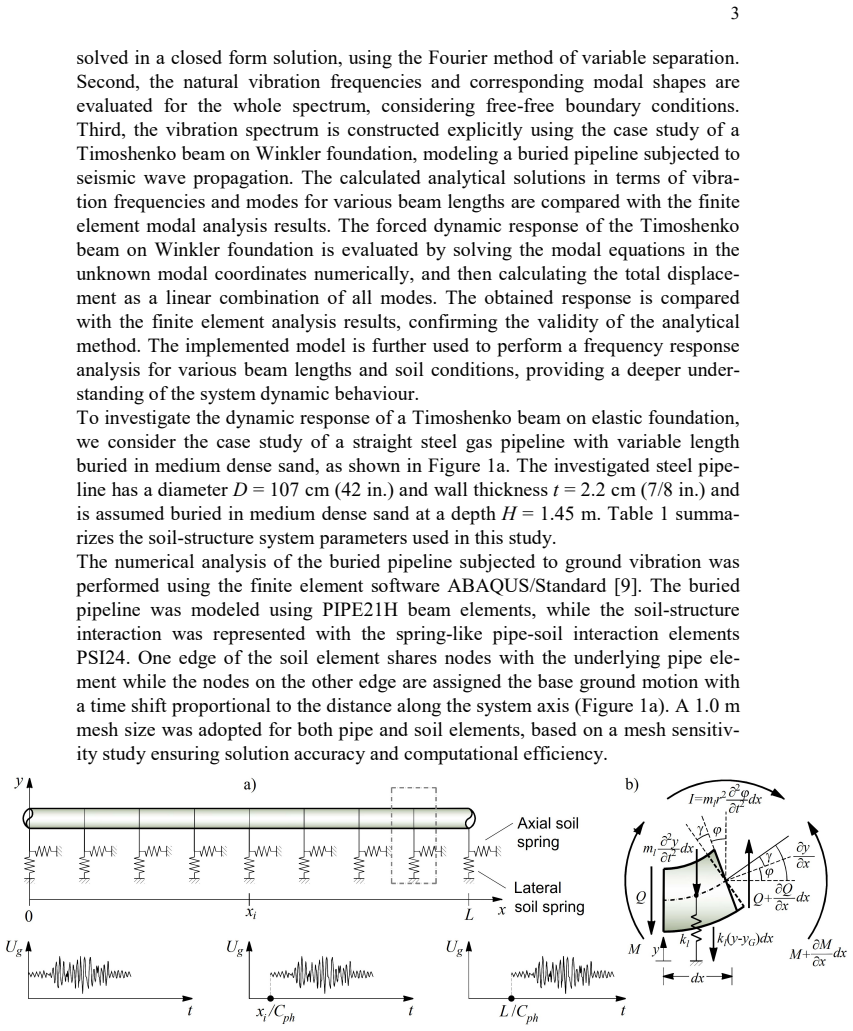
Underground lifelines, such as pipelines and tunnels, are susceptible to ground vibrations from seismic events, traffic, and other dynamic sources. Accurate prediction of their response is essential for ensuring structural safety and operability. This study introduces a semi-analytical model for transverse vibration analysis of buried lifelines, formulated using the Timoshenko beam theory on elastic foundation. The closed-form analytical solutions revealed that the vibration spectrum comprises four parts, separated by three transition frequencies. At each transition, the oscillatory characteristics of the modes change as a function of the system properties, leading to marked variations in dynamic amplification. The model's validity is confirmed through case studies of buried steel pipelines of varying lengths and operating conditions, showing excellent agreement with finite element simulations. A subsequent parametric study quantifies the influence of key factors - including soil stiffness and system length - on dynamic performance. The proposed method provides a computationally efficient and physically transparent framework for capturing complex vibration phenomena beyond simplified travelling-wave approaches, offering valuable guidance for the design and resilience assessment of underground lifeline systems subjected to various dynamic loads.
Editorial analysis
A structured set of objections, weighed in public.
Referee Report
Summary. The manuscript develops a semi-analytical model for transverse vibrations of buried lifelines using Timoshenko beam theory resting on a Winkler elastic foundation. Closed-form solutions of the governing system are shown to partition the frequency spectrum into four regimes separated by three transition frequencies; at these points the character of the spatial modes changes (from oscillatory to evanescent or vice versa), producing corresponding changes in dynamic amplification. The approach is validated on buried steel pipelines of varying lengths and soil conditions, with reported excellent agreement to finite-element results, and is followed by a parametric study of soil stiffness and system length.
Significance. If the reported division into four spectral regimes and the associated amplification variations are confirmed, the work supplies a computationally efficient, physically transparent alternative to purely numerical or travelling-wave approximations for lifeline vibration analysis. Explicit identification of the transition frequencies derived from the quartic characteristic equation could directly inform frequency-dependent design criteria for underground pipelines and tunnels under seismic or traffic loading.
minor comments (2)
- The abstract states that the solutions are 'closed-form analytical' while the title and model description emphasize 'semi-analytical'; a brief clarification of what remains numerical (e.g., root-finding for transition frequencies or assembly of the modal expansion) would remove potential confusion.
- The case-study comparisons with finite-element simulations are described as showing 'excellent agreement,' yet no quantitative error metrics, exact boundary-condition statements, or discussion of mesh convergence appear in the provided summary; adding these details would strengthen the validation of the transition-frequency predictions.
Simulated Author's Rebuttal
We thank the referee for the positive summary, recognition of the significance of the four-regime spectral partitioning, and recommendation of minor revision. No specific major comments were listed in the report.
Circularity Check
No significant circularity detected
full rationale
The derivation begins from the standard governing differential equations of the Timoshenko beam on Winkler foundation, assumes time-harmonic motion to obtain the quartic characteristic equation, and identifies transition frequencies as the points where the nature of the roots changes (real to imaginary or zero crossings). These transition points and the resulting four spectral regimes follow directly from algebraic analysis of that quartic without any fitted parameters, self-referential definitions, or load-bearing self-citations. The closed-form solutions are then validated against independent finite-element simulations for multiple lengths and stiffnesses, confirming the regime changes and amplification variations as emergent mathematical features rather than inputs. The Winkler and Timoshenko assumptions are stated explicitly as modeling choices but do not reduce the claimed spectral structure to a tautology or prior result by the same authors.
Axiom & Free-Parameter Ledger
free parameters (1)
- soil stiffness modulus
axioms (1)
- domain assumption Linear elastic behavior of both beam and foundation with perfect contact
Lean theorems connected to this paper
-
IndisputableMonolith/Foundation/AlexanderDuality.leanalexander_duality_circle_linking unclear?
unclearRelation between the paper passage and the cited Recognition theorem.
The closed-form analytical solutions revealed that the vibration spectrum comprises four parts, separated by three transition frequencies. ... The nature of the roots λ varies across the three transition frequencies ω̃i ... Modal shape ϕn(x) for the different parts of the frequency vibration spectrum.
-
IndisputableMonolith/Cost/FunctionalEquation.leanwashburn_uniqueness_aczel unclear?
unclearRelation between the paper passage and the cited Recognition theorem.
governing differential equation ... fourth order differential equation ... solutions have the form of exponential functions exp(λx)
What do these tags mean?
- matches
- The paper's claim is directly supported by a theorem in the formal canon.
- supports
- The theorem supports part of the paper's argument, but the paper may add assumptions or extra steps.
- extends
- The paper goes beyond the formal theorem; the theorem is a base layer rather than the whole result.
- uses
- The paper appears to rely on the theorem as machinery.
- contradicts
- The paper's claim conflicts with a theorem or certificate in the canon.
- unclear
- Pith found a possible connection, but the passage is too broad, indirect, or ambiguous to say the theorem truly supports the claim.
Reference graph
Works this paper leans on
-
[1]
American Lifelines Alliance (ALA) (2001) Guidelines for the Design of Buried Steel Pipe; FEMA: Washington, DC, USA
work page 2001
-
[2]
American Society of Civil Engineers (ASCE) (1984) Guidelines for the Seismic De- sign of Oil and Gas Pipeline Systems, Committee on Gas and Liquid Fuel Lifelines
work page 1984
-
[3]
Part 4: silos, tanks and pipelines
European Committee for Standardization (CEN) (2003) Eurocode 8: Design of struc- tures for earthquake resistance. Part 4: silos, tanks and pipelines. Draft No. 2
work page 2003
-
[4]
O’Rourke MJ, Liu X (2012) Seismic Design of Buried and Offshore Pipelines; Tech- nical Report MCEER-12-MN04; Multidisciplinary Center for Earthquake Engineer- ing: Buffalo, NY, USA. p. 380
work page 2012
-
[5]
Journal of the Technical Councils of ASCE, 104(1): 71-89
Wang LRL (1978) Vibration frequencies of buried pipelines. Journal of the Technical Councils of ASCE, 104(1): 71-89
work page 1978
-
[6]
In Proceedings of the 11th world conference on earthquake engineering, 81-88
Mavridis G, Pitilakis K (1996) Axial and transverse seismic analysis of buried pipe- lines. In Proceedings of the 11th world conference on earthquake engineering, 81-88
work page 1996
-
[7]
Journal of Sound and Vibration, 445: 204-227
Wu CC (2019) Free vibration analysis of a free-free Timoshenko beam carrying mul- tiple concentrated elements with effect of rigid-body motions considered. Journal of Sound and Vibration, 445: 204-227
work page 2019
-
[8]
arXiv preprint arXiv:2507.22850
Banushi G (2025) Dynamic analysis of free-free Timoshenko beams on elastic founda- tion under transverse transient ground deformation. arXiv preprint arXiv:2507.22850
- [9]
discussion (0)
Sign in with ORCID, Apple, or X to comment. Anyone can read and Pith papers without signing in.