REVIEW 4 major objections 6 minor 31 references
I2VWM embeds a watermark in a still image that remains verifiable inside AI-generated video, using a simulation noise layer and optical-flow frame alignment to extend traceability over time.
Reviewed by Pith at T0; open to challenge. T0 means a machine referee read the full paper against a public rubric. the ladder, T0–T4 →
T0 review · deepseek-v4-flash
2026-08-04 15:49 UTC pith:B7JDCXPF
load-bearing objection Useful new task framing and metrics for tracing images into generated video, but the paper's headline mechanism is never ablated. the 4 major comments →
LoT-Pass: Long-term-robust Image Watermarking for Image to Video Generation
The pith
A machine-rendered reading of the paper's core claim, the machinery that carries it, and where it could break.
Core claim
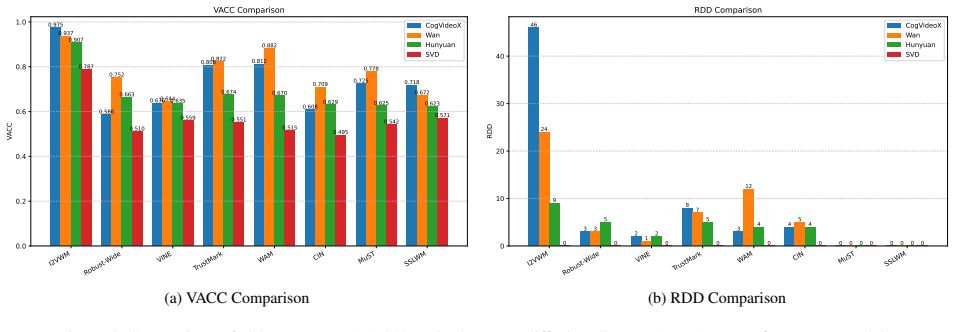
The paper claims that an image watermark can be made traceable in videos generated from that image, even in frames far from the start, by training the watermark decoder against distortions that mimic video generation and by aligning distant frames back to the reference frame before extraction. It introduces Robust Diffusion Distance, the highest frame index at which extraction accuracy stays above a threshold (0.9), and reports that I2VWM attains the best RDD on three prompt-conditioned open-source generators and long persistence on two commercial generators, while all methods fail on a non-prompt generator.
What carries the argument
The central mechanism is a two-part training/inference scheme: (1) a video-simulation noise layer that adds a latent-diffusion reconstruction step and random smooth warping to the watermarked image during training, teaching the decoder to survive generation-like distortion; (2) an optical-flow alignment module at inference that warps each video frame into the first frame's coordinates before decoding, plus majority voting across the per-frame decoded bits.
Load-bearing premise
I2VWM assumes a generated video never departs so far from the input image that optical flow cannot map later frames back to the first frame's coordinate system; the paper's own non-prompt-conditioned generator results, where RDD is zero for all methods, show this premise has a real boundary.
What would settle it
Run I2VWM on videos generated with large camera motion, occlusion, or scene cuts so that later frames share little content with the first frame; if extraction accuracy after optical-flow alignment stays below the 0.9 threshold (RDD=0) on a prompt-conditioned generator, the alignment-based extension claim is falsified.
If this is right
- Tracing a leaked video back to its source image becomes possible in prompt-conditioned generators, with Robust Diffusion Distance as a quantitative guarantee.
- Because the decoder is trained on a noise layer rather than a specific generator, the same watermarking model transfers to unseen open-source and commercial generators without retraining.
- Frame-wise accuracy, video accuracy, and RDD give future work a standard way to compare cross-modal watermark robustness.
- Video generators that produce higher-quality outputs tend to preserve watermark signals over longer durations, so watermark persistence can function as a by-product indicator of output fidelity.
- Optical-flow alignment measurably raises extraction accuracy on later frames, making the alignment module the component that extends temporal reach.
Where Pith is reading between the lines
- If the simulation-noise layer approximates the true distribution of diffusion-generated distortions, the same training recipe could extend to other cross-modal transformations, such as image-to-3D or multi-view generation, without redesigning the watermarking architecture.
- RDD could be repurposed as a diagnostic for generation models: a generator that erases watermarks quickly is likely also diverging from its conditioning image quickly, which may track perceptual fidelity.
- The alignment step could be run in reverse—warping the reference image forward along the optical flow to meet each target frame—which may recover watermark signals in cases where backward warping of later frames is unreliable.
- Commercial generators' longer RDD may reflect implicit mechanisms that keep conditioning-image features influential over time; if so, watermark persistence becomes a measurable proxy for those mechanisms.
Editorial analysis
A structured set of objections, weighed in public.
Referee Report
Summary. The paper addresses watermark robustness in the emerging image-to-video (I2V) generation setting, where an image watermark must remain verifiable across generated video frames. It introduces three evaluation quantities: frame accuracy (FACC), video accuracy (VACC), and Robust Diffusion Distance (RDD), defined as the last frame index for which per-frame bit accuracy exceeds a threshold. The proposed method, I2VWM, uses an encoder--decoder architecture with a JND-based fusion, an adversarial discriminator, and a training-time video-simulation noise layer that combines SD-VAE reconstruction and random warping with classical distortions. At inference, an optical-flow alignment module warps later frames into the reference-frame coordinate system before extraction, and majority voting aggregates per-frame messages. Experiments compare I2VWM with seven published watermarking baselines on four open-source I2V models and two commercial services, reporting that I2VWM achieves the largest RDD on three open-source models, while all methods fail on Stable Video Diffusion (RDD=0). An ablation study evaluates the optical-flow alignment module; no ablation isolates the video-simulation noise layer.
Significance. If the empirical claims are supported, the paper makes a useful contribution by formalizing a practically important problem: tracing a watermarked image through a generated video. RDD/FACC/VACC are simple, well-defined metrics and could become standard for this emerging benchmark. Releasing code and including both open-source and commercial generators are strengths, as is the honest documentation of limitations in Section 5. The optical-flow alignment ablation is a positive first step in attributing the source of the improvement. However, the central claimed mechanism—the video-simulation noise layer—is not causally tested, and the evaluation scale and SVD failure substantially weaken the generalization claim. The result is therefore plausible but not yet established at the level claimed in the abstract and conclusions.
major comments (4)
- [§3.1–3.2 versus §4.4] The abstract and Section 1 attribute I2VWM's robustness to two components: the video-simulation noise layer (SD-VAE reconstruction and random warping, Eqs. 2–6, with adaptive reweighting Eq. 7) and the optical-flow alignment module (Section 3.3). Only the latter is ablated (Section 4.4, Fig. 6). There is no experiment that trains the same architecture with and without the video-simulation noise layer, or that varies its components independently. Consequently, the reported improvement over WAM at the same 32-bit capacity cannot be causally attributed to the noise layer rather than to the MUNIT fusion, JND scaling, ConvNeXt decoder, adversarial loss, loss coefficients, or training schedule. The first contribution bullet explicitly claims that the noise layer 'explicitly models generation-induced distortions and achieves strong robustness against them'; this claim is currently unsupported.
- [§4.3 and Eq. (23)] The quantitative claims are based on small samples with no uncertainty quantification. Only 50 generated videos are used for each open-source model (Section 4.3.1), and 10 for each commercial model (Section 4.3.2); FACC per frame is averaged over N=50 (Eq. 23). No standard deviations, confidence intervals, or significance tests are reported. Given this sample size, differences such as VACC 0.975 vs. 0.937, or RDD 46 vs. 24, may not be stable. The paper should report per-frame variance and, at minimum, bootstrap confidence intervals for RDD and VACC. Relatedly, the claim in Section 5 that I2VWM 'achieves state-of-the-art performance without overfitting to any specific generator' is contradicted by the SVD result in Section 4.3.1, where all methods, including I2VWM, obtain RDD=0. This boundary case should be discussed as a limitation in the conclusions, not only in the results narrative.
- [Eq. (24) and Section 4.2] RDD is the headline metric and the paper's motivating contribution, but its definition depends on an arbitrary reliability threshold τ=0.9 and on the discrete frame index at which accuracy first drops below τ. The paper provides no sensitivity analysis for τ; with τ=0.8 or τ=0.95, the reported rankings could change, especially for methods clustered near the threshold. Additionally, for SVD, RDD=0 would be reported even if frame 0 accuracy were, say, 0.91 and frame 1 accuracy 0.89—so the metric's behavior near the boundary should be characterized. Please report FACC trajectories for all compared methods (or at least the top performers) and show RDD for multiple thresholds.
- [Section 5, Limitation paragraph] The paper itself states that the method cannot handle temporal cropping or frame shuffling, does not fully address random rotations, and lacks evaluation of video generation quality. These are not merely cosmetic limitations: they bound the practical scope of the 'robust diffusion distance' paradigm. The conclusions should not claim a 'new paradigm for cross-modal watermarking' without explicitly conditioning on these scope restrictions. I recommend adding a dedicated 'Scope and Limitations' paragraph in the main text and referencing the limitation in the abstract.
minor comments (6)
- [Section 5, first sentence] Duplicated phrase: 'we propose three effective metrics proposes three effective evaluation metrics' should read 'we propose three effective evaluation metrics'.
- [Table 1] The table formatting appears corrupted in several cells: e.g., SSLWM's '# Params' and 'BER' columns show '0.06 - 26.42 26.42' and similar concatenations in other rows. Please reformat the table so that each metric is clearly separated and labels align with column headers.
- [Eq. (21)] The majority-voting formula does not define the tie-breaking rule when L is even and the vote count is exactly N/2. Specify whether ties are resolved deterministically (e.g., bit=0) or by random choice, and justify the choice.
- [Section 3.3, Eqs. (13)–(14)] The resolution-adaptive inference uses 'Interpolate' without specifying the interpolation method or how the residual scaling interacts with the JND fusion used during training. Please clarify the exact interpolation and whether this process was used for the experiments in Table 2 and the video tests.
- [Section 3.3, Eqs. (15)–(19)] The optical-flow module is described generically (feature extractor ϕ, correlation volume C, recurrent update ψ) but no specific model or citation is given. Since the ablation depends entirely on this module, please state which optical-flow network is used and its pretraining details.
- [General] Several hyperparameters are introduced without a sensitivity study or full specification: JND scaling λ (Eq. 1), inference strength α (Eq. 14), random-warping amplitude σ and scale α (Eqs. 2 and 5), noise-reweighting floor and adjustment interval (Eq. 7), and warp control grid size. Please add a hyperparameter table and, ideally, one sensitivity experiment for the most influential parameters (e.g., λ and the warping scale).
Circularity Check
No significant circularity: the paper's claims rest on empirical measurements and standard training/inference procedures, not on definitions or self-citations that force the result.
full rationale
The paper's central claims—that I2VWM improves watermark robustness across generated video frames and that RDD/FACC/VACC measure this—are supported by direct experimental measurements on held-out video generation models. The metrics RDD, FACC, and VACC are defined as frame-level accuracy aggregations (Eqs. 22–25) and are not derived from fitted parameters. The adaptive noise reweighting in Eq. 7 is a validation-based tuning rule, not a prediction generated from the same data used to evaluate the method. The only self-citation is MuST [26] used as a baseline; it is neither load-bearing for the proposed method nor invoked as a uniqueness or grounding theorem. The paper's own limitation section acknowledges boundary conditions (e.g., RDD=0 under SVD, and failure under temporal distortions), which is consistent with the claims being empirical rather than circular. The absence of an ablation isolating the video-simulation noise layer is a legitimate evidence gap for causal attribution, but it is not a circularity: the reported gains are not forced by construction, and no equation in the paper reduces the headline result to its inputs. Therefore the appropriate circularity score is 0.
Axiom & Free-Parameter Ledger
free parameters (8)
- JND scaling factor λ (Eq. 1) =
not specified
- Inference strength factor α (Eq. 14) =
not specified
- Loss coefficients λ1..λ4 (Eq. 8) =
1, 0.1, 0.1, 50
- Random warping amplitude σ and scale α (Eqs. 2, 5) =
not specified
- RDD reliability threshold τ (Eq. 24) =
0.9
- Noise-reweighting floor and adjustment interval (Eq. 7) =
max(e_i, 0.01)
- Warp control grid size (gridsize) =
not specified
- Classic noise augmentation ranges =
e.g., RealCrop 50-70%, JPEG 50-80, brightness/contrast/saturation 0.5-2
axioms (6)
- domain assumption Generated videos are finite and do not completely deviate from the source image content
- domain assumption SD-VAE reconstruction plus random warping captures the distortions introduced by actual I2V generation
- domain assumption Optical-flow alignment can warp later frames into the reference frame's coordinates without erasing the watermark
- ad hoc to paper When watermark signal is lost, extracted bits behave as unbiased binomial samples
- domain assumption Adjusting all baselines to PSNR > 36 dB yields fair comparisons
- domain assumption The selected open-source models represent the I2V model class
invented entities (1)
-
Robust Diffusion Distance (RDD)
no independent evidence
Cite this review
Pith. "Pith review of LoT-Pass: Long-term-robust Image Watermarking for Image to Video Generation." pith.science (2026). https://pith.science/paper/B7JDCXPF
@misc{pith2026250917773,
  author       = {Pith},
  title        = {Pith review of: LoT-Pass: Long-term-robust Image Watermarking for Image to Video Generation},
  year         = {2026},
  howpublished = {\url{https://pith.science/paper/B7JDCXPF}},
  note         = {Machine review of arXiv:2509.17773}
}
read the original abstract
The rapid progress of image-guided video generation (I2V) has raised concerns about its potential misuse in misinformation and fraud, underscoring the urgent need for effective digital watermarking. While existing watermarking methods demonstrate robustness within a single modality, they fail to trace source images in I2V settings. To address this gap, we introduce the concept of Robust Diffusion Distance, which measures the temporal persistence of watermark signals in generated videos. Building on this, we propose I2VWM, a cross-modal watermarking framework designed to enhance watermark robustness across time. I2VWM leverages a video-simulation noise layer during training and employs an optical-flow-based alignment module during inference. Experiments on both open-source and commercial I2V models demonstrate that I2VWM significantly improves robustness while maintaining imperceptibility, establishing a new paradigm for cross-modal watermarking in the era of generative video. \href{https://github.com/MrCrims/I2VWM-Robust-Watermarking-for-Image-to-Video-Generation}{Code Released.}
Figures




Reference graph
Works this paper leans on
-
[1]
Ntire 2017 chal- lenge on single image super-resolution: Dataset and study
Eirikur Agustsson and Radu Timofte. Ntire 2017 chal- lenge on single image super-resolution: Dataset and study. InThe IEEE Conference on Computer Vision and Pattern Recognition (CVPR) Workshops, 2017. 5
2017
-
[2]
Stego image quality and the reliability of psnr
Adel Almohammad and Gheorghita Ghinea. Stego image quality and the reliability of psnr. In2010 2nd International Conference on Image Processing The- ory, Tools and Applications, pages 215–220. IEEE,
-
[3]
Qwen2.5- vl technical report.arXiv preprint arXiv:2502.13923,
Shuai Bai, Keqin Chen, Xuejing Liu, Jialin Wang, Wenbin Ge, Sibo Song, Kai Dang, Peng Wang, Shi- jie Wang, Jun Tang, Humen Zhong, Yuanzhi Zhu, Mingkun Yang, Zhaohai Li, Jianqiang Wan, Pengfei Wang, Wei Ding, Zheren Fu, Yiheng Xu, Jiabo Ye, Xi Zhang, Tianbao Xie, Zesen Cheng, Hang Zhang, Zhibo Yang, Haiyang Xu, and Junyang Lin. Qwen2.5- vl technical report...
-
[4]
Stable video dif- fusion: Scaling latent video diffusion models to large datasets, 2023
Andreas Blattmann, Tim Dockhorn, Sumith Kulal, Daniel Mendelevitch, Maciej Kilian, Dominik Lorenz, Yam Levi, Zion English, Vikram V oleti, Adam Letts, Varun Jampani, and Robin Rombach. Stable video dif- fusion: Scaling latent video diffusion models to large datasets, 2023. 1, 2, 5
2023
-
[5]
Tu Bui, Shruti Agarwal, and John Collomosse. Trust- mark: Universal watermarking for arbitrary resolution images.arXiv preprint arXiv:2311.18297, 2023. 2, 5
Pith/arXiv arXiv 2023
-
[6]
Chun-Hsien Chou and Yun-Chin Li. A perceptually tuned subband image coder based on the measure of just-noticeable-distortion profile.IEEE Transactions on Circuits and Systems for Video Technology, 5(6): 467–476, 1995. 2
1995
-
[7]
Pimog: An effective screen- shooting noise-layer simulation for deep-learning- based watermarking network
Han Fang, Zhaoyang Jia, Zehua Ma, Ee-Chien Chang, and Weiming Zhang. Pimog: An effective screen- shooting noise-layer simulation for deep-learning- based watermarking network. InProceedings of the 30th ACM international conference on multimedia, pages 2267–2275, 2022. 1
2022
-
[8]
Watermark- ing images in self-supervised latent spaces
Pierre Fernandez, Alexandre Sablayrolles, Teddy Furon, Herv´e J´egou, and Matthijs Douze. Watermark- ing images in self-supervised latent spaces. InICASSP 2022-2022 IEEE International Conference on Acous- tics, Speech and Signal Processing (ICASSP), pages 3054–3058. IEEE, 2022. 2, 5
2022
-
[9]
Zeki Yalniz, and Alexandre Mourachko
Pierre Fernandez, Hady Elsahar, I. Zeki Yalniz, and Alexandre Mourachko. Video seal: Open and efficient video watermarking.arXiv preprint arXiv:2412.09492, 2024. 1
Pith/arXiv arXiv 2024
-
[10]
Deep residual learning for image recognition
Kaiming He, Xiangyu Zhang, Shaoqing Ren, and Jian Sun. Deep residual learning for image recognition. InProceedings of the IEEE conference on computer vision and pattern recognition, pages 770–778, 2016. 2
2016
-
[11]
Robust-wide: Robust watermarking against instruction-driven image editing
Runyi Hu, Jie Zhang, Ting Xu, Jiwei Li, and Tianwei Zhang. Robust-wide: Robust watermarking against instruction-driven image editing. InEuropean Con- ference on Computer Vision, pages 20–37. Springer,
-
[12]
Mask im- age watermarking.arXiv preprint arXiv:2504.12739,
Runyi Hu, Jie Zhang, Shiqian Zhao, Nils Lukas, Jiwei Li, Qing Guo, Han Qiu, and Tianwei Zhang. Mask im- age watermarking.arXiv preprint arXiv:2504.12739,
-
[13]
Multimodal unsupervised image-to-image translation
Xun Huang, Ming-Yu Liu, Serge Belongie, and Jan Kautz. Multimodal unsupervised image-to-image translation. InECCV, 2018. 2
2018
-
[14]
Segment anything.arXiv preprint arXiv:2304.02643, 2023
Alexander Kirillov, Eric Mintun, Nikhila Ravi, Hanzi Mao, Chloe Rolland, Laura Gustafson, Tete Xiao, Spencer Whitehead, Alexander C Berg, Wan-Yen Lo, et al. Segment anything.arXiv preprint arXiv:2304.02643, 2023. 2
Pith/arXiv arXiv 2023
-
[15]
Hunyuanvideo: A sys- tematic framework for large video generative models
Weijie Kong, Qi Tian, Zijian Zhang, Rox Min, Zuozhuo Dai, Jin Zhou, Jiangfeng Xiong, Xin Li, Bo Wu, Jianwei Zhang, et al. Hunyuanvideo: A sys- tematic framework for large video generative models. arXiv preprint arXiv:2412.03603, 2024. 1, 2, 5
Pith/arXiv arXiv 2024
-
[16]
Enhanced deep resid- ual networks for single image super-resolution
Bee Lim, Sanghyun Son, Heewon Kim, Seungjun Nah, and Kyoung Mu Lee. Enhanced deep resid- ual networks for single image super-resolution. In The IEEE Conference on Computer Vision and Pat- tern Recognition (CVPR) Workshops, 2017. 5
2017
-
[17]
Microsoft coco: Com- mon objects in context
Tsung-Yi Lin, Michael Maire, Serge Belongie, James Hays, Pietro Perona, Deva Ramanan, Piotr Dollar, and C Lawrence Zitnick. Microsoft coco: Com- mon objects in context. InComputer Vision–ECCV 2014: 13th European Conference, Zurich, Switzer- land, September 6-12, 2014, Proceedings, Part V 13, pages 740–755. Springer, 2014. 5
2014
-
[18]
A convnet for the 2020s.Proceedings of the IEEE/CVF Conference on Computer Vision and Pattern Recogni- tion (CVPR), 2022
Zhuang Liu, Hanzi Mao, Chao-Yuan Wu, Christoph Feichtenhofer, Trevor Darrell, and Saining Xie. A convnet for the 2020s.Proceedings of the IEEE/CVF Conference on Computer Vision and Pattern Recogni- tion (CVPR), 2022. 4
2022
-
[19]
Decou- pled weight decay regularization.arXiv preprint arXiv:1711.05101, 2017
Ilya Loshchilov and Frank Hutter. Decou- pled weight decay regularization.arXiv preprint arXiv:1711.05101, 2017. 5
Pith/arXiv arXiv 2017
-
[20]
Shilin Lu, Zihan Zhou, Jiayou Lu, Yuanzhi Zhu, and Adams Wai-Kin Kong. Robust watermark- ing using generative priors against image editing: From benchmarking to advances.arXiv preprint arXiv:2410.18775, 2024. 2, 5
Pith/arXiv arXiv 2024
-
[21]
Towards blind wa- termarking: Combining invertible and non-invertible mechanisms
Rui Ma, Mengxi Guo, Yi Hou, Fan Yang, Yuan Li, Huizhu Jia, and Xiaodong Xie. Towards blind wa- termarking: Combining invertible and non-invertible mechanisms. InProceedings of the 30th ACM Interna- tional Conference on Multimedia, pages 1532–1542,
-
[22]
Pytorch: An imperative style, high- performance deep learning library.Advances in neural information processing systems, 32, 2019
Adam Paszke, Sam Gross, Francisco Massa, Adam Lerer, James Bradbury, Gregory Chanan, Trevor Killeen, Zeming Lin, Natalia Gimelshein, Luca Antiga, et al. Pytorch: An imperative style, high- performance deep learning library.Advances in neural information processing systems, 32, 2019. 5
2019
-
[23]
High- resolution image synthesis with latent diffusion mod- els, 2021
Robin Rombach, Andreas Blattmann, Dominik Lorenz, Patrick Esser, and Bj ¨orn Ommer. High- resolution image synthesis with latent diffusion mod- els, 2021. 3
2021
-
[24]
Watermark anything with localized messages.arXiv preprint arXiv:2411.07231,
Tom Sander, Pierre Fernandez, Alain Durmus, Teddy Furon, and Matthijs Douze. Watermark anything with localized messages.arXiv preprint arXiv:2411.07231,
-
[25]
Wan: Open and advanced large-scale video generative models.arXiv preprint arXiv:2503.20314, 2025
Team Wan, Ang Wang, Baole Ai, Bin Wen, Chao- jie Mao, Chen-Wei Xie, Di Chen, Feiwu Yu, Haim- ing Zhao, Jianxiao Yang, Jianyuan Zeng, Jiayu Wang, Jingfeng Zhang, Jingren Zhou, Jinkai Wang, Jixuan Chen, Kai Zhu, Kang Zhao, Keyu Yan, Lianghua Huang, Mengyang Feng, Ningyi Zhang, Pandeng Li, Pingyu Wu, Ruihang Chu, Ruili Feng, Shiwei Zhang, Siyang Sun, Tao Fan...
Pith/arXiv arXiv 2025
-
[26]
Must: Ro- bust image watermarking for multi-source tracing
Guanjie Wang, Zehua Ma, Chang Liu, Xi Yang, Han Fang, Weiming Zhang, and Nenghai Yu. Must: Ro- bust image watermarking for multi-source tracing. In Proceedings of the AAAI Conference on Artificial In- telligence, pages 5364–5371, 2024. 1, 2, 3, 5
2024
-
[27]
Image quality assessment: from error visibility to structural similarity.IEEE transac- tions on image processing, 13(4):600–612, 2004
Zhou Wang, Alan C Bovik, Hamid R Sheikh, and Eero P Simoncelli. Image quality assessment: from error visibility to structural similarity.IEEE transac- tions on image processing, 13(4):600–612, 2004. 6
2004
-
[28]
Zhuoyi Yang, Jiayan Teng, Wendi Zheng, Ming Ding, Shiyu Huang, Jiazheng Xu, Yuanming Yang, Wenyi Hong, Xiaohan Zhang, Guanyu Feng, et al. Cogvideox: Text-to-video diffusion models with an expert transformer.arXiv preprint arXiv:2408.06072,
-
[29]
Itov: Efficiently adapting deep learning-based image watermarking to video water- marking, 2023
Guanhui Ye, Jiashi Gao, Yuchen Wang, Liyan Song, and Xuetao Wei. Itov: Efficiently adapting deep learning-based image watermarking to video water- marking, 2023. 1
2023
-
[30]
Efros, Eli Shechtman, and Oliver Wang
Richard Zhang, Phillip Isola, Alexei A. Efros, Eli Shechtman, and Oliver Wang. The unreasonable effec- tiveness of deep features as a perceptual metric, 2018. 4
2018
-
[31]
Kaplan, Justin Johnson, and Li Fei-Fei
Jiren Zhu, R. Kaplan, Justin Johnson, and Li Fei-Fei. Hidden: Hiding data with deep networks. InProceed- ings of the 15th European Conference on Computer Vision, pages 682–697, 2018. 2, 3
2018
discussion (0)
Sign in with ORCID, Apple, or X to comment. Anyone can read and Pith papers without signing in.