Exploring the impact of AGN feedback model variations on the Lyman-α Forest Flux Power Spectrum
Pith reviewed 2026-05-18 14:11 UTC · model grok-4.3
The pith
Stronger AGN feedback suppresses the Lyman-alpha forest power spectrum only if it leaves the number of massive jet-producing black holes unchanged.
A machine-rendered reading of the paper's core claim, the machinery that carries it, and where it could break.
Core claim
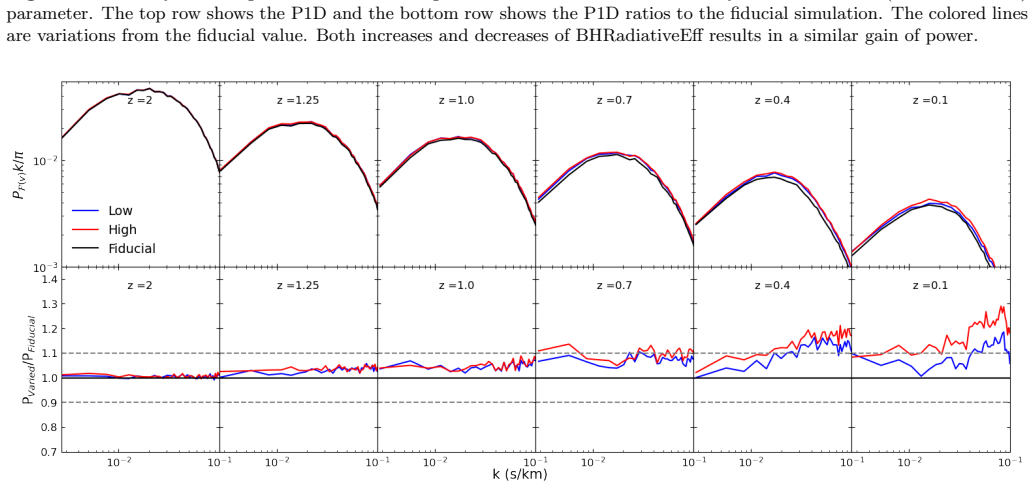
Variations in the Simba AGN feedback model show that the Lyman-α forest 1D flux power spectrum responds primarily to jet feedback from the most massive supermassive black holes. Increasing AGN feedback strength suppresses the power spectrum, but only when the feedback does not alter the number of massive jet-producing black holes. Higher radiative efficiency suppresses black hole growth and thereby reduces later feedback, while jet heating clears neutral hydrogen yet inhibits additional jet production.
What carries the argument
The Simba subgrid AGN feedback model, specifically its jet mode triggered above a minimum black hole mass, which couples momentum and thermal energy injection to the surrounding gas.
If this is right
- Stronger AGN jets heat gas to virial temperature, removing neutral hydrogen from the Lyman-alpha forest.
- This same heating reduces further jet feedback by limiting black hole growth.
- Higher radiative efficiency suppresses black hole growth and thereby lowers later AGN feedback.
- Only black holes above the jet mass threshold produce the dominant effect on the forest power spectrum.
Where Pith is reading between the lines
- AGN feedback implementations must separate direct impacts on the intergalactic medium from indirect changes to the black hole mass function.
- Repeating the parameter scan in other simulation codes could test whether the conditional suppression depends on Simba-specific choices.
- Observed Lyman-alpha forest statistics may need to be interpreted with allowance for how feedback strength correlates with black hole demographics.
Load-bearing premise
The Simba subgrid AGN feedback model and its parameter variations accurately capture the causal effects on the intergalactic medium without major numerical artifacts or unaccounted couplings between feedback channels and black hole population statistics.
What would settle it
Counting the number of massive black holes in simulation snapshots across feedback parameter variations and verifying that power-spectrum suppression appears only in runs where this count stays constant.
Figures




read the original abstract
We study the effects of varying different Active Galactic Nuclei (AGN) feedback parameters on the Lyman-$\alpha$ (Ly$\alpha$) forest 1D transmitted flux power spectrum (P1D). We use the Cosmological and Astrophysics with Machine Learning Simulations (CAMELS) suite to explore variations on the Simba simulation AGN feedback model. The parameters explored include AGN momentum flux, AGN jet speed, supermassive black hole (SMBH) radiative efficiency, jet velocity threshold, and minimum SMBH mass needed to produce jet feedback. Although all parameters affect the P1D, this work explores the radiative efficiency, jet velocity threshold, and minimum SMBH mass in this context for the first time and finds the following results: Primarily, the most massive SMBHs impact the Ly$\alpha$ forest through the jet feedback mode. While heating AGN jets to the virial temperature at injection aids in the removal of neutral hydrogen from the Ly$\alpha$ forest, this heating also inhibits further jet feedback. Similar behaviors are seen when varying the SMBH radiative efficiency, with higher values resulting in a suppression of SMBH growth and thus a later reduction in AGN feedback and lower values directly reducing the impact of AGN feedback on the Ly$\alpha$ forest P1D. These results imply that increasing the AGN feedback strength in the Simba simulation model suppresses the Ly$\alpha$ forest P1D, but only if the feedback does not impact the number of massive jet producing BHs. Future studies of AGN feedback models will require careful exploration of the unique aspects of the specific subgrid model, and how they interact with one another, for a complete understanding of the potential astrophysical impacts of SMBH feedback.
Editorial analysis
A structured set of objections, weighed in public.
Referee Report
Summary. The manuscript uses the CAMELS suite to perform parameter variations on the Simba AGN feedback model and measures the resulting changes to the Lyman-α forest 1D transmitted flux power spectrum (P1D). It reports that the most massive SMBHs affect the forest primarily through the jet mode, that jet heating to virial temperature removes neutral hydrogen but self-limits further feedback, and that higher radiative efficiency suppresses SMBH growth and thereby reduces later AGN impact. The central result is the conditional statement that increasing AGN feedback strength suppresses the P1D only when the variation does not alter the number of massive jet-producing black holes.
Significance. If the reported trends are robust, the work demonstrates that subgrid AGN feedback implementations contain internal couplings that produce non-monotonic effects on IGM observables. This is relevant for cosmological analyses that rely on the Lyα forest P1D to constrain parameters, because it shows that model-specific interactions between radiative efficiency, BH growth, and jet demographics must be understood before feedback strength can be mapped to observable suppression.
major comments (2)
- [Abstract] Abstract: The conditional qualifier in the headline result—that suppression of the P1D occurs 'only if the feedback does not impact the number of massive jet producing BHs'—is not isolated from self-consistent changes in the BH population. Parameters such as SMBH radiative efficiency, jet velocity threshold, and minimum SMBH mass for jet feedback directly modulate accretion and growth rates in the Simba subgrid model, so an increase in one channel can reduce the count of BHs above the jet threshold. Without a control run that holds the BH mass function fixed (or post-hoc reweighting), the observed P1D changes cannot be unambiguously attributed to direct IGM heating versus altered BH demographics.
- [Results] Results section (parameter sweeps): The manuscript presents qualitative trends but does not report quantitative error bars on the P1D measurements, convergence tests with respect to resolution or volume, or the precise definition of the 'suppression' metric used to compare runs. These omissions make it difficult to judge whether the reported differences exceed numerical or cosmic variance uncertainties.
minor comments (2)
- [Introduction] The abstract states that the work 'explores the radiative efficiency, jet velocity threshold, and minimum SMBH mass in this context for the first time'; a brief literature comparison in the introduction would help readers assess the degree of novelty.
- Notation for the 1D power spectrum is given as P1D; consistent use of this abbreviation (or explicit definition on first use) throughout the text would improve readability.
Simulated Author's Rebuttal
We thank the referee for their careful reading of the manuscript and for the constructive comments. Below we respond point by point to the major comments, indicating where revisions will be made and where limitations of the present study prevent a complete response.
read point-by-point responses
-
Referee: The conditional qualifier in the headline result—that suppression of the P1D occurs 'only if the feedback does not impact the number of massive jet producing BHs'—is not isolated from self-consistent changes in the BH population. Parameters such as SMBH radiative efficiency, jet velocity threshold, and minimum SMBH mass for jet feedback directly modulate accretion and growth rates in the Simba subgrid model, so an increase in one channel can reduce the count of BHs above the jet threshold. Without a control run that holds the BH mass function fixed (or post-hoc reweighting), the observed P1D changes cannot be unambiguously attributed to direct IGM heating versus altered BH demographics.
Authors: We agree that the explored parameters affect both the strength of AGN feedback and the demographics of the black-hole population through the self-consistent evolution built into the Simba model. The central result of the paper is precisely this conditional dependence, which arises naturally from the internal couplings of the subgrid implementation. The parameter variations we consider are those provided by the CAMELS suite; the observed non-monotonic behavior on the P1D is therefore a direct consequence of how changes in radiative efficiency, jet threshold, or minimum jet mass alter both heating and the number of jet-producing BHs. A dedicated control simulation that holds the BH mass function fixed would require new runs outside the existing CAMELS data set. We will add a paragraph in the discussion section clarifying that the reported P1D changes include both direct IGM heating and demographic effects, and we will note the absence of a fixed-BHMF control as a limitation for future work. revision: partial
-
Referee: The manuscript presents qualitative trends but does not report quantitative error bars on the P1D measurements, convergence tests with respect to resolution or volume, or the precise definition of the 'suppression' metric used to compare runs. These omissions make it difficult to judge whether the reported differences exceed numerical or cosmic variance uncertainties.
Authors: We acknowledge that quantitative error bars, convergence information, and an explicit definition of the suppression metric were not provided. In the revised manuscript we will (i) report error bars on the P1D derived from the ensemble variance across the CAMELS realizations, (ii) include a brief convergence discussion using the resolution and volume variations already available in the CAMELS suite, and (iii) define the suppression metric explicitly (e.g., the ratio of P1D(k) in each varied run to the fiducial run, evaluated at representative wavenumbers). revision: yes
- Performing new control simulations that hold the black-hole mass function fixed in order to fully separate direct feedback heating from demographic changes, as such runs lie outside the CAMELS simulation suite used for this study.
Circularity Check
No circularity: results from direct simulation parameter sweeps
full rationale
The paper's central findings are obtained by executing CAMELS-Simba simulations with explicit variations in AGN subgrid parameters (radiative efficiency, jet velocity threshold, minimum SMBH mass) and then measuring the transmitted flux P1D directly from the simulation outputs. No step reduces a claimed prediction or result to a fitted input by construction, nor does any load-bearing premise rest on a self-citation chain that itself assumes the target outcome. The conditional statement about feedback strength and BH demographics is an empirical observation from the runs, not a definitional equivalence. Self-citations to the Simba or CAMELS frameworks supply the simulation code but do not substitute for the independent parameter explorations performed here.
Axiom & Free-Parameter Ledger
free parameters (5)
- AGN momentum flux
- AGN jet speed
- SMBH radiative efficiency
- jet velocity threshold
- minimum SMBH mass for jet feedback
axioms (2)
- domain assumption The Simba simulation subgrid model correctly represents AGN feedback physics and its coupling to the intergalactic medium.
- ad hoc to paper Individual AGN feedback parameters can be varied independently while holding other aspects of the simulation fixed.
Lean theorems connected to this paper
-
IndisputableMonolith/Foundation/RealityFromDistinction.leanreality_from_one_distinction unclear?
unclearRelation between the paper passage and the cited Recognition theorem.
We study the effects of varying different Active Galactic Nuclei (AGN) feedback parameters on the Lyman-α forest 1D transmitted flux power spectrum (P1D). We use the Cosmological and Astrophysics with Machine Learning Simulations (CAMELS) suite to explore variations on the Simba simulation AGN feedback model.
-
IndisputableMonolith/Cost/FunctionalEquation.leanwashburn_uniqueness_aczel unclear?
unclearRelation between the paper passage and the cited Recognition theorem.
These results imply that increasing the AGN feedback strength in the Simba simulation model suppresses the Lyα forest P1D, but only if the feedback does not impact the number of massive jet producing BHs.
What do these tags mean?
- matches
- The paper's claim is directly supported by a theorem in the formal canon.
- supports
- The theorem supports part of the paper's argument, but the paper may add assumptions or extra steps.
- extends
- The paper goes beyond the formal theorem; the theorem is a base layer rather than the whole result.
- uses
- The paper appears to rely on the theorem as machinery.
- contradicts
- The paper's claim conflicts with a theorem or certificate in the canon.
- unclear
- Pith found a possible connection, but the passage is too broad, indirect, or ambiguous to say the theorem truly supports the claim.
Reference graph
Works this paper leans on
-
[1]
Marsh, D. J. E., & Baur, J. 2017, Monthly Notices of the Royal Astronomical Society, 471, 4606, doi: 10.1093/mnras/stx1870
-
[2]
2017, JCAP, 2017, 013, doi: 10.1088/1475-7516/2017/12/013
Baur, J., Palanque-Delabrouille, N., Y` eche, C., et al. 2017, JCAP, 2017, 013, doi: 10.1088/1475-7516/2017/12/013
-
[3]
2016, Journal of Cosmology and Astroparticle Physics, 2016, 012, doi: 10.1088/1475-7516/2016/08/012
Baur, J., Palanque-Delabrouille, N., Y` eche, C., Magneville, C., & Viel, M. 2016, Journal of Cosmology and Astroparticle Physics, 2016, 012, doi: 10.1088/1475-7516/2016/08/012
-
[4]
Becker, G. D., Bolton, J. S., Haehnelt, M. G., & Sargent, W. L. W. 2011, MNRAS, 410, 1096, doi: 10.1111/j.1365-2966.2010.17507.x
-
[5]
2017, FSFE: Fake Spectra Flux Extractor
Bird, S. 2017, FSFE: Fake Spectra Flux Extractor. http://ascl.net/1710.012
work page 2017
-
[6]
2015, MNRAS, 447, 1834, doi: 10.1093/mnras/stu2542
Bird, S., Haehnelt, M., Neeleman, M., et al. 2015, MNRAS, 447, 1834, doi: 10.1093/mnras/stu2542
-
[7]
2022, MNRAS, 512, 3703, doi: 10.1093/mnras/stac648
Bird, S., Ni, Y., Di Matteo, T., et al. 2022, MNRAS, 512, 3703, doi: 10.1093/mnras/stac648
-
[8]
2023, arXiv e-prints, arXiv:2306.05471, doi: 10.48550/arXiv.2306.05471
Bird, S., Fernandez, M., Ho, M.-F., et al. 2023, arXiv e-prints, arXiv:2306.05471, doi: 10.48550/arXiv.2306.05471
-
[9]
Blanton, M. R., Bershady, M. A., Abolfathi, B., et al. 2017, AJ, 154, 28, doi: 10.3847/1538-3881/aa7567
-
[10]
Boera, E., Becker, G. D., Bolton, J. S., & Nasir, F. 2019, ApJ, 872, 101, doi: 10.3847/1538-4357/aafee4 The Impact of AGN Models on the Ly α P1D 11
-
[11]
Carswell, R. F. 2008, Monthly Notices of the Royal Astronomical Society, 386, 1131, doi: 10.1111/j.1365-2966.2008.13114.x
-
[12]
Burkhart, B., Tillman, M., Gurvich, A. B., et al. 2022, The Astrophysical Journal Letters, 933, L46, doi: 10.3847/2041-8213/ac7e49
-
[13]
2020, MNRAS, 495, 1825, doi: 10.1093/mnras/staa1242
Chabanier, S., Bournaud, F., Dubois, Y., et al. 2020, MNRAS, 495, 1825, doi: 10.1093/mnras/staa1242
-
[14]
F., Dav´ e, R., Sorini, D., & Angl´ es-Alc´ azar, D
Christiansen, J. F., Dav´ e, R., Sorini, D., & Angl´ es-Alc´ azar, D. 2020, MNRAS, 499, 2617, doi: 10.1093/mnras/staa3007 Dav´ e, R., Angl´ es-Alc´ azar, D., Narayanan, D., et al. 2019a, MNRAS, 486, 2827, doi: 10.1093/mnras/stz937 —. 2019b, MNRAS, 486, 2827, doi: 10.1093/mnras/stz937 Dav´ e, R., Cen, R., Ostriker, J. P., et al. 2001, ApJ, 552, 473, doi: 1...
-
[15]
The Baryon Oscillation Spectroscopic Survey of SDSS-III
Dawson, K. S., Schlegel, D. J., Ahn, C. P., et al. 2013, AJ, 145, 10, doi: 10.1088/0004-6256/145/1/10
work page internal anchor Pith review doi:10.1088/0004-6256/145/1/10 2013
-
[16]
Dawson, K. S., Kneib, J.-P., Percival, W. J., et al. 2016, AJ, 151, 44, doi: 10.3847/0004-6256/151/2/44
-
[17]
The DESI Experiment Part I: Science,Targeting, and Survey Design
Kotzlowski, H. 2000, in Society of Photo-Optical Instrumentation Engineers (SPIE) Conference Series, Vol. 4008, Optical and IR Telescope Instrumentation and Detectors, ed. M. Iye & A. F. Moorwood, 534–545, doi: 10.1117/12.395512 DESI Collaboration, Aghamousa, A., Aguilar, J., et al. 2016, arXiv e-prints, arXiv:1611.00036, doi: 10.48550/arXiv.1611.00036
work page internal anchor Pith review Pith/arXiv arXiv doi:10.1117/12.395512 2000
-
[18]
2023, ApJL, 945, L28, doi: 10.3847/2041-8213/acba89
Dong, C., Lee, K.-G., Ata, M., Horowitz, B., & Momose, R. 2023, ApJL, 945, L28, doi: 10.3847/2041-8213/acba89
-
[19]
2024, arXiv e-prints, arXiv:2402.13568, doi: 10.48550/arXiv.2402.13568
Dong, C., Lee, K.-G., Dav´ e, R., Cui, W., & Sorini, D. 2024, arXiv e-prints, arXiv:2402.13568, doi: 10.48550/arXiv.2402.13568
-
[20]
Eisenstein, D. J., Weinberg, D. H., Agol, E., et al. 2011, AJ, 142, 72, doi: 10.1088/0004-6256/142/3/72
-
[21]
Fernandez, M. A., Bird, S., & Ho, M.-F. 2023, arXiv e-prints, arXiv:2309.03943, doi: 10.48550/arXiv.2309.03943
-
[22]
Gaikwad, P., Srianand, R., Haehnelt, M. G., & Choudhury, T. R. 2021, MNRAS, 506, 4389, doi: 10.1093/mnras/stab2017
-
[23]
2018, JCAP, 2018, 011, doi: 10.1088/1475-7516/2018/09/011
Garny, M., Konstandin, T., Sagunski, L., & Tulin, S. 2018, JCAP, 2018, 011, doi: 10.1088/1475-7516/2018/09/011
-
[24]
2017, ApJ, 835, 175, doi: 10.3847/1538-4357/835/2/175
Gurvich, A., Burkhart, B., & Bird, S. 2017, ApJ, 835, 175, doi: 10.3847/1538-4357/835/2/175
-
[25]
Hopkins, P. F. 2015, MNRAS, 450, 53, doi: 10.1093/mnras/stv195 —. 2017, arXiv e-prints, arXiv:1712.01294, doi: 10.48550/arXiv.1712.01294
work page internal anchor Pith review Pith/arXiv arXiv doi:10.1093/mnras/stv195 2015
-
[26]
Hu, T., Khaire, V., Hennawi, J. F., et al. 2023, arXiv e-prints, arXiv:2311.17895, doi: 10.48550/arXiv.2311.17895 Irˇ siˇ c, V., Viel, M., Haehnelt, M. G., Bolton, J. S., &
-
[27]
Becker, G. D. 2017, PhRvL, 119, 031302, doi: 10.1103/PhysRevLett.119.031302
-
[28]
Khaire, V., Burchett, J. N., Hennawi, J., et al. 2022, Searching for the Imprints of AGN Feedback on the Ly-alpha Forest Around Massive Quenched Galaxies, HST Proposal. Cycle 30, ID. #17048
work page 2022
-
[29]
Khaire, V., Hu, T., Hennawi, J. F., et al. 2023, arXiv e-prints, arXiv:2311.08470, doi: 10.48550/arXiv.2311.08470
-
[30]
Khaire, V., Hu, T., Hennawi, J. F., Walther, M., & Davies, F. 2024, MNRAS, 527, 4545, doi: 10.1093/mnras/stad3374
-
[31]
2015, MNRAS, 451, L30, doi: 10.1093/mnrasl/slv060
Khaire, V., & Srianand, R. 2015, MNRAS, 451, L30, doi: 10.1093/mnrasl/slv060
-
[32]
Lee, K.-G., Hennawi, J. F., Spergel, D. N., et al. 2015, The Astrophysical Journal, 799, 196, doi: 10.1088/0004-637X/799/2/196
-
[33]
2016, ARA&A, 54, 313, doi: 10.1146/annurev-astro-082214-122355
McQuinn, M. 2016, ARA&A, 54, 313, doi: 10.1146/annurev-astro-082214-122355
-
[34]
Meiksin, A. A. 2009, Rev. Mod. Phys., 81, 1405, doi: 10.1103/RevModPhys.81.1405
-
[35]
Nasir, F., Bolton, J. S., Viel, M., et al. 2017, MNRAS, 471, 1056, doi: 10.1093/mnras/stx1648
-
[36]
2023, arXiv e-prints, arXiv:2304.02096, doi: 10.48550/arXiv.2304.02096
Ni, Y., Genel, S., Angl´ es-Alc´ azar, D., et al. 2023, arXiv e-prints, arXiv:2304.02096, doi: 10.48550/arXiv.2304.02096
-
[37]
2020, JCAP, 2020, 038, doi: 10.1088/1475-7516/2020/04/038
Palanque-Delabrouille, N., Y` eche, C., Sch¨ oneberg, N., et al. 2020, JCAP, 2020, 038, doi: 10.1088/1475-7516/2020/04/038
-
[38]
2015a, Journal of Cosmology and Astroparticle Physics, 2015, 045, doi: 10.1088/1475-7516/2015/02/045
Palanque-Delabrouille, N., Y` eche, C., Lesgourgues, J., et al. 2015a, Journal of Cosmology and Astroparticle Physics, 2015, 045, doi: 10.1088/1475-7516/2015/02/045
-
[39]
2015b, Journal of Cosmology and Astroparticle Physics, 2015, 011, doi: 10.1088/1475-7516/2015/11/011
Palanque-Delabrouille, N., Y` eche, C., Baur, J., et al. 2015b, Journal of Cosmology and Astroparticle Physics, 2015, 011, doi: 10.1088/1475-7516/2015/11/011
-
[40]
WEAVE-QSO: A Massive Intergalactic Medium Survey for the William Herschel Telescope
Pieri, M. M., Bonoli, S., Chaves-Montero, J., et al. 2016, in SF2A-2016: Proceedings of the Annual meeting of the French Society of Astronomy and Astrophysics, ed. C. Reyl´ e, J. Richard, L. Cambr´ esy, M. Deleuil, E. P´ econtal, L. Tresse, & I. Vauglin, 259–266, doi: 10.48550/arXiv.1611.09388
work page internal anchor Pith review Pith/arXiv arXiv doi:10.48550/arxiv.1611.09388 2016
-
[41]
Qezlou, M., Newman, A. B., Rudie, G. C., & Bird, S. 2022, ApJ, 930, 109, doi: 10.3847/1538-4357/ac6259 12 Pirecki et al
-
[42]
2017, ApJS, 233, 12, doi: 10.3847/1538-4365/aa93d6 —
Rossi, G. 2017, ApJS, 233, 12, doi: 10.3847/1538-4365/aa93d6 —. 2020, ApJS, 249, 19, doi: 10.3847/1538-4365/ab9d1e
-
[43]
Rudie, G. C., Steidel, C. C., & Pettini, M. 2012, ApJL, 757, L30, doi: 10.1088/2041-8205/757/2/L30
-
[44]
Springel, V. 2010, MNRAS, 401, 791, doi: 10.1111/j.1365-2966.2009.15715.x
-
[45]
Monthly Notices of the Royal Astronomical Society 362:41–58
Springel, V., Di Matteo, T., & Hernquist, L. 2005, MNRAS, 361, 776, doi: 10.1111/j.1365-2966.2005.09238.x
-
[46]
Bryan, G. L. 2024, arXiv e-prints, arXiv:2410.05383, doi: 10.48550/arXiv.2410.05383
-
[47]
T., Burkhart, B., Tonnesen, S., et al
Tillman, M. T., Burkhart, B., Tonnesen, S., et al. 2023a, ApJL, 945, L17, doi: 10.3847/2041-8213/acb7f1 —. 2023b, AJ, 166, 228, doi: 10.3847/1538-3881/ad02f5 Upton Sanderbeck, P. R., D’Aloisio, A., & McQuinn, M. J. 2016, Monthly Notices of the Royal Astronomical Society, 460, 1885, doi: 10.1093/mnras/stw1117
-
[48]
Viel, M., Becker, G. D., Bolton, J. S., & Haehnelt, M. G. 2013, Phys. Rev. D, 88, 043502, doi: 10.1103/PhysRevD.88.043502
-
[49]
Viel, M., Becker, G. D., Bolton, J. S., et al. 2008, Phys. Rev. Lett., 100, 041304, doi: 10.1103/PhysRevLett.100.041304
-
[50]
2009, MNRAS, 397, L64, doi: 10.1111/j.1745-3933.2009.00685.x
Viel, M., Bolton, J. S., & Haehnelt, M. G. 2009, MNRAS, 399, L39, doi: 10.1111/j.1745-3933.2009.00720.x
-
[51]
Viel, M., & Haehnelt, M. G. 2006, Monthly Notices of the Royal Astronomical Society, 365, 231, doi: 10.1111/j.1365-2966.2005.09703.x
-
[52]
Viel, M., Haehnelt, M. G., Bolton, J. S., et al. 2017, MNRAS, 467, L86, doi: 10.1093/mnrasl/slx004
-
[53]
2021, ApJ, 915, 71, doi: 10.3847/1538-4357/abf7ba
Villaescusa-Navarro, F., Angl´ es-Alc´ azar, D., Genel, S., et al. 2021, ApJ, 915, 71, doi: 10.3847/1538-4357/abf7ba
-
[54]
2023, ApJS, 265, 54, doi: 10.3847/1538-4365/acbf47
Villaescusa-Navarro, F., Genel, S., Angl´ es-Alc´ azar, D., et al. 2023, ApJS, 265, 54, doi: 10.3847/1538-4365/acbf47
-
[55]
2023, PhRvD, 108, 023502, doi: 10.1103/PhysRevD.108.023502
Villasenor, B., Robertson, B., Madau, P., & Schneider, E. 2023, PhRvD, 108, 023502, doi: 10.1103/PhysRevD.108.023502
-
[56]
Vogt, S. S., Allen, S. L., Bigelow, B. C., et al. 1994, in Society of Photo-Optical Instrumentation Engineers (SPIE) Conference Series, Vol. 2198, Instrumentation in Astronomy VIII, ed. D. L. Crawford & E. R. Craine, 362, doi: 10.1117/12.176725
-
[57]
Walther, M., Hennawi, J. F., Hiss, H., et al. 2018, ApJ, 852, 22, doi: 10.3847/1538-4357/aa9c81
-
[58]
2020, ApJS, 248, 32, doi: 10.3847/1538-4365/ab908c
Weinberger, R., Springel, V., & Pakmor, R. 2020, ApJS, 248, 32, doi: 10.3847/1538-4365/ab908c
-
[59]
2017, MNRAS, 465, 3291, doi: 10.1093/mnras/stw2944 10
Weinberger, R., Springel, V., Hernquist, L., et al. 2017, MNRAS, 465, 3291, doi: 10.1093/mnras/stw2944 Y` eche, C., Palanque-Delabrouille, N., Baur, J., & du Mas des Bourboux, H. 2017, Journal of Cosmology and Astroparticle Physics, 2017, 047, doi: 10.1088/1475-7516/2017/06/047
work page internal anchor Pith review doi:10.1093/mnras/stw2944 2017
-
[60]
2001, ApJ, 557, 519, doi: 10.1086/321652
Zaldarriaga, M., Hui, L., & Tegmark, M. 2001, ApJ, 557, 519, doi: 10.1086/321652
-
[61]
Zhu, Y., Becker, G. D., Bosman, S. E. I., et al. 2021, ApJ, 923, 223, doi: 10.3847/1538-4357/ac26c2
discussion (0)
Sign in with ORCID, Apple, or X to comment. Anyone can read and Pith papers without signing in.