Assessing the operating characteristics of an ion-milled phonon-mediated quantum parity detector
Pith reviewed 2026-05-18 15:07 UTC · model grok-4.3
The pith
Quantum parity detector shows quiescent quasiparticle density of 1.8 ± 0.8 per cubic micrometer as expected.
A machine-rendered reading of the paper's core claim, the machinery that carries it, and where it could break.
Core claim
The device exhibits a quiescent quasiparticle density of 1.8 ± 0.8 μm^{-3}, which is in line with expectation for a well-functioning phonon-sensitive qubit.
What carries the argument
The argon ion-mill process for multi-step Josephson Junction fabrication that avoids secondary parasitic junctions, combined with the phonon-mediated quasiparticle sensing in the QPD.
If this is right
- The low quasiparticle density supports achieving sub-eV thresholds in rare-event searches.
- The ion-milling technique enables reliable multi-step fabrication of Josephson junctions.
- This validates the QPD as a viable platform for phonon-sensitive detection.
Where Pith is reading between the lines
- This result suggests that similar devices could be scaled for larger arrays in neutrino or dark matter detectors.
- The fabrication approach might reduce defects in other types of superconducting quantum devices.
- Testing the detector with actual low-energy particle interactions would confirm its utility beyond characterization.
Load-bearing premise
The measurement accurately isolates the quiescent quasiparticle density from other noise sources or systematic effects in the cryogenic readout and that the device model is free of unaccounted biases.
What would settle it
An independent measurement of the quasiparticle density yielding a value significantly different from 1.8 ± 0.8 μm^{-3} under similar conditions would challenge the result.
Figures
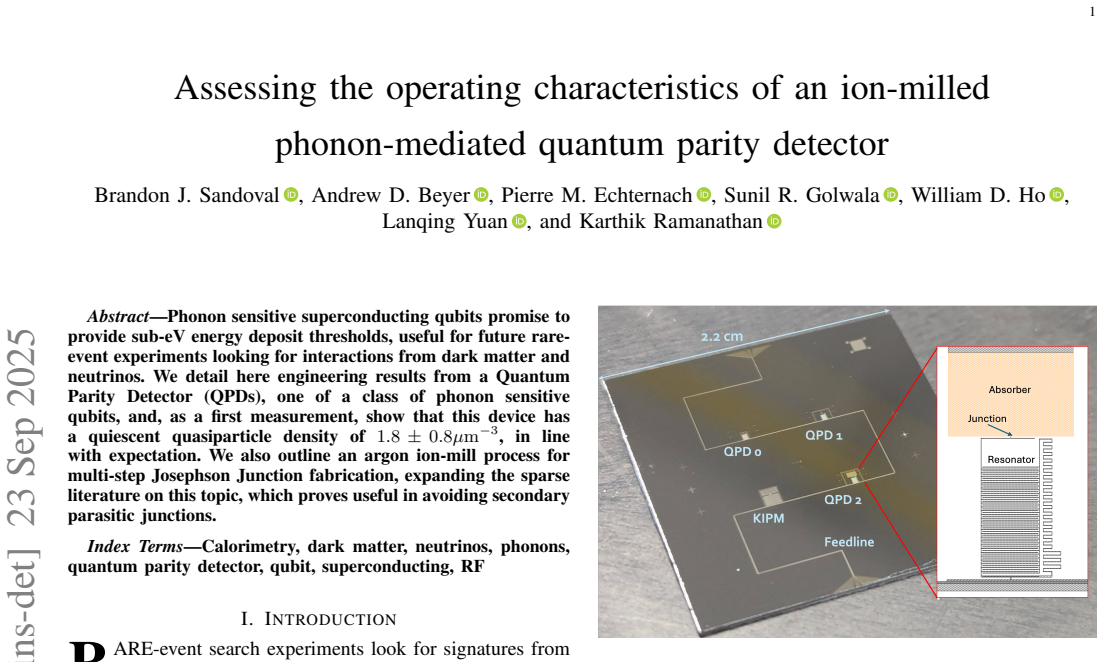


read the original abstract
Phonon sensitive superconducting qubits promise to provide sub-eV energy deposit thresholds, useful for future rare-event experiments looking for interactions from dark matter and neutrinos. We detail here engineering results from a Quantum Parity Detector (QPDs), one of a class of phonon sensitive qubits, and, as a first measurement, show that this device has a quiescent quasiparticle density of $1.8 \pm 0.8 \mu \mathrm{m}^{-3}$, in line with expectation. We also outline an argon ion-mill process for multi-step Josephson Junction fabrication, expanding the sparse literature on this topic, which proves useful in avoiding secondary parasitic junctions.
Editorial analysis
A structured set of objections, weighed in public.
Referee Report
Summary. The paper describes the fabrication and initial characterization of a phonon-mediated quantum parity detector (QPD) using an argon ion-mill process for multi-step Josephson junctions. The central experimental result is a measurement of the quiescent quasiparticle density n_qp = 1.8 ± 0.8 μm^{-3}, reported as consistent with expectations, with discussion of its relevance for sub-eV threshold rare-event searches.
Significance. If validated, the quasiparticle density benchmark and the ion-mill fabrication details would provide useful engineering guidance for superconducting phonon sensors aimed at dark matter and neutrino detection. The work adds to the limited literature on ion-milling for junction fabrication and offers a concrete operating characteristic for this class of devices.
major comments (1)
- [Abstract and results section describing the density measurement] The abstract and results presentation state n_qp = 1.8 ± 0.8 μm^{-3} with error bars but provide no description of the observable fitted (e.g., parity-switching rate or excess noise), the device model relating it to density, the values or uncertainties of input parameters such as quasiparticle lifetime or junction volume, or how non-quasiparticle contributions (readout noise, TLS, surface states) were bounded. This information is required to evaluate whether the reported uncertainty captures all relevant systematics.
minor comments (2)
- [Abstract] The abstract refers to 'expectation' without citing the specific prior value or reference used for comparison.
- [Methods or experimental setup] Clarify the definition of 'quiescent' quasiparticle density and any assumptions about thermal equilibrium or residual RF leakage in the cryogenic setup.
Simulated Author's Rebuttal
We thank the referee for their careful reading and constructive feedback on our manuscript. We address the major comment below and will incorporate the requested clarifications in the revised version.
read point-by-point responses
-
Referee: [Abstract and results section describing the density measurement] The abstract and results presentation state n_qp = 1.8 ± 0.8 μm^{-3} with error bars but provide no description of the observable fitted (e.g., parity-switching rate or excess noise), the device model relating it to density, the values or uncertainties of input parameters such as quasiparticle lifetime or junction volume, or how non-quasiparticle contributions (readout noise, TLS, surface states) were bounded. This information is required to evaluate whether the reported uncertainty captures all relevant systematics.
Authors: We agree that the current presentation would benefit from additional detail on the analysis procedure to allow readers to fully assess the systematic uncertainties. In the revised manuscript we will expand the results section (and, where appropriate, the methods) to explicitly state the fitted observable, describe the device model used to convert the observable to quasiparticle density, provide the numerical values and uncertainties adopted for key parameters such as quasiparticle lifetime and junction volume, and explain how non-quasiparticle contributions were bounded or shown to be sub-dominant. These additions will make the origin of the reported uncertainty transparent. revision: yes
Circularity Check
No circularity: experimental measurement of quasiparticle density is independent of paper's own equations
full rationale
The paper reports the quiescent quasiparticle density as a first measurement obtained from device operation, presented as an experimental result compared against prior expectation rather than derived or predicted from the paper's equations. No load-bearing step reduces by construction to a fitted input, self-citation, or ansatz within the manuscript; the extraction is framed as direct assessment of operating characteristics. This is the most common honest finding for an experimental instrumentation paper with no claimed first-principles derivation chain.
Axiom & Free-Parameter Ledger
axioms (1)
- domain assumption Standard theoretical expectations for quiescent quasiparticle density in similar superconducting qubits apply directly to this Quantum Parity Detector design.
Reference graph
Works this paper leans on
-
[1]
Strategies for determining the nature of dark matter,
D. Hooper and E. A. Baltz, “Strategies for determining the nature of dark matter,”Annual Review of Nuclear and Particle Science, vol. 58, no. 1, pp. 293–314, 2008
work page 2008
-
[2]
Coherent effects of a weak neutral current,
D. Z. Freedman, “Coherent effects of a weak neutral current,”Physical Review D, vol. 9, no. 5, p. 1389, 1974
work page 1974
-
[3]
R. Kolb, H. Weerts, N. Toro, R. Van de Water, R. Essig, D. McKinsey, K. Zurek, A. Chou, P. Graham, J. Estradaet al., “Basic research needs for dark-matter small projects new initiatives: Report of the department of energy’s high energy physics workshop on dark matter,” USDOE Office of Science (SC)(United States), Tech. Rep., 2018
work page 2018
-
[4]
Novel quantum sensors for light dark matter and neutrino detection,
S. R. Golwala and E. Figueroa-Feliciano, “Novel quantum sensors for light dark matter and neutrino detection,”Annual Review of Nuclear and Particle Science, vol. 72, pp. 419–446, 2022
work page 2022
-
[5]
Multi- channel direct detection of light dark matter: Theoretical framework,
T. Trickle, Z. Zhang, K. M. Zurek, K. Inzani, and S. M. Griffin, “Multi- channel direct detection of light dark matter: Theoretical framework,” Journal of High Energy Physics, vol. 2020, no. 3, pp. 1–36, 2020
work page 2020
-
[6]
Strong coupling of a single photon to a superconducting qubit using circuit quantum electrodynamics,
A. Wallraff, D. I. Schuster, A. Blais, L. Frunzio, R.-S. Huang, J. Majer, S. Kumar, S. M. Girvin, and R. J. Schoelkopf, “Strong coupling of a single photon to a superconducting qubit using circuit quantum electrodynamics,”Nature, vol. 431, no. 7005, pp. 162–167, 2004
work page 2004
-
[7]
J. M. Martinis, M. Ansmann, and J. Aumentado, “Energy decay in super- conducting josephson-junction qubits¡? format?¿ from nonequilibrium quasiparticle excitations,”Physical review letters, vol. 103, no. 9, p. 097002, 2009
work page 2009
-
[8]
M. Shaw, J. Bueno, P. Day, C. Bradford, and P. Echternach, “Quantum capacitance detector: A pair-breaking radiation detector based on the single cooper-pair box,”Physical Review B—Condensed Matter and Materials Physics, vol. 79, no. 14, p. 144511, 2009
work page 2009
-
[9]
Single photon detection of 1.5 thz radiation with the quantum capacitance detector,
P. Echternach, B. Pepper, T. Reck, and C. Bradford, “Single photon detection of 1.5 thz radiation with the quantum capacitance detector,” Nature Astronomy, vol. 2, no. 1, pp. 90–97, 2018
work page 2018
-
[10]
K. Ramanathan, J. E. Parker, L. M. Joshi, A. D. Beyer, P. M. Echternach, S. Rosenblum, B. J. Sandoval, and S. R. Golwala, “Quantum parity detectors: a qubit based particle detection scheme with mev thresholds for rare-event searches,”arXiv preprint arXiv:2405.17192, 2024. 6
work page internal anchor Pith review Pith/arXiv arXiv 2024
-
[11]
C. W. Fink, C. P. Salemi, B. A. Young, D. I. Schuster, and N. A. Kurinsky, “Superconducting quasiparticle-amplifying transmon: A qubit- based sensor for mev-scale phonons and single terahertz photons,” Physical Review Applied, vol. 22, no. 5, p. 054009, 2024
work page 2024
-
[12]
R. Linehan, I. Hernandez, D. Temples, S. Dang, D. Baxter, L. Hsu, E. Figueroa-Feliciano, R. Khatiwada, K. Anyang, D. Bowringet al., “Estimating the energy threshold of phonon-mediated superconducting qubit detectors operated in an energy-relaxation sensing scheme,”Phys- ical Review D, vol. 111, no. 6, p. 063047, 2025
work page 2025
-
[13]
Performance of a phonon-mediated kinetic inductance detector at the nexus cryogenic facility,
D. J. Temples, O. Wen, K. Ramanathan, T. Aralis, Y .-Y . Chang, S. Gol- wala, L. Hsu, C. Bathurst, D. Baxter, D. Bowringet al., “Performance of a phonon-mediated kinetic inductance detector at the nexus cryogenic facility,”Physical Review Applied, vol. 22, no. 4, p. 044045, 2024
work page 2024
-
[14]
A broadband superconducting detector suitable for use in large arrays,
P. K. Day, H. G. LeDuc, B. A. Mazin, A. Vayonakis, and J. Zmuidzinas, “A broadband superconducting detector suitable for use in large arrays,” Nature, vol. 425, no. 6960, pp. 817–821, 2003
work page 2003
-
[15]
Large array of low-frequency readout quantum capacitance detectors,
P. M. Echternach, A. D. Beyer, and C. M. Bradford, “Large array of low-frequency readout quantum capacitance detectors,”Journal of Astronomical Telescopes, Instruments, and Systems, vol. 7, no. 1, pp. 011 003–011 003, 2021
work page 2021
-
[16]
Kinetics of the superconduct- ing charge qubit in the presence of a quasiparticle,
R. Lutchyn, L. Glazman, and A. Larkin, “Kinetics of the superconduct- ing charge qubit in the presence of a quasiparticle,”Physical Review B—Condensed Matter and Materials Physics, vol. 74, no. 6, p. 064515, 2006
work page 2006
-
[17]
Overlap junctions for high coherence superconducting qubits,
X. Wu, J. Long, H. S. Ku, R. Lake, M. Bal, and D. P. Pappas, “Overlap junctions for high coherence superconducting qubits,”Applied Physics Letters, vol. 111, no. 3, 2017
work page 2017
-
[18]
An argon ion beam milling process for native alox layers enabling coherent superconducting contacts,
L. Gr ¨unhaupt, U. von L ¨upke, D. Gusenkova, S. T. Skacel, N. Maleeva, S. Schl ¨or, A. Bilmes, H. Rotzinger, A. V . Ustinov, M. Weideset al., “An argon ion beam milling process for native alox layers enabling coherent superconducting contacts,”Applied Physics Letters, vol. 111, no. 7, 2017
work page 2017
-
[19]
Efficient and robust analysis of complex scattering data under noise in microwave resonators,
S. Probst, F. Song, P. A. Bushev, A. V . Ustinov, and M. Weides, “Efficient and robust analysis of complex scattering data under noise in microwave resonators,”Review of Scientific Instruments, vol. 86, no. 2, 2015
work page 2015
-
[20]
An analysis method for asymmetric resonator transmission applied to superconduct- ing devices,
M. S. Khalil, M. Stoutimore, F. Wellstood, and K. Osborn, “An analysis method for asymmetric resonator transmission applied to superconduct- ing devices,”Journal of Applied Physics, vol. 111, no. 5, 2012
work page 2012
-
[21]
T. Connolly, P. D. Kurilovich, S. Diamond, H. Nho, C. G. Bøttcher, L. I. Glazman, V . Fatemi, and M. H. Devoret, “Coexistence of nonequi- librium density and equilibrium energy distribution of quasiparticles in a superconducting qubit,”Physical Review Letters, vol. 132, no. 21, p. 217001, 2024
work page 2024
-
[22]
Vanishing quasiparticle density in a hybrid al/cu/al single-electron transistor,
O.-P. Saira, A. Kemppinen, V . F. Maisi, and J. P. Pekola, “Vanishing quasiparticle density in a hybrid al/cu/al single-electron transistor,” Physical Review B—Condensed Matter and Materials Physics, vol. 85, no. 1, p. 012504, 2012
work page 2012
-
[23]
Millisecond charge-parity fluctuations and induced decoherence in a superconducting transmon qubit,
D. Rist `e, C. Bultink, M. J. Tiggelman, R. N. Schouten, K. W. Lehnert, and L. DiCarlo, “Millisecond charge-parity fluctuations and induced decoherence in a superconducting transmon qubit,”Nature communi- cations, vol. 4, no. 1, p. 1913, 2013
work page 1913
-
[24]
Quantum dynamics of superconductors and tunneling between superconductors,
V . Ambegaokar, “Quantum dynamics of superconductors and tunneling between superconductors,” inPercolation, Localization, and Supercon- ductivity. Springer, 1984, pp. 43–63
work page 1984
-
[25]
An engineering guide to superconducting quantum circuit shielding,
E. I. Malevannaya, V . I. Polozov, A. I. Ivanov, A. R. Matanin, N. S. Smirnov, V . V . Echeistov, D. O. Moskalev, D. A. Mikhalin, D. E. Shirokov, Y . V . Panfilov, I. A. Ryzhikov, A. V . Andriyash, and I. A. Rodionov, “An engineering guide to superconducting quantum circuit shielding,” 2025. [Online]. Available: https://arxiv.org/abs/2505.14274
-
[26]
Performance of a phonon-mediated detector using kids optimized for sub-gev dark matter,
O. Wen, T. Aralis, R. Basu Thakur, B. Bumble, Y .-Y . Chang, K. Ra- manathan, and S. Golwala, “Performance of a phonon-mediated detector using kids optimized for sub-gev dark matter,”Journal of Low Temper- ature Physics, vol. 209, no. 3, pp. 510–517, 2022
work page 2022
-
[27]
Identifying drivers of energy resolution variation in a multi-kid phonon-mediated detector,
K. Ramanathan, T. Aralis, R. Basu Thakur, B. Bumble, Y .-Y . Chang, O. Wen, and S. R. Golwala, “Identifying drivers of energy resolution variation in a multi-kid phonon-mediated detector,”Journal of Low Temperature Physics, vol. 209, no. 3, pp. 457–463, 2022
work page 2022
-
[28]
Final results of calder: kinetic inductance light detectors to search for rare events,
L. Cardani, N. Casali, I. Colantoni, A. Cruciani, S. Di Domizio, M. Martinez, V . Pettinacci, G. Pettinari, and M. Vignati, “Final results of calder: kinetic inductance light detectors to search for rare events,” The European Physical Journal C, vol. 81, no. 7, p. 636, 2021
work page 2021
-
[29]
S. A. De Rooij, J. J. Baselmans, V . Murugesan, D. J. Thoen, and P. J. De Visser, “Strong reduction of quasiparticle fluctuations in a superconductor due to decoupling of the quasiparticle number and lifetime,”Physical Review B, vol. 104, no. 18, p. L180506, 2021
work page 2021
-
[30]
Fluctuations in the electron system of a superconductor exposed to a photon flux,
P. J. de Visser, J. Baselmans, J. Bueno, N. Llombart, and T. Klapwijk, “Fluctuations in the electron system of a superconductor exposed to a photon flux,”Nature communications, vol. 5, no. 1, p. 3130, 2014
work page 2014
-
[31]
Theory of quasiparticle genera- tion by microwave drives in superconducting qubits,
S. Chowdhury, M. Hays, S. R. Jha, K. Serniak, T. P. Orlando, J. A. Grover, and W. D. Oliver, “Theory of quasiparticle genera- tion by microwave drives in superconducting qubits,”arXiv preprint arXiv:2505.00773, 2025
-
[32]
Non-equilibrium superconductivity in quantum-sensing superconducting resonators,
D. Goldie and S. Withington, “Non-equilibrium superconductivity in quantum-sensing superconducting resonators,”Superconductor Science and Technology, vol. 26, no. 1, p. 015004, 2012
work page 2012
discussion (0)
Sign in with ORCID, Apple, or X to comment. Anyone can read and Pith papers without signing in.