WaveDriver: a Laser Guide Star AO System for HWO
Pith reviewed 2026-05-18 15:01 UTC · model grok-4.3
The pith
WaveDriver laser guide star AO system can enable picometer wavefront stability for HWO while relaxing other requirements.
A machine-rendered reading of the paper's core claim, the machinery that carries it, and where it could break.
Core claim
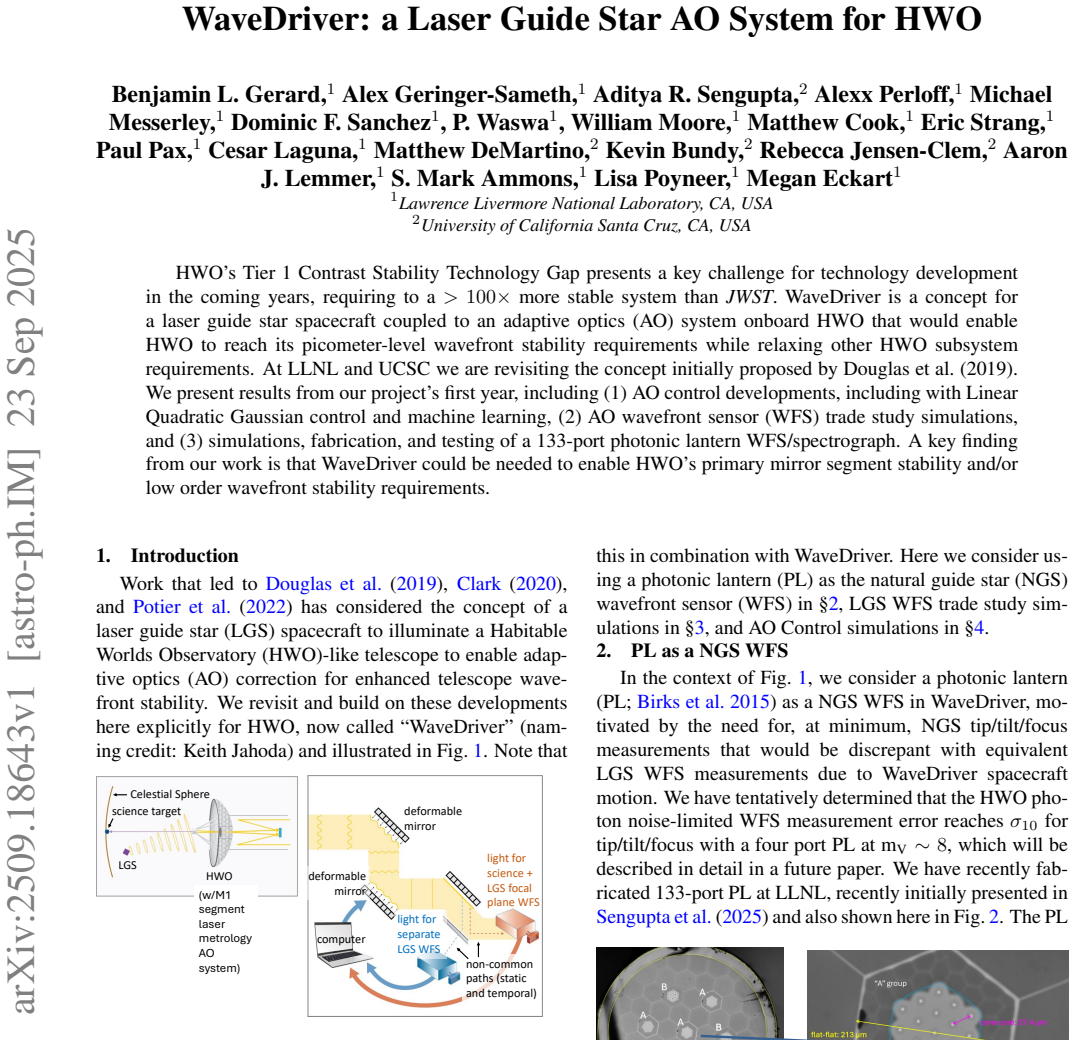
WaveDriver is a laser guide star spacecraft coupled to an adaptive optics system onboard HWO that enables the observatory to reach its picometer-level wavefront stability requirements while relaxing other HWO subsystem requirements.
What carries the argument
WaveDriver, the laser guide star reference source used by the onboard adaptive optics system to sense and correct wavefront errors at the picometer level.
If this is right
- Primary mirror segment stability requirements for HWO can be relaxed if WaveDriver is used.
- Low-order wavefront stability requirements can be met through the laser guide star reference.
- Linear Quadratic Gaussian and machine learning control methods improve correction performance in the AO system.
- A 133-port photonic lantern can serve as a compact wavefront sensor and spectrograph for the required measurements.
Where Pith is reading between the lines
- WaveDriver integration could simplify the engineering trade space for HWO's primary mirror technology.
- The same laser guide star approach might apply to stability challenges in other future large space telescopes.
- Ground-based or suborbital tests of the photonic lantern could provide early validation before flight hardware.
Load-bearing premise
The simulations and photonic lantern tests accurately capture the on-orbit disturbance environment and that the laser guide star reference remains sufficiently stable and bright to support the required picometer-level corrections without introducing new error sources.
What would settle it
A measurement or simulation of on-orbit disturbances larger than modeled, or instability in the laser guide star brightness or position, that prevents the system from holding picometer corrections.
Figures


read the original abstract
HWO's Tier 1 Contrast Stability Technology Gap presents a key challenge for technology development in the coming years, requiring to a >100x more stable system than JWST. WaveDriver is a concept for a laser guide star spacecraft coupled to an adaptive optics (AO) system onboard HWO that would enable HWO to reach its picometer-level wavefront stability requirements while relaxing other HWO subsystem requirements. At LLNL and UCSC we are revisiting the concept initially proposed by Douglas et al. (2019). We present results from our project's first year, including (1) AO control developments, including with Linear Quadratic Gaussian control and machine learning, (2) AO wavefront sensor (WFS) trade study simulations, and (3) simulations, fabrication, and testing of a 133-port photonic lantern WFS/spectrograph. A key finding from our work is that WaveDriver could be needed to enable HWO's primary mirror segment stability and/or low order wavefront stability requirements.
Editorial analysis
A structured set of objections, weighed in public.
Referee Report
Summary. The manuscript presents the WaveDriver concept for a laser guide star adaptive optics system to support the Habitable Worlds Observatory (HWO) in achieving its required picometer-level wavefront stability. It reports on first-year project results from LLNL and UCSC, including AO control algorithm developments using Linear Quadratic Gaussian (LQG) control and machine learning techniques, wavefront sensor trade study simulations, and the simulation, fabrication, and laboratory testing of a 133-port photonic lantern wavefront sensor/spectrograph. The central claim is that WaveDriver could be necessary to meet HWO's primary mirror segment stability and/or low-order wavefront stability requirements.
Significance. If the presented simulations and hardware tests prove representative of on-orbit conditions, this work could be significant for HWO technology development by demonstrating a pathway to relax stringent requirements on the primary mirror segments and other subsystems through the use of an external laser guide star reference and onboard AO correction. The exploration of advanced control methods and the photonic lantern development represent concrete technical progress toward high-precision space-based AO. The manuscript provides credit for these engineering efforts in addressing the Tier 1 Contrast Stability Technology Gap.
major comments (2)
- Abstract: The key finding that 'WaveDriver could be needed to enable HWO's primary mirror segment stability and/or low order wavefront stability requirements' is presented as a qualitative inference without accompanying quantitative performance numbers, residual error budgets, or direct comparisons to the HWO stability requirements, which undermines the ability to assess the strength of this conclusion.
- AO control developments and WFS trade studies: The simulations rely on specific input disturbance power spectra and temporal correlations for segment motion and low-order modes; however, the manuscript does not demonstrate that these match the expected on-orbit thermal, mechanical, and jitter environments, which is load-bearing for the claim that current HWO subsystems fall short.
minor comments (2)
- Photonic lantern tests: The 133-port photonic lantern results are laboratory demonstrations; it would be helpful to clarify how these tests account for or exclude orbital dynamics, radiation effects, and long-term brightness variations in the laser guide star.
- Overall: Consider adding a dedicated section or table summarizing the quantitative metrics from the simulations and tests to support the key findings.
Simulated Author's Rebuttal
We thank the referee for their constructive comments on our manuscript. We have carefully considered each point and provide our responses below. We plan to make revisions to address the concerns raised regarding the abstract and the simulation assumptions.
read point-by-point responses
-
Referee: Abstract: The key finding that 'WaveDriver could be needed to enable HWO's primary mirror segment stability and/or low order wavefront stability requirements' is presented as a qualitative inference without accompanying quantitative performance numbers, residual error budgets, or direct comparisons to the HWO stability requirements, which undermines the ability to assess the strength of this conclusion.
Authors: We agree with the referee that the abstract would benefit from quantitative support to better substantiate our key finding. In the revised version, we will incorporate specific numbers from our AO simulations, including residual error levels achieved and comparisons to the required picometer stability for HWO. This will make the conclusion more assessable. revision: yes
-
Referee: AO control developments and WFS trade studies: The simulations rely on specific input disturbance power spectra and temporal correlations for segment motion and low-order modes; however, the manuscript does not demonstrate that these match the expected on-orbit thermal, mechanical, and jitter environments, which is load-bearing for the claim that current HWO subsystems fall short.
Authors: The disturbance spectra in our simulations are derived from available data on segment dynamics and low-order modes, informed by JWST performance and general models for space telescope environments. We will add a section or clarification in the manuscript detailing the origin of these inputs and explicitly noting that they are representative of expected conditions but not yet validated against finalized HWO on-orbit predictions, as those are still being developed. This addresses the concern by providing transparency on the assumptions. revision: partial
Circularity Check
No circularity: claim rests on independent simulations and tests
full rationale
The paper's key finding—that WaveDriver could be needed for HWO primary mirror segment or low-order wavefront stability—is presented as the outcome of AO control simulations (LQG and ML), WFS trade-study simulations, and 133-port photonic lantern fabrication/testing. These steps compare modeled performance against externally defined HWO requirements rather than redefining the target stability metric or fitting a parameter to a closely related quantity. No equations, ansatzes, or uniqueness theorems are shown that reduce by construction to the paper's own inputs. The cited prior concept (Douglas et al. 2019) is external and not load-bearing for the new results. The derivation chain is therefore self-contained against external benchmarks.
Axiom & Free-Parameter Ledger
axioms (1)
- domain assumption The HWO primary mirror segment and low-order wavefront stability requirements are as stated in the Tier 1 Contrast Stability Technology Gap.
Reference graph
Works this paper leans on
-
[1]
2024, in Society of Photo- Optical Instrumentation Engineers (SPIE) Conference Series, V ol
Bendek, E., Allan, G., Ruane, G., et al. 2024, in Society of Photo- Optical Instrumentation Engineers (SPIE) Conference Series, V ol. 13092, Space Telescopes and Instrumentation 2024: Op- tical, Infrared, and Millimeter Wave, ed. L. E. Coyle, S. Mat- suura, & M. D. Perrin, 130921X
work page 2024
- [2]
-
[3]
A., Gris-S ´anchez, I., Yerolatsitis, S., et al
Birks, T. A., Gris-S ´anchez, I., Yerolatsitis, S., et al. 2015, Ad- vances in Optics and Photonics, 7, 107
work page 2015
-
[4]
Clark, J. R. 2020, PhD thesis, Massachusetts Institute of Technol- ogy, Department of Aeronautics and Astronautics
work page 2020
- [5]
-
[6]
Feinberg, Lee, e. a. 2025, in HWO25 conference proceedings, ASP HWO25 Conference Series
work page 2025
- [7]
-
[8]
L., Dillon, D., Cetre, S., et al
Gerard, B. L., Dillon, D., Cetre, S., et al. 2023, PASP, 135, 024502
work page 2023
-
[9]
2005, ApJ, 629, 592 Perez Soto, J., Laguna, C., Gerard, B., et al
Guyon, O. 2005, ApJ, 629, 592 Perez Soto, J., Laguna, C., Gerard, B., et al. 2023, in Society of Photo-Optical Instrumentation Engineers (SPIE) Conference
work page 2005
-
[10]
2022, Journal of Astronom- ical Telescopes, Instruments, and Systems, 8, 035002
Potier, A., Ruane, G., Stark, C., et al. 2022, Journal of Astronom- ical Telescopes, Instruments, and Systems, 8, 035002
work page 2022
-
[11]
Poyneer, L. A., Ammons, S. M., Kim, M. K., et al. 2023, ApOpt, 62, 1871
work page 2023
-
[12]
2024, in Soci- ety of Photo-Optical Instrumentation Engineers (SPIE) Con- ference Series, V ol
Redding, D., Basinger, S., Bikkannavar, S., et al. 2024, in Soci- ety of Photo-Optical Instrumentation Engineers (SPIE) Con- ference Series, V ol. 13092, Space Telescopes and Instrumen- tation 2024: Optical, Infrared, and Millimeter Wave, ed. L. E
work page 2024
-
[13]
R., Chambouleyron, V ., Diaz, J., et al
Sengupta, A. R., Chambouleyron, V ., Diaz, J., et al. 2025
work page 2025
-
[14]
Zeimer, John, e. a. 2025, in HWO25 conference proceedings, ASP HWO25 Conference Series
work page 2025
discussion (0)
Sign in with ORCID, Apple, or X to comment. Anyone can read and Pith papers without signing in.