Total absorption of tailored incoming signals by black holes
Pith reviewed 2026-05-18 14:11 UTC · model grok-4.3
The pith
Tailored time modulations let black holes absorb incoming signals with no reflection for the full scattering duration.
A machine-rendered reading of the paper's core claim, the machinery that carries it, and where it could break.
Core claim
Resonances in the complex plane can be excited via tailored time-dependent scattering, leading to complete absorption for the entire duration of the scattering process. This makes stars and black holes truly black. Energy is stored with high efficiency and released once the process finishes via relaxation into the characteristic virtual absorption modes, also known as total transmission modes. Four-dimensional black holes have a restricted set of solutions, while higher-dimensional black holes exhibit a complex and interesting structure of virtual absorption modes.
What carries the argument
Virtual absorption modes (total transmission modes), which are complex-plane resonances matched exactly by a chosen time-dependent incoming waveform to achieve perfect absorption during scattering.
Load-bearing premise
Complex-plane resonances exist that can be matched by a physically realizable time-dependent waveform without infinite precision or unphysical amplitudes.
What would settle it
Numerical evolution of a precisely modulated wave packet scattering off a black hole spacetime, checking for zero reflected amplitude during the interaction followed by ringing in the predicted virtual absorption modes.
Figures
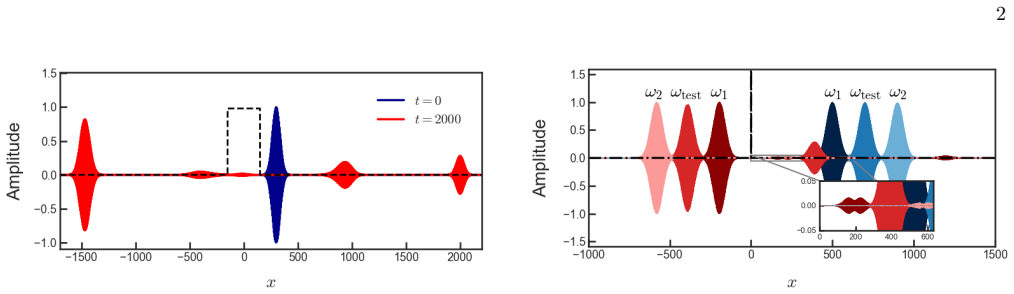

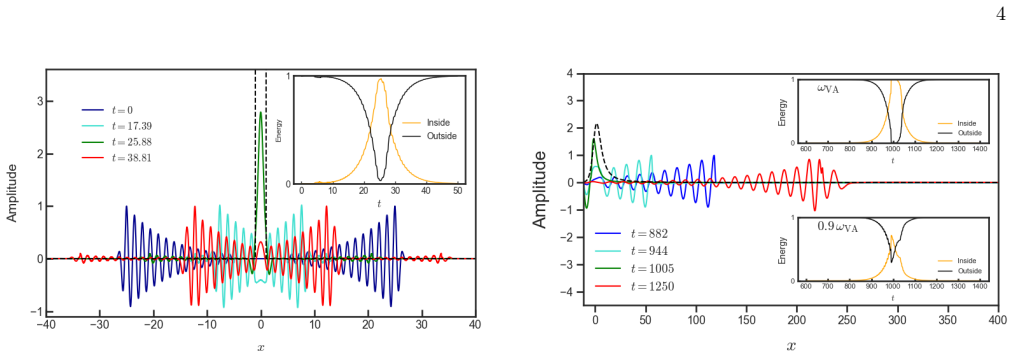

read the original abstract
We uncover a new class of phenomena in gravitational physics, whereby resonances in the complex plane can be excited via tailored time-dependent scattering. We show that specific forms of temporal modulation of an incoming signal can lead to complete absorption for the entire duration of the scattering process. This, then, makes stars and black holes truly black. Such ``virtual absorption'' stores energy with high efficiency, releasing it once the process finishes via relaxation into the characteristic virtual absorption modes -- also known as total transmission modes -- of the object. While such modes are challenging to obtain and four-dimensional black holes have a restricted set of solutions, we also show that higher dimensional black holes have a complex and interesting structure of virtual absorption modes.
Editorial analysis
A structured set of objections, weighed in public.
Referee Report
Summary. The manuscript claims that resonances in the complex plane can be excited through tailored temporal modulation of incoming signals, resulting in complete absorption by black holes and stars for the full duration of the scattering process. This 'virtual absorption' stores energy efficiently before release via relaxation into virtual absorption modes (also termed total transmission modes). The work notes that four-dimensional black holes have a restricted set of such modes while higher-dimensional black holes possess a richer structure.
Significance. If the central claim is established with physically realizable waveforms, the result would introduce a new mechanism for perfect absorption in gravitational scattering, with potential implications for black-hole perturbation theory and gravitational-wave interactions. The discussion of higher-dimensional mode structure adds interest, though the assessment of significance is tempered by the absence of explicit derivations or numerical demonstrations in the provided text.
major comments (2)
- [Abstract] Abstract: the assertion that specific temporal modulations achieve 'complete absorption for the entire duration' rests on exact excitation of complex-frequency virtual absorption modes. These modes are defined with outgoing boundary conditions at infinity, so their time-domain realization requires an exponentially growing precursor as t → −∞. This growth implies either infinite energy or an unphysical infinite past, directly challenging the physical realizability of the claimed finite, causal scattering process.
- [Higher-dimensional black holes] Higher-dimensional black holes section: while a richer mode spectrum is reported, the horizon ingoing / infinity outgoing boundary conditions that generate the complex poles remain unchanged. It is therefore unclear how the additional modes remove the time-asymmetry that forces exponentially growing incoming signals, leaving the central claim of total absorption vulnerable to the same realizability objection.
minor comments (1)
- The distinction between 'virtual absorption modes' and standard quasinormal modes should be stated explicitly with their respective boundary conditions at the first mention, rather than relying on the parenthetical 'also known as total transmission modes'.
Simulated Author's Rebuttal
We thank the referee for the careful reading of our manuscript and the insightful comments regarding physical realizability. We address each point below and have revised the text to better delineate the assumptions underlying our claims.
read point-by-point responses
-
Referee: [Abstract] Abstract: the assertion that specific temporal modulations achieve 'complete absorption for the entire duration' rests on exact excitation of complex-frequency virtual absorption modes. These modes are defined with outgoing boundary conditions at infinity, so their time-domain realization requires an exponentially growing precursor as t → −∞. This growth implies either infinite energy or an unphysical infinite past, directly challenging the physical realizability of the claimed finite, causal scattering process.
Authors: We agree that exact excitation of the virtual absorption modes, which satisfy outgoing boundary conditions at infinity, formally requires an exponentially growing incoming component as t → −∞. Our analysis focuses on the finite-duration scattering interval during which the tailored modulation produces complete absorption. In the revised manuscript we have clarified this scope in the abstract and added a dedicated paragraph discussing practical approximations via truncated precursors, the associated finite energy cost for any chosen cutoff, and the resulting small initial transient. These changes make explicit that the central claim applies to the primary interaction period rather than an idealized infinite past. revision: yes
-
Referee: [Higher-dimensional black holes] Higher-dimensional black holes section: while a richer mode spectrum is reported, the horizon ingoing / infinity outgoing boundary conditions that generate the complex poles remain unchanged. It is therefore unclear how the additional modes remove the time-asymmetry that forces exponentially growing incoming signals, leaving the central claim of total absorption vulnerable to the same realizability objection.
Authors: We concur that the horizon-ingoing and infinity-outgoing boundary conditions are identical in higher dimensions, so the underlying time-asymmetry is not removed. The richer spectrum of complex poles nevertheless supplies additional degrees of freedom for signal design. In the revised section we now state explicitly that the realizability challenge persists while noting that the larger set of modes can facilitate more flexible, approximately causal waveforms and multi-mode absorption scenarios. This clarification preserves the original observation about the mode structure without overstating its effect on the time-domain issue. revision: partial
Circularity Check
Derivation of complete absorption via tailored signals rests on independent resonance construction without self-referential reduction.
full rationale
The paper presents a mathematical construction in which time-dependent modulations of incoming waves are chosen to excite complex-plane resonances (virtual absorption modes), resulting in total absorption during scattering. This relies on standard quasinormal-mode calculations with ingoing horizon and outgoing infinity boundary conditions, which are computed independently of the specific tailored waveform. No step defines the absorption outcome in terms of the input signal itself, renames a fitted quantity as a prediction, or reduces the central result to a self-citation chain. The derivation chain remains self-contained against external benchmarks of linear perturbation theory.
Axiom & Free-Parameter Ledger
axioms (1)
- domain assumption Linearized wave equations on black-hole spacetimes admit resonances in the complex frequency plane that can be excited by external driving.
invented entities (1)
-
virtual absorption modes (total transmission modes)
no independent evidence
Lean theorems connected to this paper
-
IndisputableMonolith/Foundation/AlexanderDuality.leanalexander_duality_circle_linking unclear?
unclearRelation between the paper passage and the cited Recognition theorem.
We uncover a new class of phenomena in gravitational physics, whereby resonances in the complex plane can be excited via tailored time-dependent scattering... virtual absorption modes – also known as total transmission modes
-
IndisputableMonolith/Foundation/AlexanderDuality.leanD3_admits_circle_linking unclear?
unclearRelation between the paper passage and the cited Recognition theorem.
higher dimensional black holes have a complex and interesting structure of virtual absorption modes
What do these tags mean?
- matches
- The paper's claim is directly supported by a theorem in the formal canon.
- supports
- The theorem supports part of the paper's argument, but the paper may add assumptions or extra steps.
- extends
- The paper goes beyond the formal theorem; the theorem is a base layer rather than the whole result.
- uses
- The paper appears to rely on the theorem as machinery.
- contradicts
- The paper's claim conflicts with a theorem or certificate in the canon.
- unclear
- Pith found a possible connection, but the passage is too broad, indirect, or ambiguous to say the theorem truly supports the claim.
Forward citations
Cited by 1 Pith paper
-
Total transmission modes in draining bathtub model with vorticity
Numerical spectra of total transmission modes in the draining bathtub model with vorticity can have positive or negative imaginary parts depending on parameters, with higher overtones exhibiting pronounced spectral mobility.
Reference graph
Works this paper leans on
-
[1]
Perturbation theory on spherical symmetric black hole spacetime We consider a spherically symmetric spacetime ind dimensions. In the usual Schwarzschild coordinatesx µ = (t, r, XA) (A= 2· · ·d−1), we work with the line element in the form ds2 =−f(r)dt 2 + 1 f(r) dr2 +r 2dX2,(A1) with dX 2 the volume element of the unit sphere ind−2 dimension and f= 1− rd−...
-
[2]
Compact coordinate adapted to V AMs To solve the VAM problem using techniques similar to the conformal framework for BH theory [38, 39], we in- troduce a new set of coordinate systemx µ ± = (t±, σ, θ, φ) via t=r h t± ∓x d(σ) , r= rh σ ,(A8) with xd(σ) = x(r(σ)) rh (A9) the dimensionless tortoise coordinate. It is straightfor- ward to see thatt + =v/r h an...
-
[3]
Results We calculate the VAMs with the scheme described in sec. A 2. For that purpose, we perform a Chebyshev spec- tral discretization of the differentiation matrices with two resolutionsN 1 =NandN 2 =N−5. With the resulting set of eigenvalues associated with each resolution, we fil- ter modes with relative difference within TOL<10 −10. We perform tests ...
-
[4]
1 1 10 100 1000 0 5 10 15 20 25 ℓ = 2 ℓ = 3 ℓ = 4 ℓ = 5 ℓ = 6 ℓ = 7 ℓ = 8 ℓ = 9 ℓ = 10 |Im (rhω )| Extra Dimension (d − 4) Regge-Wheeler (spin = 2) −11 −10 −9 −8 −7 −6 −5 −4 −3 −2 −15 −10 −5 0 5 10 15 Im (rhω ) Re (rhω ) 10 15 20 25 30 35 d Regge-Wheeler (spin, ℓ ) = (2 , 2) FIG. 6.T op Panel:Gravitational VAMs on the imaginary axis for the Tangherlini sp...
- [5]
- [6]
-
[7]
L. I. Schiff,Quantum Mechanics(McGraw-Hill Educa- tion, Lisbon, 1968)
work page 1968
-
[8]
Merzbacher,Quantum Mechanics(John Wiley and Sons, Lisbon, 1997)
E. Merzbacher,Quantum Mechanics(John Wiley and Sons, Lisbon, 1997)
work page 1997
-
[9]
J. A. H. Futterman, F. A. Handler, and R. A. Matzner, SCATTERING FROM BLACK HOLES, Cambridge Monographs on Mathematical Physics (Cambridge Uni- versity Press, 2012)
work page 2012
-
[10]
S. R. Dolan, Class. Quant. Grav.25, 235002 (2008), arXiv:0801.3805 [gr-qc]
work page internal anchor Pith review Pith/arXiv arXiv 2008
-
[11]
M. Pijnenburg, G. Cusin, C. Pitrou, and J.-P. Uzan, Am. J. Phys.92, 597 (2024), arXiv:2211.14113 [math-ph]
-
[12]
S. A. Teukolsky and W. H. Press, Astrophys. J.193, 443 (1974)
work page 1974
-
[13]
Chandrasekhar,The mathematical theory of black holes(1985)
S. Chandrasekhar,The mathematical theory of black holes(1985)
work page 1985
-
[14]
Superradiance -- the 2020 Edition
R. Brito, V. Cardoso, and P. Pani, Lect. Notes Phys. 906, pp.1 (2015), arXiv:1501.06570 [gr-qc]
work page internal anchor Pith review Pith/arXiv arXiv 2015
-
[15]
R. F. Rosato, S. Biswas, S. Chakraborty, and P. Pani, Phys. Rev. D111, 084051 (2025), arXiv:2501.16433 [gr- qc]
work page internal anchor Pith review Pith/arXiv arXiv 2025
-
[16]
Quasinormal modes of black holes and black branes
E. Berti, V. Cardoso, and A. O. Starinets, Class. Quant. Grav.26, 163001 (2009), arXiv:0905.2975 [gr-qc]
work page internal anchor Pith review Pith/arXiv arXiv 2009
-
[17]
Testing the nature of dark compact objects: a status report
V. Cardoso and P. Pani, Living Rev. Rel.22, 4 (2019), arXiv:1904.05363 [gr-qc]
work page internal anchor Pith review Pith/arXiv arXiv 2019
-
[18]
Black hole spectroscopy: from theory to experiment
E. Bertiet al., (2025), arXiv:2505.23895 [gr-qc]
work page internal anchor Pith review Pith/arXiv arXiv 2025
-
[19]
Analytic treatment of black-hole gravitational waves at the algebraically special frequency
A. Maassen van den Brink, Phys. Rev. D62, 064009 (2000), arXiv:gr-qc/0001032
work page internal anchor Pith review Pith/arXiv arXiv 2000
-
[20]
G. B. Cook and M. Zalutskiy, Phys. Rev. D94, 104074 (2016), arXiv:1607.07406 [gr-qc]
work page internal anchor Pith review Pith/arXiv arXiv 2016
-
[21]
D. G. Baranov, A. Krasnok, and A. Al` u, Optica4, 1457 (2017)
work page 2017
-
[22]
G. Trainiti, Y. Ra’di, M. Ruzzene, and A. Al` u, Science Advances5, eaaw3255 (2019), https://www.science.org/doi/pdf/10.1126/sciadv.aaw3255
-
[23]
C. Rasmussen, M. I. N. Rosa, J. Lewton, and M. Ruzzene, Advanced Science10, 2301811 (2023)
work page 2023
- [24]
-
[25]
A. Farhi, D. Hershkovitz, and H. Suchowski, arXiv e-prints (2025), 10.48550/arXiv.2506.03485, arXiv:2506.03485 [physics.optics]
-
[26]
W. H. Press and S. A. Teukolsky, Nature238, 211 (1972)
work page 1972
-
[27]
The black hole bomb and superradiant instabilities
V. Cardoso, O. J. C. Dias, J. P. S. Lemos, and S. Yoshida, Phys. Rev. D70, 044039 (2004), [Erratum: Phys.Rev.D 70, 049903 (2004)], arXiv:hep-th/0404096
work page internal anchor Pith review Pith/arXiv arXiv 2004
-
[28]
CoG,https://the-center-of-gravity.com/
-
[29]
Is the gravitational-wave ringdown a probe of the event horizon?
V. Cardoso, E. Franzin, and P. Pani, Phys. Rev. Lett.116, 171101 (2016), [Erratum: Phys.Rev.Lett. 117, 089902 (2016)], arXiv:1602.07309 [gr-qc]
work page internal anchor Pith review Pith/arXiv arXiv 2016
-
[30]
V. Cardoso, S. Hopper, C. F. B. Macedo, C. Palen- zuela, and P. Pani, Phys. Rev. D94, 084031 (2016), arXiv:1608.08637 [gr-qc]
work page internal anchor Pith review Pith/arXiv arXiv 2016
-
[31]
Tests for the existence of horizons through gravitational wave echoes
V. Cardoso and P. Pani, Nature Astron.1, 586 (2017), arXiv:1709.01525 [gr-qc]
work page internal anchor Pith review Pith/arXiv arXiv 2017
-
[32]
V. Boyanov, K. Destounis, R. Panosso Macedo, V. Car- doso, and J. L. Jaramillo, Phys. Rev. D107, 064012 (2023), arXiv:2209.12950 [gr-qc]
-
[33]
E. Maggio, V. Cardoso, S. R. Dolan, and P. Pani, Phys. Rev. D99, 064007 (2019), arXiv:1807.08840 [gr-qc]
work page internal anchor Pith review Pith/arXiv arXiv 2019
-
[34]
Coudray, Journal of Physics A: Mathematical and General13, 2937 (1980)
C. Coudray, Journal of Physics A: Mathematical and General13, 2937 (1980)
work page 1980
-
[35]
P. Grinevich and R. Novikov, Communications in Math- ematical Physics174(1994), 10.1007/BF02099609
- [36]
-
[37]
F. R. Tangherlini, Nuovo Cim.27, 636 (1963)
work page 1963
-
[38]
H. Kodama and A. Ishibashi, Prog. Theor. Phys.110, 701 (2003), arXiv:hep-th/0305147
work page internal anchor Pith review Pith/arXiv arXiv 2003
-
[39]
H. Kodama and A. Ishibashi, Prog. Theor. Phys.111, 29 (2004), arXiv:hep-th/0308128
work page internal anchor Pith review Pith/arXiv arXiv 2004
-
[40]
Quasinormal modes of Schwarzschild black holes in four and higher dimensions
V. Cardoso, J. P. S. Lemos, and S. Yoshida, Phys. Rev. D69, 044004 (2004), arXiv:gr-qc/0309112
work page internal anchor Pith review Pith/arXiv arXiv 2004
-
[41]
J. Matyjasek, Phys. Rev. D104, 084066 (2021), arXiv:2107.04815 [gr-qc]
-
[42]
A geometric framework for black hole perturbations
A. Zenginoglu, Phys. Rev. D83, 127502 (2011), arXiv:1102.2451 [gr-qc]
work page internal anchor Pith review Pith/arXiv arXiv 2011
-
[43]
R. Panosso Macedo, Phil. Trans. Roy. Soc. Lond. A382, 20230046 (2024), arXiv:2307.15735 [gr-qc]
-
[44]
J. L. Jaramillo, R. Panosso Macedo, and L. Al Sheikh, Phys. Rev. X11, 031003 (2021), arXiv:2004.06434 [gr- qc]
work page internal anchor Pith review arXiv 2021
-
[45]
Universal quasinormal modes of large D black holes
R. Emparan and K. Tanabe, Phys. Rev. D89, 064028 (2014), arXiv:1401.1957 [hep-th]
work page internal anchor Pith review Pith/arXiv arXiv 2014
-
[46]
C. M. Watts, X. Liu, and W. J. Padilla, Advanced Ma- terials24, OP98 (2012)
work page 2012
- [47]
-
[48]
Z. Liu, X. Zhang, Y. Mao, Y. Y. Zhu, Z. Yang, C. T. Chan, and P. Sheng, Science289, 1734 (2000), https://www.science.org/doi/pdf/10.1126/science.289.5485.1734
-
[49]
E. Baravelli and M. Ruzzene, Journal of Sound and Vi- bration332, 6562 (2013)
work page 2013
-
[50]
SFI,ttps://www.sfi.org.bm/
-
[51]
SF,https://www.simonsfoundation.org/
discussion (0)
Sign in with ORCID, Apple, or X to comment. Anyone can read and Pith papers without signing in.