Rapid Autotuning of a SiGe Quantum Dot into the Single-Electron Regime with Machine Learning and RF-Reflectometry FPGA-Based Measurements
Pith reviewed 2026-05-18 13:35 UTC · model grok-4.3
The pith
Combining neural network autotuning with FPGA-accelerated measurements reduces SiGe quantum dot initialization time by a factor of 2.2
A machine-rendered reading of the paper's core claim, the machinery that carries it, and where it could break.
Core claim
Using an autotuning algorithm based on a neural network and faster measurements by harnessing the FPGA embedded in Keysight's Quantum Engineering Toolkit (QET), the measurement time of stability diagrams has been reduced by a factor of 9.8. This led to an acceleration factor of 2.2 for the total initialization time of a SiGe quantum dot into the single-electron regime, which is limited by the Python code execution.
What carries the argument
Neural-network autotuning algorithm that classifies charge states from stability diagrams acquired via FPGA-driven RF-reflectometry
If this is right
- Stability diagrams can be acquired nearly ten times faster than before.
- The total time to bring a SiGe quantum dot into the single-electron regime drops by a factor of 2.2.
- The method directly addresses the rapid growth in voltage search space that occurs when scaling to multi-qubit processors.
- Further overall acceleration is possible once the Python execution overhead that now limits total time is reduced.
Where Pith is reading between the lines
- The same combination of neural-network classification and FPGA measurement acceleration could be transferred to other quantum-dot platforms with only modest retraining.
- Reducing the software overhead that currently caps the speedup would produce still larger total gains.
- Training the network on a broader set of simulated charge diagrams might lower the need for device-specific retraining on future chips.
Load-bearing premise
The neural network, trained on prior devices or simulated data, will correctly classify charge states on the new SiGe device without substantial retraining or false positives that require manual intervention.
What would settle it
Running the autotuning routine on several fresh SiGe devices and finding that the neural network repeatedly selects incorrect charge regions, forcing manual intervention and erasing the reported speedup.
Figures



read the original abstract
Spin qubits need to operate within a very precise voltage space around charge state transitions to achieve high-fidelity gates. However, the stability diagrams that allow the identification of the desired charge states are long to acquire. Moreover, the voltage space to search for the desired charge state increases quickly with the number of qubits. Therefore, faster stability diagram acquisitions are needed to scale up a spin qubit quantum processor. Currently, most methods focus on more efficient data sampling. Our approach shows a significant speedup by combining measurement speedup and a reduction in the number of measurements needed to tune a quantum dot device. Using an autotuning algorithm based on a neural network and faster measurements by harnessing the FPGA embedded in Keysight's Quantum Engineering Toolkit (QET), the measurement time of stability diagrams has been reduced by a factor of 9.8. This led to an acceleration factor of 2.2 for the total initialization time of a SiGe quantum dot into the single-electron regime, which is limited by the Python code execution.
Editorial analysis
A structured set of objections, weighed in public.
Referee Report
Summary. The manuscript presents an autotuning algorithm for initializing a SiGe quantum dot into the single-electron regime. It combines a neural-network classifier for charge-state identification with FPGA-based RF-reflectometry measurements using Keysight's Quantum Engineering Toolkit (QET) to accelerate stability-diagram acquisition. The central claims are a measured 9.8-fold reduction in stability-diagram measurement time and a resulting 2.2-fold speedup in total device initialization time, with the latter limited by Python code execution overhead.
Significance. If the neural-network generalization holds without substantial manual intervention, the work provides a concrete, hardware-validated route to reducing the dominant time cost in scaling spin-qubit processors. The direct wall-clock timing measurements on actual devices and the integration of FPGA acceleration constitute reproducible, falsifiable evidence of practical speedup that does not rely on fitted parameters or self-referential definitions.
major comments (2)
- [Abstract and experimental results section] Abstract and experimental results section: the reported 9.8× measurement-time and 2.2× total-initialization speedups are presented as direct outcomes of the NN-driven autotuning loop, yet no quantitative classifier error rate, confusion matrix, or failure-rate statistic under the exact FPGA acquisition conditions is supplied. This is load-bearing for the central claim; if false-positive charge-state identifications occur at non-negligible frequency on the target SiGe device, the measured acceleration factors become conditional on unquantified post-hoc manual corrections.
- [Methods / neural-network training subsection] Methods / neural-network training subsection: the manuscript states that the network is trained on prior devices or simulated data and then applied to the new SiGe dot, but provides neither the training/validation split details nor a hold-out test on a fresh device under the FPGA readout protocol used for the timing benchmarks. Without this, the assumption that the autotuning loop completes without human intervention remains unverified and directly affects the reproducibility of the quoted acceleration factors.
minor comments (2)
- [Abstract] The abstract introduces the acronym QET without expansion; a parenthetical definition on first use would improve readability for readers outside the immediate instrumentation community.
- [Figure captions] Figure captions for the stability diagrams should explicitly state the voltage ranges and the charge-state labels assigned by the neural network to allow direct comparison with conventional manual tuning.
Simulated Author's Rebuttal
We thank the referee for their thorough review and valuable comments on our manuscript. We address each of the major comments point by point below, and we will incorporate the suggested improvements in the revised version to enhance the clarity and reproducibility of our results.
read point-by-point responses
-
Referee: [Abstract and experimental results section] Abstract and experimental results section: the reported 9.8× measurement-time and 2.2× total-initialization speedups are presented as direct outcomes of the NN-driven autotuning loop, yet no quantitative classifier error rate, confusion matrix, or failure-rate statistic under the exact FPGA acquisition conditions is supplied. This is load-bearing for the central claim; if false-positive charge-state identifications occur at non-negligible frequency on the target SiGe device, the measured acceleration factors become conditional on unquantified post-hoc manual corrections.
Authors: We appreciate the referee pointing out the need for quantitative performance metrics of the classifier. The 9.8× and 2.2× speedups were obtained from direct wall-clock measurements of the full autotuning procedure executed on the SiGe device using the FPGA-accelerated RF reflectometry. To address this concern and strengthen the manuscript, we will include in the revised version a confusion matrix and the classifier error rates specifically measured under the FPGA acquisition conditions used in the timing experiments. This will demonstrate that false-positive identifications were not a significant factor and that the reported accelerations reflect the performance of the automated loop with minimal manual corrections. revision: yes
-
Referee: [Methods / neural-network training subsection] Methods / neural-network training subsection: the manuscript states that the network is trained on prior devices or simulated data and then applied to the new SiGe dot, but provides neither the training/validation split details nor a hold-out test on a fresh device under the FPGA readout protocol used for the timing benchmarks. Without this, the assumption that the autotuning loop completes without human intervention remains unverified and directly affects the reproducibility of the quoted acceleration factors.
Authors: We agree that providing more details on the neural network training procedure is important for reproducibility. The network was pretrained on data from earlier devices and simulations before being deployed on the new SiGe quantum dot. In the revised manuscript, we will add the specific training and validation split details, including dataset sizes and ratios. Additionally, we will report the results of a hold-out test performed on data from the target device acquired with the FPGA readout protocol, which will confirm the generalization capability and verify that the autotuning completed with negligible human intervention during the benchmarked runs. revision: yes
Circularity Check
No circularity in experimental timing claims
full rationale
The paper reports direct wall-clock measurements of stability-diagram acquisition time (reduced by 9.8×) and total device-initialization time (accelerated by 2.2×) on a physical SiGe quantum-dot setup that combines FPGA-based RF reflectometry with a neural-network autotuner. These numerical factors are obtained from hardware timing rather than from any mathematical derivation, fitted parameter, or self-referential definition that would reduce the reported result to its own inputs. No equations, uniqueness theorems, or ansatzes are invoked whose validity depends on the present paper's own outputs or on a self-citation chain; the neural-network generalization assumption is an empirical premise but does not create circularity in the timing data themselves.
Axiom & Free-Parameter Ledger
free parameters (1)
- neural-network weights and hyperparameters
axioms (1)
- domain assumption RF reflectometry signals acquired via the Keysight QET FPGA accurately reflect the charge-state transitions of the SiGe quantum dot.
Lean theorems connected to this paper
-
IndisputableMonolith/Foundation/ArithmeticFromLogic.leanreality_from_one_distinction unclear?
unclearRelation between the paper passage and the cited Recognition theorem.
Using an autotuning algorithm based on a neural network and faster measurements by harnessing the FPGA embedded in Keysight's Quantum Engineering Toolkit (QET), the measurement time of stability diagrams has been reduced by a factor of 9.8.
What do these tags mean?
- matches
- The paper's claim is directly supported by a theorem in the formal canon.
- supports
- The theorem supports part of the paper's argument, but the paper may add assumptions or extra steps.
- extends
- The paper goes beyond the formal theorem; the theorem is a base layer rather than the whole result.
- uses
- The paper appears to rely on the theorem as machinery.
- contradicts
- The paper's claim conflicts with a theorem or certificate in the canon.
- unclear
- Pith found a possible connection, but the passage is too broad, indirect, or ambiguous to say the theorem truly supports the claim.
Forward citations
Cited by 1 Pith paper
-
AI-enhanced tuning of quantum dot Hamiltonians toward Majorana modes
A vision-transformer neural network trained unsupervised on synthetic conductance data proposes Hamiltonian parameter updates that drive quantum dot chains into the topological phase with Majorana modes, often succeed...
Reference graph
Works this paper leans on
-
[1]
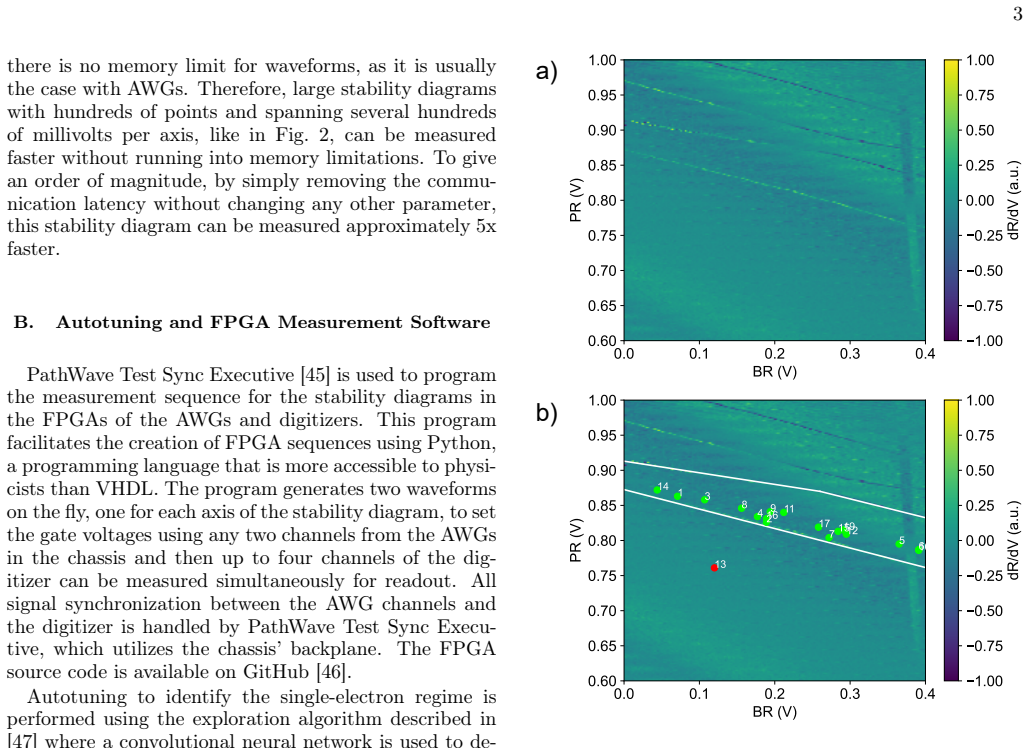
where a convolutional neural network is used to de- tect the charge transition lines on small 18 mV x 18 mV voltagepatcheswith1mVpixels. Thankstothefastvolt- age ramps, the algorithm can explore the voltage space in many directions with an X-shaped pattern to cover a large area with only a minimal time penalty in order to find the first transition. When a...
-
[2]
Electron spin coherence exceeding seconds in high-purity silicon,
A. M. Tyryshkin, S. Tojo, J. J. Morton, H. Riemann, N. V. Abrosimov, P. Becker, H. J. Pohl, T. Schenkel, M. L. Thewalt, K. M. Itoh, and S. A. Lyon, “Electron spin coherence exceeding seconds in high-purity silicon,” Nature Materials, vol. 11, no. 2, pp. 143–147, Dec. 2011, publisher: Nature Publishing Group. [Online]. Available: https://doi.org/10.1038/nmat3182
-
[3]
Storing quantum information for 30 seconds in a nanoelectronic device
J. T. Muhonen, J. P. Dehollain, A. Laucht, F. E. Hudson, R. Kalra, T. Sekiguchi, K. M. Itoh, D. N. Jamieson, J. C. McCallum, A. S. Dzurak, and A. Morello, “Storing quantum information for 30 seconds in a nanoelectronic device,”Nature Nanotechnology, vol. 9, no. 12, pp. 986–991, Oct. 2014, arXiv: 1402.7140 Publisher: Nature Publishing Group. [Online]. Avai...
work page internal anchor Pith review Pith/arXiv arXiv doi:10.1038/nnano.2014.211 2014
-
[4]
Room- temperature quantum bit storage exceeding 39 minutes using ionized donors in silicon-28,
K. Saeedi, S. Simmons, J. Z. Salvail, P. Dluhy, H. Riemann, N. V. Abrosimov, P. Becker, H. J. Pohl, J. J. L. Morton, and M. L. W. Thewalt, “Room- temperature quantum bit storage exceeding 39 minutes using ionized donors in silicon-28,”Science, vol. 342, no. 6160, pp. 830–833, Nov. 2013. [Online]. Available: https://doi.org/10.1126/science.1239584
-
[5]
An addressable quantum dot qubit with fault-tolerant control-fidelity,
M. Veldhorst, J. C. Hwang, C. H. Yang, A. W. Leenstra, B. De Ronde, J. P. Dehollain, J. T. Muhonen, F. E. Hudson, K. M. Itoh, A. Morello, and A. S. Dzurak, “An addressable quantum dot qubit with fault-tolerant control-fidelity,”Nature Nanotechnology, vol. 9, no. 12, pp. 981–985, Dec. 2014, publisher: Nature Publishing Group. [Online]. Available: http: //w...
work page 2014
-
[6]
Low charge noise quantum dots with industrial CMOS manufacturing,
A. Elsayed, M. M. Shehata, C. Godfrin, S. Kubicek, S. Massar, Y. Canvel, J. Jussot, G. Simion, M. Mongillo, D. Wan, B. Govoreanu, I. P. Radu, R. Li, P. Van Dorpe, and K. De Greve, “Low charge noise quantum dots with industrial CMOS manufacturing,”npj Quantum Information, vol. 10, no. 1, p. 70, Jul. 2024, arXiv: 2212.06464 Publisher: Nature Publishing Grou...
-
[7]
Spin Qubits with Scalable milli-kelvin CMOS Control,
S. K. Bartee, W. Gilbert, K. Zuo, K. Das, T. Tanttu, C. H. Yang, N. D. Stuyck, S. J. Pauka, R. Y. Su, W. H. Lim, S. Serrano, C. C. Escott, F. E. Hudson, K. M. Itoh, A. Laucht, A. S. Dzurak, and D. J. Reilly, “Spin Qubits with Scalable milli-kelvin CMOS Control,” arXiv, Jul. 2024, arXiv: 2407.15151. [Online]. Available: https://arxiv.org/abs/2407.15151
-
[8]
Silicon CMOS architecture for a spin- based quantum computer,
M. Veldhorst, H. G. J. Eenink, C. H. Yang, and A. S. Dzurak, “Silicon CMOS architecture for a spin- based quantum computer,”Nature Communications, vol. 8, no. 1, p. 1766, Dec. 2017, publisher: Nature Publishing Group. [Online]. Available: https: //doi.org/10.1038/s41467-017-01905-6
-
[9]
Gate-based high fidelity spin readout in a CMOS device,
M. Urdampilleta, D. J. Niegemann, E. Chanrion, B. Jadot, C. Spence, P. A. Mortemousque, C. Bäuerle, L. Hutin, B. Bertrand, S. Barraud, R. Maurand, M. San- quer, X. Jehl, S. De Franceschi, M. Vinet, and T. Meu- nier, “Gate-based high fidelity spin readout in a CMOS device,”Nature Nanotechnology, 2019
work page 2019
-
[10]
Efficiently measuring a quantum device using machine learning,
D. T. Lennon, H. Moon, L. C. Camenzind, L. Yu, D. M. Zumbühl, G. A. Briggs, M. A. Osborne, E. A. Laird, and N. Ares, “Efficiently measuring a quantum device using machine learning,”npj Quantum Information, vol. 5, no. 1, p. 79, Sep. 2019, arXiv: 1810.10042 Publisher: Nature Partner Journals. [Online]. Available: https://doi.org/10.1038/s41534-019-0193-4
-
[11]
Ray-Based Framework for State Identification in Quantum Dot Devices,
J. P. Zwolak, T. McJunkin, S. S. Kalantre, S. F. Neyens, E. R. MacQuarrie, M. A. Eriksson, and J. M. Taylor, “Ray-Based Framework for State Identification in Quantum Dot Devices,”PRX Quantum, vol. 2, no. 2, p. 20335, Jun. 2021, arXiv: 2102.11784. [Online]. Available: https://doi.org/10.1103/PRXQuantum.2.020335
-
[12]
Machine learning enables completely automatic tuning of a quantum device faster than human experts,
H. Moon, D. T. Lennon, J. Kirkpatrick, N. M. van Esbroeck, L. C. Camenzind, L. Yu, F. Vigneau, D. M. Zumbühl, G. A. Briggs, M. A. Osborne, D. Sejdinovic, 7 E. A. Laird, and N. Ares, “Machine learning enables completely automatic tuning of a quantum device faster than human experts,”Nature Communications, vol. 11, no. 1, p. 4161, Aug. 2020, arXiv: 2001.025...
-
[13]
Colloquium: Advances in automation of quantum dot devices control,
J. P. Zwolak and J. M. Taylor, “Colloquium: Advances in automation of quantum dot devices control,”Reviews of Modern Physics, vol. 95, no. 1, p. 011006, Feb. 2023, arXiv: 2112.09362. [Online]. Available: https: //link.aps.org/doi/10.1103/RevModPhys.95.011006
-
[14]
BATIS: Bootstrapping, Autonomous Testing, and Initialization System for Quantum Dot Devices,
T. J. Kovach, D. Schug, M. A. Wolfe, E. R. MacQuarrie, P. J. Walsh, J. Benson, M. Friesen, M. A. Eriksson, and J. P. Zwolak, “BATIS: Bootstrapping, Autonomous Testing, and Initialization System for Quantum Dot Devices,”arXiv, Dec. 2024, arXiv: 2412.07676. [Online]. Available: https://arxiv.org/abs/2412.07676v2
-
[15]
Computer-automated tuning procedures for semiconductor quantum dot arrays,
A. R. Mills, M. M. Feldman, C. Monical, P. J. Lewis, K. W. Larson, A. M. Mounce, and J. R. Petta, “Computer-automated tuning procedures for semiconductor quantum dot arrays,”Applied Physics Letters, vol. 115, no. 11, p. 113501, Sep. 2019, arXiv: 1907.10775. [Online]. Available: https://doi.org/ 10.1063/1.5121444
-
[16]
A. S. Rao, D. Buterakos, B. van Straaten, V. John, C. X. Yu, S. D. Oosterhout, L. Stehouwer, G. Scappucci, M. Veldhorst, F. Borsoi, and J. P. Zwolak, “MAViS: Modular Autonomous Virtualization System for Two- Dimensional Semiconductor Quantum Dot Arrays,” Physical Review X, vol. 15, no. 2, p. 021034, Apr. 2025, arXiv: 2411.12516 Publisher: American Physica...
-
[17]
Algorithm for automated tuning of a quantum dot into the single-electron regime,
M. Lapointe-Major, O. Germain, J. Camirand Lemyre, D. Lachance-Quirion, S. Rochette, F. Camirand Lemyre, and M. Pioro-Ladrière, “Algorithm for automated tuning of a quantum dot into the single-electron regime,”Physical Review B, vol. 102, no. 8, p. 085301, Aug. 2020, arXiv: 1911.11651 Publisher: American Physical Society. [Online]. Available: https: //lin...
-
[18]
Miniaturizing neural networks for charge state autotuning in quantum dots,
S. Czischek, V. Yon, M. A. Genest, M. A. Roux, S. Rochette, J. C. Lemyre, M. Moras, M. Pioro-Ladrière, D. Drouin, Y. Beilliard, and R. G. Melko, “Miniaturizing neural networks for charge state autotuning in quantum dots,”Machine Learning: Science and Technology, vol. 3, no. 1, p. 015001, Nov. 2021, arXiv: 2101.03181 Publisher: IOP Publishing. [Online]. Av...
-
[19]
Tuning Arrays with Rays: Physics- Informed Tuning of Quantum Dot Charge States,
J. Ziegler, F. Luthi, M. Ramsey, F. Borjans, G. Zheng, and J. P. Zwolak, “Tuning Arrays with Rays: Physics- Informed Tuning of Quantum Dot Charge States,” Physical Review Applied, vol. 20, no. 3, p. 34067, Sep. 2023, arXiv: 2209.03837. [Online]. Available: https://doi.org/10.1103/PhysRevApplied.20.034067
-
[20]
Automated Tuning of Double Quantum DotsintoSpecificChargeStatesUsingNeuralNetworks,
R. Durrer, B. Kratochwil, J. V. Koski, A. J. Landig, C. Reichl, W. Wegscheider, T. Ihn, and E. Greplova, “Automated Tuning of Double Quantum DotsintoSpecificChargeStatesUsingNeuralNetworks,” Physical Review Applied, vol. 13, no. 5, p. 054019, May 2020, arXiv: 1912.02777. [Online]. Available: https://doi.org/10.1103/PhysRevApplied.13.054019
-
[21]
Autotuning of double-dot devices in situ with machine learning,
J. P. Zwolak, T. McJunkin, S. S. Kalantre, J. Dodson, E. MacQuarrie, D. Savage, M. Lagally, S. Coppersmith, M. A. Eriksson, and J. M. Taylor, “Autotuning of double-dot devices in situ with machine learning,” Physical Review Applied, vol. 13, no. 3, p. 34075, Mar. 2020, arXiv: 1909.08030. [Online]. Available: https: //link.aps.org/doi/10.1103/PhysRevApplie...
-
[22]
Experimental Online Quantum Dots Charge Autotuning Using Neural Networks,
V. Yon, B. Galaup, C. Rohrbacher, J. Rivard, A. Morel, D. Leclerc, C. Godfrin, R. Li, S. Kubicek, K. D. Greve, E. Dupont Ferrier, Y. Beilliard, R. G. Melko, and D. Drouin, “Experimental Online Quantum Dots Charge Autotuning Using Neural Networks,”Nano Letters, vol. 25, no. 10, pp. 3717–3725, Mar. 2025, arXiv: 2409.20320 Publisher: American Chemical Societ...
-
[23]
Quantum device fine-tuning using unsupervised embedding learning,
N. M. Van Esbroeck, D. T. Lennon, H. Moon, V. Nguyen, F. Vigneau, L. C. Camenzind, L. Yu, D. M. Zumbühl, G. A. Briggs, D. Sejdinovic, and N. Ares, “Quantum device fine-tuning using unsupervised embedding learning,”New Journal of Physics, vol. 22, no. 9, p. 095003, Sep. 2020, arXiv: 2001.04409 Publisher: IOP Publishing. [Online]. Available: https: //iopsci...
-
[24]
Identifying Pauli spin blockade using deep learning,
J. Schuff, D. T. Lennon, S. Geyer, D. L. Craig, F. Fedele, F. Vigneau, L. C. Camenzind, A. V. Kuhlmann, G. D. Briggs, D. M. Zumbühl, D. Sejdinovic, and N. Ares, “Identifying Pauli spin blockade using deep learning,”Quantum, vol. 7, p. 1077, Aug. 2023, arXiv: 2202.00574. [Online]. Available: https: //doi.org/10.22331/q-2023-08-08-1077
-
[25]
Autonomous Bootstrapping of Quantum Dot Devices,
A. Zubchenko, D. Middlebrooks, T. Rasmussen, L. Lausen, F. Kuemmeth, A. Chatterjee, and J. P. Zwolak, “Autonomous Bootstrapping of Quantum Dot Devices,”Physical Review Applied, vol. 23, no. 1, p. 014072, Jan. 2025, arXiv: 2407.20061 Publisher: American Physical Society. [Online]. Available: https: //link.aps.org/doi/10.1103/PhysRevApplied.23.014072
-
[26]
Cross-architecture tuning of silicon and SiGe-based quantum devices using machine learning,
B. Severin, D. T. Lennon, L. C. Camenzind, F. Vigneau, F. Fedele, D. Jirovec, A. Ballabio, D. Chrastina, G. Isella, M. de Kruijf, M. J. Carballido, S. Svab, A. V. Kuhlmann, S. Geyer, F. N. Froning, H. Moon, M. A. Osborne, D. Sejdinovic, G. Katsaros, D. M. Zumbühl, G. A. Briggs, and N. Ares, “Cross-architecture tuning of silicon and SiGe-based quantum devi...
-
[27]
Computer-automatedtuning of semiconductor double quantum dots into the single- electron regime,
T. A. Baart, P. T. Eendebak, C. Reichl, W. Wegscheider, andL.M.K.Vandersypen, “Computer-automatedtuning of semiconductor double quantum dots into the single- electron regime,”Applied Physics Letters, vol. 108, no. 21, p. 213104, May 2016, publisher: AIP Publishing LLC. [Online]. Available: http://aip.scitation.org/doi/ 10.1063/1.4952624
-
[28]
Fully autonomous tuning of a spin qubit,
J. Schuff, M. J. Carballido, M. Kotzagiannidis, J. C. Calvo, M. Caselli, J. Rawling, D. L. Craig, B. van Straaten, B. Severin, F. Fedele, S. Svab, P. C. Kwon, R. S. Eggli, T. Patlatiuk, N. Korda, D. Zumbühl, and N. Ares, “Fully autonomous tuning of a spin qubit,” arXiv, Feb. 2024, arXiv: 2402.03931. [Online]. Available: https://arxiv.org/abs/2402.03931
-
[29]
An automated approach for consecutive tuning of quantum dot arrays,
H. Liu, B. Wang, N. Wang, Z. Sun, H. Yin, H. Li, G. Cao, and G. Guo, “An automated approach for consecutive tuning of quantum dot arrays,”Applied Physics Letters, 8 vol. 121, no. 8, p. 84002, Aug. 2022, arXiv: 2208.12414v1 Publisher: American Institute of Physics Inc. [Online]. Available: https://doi.org/10.1063/5.0111128
-
[30]
Fast charge sensing of a cavity-coupled double quantum dot using a Josephson parametric amplifier
J. Stehlik, Y. Y. Liu, C. M. Quintana, C. Eichler, T. R. Hartke, and J. R. Petta, “Fast charge sensing of a cavity-coupled double quantum dot using a Josephson parametric amplifier,”Physical Review Applied, vol. 4, no. 1, p. 014018, Jul. 2015, arXiv: 1502.01283. [Online]. Available: https: //doi.org/10.1103/PhysRevApplied.4.014018
work page internal anchor Pith review Pith/arXiv arXiv doi:10.1103/physrevapplied.4.014018 2015
-
[31]
Y. Xu, G. Huang, J. Balewski, R. Naik, A. Morvan, B. Mitchell, K. Nowrouzi, D. I. Santiago, and I. Siddiqi, “QubiC: An Open-Source FPGA-Based Control and Measurement System for Superconducting Quantum Information Processors,”IEEE Transactions on Quantum Engineering, vol. 2, pp. 1–11, Sep. 2021, arXiv: 2101.00071 Publisher: Institute of Electrical and Elec...
-
[32]
L. Stefanazzi, K. Treptow, N. Wilcer, C. Stoughton, C. Bradford, S. Uemura, S. Zorzetti, S. Montella, G. Cancelo, S. Sussman, A. Houck, S. Saxena, H. Arnaldi, A. Agrawal, H. Zhang, C. Ding, and D. I. Schuster, “The QICK (Quantum Instrumentation Control Kit): Readout and control for qubits and detectors,”Review of Scientific Instruments, vol. 93, no. 4, p....
-
[33]
FASQuiC: Flexible Architecture for Scalable Spin Qubit Control,
M. Toubeix, E. Guthmuller, A. Evans, A. Faurie, and T. Meunier, “FASQuiC: Flexible Architecture for Scalable Spin Qubit Control,”IEEE Transactions on Quantum Engineering, vol. 5, pp. 1–16, Jun. 2024, publisher: Institute of Electrical and Electronics Engineers Inc. [Online]. Available: https://doi.org/10. 1109/TQE.2024.3409811
-
[34]
ICARUS-Q: Integrated control and readout unit for scalable quantum processors,
K. H. Park, Y. S. Yap, Y. P. Tan, C. Hufnagel, L. H. Nguyen, K. H. Lau, P. Bore, S. Efthymiou, S. Carrazza, R. P. Budoyo, and R. Dumke, “ICARUS-Q: Integrated control and readout unit for scalable quantum processors,”Review of Scientific Instruments, vol. 93, no. 10, p. 104704, Oct. 2022, arXiv: 2112.02933 Publisher: American Institute of Physics Inc. [Onl...
-
[35]
Real-Time Feedback Control of Charge Sensing for Quantum Dot Qubits,
T.Nakajima, Y.Kojima, Y.Uehara, A.Noiri, K.Takeda, T. Kobayashi, and S. Tarucha, “Real-Time Feedback Control of Charge Sensing for Quantum Dot Qubits,” Physical Review Applied, vol. 15, no. 3, p. L031003, Mar. 2021, arXiv: 2103.15258 ISBN: 1000100200. [Online]. Available: https://doi.org/10.1103/PhysRevApplied.15. L031003
-
[36]
Universal control of a six-qubit quantum processor in silicon,
S. G. Philips, M. T. Mądzik, S. V. Amitonov, S. L. de Snoo, M. Russ, N. Kalhor, C. Volk, W. I. Lawrie, D. Brousse, L. Tryputen, B. P. Wuetz, A. Sammak, M. Veldhorst, G. Scappucci, and L. M. Vandersypen, “Universal control of a six-qubit quantum processor in silicon,”Nature, vol. 609, no. 7929, pp. 919–924, Sep. 2022, arXiv: 2202.09252 Publisher: Nature Pu...
-
[37]
Tomography of entangling two-qubit logic operations in exchange-coupled donor electron spin qubits,
H. G. Stemp, S. Asaad, M. R. v. Blankenstein, A. Vaartjes, M. A. I. Johnson, M. T. Mądzik, A. J. A. Heskes, H. R. Firgau, R. Y. Su, C. H. Yang, A. Laucht, C. I. Ostrove, K. M. Rudinger, K. Young, R. Blume- Kohout, F. E. Hudson, A. S. Dzurak, K. M. Itoh, A. M. Jakob, B. C. Johnson, D. N. Jamieson, and A. Morello, “Tomography of entangling two-qubit logic o...
-
[38]
Real-time two-axis control of a spin qubit,
F. Berritta, T. Rasmussen, J. A. Krzywda, J. van der Heijden, F. Fedele, S. Fallahi, G. C. Gardner, M. J. Manfra, E. van Nieuwenburg, J. Danon, A. Chatterjee, and F. Kuemmeth, “Real-time two-axis control of a spin qubit,”Nature Communications, vol. 15, no. 1, p. 1676, Feb. 2024, arXiv: 2308.02012 Publisher: Nature Publishing Group. [Online]. Available: ht...
-
[39]
Passive and active suppression of transduced noise in silicon spin qubits,
J. Park, H. Jang, H. Sohn, J. Yun, Y. Song, B. Kang, L. E. A. Stehouwer, D. D. Esposti, G. Scappucci, and D. Kim, “Passive and active suppression of transduced noise in silicon spin qubits,”Nature Communications, vol. 16, no. 1, p. 78, 2025. [Online]. Available: https://doi.org/10.1038/s41467-024-55338-z
-
[40]
High-fidelity single-spin shuttling in silicon,
M. De Smet, Y. Matsumoto, A.-M. J. Zwerver, L. Tryputen, S. L. de Snoo, S. V. Amitonov, S. R. Katiraee-Far, A. Sammak, N. Samkharadze, O. Gül, R. N. M. Wasserman, E. Greplová, M. Rimbach- Russ, G. Scappucci, and L. M. K. Vandersypen, “High-fidelity single-spin shuttling in silicon,”Nature Nanotechnology, vol. 20, no. 7, pp. 866–872, Jun. 2025, arXiv: 2406...
-
[41]
R. Xue, M. Beer, I. Seidler, S. Humpohl, J.-S. Tu, S. Trellenkamp, T. Struck, H. Bluhm, and L. R. Schreiber, “Si/SiGe QuBus for single electron information-processing devices with memory and micron- scale connectivity function,”Nature Communications, vol. 15, no. 1, p. 2296, Mar. 2024. [Online]. Available: https://doi.org/10.1038/s41467-024-46519-x
-
[42]
Industrial300mmwaferprocessedspinqubitsinnatural silicon/silicon-germanium,
T. Koch, C. Godfrin, V. Adam, J. Ferrero, D. Schroller, N. Glaeser, S. Kubicek, R. Li, R. Loo, S. Massar, G. Simion, D. Wan, K. De Greve, and W. Wernsdorfer, “Industrial300mmwaferprocessedspinqubitsinnatural silicon/silicon-germanium,”npj Quantum Information, vol. 11, no. 1, p. 59, Apr. 2025. [Online]. Available: https://doi.org/10.1038/s41534-025-01016-x
-
[43]
The radio-frequency single-electron transistor (RF-SET): A fast and ultra- sensitive electrometer,
R. J. Schoelkopf, P. Wahlgren, A. A. Kozhevnikov, P. Delsing, and D. E. Prober, “The radio-frequency single-electron transistor (RF-SET): A fast and ultra- sensitive electrometer,”Science, vol. 280, no. 5367, pp. 1238–1242, May 1998, publisher: American Assoc for the Advancement of Science. [Online]. Available: https://doi.org/10.1126/science.280.5367.1238
-
[44]
T. A. Zirkle, M. J. Filmer, J. Chisum, A. O. Orlov, E. Dupont-Ferrier, J. Rivard, M. Huebner, M. Sanquer, X. Jehl, and G. L. Snider, “Radio Frequency Reflectometry of Single-Electron Box Arrays for Nanoscale Voltage Sensing Applications,”Applied Sciences, vol. 10, no. 24, 2020. [Online]. Available: https://doi.org/10.3390/app10248797
-
[45]
Multimode RF Reflectometry for Spin Qubit Readout and Device Characterization,
J. Rivard, C. Rohrbacher, A. Morel, O. Romain, E. B. Ndiaye, A. Idris, C. Lupien, C. Godfrin, and E. Dupont- Ferrier, “Multimode RF Reflectometry for Spin Qubit Readout and Device Characterization,”(in preparation), 2025
work page 2025
-
[46]
PathWave Test Sync Executive | Keysight
“PathWave Test Sync Executive | Keysight.” [Online]. Available: https://www.keysight.com/us/en/product/ 9 KS2201A/pathwave-test-sync-executive.html
-
[47]
M.-A. Roux, “hvi-sweeper,” Sep. 2025. [Online]. Available: https://github.com/Marc-AntoineRoux/ hvi-sweeper
work page 2025
-
[48]
Robust quantum dots charge autotuning using neural network uncertainty,
V. Yon, B. Galaup, C. Rohrbacher, J. Rivard, C. Godfrin, R. Li, S. Kubicek, K. De Greve, L. Gaudreau, E. Dupont-Ferrier, Y. Beilliard, R. G. Melko, and D. Drouin, “Robust quantum dots charge autotuning using neural network uncertainty,”Machine Learning: Science and Technology, vol. 5, no. 4, p. 045034, Nov. 2024, arXiv: 2406.05175 Publisher: IOP Publishin...
discussion (0)
Sign in with ORCID, Apple, or X to comment. Anyone can read and Pith papers without signing in.